
- Home
- »
- Next Generation Technologies
- »
-
Smart Grid Sensor Market Size, Growth Report, 2026-2033GVR Report cover

Smart Grid Sensors Market (2026 - 2033)
Size, Share & Trends Analysis Report By Sensor Type (Current Sensor, Outage Detection Sensors), By Application (Advanced Metering Infrastructure, Smart Energy Meter), By End-use (Residential, Commercial, Utility, Industrial), By Region, And Segment Foreca
Market Size, 2025
$777.5MMarket Estimate, 2026
$904.8MMarket Forecast, 2033
$2,896.9MCAGR, 2026–2033
18.1%Smart Grid Sensors Market Summary
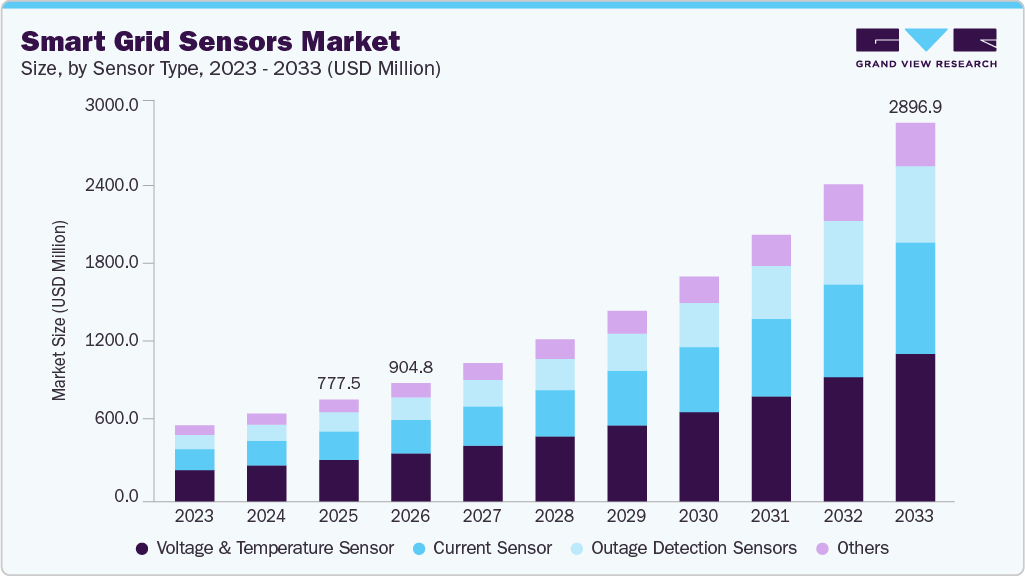
The global smart grid sensors market size was valued at USD 777.5 million in 2025 and is projected to grow from USD 904.8 million in 2026 to USD 2,896.9 million by 2033, at a CAGR of 18.1% from 2026 to 2033. The market in North America dominated with a revenue share of 38.4% in 2025. The market growth can be attributed to the increasing need for reliable and efficient power distribution, which is driving the deployment of smart grid sensors across modern power networks.
 Source: Grand View Research, IR Documents, Primary Interviews, Paid DatabasesTo learn more about this report,
 Download Free Sample Report
 Key Market Trends & Insights
- By sensor type: Voltage and temperature sensor segment held the largest market share of 40.8% in 2025.
- By application: Advanced metering infrastructure segment held the largest market share of 34.1% in 2025.
- By end-use: Utility segment held the largest market share in 2025.
Regional Highlights
- Largest regional market: North America (38.4% revenue share, 2025)
- Fastest-growing regional market: Asia Pacific (highest CAGR, 2026-2033)
- By country: U.S. held the largest market share in 2025
Market Size & Forecast
- Market size in 2025: USD 777.5 Million
- Estimated market size in 2026: USD 904.8 Million
- Projected market size by 2033: USD 2,896.9 Million
- CAGR (2026-2033): 18.1%
Three ways to get this report
Buy it, customize it, or ask a question.Ask an Analyst
Analyst response in 1 business day
- AccessReport author, directly
- Reply timeWithin 1 working day
- No sales callDirect answer only
- FormatEmail reply
- CostFree, no cost
Get the Full Report
What the study covers
- FormatsPDF · Excel · Dashboard
- Timeline2026–2033 annual, 2025 base
- Coverage20+ countries, 5 regions
- Companies10+ key players profiled
Customize the Report
20% free customization
- IncludeCountries, segments, points
- TailorTo your product definition
- ExtendDeeper competitor detail
- OrA fully bespoke study
- Turnaround5–10 working days
These sensors enable rapid fault detection and minimize transmission and distribution losses, thereby improving grid reliability and operational efficiency. Furthermore,the increasing integration of renewable energy sources is driving the adoption of smart grid sensors, as they optimize load distribution and ensure the stability and sustainability of power networks.
The growth of the smart grid sensor market is driven by rising electricity consumption and the increasing need to minimize power outages. Utilities are increasingly deploying smart grid sensors that enable real-time monitoring and rapid fault detection, thereby improving grid reliability and operational efficiency. In addition, the shift toward sustainable energy practices and the growing integration of renewable energy sources are further driving the adoption of smart sensors, as they allow utilities to optimize power flow and maintain grid stability. Furthermore, regulatory support and government initiatives are being provided to accelerate smart grid adoption. These measures are encouraging utilities and technology providers to invest in advanced sensor solutions and expand the deployment of smart grid infrastructure.
 To learn more about this report, Download Free Sample Report
 Significant funding has been secured in the global smart grid sensor market by various smart grid manufacturers, driven by the increasing demand for early fault detection, grid reliability, and disaster prevention solutions. For instance, in November 2025, Gridware Inc., a technology company focused on enhancing and protecting the electrical grid, raised USD 55 million in a Series B growth round led by Tiger Global and Generation Investment Management to accelerate the deployment of its Gridscope system. The company’s pole‑mounted Gridscope system enables Active Grid Response (AGR) by measuring electrical, mechanical, and environmental signals to provide real-time insight into grid conditions and identify hazards as they emerge. Such initiatives are expected to contribute to the growth of the market during the forecast period.
Increasing investments by both public and private stakeholders in grid modernization and sensor-based technologies are driving the market growth. These investments support the deployment of advanced sensing solutions that improve grid visibility, reliability, and efficiency. For instance, in May 2025, G&W Electric invested in Safegrid (provider of intelligent grid-monitoring sensors) to deepen its expertise in fault prediction and AI‑enhanced analytics for medium‑voltage networks. In addition, in January, Smart Wires, a grid enhancing technology and services provider, raised USD 65 million in growth capital from investors, including BP Energy Partners and Keystone Group, to scale its grid-enhancement technologies, which support utilities in managing capacity and in deploying sensor‑driven infrastructure. These investments illustrate how venture capital, strategic partnerships, and corporate funding are being leveraged to accelerate innovation in advanced sensing technologies.
An increasing number of government regulations and standards are influencing the growth of smart grid sensor market. Agencies such as the U.S. Environmental Protection Agency (EPA) and regional energy commissions are mandating emission reductions, energy efficiency, and grid modernization, which are encouraging the adoption of sensor technologies. In addition, regulatory incentives and funding programs are being introduced to support smart grid deployment. For instance, under the U.S. Department of Energy’s Grid Resilience and Innovation Partnerships (GRIP) program, up to USD 3 billion in Smart Grid Grants is being made available through 2026 to support grid flexibility and resiliency projects that include advanced sensor and monitoring technologies.
High initial costs of smart sensors and associated infrastructure may hinder adoption among utilities, particularly in developing regions. In addition, the complexity of integrating these sensors with existing legacy systems and concerns over data security and cyber threats can obstruct adoption. Maintenance requirements and the need for skilled personnel to operate advanced sensor networks are further limiting the rapid deployment of smart grid sensors in certain regions.
Market Dynamics
The increasing modernization of aging power infrastructure is a major factor driving demand for smart grid sensors globally. Utilities are rapidly deploying advanced sensing technologies to improve grid visibility, operational efficiency, and real-time monitoring capabilities across transmission and distribution networks. The growing integration of renewable energy sources such as solar and wind is further accelerating the need for intelligent sensors capable of managing fluctuating power loads and ensuring grid stability. In addition, rising electricity consumption and peak load management requirements are encouraging utilities to adopt smart sensing systems for predictive maintenance and fault detection.
Governments and regulatory authorities across North America, Europe, and Asia Pacific are also investing heavily in smart grid development programs to enhance energy security and reduce transmission losses. The expansion of smart cities and digital substations is creating substantial opportunities for advanced voltage, current, temperature, and line monitoring sensors. Furthermore, increasing occurrences of grid failures, cyber vulnerabilities, and weather-related disruptions are pushing utilities toward automated and self-healing grid networks supported by real-time sensor data. The rapid deployment of electric vehicle charging infrastructure is also increasing pressure on power distribution systems, thereby boosting adoption of smart grid sensing technologies. Additionally, advancements in IoT, AI-enabled analytics, and wireless communication technologies are improving the performance and scalability of smart grid sensors, making them more cost-effective and efficient for large-scale deployment.
The high initial investment associated with smart grid sensor deployment remains a significant restraint for market growth, particularly in developing economies with limited utility modernization budgets. Installation of advanced sensing infrastructure requires substantial expenditure on communication networks, grid automation systems, software integration, and maintenance activities. In addition, many legacy power grids lack compatibility with modern digital sensing technologies, increasing retrofitting complexity and implementation costs for utilities.
Cybersecurity and data privacy concerns are also limiting large-scale adoption of smart grid sensors, as interconnected grid systems remain vulnerable to cyberattacks, data breaches, and operational disruptions. Utilities often face challenges in securing real-time data transmission across distributed grid networks, especially with increasing integration of IoT-enabled devices. Furthermore, the absence of standardized interoperability frameworks across regions and utilities creates integration difficulties between sensors, control systems, and communication platforms. Limited technical expertise and shortage of skilled workforce for managing advanced smart grid infrastructure further slow adoption rates in several emerging markets. Additionally, concerns regarding sensor reliability, calibration accuracy, and performance under harsh environmental conditions continue to impact purchasing decisions among utility operators.
The rapid expansion of renewable energy generation infrastructure is creating significant growth opportunities for the smart grid sensors market. Increasing deployment of solar farms, wind power installations, and distributed energy resources requires advanced sensing technologies for real-time grid balancing, voltage regulation, and power quality monitoring. Utilities are increasingly investing in intelligent grid management systems to efficiently integrate intermittent renewable energy sources into existing transmission and distribution networks.
The growing development of smart cities worldwide is also accelerating demand for advanced grid monitoring and automation solutions. Governments and municipal authorities are implementing digital energy infrastructure projects that rely heavily on smart sensors for efficient electricity distribution, outage management, and energy optimization. Furthermore, rising investments in electric vehicle charging networks and decentralized energy systems are generating new opportunities for grid sensing technologies capable of managing dynamic power loads.
Market Concentration & Characteristics
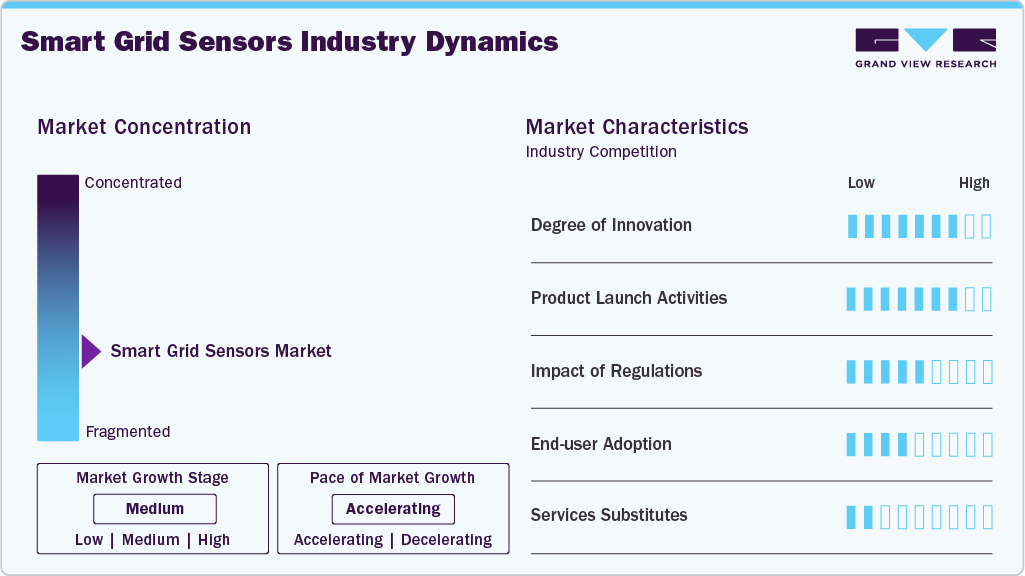
The smart grid sensors market is moderately fragmented, with several global power equipment manufacturers, grid automation companies, industrial sensor providers, and specialized smart infrastructure technology vendors competing across various grid applications and regions. Major players such as Schneider Electric, Siemens, ABB, General Electric, Honeywell, and Itron dominate the market through extensive product portfolios, strong utility partnerships, and advanced grid monitoring capabilities. However, the market also includes numerous regional and niche players specializing in IoT-enabled sensing systems, wireless monitoring technologies, fault detection sensors, and AI-based grid analytics solutions.
 To learn more about this report, Download Free Sample Report
 Market fragmentation is further supported by the rapid expansion of renewable energy integration, smart substations, digital transmission networks, and distributed energy resources, which continue to create opportunities for innovative and application-specific sensor providers. Emerging companies are increasingly gaining traction by offering cost-effective, cloud-connected, and real-time monitoring solutions tailored to utility modernization requirements. In addition, advancements in smart city infrastructure, electric vehicle charging networks, and self-healing grid technologies are encouraging new entrants to develop specialized sensing platforms. At the same time, strategic collaborations, technology partnerships, acquisitions, and integrated grid automation offerings among major industry participants are gradually increasing market consolidation across high-value segments of the smart grid sensors ecosystem.
Sensor Type Insights
The voltage and temperature sensor segment accounted for the largest share of 40.75% in 2025. Voltage and temperature sensors are fundamental for continuous monitoring of grid health and operational conditions. They are widely deployed across substations, transformers, and transmission lines to detect voltage fluctuations or abnormal temperature rises that could indicate faults, enabling utilities to implement preventive maintenance and reduce downtime. These sensors form the backbone of grid monitoring networks and are often prioritized in modernization projects because of their critical role in ensuring service reliability and equipment longevity.
The outage detection sensors segment is expected to grow at the fastest CAGR during the forecast period. The growth of the segment is attributed to the increasing need for rapid fault identification and restoration in modern electrical networks. These sensors enable utilities to pinpoint disruptions in real time, thereby enabling faster service restoration and minimizing economic losses from prolonged outages. The demand for outage detection capabilities has been further highlighted by recent deployments of advanced grid monitoring solutions that embed fault detection directly into smart meters and edge devices. For instance, in February 2026, Sense, a company focused on grid edge intelligence, announced a new edge-powered Fault Detection Solution embedded directly into next-generation smart meters. The software provides utilities with real-time visibility into faults across the distribution grid.
Application Insights
The Advanced Metering Infrastructure (AMI) segment held the largest market share of 34.10% in 2025. AMI systems rely on sensors embedded in smart meters and communication networks to collect, transmit, and analyze consumption data, thereby allowing utilities to improve billing accuracy, detect unusual usage patterns, and manage loads more effectively. Due to these capabilities, AMI has been widely adopted in grid modernization efforts. For instance, in September 2025, National Grid continued the large‑scale rollout of smart meters across upstate New York by replacing traditional meters with advanced infrastructure that supports remote monitoring and data collection for electricity and gas customers, enhancing visibility and operational efficiency.
The smart grid distribution management segment is expected to grow at a significant CAGR during the forecast period. Sensors monitor distribution lines, substations, and transformers in real time to detect faults and support automated network reconfiguration. The rising complexity of distribution networks, driven by distributed generation (such as rooftop solar) and bi‑directional power flows, has made distribution management systems essential for ensuring grid stability and enabling reliable integration of renewable energy sources. For instance, in February 2026, GE Vernova Inc. (NYSE: GEV) launched its GridOS for Distribution solution, which unifies AI analytics and ADMS capabilities to help utilities orchestrate the distribution grid as one intelligent system, with early adopters such as Alabama Power improving reliability and reducing outages by using sensor data and advanced distribution management tools.
End-use Insights
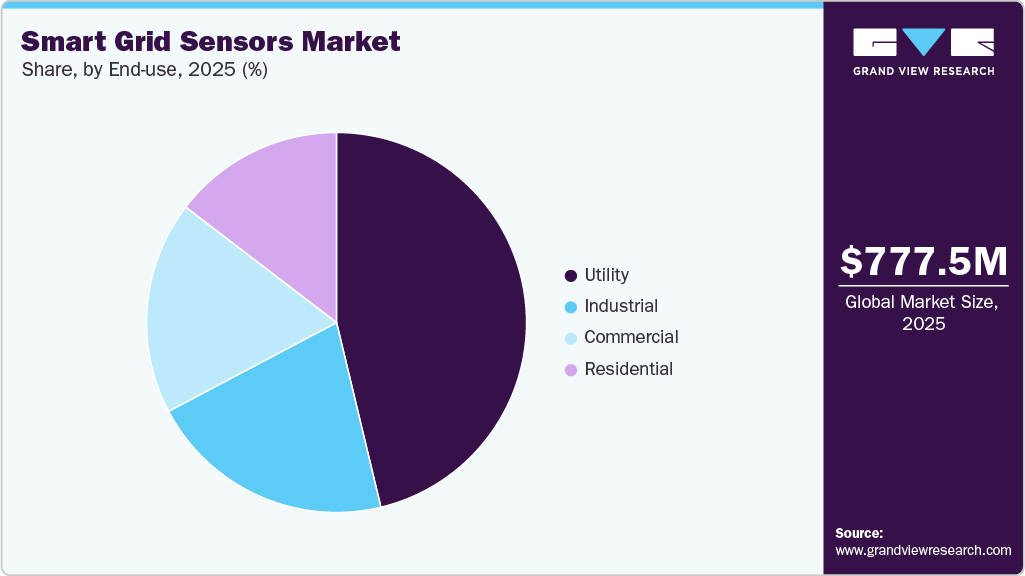
The utility segment dominated the market in 2025. Smart grid sensors enable utilities to monitor grid performance, detect faults, optimize energy flow, and ensure a reliable electricity supply. Due to the critical role of utilities in grid operations, there has been a significant increase in the deployment and adoption of sensor-based infrastructure for real-time monitoring, predictive maintenance, and outage management. For instance, in January 2025, NV Energy partnered with LineVision Inc. to deploy 29 advanced grid monitoring sensors across approximately 144 kilometers of transmission lines in Nevada to enable real-time monitoring of line conditions and improve grid reliability and transmission capacity. Such deployments highlight how utilities are increasingly adopting sensor technologies to modernize grid infrastructure and improve operational efficiency.
 To learn more about this report, Download Free Sample Report
 The industrial segment is projected to grow at the fastest CAGR of 19.2% over the forecast period. Data centers and large industrial facilities are increasingly adopting smart grid sensors to monitor internal energy consumption and integrate on-site renewable energy sources. Industrial facilities require highly reliable power to maintain production continuity and minimize downtime caused by voltage fluctuations or outages. Smart sensors and IoT-enabled energy management systems allow operators to monitor electricity usage in real time and detect anomalies in grid performance and implement predictive maintenance strategies to improve operational efficiency. In addition, the growing focus on industrial digitalization and smart factory initiatives is accelerating the adoption of advanced grid-sensing technologies within industrial power management systems.
Regional Insights
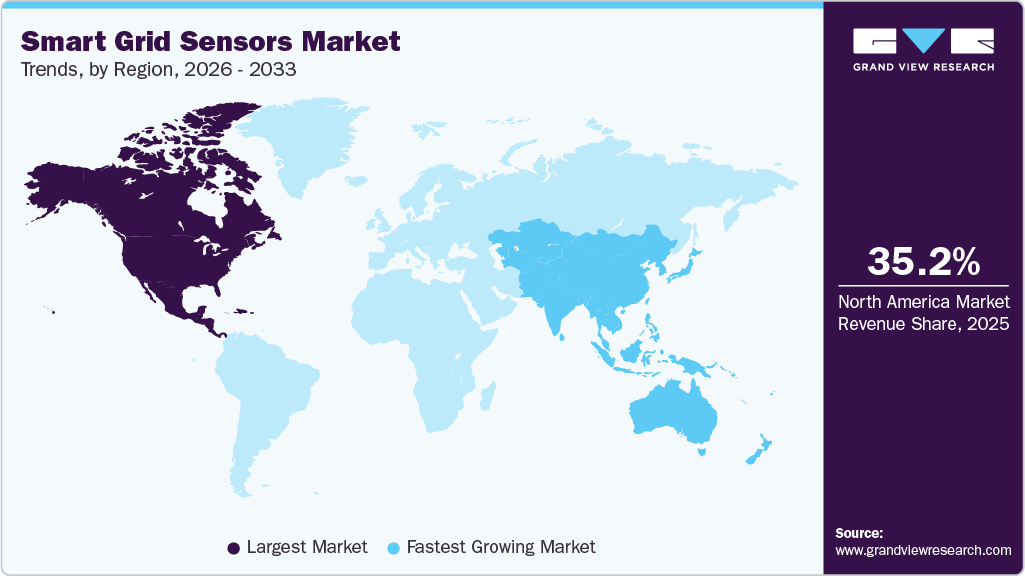
The North America smart grid sensors market held a dominant position in 2025, accounting for a share of 35.2%. The growing demand for advanced grid monitoring and efficient energy management across electricity networks is accelerating the regional growth. The expansion of distributed energy resources and electric vehicle charging infrastructure is increasing the complexity of power systems, thus driving the adoption of sensor-based monitoring solutions. Utilities in this region are increasingly deploying smart grid sensors to gain better visibility into transmission and distribution networks. A key trend in the market is the rapid adoption of digital grid technologies, including cloud-based grid analytics platforms and edge-enabled sensors that allow real-time data collection and faster decision-making.
 To learn more about this report, Download Free Sample Report
 U.S. Smart Grid Sensors Market Trends
The U.S. smart grid sensors market held a dominant position in 2025.Aging power infrastructure is being upgraded with sensor-based systems to improve fault detection, outage management, and grid reliability. The integration of renewable energy sources such as solar and wind has also increased the need for real-time monitoring and intelligent grid management solutions. In addition, strong government support has been provided to accelerate smart grid deployment. For instance, the U.S. Department of Energy launched the Grid Resilience and Innovation Partnerships (GRIP) program, allocating more than USD 10 billion to strengthen grid infrastructure and deploy advanced monitoring technologies across the country.
Europe Smart Grid Sensors Industry Trends
The Europe smart grid sensors industry was identified as a lucrative region in 2025. The market is primarily driven by renewable energy integration and grid decarbonization. Advanced sensors are being deployed in smart substations and digital transmission networks to manage fluctuating power flows, improve demand management, and improve grid resilience. Collaborative initiatives between utilities and technology providers are accelerating adoption.
The UK smart grid sensors market is expected to grow rapidly in the coming years. Smart grid sensors are being widely deployed as part of the nationwide smart meter rollout, which saw over 40 million smart and advanced meters in operation by the third quarter of 2025, thus improving visibility into energy usage and grid performance. Real‑time data from these meters supports load balancing, fault detection as well as efficient grid management by utilities.
Smart grid sensors market in Germany held a substantial market share in 2025. The market is supported by initiatives to modernize grid infrastructure with its Energiewende strategy and the growing share of renewable energy. Smart meters with communication capabilities are being rolled out, and pilot deployments of grid sensors are being integrated into digital distribution systems to manage variable solar and wind generation better. Germany has begun accelerating smart meter installations for large electricity consumers, thus expanding the sensor network needed for advanced distribution monitoring and load control.
Asia Pacific Smart Grid Sensors Industry Trends
The Asia Pacific smart grid sensors market is anticipated to grow at a CAGR of 19.2% during the forecast period. Rapid urbanization, industrialization, and increasing electricity demand across countries are driving growth. Further, the growing deployment of renewable energy sources is accelerating the adoption of sensor-based monitoring and grid automation solutions. A key trend in the region is the integration of IoT, AI, and real-time analytics into distribution and transmission networks, which enables fault detection and improved energy management.
Smart grid sensors industry in China is expected to grow rapidly in the coming years. Advanced sensors are being deployed across ultra‑high voltage (UHV) transmission lines and substations. In 2025, the State Grid Corporation of China (SGCC) significantly expanded its deployment of sensor‑based monitoring technologies as part of a record‑breaking 650 billion yuan (≈ USD 89 billion-USD 90 billion) investment in grid infrastructure, with an emphasis on green transformation, digitization, and AI‑driven operations. This large‑scale investment highlights China’s move toward greater resilience.
The Japan smart grid sensors market held a substantial market share in 2025. Utilities are deploying advanced sensor networks in transmission and distribution systems to monitor voltage, frequency, and power quality in real time and to improve grid reliability. For instance, in April 2025, Sense partnered with Chugoku Electric Power and Chugoku Keiki Kogyo to bring high‑resolution grid edge intelligence and sensor‑enabled smart metering (AMI 2.0) to Japanese utilities, enabling real‑time data processing and improved fault detection across distribution networks, managing complex grid conditions. Such collaborations demonstrate how sensor‑based technologies are being introduced to support Japan’s transition to resilient and data‑driven grid operations.
Key Smart Grid Sensors Company Insights
Some of the key companies in the smart grid sensors market include Siemens AG, General Electric (GE) Grid Solutions, ABB Ltd, Schneider Electric, and others. Organizations are focusing on increasing customer base to gain a competitive edge in the industry. Therefore, key players are taking several strategic initiatives, such as mergers and acquisitions, and partnerships with other major companies.
-
Siemens AG operates through its Smart Infrastructure division, which provides advanced solutions for digitalizing power grids. Siemens AG develops smart grid sensors, phasor measurement units, and grid monitoring systems that enable utilities improve grid reliability, detect faults in real time, and optimize energy distribution. Its SICAM grid sensor technologies enable utilities to monitor power quality, voltage levels, and network stability across distribution networks. Siemens solutions are widely used in renewable energy integration, grid automation, and digital grid management.
-
ABB Ltd is provider of smart grid technologies, power monitoring sensors, and digital grid solutions. ABB Ltd offers advanced current sensors, voltage sensors, and grid monitoring devices that improve power system automation and reliability. The company integrates sensor data with analytics to provide real-time insights into grid performance, through its ABB Ability digital platform. ABB’s smart grid sensor solutions help utilities reduce outages, improve energy efficiency, and support the integration of renewable energy sources into modern electricity networks.
Key Smart Grid Sensors Companies:
The following key companies have been profiled for this study on the smart grid sensors market.
- Siemens AG
- General Electric (GE) Grid Solutions
- ABB Ltd
- Schneider Electric
- Itron, Inc.
- Eaton
- LEM
- Ampacimon
- Cisco Systems
- Radiant Enterprises
Competitive Benchmarking
Operating Strategies
Competitive Edge
Weaknesses
Mature Players: Siemens; ABB; Schneider Electric; General Electric
- Mature players focus on delivering integrated smart grid sensing and grid automation solutions across transmission, distribution, and substation infrastructure.
- Their strategies emphasize long-term utility partnerships, deployment of advanced monitoring systems, and integration of sensors with grid analytics, SCADA, and energy management platforms.
- Strong expertise in power infrastructure, grid automation, and utility-scale energy management systems.
- Established global presence with extensive relationships across utilities, transmission operators, and government smart grid programs.
- Large organizational structures may reduce operational flexibility and delay innovation compared to smaller technology-focused firms.
- High deployment and integration costs can limit adoption among smaller utilities and developing regions.
Emerging Players: Itron; Ampacimon
- Emerging players focus on specialized smart sensing technologies such as IoT-enabled monitoring systems, wireless grid sensors, smart metering integration, and cloud-based grid analytics platforms.
- Their strategies emphasize flexible deployment models, cost-efficient monitoring solutions, and advanced real-time data analytics capabilities.
- Higher agility and faster product innovation cycles compared to established incumbents.
- Strong capabilities in IoT connectivity, cloud platforms, edge analytics, and AI-driven grid monitoring applications.
- Limited geographic reach and smaller operational scale restrict participation in large-scale national grid modernization projects.
- Lower brand recognition and limited utility relationships may affect customer acquisition and long-term contract opportunities.
Recent Developments
-
In December 2025, Siemens AG announced a grid transparency and fault detection solution leveraging its Electrification X IoT suite, combining Sentron 3NA6 COM smart fuses and Sicam Enhanced Grid sensors to deliver 24/7 monitoring and improve distribution network visibility.
-
In December 2025, Schneider Electric announced the launch of “One Digital Grid Platform”, an AI-enabled software solution designed to help utilities modernize their operations, improve grid resilience and reduce energy costs. The platform integrated planning and asset management into a unified, modular system, allowing utilities to innovate without overhauling existing infrastructure. It also provided real-time outage restoration estimates, including during storms and Public Safety Power Shutoffs, improving transparency and customer communication.
Smart Grid Sensors Market Report Scope
Report Attribute
Details
Market size in 2025
USD 777.5 million
Estimated Market size In 2026
USD 904.8 million
Projected Market size by 2033
USD 2,896.9 million
Growth rate
CAGR of 18.1% from 2026 to 2033
Base year for estimation
2025
Historical data
2021 - 2024
Forecast period
2026 - 2033
Quantitative units
Revenue in USD million/billion and CAGR from 2026 to 2033
Report vehicle
Revenue forecast, company ranking, competitive landscape, growth factors, and trends
Segments covered
Sensor type, application, end-use, region
Regional scope
North America; Europe; Asia Pacific; Latin America; MEA
Country scope
U.S.; Canada; Mexico; Germany; UK; France; China; Japan; India; South Korea; Australia; Brazil; KSA; UAE; South Africa
Key companies profiled
Siemens AG; General Electric; ABB Ltd; Schneider Electric; Itron, Inc.; Eaton; LEM; Ampacimon; Cisco Systems; Radiant Enterprises.
Customization scope
Free report customization (equivalent up to 8 analysts working days) with purchase. Addition or alteration to country, regional & segment scope.
Pricing and purchase options
Avail customized purchase options to meet your exact research needs. Explore purchase options
Global Smart Grid Sensors Market Report Segmentation
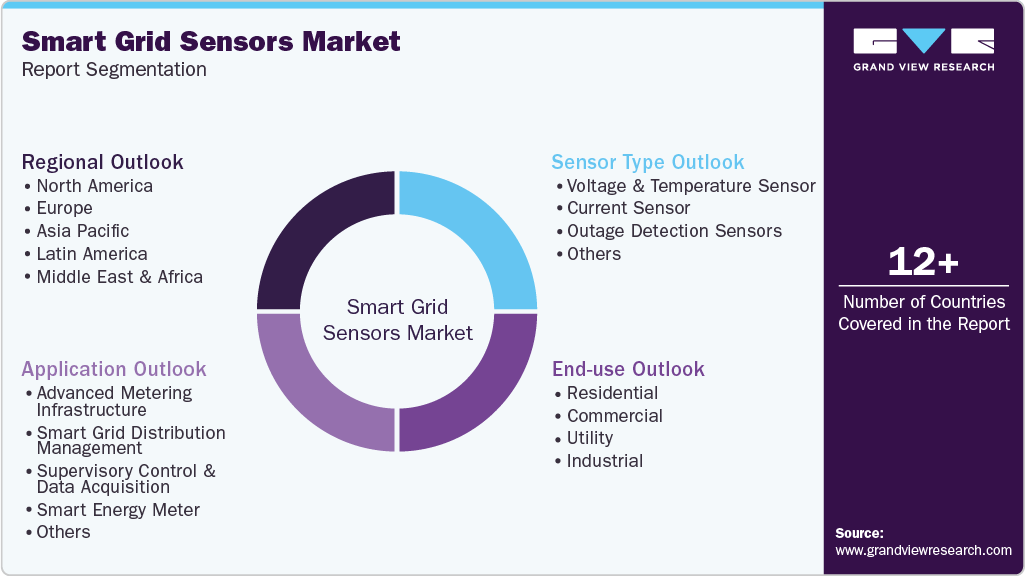
This report forecasts revenue growth at global, regional, and country levels and provides an analysis of the latest industry trends in each of the sub-segments from 2021 to 2033. For this study, Grand View Research has segmented the global smart grid sensors market report based on sensor type, application, end-use, and region:
 To learn more about this report, Download Free Sample Report
 -
Sensor Type Outlook (Revenue, USD Million, 2021 - 2033)
-
Voltage and Temperature Sensor
-
Current Sensor
-
Outage Detection Sensors
-
Others
-
-
Application Outlook (Revenue, USD Million, 2021 - 2033)
-
Advanced Metering Infrastructure
-
Smart Grid Distribution Management
-
Supervisory Control and Data Acquisition
-
Smart Energy Meter
-
Others
-
-
End-use Outlook (Revenue, USD Million, 2021 - 2033)
-
Residential
-
Commercial
-
Utility
-
Industrial
-
-
Regional Outlook (Revenue, USD Million, 2021 - 2033)
-
North America
-
U.S.
-
Canada
-
Mexico
-
-
Europe
-
Germany
-
UK
-
France
-
-
Asia Pacific
-
China
-
Japan
-
India
-
South Korea
-
Australia
-
-
Latin America
-
Brazil
-
-
Middle East and Africa (MEA)
-
KSA
-
UAE
-
South Africa
-
-
Delivered Customizations
This report has been delivered with the following In-depth customizations
Client Request
Customization Delivered
Value Adds
Smart Grid Sensor Market Analysis
- Segmentation of smart grid sensors across transmission, distribution, and grid monitoring applications.
- Technology assessment including IoT-enabled, wireless, and AI-integrated sensors
- Regional demand analysis across utility modernization programs.
- Identified high-growth segments in distribution automation and real-time grid monitoring.
- Supported utility investment prioritization and digital grid roadmap development.
Utility Modernization
- Evaluation of smart metering integration, substation automation, and fault detection systems.
- Analysis of sensor deployment in renewable-integrated grids and microgrids.
- Improved understanding of grid modernization use cases and adoption barriers.
- Enabled optimization of deployment strategy for utilities and EPC players.
Competitive Landscape Assessment
- Benchmarking of leading smart grid sensor manufacturers and solution providers.
- Feature comparison across sensing accuracy, connectivity, and analytics capabilities.
- Pricing models and partnership ecosystem analysis (utilities, telecom, software vendors).
- Supported competitive positioning and technology differentiation strategy.
- Identified opportunities in predictive maintenance and edge analytics integration.
Frequently Asked Questions About This Report
North America dominated with a 38.4% revenue share in 2025.
Asia Pacific is the fastest-growing region over the forecast period.
The advanced metering infrastructure segment led with a 34.1% revenue share in 2025.
Which end-use segment dominated the smart grid sensors market?
The global smart grid sensor market size was estimated at USD 777.5 million in 2025 and is expected to reach USD 904.8 million in 2026.
The global smart grid sensor market is expected to grow at a compound annual growth rate of 18.1% from 2026 to 2033 to reach USD 2,896.9 million by 2033.
Voltage and temperature sensor segment dominated the smart grid sensor market with a share of 40.8% in 2025. Voltage and temperature sensors are fundamental for continuous monitoring of grid health and operational conditions.
Increasing need for reliable and efficient power distribution is driving the deployment of smart grid sensors across modern power networks.
Some key players operating in the smart grid sensor market include Siemens AG, General Electric (GE) Grid Solutions, ABB Ltd, Schneider Electric, Itron, Inc., Eaton, LEM, Ampacimon, Cisco Systems, Radiant Enterprises
About the Author(s)
Next Generation Technologies Research Team
Technology · Next Generation TechnologiesThis report was authored by the next generation technologies research team at Grand View Research - comprising two research analysts, one senior research analyst, and one industry expert - with specialized expertise in the next generation technologies segment of the technology industry. All findings are based on proprietary technology databases, executive interviews, and regulatory analysis, subject to internal peer review prior to publication.
Last Updated:
Speak to Analyst

Customize this report to your needs - add regions, segments, or data points, with 20% free customization.
Or view our licence options:


ISO 9001:2015 & 27001:2022 Certified
We are GDPR and CCPA compliant! Your transaction & personal information is safe and secure. For more details, please read our privacy policy.


