
- Home
- »
- Next Generation Technologies
- »
-
Smart Hospitality Market Size And Share Report, 2026-2033GVR Report cover

Smart Hospitality Market (2026 - 2033)
Size, Share & Trends Analysis Report By Component (Hardware, Software, Services), By Deployment (On-Premises, Cloud), By End Use (Hotels & Resorts, Luxury Yachts), By Region, And Segment Forecasts
Market Size, 2025
$39.3BMarket Estimate, 2026
$49.2BMarket Forecast, 2033
$197.3BCAGR, 2026–2033
21.9%Smart Hospitality Market Summary
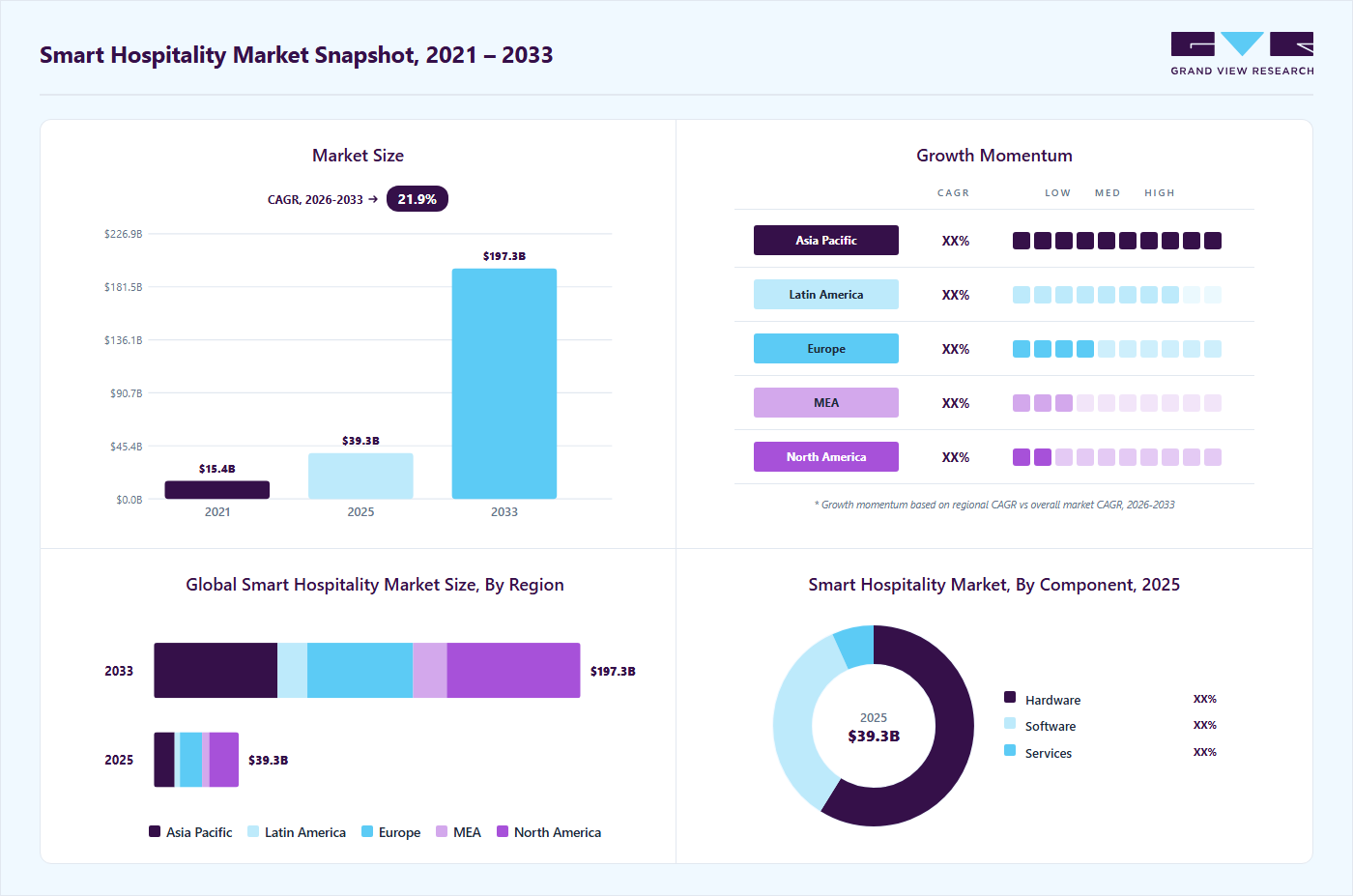
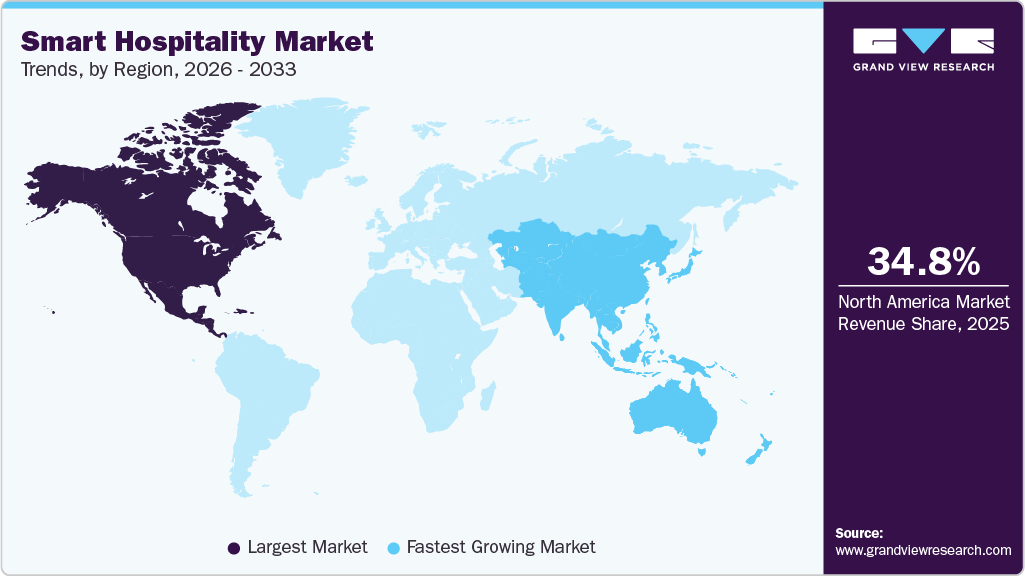
The global smart hospitality market size was valued at USD 39.3 billion in 2025 and is projected to grow from USD 49.2 billion in 2026 to USD 197.3 billion by 2033, at a CAGR of 21.9% from 2026 to 2033. The North America market held the largest share of 34.8% of the global market in 2025. The market is expanding rapidly due to the increasing demand for enhanced guest experiences and personalized services across hotels, resorts, and other accommodation providers.
 Source: Grand View Research, IR Documents, Primary Interviews, Paid DatabasesTo learn more about this report,
 Download Free Sample Report
 Key Market Trends & Insights
- By component: The hardware segment held the largest revenue share of 58.8% in 2025.
- By deployment: The cloud segment dominated the smart hospitality industry in 2025.
- By end use: The hotels & resorts segment dominated the market in 2025.
Market Size & Forecast
- Largest regional market: North America (34.8% revenue share, 2025)
- Fastest-growing regional market: Asia Pacific (highest CAGR, 2026-2033)
- By country: The U.S. held the largest market share in 2025.
Three ways to get this report
Buy it, customize it, or ask a question.Ask an Analyst
Analyst response in 1 business day
- AccessReport author, directly
- Reply timeWithin 1 working day
- No sales callDirect answer only
- FormatEmail reply
- CostFree, no cost
Get the Full Report
What the study covers
- FormatsPDF · Excel · Dashboard
- Timeline2026–2033 annual, 2025 base
- Coverage20+ countries, 5 regions
- Companies10+ key players profiled
Customize the Report
20% free customization
- IncludeCountries, segments, points
- TailorTo your product definition
- ExtendDeeper competitor detail
- OrA fully bespoke study
- Turnaround5–10 working days
Market Size & Forecast
- Market size in 2025: USD 39.3 Billion
- Estimated market size in 2026: USD 49.2 Billion
- Projected market size by 2033: USD 197.3 Billion
- CAGR (2026-2033): 21.9%
Hospitality operators are increasingly adopting smart technologies such as IoT-enabled room automation, mobile-based check-in and check-out, digital concierge services, and AI-powered guest engagement tools to improve convenience and customer satisfaction. These technologies enable real-time service customization, which is becoming a critical competitive factor for hospitality businesses.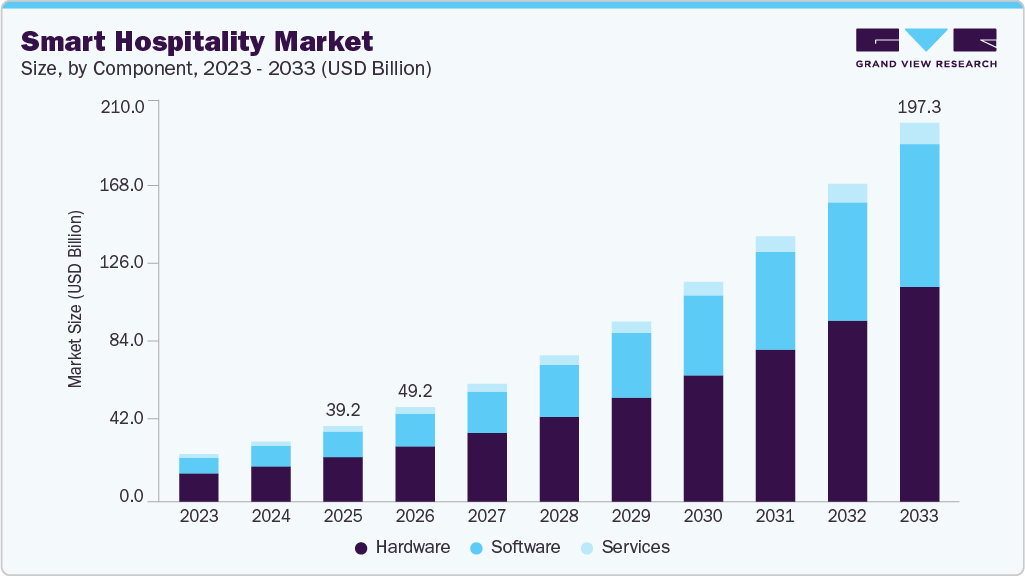 To learn more about this report, Download Free Sample Report
 The growing focus on operational efficiency and cost optimization is a major driver accelerating market growth. Smart hospitality solutions help property managers automate routine tasks such as energy management, housekeeping scheduling, predictive maintenance, and security monitoring. The integration of connected devices and centralized management platforms enables hotels to reduce energy consumption, optimize resource utilization, and lower operational expenses. In addition, rising energy costs and increasing sustainability goals among hospitality providers are encouraging the adoption of intelligent building management systems and smart energy solutions.
The rapid adoption of cloud-based deployment models is also contributing significantly to market expansion. Cloud platforms allow hospitality businesses to manage operations remotely, integrate multiple systems seamlessly, and scale services based on business requirements. The increasing use of data analytics and artificial intelligence further enables operators to analyze guest preferences, forecast demand patterns, and deliver targeted services. Moreover, the increasing use of mobile applications and contactless technologies, particularly following the global shift toward digital and touchless interactions, is strengthening demand for smart hospitality platforms.
Furthermore, the increasing investments in smart infrastructure and digital transformation across the travel and tourism sector are supporting market growth. Governments and private organizations are focusing on developing smart cities and connected tourism ecosystems, which is accelerating the adoption of smart hospitality technologies. The expansion of luxury hotels, boutique accommodations, and technologically advanced resorts, along with rising international tourism and business travel activities, is expected to create strong growth opportunities for solution and service providers in the smart hospitality industry during the forecast period.
Market Dynamics
The rising adoption of IoT-enabled smart hotel infrastructure is significantly driving growth in the smart hospitality market by enabling hotels to improve operational efficiency, reduce energy consumption, and enhance guest experiences through connected technologies. Hotels are increasingly deploying smart room automation systems, AI-enabled thermostats, occupancy sensors, connected lighting, digital access controls, smart TVs, and centralized building management platforms to create seamless and personalized guest environments. IoT integration also allows hotel operators to monitor assets in real time, automate maintenance scheduling, optimize HVAC and utility consumption, and improve staff productivity through data-driven decision-making. As hospitality providers compete on digital guest experience differentiation, investments in intelligent infrastructure continue to accelerate across luxury, business, and mid-scale hotel segments globally.
For instance, in June 2025, Anacove announced the integration of its AI-enabled smart hotel devices with LG Electronics’ Pro:Centric hotel TV platform during HITEC 2025. The launch introduced AI-driven thermostats, leak-detection systems, asset trackers, and safety alert solutions that transform in-room hotel TVs into centralized operational intelligence hubs. Similarly, in March 2025, Huawei and Meliá Hotels International launched a Global Smart Hotel Showcase focused on intelligent hotel connectivity and IoT-enabled hospitality infrastructure to accelerate digital transformation across the hospitality industry. Such developments highlight the growing industry-wide investment in connected hospitality ecosystems, which is accelerating the adoption of smart infrastructure solutions and contributing significantly to the overall growth of the Smart Hospitality Market.
High maintenance and continuous upgrade requirements are a major restraint in the Smart Hospitality Market, as smart hotel ecosystems rely on interconnected hardware, cloud platforms, AI software, IoT sensors, cybersecurity systems, and network infrastructure that require ongoing monitoring and maintenance. Hotels deploying smart room controls, digital concierge systems, smart energy management platforms, and connected security solutions must continuously invest in software patches, firmware updates, cybersecurity protection, cloud subscriptions, and technical support services to ensure uninterrupted performance. In addition, malfunctioning smart devices or system downtime can directly affect guest experience and hotel operations, increasing the need for proactive maintenance and dedicated IT management teams. These recurring operational costs can become financially challenging, particularly for small and mid-sized hospitality operators with limited technology budgets.
The rapid pace of technological advancement further intensifies this challenge, as hospitality operators are often required to upgrade systems frequently to remain compatible with evolving AI, IoT, cloud computing, and cybersecurity standards. Older smart infrastructure may quickly become outdated due to changing guest expectations, new digital service capabilities, and evolving integration requirements across hotel management platforms. Continuous upgrades also involve employee retraining, system migration risks, and temporary operational disruptions during implementation. As a result, many hotels hesitate to adopt large-scale smart hospitality solutions despite the long-term operational benefits, thereby slowing market penetration in cost-sensitive regions and independent hotel segments.
The expansion of AI-powered personalized guest experiences is creating significant growth opportunities in the smart hospitality market as hotels increasingly focus on enhancing customer satisfaction, loyalty, and operational efficiency through intelligent digital technologies. AI enables hospitality providers to analyze guest preferences, booking behavior, travel history, spending patterns, and real-time interactions to deliver highly customized services and recommendations. Hotels are adopting AI-powered chatbots, virtual concierges, recommendation engines, dynamic pricing systems, and predictive analytics platforms to personalize room settings, dining suggestions, entertainment options, promotional offers, and customer support services. These capabilities help hotels improve guest engagement, increase repeat bookings, optimize revenue generation, and differentiate their services in an increasingly competitive hospitality environment.
The growing demand for seamless, personalized experiences is accelerating investments in advanced AI-driven hospitality platforms across the luxury, business, and resort segments worldwide. AI technologies also enable hotels to automate guest communication, provide multilingual support, anticipate customer needs, and improve operational responsiveness through real-time analytics and automation. As travelers increasingly expect digitally connected and customized hospitality experiences similar to those offered by major e-commerce and entertainment platforms, hotels are prioritizing AI integration as a core competitive strategy. This trend is expected to create substantial opportunities for software providers, cloud platform vendors, IoT companies, and AI solution developers operating within the smart hospitality market over the forecast period.
Market Concentration & Characteristics
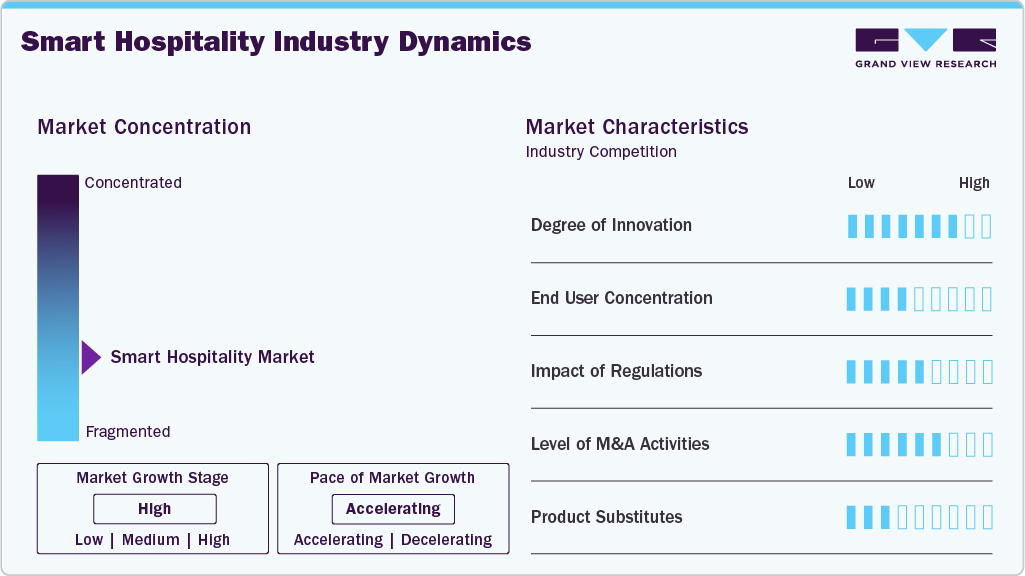
The smart hospitality market is fragmented, with multiple global technology giants, hospitality automation specialists, IoT solution providers, and cloud-based SaaS vendors competing across different solution layers, including smart room automation, digital concierge services, guest engagement platforms, and building management systems. The smart hospitality market is experiencing strong expansion driven by rapid digital transformation across hotels, resorts, cruise operators, and serviced accommodations. Large enterprises dominate enterprise-grade deployments, but regional integrators and niche software firms continue to gain traction by offering customized and cost-effective solutions for independent hotels and mid-scale hospitality chains. Strategic partnerships, platform integrations, and selective acquisitions are increasingly shaping competitive dynamics as vendors attempt to build end-to-end smart hospitality ecosystems.
 To learn more about this report, Download Free Sample Report
 The degree of innovation in the smart hospitality market is high, driven by continuous advancements in AI-powered personalization, IoT-enabled room automation, contactless technologies, cloud-based property management systems, and predictive analytics. Hospitality operators are aggressively adopting technologies such as mobile check-ins, smart energy management, digital room controls, AI chatbots, and voice-enabled guest services to enhance customer experience while improving operational efficiency. Innovation is also accelerating because hotels are increasingly competing on digital guest experience differentiation rather than only on pricing or location advantages. The integration of AI, cybersecurity, edge computing, and sustainability-focused automation solutions is expected to further intensify technological innovation across the market over the forecast period.
Component Insights
The hardware segment held the largest revenue share of 58.8% in 2025. The segment’s dominance is primarily driven by the increasing adoption of connected physical infrastructure across hotels and hospitality facilities to enhance operational efficiency and guest experience. Hardware solutions such as access control & security systems, in-room automation devices, guest self-service kiosks, and other smart equipment enable automated check-ins, personalized room settings, energy management, and improved safety monitoring. Hotels are increasingly investing in smart locks, sensors, kiosks, and IoT-enabled devices to reduce manual intervention and optimize staff productivity while delivering seamless and contactless services to guests. The growing demand for enhanced guest convenience and security, along with rising investments in smart hotel modernization and digital transformation initiatives, remains a key driver supporting the growth of the hardware segment.
The services segment is expected to grow at a significant CAGR during the forecast period. The growth of this segment is mainly driven by the increasing need for system integration, consulting, maintenance, and technical support services as hospitality providers adopt advanced smart technologies. Hotels and resorts often require expert support to install, customize, and manage smart solutions effectively. As smart hospitality systems become more complex and interconnected, the demand for professional and managed services continues to rise. A major trend supporting this segment was the growing preference for outsourced technology management and cloud-based service support. Many hospitality businesses, especially mid-sized and independent hotels, relied on third-party service providers to manage software updates, cybersecurity, and system performance.
Deployment Insights
The cloud segment dominated the smart hospitality industry in 2025. The growth of this segment is mainly driven by the increasing demand for flexible, scalable, and cost-effective technology solutions among hospitality providers. Cloud-based platforms allow hotels and resorts to manage reservations, guest data, room automation, and operational systems from a centralized and remote location. These solutions reduce the need for heavy upfront infrastructure investments and provide easier system upgrades, making them highly attractive for both large hotel chains and smaller properties. A key trend supporting this segment was the growing adoption of cloud-based property management systems, guest engagement platforms, and data analytics tools. Hospitality providers increasingly prefer cloud solutions because they allow real-time data access and better integration with mobile applications and contactless services. In addition, the rising focus on remote monitoring, cybersecurity improvements, and seamless system integration across multiple hotel locations further strengthened the demand for cloud deployment in the smart hospitality industry.
The on-premises segment is expected to grow at a significant CAGR over the forecast period. The growth of this segment is mainly driven by the increasing need for stronger data security, system control, and customization among large hotels and luxury hospitality providers. Many organizations prefer on-premises deployment to maintain full control over sensitive guest information, payment systems, and operational data. It also allows hospitality businesses to tailor smart technology systems according to their specific operational requirements and internal policies. A key trend supporting this segment was the rising adoption of hybrid technology environments, where hospitality providers combined on-premises infrastructure with selected cloud features. High-end hotels and large hospitality chains increasingly invest in advanced in-house IT infrastructure to ensure reliable system performance and faster data processing. In addition, strict data privacy regulations and growing concerns about cybersecurity encouraged several hospitality operators to maintain locally hosted systems, further supporting the growth of the on-premises segment.
End Use Insights
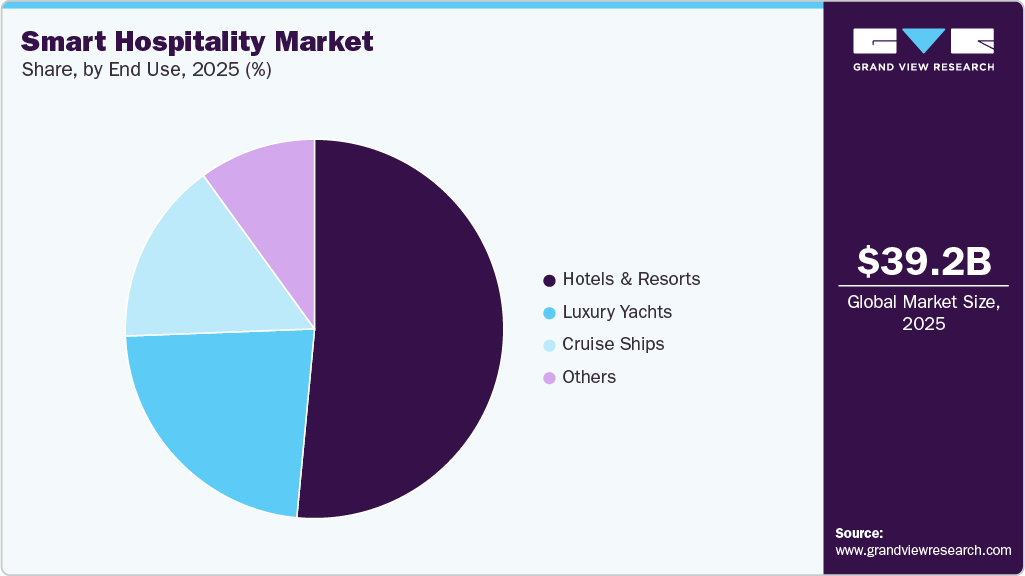
The hotels & resorts segment dominated the market in 2025. The growth of this segment is mainly driven by the increasing focus on improving guest comfort, convenience, and personalized experiences. Hotels and resorts are widely adopting smart technologies such as automated room controls, digital concierge services, mobile check-in and check-out systems, and AI-based customer service platforms. These solutions help hospitality providers enhance service quality, improve operational efficiency, and build stronger customer loyalty. Many hotels and resorts introduced smart room features that allow guests to control lighting, temperature, and entertainment systems through mobile applications or voice assistants. In addition, the rising demand for luxury and premium travel experiences encouraged hospitality providers to invest in advanced automation and smart infrastructure, further strengthening the adoption of smart hospitality solutions in hotels and resorts.
 To learn more about this report, Download Free Sample Report
 The luxury yachts segment is expected to grow at the fastest CAGR over the forecast period. The growth of this segment is mainly driven by the increasing demand for premium and personalized travel experiences among high-net-worth individuals. Luxury yacht operators are increasingly adopting smart hospitality technologies such as automated cabin controls, advanced entertainment systems, smart navigation support, and AI-based guest service solutions. These technologies help improve passenger comfort, safety, and onboard service efficiency, making luxury yacht experiences more advanced and attractive. Yacht operators focused on providing fully connected environments where passengers could control lighting, climate settings, entertainment, and service requests through mobile devices or voice assistants. In addition, the rising demand for energy-efficient and sustainable yacht operations encouraged the adoption of smart energy management and monitoring solutions, further supporting the growth of smart hospitality technologies in the luxury yacht segment.
Regional Insights
North America smart hospitality industry dominated with a revenue share of over 34.8% in 2025. The region’s growth is supported by the strong presence of large hotel chains, early adoption of advanced technologies, and high investments in digital transformation. Hospitality providers across Canada and other parts of North America are increasingly implementing smart building systems, AI-driven guest service platforms, and advanced energy management solutions to improve operational performance. The region also benefits from well-developed IT infrastructure and high customer expectations for seamless and technology-driven hospitality services.
 To learn more about this report, Download Free Sample Report
 U.S. Smart Hospitality Market Trends
The U.S. smart hospitality industry dominated the market in 2025, and it is expected to grow significantly from 2026 to 2033. The growth is mainly driven by the rapid adoption of contactless technologies, mobile-based guest services, and data-driven personalization across hotels and resorts. U.S. hospitality companies are actively investing in automation, cybersecurity solutions, and cloud-based property management platforms to enhance guest satisfaction and streamline operations. In addition, the increasing expansion of luxury hotels, smart resorts, and digitally connected tourism facilities is further supporting market growth across the country.
Asia Pacific Smart Hospitality Market Trends
The smart hospitality industry in the Asia Pacific is growing at the fastest CAGR from 2026 to 2033. The growth is mainly driven by the rapid expansion of tourism, increasing investments in hotel infrastructure, and rising demand for technology-driven guest services across countries such as Japan, India, Southeast Asia, and Australia. Hospitality providers in the region are focusing on adopting mobile-based booking systems, smart room automation, and AI-powered customer service tools to attract tech-savvy travelers. In addition, government initiatives supporting smart city development and digital transformation in the tourism sector are further encouraging the adoption of smart hospitality solutions across the region.
China smart hospitality industry’s growth is driven by the country’s strong focus on digital innovation and the large-scale expansion of modern hotels and smart resorts. Hospitality operators in China are increasingly implementing facial recognition check-ins, robot-based room services, and fully automated hotel management systems to improve guest convenience and operational efficiency. The rising number of domestic and international travelers, along with growing investments in luxury hospitality infrastructure and smart tourism projects, is further supporting the adoption of advanced smart hospitality technologies across the country.
Europe Smart Hospitality Market Trends
Europe smart hospitality industry is growing at a significant CAGR from 2026 to 2033. The smart hospitality industry in Europe is experiencing steady growth, supported by the region’s strong focus on sustainable tourism and energy-efficient hotel operations. Hospitality providers across countries such as France, the UK, Italy, and Spain are increasingly adopting smart building technologies, automated guest service platforms, and digital property management systems to enhance service quality and reduce operating costs. The growing popularity of eco-friendly hotels and strict energy efficiency regulations is encouraging hospitality operators to implement smart energy monitoring and automation solutions, which is supporting market expansion across the region.
The smart hospitality industry in Germany is expected to grow significantly during the forecast period. The Germany market’s growth is driven by the country’s advanced technology infrastructure and strong focus on sustainability and operational efficiency. Hotels and resorts in Germany are increasingly adopting smart room control systems, digital check-in platforms, and AI-based service management tools to improve guest experiences and streamline operations. In addition, the rising demand for business travel and premium hospitality services, along with increasing investments in smart hotel construction and renovation projects, is further supporting the adoption of smart hospitality technologies in the country.
Key Smart Hospitality Company Insights
Some of the key companies operating in the smart hospitality industry, include Agilysys NV LLC., Cisco Systems, Inc., Cloudbeds, Mews Systems, Oracle, and others.
-
Cisco Systems, Inc. is a global company in networking and IT solutions, known for its advanced hardware, software, and services that connect people and devices securely and efficiently. In the smart hospitality industry, Cisco offers Cisco Spaces and Meraki-based solutions that enable hotels and resorts to deliver seamless guest Wi-Fi, indoor location services, IoT-enabled smart building automation, occupancy analytics, and personalized mobile experiences using existing wireless infrastructure.
-
Oracle Corporation / Oracle Hospitality is a global technology company offering comprehensive software and cloud solutions for the hospitality industry. Its portfolio includes OPERA Cloud Property Management, Simphony POS, guest engagement tools, analytics, mobile check-in, loyalty, payments, and integration platforms that help hotels and resorts streamline operations and enhance guest experiences. Oracle’s solutions enable real-time data insights, seamless system integration, and scalable cloud deployment, making it a key player in smart hospitality worldwide.
Key Smart Hospitality Companies:
The following key companies have been profiled for this study on the smart hospitality market
- Agilysys NV LLC.
- Cisco Systems, Inc.
- Cloudbeds
- Honeywell International Inc.
- Hotelogix
- Huawei Technologies Co., Ltd.
- IBM
- Infor
- Johnson Controls
- Mews Systems
- Oracle
- SAMSUNG
- Schneider Electric
- Siemens
- StayNTouch
Competitive Benchmarking
Operating Strategies
Competitive Edge
Weakness
Mature Players: Agilysys NV LLC; Cisco Systems, Inc.; Honeywell International Inc.; Huawei Technologies Co., Ltd.; IBM
- Investing heavily in AI-powered guest experience platforms, IoT-enabled smart room infrastructure, and cloud-based hospitality management systems to strengthen digital hotel ecosystems.
- Expanding strategic collaborations with telecom providers, cloud vendors, and hospitality operators to develop integrated smart hospitality ecosystems.
- Strong global presence and established relationships with large hotel chains, resorts, and enterprise hospitality groups.
- Ability to provide scalable solutions across luxury hotels, resorts, business hotels, and global hospitality chains.
- Dependence on enterprise contracts can lead to longer sales cycles and slower penetration into independent hotel segments.
- Increasing cybersecurity risks and regulatory compliance requirements can increase operational complexity
Emerging Players: Cloudbeds; Hotelogix; Mews Systems; StayNTouch
- Developing cloud-native property management systems (PMS), mobile-first hotel operations platforms, and SaaS-based guest engagement tools targeting flexible deployment.
- Prioritizing integration with third-party travel platforms, payment gateways, and customer engagement applications to improve interoperability.
- Lower implementation costs and faster onboarding processes attract small and medium-sized hotel operators.
- Greater flexibility in responding to evolving hospitality technology trends and customer demands.
- Dependence on partnerships and external integrations may create scalability and compatibility challenges over time.
- Narrower service portfolios compared to diversified enterprise technology providers.
Recent Developments
-
In January 2026, Oracle Hospitality’s OPERA Cloud was officially approved by IHG Hotels & Resorts as a property management system provider across IHG’s managed and franchised hotels globally. This designation enables IHG properties to adopt OPERA Cloud for reservations, guest services, and operations, helping standardize technology, improve efficiency, and enhance guest experiences across the brand’s portfolio.
-
In June 2025, Omni Hotels & Resorts expanded its use of Oracle Cloud technologies to enhance guest experiences and streamline operations across more than 50 properties. By integrating Oracle’s OPERA Cloud Property Management and related systems, Omni improved service delivery, modernized its technology stack, and strengthened its ability to manage reservations, guest preferences, and daily operations from a unified cloud platform.
-
In May 2025, Anacove expanded its collaboration with Oracle by making its AI-driven hotel energy management solutions available through the Oracle Cloud Marketplace. The integration allows hospitality operators using Oracle Cloud Infrastructure to connect Anacove’s platform with OPERA Cloud via the Oracle Hospitality Integration Platform. This development helps hotels improve energy monitoring, automate resource usage, and enhance operational efficiency through connected, cloud-based management tools.
Smart Hospitality Market Report Scope
Report Attribute
Details
Market size in 2025
USD 39.3 billion
Market size value in 2026
USD 49.2 billion
Revenue forecast in 2033
USD 197.3 billion
Growth rate
CAGR of 21.9% from 2026 to 2033
Actual data
2021 - 2025
Forecast period
2026 - 2033
Quantitative units
Revenue in USD billion and CAGR from 2026 to 2033
Report coverage
Revenue forecast, company share, competitive landscape, growth factors, and trends
Segments covered
Component, deployment, end use, region
Regional scope
North America; Europe; Asia Pacific; Latin America; MEA
Country scope
U.S.; Canada; Mexico; UK; Germany; France; China; India; Japan; Australia; South Korea; Brazil; UAE; Saudi Arabia; South Africa
Key companies profiled
Agilysys NV LLC.; Cisco Systems, Inc.; Cloudbeds; Honeywell International Inc.; Hotelogix; Huawei Technologies Co., Ltd.; IBM; Infor; Johnson Controls; Mews Systems; Oracle; SAMSUNG; Schneider Electric; Siemens; StayNTouch
Customization scope
Free report customization (equivalent to 8 analysts working days) with purchase. Addition or alteration to country, regional & segment scope.
Pricing and purchase options
Avail customized purchase options to meet your exact research needs. Explore purchase options
Global Smart Hospitality Market Report Segmentation
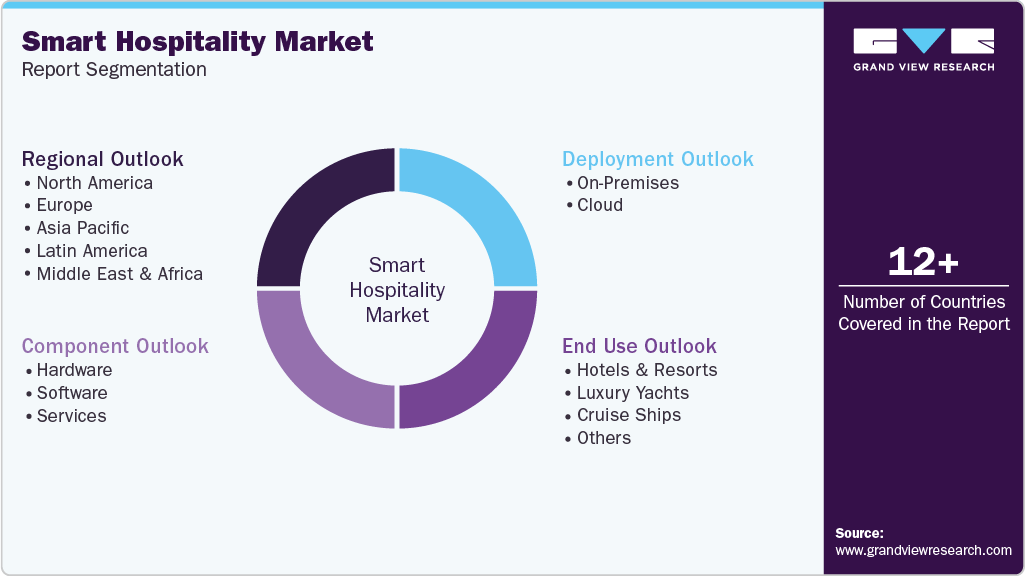
This report forecasts revenue growth at global, regional, and country levels and provides an analysis of the latest industry trends in each of the sub-segments from 2021 to 2033. For this study, Grand View Research has segmented the smart hospitality market report based on component, deployment, end use, and region.
 To learn more about this report, Download Free Sample Report
 -
Component Outlook (Revenue, USD Billion, 2021 - 2033)
-
Hardware
-
Access Control & Security
-
In-Room Automation
-
Guest Self-Service
-
Others
-
-
Software
-
Guest Experience Management
-
Property & Facility Management
-
Security Management
-
Others
-
-
Services
-
Professional Services
-
Managed Services
-
-
-
Deployment Outlook (Revenue, USD Billion, 2021 - 2033)
-
On-Premises
-
Cloud
-
-
End Use Outlook (Revenue, USD Billion, 2021 - 2033)
-
Hotels & Resorts
-
Luxury Yachts
-
Cruise Ships
-
Others
-
-
Regional Outlook (Revenue, USD Billion, 2021 - 2033)
-
North America
-
U.S.
-
Canada
-
Mexico
-
-
Europe
-
Germany
-
UK
-
France
-
-
Asia Pacific
-
China
-
India
-
Japan
-
South Korea
-
Australia
-
-
Latin America
-
Brazil
-
-
Middle East & Africa
-
UAE
-
Saudi Arabia
-
South Africa
-
-
Delivered Customizations
This report has been delivered with the following In-depth customizations
Client Request
Customization Delivered
Value Adds
Assessment of contactless hospitality solutions demand across hotel chains
- Analysis of mobile check-in, digital key, self-service kiosk, and contactless payment adoption trends
- Evaluation of customer preference shifts toward frictionless guest experiences
- Review of integration trends between mobile apps and hotel management systems
- Identified evolving guest experience expectations
- Supported development of mobile-first hospitality offerings
- Highlighted competitive differentiation opportunities in contactless services
AI-driven guest personalization strategy assessment for hospitality software company
- Analysis of AI chatbot, predictive analytics, recommendation engine, and virtual concierge adoption trends
- Evaluation of personalized guest experience use cases across hospitality segments
- Identified emerging AI application areas in hospitality
- Supported innovation roadmap and service enhancement strategies
- Highlighted competitive advantages in guest personalization technologies
Hospitality automation and operational efficiency assessment for robotics and automation provider
- Analysis of robotic service delivery, housekeeping automation, AI-enabled workforce management, and predictive maintenance adoption trends
- Review of operational automation deployment challenges and integration requirements
- Identified automation adoption opportunities across hospitality operations
- Highlighted emerging demand for labor-efficient hospitality technologies
Frequently Asked Questions About This Report
North America dominated with a 34.8% revenue share in 2025.
Asia Pacific is the fastest-growing region over the forecast period.
The hardware segment led with a 58.8% revenue share in 2025, while services is growing significantly.
The cloud segment held the highest market share in 2025. while on-premises is growing significantly.
The hotels & resorts segment held the highest market share in 2025, while luxury yachts is the fastest-growing segment.
The global smart hospitality market size was estimated at USD 39.3 billion in 2025 and is expected to reach USD 49.2 billion in 2026.
The global smart hospitality market is expected to grow at a compound annual growth rate of 21.9% from 2026 to 2033 to reach USD 197.3 billion by 2033.
The hardware segment held the largest revenue share of 58.8% in 2025. The segment’s dominance is primarily driven by the increasing adoption of connected physical infrastructure across hotels and hospitality facilities to enhance operational efficiency and guest experience.
Some key players operating in the market include Agilysys NV LLC.; Cisco Systems, Inc.; Cloudbeds; Honeywell International Inc.; Hotelogix; Huawei Technologies Co., Ltd.; IBM; Infor; Johnson Controls; Mews Systems; Oracle; SAMSUNG; Schneider Electric; Siemens; StayNTouch
Key factors include increasing adoption of IoT-enabled hotel infrastructure, rising demand for personalized guest experiences, growing implementation of contactless and mobile-based services, integration of AI-driven analytics for operational efficiency, and the rapid digital transformation of hotels and resorts are the key factors driving the market growth.
About the Author(s)
Next Generation Technologies Research Team
Technology · Next Generation TechnologiesThis report was authored by the next generation technologies research team at Grand View Research - comprising two research analysts, one senior research analyst, and one industry expert - with specialized expertise in the next generation technologies segment of the technology industry. All findings are based on proprietary technology databases, executive interviews, and regulatory analysis, subject to internal peer review prior to publication.
Last Updated:
Speak to Analyst

Customize this report to your needs - add regions, segments, or data points, with 20% free customization.
Or view our licence options:


ISO 9001:2015 & 27001:2022 Certified
We are GDPR and CCPA compliant! Your transaction & personal information is safe and secure. For more details, please read our privacy policy.


