
- Home
- »
- Advanced Interior Materials
- »
-
Smart HVAC Systems Market Size Report, 2025-2033GVR Report cover

Smart HVAC Systems Market (2025 - 2033) Size, Share & Trends Analysis Report By Technology (Heating, Ventilation, Cooling), By Application (Residential, Commercial, Industrial), By Distribution Channel, By Region, And Segment Forecasts
Market Size, 2024
$96.6BMarket Estimate, 2026
$111.1BMarket Forecast, 2033
$178.3BCAGR, 2025–2033
7.0%Smart HVAC Systems Market Summary
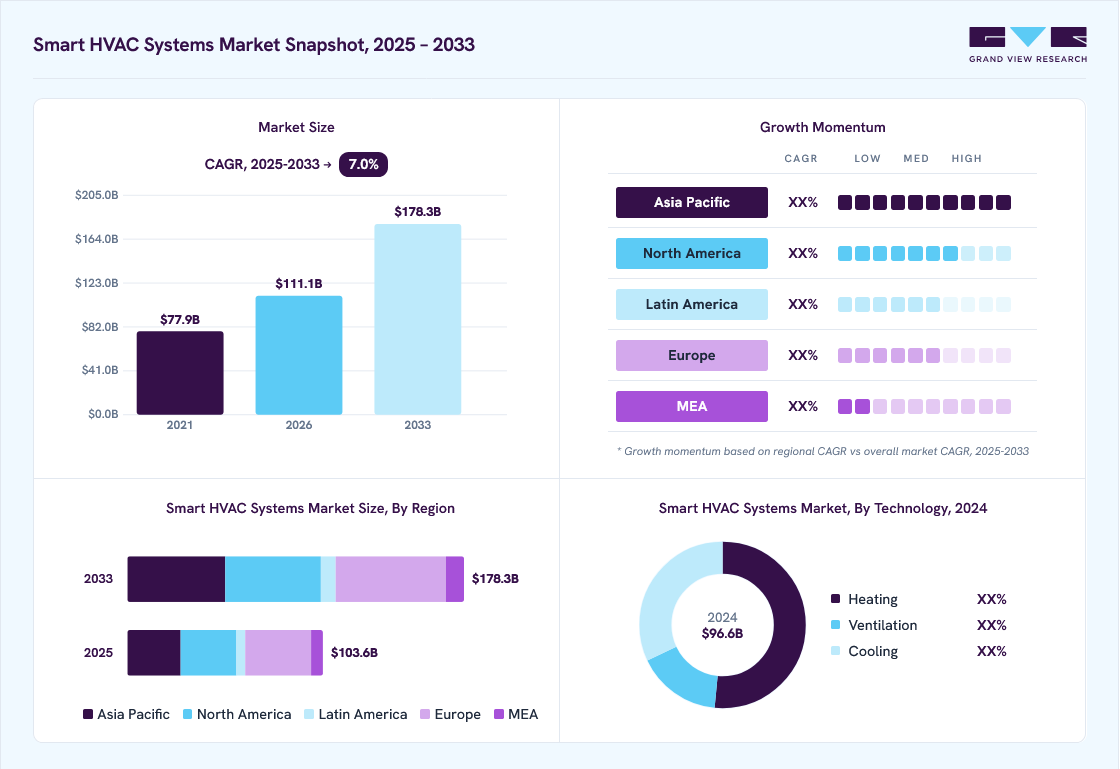
The global smart HVAC systems market size was valued at USD 96.6 billion in 2024 and is projected to grow from USD 111.1 billion in 2026 to USD 178.3 billion by 2033, at a CAGR of 7.0% from 2025 to 2033. Europe dominated the market, accounting for a revenue share of 33.8% in 2024. The global smart HVAC systems industry is primarily driven by rising demand for energy-efficient and sustainable solutions.
 Source: Grand View Research, IR Documents, Primary Interviews, Paid DatabasesTo learn more about this report,
 Download Free Sample Report
 Key Market Trends & Insights
- Europe dominated the smart HVAC systems market with the largest revenue share of 33.8% in 2024.
- By technology, the heating segment is expected to grow at the fastest CAGR of 7.4% from 2025 to 2033.
- By application, the commercial segment is expected to grow at the fastest CAGR of 7.6% from 2025 to 2033.
- By distribution channel, the online segment is expected to grow at the fastest CAGR of 7.9% from 2025 to 2033.
Market Size & Forecast
- 2024 Market Size: USD 96.6 billion
- 2033 Projected Market Size: USD 178.3 billion
- CAGR (2025-2033): 7.0%
- Europe: Largest market in 2024
Three ways to get this report
Buy it, customize it, or ask a question.Ask an Analyst
Analyst response in 1 business day
- AccessReport author, directly
- Reply timeWithin 1 working day
- No sales callDirect answer only
- FormatEmail reply
- CostFree, no cost
Get the Full Report
What the study covers
- FormatsPDF · Excel · Dashboard
- Timeline2025–2033 annual, 2024 base
- Coverage20+ countries, 5 regions
- Companies10+ key players profiled
Customize the Report
20% free customization
- IncludeCountries, segments, points
- TailorTo your product definition
- ExtendDeeper competitor detail
- OrA fully bespoke study
- Turnaround5–10 working days
Integration of IoT, AI, and cloud-based technologies enables real-time monitoring, predictive maintenance, and remote control, boosting system efficiency and user convenience. Urbanization, smart city initiatives, and stricter environmental regulations further fuel adoption across residential, commercial, and industrial sectors. Moreover, advancements in sensor technologies and the increasing popularity of home automation systems are accelerating the shift toward smart HVAC solutions. North America and Asia Pacific are expected to dominate due to high technological adoption and infrastructural development. As climate change concerns grow, the need for smarter, adaptive climate control systems will drive continued innovation and robust market growth through 2030 and beyond.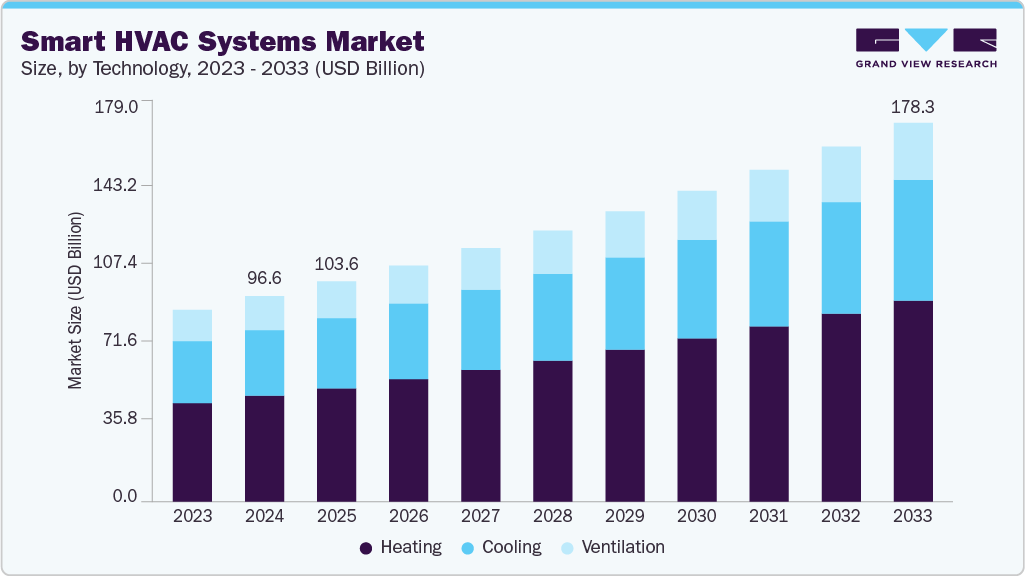 To learn more about this report, Download Free Sample Report
 Market Concentration & Characteristics
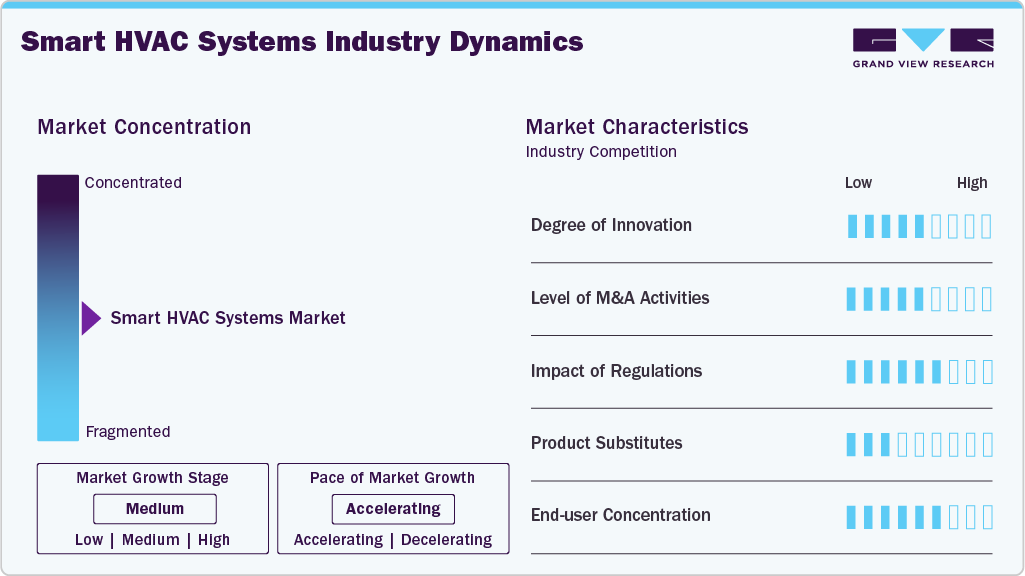
The smart HVAC systems industry is moderately fragmented, with a mix of established players and emerging startups competing globally. Key companies like Honeywell, Johnson Controls, and Daikin dominate with strong R&D capabilities and broad product portfolios. However, numerous regional and niche players offer innovative, cost-effective solutions, intensifying competition. Technological advancements and growing demand attract new entrants, while strategic partnerships and acquisitions shape market dynamics.
The smart HVAC systems industry is experiencing high innovation, driven by IoT, AI, machine learning, and cloud integration. Companies are developing predictive maintenance, self-learning systems, and enhanced user interfaces. Energy efficiency, automation, and climate adaptability are key innovation areas. Continuous R&D and smart home integration trends are accelerating product advancements, improving performance, and meeting evolving customer expectations.
 To learn more about this report, Download Free Sample Report
 Mergers and acquisitions are shaping the market, as larger firms acquire startups to access advanced technologies and expand their product lines. Key players aim to strengthen market presence, integrate AI capabilities, and enhance global distribution. These activities enable faster innovation, cost synergies, and competitive positioning, reflecting the market’s dynamic nature and the strategic importance of smart HVAC solutions.
Regulations play a crucial role in shaping the smart HVAC systems industry. Governments worldwide are implementing stricter energy efficiency and environmental standards, encouraging the adoption of smart, eco-friendly HVAC solutions. Policies such as LEED certifications, energy labeling, and emissions limits drive innovation and compliance. These regulations push manufacturers to develop smarter, greener systems, aligning with global sustainability and climate goals.
Drivers, Opportunities & Restraints
A major driver for the smart HVAC systems industry is the growing demand for energy-efficient solutions. Rising energy costs and environmental awareness push consumers and businesses to adopt intelligent HVAC systems that optimize energy use. These systems reduce operational costs and carbon emissions through automation, real-time monitoring, and data-driven performance, making them essential for sustainable building management.
Integration of the smart HVAC systems industry with broader smart home and building automation platforms presents a significant opportunity. As smart cities and connected living gain traction, demand for centralized, AI-powered climate control is rising. Companies can capitalize on this trend by offering interoperable, scalable HVAC solutions that seamlessly connect with IoT ecosystems, enhancing comfort, efficiency, and user control.
A significant challenge in the smart HVAC systems industry is the high upfront cost and complexity of system installation. Despite long-term energy savings, many customers hesitate due to the initial investment, integration issues with legacy systems, and the need for skilled technicians. This creates adoption barriers, especially in developing regions, slowing market penetration and limiting access to advanced HVAC technologies.
Technology Insights
Cooling segment is expected to grow at the fastest CAGR of 7.0% from 2025 to 2033. The heating segment led the market with the largest revenue share of 51.4% in 2024, due to its low cost, ease of use, and wide applicability across warehouses and retail outlets. They are a preferred choice for short-distance material handling and smaller-scale operations. Industrial and electric variants cater to both small businesses and large distribution centers. Their affordability and reliability continue to make them the most widely adopted equipment type.
The cooling segment is anticipated to grow at the fastest CAGR during the forecast period, due to rising global temperatures, urbanization, and increased demand for indoor comfort. Smart cooling systems equipped with IoT and AI enable energy-efficient operation, remote access, and predictive maintenance, enhancing user convenience and reducing energy consumption. Growing commercial and residential construction, particularly in Asia-Pacific and the Middle East, further drives adoption. Integration with smart home ecosystems and demand for sustainable cooling solutions are accelerating this segment’s expansion.
Application Insights
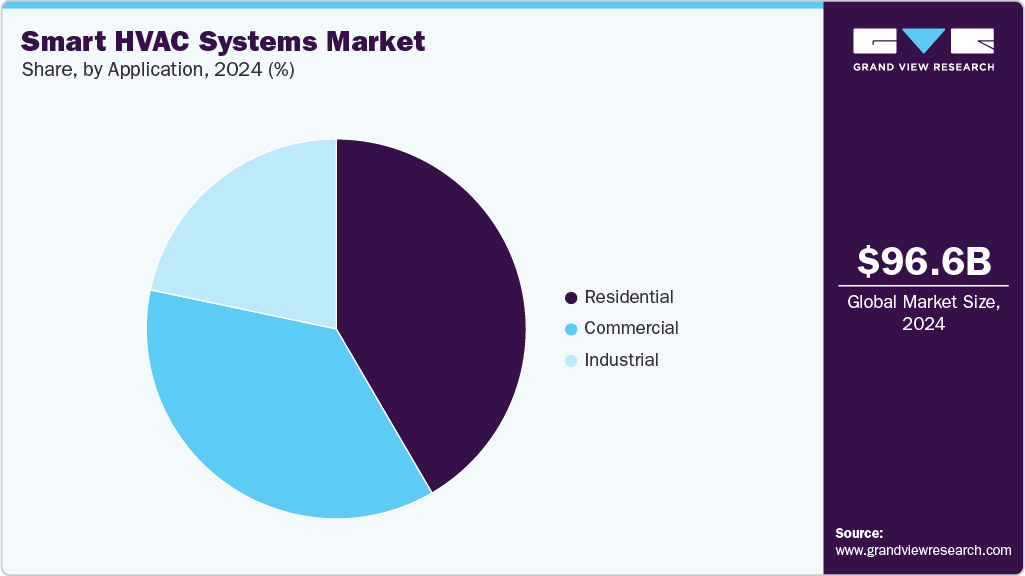
The commercial segment is expected to grow at the fastest CAGR of 7.6% from 2025 to 2033. The residential segment led the market with the largest revenue share of 41.6% in 2024, due to increasing adoption of smart home technologies and rising consumer awareness of energy efficiency. Homeowners are seeking greater comfort, remote control, and cost savings through IoT-enabled HVAC systems. Urbanization, higher disposable incomes, and government incentives for energy-efficient appliances fuel demand. Integration with voice assistants and home automation platforms is also boosting appeal, particularly in North America, Europe, and rapidly developing markets like India and China.
 To learn more about this report, Download Free Sample Report
 The commercial segment is anticipated to grow at the fastest CAGR during the forecast period, as businesses prioritize energy efficiency, operational cost reduction, and regulatory compliance. Smart HVAC systems in offices, retail spaces, hotels, and hospitals enable centralized control, predictive maintenance, and improved occupant comfort. Increased construction of smart buildings and green-certified infrastructure is driving demand.
Distribution Channel Insights
The online segment is expected to grow at the fastest CAGR of 7.9% from 2025 to 2033. The retail stores segment led the market with the largest revenue share of 40.4% in 2024, especially in developing regions where consumers prefer in-person consultations and physical product assessments. Brick-and-mortar stores offer hands-on demonstrations, personalized guidance, and after-sales support, which builds consumer trust. Partnerships between HVAC brands and major electronics or home improvement retailers enhance visibility and accessibility.
The online segment is anticipated to grow at the fastest CAGR during the forecast period, due to increasing digitalization and consumer preference for convenient, contactless shopping. E-commerce platforms offer a wide range of products, detailed specifications, competitive pricing, and easy comparisons, driving higher online sales. Manufacturers are also enhancing their direct-to-consumer (DTC) strategies through branded websites. The rise of smart homes and tech-savvy consumers further supports online purchases, particularly in developed regions with high internet penetration and digital infrastructure.
Regional Insights
The smart HVAC systems market in North America is anticipated to grow at a significant CAGR of 7.0% during the forecast period, due to early technology adoption, strong infrastructure, and rising demand for energy-efficient solutions. Government incentives, smart home trends, and stringent environmental regulations drive market expansion. The region’s focus on sustainability and increasing retrofitting activities in residential and commercial buildings is further propelling demand for advanced HVAC technologies.
U.S. Smart HVAC Systems Market Trends
The smart HVAC systems market in the U.S. dominates the North American market, due to high smart home penetration, consumer awareness, and government-backed energy efficiency programs. Demand is strong across residential and commercial sectors, driven by technological innovation and environmental policies. Smart thermostats, AI integration, and IoT-enabled HVAC systems are gaining traction as homeowners and businesses prioritize comfort, cost savings, and sustainability.
The Mexico smart HVAC market is growing steadily, supported by urbanization, rising temperatures, and expanding construction activities. While still in early stages compared to the U.S., increasing awareness of energy efficiency and growing middle-class demand for smart technologies are boosting adoption. Government initiatives promoting sustainability and the presence of international HVAC manufacturers are also contributing to gradual market development in Mexico.
Asia Pacific Smart HVAC Systems Market Trends
The smart HVAC systems market in the Asia Pacific is growing, driven by rising urbanization, increasing disposable incomes, and expanding smart city initiatives. Governments are promoting energy-efficient technologies amid growing environmental concerns. Strong construction activity and technological advancements are driving demand, especially in residential and commercial sectors. Key markets like China, India, and Japan are fueling regional expansion through innovation and investment.
The China smart HVAC systems market leads the Asia-Pacific region, driven by massive urban development, smart city projects, and strict energy efficiency regulations. The government’s push for green buildings and carbon neutrality targets boosts demand for intelligent climate control solutions. Rapid adoption of IoT and AI technologies, combined with a large domestic manufacturing base, supports the expansion of both residential and commercial smart HVAC systems.
The smart HVAC systems market in India is growing swiftly due to rising temperatures, increasing electricity costs, and demand for energy-efficient solutions. Smart home adoption and government initiatives like Smart Cities Mission are key drivers. While market penetration remains lower than in developed countries, falling hardware prices, growing digital awareness, and investments from global HVAC companies are accelerating adoption across urban residential and commercial sectors.
Europe Smart HVAC Systems Market Trends
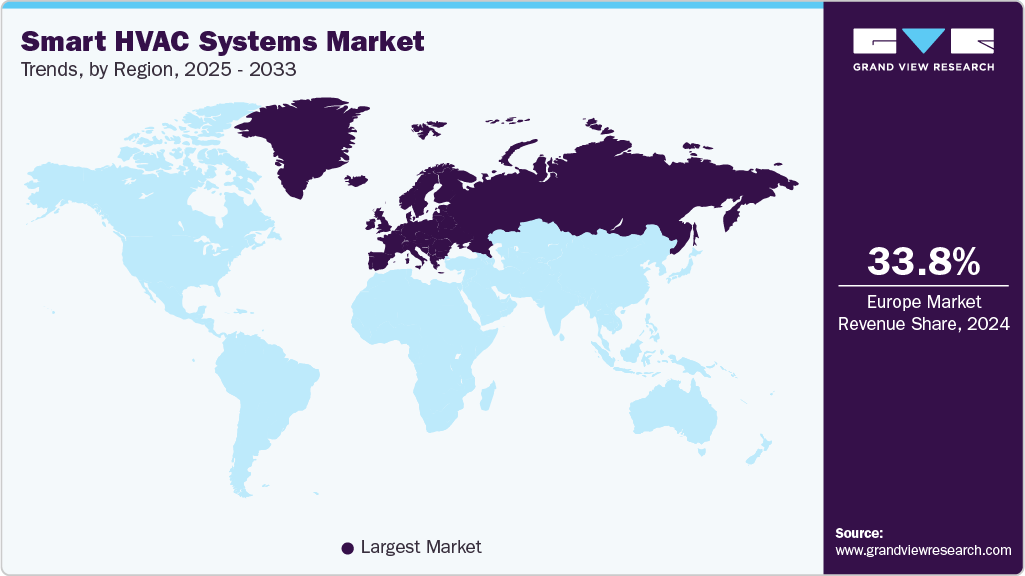
Europe dominated the global smart HVAC systems market with the largest revenue share of 33.8% in 2024, driven by strict environmental regulations, energy efficiency goals, and sustainability initiatives like the EU Green Deal. High awareness of climate change and widespread adoption of smart building technologies are fueling demand. Government incentives for green retrofits and strong support for renewable energy integration further accelerate regional market expansion.
 To learn more about this report, Download Free Sample Report
 The smart HVAC systems market in Germany accounted for the largest market revenue share in Europe in 2024, due to its commitment to energy efficiency and climate neutrality. The country’s strong engineering sector and advanced infrastructure support innovation in HVAC technologies. Government programs promoting building automation and renewable energy use, such as heat pumps and solar integration, are encouraging both residential and commercial sectors to adopt smart HVAC solutions rapidly.
The UK smart HVAC systems market is seeing notable growth, propelled by net-zero targets, energy-saving regulations, and demand for smart home technologies. Initiatives like the Future Homes Standard and increased retrofitting of old buildings support adoption. Consumers and businesses are embracing connected HVAC systems to cut energy costs and emissions, driving market growth across residential and commercial applications.
Middle East & Africa Smart HVAC Systems Market Trends
The smart HVAC systems market in the Middle East and Africa is growing steadily, driven by rising temperatures, rapid urbanization, and smart city developments. Increasing investments in infrastructure and sustainability, especially in Gulf countries, are boosting demand. Governments are promoting energy efficiency and green building standards, while luxury real estate and commercial projects are accelerating the adoption of advanced, climate-adaptive HVAC systems across the region.
The Saudi Arabia smart HVAC systems market is growing, fueled by Vision 2030, which emphasizes sustainability, smart cities, and energy efficiency. Massive urban projects like NEOM and the rapid expansion of commercial infrastructure are driving demand for intelligent climate control solutions. Harsh climate conditions, coupled with rising electricity consumption, are pushing both residential and commercial sectors toward smart, energy-efficient HVAC technologies.
Latin America Smart HVAC Systems Market Trends
The smart HVAC systems market in Latin America is gradually expanding, driven by urbanization, growing awareness of energy efficiency, and rising middle-class demand for modern home technologies. Governments are promoting sustainable building practices, and smart city initiatives are emerging in major urban centers. While adoption is slower than in developed regions, improving digital infrastructure and foreign investments are supporting market growth across residential and commercial sectors.
The Brazil smart HVAC systems market is leading smart HVAC adoption in Latin America, supported by urban growth, hot climate conditions, and rising demand for energy-efficient solutions. Increasing smart home penetration and government focus on energy conservation are key drivers. Though challenges like high costs and limited awareness remain, growing investments in infrastructure and green buildings are creating opportunities for smart HVAC solutions in both residential and commercial markets.
Key Smart HVAC Systems Company Insights
Some of the key players operating in the market include Honeywell International Inc., Johnson Controls International plc, Siemens AG
-
Honeywell International Inc. is a global player in smart HVAC systems, offering advanced building automation and energy management solutions. Known for its innovation in IoT and cloud-based technologies, Honeywell's smart thermostats and HVAC controls enhance energy efficiency, occupant comfort, and operational performance across residential, commercial, and industrial applications worldwide.
-
Johnson Controls is a major player in the smart HVAC market, providing intelligent building systems, energy-efficient solutions, and integrated controls. Its Metasys and OpenBlue platforms enable seamless HVAC management through AI and data analytics. The company emphasizes sustainability and smart infrastructure, serving commercial, institutional, and industrial clients globally.
Key Smart HVAC Systems Companies:
The following are the leading companies in the smart HVAC systems market. These companies collectively hold the largest market share and dictate industry trends.
- Honeywell International Inc.
- Johnson Controls International plc
- Siemens AG
- Schneider Electric SE
- Daikin Industries Ltd.
- Carrier Global Corporation
- Trane Technologies plc
- Lennox International Inc.
- Emerson Electric Co.
- LG Electronics Inc.
- Mitsubishi Electric Corporation
- Robert Bosch GmbH
- Ecobee Inc.
- Nest Labs (Google LLC)
- Toshiba Carrier Corporation
Recent Developments
-
In September 2025, Johnson Controls expanded its thermal management portfolio by introducing a scalable liquid cooling solution designed for high-density data centers. This innovation addresses growing cooling demands by efficiently managing heat in compact, power-intensive environments. The liquid cooling system enhances energy efficiency, reduces operational costs, and supports data center reliability, helping operators maintain optimal performance as computing workloads continue to increase.
-
In December 2024, Mitsubishi Electric acquired Crystal Air Holdings Limited, an Irish company specializing in air-conditioning installation and maintenance services. This acquisition enhances Mitsubishi Electric's service capabilities in Europe, particularly in Ireland and the UK. Crystal Air's expertise will support the company's expansion in the HVAC sector, aligning with its growth strategy in the region.
Smart HVAC Systems Market Report Scope
Report Attribute
Details
Market size in 2024
USD 96.6 billion
Estimated market size in 2026
USD 111.1 billion
Projected market size by 2033
USD 178.3 billion
Growth rate
CAGR of 7.0% from 2025 to 2033
Base year for estimation
2024
Historical data
2021 - 2023
Forecast period
2025 - 2033
Quantitative units
Revenue in USD million/billion and CAGR from 2025 to 2033
Report coverage
Revenue forecast, company ranking, competitive landscape, growth factors, and trends
Segments covered
Technology, application, distribution channel, region.
Regional scope
North America; Europe; Asia Pacific; Latin America; Middle East & Africa
Country scope
U.S.; Canada; Mexico; UK; Germany; France; Spain; Italy; China; Japan; India; Australia; South Korea; Brazil; Argentina; Saudi Arabia; South Africa; UAE
Key companies profiled
Honeywell International Inc.; Johnson Controls International plc; Siemens AG; Schneider Electric SE; Daikin Industries Ltd.; Carrier Global Corporation; Trane Technologies plc; Lennox International Inc.; Emerson Electric Co.; LG Electronics Inc.; Mitsubishi Electric Corporation; Robert Bosch GmbH; Ecobee Inc.; Nest Labs (Google LLC); Toshiba Carrier Corporation
Customization scope
Free report customization (equivalent up to 8 analysts working days) with purchase. Addition or alteration to country, regional & segment scope.
Pricing and purchase options
Avail customized purchase options to meet your exact research needs. Explore purchase options
Global Smart HVAC Systems Market Report Segmentation
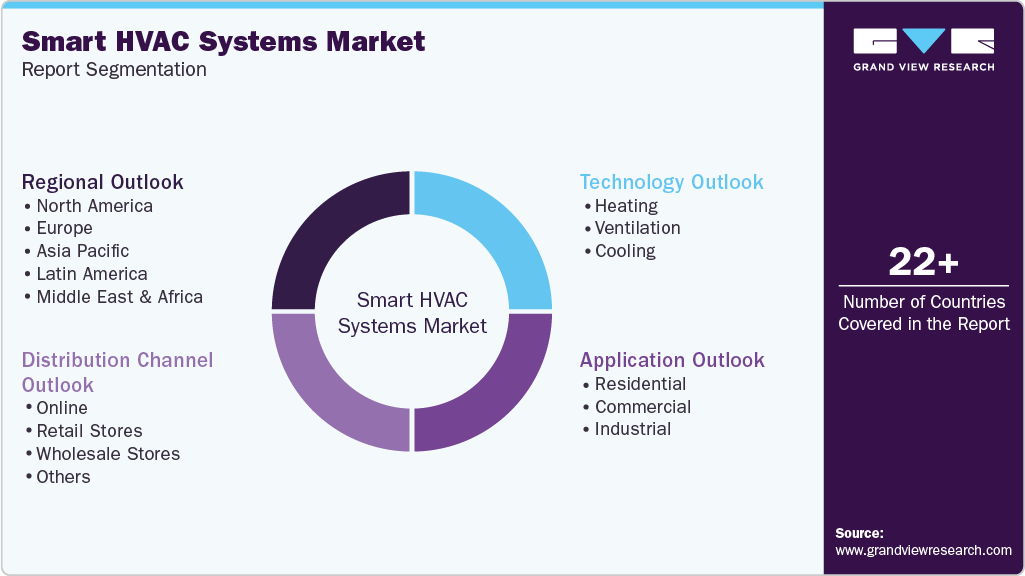
This report forecasts revenue growth at global, regional, and country levels and provides an analysis of the latest industry trends in each of the sub-segments from 2021 to 2033. For this study, Grand View Research has segmented the global smart HVAC systems market report based on technology, application, distribution channel, and region:
 To learn more about this report, Download Free Sample Report
 -
Technology Outlook (Revenue, USD Million, 2021 - 2033)
-
Heating
-
Ventilation
-
Cooling
-
-
Application Outlook (Revenue, USD Million, 2021 - 2033)
-
Residential
-
Commercial
-
Industrial
-
-
Distribution Channel Outlook (Revenue, USD Million, 2021 - 2033)
-
Online
-
Retail Stores
-
Wholesale Stores
-
Others
-
-
Regional Outlook (Revenue, USD Million, 2021 - 2033)
-
North America
-
U.S.
-
Canada
-
Mexico
-
-
Europe
-
Germany
-
France
-
Italy
-
Spain
-
UK
-
-
Asia Pacific
-
China
-
India
-
Japan
-
South Korea
-
Australia
-
-
Latin America
-
Brazil
-
Argentina
-
-
Middle East and Africa
-
Saudi Arabia
-
UAE
-
South Africa
-
-
Frequently Asked Questions About This Report
The global smart HVAC systems market is expected to grow at a CAGR of 7.0% from 2025 to 2033, reaching USD 178.3 billion by 2033.
Residential application segment continues to dominate the market and accounted for a share of 41.6% in 2024, due to increasing adoption of smart home technologies and rising consumer awareness of energy efficiency. Homeowners are seeking greater comfort, remote control, and cost savings through IoT-enabled HVAC systems.
Some of the key players operating in the global smart HVAC systems market include Honeywell International Inc., Johnson Controls International plc, Siemens AG, Schneider Electric SE, Daikin Industries Ltd., Carrier Global Corporation, Trane Technologies plc, Lennox International Inc., Emerson Electric Co., LG Electronics Inc., Mitsubishi Electric Corporation, Robert Bosch GmbH, Ecobee Inc., Nest Labs (Google LLC), Toshiba Carrier Corporation
Key factors driving the global smart HVAC systems market include rising demand for energy-efficient solutions, growing adoption of smart home technologies, increasing urbanization, and strict government regulations on energy consumption. Integration of IoT, AI, and cloud technologies enhances system performance, enabling real-time monitoring, predictive maintenance, and remote control, further boosting market growth.
The global smart HVAC systems market size was valued at USD 96.6 billion in 2024 and is estimated at USD 111.1 billion for 2026.
About the Author(s)
Advanced Interior Materials Research Team
Advanced Materials · Advanced Interior MaterialsThis report was authored by the advanced interior materials research team at Grand View Research - comprising two research analysts, one senior research analyst, and one industry expert - with specialized expertise in the advanced interior materials segment of the advanced materials industry. All findings are based on proprietary advanced materials databases, executive interviews, and regulatory analysis, subject to internal peer review prior to publication.
Last Updated:
Speak to Analyst

Customize this report to your needs - add regions, segments, or data points, with 20% free customization.
Or view our licence options:


ISO 9001:2015 & 27001:2022 Certified
We are GDPR and CCPA compliant! Your transaction & personal information is safe and secure. For more details, please read our privacy policy.


