
- Home
- »
- Plastics, Polymers & Resins
- »
-
Smart Plastics For Flexible & Wearable Electronics Market Report, 2033GVR Report cover

Smart Plastics For Flexible & Wearable Electronics Market (2026 - 2033)
Size, Share & Trends Analysis Report By Material Type (Conductive Polymers, Thermoplastic Elastomers, Self-Healing Polymers), By Application, By Region, And Segment Forecasts
Market Size, 2025
$4.2BMarket Estimate, 2026
$4.4BMarket Forecast, 2033
$7.9BCAGR, 2026–2033
8.7%Smart Plastics For Flexible & Wearable Electronics Market Summary
The global smart plastics for flexible & wearable electronics market size was valued at USD 4.2 billion in 2025 and is projected to grow from USD 4.4 billion in 2026 to USD 7.9 billion by 2033, at a CAGR of 8.7% from 2026 to 2033. Asia Pacific dominated the market, accounting for a revenue share of 40.2% in 2025. The growing demand for lightweight, durable, and flexible materials in wearable electronics, coupled with advancements in nanotechnology and conductive polymers, is driving the smart plastics market. Additionally, increasing adoption of IoT and smart devices in healthcare and consumer electronics is boosting demand.
 Source: Grand View Research, IR Documents, Primary Interviews, Paid DatabasesTo learn more about this report,
 Download Free Sample Report
Key Market Trends & Insights
- By material type: Conductive polymers segment dominated the market, with a revenue share of 35.6% in 2025.
- By application: Healthcare & medical wearables segment held the largest market share of 39.7% in 2025.
Regional Highlights
- Largest regional market: Asia Pacific (40.2% revenue share, 2025)
- By country: China held the largest market share in 2025.
Market Size & Forecast
- Market size in 2025: USD 4.2 Billion
- Estimated market size in 2026: USD 4.4 Billion
- Projected market size by 2033: USD 7.9 Billion
- CAGR (2026-2033): 8.7%
Prism AI by Grand View Research Free to tryAsk a question about the smart plastics for flexible & wearable electronics marketTry asking✓Every figure cited from GVR research Prefer the report? Download free sample →
The rapid growth of the wearable technology market, driven by increasing consumer demand for fitness trackers, smartwatches, and health monitoring devices, is a significant factor propelling the adoption of smart plastics. These plastics offer superior flexibility, lightweight properties, and durability, making them ideal for wearable devices that need to be comfortable while maintaining functionality. Smart plastics, such as conductive polymers and shape-memory materials, enable seamless integration of electronic components in flexible devices. For example, thermoplastic polyurethane (TPU) is widely used in smart bands and health-monitoring wearables due to its flexibility and biocompatibility. Moreover, with the proliferation of the Internet of Things (IoT), smart plastics enable real-time data transmission and connectivity in wearable devices, enhancing user experiences and promoting further adoption.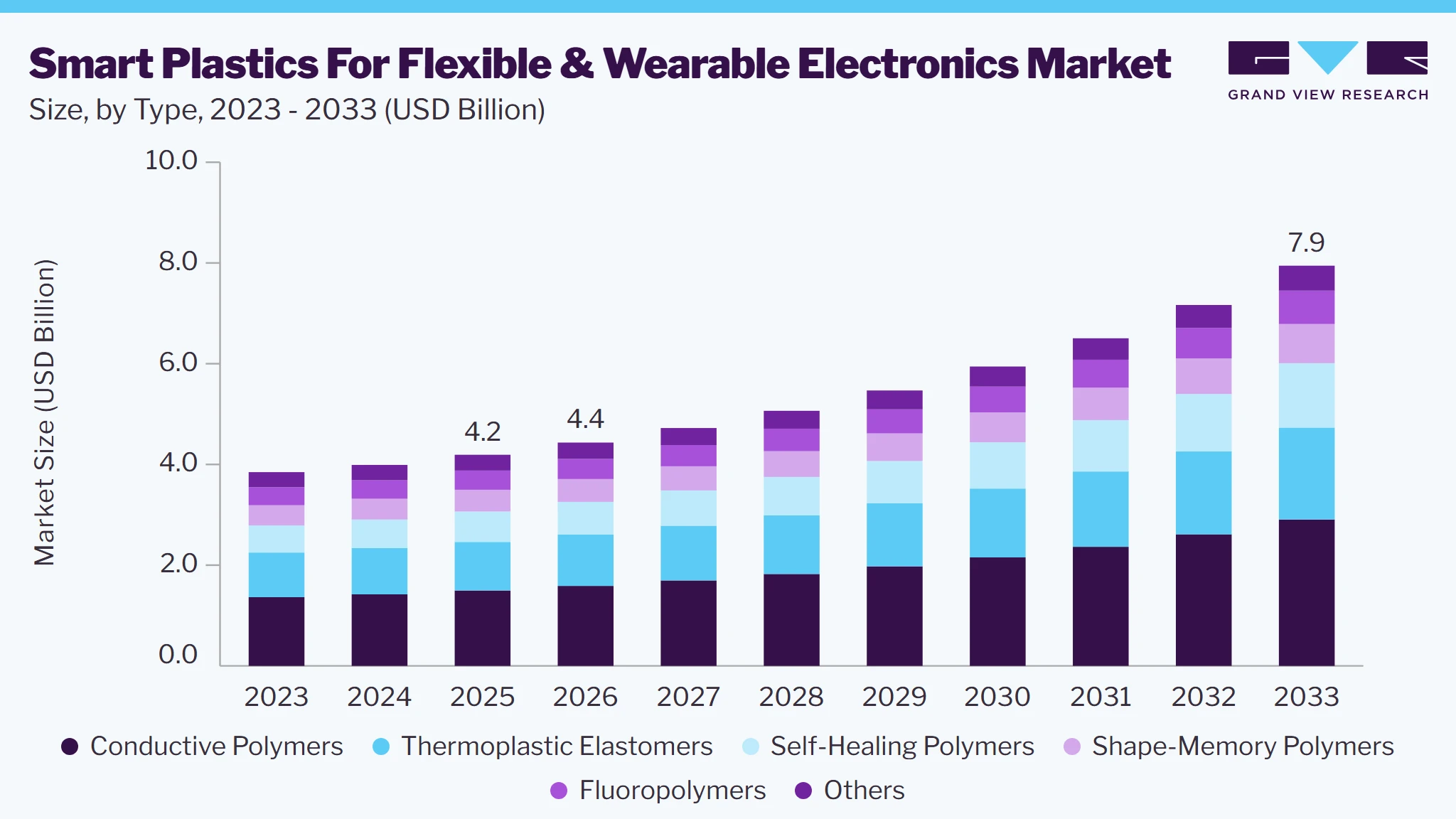 To learn more about this report, Download Free Sample Report
Continuous advancements in material science, particularly in the development of conductive polymers and nanocomposites, are driving the growth of smart plastics for flexible and wearable electronics industry. Conductive polymers such as polyaniline (PANI) and polypyrrole (PPy) exhibit excellent electrical conductivity while retaining mechanical flexibility, making them suitable for use in sensors, displays, and energy storage devices embedded within wearables. Furthermore, incorporating nanomaterials such as graphene and carbon nanotubes into polymer matrices enhances the conductivity, strength, and flexibility of smart plastics. For example, graphene-based nanocomposites have been integrated into wearable strain sensors, enabling real-time health monitoring and movement detection. These material innovations are expanding the possibilities for flexible and wearable electronics, driving further development in the market.
The rise of smart textiles and e-textiles, which integrate electronic functionality into fabrics, is further driving the demand for smart plastics. Conductive fibers, stretchable electronics, and polymer-based sensors embedded in textiles allow for the development of garments that can monitor body movements, control temperature, and track physiological responses. Smart plastics such as elastomers and conductive inks play a crucial role in enabling these functions while maintaining the flexibility and comfort required for wearable textiles. For example, thermoplastic elastomers (TPEs) are used to create flexible circuits within e-textiles, enabling seamless integration of electronics without compromising wearability. The increasing adoption of smart clothing in sports, healthcare, and defense industries is pushing manufacturers to innovate with advanced smart plastics, further fueling market growth.
Market Dynamics
The market is defined by steady adoption of conductive polymers, thermoplastic elastomers, and self-healing materials that enable thinner, lighter, and more durable wearable electronics. Healthcare and medical wearables remain the largest revenue base, while e-textiles and smart clothing are moving from pilot use toward wider commercial integration. Demand is concentrated in Asia Pacific, which held over 40.0% of the market in 2024, supported by electronics manufacturing strength in China, Japan, South Korea, and Taiwan. Commercially, the market remains partnership-led, with suppliers, OEMs, and electronics integrators co-developing application-specific formulations rather than selling standardized grades.
The strongest driver is the growing use of smart plastics in healthcare and medical wearables, where flexibility, biocompatibility, and durability are required for glucose monitors, biosensors, smart patches, and drug delivery systems. Grand View Research identified healthcare and medical wearables as the largest application segment, while e-textiles and smart clothing are also gaining traction through temperature regulation, posture correction, and heart-rate tracking. This is broadening demand for conductive polymers, self-healing polymers, and high-performance elastomeric substrates.
The commercial pull is reinforced by the electronics manufacturing base in Asia Pacific, where China, Japan, South Korea, and Taiwan are scaling flexible display and wearable device output. The region’s integrated supply chains shorten qualification cycles and support conversion from prototype to production. For material suppliers, this shifts demand from generic plastics to engineered formulations that can maintain conductivity, comfort, and mechanical stability under repeated bending.
A major restraint is the high qualification burden created by application-specific performance requirements across medical, consumer, and textile-led wearables. Suppliers must prove consistency in conductivity, flexibility, wash resistance, skin compatibility, and long-term durability before OEM adoption. In healthcare, the regulatory bar is higher because wearable medical devices face specialized approval pathways in the U.S., while Europe’s REACH and RoHS frameworks raise compliance and formulation costs. This slows commercialization for smaller vendors and makes scaling difficult where order volumes remain limited and development cycles are long.
Europe’s sustainability focus and the growing use of recycled-content thermoplastic elastomers create a clear opportunity for recyclable smart plastics in consumer wearables and smart clothing. Materials that combine functionality with lower environmental impact can help OEMs meet circularity, REACH, and RoHS expectations without compromising device performance. Suppliers that can pair smart material design with end-of-life support and healthcare-grade reliability are better positioned to win premium contracts.
Analyst Perspective
The market is moving from early-stage experimentation to value-led commercialization, where material performance, compliance readiness, and device integration matter more than basic polymer supply. Healthcare wearables will remain the primary demand anchor, but e-textiles, smart clothing, and industrial wearables will create the next layer of growth as customers seek lighter, washable, biocompatible, and more durable materials. Competitive leadership will depend on formulation depth, intellectual property, OEM co-development, regional manufacturing presence, and the ability to meet sustainability requirements without losing functional performance. Asia Pacific will continue to shape supply-side scale, while North America and Europe will remain important for premium medical and sustainability-driven demand. Profitability risks will remain tied to qualification cost, raw material volatility, and price pressure, particularly for smaller suppliers that lack regulatory depth or broad customer coverage.
Material Type Insights
Based on the material type, the conductive polymers segment led the market with the largest revenue share of 35.7% in 2025. These are organic materials that possess electrical conductivity, making them ideal for flexible and wearable electronics. These materials, such as polyaniline (PANI) and polypyrrole (PPy), offer lightweight, flexible, and highly processable alternatives to traditional conductive materials such as metals. They are widely used in flexible sensors, wearable displays, and electronic textiles due to their excellent mechanical flexibility and ease of integration into complex designs.
The self-healing polymers segment is projected to grow at the fastest CAGR of 8.8% during the forecast period. Self-healing polymers are innovative materials designed to autonomously repair damage, extending the lifespan and durability of wearable electronics. These polymers utilize mechanisms such as microencapsulation and reversible polymerization to restore their original properties after mechanical stress or environmental damage. Self-healing polymers are gaining traction in smart coatings, wearable sensors, and other flexible electronic devices.
Application Insights
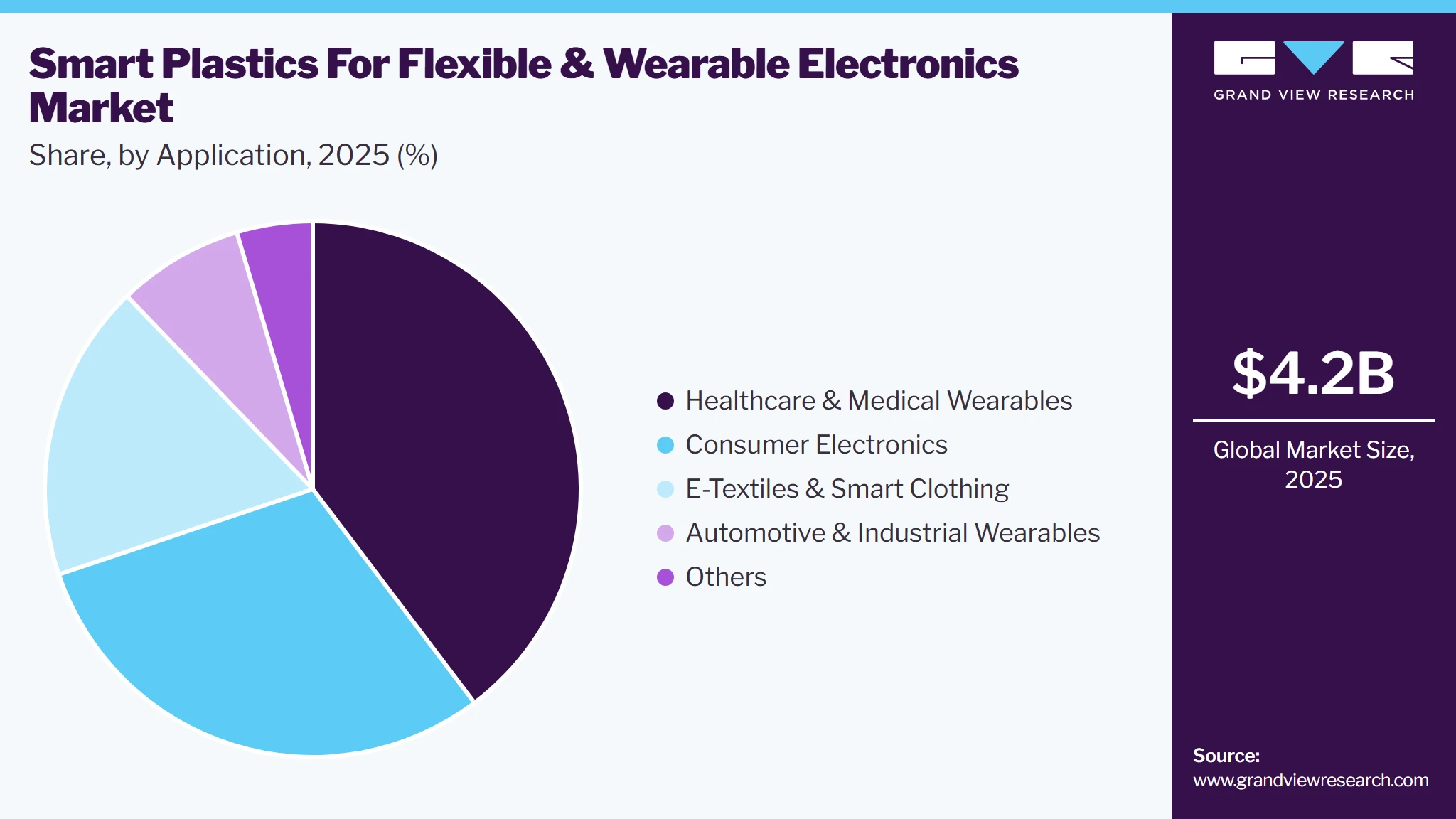
Based on the application, the healthcare & medical wearables segment led the market with the largest revenue share of 39.7% in 2025. Smart plastics in healthcare and medical wearables are used for applications such as glucose monitors, biosensors, smart patches, and drug delivery systems. These materials provide flexibility, biocompatibility, and durability, making them ideal for continuous health monitoring and patient care. The growing prevalence of chronic diseases such as diabetes and cardiovascular disorders is driving demand for continuous monitoring devices. Increased adoption of telemedicine and remote patient monitoring post-COVID-19 has accelerated the use of medical wearables.
 To learn more about this report, Download Free Sample Report
The e-textiles & smart clothing segment is projected to grow at the fastest CAGR of 8.3% during the forecast period. E-textiles and smart clothing incorporate conductive fibers, flexible polymers, and sensors to provide functionalities such as temperature regulation, heart rate monitoring, and posture correction. These applications are widely adopted in sportswear, military gear, and healthcare monitoring.
Regional Insights
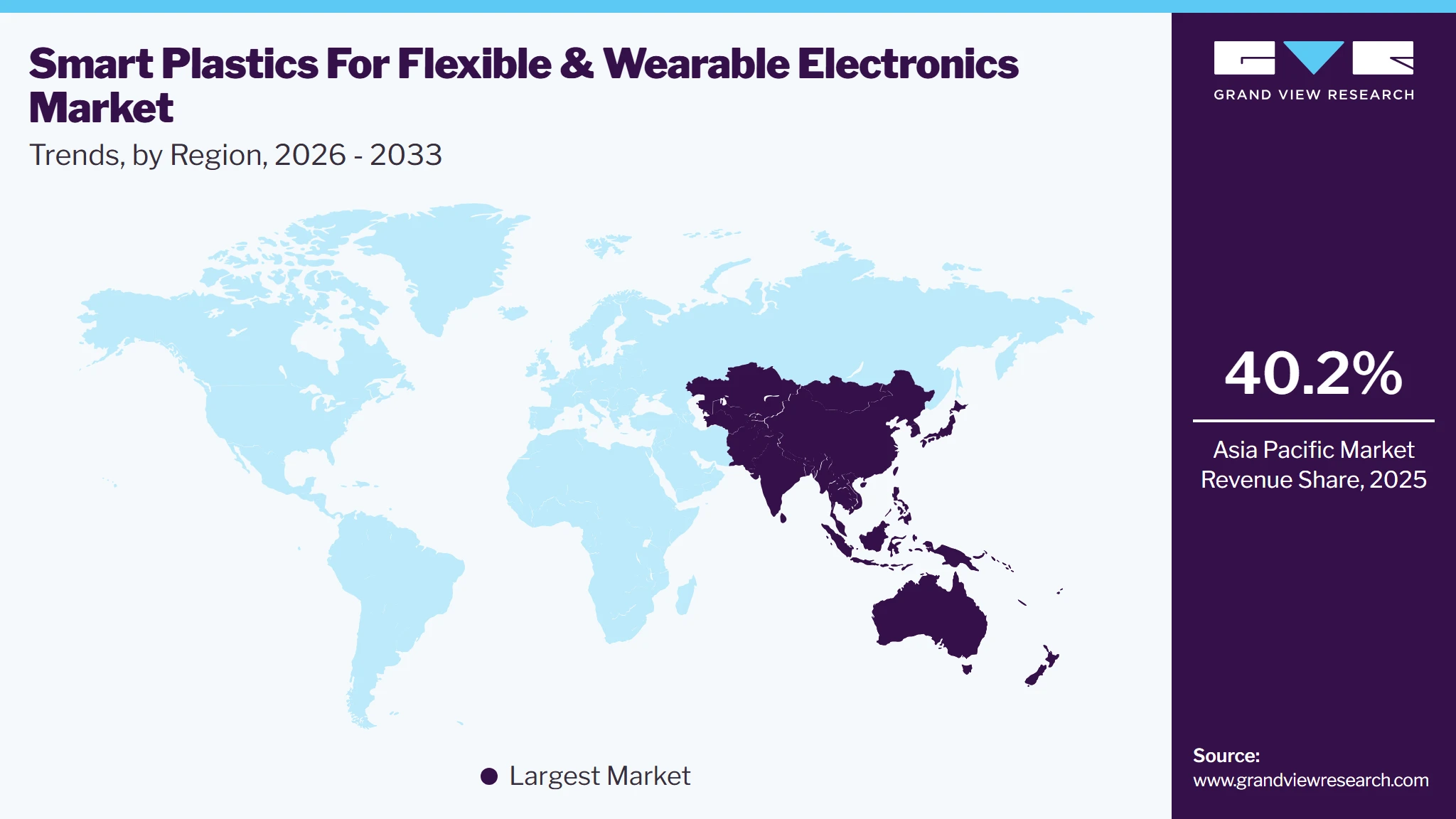
Asia Pacific dominated the smart plastics for flexible & wearable electronics market with the largest revenue share of 40.2% in 2025. This positive outlook is due to its robust electronics manufacturing infrastructure and technological innovation hubs. Countries such as South Korea, Japan, China, and Taiwan have established themselves as leaders in consumer electronics production, with companies such as Samsung, LG, and Xiaomi investing heavily in flexible display technologies and wearable devices. These manufacturers are increasingly incorporating smart plastics to create thinner, lighter, and more durable products that can conform to various shapes and withstand mechanical stress.
 To learn more about this report, Download Free Sample Report
China Smart Plastics For Flexible & Wearable Electronics Market Trends
The smart plastics for flexible & wearable electronics market in China held the largest share in the Asia Pacific region in 2025. China's smart plastics for flexible & wearable electronics market is experiencing robust growth primarily due to its comprehensive ecosystem of manufacturing capabilities, significant government support, strong domestic demand, and strategic investments in research and development. The country has established the world's largest electronics manufacturing base, with companies such as BOE Technology, Royole, and Xiaomi leading innovations in flexible displays and wearable technologies. These manufacturers leverage local supply chains for specialized polymers and conductive materials, creating an integrated ecosystem that accelerates product development cycles.
North America Smart Plastics for Flexible & Wearable Electronics Market Trends
The healthcare sector is a primary driver in North America, with smart plastics being incorporated into wearable health monitors, smart bandages, and medical implants. For example, companies such as MC10 have developed electronic systems that can be applied directly to skin like temporary tattoos to monitor vital signs. Additionally, the region's strong consumer electronics market has embraced flexible displays and wearable technology, creating demand for plastics that can withstand repeated bending and stretching while maintaining electronic functionality.
The U.S. smart plastics for flexible & wearable electronics industry growth is majorly driven by its robust ecosystem of technology innovation, research institutions, and venture capital investment. U.S. military and healthcare sectors have provided crucial early adoption pathways for these technologies. Moreover, the regulatory environment in the U.S. has also been conducive to market growth, with the FDA creating specialized approval pathways for wearable medical devices that incorporate smart plastics.
Europe Smart Plastics for Flexible & Wearable Electronics Market Trends
Europe’s growth in the global smart plastics for flexible & wearable electronics industry is due to its strong focus on sustainability and circular economy initiatives. European regulations such as REACH and RoHS have pushed manufacturers to develop eco-friendly smart plastics that reduce electronic waste while maintaining high performance. These regulatory frameworks have positioned European companies at the forefront of biodegradable and recyclable smart plastic innovations for electronics. Moreover, region's aging population and advanced healthcare systems have created strong demand for medical wearables using smart plastics.
The smart plastics for flexible & wearable electronics market in Germany is primarily driven by its robust industrial ecosystem and leadership in advanced manufacturing technologies. Germany's "Industrie 4.0" initiative has accelerated the integration of smart materials into electronic manufacturing processes, with companies such as BASF, Covestro, and Evonik AG pioneering specialized conductive and semi-conductive polymers that maintain flexibility while enabling electronic functionality.
Key Smart Plastics For Flexible & Wearable Electronics Company Insights
The competitive environment of smart plastics for flexible & wearable electronics market is characterized by the presence of established material manufacturers, technology innovators, and emerging startups focusing on advanced polymer solutions. Key players are investing in R&D to enhance material durability, flexibility, and conductivity to meet the evolving demands of the wearable electronics sector. Additionally, partnerships and collaborations between material developers and wearable device manufacturers are driving innovations, while startups are contributing niche solutions, such as self-healing polymers and biodegradable substrates. The market is highly competitive, with continuous technological advancements and increasing consumer demand for lightweight, durable, and comfortable smart wearables pushing companies to differentiate through innovation and product performance.
-
In October 2024, Avient Corporation introduced new sustainable material solutions, including recycled-content thermoplastic elastomers (TPEs) and metallic effect sulfone formulations. The TPEs, such as the reSound REC GP 7820 grades, contain up to 60% post-consumer recycled content and are suitable for applications like consumer electronics and personal care products.
-
In July 2024, Alfa Chemistry expanded its product line to include a range of advanced fluoropolymers, further solidifying its position as a major provider of high-performance materials. This expansion includes the addition of PTFE (Polytetrafluoroethylene), PCTFE (Polychlorotrifluoroethylene), and ETFE (Ethylene Tetrafluoroethylene), along with various fluoropolymer coatings.
Key Smart Plastics For Flexible & Wearable Electronics Companies
The following key companies have been profiled for this study on the smart plastics for flexible & wearable electronics market.
-
Syensqo
-
Dycotec Materials Ltd
-
LyondellBasell Industries Holdings B.V.
-
BASF
-
Eastman Chemical Company
-
Covestro AG
-
Ensinger
-
Dow
-
DuPont
-
Solvay
-
Huntsman International LLC
-
SABIC
Competitive Benchmarking
Category
Operating Strategies
Competitive Edge
Weakness
Established Players (Syensqo, LyondellBasell Industries Holdings B.V., BASF, Eastman Chemical Company, Covestro AG, Dow, DuPont, Solvay, Huntsman International LLC, SABIC)
- Expand into conductive, elastomeric, fluoropolymer, and specialty polymer grades for wearable electronics.
- Pursue OEM partnerships, co-development programs, and validation-linked supply agreements.
- Use global manufacturing and distribution networks to support multi-region qualification and supply continuity.
- Strong scale, brand recognition, and broad polymer portfolios.
- Higher R&D depth and stronger application support for regulated end uses.
- Ability to serve both high-volume and premium-grade demand.
- Longer product qualification cycles and slower response to niche requests.
- Higher cost base and stronger pricing pressure in commoditized subsegments.
- Less agility when customer requirements shift toward small-batch customization.
Emerging Players (Dycotec Materials Ltd, Ensinger)
- Focus on niche formulations, technical service, and direct customer engagement.
- Target pilot programs in medical wearables, smart textiles, and specialty flexible electronics.
- Compete through customization, fast iteration, and application-specific support.
- Greater agility in formulation changes and product adaptation.
- Stronger focus on specialized use cases and technical differentiation.
- Lower overhead structures that support niche commercialization.
- Limited scale and narrower geographic reach.
- Lower brand recognition in medical and regulated applications.
- Higher dependence on a small number of customer programs and development cycles.
Smart Plastics for Flexible & Wearable Electronics Market Report Scope
Report Attribute
Details
Market size in 2025
USD 4.2 billion
Estimated market size in 2026
USD 4.4 billion
Projected market size by 2033
USD 7.9 billion
Growth rate
CAGR of 8.7% from 2026 to 2033
Base year for estimation
2025
Historical data
2021 - 2024
Forecast period
2026 - 2033
Quantitative units
Revenue in USD million/billion, volume in kilotons, and CAGR from 2026 to 2033
Report coverage
Revenue forecast, company ranking, competitive landscape, growth factors, and trends
Segments covered
Material type, application, region
Regional scope
North America; Europe; Asia Pacific; Central & South America; Middle East & Africa
Country scope
U.S., Canada; Mexico; Germany; UK; France; Italy; Spain, China; India; Japan; South Korea, Australia Brazil; Argentina, Saudi Arabia, UAE, South Africa
Key companies profiled
Syensqo; Dycotec Materials Ltd; LyondellBasell Industries Holdings B.V.; BASF; Eastman Chemical Company; Covestro AG; Ensinger; Dow; DuPont; Solvay; Huntsman International LLC; SABIC
Customization scope
Free report customization (equivalent up to 8 analysts' working days) with purchase. Addition or alteration to country, regional & segment scope.
Pricing and purchase options
Avail customized purchase options to meet your exact research needs. Explore purchase options
Global Smart Plastics For Flexible & Wearable Electronics Market Report Segmentation
This report forecasts volume & revenue growth at a global level and provides an analysis of the latest industry trends in each of the sub-segments from 2018 to 2030. For this study, Grand View Research has segmented global smart plastics for flexible & wearable electronics market report based on material type, application, and region:
 To learn more about this report, Download Free Sample Report
-
Material Type Outlook (Volume, Kilotons; Revenue, USD Million, 2021 - 2033)
-
Conductive Polymers
-
Thermoplastic Elastomers
-
Self-Healing Polymers
-
Shape-Memory Polymers
-
Fluoropolymers
-
Others
-
-
Application Outlook (Volume, Kilotons; Revenue, USD Million, 2021 - 2033)
-
Healthcare & Medical Wearables
-
Consumer Electronics
-
E-Textiles & Smart Clothing
-
Automotive & Industrial Wearables
-
Others
-
-
Region Outlook (Volume, Kilotons; Revenue, USD Million, 2021 - 2033)
-
North America
-
U.S.
-
Canada
-
Mexico
-
-
Europe
-
Germany
-
France
-
UK
-
Italy
-
Spain
-
-
Asia Pacific
-
China
-
India
-
Japan
-
South Korea
-
Australia
-
-
Central & South America
-
Brazil
-
Argentina
-
-
Middle East & Africa
-
South Africa
-
Saudi Arabia
-
UAE
-
-
Research Methodology
The smart plastics for flexible & wearable electronics market figures in this report are based on a proven research process that combines executive interviews with secondary research from proprietary databases, company filings, and recognized regulatory and institutional sources. Market size is built through value-chain sizing - reconciling supply-side and demand-side estimates - and triangulated with bottom-up and top-down approaches. Every estimate passes multiple levels of expert validation before publication, with each smart plastics for flexible & wearable electronics segment quantified using the revenue-capture definitions in the table below.
Segment Definition
Segment - Type
Revenue capture definition
Conductive Polymers
Revenue is captured through sales of intrinsically conductive resins, dispersions, inks, and masterbatches used in sensors, circuits, electrodes, and flexible wearable assemblies.
Thermoplastic Elastomers
Revenue is captured through sale of flexible TPE grades, compounds, and modified blends used in straps, housings, soft-touch interfaces, wearable bands, and skin-contact components.
Self-Healing Polymers
Revenue is captured through specialty formulations sold into wearables that need damage recovery, longer service life, and reduced replacement cycles under repeated flexing or abrasion.
Shape-Memory Polymers
Revenue is captured through advanced polymer systems used in adaptive fit, deployment structures, actuators, and temperature-responsive wearable functions.
Fluoropolymers
Revenue is captured through high-performance fluoropolymer grades used in insulation, chemical resistance layers, connectors, protective films, and precision wearable electronics.
Others
Revenue is captured through niche smart plastics, nanocomposites, specialty blends, and hybrid materials that do not fall into the core families but are sold into wearable applications.
Segment - Application
Revenue capture definition
Healthcare & Medical Wearables
Revenue is captured through material demand from glucose monitors, biosensors, smart patches, remote patient monitoring devices, and other medical wearables requiring biocompatibility and durability.
Consumer Electronics
Revenue is captured through smart plastic use in smartwatches, fitness bands, wireless devices, flexible displays, and portable consumer electronics with wearable functionality.
E-Textiles & Smart Clothing
Revenue is captured through conductive fibers, flexible substrates, printed sensors, and textile-integrated polymer systems used in garments and performance wear.
Automotive & Industrial Wearables
Revenue is captured through materials used in safety wearables, industrial monitoring devices, connected work gear, and automotive-adjacent human-machine interface wearables.
Others
Revenue is captured through residual demand from defense, sports, rehabilitation, lifestyle, and experimental wearable formats that do not fit the core end-use buckets.
Estimation Model
Layer Name
Key Question
Description
Material Layer
Why was material selected?
This layer captures revenue at the formulation stage, where conductive polymers, TPEs, self-healing polymers, shape-memory polymers, and fluoropolymers are monetized.
Application Layer
Why was application selected?
This layer converts material demand into use-case demand, reflecting specification differences across healthcare, consumer electronics, e-textiles, and industrial wearables.
Regional Layer
Why was region selected?
This layer captures manufacturing concentration, premium adoption patterns, and compliance intensity, with Asia Pacific leading volume and North America and Europe shaping value.
Company Layer
Why was company selected?
This layer validates competitive control through portfolios, partnerships, and launch activity, separating global integrated suppliers from niche formulators and specialist compounders.
Delivered Customizations
This report has been delivered with the following In-depth customizations
Client Request
Customization Delivered
Value Adds
Add country-level coverage
Added country-level commentary for major manufacturing and demand centers within each region, with sharper visibility on local wearable electronics ecosystems.
Improves regional decision-making and helps identify priority country markets.
Expand application split
Refined application coverage across healthcare, consumer electronics, e-textiles, automotive and industrial wearables, and other niche use cases.
Improves revenue capture logic and separates premium demand pockets from secondary uses.
Add competitor benchmarking
Included a maturity-based participant view across integrated majors and niche specialists, with strategy, strength, and weakness assessment.
Supports supplier comparison, positioning analysis, and partnership screening.
Frequently Asked Questions About This Report
Healthcare & medical wearables segment held the largest market share of 39.7% in 2025.Smart plastics in healthcare and medical wearables are used for applications such as glucose monitors, biosensors, smart patches, and drug delivery systems.
Asia Pacific dominated the smart plastics for flexible & wearable electronics market with the largest revenue share of 40.2% in 2025.
The market is defined by steady adoption of conductive polymers, thermoplastic elastomers, and self-healing materials that enable thinner, lighter, and more durable wearable electronics. Healthcare and medical wearables remain the largest revenue base, while e-textiles and smart clothing are moving from pilot use toward wider commercial integration.
The key players in the smart plastics for flexible & wearable electronics market include Syensqo, Dycotec Materials Ltd, LyondellBasell Industries Holdings B.V., BASF, Eastman Chemical Company, Covestro AG, Ensinger, Dow, DuPont, Solvay, Huntsman International LLC, and SABIC.
The global smart plastics for flexible & wearable electronics market size was valued at USD 4.2 billion in 2025 and is estimated at USD 4.4 billion for 2026.
The global smart plastics for flexible & wearable electronics market is expected to grow at a CAGR of 8.7% from 2026 to 2033, reaching USD 7.9 billion by 2033.
Which material type segment dominated the smart plastics for flexible & wearable electronics market?Conductive polymers segment dominated the market, with a revenue share of 35.6% in 2025.
The smart plastics for flexible & wearable electronics market is driven by increasing demand for lightweight, durable, and flexible materials in next-generation wearables and rising adoption of IoT-enabled devices. Advancements in conductive polymers, shape-memory plastics, and biocompatible materials are also fueling market growth.
About the Author(s)
Plastics, Polymers & Resins Research Team
Bulk Chemicals · Plastics, Polymers & ResinsThis report was authored by the plastics, polymers & resins research team at Grand View Research - comprising two research analysts, one senior research analyst, and one industry expert - with specialized expertise in the plastics, polymers & resins segment of the bulk chemicals industry. All findings are based on proprietary bulk chemicals databases, executive interviews, and regulatory analysis, subject to internal peer review prior to publication.
Last Updated:
Speak to Analyst

Customize this report to your needs - add regions, segments, or data points, with 20% free customization.
Or view our licence options:


ISO 9001:2015 & 27001:2022 Certified
We are GDPR and CCPA compliant! Your transaction & personal information is safe and secure. For more details, please read our privacy policy.


