
- Home
- »
- Next Generation Technologies
- »
-
Smart Shopping Cart Market Size, Industry Report, 2033GVR Report cover
![Smart Shopping Cart Market Size, Share & Trends Report]()
Smart Shopping Cart Market (2026 - 2033) Size, Share & Trends Analysis Report By Component (Hardware, Software), By Deployment (Cloud, On-premise), By Product Type (Fully Automated Smart Carts, Semi-Automated Smart Carts), By End Use, By Region, And Segment Forecasts
- Report ID: GVR-4-68040-905-1
- Number of Report Pages: 120
- Format: PDF
- Historical Range: 2021 - 2025
- Forecast Period: 2026 - 2033
- Industry: Technology
- Report Summary
- Table of Contents
- Segmentation
- Methodology
- Download FREE Sample
-
 Download Sample Report
Smart Shopping Cart Market Summary
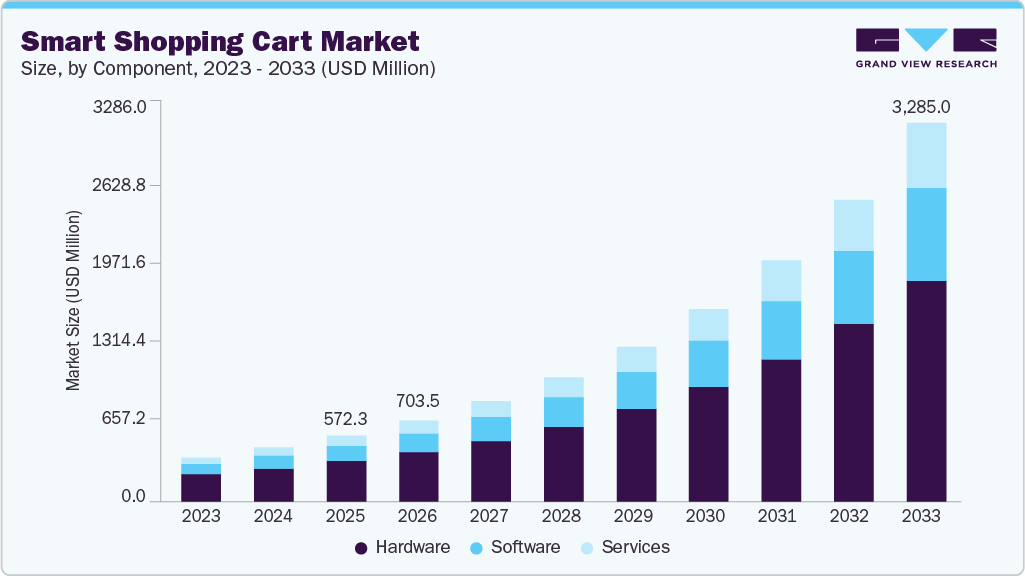
The global smart shopping cart market size was valued at USD 572.3 million in 2025 and is projected to reach USD 3,285.0 million by 2033, growing at a CAGR of 24.6% from 2026 to 2033. The expansion of cashier-less and autonomous store concepts is driving market growth.
Key Market Trends & Insights
- North America held 43.8% revenue share of the smart shopping cart market.
- The U.S. smart shopping cart market is driven by rising adoption of automation in retail operations.
- By component, the hardware segment held the largest revenue share of 61.3% in 2025.
- By product component, the fully automated smart carts segment held the largest revenue share in 2025.
- By deployment, the cloud segment held the largest revenue share in 2025.
Market Size & Forecast
- 2025 Market Size: USD 572.3 Million
- 2033 Projected Market Size: USD 3,285.0 Million
- CAGR (2026 - 2033): 24.6%
- North America: Largest Market in 2025
- Asia Pacific: Fastest Growing Market
The increasing need for enhanced customer convenience and seamless retail experiences is driving market growth. Modern consumers are increasingly seeking faster, frictionless shopping journeys, with long checkout queues and manual billing processes minimized or eliminated. Smart shopping carts equipped with barcode scanners, sensors, and automated billing systems directly address this need by enabling customers to scan items as they shop and complete transactions without waiting at traditional checkout counters. This convenience significantly improves customer satisfaction and encourages repeat visits, especially in busy urban retail environments. Retailers are recognizing that improving the in-store experience is becoming as important as pricing and product availability, accelerating the adoption of such technologies.The rapid growth of organized retail and large-format stores, particularly in emerging economies, is significantly contributing to the adoption of smart shopping carts. Supermarkets, hypermarkets, and retail chains are expanding aggressively to meet the demands of urbanization and rising disposable incomes, creating a need for efficient in-store technologies. Larger store formats often face challenges with crowd management, long checkout lines, and complex inventory management, which smart shopping carts can effectively address. These solutions enhance the scalability of operations by streamlining the shopping process even during peak hours. In addition, organized retailers are more willing to invest in advanced technologies to differentiate their brands and attract tech-savvy consumers. The expansion of retail infrastructure, especially in high-growth regions, is therefore creating a favorable environment for the deployment of smart cart systems. This structural shift in the retail landscape is directly supporting market expansion.
The growing demand for personalized shopping experiences is driving the growth of the smart shopping cart market. Modern consumers expect retailers to understand their preferences and deliver tailored recommendations during their shopping journey. Smart carts equipped with digital interfaces and connected systems can suggest products based on past purchases, real-time behavior, and promotional campaigns. This level of personalization enhances customer engagement and encourages impulse buying, thereby increasing average basket size. Retailers benefit from the ability to create a more interactive, customized in-store environment that mirrors the personalization found on e-commerce platforms. As physical stores strive to remain competitive against online channels, the integration of personalized features through smart carts is becoming a strategic priority. This shift toward experience-driven retail is driving the adoption of advanced cart technologies.
The growing adoption of digital payment systems is accelerating the adoption of smart shopping carts. With the widespread use of mobile wallets, contactless cards, and QR-based payment solutions, consumers are increasingly comfortable with cashless transactions. Smart carts seamlessly integrate these payment methods, allowing customers to complete purchases directly from the cart without visiting a checkout counter. This capability reduces friction in the shopping process and shortens the overall time spent in-store. Retailers are also benefiting from faster transaction processing and reduced dependency on traditional point-of-sale infrastructure. The alignment between smart cart functionality and the broader digital payment ecosystem is creating a strong foundation for market growth. As cashless economies continue to expand, the relevance and demand for such integrated solutions are expected to increase further.
The rising competition between brick-and-mortar retailers and e-commerce platforms is driving innovation in physical stores. Online shopping offers convenience, speed, and personalized experiences, which traditional retail has historically struggled to match. Smart shopping carts help bridge this gap by introducing digital capabilities into the in-store environment, such as instant billing, product recommendations, and navigation assistance. These features enable physical stores to offer a hybrid experience that combines the advantages of online and offline shopping. Retailers are increasingly adopting such technologies to retain customers and prevent migration to purely digital channels. The pressure to stay relevant in an evolving retail landscape is pushing businesses to invest in smart infrastructure. This competitive dynamic is accelerating the deployment of smart shopping carts across various retail formats.
Component Insights
The hardware segment accounted for the largest market share of 61.3% in 2025 in the smart shopping cart market. The increasing demand for durable and long-lasting retail equipment is significantly influencing the growth of the hardware segment. Shopping carts are subjected to frequent use, physical stress, and varying environmental conditions within stores, making durability a critical factor. Manufacturers are focusing on developing robust hardware components that can withstand daily wear and tear without frequent maintenance or replacement. High-quality materials, reinforced structures, and protected electronic modules are being incorporated to extend the lifespan of smart carts. Retailers prefer investing in solutions that offer long-term reliability, as this reduces maintenance costs and operational disruptions. The emphasis on durability also ensures consistent performance of embedded technologies such as sensors and displays. This focus on building resilient hardware systems is driving innovation and adoption within the segment.
The services segment is anticipated to grow at the fastest CAGR during the forecast period. The expansion of managed services and subscription-based models is playing a crucial role in the development of the services segment. Many retailers prefer outsourcing the management of smart cart systems to specialized service providers rather than handling it in-house. Managed services include system monitoring, updates, security management, and performance optimization, all delivered on a subscription basis. This approach reduces the burden on internal IT teams and provides predictable operational costs. Retailers benefit from continuous improvements and access to the latest features without significant upfront investment. The shift toward service-based business models aligns with broader digital transformation trends across industries. This transition is significantly boosting the demand for managed and subscription-based services in the smart shopping cart market.
Product Type Insights
The fully automated smart carts segment dominated the smart shopping cart market in 2025. The expansion of large-format retail stores and high-traffic shopping environments is significantly influencing the adoption of fully automated smart carts. In busy supermarkets and hypermarkets, managing long queues and high customer volumes is a persistent challenge. Fully automated carts help address this issue by decentralizing the checkout process and distributing it across the shopping journey. This reduces congestion at billing counters and improves overall store flow. Retailers can handle higher footfall without investing heavily in additional checkout infrastructure. The scalability of fully automated systems makes them suitable for large retail operations. As store sizes and customer volumes continue to grow, the demand for such efficient solutions is increasing.
The smart cart add-on devices segment is expected to register the fastest CAGR from 2026 to 2033. The increasing demand for flexible, modular retail solutions is driving the growth of the smart cart add-on devices segment. Retailers operate in diverse environments and require solutions that can be easily adapted to different store formats and operational needs. Add-on devices offer modularity, allowing retailers to select specific features such as barcode scanning, RFID reading, or digital interfaces based on their requirements. This flexibility enables businesses to customize their smart cart capabilities without committing to a one-size-fits-all solution. It also allows for incremental upgrades as technology evolves or business needs change. Retailers can experiment with different configurations and gradually scale up deployments. This adaptability is making add-on devices an attractive option for retailers seeking scalable and future-ready solutions.
Deployment Insights
The cloud segment dominated the smart shopping cart market in 2025. The growing focus on remote monitoring and management capabilities is driving the adoption of cloud-based smart cart solutions. Retailers need the ability to oversee operations across multiple locations without being physically present at each store. Cloud platforms enable centralized monitoring of smart carts, allowing retailers to track performance, detect issues, and implement updates remotely. This reduces the need for on-site technical interventions and lowers operational costs. Remote management also ensures faster response times to technical problems, minimizing downtime. Retailers can maintain consistent service quality across all locations through centralized control. This capability is particularly valuable for large retail networks, driving the demand for cloud-based deployments.
The on-premise segment is expected to register a significant CAGR from 2026 to 2033. The growing concerns about data privacy regulations and compliance requirements are driving the expansion of the on-premises segment. Different regions have varying laws regarding data storage, processing, and cross-border data transfer. On-premise systems enable retailers to ensure that all data remains within designated geographic boundaries, helping them comply with local regulations. This is particularly important for businesses operating in regions with strict data protection frameworks. Retailers can implement compliance measures more effectively when they have direct control over their infrastructure. This reduces the risk of regulatory penalties and enhances customer trust. The need to align with evolving data privacy standards is a significant driver for on-premise deployments.
End Use Insights
The supermarkets & hypermarkets segment accounted for the largest market share of the smart shopping cart industry in 2025. The wide product assortment and complex store layouts in supermarkets and hypermarkets are significantly contributing to the demand for smart shopping carts. These stores often carry thousands of products across multiple categories, making it challenging for customers to locate items and make purchasing decisions. Smart carts equipped with navigation assistance, product search, and real-time recommendations simplify the shopping experience. Customers can find products more easily, reducing frustration and time spent searching within large store spaces. Retailers benefit from improved customer engagement and a higher likelihood of purchase completion. The ability to guide customers efficiently through extensive store layouts enhances both convenience and sales performance. The complexity of large-format retail environments is therefore a strong driver for smart cart adoption.
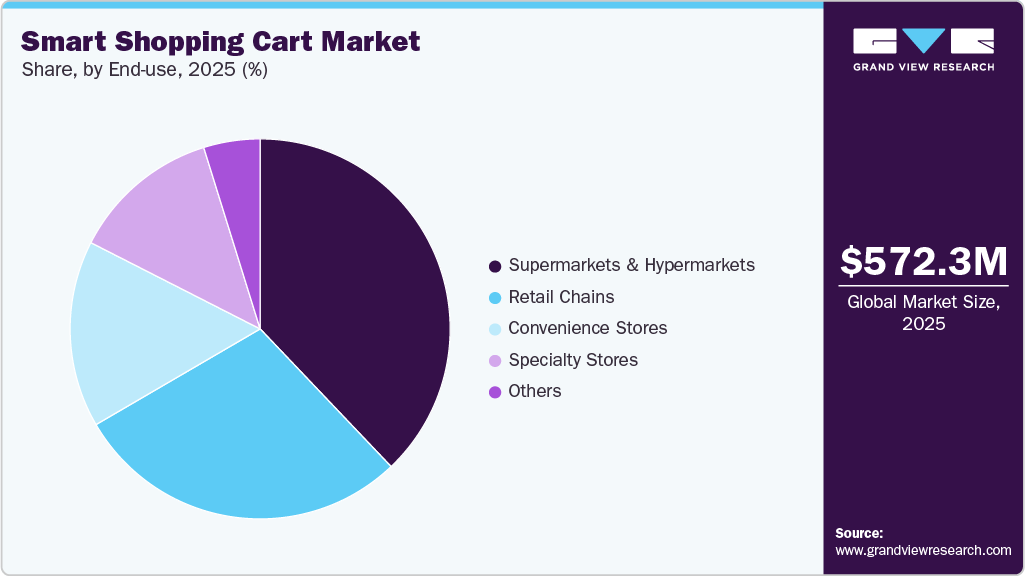
The retail chains segment is anticipated to register the fastest CAGR during the forecast period. The need for efficient multi-store inventory management is driving this segment's growth. Retail chains must coordinate inventory across various locations to ensure optimal stock availability and reduce inefficiencies. Smart shopping carts enable real-time inventory updates as customers select items, improving visibility across the network. This enables better demand forecasting and more accurate replenishment strategies, reducing both stockouts and excess inventory. Retail chains can also use this data to balance stock distribution between stores based on regional demand patterns. Improved inventory control leads to cost savings and enhanced customer satisfaction. The complexity of managing inventory at scale is therefore pushing chains toward adopting smart cart solutions.
Regional Insights
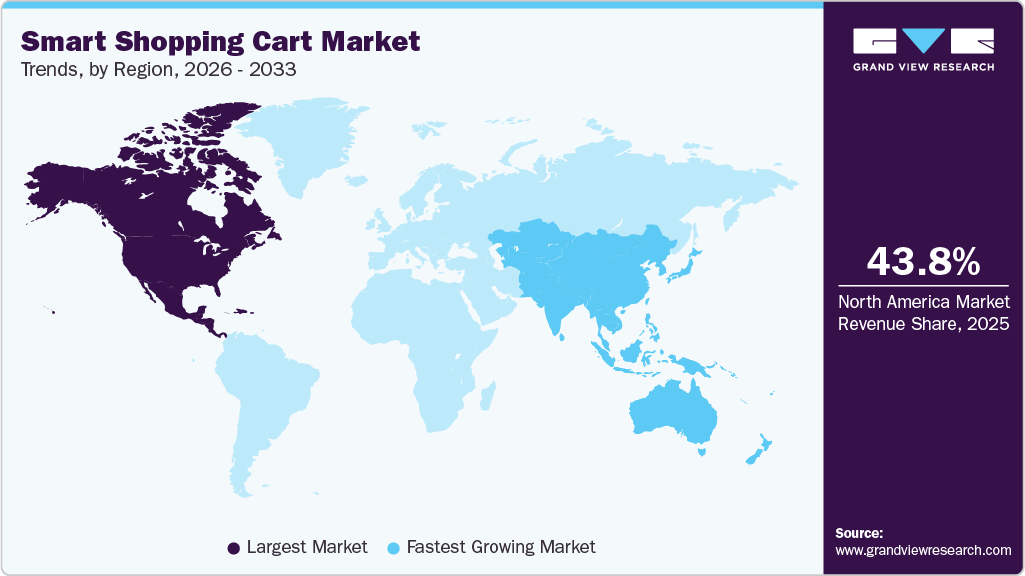
North America dominated the smart shopping cart industry, accounting for 43.8% of revenue in 2025. The strong presence of large retail chains and hypermarket operators is driving the adoption of smart shopping carts in North America. These retailers operate extensive store networks and have the financial capacity to invest in advanced technologies. Their focus on improving operational efficiency and enhancing customer experience makes them early adopters of innovative solutions. Smart carts help these organizations manage high customer volumes, streamline checkout processes, and gather valuable data across multiple locations. The scale of operations amplifies the benefits of automation, making the return on investment more optimal.
U.S. Smart Shopping Cart Market Trends
The U.S. smart shopping cart market is projected to grow significantly during the forecast period. The increasing demand for frictionless, time-efficient shopping experiences is significantly driving the expansion of the smart shopping cart market in the U.S. Consumers often prioritize speed and convenience due to busy lifestyles and high expectations for retail services. Long checkout queues are widely viewed as a negative aspect of in-store shopping, pushing retailers to adopt solutions that eliminate delays. Smart shopping carts allow customers to scan items, monitor spending, and complete transactions directly, reducing or removing the need for traditional checkout counters. This streamlined process enhances overall customer satisfaction and encourages repeat visits. Retailers that offer faster and smoother shopping experiences are better positioned to retain customers in a highly competitive environment. The strong consumer preference for convenience-driven solutions is therefore a key driver in the U.S. market.
Asia Pacific Smart Shopping Cart Market Trends
The smart shopping cart market in Asia Pacific is expected to grow at the fastest CAGR from 2026 to 2033. The increasing adoption of digital payment systems and mobile-based transactions is significantly contributing to the expansion of the smart shopping cart market in the Asia Pacific. Consumers across the region are rapidly embracing cashless payment methods, including mobile wallets, QR code payments, and contactless cards. Smart shopping carts integrate seamlessly with these payment systems, enabling customers to complete transactions without traditional checkout. This alignment with digital payment ecosystems enhances convenience and speeds up the shopping experience. Retailers benefit from faster transaction processing and reduced reliance on cash handling infrastructure. The widespread acceptance of digital payments lowers barriers to adopting smart cart solutions. This strong digital payment culture is therefore a key driver in the region.
The smart shopping cart industry in China is projected to grow significantly during the forecast period. The push toward automation and smart retail technologies is contributing to the expansion of the smart shopping cart market in China. Retailers are actively investing in advanced technologies such as artificial intelligence, computer vision, and IoT to modernize their operations. Fully automated and semi-automated smart carts are part of this broader transformation toward intelligent retail environments. These systems improve billing accuracy, enhance inventory management, and provide valuable data insights. The integration of automation helps retailers reduce operational inefficiencies and improve overall productivity. Continuous innovation in retail technology is a defining characteristic of the Chinese market. This technological momentum is driving the adoption of smart shopping carts.
Europe Smart Shopping Cart Market Trends
The smart shopping cart industry in Europe is anticipated to grow steadily from 2026 to 2033. The presence of diverse retail formats and cross-border operations in Europe is supporting the expansion of the smart shopping cart market. Retailers often operate in multiple countries, each with its own consumer preferences, regulatory requirements, and market dynamics. Smart shopping carts provide a flexible platform that can be adapted to different store environments and customer needs. Retailers can customize features such as language, payment options, and promotional content based on regional requirements. This adaptability allows businesses to maintain consistency while catering to local markets. The ability to operate efficiently across diverse regions is a significant advantage. The complexity of multi-market retail operations is therefore a strong driver for adoption.
The smart shopping cart industry in the UK is expected to grow significantly during the forecast period. The growing demand for faster, more convenient shopping experiences is driving the expansion of the smart shopping cart market in the UK Shoppers are increasingly seeking to minimize time spent in stores, particularly during peak hours and after work. Long checkout queues are a common pain point, prompting retailers to adopt solutions that streamline the payment process. Smart shopping carts allow customers to scan items, monitor their spending, and complete transactions without waiting in line. This reduces friction in the shopping journey and enhances overall satisfaction. Retailers benefit from improved customer retention and higher store efficiency. The strong consumer preference for time-saving solutions is therefore a key driver in the UK market.
Key Smart Shopping Cart Company Insights
Some prominent players in the smart shopping cart market include Amazon.com, Inc., and Instacart, among others.
-
Amazon.com, Inc. is a global technology and e-commerce company. Amazon has contributed through its broader Just Walk Out and automated retail ecosystem, which integrates computer vision, sensor fusion, and artificial intelligence to enable cashier-less shopping experiences. Rather than relying solely on traditional cart-based systems, Amazon’s approach embeds smart shopping capabilities into the store infrastructure, allowing customers to pick items and leave without manual checkout. However, the company has also explored smart cart concepts, such as sensor-enabled carts that automatically detect items placed inside, track purchases in real time, and provide a running total to the shopper. These carts are designed to reduce checkout friction, improve convenience, and enhance the overall in-store experience.
-
Instacart is a U.S.-based grocery technology company that provides online grocery delivery, pickup services, and retail enablement solutions for supermarkets and consumer brands. Instacart has expanded its capabilities through technology solutions designed to modernize in-store shopping. The company has introduced smart cart systems that incorporate sensors, cameras, and real-time processing technologies to automatically identify items as they are placed in the cart. These carts provide a running total, support digital payments, and enable customers to bypass traditional checkout lines, improving convenience and reducing wait times. Instacart’s smart carts are part of its broader Connected Stores platform, which integrates in-store hardware with cloud-based software and retail analytics.
Key Smart Shopping Cart Companies:
The following key companies have been profiled for this study on the smart shopping cart market.
- Amazon.com, Inc.
- Cust2Mate USA Inc.
- HiCart Technology
- Instacart
- IoT Retail Tech
- Shekel Ltd.
- shopreme
- SmartCart
- Superhii Corporation
- ZEROQS
Recent Developments
-
In February 2026, Scallix Inc. partnered with Cust2Mate, under which Scallix will act as the official representative for Cust2Mate in Canada, bringing a proven smart cart solution to retailers across the country. This collaboration combines Cust2Mate’s advanced smart cart technology with Scallix’s strong expertise in the Canadian retail market, enabling a more effective rollout of intelligent in-store solutions across grocery stores, large-format retailers, and specialty outlets. The partnership is expected to drive faster adoption of smart retail innovations by aligning technological capabilities with local market insights.
-
In September 2025, Instacart and Morrisons announced plans to launch Caper Carts, Instacart’s AI-enabled smart shopping trolleys, in the UK in 2026, beginning with a single Morrisons store and with the possibility of expanding to additional locations over time. This collaboration marks Instacart’s first retail partnership in the UK, bringing its advanced smart cart technology to British shoppers. For Morrisons shoppers, these smart trolleys are seamlessly connected to the Morrisons More Card loyalty program, enabling customers to access personalized savings and enjoy a more efficient, convenient shopping journey.
-
In July 2025, Instacart launched its AI-enabled Caper Carts at Wegmans stores in New York, U.S. These carts are designed to provide customers with a more convenient and efficient way to shop by allowing them to monitor their spending in real time and complete checkout seamlessly. The system automatically identifies items as they are placed in the cart, enabling shoppers to bag products as they shop without a traditional checkout process. This functionality is powered by a combination of cameras, a built-in digital scale, and location sensors, all integrated with NVIDIA Jetson hardware to ensure accurate item recognition.
Smart Shopping Cart Market Report Scope
Report Attribute
Details
Market size value in 2026
USD 703.5 million
Revenue forecast in 2033
USD 3,285.0 million
Growth rate
CAGR of 24.6% from 2026 to 2033
Actual data
2021 - 2025
Forecast period
2026 - 2033
Quantitative units
Revenue in USD million/billion and CAGR from 2026 to 2033
Report coverage
Revenue forecast, company share, competitive landscape, growth factors, and trends
Segments covered
Component, deployment, product type, end use, region
Regional scope
North America; Europe; Asia Pacific; Latin America; MEA
Country scope
U.S.; Canada; Mexico; UK; Germany; France; China; India; Japan; Australia; South Korea; Brazil; UAE; Saudi Arabia; South Africa
Key companies profiled
Amazon.com, Inc.; Cust2Mate USA Inc.; HiCart Technology; Instacart; IoT Retail Tech; shopreme; Shekel Ltd.; SmartCart; Superhii Corporation; ZEROQS
Customization scope
Free report customization (equivalent to 8 analysts working days) with purchase. Addition or alteration to country, regional & segment scope.
Pricing and purchase options
Avail customized purchase options to meet your exact research needs. Explore purchase options
Global Smart Shopping Cart Market Report Segmentation
This report forecasts revenue growth at global, regional, and country levels and provides an analysis of the latest industry trends in each of the sub-segments from 2021 to 2033. For this study, Grand View Research has segmented the global smart shopping cart market report based on component, deployment, product type, end use, and region.
-
Component Outlook (Revenue, USD Million, 2021 - 2033)
-
Hardware
-
Software
-
Services
-
-
Deployment Outlook (Revenue, USD Million, 2021 - 2033)
-
Cloud
-
On-premise
-
-
Product Type Outlook (Revenue, USD Million, 2021 - 2033)
-
Fully Automated Smart Carts
-
Semi-Automated Smart Carts
-
Smart Cart Add-On Devices
-
-
End Use Outlook (Revenue, USD Million, 2021 - 2033)
-
Supermarkets & Hypermarkets
-
Convenience Stores
-
Retail Chains
-
Specialty Stores
-
Others
-
-
Regional Outlook (Revenue, USD Million, 2021 - 2033)
-
North America
-
U.S.
-
Canada
-
Mexico
-
-
Europe
-
Germany
-
UK
-
France
-
-
Asia Pacific
-
China
-
India
-
Japan
-
South Korea
-
Australia
-
-
Latin America
-
Brazil
-
-
Middle East & Africa
-
UAE
-
Saudi Arabia
-
South Africa
-
-
Frequently Asked Questions About This Report
b. The hardware segment accounted for the largest market share of 61.3% in 2025 in the smart shopping cart market. The increasing demand for durable and long-lasting retail equipment is significantly influencing the growth of the hardware segment.
b. Some key players operating in the market include Amazon.com, Inc., Cust2Mate USA Inc., HiCart Technology, Instacart, IoT Retail Tech, shopreme, Shekel Ltd., SmartCart, Superhii Corporation, ZEROQS.
b. The global smart shopping cart market size was estimated at USD 572.3 million in 2025 and is expected to reach USD 703.5 million in 2026.
b. The global smart shopping cart market is expected to grow at a compound annual growth rate of 24.6% from 2026 to 2033 to reach USD 3,285.0 million by 2033.
b. The expansion of cashier-less and autonomous store concepts is driving the global smart shopping cart market growth. The increasing need for enhanced customer convenience and seamless retail experiences is driving market growth.


Share this report with your colleague or friend.
Need a Tailored Report?
Customize this report to your needs — add regions, segments, or data points, with 20% free customization.


ISO 9001:2015 & 27001:2022 Certified
We are GDPR and CCPA compliant! Your transaction & personal information is safe and secure. For more details, please read our privacy policy.
Trusted market insights - try a free sample
See how our reports are structured and why industry leaders rely on Grand View Research. Get a free sample or ask us to tailor this report to your needs.













