
- Home
- »
- Advanced Interior Materials
- »
-
Solder Materials Market Size And Share Report, 2026-2033GVR Report cover

Solder Materials Market (2026 - 2033)
Size, Share & Trends Analysis Report By Product (Solder Wire, Solder Paste, Solder Bar, Solder Powder), By End-use (Electronics, Automotive, Industrial Equipment, Telecommunications), By Region, And Segment Forecasts
Market Size, 2025
$5.0BMarket Estimate, 2026
$5.2BMarket Forecast, 2033
$6.9BCAGR, 2026–2033
4.2%Solder Materials Market Summary
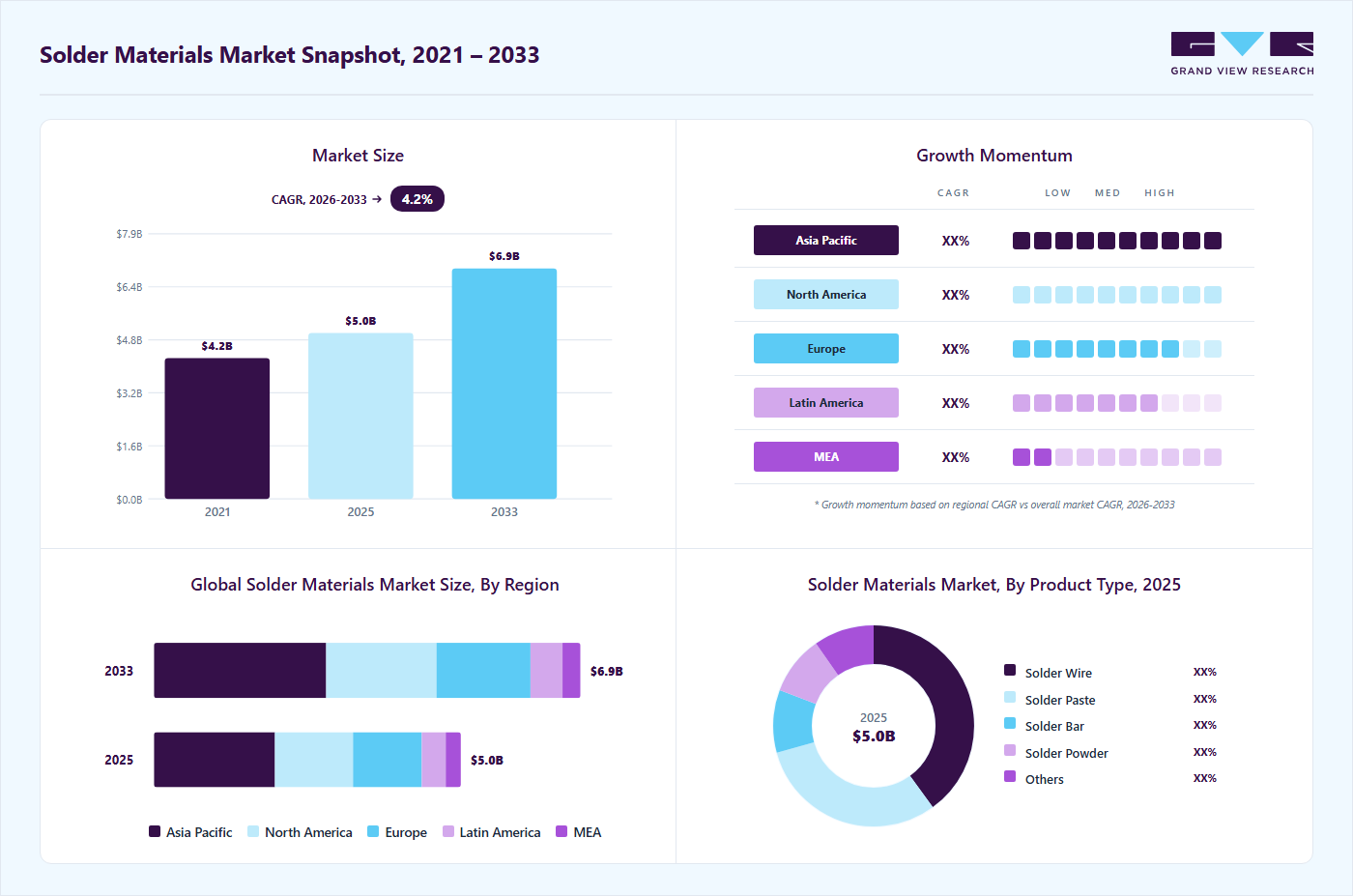
The global solder materials market size was valued at USD 5.0 billion in 2025 and is projected to grow from USD 5.2 billion in 2026 to USD 6.9 billion by 2033, at a CAGR of 4.2% from 2026 to 2033. The market in Asia Pacific dominated with a revenue share of 39.4% in 2025. Demand for solder materials is increasing as the electronics manufacturing industry rapidly expands across consumer electronics, automotive electronics, and industrial equipment.
 Source: Grand View Research, IR Documents, Primary Interviews, Paid DatabasesTo learn more about this report,
 Download Free Sample Report
 Key Market Trends & Insights
- By product: Solder wire segment led the market with the largest revenue share of 39.9% in 2025.
- By end use: Electronics segment led the market with the largest revenue share of 48.3% in 2025.
Regional Highlights
- Largest regional market: Asia Pacific (39.4% revenue share, 2025)
- By country: The China held the largest market share in 2025.
Market Size & Forecast
- Market size in 2025: USD 5.0 billion
- Estimated market size in 2026: USD 5.2 billion
- Projected market size by 2033: USD 6.9 billion
- CAGR (2026-2033): 4.2%
Three ways to get this report
Buy it, customize it, or ask a question.Ask an Analyst
A direct answer, usually in 1 working day
- AccessReport author, directly
- Reply timeWithin 1 working day
- No sales callDirect answer only
- FormatEmail reply
- CostFree, no cost
Get the Full Report
What the study covers
- FormatsPDF · Excel · Dashboard
- Timeline2026–2033 annual, 2025 base
- Coverage20+ countries, 5 regions
- Companies10+ key players profiled
Customize the Report
20% free customization
- IncludeCountries, segments, points
- TailorTo your product definition
- ExtendDeeper competitor detail
- OrA fully bespoke study
- Turnaround5–10 working days
The rising adoption of smartphones, wearables, and smart home devices has significantly increased the volume of printed circuit boards (PCBs), thereby driving solder consumption. Growth in electric vehicles and advanced driver-assistance systems (ADAS) has further amplified demand, as these systems require reliable and high-performance soldering solutions. In addition, miniaturization of electronic components has increased the need for high-precision solder materials. Expansion of data centers and 5G infrastructure has also supported consistent demand growth. Medical electronics and industrial automation applications are emerging as additional drivers of demand.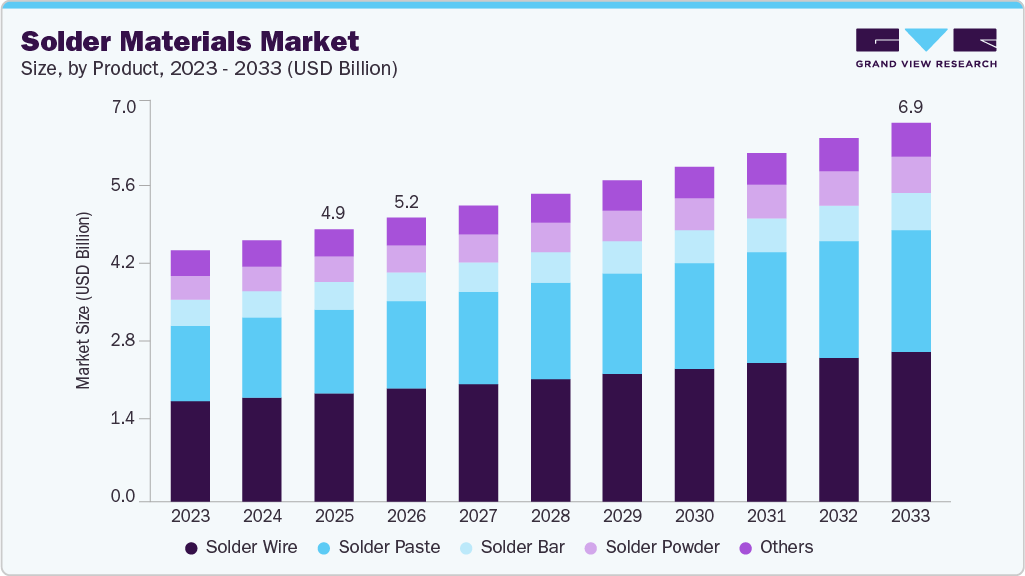 To learn more about this report, Download Free Sample Report
 Key demand drivers include technological advancements in electronics, increasing PCB assembly volumes, and the transition toward lead-free solder materials. Automotive electrification and rising semiconductor content per vehicle have significantly increased solder usage. Growth in renewable energy systems, such as solar inverters and energy storage electronics, also contributes to demand. Increasing investments in electronics manufacturing across the Asia Pacific and North America have strengthened market growth. Stringent reliability requirements in aerospace, defense, and medical devices have further increased demand for high-quality solder alloys. Rising automation in electronics manufacturing is supporting consistent solder paste and wire consumption.
The solder materials industry is witnessing strong innovation in lead-free solder alloys, low-temperature soldering solutions, and high-reliability materials for advanced electronics. Development of solder materials compatible with fine-pitch and miniaturized components is a key trend. Manufacturers are focusing on improving thermal fatigue resistance and electrical conductivity to meet demanding application requirements. Growth in no-clean and halogen-free solder pastes is gaining traction due to environmental and performance advantages. Automation-friendly solder materials designed for high-speed assembly lines are becoming more common. R&D efforts are also focused on improving joint reliability in harsh environments. These innovations are shaping the next generation of solder materials.
Market Concentration & Characteristics
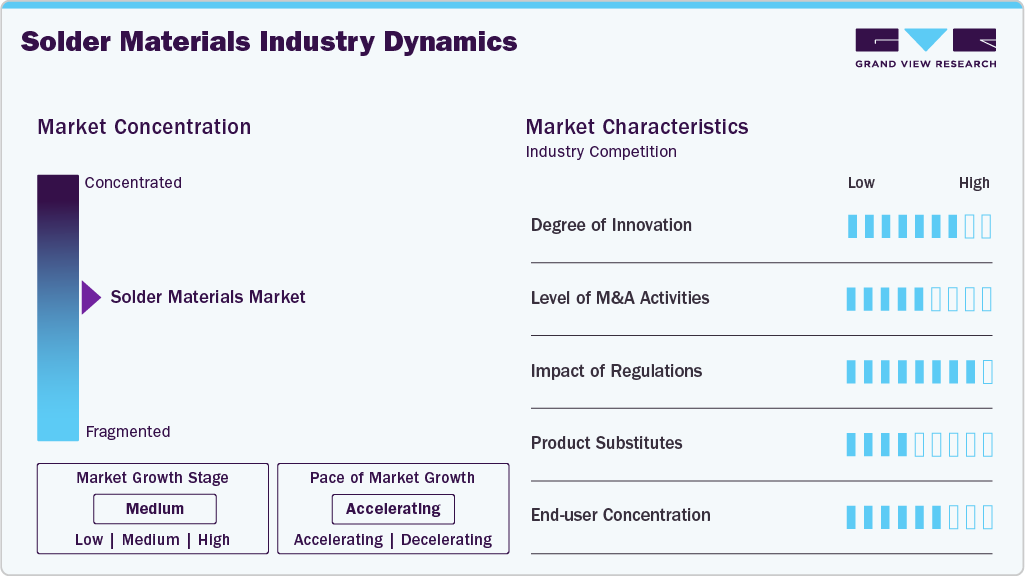
The solder materials industry is moderately consolidated, with a few global players holding significant market share alongside several regional manufacturers. Leading companies benefit from strong R&D capabilities, established distribution networks, and long-term relationships with electronics manufacturers. Barriers to entry include stringent quality standards and high reliability requirements. However, regional players remain competitive in price-sensitive markets. Mergers, capacity expansions, and product differentiation are common strategies. The presence of both multinational and specialized players contributes to balanced competition. Overall, the market demonstrates moderate consolidation with stable competitive dynamics.
 To learn more about this report, Download Free Sample Report
 The threat of substitutes in the solder materials industry is moderate, as soldering remains the most reliable and cost-effective method for electronic interconnections. Alternatives such as conductive adhesives are used in niche applications but often face limitations in electrical and mechanical performance. Solder materials continue to offer superior thermal and electrical conductivity. High-volume electronics manufacturing still relies heavily on traditional soldering techniques. Switching costs and reliability concerns limit large-scale substitution. Technological improvements in solder materials further reduce the threat of substitutes.
Product Insights
The solder wire segment led the market with the largest revenue share of 39.9% in 2025, primarily due to its widespread usage across manual and automated soldering processes in electronics assembly, maintenance, and repair applications. Solder wire offers ease of handling, consistent alloy composition, and cost effectiveness, making it a preferred choice for high-volume production as well as aftermarket servicing. Its extensive adoption across consumer electronics, industrial equipment, and electrical applications has contributed to stable and recurring demand, supporting its dominant revenue position in the market.
The solder paste segment is expected to grow at the fastest CAGR of 4.8% over the forecast period, driven by increasing adoption of surface-mount technology (SMT) and automated PCB assembly lines. Solder paste is essential for high-density and fine-pitch component placement, making it critical for advanced electronics manufacturing. Rising demand for miniaturized electronic devices, coupled with growth in semiconductor packaging and high-speed production environments, is accelerating the adoption of solder paste solutions. Continuous innovations in lead-free and low-residue formulations are further supporting segment growth.
End-use Insights
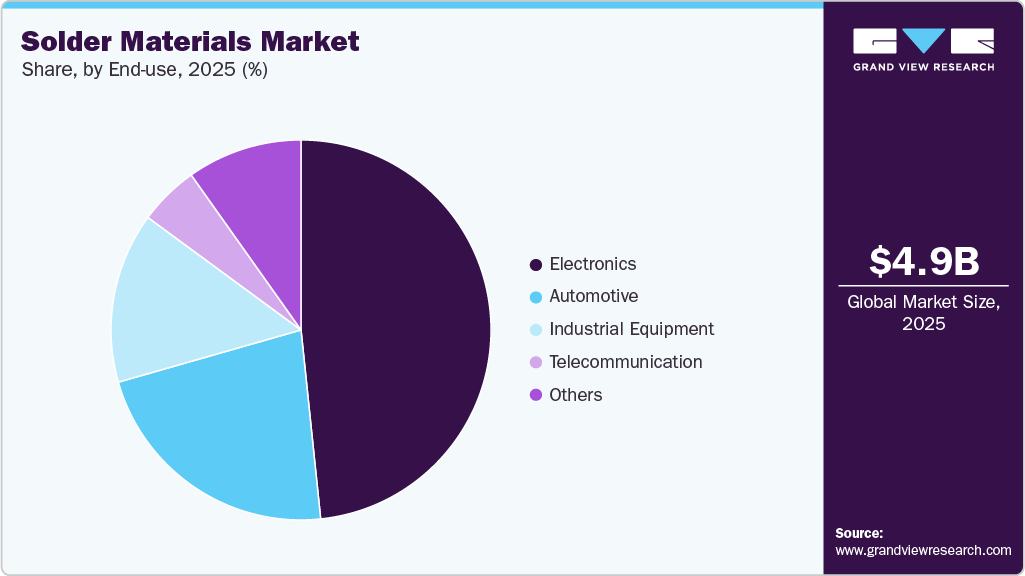
The electronics segment led the market with the largest revenue share of 48.3% in 2025, due to the extensive use of solder materials in the manufacturing of consumer electronics, industrial electronics, and communication devices. High production volumes of smartphones, laptops, wearables, and networking equipment continue to generate strong demand for solder materials. In addition, the increasing complexity of electronic assemblies and higher component densities require reliable soldering solutions, reinforcing the dominance of the electronics end-use segment in overall market revenues.
 To learn more about this report, Download Free Sample Report
 The automotive segment is expected to grow at the fastest CAGR of 4.7% over the forecast period, supported by the rapid increase in electronic content per vehicle and the ongoing shift toward electric and hybrid vehicles. Advanced driver-assistance systems, infotainment systems, battery management systems, and power electronics require high-reliability solder materials that withstand harsh operating conditions. Stricter safety and performance standards in the automotive industry are further driving demand for advanced solder materials, positioning the automotive segment as a key growth area in the market.
Regional Insights
The solder materials market in North America shows steady demand growth driven by advanced electronics, aerospace, defense, and automotive applications. Strong focus on high-reliability solder materials supports market expansion. Reshoring of electronics manufacturing is positively influencing demand. Growth in data centers and telecom infrastructure is another key driver. Environmental regulations are also supporting the adoption of lead-free solder. R&D-intensive product development is common in the region. The market remains innovation-driven.
U.S. Solder Materials Market Trends
The solder materials market in the U.S. benefits from robust demand in aerospace, defense, medical devices, and automotive electronics. Increasing investments in semiconductor manufacturing are strengthening domestic demand. Emphasis on regulatory compliance has accelerated the adoption of lead-free solder. High-performance and specialty solder materials are in strong demand. Technological innovation remains a key focus. Strategic partnerships with OEMs support stable growth. The U.S. remains a high-value market.
Asia Pacific Solder Materials Market Trends
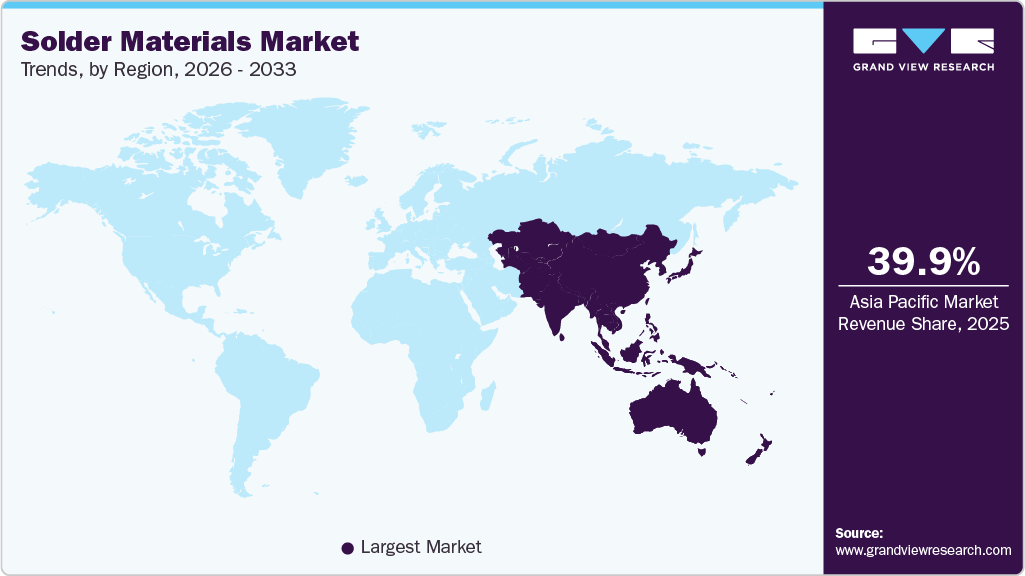
Asia Pacific dominated the global solder materials market with the largest revenue share of 39.9% in 2025 and is anticipated to grow at the fastest CAGR during the forecast period, driven by its strong electronics manufacturing base and large-scale PCB production. Countries such as China, Japan, South Korea, and Taiwan host major semiconductor and electronics manufacturing hubs. Availability of skilled labor and cost advantages support regional dominance. Strong demand from consumer electronics and automotive sectors drives growth. Government support for electronics production further strengthens the market. Increasing investments in EV manufacturing are also contributing. The region is expected to maintain leadership throughout the forecast period.
 To learn more about this report, Download Free Sample Report
 The solder materials market in China accounted for the largest market revenue share in the Asia Pacific in 2025, due to its extensive electronics and semiconductor manufacturing ecosystem. Domestic production of consumer electronics, industrial equipment, and EV components supports consistent demand. Government initiatives promoting self-reliance in electronics manufacturing are boosting local consumption of solder materials. The rapid expansion of PCB assembly plants is strengthening market growth. Local manufacturers compete strongly on pricing. Technological upgrades are improving product quality. China continues to play a critical role in global supply chains.
Europe Solder Materials Market Trends
The solder materials market in Europe is driven by automotive electronics, industrial automation, and renewable energy systems. Strict environmental regulations support the adoption of advanced lead-free solder solutions. Germany, France, and the UK are key contributors. Demand for high-reliability soldering in the automotive and aerospace sectors is increasing. Sustainable manufacturing practices influence product development. Automation trends support stable consumption. Europe shows moderate but consistent growth.
The Germany solder materials market is expanding rapidly, due to its strong automotive and industrial electronics base. Advanced manufacturing standards drive demand for high-quality solder materials. Emphasis on electric mobility and Industry 4.0 supports growth. Environmental regulations promote lead-free solutions. Strong engineering capabilities encourage the adoption of advanced solder alloys. Domestic electronics production remains stable. Germany remains a technology-driven market.
Latin America Solder Materials Market Trends
The solder materials market in Latin America is experiencing gradual growth, supported by expanding electronics assembly and automotive manufacturing. Countries such as Mexico and Brazil are key contributors. Increasing foreign investments in manufacturing facilities drive solder consumption. Price-sensitive demand favors standard solder materials. Infrastructure and telecom projects support market expansion. Regulatory frameworks are evolving. Growth remains moderate but steady.
Middle East & Africa Solder Materials Market Trends
The solder materials market in the Middle East & Africa is in a developing phase, driven by industrialization and infrastructure projects. Growth in consumer electronics demand supports solder material consumption. Increasing investments in manufacturing and renewable energy systems contribute to market expansion. Import dependence remains high in several countries. Demand is primarily focused on basic solder materials. Gradual adoption of environmental standards is influencing product selection. The region offers long-term growth opportunities.
Key Solder Materials Company Insights
Some of the key players operating in the market include Qualitek International, Inc. and Indium Corporation.
-
Qualitek International, Inc. is a U.S.-based manufacturer specializing in solder pastes, solder wires, fluxes, and electronic assembly materials. The company focuses on providing cost-effective, application-specific soldering solutions for PCB assembly and electronics manufacturing. Qualitek serves a wide range of industries, including consumer electronics, automotive electronics, telecommunications, and industrial equipment.
-
Indium Corporation is a globally recognized materials manufacturer specializing in solder alloys, thermal interface materials, and advanced electronic assembly solutions. Headquartered in the U.S., the company serves high-reliability industries, including aerospace, defense, automotive electronics, and semiconductors. Indium Corporation is known for its strong R&D capabilities and innovation in lead-free, low-temperature, and high-reliability solder materials.
Henkel AG & Co. KGaA and AIM Solder are some of the emerging market participants in the solder materials industry.
-
Henkel AG & Co. KGaA is a global specialty chemicals company with a strong presence in electronic materials through its Adhesive Technologies division. The company provides solder pastes, fluxes, thermal management materials, and advanced electronic assembly solutions. Henkel serves key industries including automotive electronics, consumer electronics, industrial automation, and renewable energy.
-
AIM Solder is a global supplier of solder materials, including solder pastes, bars, wires, and fluxes for electronic assembly. The company serves OEMs and EMS providers across automotive, aerospace, consumer electronics, and industrial markets. AIM Solder is known for its metallurgical expertise and focus on reliability and process performance. It offers a broad portfolio of lead-free and specialty solder alloys.
Key Solder Materials Companies:
The following key companies have been profiled for this study on the solder materials market.
- MacDermid Alpha Electronics Solutions
- Kester
- Henkel AG & Co. KGaA
- Indium Corporation
- Senju Metal Industry Co., Ltd
- Heraeus Electronics
- AIM Solder
- KOKI Company Ltd.
- Qualitek International, Inc.
- MG Chemicals Ltd.
Recent Developments
-
In October 2025, Element Solutions, parent of MacDermid Alpha, announced an agreement to acquire Micromax (advanced electronic inks & pastes supplier), which is expected to close in early 2026, broadening advanced materials capabilities.
-
In December 2025, Indium Corporation launched SiPaste C312HF, a halogen-free, cleanable solder paste optimized for fine-feature printing (Type 7 powder), improving consistency, reflow performance, and yield for advanced packaging.
Solder Materials Market Report Scope
Report Attribute
Details
Market size in 2025
USD 5.0 billion
Estimated market size in 2026
USD 5.2 billion
Projected market size by 2033
USD 6.9 billion
Growth rate
CAGR of 4.2% from 2026 to 2033
Base year for estimation
2025
Historical data
2021 - 2024
Forecast period
2026 - 2033
Quantitative units
Revenue in USD million/billion, and CAGR from 2026 to 2033
Report coverage
Revenue forecast, company ranking, competitive landscape, growth factors, and trends
Segments covered
Product, end-use, region.
Regional scope
North America; Europe; Asia Pacific; Latin America; Middle East & Africa
Country scope
U.S.; Canada; Mexico; Germany; UK; Italy; France; Spain; China; Japan; India
Key companies profiled
MacDermid Alpha Electronics Solutions; Kester; Henkel AG & Co. KGaA; Indium Corporation; Senju Metal Industry Co., Ltd; Heraeus Electronics; AIM Solder; Bridgestone Corporation; Qualitek International, Inc.; MG Chemicals Ltd.; KOKI company Ltd.
Customization scope
Free report customization (equivalent up to 8 analysts working days) with purchase. Addition or alteration to country, regional & segment scope.
Pricing and purchase options
Avail customized purchase options to meet your exact research needs. Explore purchase options
Global Solder Materials Market Report Segmentation
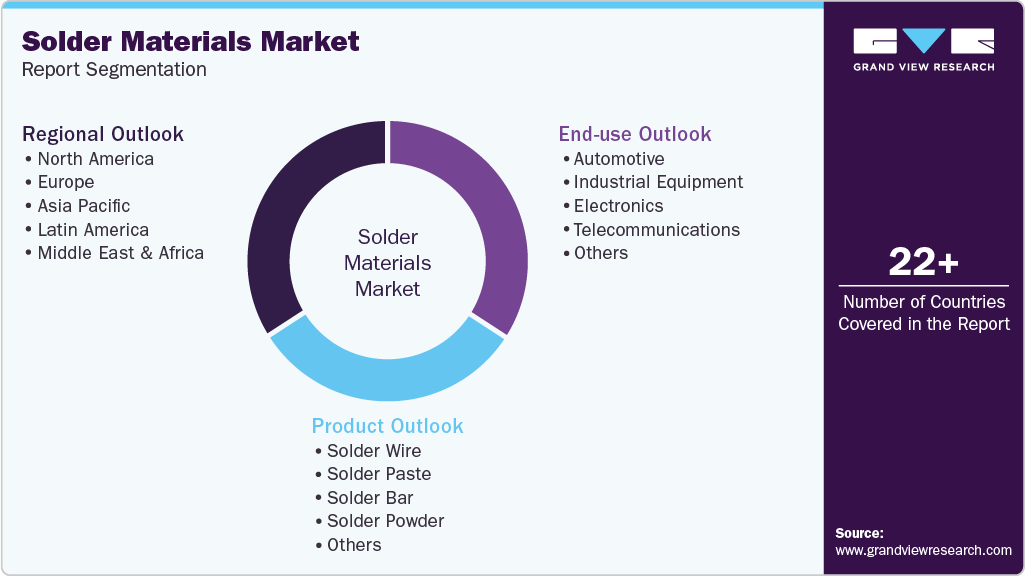
This report forecasts revenue growth at regional & country levels and provides an analysis on the industry trends in each of the sub-segments from 2021 to 2033. For this study, Grand View Research has segmented the global solder materials market report based on the product, end-use, and region:
 To learn more about this report, Download Free Sample Report
 -
Product Outlook (Revenue, USD Billion, 2021 - 2033)
-
Solder Wire
-
Solder Paste
-
Solder Bar
-
Solder Powder
-
Others
-
-
End-use Outlook (Revenue, USD Billion, 2021 - 2033)
-
Automotive
-
Industrial Equipment
-
Electronics
-
Telecommunications
-
Others
-
-
Regional Outlook (Revenue, USD Billion, 2021 - 2033)
-
North America
-
U.S.
-
Canada
-
Mexico
-
-
Europe
-
UK
-
Germany
-
France
-
Italy
-
-
Asia Pacific
-
China
-
Japan
-
India
-
-
Latin America
-
Middle East and Africa
-
Frequently Asked Questions About This Report
The global solder materials market size was estimated at USD 5.0 billion in 2025 and is expected to reach USD 5.2 billion in 2026.
Asia Pacific dominated with a 39.9% revenue share in 2025.
Some of the key players operating in the solder materials market include MacDermid Alpha Electronics Solutions, Kester, Henkel AG & Co. KGaA, Indium Corporation, Senju Metal Industry Co., Ltd, Heraeus Electronics, AIM Solder, Bridgestone Corporation, MG Chemicals Ltd., and Qualitek International, Inc.
Rising electronics manufacturing volumes, the miniaturization of components, growth in automotive and EV electronics, expansion of 5G and data center infrastructure, and the global shift toward lead-free and high-reliability solder solutions are key factors driving the solder materials market.
The global solder materials market is expected to grow at a compound annual growth rate of 4.2% from 2026 to 2033 to reach USD 6.9 billion by 2033.
The solder wire segment led the market with the largest revenue share of 39.9% in 2025, while solder paste segment is expected to be the fastest-growing market.
The electronics segment led the market with the largest revenue share of 48.3% in 2025 and automotive segment is second fastest growing market
About the Author(s)
Advanced Interior Materials Research Team
Advanced Materials · Advanced Interior MaterialsThis report was authored by the advanced interior materials research team at Grand View Research - comprising two research analysts, one senior research analyst, and one industry expert - with specialized expertise in the advanced interior materials segment of the advanced materials industry. All findings are based on proprietary advanced materials databases, executive interviews, and regulatory analysis, subject to internal peer review prior to publication.
Last Updated:
Speak to Analyst

Customize this report to your needs - add regions, segments, or data points, with 20% free customization.
Or view our licence options:


ISO 9001:2015 & 27001:2022 Certified
We are GDPR and CCPA compliant! Your transaction & personal information is safe and secure. For more details, please read our privacy policy.


