
- Home
- »
- Next Generation Technologies
- »
-
Spa And Salon Software Market Size Report, 2026-2033GVR Report cover

Spa And Salon Software Market (2026 - 2033)
Size, Share & Trends Analysis Report By Type (Appointment Scheduling Software, Point-of-Sale (POS) Systems, CRM Software), By Deployment, By Organization Size, By End User, By Region, And Segment Forecasts
Market Size, 2025
$1.6BMarket Estimate, 2026
$1.8BMarket Forecast, 2033
$3.8BCAGR, 2026–2033
11.6%Spa And Salon Software Market Summary
The global spa and salon software market size was valued at USD 1.6 billion in 2025 and is projected to grow from USD 1.8 billion in 2026 to USD 3.8 billion by 2033, at a CAGR of 11.6% from 2026 to 2033. North America accounted for the largest revenue share of 38.8% of the global market in 2025. The market is rapidly expanding within the broader vertical SaaS ecosystem, driven by the digital transformation of the beauty and wellness industry.
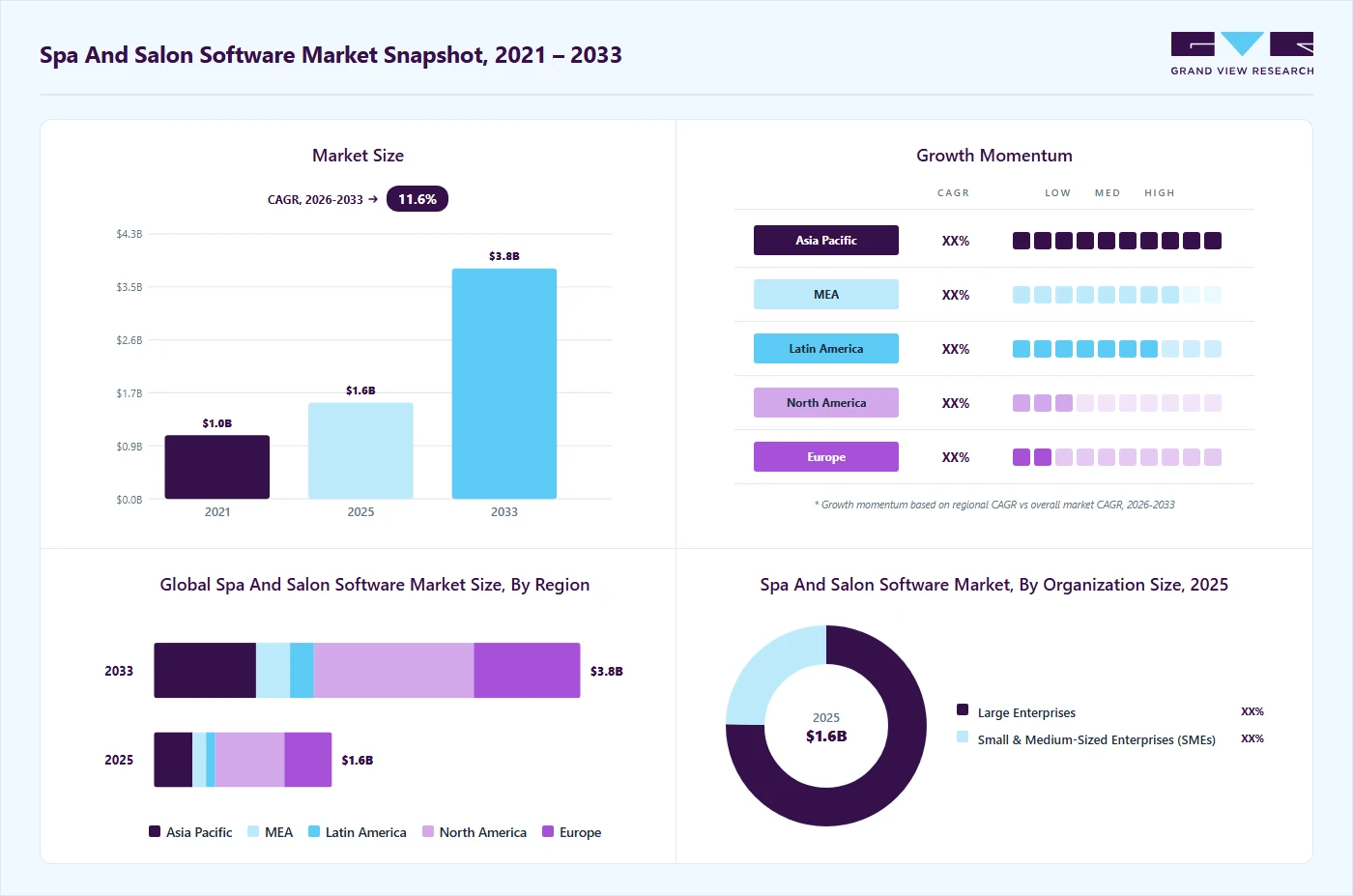 Source: Grand View Research, IR Documents, Primary Interviews, Paid DatabasesTo learn more about this report,
 Download Free Sample Report
 Key Market Trends & Insights
- By type: Appointment scheduling software segment held the largest revenue share of 31.9% in 2025.
- By end user: Beauty salons segment led the market with the largest revenue share in 2025.
- By deployment: Cloud segment accounted for the largest share in 2025.
- By organization size: Large enterprises segment held the largest revenue share in 2025.
Regional Highlights
- Largest regional market: North America (38.8% revenue share, 2025)
- Fastest-growing regional market: Asia Pacific (highest CAGR, 2026-2033)
- By country: The U.S. spa and salon software market is expected to grow significantly from 2026 to 2033.
Market Size & Forecast
- Market size in 2025: USD 1.6 Billion
- Estimated market size in 2026: USD 1.8 Billion
- Projected market size by 2033: USD 3.8 Billion
- CAGR (2026-2033): 11.6%
Three ways to get this report
Buy it, customize it, or ask a question.Ask an Analyst
Analyst response in 1 business day
- AccessReport author, directly
- Reply timeWithin 1 working day
- No sales callDirect answer only
- FormatEmail reply
- CostFree, no cost
Get the Full Report
What the study covers
- FormatsPDF · Excel · Dashboard
- Timeline2026–2033 annual, 2025 base
- Coverage20+ countries, 5 regions
- Companies10+ key players profiled
Customize the Report
20% free customization
- IncludeCountries, segments, points
- TailorTo your product definition
- ExtendDeeper competitor detail
- OrA fully bespoke study
- Turnaround5–10 working days
These software solutions enable businesses such as salons, spas, med spas, and grooming studios to streamline operations through integrated functionalities, including appointment scheduling, point-of-sale (POS), customer relationship management (CRM), and marketing automation. The spa and salon software industry is witnessing steady growth as service providers adopt cloud-based platforms to enhance operational efficiency, improve the customer experience, and enable data-driven decision-making. The global market is projected to grow at a healthy pace, supported by rising demand for automation and the increasing penetration of online booking systems.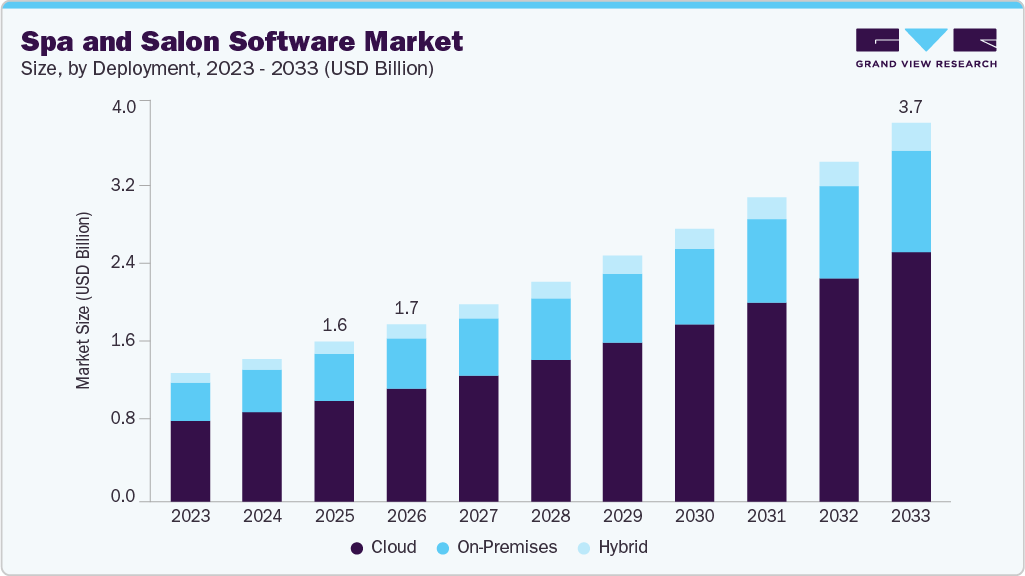 To learn more about this report, Download Free Sample Report
 Additionally, the growing importance of customer retention strategies has accelerated the adoption of advanced CRM and marketing automation features, including personalized promotions and loyalty programs. Integration with mobile applications and digital payment systems is further enhancing the value proposition of these platforms.
North America holds the largest market share due to early adoption of technology and the presence of well-established salon chains, while Asia Pacific is emerging as the fastest-growing region driven by urbanization, rising disposable incomes, and increasing awareness of personal grooming services. The market remains moderately fragmented, with a mix of established players and emerging startups competing on innovation, pricing, and user experience. As the beauty and wellness industry continues to evolve, the demand for scalable, user-friendly, and feature-rich software solutions is expected to drive the market growth over the forecast period.
Type Insights
The appointment scheduling software segment accounts for the largest share of the spa and salon software market because it sits at the core of daily salon operations, directly enabling bookings, reducing no-shows, and improving customer convenience through real-time online scheduling. In addition, the rising demand for mobile-first booking experiences, instant confirmations, and integrated calendars across multiple staff and locations has made scheduling the most frequently used and essential module in salon management platforms. Also, the importance of speed, accessibility, and automation in customer-facing workflows has further strengthened its dominance within overall software adoption. For instance, in July 2025, Vagaro launched Instant Payout to enhance financial flexibility for beauty and wellness businesses, reinforcing its ecosystem that centers heavily on appointment scheduling, online booking, and client management. This reflects that scheduling platforms are integrated with payments and business management capabilities to create seamless end-to-end workflows for salons and spas. In conclusion, the dominance of appointment scheduling software is driven by its indispensable role in customer acquisition and retention, its central position in integrated salon platforms, and its evolution into a unified operational hub within the spa and salon software ecosystem.
The marketing automation software segment is expected to grow at the fastest CAGR from 2026 to 2033, due to the increasing focus of salons, spas, and med spas on customer retention, personalized engagement, and revenue optimization through data-driven marketing strategies. As competition intensifies in the beauty and wellness industry, businesses are shifting from basic scheduling and POS tools toward integrated platforms that can automatically drive repeat bookings, reduce churn, and increase customer lifetime value through targeted campaigns, SMS/email outreach, and AI-based segmentation. For instance, in May 2022, Boulevard launched its Marketing Suite, with integrated marketing automation capabilities within its salon management platform, enabling self-care businesses to streamline email outreach, automate client communication, and convert marketing efforts directly into bookings.This demonstrates that marketing automation is evolving from a supporting function into a core revenue-generating engine within spa and salon platforms. In conclusion, the segment’s strong growth trajectory is driven by rising demand for automated client engagement, increasing adoption of omnichannel communication tools, and the integration of advanced analytics.
Deployment Insights
The cloud segment dominated the spa and salon software industry in 2025, due to its ability to deliver low-cost deployment and real-time operational access, which are critical for appointment-driven businesses like salons and spas. Cloud-based platforms eliminate the need for expensive on-premise infrastructure and IT maintenance while enabling owners to manage bookings, payments, staff schedules, and customer data from any device, improving flexibility and efficiency. Additionally, the integration of embedded payments and unified workflows across cloud platforms is accelerating adoption, enabling seamless management of appointments and financial transactions within a single system.For instance, in January 2026, Aurora Payments and eSpa247 integrated embedded payment solutions directly into a cloud-based salon and spa management platform, enabling businesses to process payments, manage appointments, and track services in real time within one unified system, reducing operational friction and improving visibility across revenue streams, staff activity, and client transactions.This reflects the broader industry shift toward cloud ecosystems that combine booking, CRM, POS, and payments into a single platform. Consequently, the dominance of cloud deployment is driven by its cost efficiency, accessibility, and growing integration with fintech and automation tools, making it the preferred choice for modern salon and spa businesses globally.
The hybrid segment is expected to grow at a significant CAGR from 2026 to 2033, driven by increasing demand from large salon chains and premium wellness businesses that require a balance between cloud flexibility and on-premises control. While cloud-only systems dominate SMEs, many enterprise-grade salons and med spa networks still prefer hybrid models to keep sensitive customer, payment, and compliance data locally stored while using the cloud for booking, CRM, marketing automation, and multi-location management. This dual structure allows businesses to ensure data security, regulatory compliance, and operational continuity, especially in regions with strict data governance requirements or unreliable connectivity. In addition, hybrid systems are gaining traction as salon enterprises expand across geographies and adopt complex workflows that require real-time synchronization across locations without fully migrating legacy systems to the cloud. As a result, vendors are enhancing interoperability and API-driven integration capabilities to support seamless hybrid environments, enabling salons and spas to scale digitally while maintaining control over critical operational data, thereby driving steady growth in this segment.
Organization Size Insights
The large enterprises segment held the largest revenue share of the spa and salon software market in 2025, because they operate multi-location salon and spa chains that require advanced software capabilities such as centralized booking systems, cross-location customer databases, workforce management, and integrated POS and CRM systems. These organizations generate higher transaction volumes compared to small and medium businesses, leading to higher software spending per account through premium subscriptions, add-on modules, and customized deployments. Additionally, large enterprises are early adopters of digital transformation initiatives, investing in scalable cloud platforms and analytics tools to optimize operations, improve customer experience, and standardize service delivery across regions. For instance, in May 2024, Vagaro, supporting large-scale salon experiences and enterprise-level events such as HairCon, highlighted that major salon networks rely on advanced software ecosystems to manage high-traffic bookings, payments, and customer engagement at scale, reinforcing the strong demand from large organizations for robust and integrated solutions that can support complex operational needs and high transaction volumes. In conclusion, the dominance of large enterprises is driven by their higher technology budgets, the need for centralized multi-location management, and their early adoption of integrated SaaS platforms that enhance efficiency and the customer experience across expansive salon and spa networks.
The Small & Medium-Sized Enterprises (SMEs) segment is expected to grow at a significant CAGR from 2026 to 2033, due to rapid digitalization among independent salons, spas, and boutique wellness businesses that are adopting affordable cloud-based SaaS solutions to streamline operations. SMEs are shifting from manual booking systems and spreadsheets to integrated platforms that offer appointment scheduling, POS billing, CRM, and marketing automation at low subscription costs, enabling them to compete more effectively with larger chains. Additionally, the rising availability of cloud-based, mobile-first, and pay-as-you-go software models has significantly reduced entry barriers, making advanced salon management tools accessible even to micro and small businesses. For instance, in October 2025, Liberis launched “Pay with Liberis,” a buy-now-pay-later solution for business tools and services, highlighting the growing ecosystem of flexible financing options that help SMEs adopt digital software solutions without high upfront costs, thereby accelerating SaaS adoption in small service-based businesses.This reflects a broader trend where fintech-enabled payment flexibility and SaaS subscription models are driving stronger penetration of spa and salon software among smaller operators. Subsequently, the SME segment is driven by the affordability of cloud solutions, increasing digital adoption among independent service providers, and the growing need for automation to improve efficiency and customer retention.
End User Insights
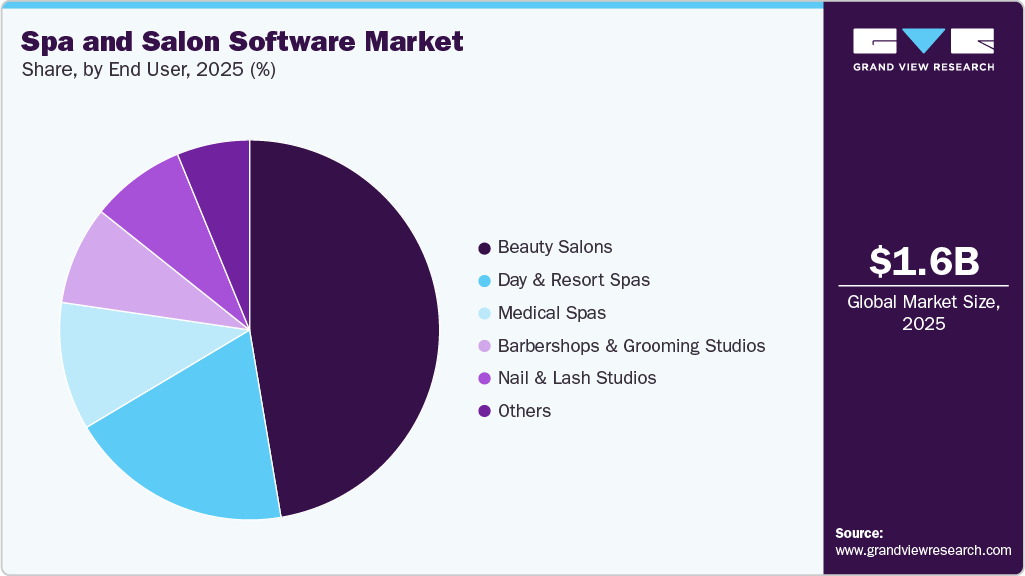
The beauty salons segment accounted for the largest revenue share of the spa and salon software industry in 2025,due to its high global density of establishments, frequent customer visitation cycles, and strong reliance on appointment scheduling, POS, and CRM systems for daily operations. Beauty salons experience high client turnover and offer recurring services such as haircuts, styling, coloring, and treatments, making digital booking systems and automated scheduling tools essential for minimizing no-shows and optimizing chair utilization. Additionally, the increasing adoption of cloud-based salon management platforms and AI-enabled workflow automation is further strengthening software penetration in this segment, as vendors are focusing heavily on improving efficiency, customer retention, and personalization for salon operators. For instance, in September 2025, Zenoti launched an industry-first AI Workforce to automate routine tasks such as appointment handling, customer engagement, and marketing workflows across salons and spas, highlighting that platforms enhance operational efficiency and the customer experience specifically for beauty and salon businesses through advanced automation and AI-driven tools.In conclusion, the dominance of the beauty salons segment is driven by its large global customer base, high-frequency service model, and strong dependency on digital tools for scheduling, billing, and client management.
 To learn more about this report, Download Free Sample Report
 The medical spas segment is expected to grow at the highest CAGR in the spa and salon software market due to the rapid expansion of aesthetic medicine, rising demand for minimally invasive cosmetic procedures, and increasing need for specialized software that combines clinical workflow management with traditional spa operations. Unlike regular beauty salons, med spas require advanced capabilities such as patient records, treatment documentation, compliance tracking, and integrated CRM systems, which are increasingly being delivered through purpose-built, all-in-one platforms. Additionally, strong growth in wellness and anti-aging treatments, higher customer spending, and the shift toward data-driven personalization are accelerating the adoption of advanced med spa software solutions. For instance, in April 2025, Nextech launched a dedicated med spa platform that highlights vendors are developing end-to-end systems tailored specifically for aesthetic and medical spa operations, integrating clinical charting, POS, CRM, and workflow automation to improve efficiency and patient experience while supporting the rapidly growing demand for wellness and aesthetic services. In conclusion, the segment’s highest CAGR is driven by its hybrid clinical-wellness nature, higher revenue per client, and increasing reliance on specialized, compliance-ready software platforms that go beyond traditional salon management tools.
Regional Insights
The North America spa and salon software market held the largest global share in 2025,due to high penetration of subscription-based salon SaaS platforms and strong adoption of integrated booking-POS ecosystems across multi-location salon chains in the U.S. and Canada. The region has also seen rapid expansion of embedded payments and instant payout features in salon management software, enabling faster revenue settlement for independent stylists and salon owners and significantly increasing platform stickiness. In addition, the presence of established vendors continuously launching AI-driven workforce management, automated scheduling optimization, and predictive client rebooking tools has accelerated enterprise adoption. Another key trend is the strong uptake of omnichannel client engagement systems that combine SMS, email, and mobile app-based booking into a single customer journey, improving retention rates in highly competitive urban salon markets.
 To learn more about this report, Download Free Sample Report
 U.S. Spa and Salon Software Market Trends
The spa and salon software industry in the U.S. is expected to grow significantly from 2026 to 2033, driven by the rapid expansion of AI-enabled salon management platforms that automate scheduling, client retention, and workforce optimization in real time. A key growth driver is the increasing adoption of embedded financial services such as instant payouts, BNPL-based software subscriptions, and integrated payment ecosystems, which are improving cash flow for independent salons and small chains. In addition, U.S. salon operators are increasingly deploying omnichannel booking systems that unify mobile apps, web platforms, and social media scheduling into a single interface, enhancing customer convenience and reducing booking friction. The market is also witnessing strong momentum from enterprise-grade consolidation of salon chains, where centralized cloud platforms are being used to manage multi-location pricing, loyalty programs, and customer data analytics, further accelerating software penetration across the industry.
Asia Pacific Spa and Salon Software Market Trends
The Asia Pacific spa and salon software industry is expected to grow at the fastest CAGR during the forecast period, driven by the rapid expansion of digitally native salon and spa businesses adopting mobile-first booking platforms and cloud-based management systems, particularly in highly urbanized markets such as India, China, and Southeast Asia. Growth is further supported by the increasing penetration of super-app ecosystems and integrated digital payment platforms that directly connect consumers with beauty and wellness service providers, reducing friction in appointment scheduling and payments. In addition, the region is witnessing strong uptake of low-cost SaaS salon solutions among independent salons and small wellness studios, enabled by rising smartphone usage and affordable internet access. Another key trend driving growth is the emergence of hyper-local, on-demand beauty service platforms that rely heavily on real-time scheduling and CRM tools to manage dynamic customer demand, positioning APAC as the most rapidly expanding regional market.
The China spa and salon software market held a significant share in 2025,driven by the rapid digitalization of the beauty and wellness sector, where WeChat-based booking ecosystems and mini-program integrations have become the primary channels for appointment scheduling and customer engagement. The market is strongly influenced by the widespread adoption of omnichannel social commerce models, in which salons and spas directly convert social platform traffic into bookings and prepaid services, significantly boosting software utilization. In addition, large urban salon chains in Tier 1 and Tier 2 cities are increasingly deploying cloud-based SaaS platforms with integrated CRM and loyalty modules to manage high customer volumes and repeat visits. The growing penetration of AI-driven customer personalization tools and automated marketing systems embedded within salon platforms is further enhancing operational efficiency and customer retention, strengthening China’s position as a key contributor to the regional market share.
The spa and salon software market in Japan is expected to grow at a significant CAGR from 2026 to 2033,due to the adoption of highly structured, appointment-driven salon operations that require advanced scheduling precision and customer management systems in a service economy focused on premium personalization. A key driver is the rising integration of automated booking platforms with POS and membership-based loyalty systems, which are widely used in Japan’s mature beauty industry to manage recurring clients and high service standards. In addition, Japanese salons are increasingly implementing cloud-based SaaS solutions that support multi-branch coordination, workforce scheduling, and digital customer records, helping streamline operations in densely urbanized markets such as Tokyo and Osaka. Another important trend is the growing use of mobile-enabled reservation systems and QR-based check-in workflows, which improve efficiency and reduce waiting times in high-volume salon environments, further supporting sustained market growth through the forecast period.
The India spa and salon software market is witnessing strong growth, driven by rapid digital transformation across the beauty and wellness industry and the increasing adoption of cloud-based salon management platforms for appointment scheduling, POS billing, CRM, inventory tracking, and marketing automation. The market is expanding as organized salon chains scale across Tier 1 and Tier 2 cities, while independent salons and boutique spas are rapidly shifting from manual processes to affordable SaaS-based solutions to improve efficiency and customer experience. A key trend is the growing integration of mobile-first booking systems, WhatsApp and social media-based appointment channels, and digital payment solutions, which are making salon services more accessible and streamlined for consumers. Additionally, vendors are introducing AI-enabled features such as automated reminders, personalized promotions, and customer retention tools, helping businesses increase repeat visits and revenue per client.
Europe Spa and Salon Software Market Trends
The Europe spa and salon software industry is projected to grow at a significant CAGR from 2026 to 2033, driven by the increasing adoption of integrated, cloud-based salon management platforms that unify appointment scheduling, POS systems, CRM, and loyalty management across multi-location salon chains. A key trend driving growth is the rising demand for data-driven customer personalization and automated retention tools, as salons and spas increasingly rely on software to optimize repeat bookings and enhance client lifetime value in highly competitive urban markets. Additionally, European businesses are accelerating the shift toward compliant digital payment ecosystems and GDPR-aligned customer data management systems, which is encouraging wider adoption of secure SaaS-based solutions. Another important factor is the growing adoption of hybrid wellness models combining traditional spa services with medical aesthetics, which require advanced software capable of managing both clinical workflows and standard salon operations, thereby supporting sustained market expansion through the forecast period.
The spa and salon software market in the UK is expected to grow rapidly in the coming years, supported by the increasing adoption of cloud-based salon management platforms that integrate online booking, POS systems, CRM, and digital payment solutions into a single ecosystem, enabling seamless customer and operational management. Growth is further driven by the rising demand for omnichannel appointment scheduling through mobile apps, websites, and social media platforms, which enhances customer convenience and reduces booking friction in highly competitive urban markets such as London and Manchester. In addition, UK salons and spas are increasingly implementing AI-powered marketing automation and loyalty programs to improve client retention and personalize customer engagement, while strict compliance with data protection regulations such as GDPR is accelerating the shift toward secure, cloud-native SaaS solutions across the industry.
The Germany spa and salon software market held a significant share in 2025, driven by strong adoption of structured appointment-based salon operations supported by enterprise-grade scheduling, CRM, and POS systems across both independent salons and chain businesses. A key trend in the country is the increasing deployment of GDPR-compliant cloud platforms that ensure secure handling of customer data while enabling centralized multi-location management for salon networks. Additionally, German salons and wellness centers are rapidly integrating digital payment systems and automated invoicing tools to streamline transactions and reduce manual administrative workload, particularly in urban hubs such as Berlin, Munich, and Hamburg. The market is also being supported by growing demand for hybrid wellness services, including medical aesthetics and spa treatments, which require advanced software capabilities for managing bookings, client records, and service customization, further strengthening Germany’s position in the European market.
Key Spa and Salon Software Company Insights
Some of the key companies operating in the market include Acuity Scheduling, Boulevard, Booker (by Mindbody), DaySmart Software, and Fresha.
-
In December 2025, Mindbody announced a strategic commercial partnership with Attentive, integrating Attentive's AI-powered SMS and email marketing tools directly into the Mindbody platform for fitness, wellness, and beauty businesses. This enables personalized, automated campaigns using Mindbody's client data, driving higher engagement, retention, and revenue.
-
In October 2025,DaySmart Software launched practical AI tools integrated into its platform for small businesses in salons, spas, veterinary, and fitness sectors, including Daisy for SOAP notes, Business Advisor for decisions, 24/7 support, and an AI description generator to cut admin time.
-
In July 2025, Boulevard, a client experience platform for spas, salons, and self-care businesses, announced a USD 80 million Series D funding round, led by JMI Equity with Index Ventures and VMG Partners participating. The funds will accelerate AI innovations and enterprise features amid booming industry growth, powering 5,000+ businesses processing USD 5 billion annually.
Key Spa And Salon Software Companies:
The following key companies have been profiled for this study on the spa and salon software market.
- Acuity Scheduling
- Boulevard
- Booker (by Mindbody)
- DaySmart Software
- Fresha
- GlossGenius
- Mangomint
- Meevo (by Millennium Systems International)
- Mindbody
- Phorest Salon Software
- Rosy Salon Software
- Salon Iris
- Square Appointments
- Vagaro
- Zenoti
Spa and Salon Software Market Report Scope
Report Attribute
Details
Market size in 2025
USD 1.6 billion
Estimated Market size in 2026
USD 1.8 billion
Projected Market size by 2033
USD 3.8 billion
Growth rate
CAGR of 11.6% from 2026 to 2033
Actual data
2021 - 2025
Forecast period
2026 - 2033
Quantitative units
Revenue in USD billion and CAGR from 2026 to 2033
Report coverage
Revenue forecast, company share, competitive landscape, growth factors, and trends
Segments covered
Type, deployment, organization size, end user, region
Regional scope
North America; Europe; Asia Pacific; Latin America; MEA
Country scope
U.S.; Canada; Mexico; UK; Germany; France; China; India; Japan; Australia; South Korea; Brazil; UAE; Saudi Arabia; South Africa
Key companies profiled
Acuity Scheduling; Boulevard; Booker (by Mindbody); DaySmart Software; Fresha; GlossGenius; Mangomint; Meevo (by Millennium Systems International); Mindbody, Phorest Salon Software; Rosy Salon Software; Salon Iris; Square Appointments; Vagaro; Zenoti
Customization scope
Free report customization (equivalent to 8 analysts working days) with purchase. Addition or alteration to country, regional & segment scope.
Pricing and purchase options
Avail customized purchase options to meet your exact research needs. Explore purchase options
Global Spa And Salon Software Market Report Segmentation
This report forecasts revenue growth at the global, regional, and country levels and provides an analysis of the latest industry trends in each of the sub-segments from 2021 to 2033. For this study, Grand View Research has segmented the spa and salon software market report based on type, deployment, organization size, end user, and region:
-
Type Outlook (Revenue, USD Billion, 2021 - 2033)
-
Appointment Scheduling Software
-
Point-of-Sale (POS) Systems
-
Customer Relationship Management (CRM) Software
-
Employee/Staff Management Software
-
Inventory Management Software
-
Marketing Automation Software
-
Business & Financial Reporting Tools
-
-
Deployment Outlook (Revenue, USD Billion, 2021 - 2033)
-
On-Premises
-
Cloud
-
Hybrid
-
-
Organization Size Outlook (Revenue, USD Billion, 2021 - 2033)
-
Large Enterprises
-
Small & Medium-Sized Enterprises (SMEs)
-
-
End User Outlook (Revenue, USD Billion, 2021 - 2033)
-
Beauty Salons
-
Day & Resort Spas
-
Medical Spas
-
Barbershops & Grooming Studios
-
Nail & Lash Studios
-
Others
-
-
Regional Outlook (Revenue, USD Billion, 2021 - 2033)
-
North America
-
U.S.
-
Canada
-
Mexico
-
-
Europe
-
Germany
-
UK
-
France
-
-
Asia Pacific
-
China
-
India
-
Japan
-
South Korea
-
Australia
-
-
Latin America
-
Brazil
-
-
Middle East & Africa
-
UAE
-
Saudi Arabia
-
South Africa
-
-
Frequently Asked Questions About This Report
The global spa and salon software market size was valued at USD 1.6 billion in 2025 and is expected to reach USD 1.8 billion in 2026.
Key players include Acuity Scheduling, Boulevard, Booker (by Mindbody), DaySmart Software, Fresha, GlossGenius, Mangomint, Meevo (by Millennium Systems International), Mindbody, Phorest Salon Software, Rosy Salon Software, Salon Iris, Square Appointments, Vagaro, and Zenoti.
The global spa and salon software market is expected to grow at a compound annual growth rate of 11.5% from 2026 to 2033 to reach USD 3.8 billion by 2033.
The appointment scheduling software segment dominated the global spa and salon software market in 2025, driven by efficient booking, reduced no-shows, and improved customer experience.
The North America spa and salon software market held the largest share of 38.8% in 2025.
The cloud segment dominated the spa and salon software industry in 2025.
The large enterprises segment held the largest revenue share of the spa and salon software market in 2025.
The beauty salons segment accounted for the largest revenue share of the spa and salon software industry in 2025.
Key factors include the increasing demand for online booking and digital customer management, growing focus on personalized customer experience and loyalty programs, and rising adoption of automation for scheduling, billing, and inventory management.
About the Author(s)
Next Generation Technologies Research Team
Technology · Next Generation TechnologiesThis report was authored by the next generation technologies research team at Grand View Research - comprising two research analysts, one senior research analyst, and one industry expert - with specialized expertise in the next generation technologies segment of the technology industry. All findings are based on proprietary technology databases, executive interviews, and regulatory analysis, subject to internal peer review prior to publication.
Last Updated:
Speak to Analyst

Customize this report to your needs - add regions, segments, or data points, with 20% free customization.
Or view our licence options:


ISO 9001:2015 & 27001:2022 Certified
We are GDPR and CCPA compliant! Your transaction & personal information is safe and secure. For more details, please read our privacy policy.


