
- Home
- »
- Next Generation Technologies
- »
-
Space Battery Market Size, Share & Growth Report, 2033GVR Report cover

Space Battery Market (2026 - 2033)
Size, Share & Trends Analysis Report By Battery Type (Lithium-Ion, Nickel-Hydrogen, Solid-State, Lead-Acid), By Power Capacity, By Technology, By Spacecraft Type, By Application, By End Use, By Region, And Segment Forecasts
Market Size, 2025
$917.2MMarket Estimate, 2026
$963.3MMarket Forecast, 2033
$1,470.5MCAGR, 2026–2033
6.2%Space Battery Market Summary
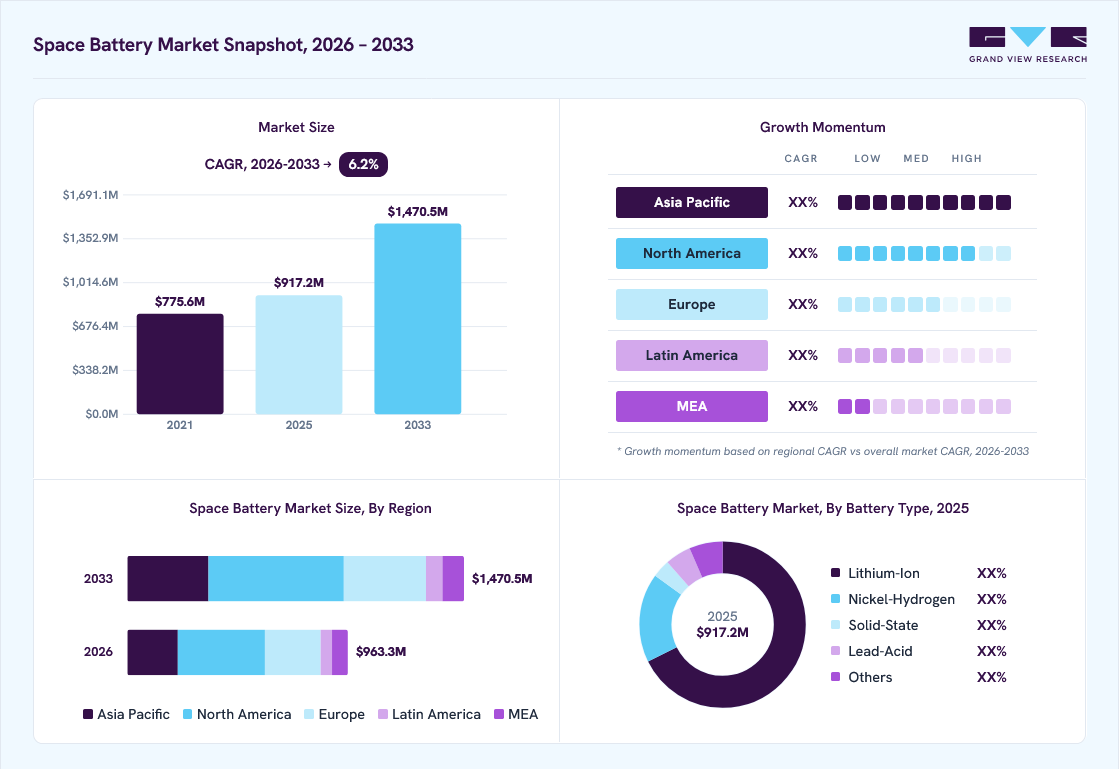
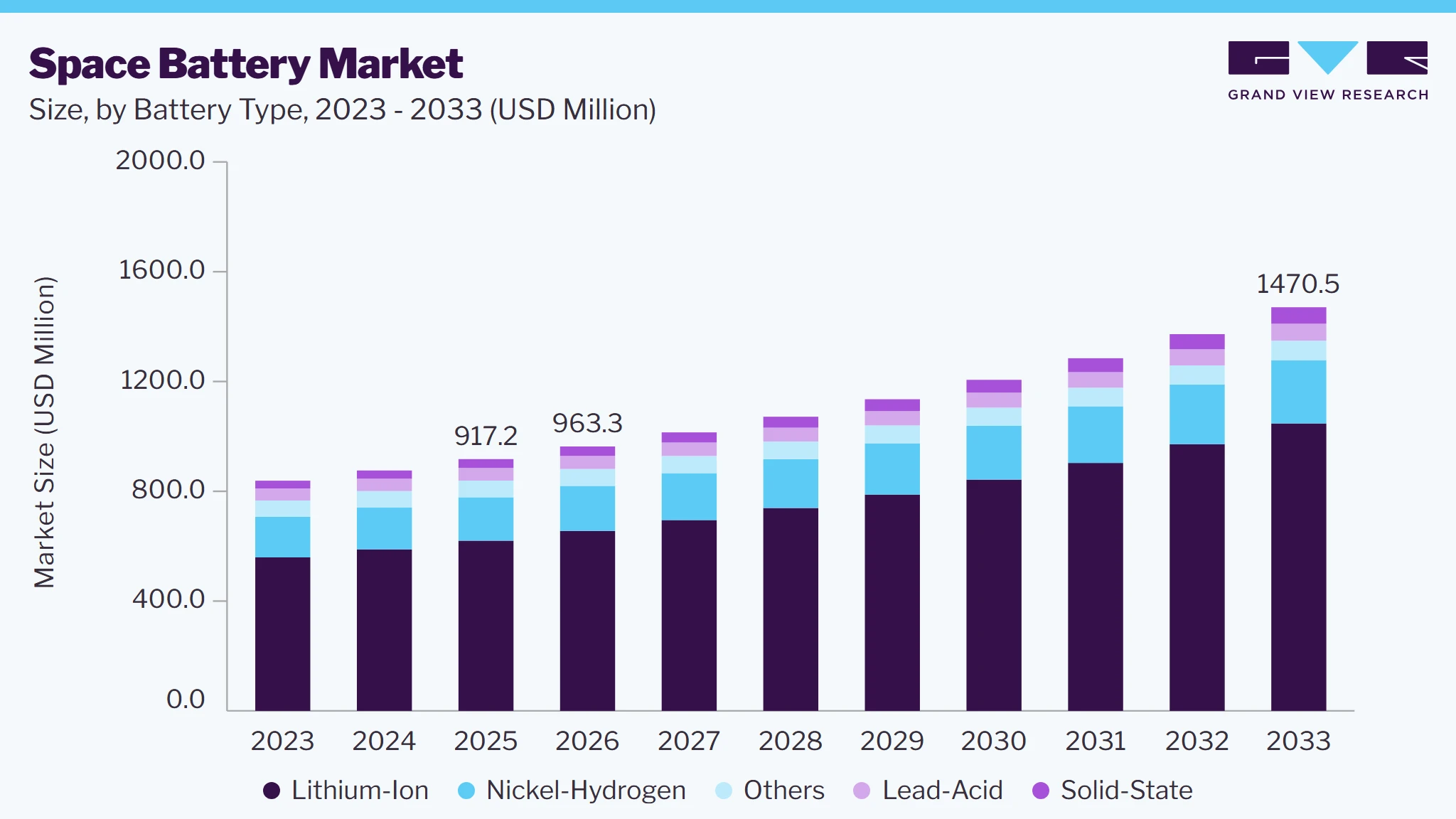
The global space battery market size was valued at USD 917.2 million in 2025 and is projected to grow from USD 963.3 million in 2026 to USD 1,470.5 million by 2033, at a CAGR of 6.2% from 2026 to 2033. The market in North America dominated with a revenue share of 39.4% in 2025. The market growth is driven by the increasing deployment of commercial satellites, expanding satellite constellations, rising demand for reliable onboard power systems, and growing investment in lunar and deep-space exploration missions.
 Source: Grand View Research, IR Documents, Primary Interviews, Paid DatabasesTo learn more about this report,
 Download Free Sample Report
 Key Market Trends & Insights
- By battery type: Lithium-ion segment held the largest market share of 67.6% in 2025.
- By power capacity: 1-10 kW segment held the largest market share of 44.8% in 2025.
- By technology: Rechargeable segment held the largest market share of 80.8% in 2025.
- By spacecraft type: Satellites segment held the largest market share of 47.9% in 2025.
- By application: Power storage segment held the largest market share of 48.0% in 2025.
- By end use: Government segment held the largest market share of 34.8% in 2025.
Regional Highlights
- Largest regional market: North America (39.4% revenue share, 2025)
- Fastest-growing regional market: Asia Pacific (highest CAGR, 2026-2033)
- By country: The U.S. held the largest market share in 2025
Market Size & Forecast
- Market size in 2025: USD 917.2 Million
- Estimated market size in 2026: USD 963.3 Million
- Projected market size by 2033: USD 1,470.5 Million
- CAGR (2026-2033): 6.2%
Three ways to get this report
Buy it, customize it, or ask a question.Ask an Analyst
Analyst response in 1 business day
- AccessReport author, directly
- Reply timeWithin 1 working day
- No sales callDirect answer only
- FormatEmail reply
- CostFree, no cost
Get the Full Report
What the study covers
- FormatsPDF · Excel · Dashboard
- Timeline2026–2033 annual, 2025 base
- Coverage20+ countries, 5 regions
- Companies10+ key players profiled
Customize the Report
20% free customization
- IncludeCountries, segments, points
- TailorTo your product definition
- ExtendDeeper competitor detail
- OrA fully bespoke study
- Turnaround5–10 working days
The adoption of high-energy-density lithium-ion batteries, increasing spacecraft power requirements, longer mission durations, and advancements in rechargeable and solid-state battery technologies are accelerating demand for space batteries.
The growth of the space battery market is driven by the increasing deployment of small satellites, rising demand for high-reliability power systems in low-Earth orbit missions, and the expansion of commercial space infrastructure. The proliferation of satellite mega-constellations, electric propulsion systems, autonomous spacecraft, on-orbit servicing missions, lunar exploration programs, and high-power payloads is encouraging spacecraft manufacturers and battery suppliers to develop compact, lightweight, high-cycle-life, and radiation-tolerant battery systems to support longer mission durations, higher operational loads, and increasingly complex space operations.
 To learn more about this report, Download Free Sample Report
 The increasing deployment of small satellites, CubeSats, and nanosatellites is driving demand for compact, reliable space battery systems. Satellite operators are increasingly using smaller spacecraft for Earth observation, remote sensing, scientific research, navigation, and communications applications, creating demand for batteries that can deliver dependable power within strict mass and volume constraints. The expansion of rideshare launch programs, standardized satellite platforms, and distributed satellite architectures is further encouraging manufacturers to develop lightweight battery systems with flexible configurations and high energy-to-weight ratios.
Moreover, the growing number of long-duration missions is driving demand for space batteries capable of maintaining performance across extended charge-discharge cycles and harsh orbital conditions. Space agencies and spacecraft operators are increasingly planning missions involving lunar surface operations, deep-space exploration, planetary science, and extended orbital service, requiring batteries with high cycle stability, low degradation, and reliable performance under temperature extremes. The need to reduce battery replacement requirements in inaccessible environments is further encouraging investment in advanced cell chemistries, improved battery management systems, and enhanced thermal-control technologies.
Market Dynamics
The space battery industry is experiencing steady growth, driven by the increasing complexity of spacecraft power architectures, rising demand for uninterrupted electrical power during orbital and mission-critical operations, and growing investment in next-generation space platforms. Spacecraft manufacturers and space agencies are increasingly requiring battery systems capable of handling frequent charge-discharge cycles, rapid load variations, radiation exposure, and extreme thermal conditions while maintaining stable performance throughout the mission. The growing adoption of high-power payloads, advanced communication systems, electric propulsion, and autonomous spacecraft operations is further encouraging the development of higher-performance, lightweight, and highly reliable battery technologies.
The increasing integration of high-power payloads, electric propulsion, high-resolution imaging systems, advanced communications, and onboard computing is raising spacecraft electricity requirements. These systems require batteries capable of delivering stable power during peak-demand periods while maintaining performance through repeated orbital charge-discharge cycles. The deployment of sophisticated spacecraft architectures is therefore encouraging manufacturers to improve energy density, thermal management, cycle life, radiation tolerance, and battery management capabilities to meet increasingly demanding mission requirements.
The expansion of large satellite platforms, high-throughput communication payloads, autonomous spacecraft, and complex scientific missions is further increasing requirements for dependable energy storage. Batteries must support spacecraft operations during eclipse periods, transient power demands, payload activation, and other periods when primary power generation is insufficient. These requirements are encouraging spacecraft manufacturers to adopt advanced lithium-ion architectures and increasingly evaluate next-generation chemistries offering improved specific energy, operational reliability, and mission endurance.
Space battery development is constrained by stringent qualification requirements covering vibration, thermal cycling, vacuum exposure, radiation, electromagnetic compatibility, safety, and long-duration reliability. Battery systems must demonstrate consistent performance under severe launch and orbital conditions before being incorporated into missions, resulting in extensive testing requirements. The qualification process can increase development timelines, engineering costs, validation workloads, and technical risks, particularly for manufacturers introducing new cell chemistries or battery architectures.
The requirement for proven flight heritage creates barriers for newer battery technologies entering space applications. Spacecraft operators generally prioritize technologies with established reliability because battery failures can compromise mission operations and cannot be easily corrected after launch. Promising solid-state cells, advanced lithium-based chemistries, and novel battery configurations may require substantial testing before achieving acceptance for critical missions, limiting their near-term adoption across conservative spacecraft procurement programs.
The development of high-energy solid-state batteries presents an opportunity to improve spacecraft energy storage through higher energy density, enhanced safety, and improved resistance to thermal or mechanical stresses. Solid-state architectures replace conventional liquid electrolytes with solid materials, potentially reducing leakage and flammability concerns while enabling advanced cell designs. These characteristics make technology particularly attractive for missions where minimizing battery mass, improving reliability, and maximizing available onboard energy are important design priorities.
Advancements in solid electrolytes, lithium-metal anodes, thin-film architectures, and manufacturing processes are supporting the development of batteries designed for demanding space environments. Research programs are increasingly evaluating solid-state technologies for lunar, planetary, satellite, and other specialized missions where conventional batteries face limitations related to temperature, mass, or energy density. Continued improvements in cell durability, manufacturing scalability, qualification procedures, and thermal performance could enable broader incorporation of solid-state batteries into future spacecraft power architectures.
Market Concentration & Characteristics
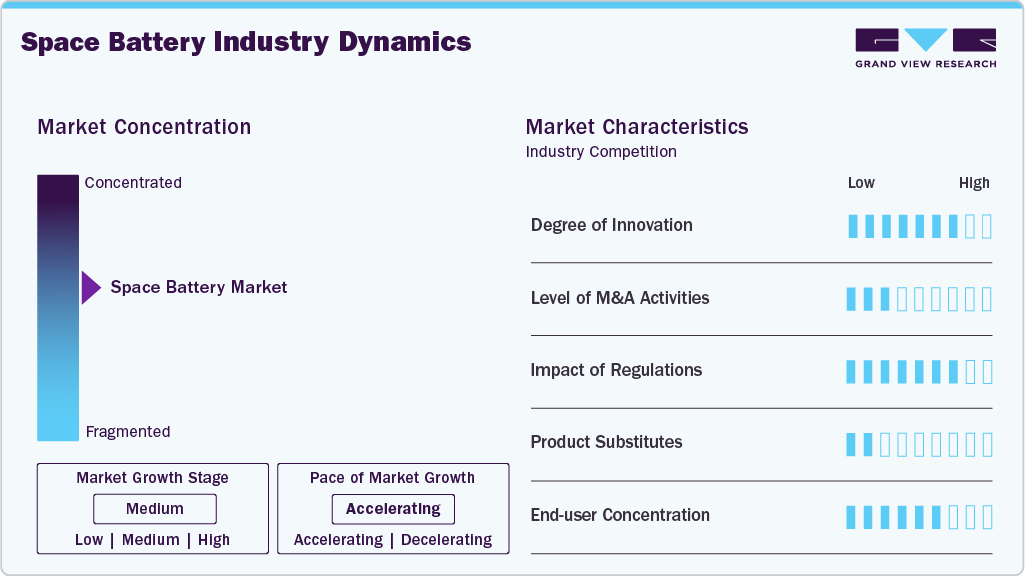
The space battery market is moderately concentrated, comprising established space battery manufacturers, aerospace and defense companies, specialized battery developers, and integrated spacecraft power-system providers competing across lithium-ion, nickel-hydrogen, solid-state, primary, and other advanced battery technologies. The market is shaped by increasing requirements for reliable onboard energy storage, higher spacecraft power loads, longer mission durations, and the expansion of commercial satellite deployments. Long-term supply agreements, technology partnerships, space-agency contracts, qualification programs, and investments in advanced battery development are enabling companies to strengthen their portfolios and expand their presence across satellite, exploration, defense, and commercial space missions.
 To learn more about this report, Download Free Sample Report
 The market is characterized by a high degree of innovation, supported by continuous advancements in high-energy-density cells, lithium-metal architectures, solid-state batteries, thermal management, battery management systems, radiation tolerance, lightweight designs, and high-cycle-life technologies. The market witnesses moderate merger and acquisition activity, as established aerospace, defense, and energy companies seek specialized battery technologies, space-qualified capabilities, and complementary power-management expertise. Competition from alternative power-storage technologies, including primary batteries, fuel cells, supercapacitors, and other specialized energy systems, remains relevant, while increasing adoption of high-power payloads, electric propulsion, autonomous spacecraft, lunar missions, and long-duration exploration programs continues to strengthen product differentiation and technology requirements.
Analyst Perspective
The space battery market is advancing through the increasing demand for dependable energy storage across increasingly complex spacecraft architectures, rising requirements for power availability during eclipse periods, and greater emphasis on mission reliability. Battery manufacturers are strengthening product portfolios through improved cell packaging, advanced battery management systems, thermal control, radiation tolerance, high-cycle-life designs, and lightweight architectures. The expansion of on-orbit servicing, satellite refueling concepts, autonomous spacecraft, lunar infrastructure, and reusable space platforms is encouraging suppliers to develop adaptable battery systems that support diverse mission profiles and extended operational requirements.
Battery Type Insights
The lithium-Ion segment accounted for the largest market share of 67.6% in 2025, propelled by its high energy density, lightweight construction, long cycle life, and established flight heritage across satellite and spacecraft missions. Spacecraft operators increasingly favor lithium-ion batteries because they provide greater energy storage within constrained mass and volume requirements while supporting repeated charge-discharge cycles during orbital operations. Improvements in cell reliability, thermal management, battery management systems, and space qualification are further strengthening the adoption of lithium-ion batteries across the space battery industry.
The solid-state segment is expected to witness the highest CAGR of over 8.0% from 2026 to 2033. The segment is driven by increasing demand for higher energy density, improved thermal stability, enhanced safety, and lightweight battery architectures for demanding space missions. Developers are increasingly exploring solid electrolytes and lithium-metal configurations to reduce battery mass while increasing stored energy. Growing requirements for lunar operations, deep-space exploration, extreme-temperature performance, and long-duration missions are expected to accelerate the development and adoption of solid-state batteries.
Power Capacity Insights
The 1-10 kW segment accounted for the largest market share of 44.8% in 2025, fueled by the widespread deployment of small and medium-sized satellites, CubeSats, Earth observation platforms, and communication spacecraft requiring moderate onboard energy storage. Battery systems in this capacity range strike a practical balance among energy availability, system weight, and spacecraft power requirements. Increasing satellite miniaturization, standardized spacecraft platforms, rideshare missions, and demand for reliable power during eclipse periods continue to strengthen the position of the 1-10 kW segment.
The more than 100 kW segment is expected to witness the highest CAGR from 2026 to 2033, driven by increasing power requirements for large spacecraft, space stations, high-capacity communication payloads, advanced scientific instruments, and electric propulsion systems. Spacecraft developers are increasingly adopting high-power architectures to support energy-intensive payloads, rapid data processing, high-throughput communications, and complex orbital operations. The expansion of large satellite platforms, lunar infrastructure, and power-intensive exploration missions is supporting demand for high-capacity battery systems.
Technology Insights
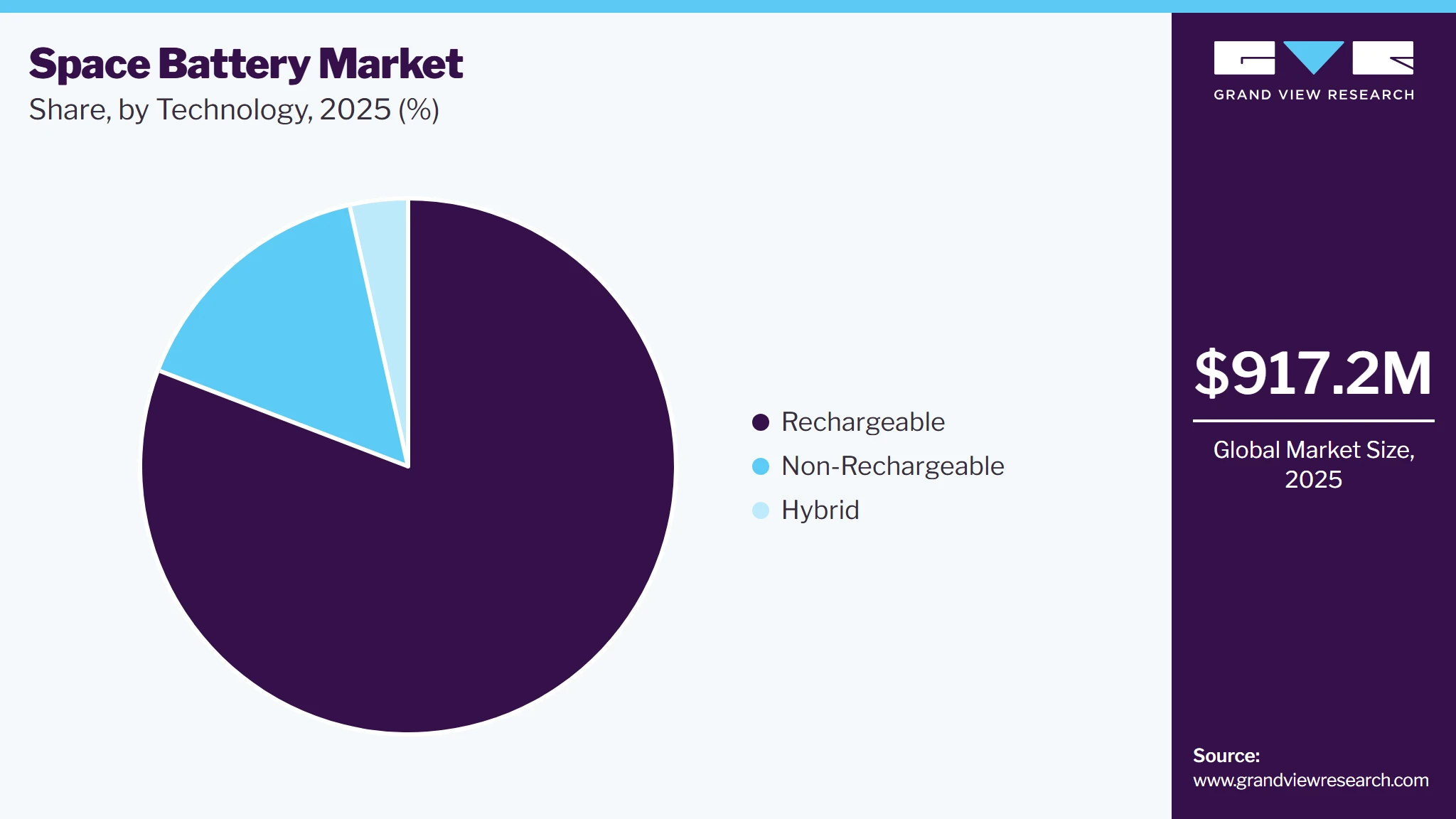
The rechargeable segment accounted for the largest market share of 80.8% in 2025, driven by the need for repeated energy storage and discharge cycles during spacecraft operations, particularly when primary power generation is unavailable. Spacecraft operators increasingly rely on rechargeable batteries to support eclipse periods, peak-load requirements, payload operations, and power stabilization without replacing the battery throughout the mission. Advances in lithium-ion technology, including improved cycle life, battery management systems, and reliable charge-discharge performance, continue to strengthen the adoption of rechargeable batteries.
 To learn more about this report, Download Free Sample Report
 The hybrid segment is expected to witness the highest CAGR from 2026 to 2033, driven by increasing demand for integrated power architectures combining multiple energy-storage or power-generation technologies to address mission-specific requirements. Spacecraft developers are increasingly evaluating hybrid configurations that can balance energy density, rapid power delivery, operational reliability, and extended mission endurance. Growing requirements for high-power payloads, electric propulsion, autonomous spacecraft, and complex lunar or deep-space missions are further encouraging the adoption of hybrid power solutions in the space battery industry.
Spacecraft Type Insights
The satellites segment accounted for the largest market share of 47.9% in 2025, fueled by the rapid deployment of communication satellites, Earth observation platforms, navigation satellites, and small satellite constellations requiring dependable onboard energy storage. Satellite operators increasingly require batteries capable of supporting eclipse operations, payload activation, power fluctuations, and repeated charge-discharge cycles throughout extended missions. The expansion of satellite constellations, increasing spacecraft miniaturization, and demand for lightweight, high-energy-density battery systems continue to strengthen battery adoption across satellite platforms.
The space rovers segment is expected to witness the highest CAGR from 2026 to 2033, driven by increasing lunar and planetary exploration missions requiring reliable energy storage under extreme environmental conditions. Rover developers are increasingly seeking batteries capable of operating through severe temperature variations, extended periods without sunlight, dust exposure, and demanding surface mobility operations. Growing investments in lunar exploration, autonomous planetary vehicles, scientific payloads, and long-duration surface missions are further accelerating demand for lightweight, high-cycle-life, and temperature-resilient battery technologies.
Application Insights
The power storage segment accounted for the largest market share of 48.0% in 2025, fueled by the increasing need for continuous electrical power during orbital eclipse periods, peak operational loads, and temporary interruptions in primary power generation. Spacecraft operators increasingly deploy batteries to store energy generated by solar arrays and release it when required for payloads, communications, navigation, and onboard systems. Rising satellite deployment, longer mission durations, and growing spacecraft power requirements continue to strengthen demand for reliable onboard energy-storage systems.
The spacecraft propulsion support segment is expected to witness the highest CAGR from 2026 to 2033, driven by increasing adoption of electric propulsion systems requiring dependable electrical power for extended orbital maneuvers and station-keeping operations. Spacecraft developers are increasingly integrating higher-power propulsion technologies that demand batteries capable of handling rapid power delivery, repeated cycling, and variable electrical loads. The growing deployment of high-efficiency propulsion systems, orbital transfer missions, satellite servicing activities, and advanced spacecraft architectures is further accelerating demand for battery systems that support propulsion operations.
End Use Insights
The government segment accounted for the largest market share of 34.8% in 2025, fueled by sustained public investment in satellite programs, space exploration missions, Earth observation systems, navigation infrastructure, and scientific spacecraft. Government agencies increasingly require highly reliable batteries to support mission-critical operations, long-duration orbital missions, and specialized spacecraft platforms. National space programs, institutional satellite deployments, technology demonstration missions, and procurement of space-qualified power systems continue to strengthen demand for advanced battery solutions within government-funded space programs.
The commercial segment is expected to witness the highest CAGR from 2026 to 2033, driven by increasing deployment of commercial satellite constellations, private Earth observation platforms, satellite communications systems, and emerging in-orbit services. Commercial spacecraft operators are increasingly seeking lightweight batteries offering high energy density, extended cycle life, rapid power delivery, and lower maintenance requirements to improve spacecraft efficiency. Growing private investment, expanding small-satellite deployments, rideshare launches, and development of commercial orbital platforms are further accelerating demand for advanced space battery systems in the market.
Regional Insights
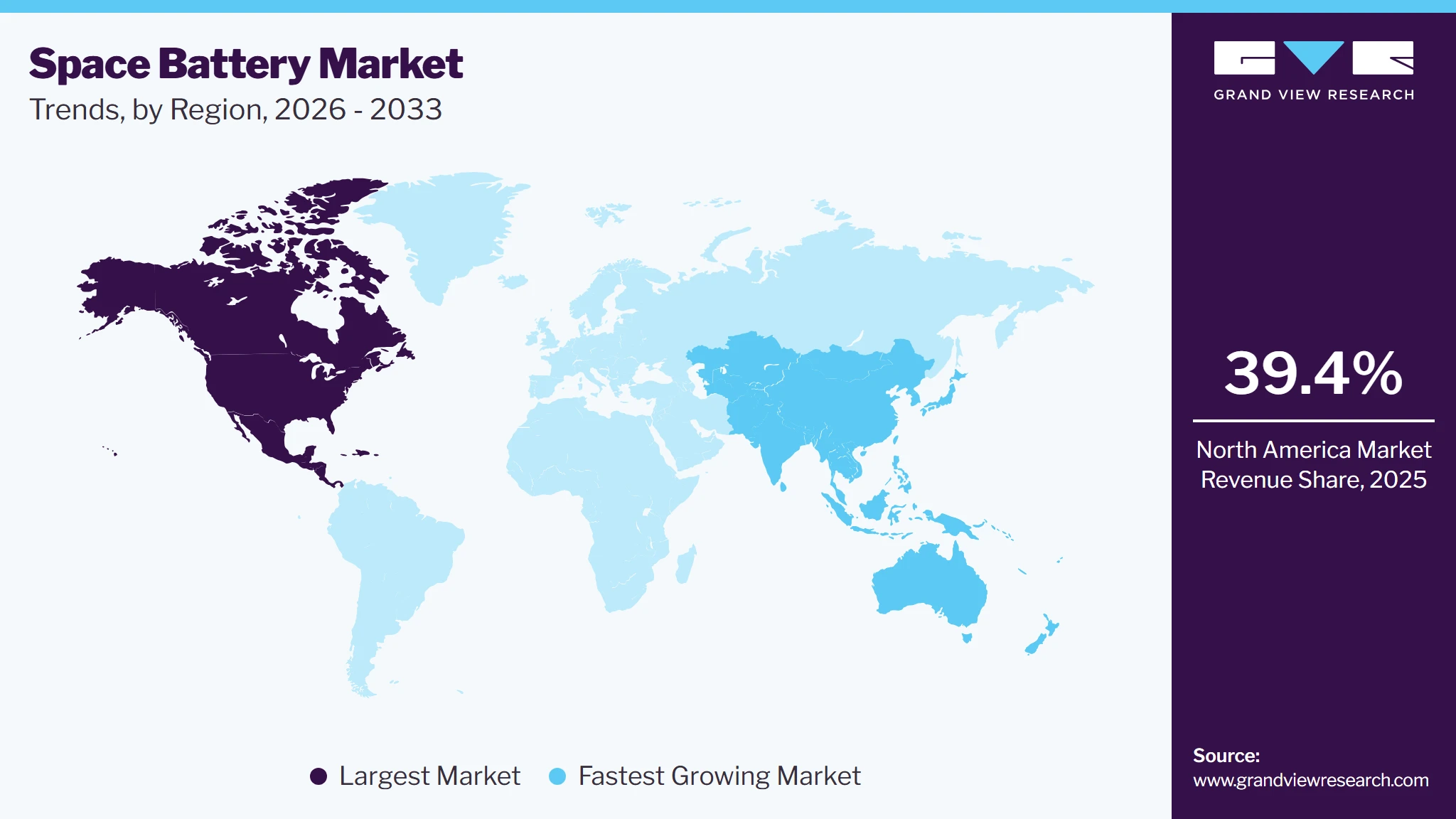
North America space battery dominated the market with a share of 39.4% in 2025, driven by the region’s strong spacecraft manufacturing base, increasing satellite deployments, and substantial government investment in space exploration and defense programs. The U.S. and Canada have well-established aerospace ecosystems supporting satellite, launch vehicle, and space exploration activities. The presence of leading battery manufacturers, spacecraft integrators, research institutions, and government space programs is further supporting the development of high-energy-density, radiation-tolerant, and long-life battery systems for increasingly complex missions.
 To learn more about this report, Download Free Sample Report
 U.S. Space Battery Market Trends
The U.S. space battery market dominated, with a share of 89.5% in 2025, driven by extensive satellite deployments, strong defense-space spending, and increasing investment in lunar exploration and advanced spacecraft programs. The country's large aerospace and defense ecosystem is driving demand for reliable energy storage systems to support communications, Earth observation, navigation, surveillance, and scientific missions. The presence of established space battery manufacturers, NASA programs, commercial launch providers, and satellite developers is also facilitating technological advancements in lithium-ion batteries, thermal management, battery monitoring, and high-reliability power systems.
Europe Space Battery Market Trends
Europe space battery market is expected to grow at a significant CAGR of 5.7% from 2026 to 2033. The market growth is driven by increasing satellite manufacturing activity, expanding Earth observation programs, and rising investments in independent European space capabilities. The region benefits from established aerospace manufacturing networks, government-backed space programs, and increasing deployment of communication and navigation satellites. The growing emphasis on sustainable spacecraft technologies, advanced power-management systems, and high-efficiency energy storage is encouraging battery suppliers to develop lightweight and reliable solutions for commercial, scientific, and institutional missions.
The space battery market in UK is expected to grow significantly in the coming years, driven by expanding satellite development, increasing defense-space investments, and growing participation in commercial space missions. The country has a well-established aerospace ecosystem supporting satellite communications, Earth observation, navigation, and scientific applications. The increasing development of small satellites and responsive spacecraft is creating demand for compact battery systems with high energy density and flexible configurations. Government-backed space initiatives, private satellite companies, and specialized technology developers are further advancing spacecraft energy-storage solutions.
The Germany space battery market is supported by the country's strong aerospace manufacturing capabilities, increasing satellite production, and expanding investment in advanced spacecraft technologies. German companies and research organizations are actively involved in satellite systems, space exploration, and high-reliability power technologies. The increasing demand for lightweight spacecraft components, efficient power-management architectures, and batteries capable of operating under extreme thermal conditions is supporting technology development. Growing participation in European space programs is also encouraging collaboration between battery developers, spacecraft manufacturers, research institutions, and government organizations.
Asia Pacific Space Battery Market Trends
The Asia Pacific space battery market is expected to grow at the highest CAGR of 7.0% from 2026 to 2033, driven by increasing satellite launches, expanding national space programs, and rising investments in commercial space infrastructure. Japan, China, India, South Korea, and Australia represent important centers for satellite manufacturing, launch activities, space research, and emerging commercial missions. The proliferation of Earth observation satellites, communications spacecraft, navigation systems, and scientific missions is supporting demand for reliable onboard energy storage. Increasing domestic development of space-qualified battery technologies is further strengthening regional supply capabilities.
The space battery market in Japan is gaining traction owing to the country's advanced satellite manufacturing capabilities, established space exploration programs, and strong expertise in high-reliability electronics. Japanese aerospace organizations and manufacturers are developing batteries for demanding satellite and exploration missions that require long operational life and stable performance. The increasing deployment of Earth observation spacecraft, scientific satellites, and exploration missions is supporting demand for advanced rechargeable battery systems. Japan's emphasis on lightweight components, precision manufacturing, and sophisticated spacecraft power management is further encouraging innovation in the space battery industry.
The China space battery market is expanding rapidly, driven by frequent satellite launches, large-scale constellation development, and increasing investment in independent space infrastructure. Chinese spacecraft manufacturers are increasingly deploying satellites for communications, navigation, remote sensing, Earth observation, and scientific applications, creating substantial requirements for onboard energy storage. Increased domestic development of lithium-ion cells, battery management systems, and space-qualified power components is strengthening local supply chains while supporting the deployment of increasingly sophisticated spacecraft.
Key Space Battery Company Insights
Some of the key players operating in the market are Saft Groupe SAS and EaglePicher Technologies, among others.
-
Saft Groupe SAS is a major player in the space battery market through its extensive space-qualified lithium-ion portfolio, long flight heritage, and broad coverage of satellite and exploration missions. The company supplies rechargeable Li-ion batteries for GEO, MEO, and LEO satellites, as well as launchers, rovers, planetary landers, and deep-space probes. Saft's batteries are designed for extreme vibration, shock, vacuum, radiation, and temperature conditions, while its modular battery architectures incorporate intelligent cell balancing and battery management capabilities.
-
EaglePicher Technologies is a major player in the space battery industry through its extensive flight heritage, broad electrochemical portfolio, and established satellite battery manufacturing capabilities. The company has supplied batteries for more than 600 satellites and has supported missions including the Hubble Space Telescope, International Space Station, GPS programs, Mars rovers, and launch vehicles. Its portfolio includes rechargeable lithium-ion batteries, thermal batteries, lithium-carbon monofluoride cells, and customized space battery systems, enabling it to serve diverse mission requirements.
KULR Technology Group, Inc. and Ultralife Corporation are some of the emerging market participants in the space battery market.
-
KULR Technology Group, Inc. is an emerging player in the space battery industry through its KULR ONE Space battery platform, which combines lightweight battery architectures with passive thermal-runaway protection and customized power-system designs. The company's space battery solutions are designed around NASA JSC 20793 requirements and incorporate screened lithium-ion cells, thermal protection, flame-arresting structures, and optional radiation-tolerant battery-management systems. These capabilities position KULR to address emerging requirements for small spacecraft and specialized missions.
-
Ultralife Corporation is an emerging specialized player in the space battery market through its expertise in lightweight, high-energy-density lithium-based cells, rechargeable battery packs, and customized power solutions. The company offers multiple lithium chemistries, including lithium-ion, lithium manganese dioxide, lithium thionyl chloride, and lithium-carbon monofluoride/manganese dioxide technologies, with products designed for demanding mission-critical applications. Its broad battery engineering capabilities and experience serving government and defense customers provide a foundation for expansion into specialized space power applications.
Key Space Battery Market Companies
The following key companies have been profiled for this study on the space battery market.
-
Saft Groupe SAS
-
EaglePicher Technologies
-
EnerSys
-
GS Yuasa International Ltd.
-
Mitsubishi Electric Corporation
-
KULR Technology Group, Inc.
-
Panasonic Energy Co., Ltd.
-
Samsung SDI Co., Ltd.
-
LG Energy Solution, Ltd.
-
Ultralife Corporation
Competitive Benchmarking
Operating Strategies
Competitive Edge
Weaknesses
Mature Players: [Saft Groupe SAS, EaglePicher Technologies, EnerSys]
Focus on expanding space-qualified battery portfolios across satellites, spacecraft, launch vehicles, and exploration missions.
Invest heavily in R&D to improve energy density, cycle life, thermal management, and radiation tolerance.
- Extensive flight heritage, established customer relationships, and proven reliability support strong market positioning.
- Ability to deliver customized, high-reliability battery systems meeting stringent spacecraft qualification and mission requirements.
- High qualification costs and complex validation processes can slow the introduction of newer battery technologies.
- Reliance on established battery chemistries may limit agility in adopting emerging solid-state technologies.
Emerging Players: [KULR Technology Group, Inc., Panasonic Energy Co., Ltd., Ultralife Corporation]
Emerging player, focusing on developing lightweight, high-energy-density battery systems for emerging small-satellite and exploration missions.
Invest in advanced cell chemistries, thermal management, and modular architectures to differentiate specialized space batteries.
- Greater technological agility enables rapid development of innovative battery architectures for evolving spacecraft requirements.
- Specialized expertise in thermal safety, advanced materials, and customized designs supports differentiated mission-specific solutions.
- Limited flight heritage and qualification history can restrict adoption in highly critical spacecraft missions.
- Smaller production capabilities may constrain large-scale manufacturing, supply consistency, and long-duration customer commitments.
Recent Developments
-
In April 2026, EnerSys refreshed its ABSL space battery product documentation, covering multiple 28 V and 100 V battery configurations. The updated portfolio reinforces EnerSys’ focus on modular, high-reliability lithium-ion systems for satellites and other spacecraft applications. The company’s ABSL platform has extensive flight heritage, supporting applications ranging from Earth-orbiting satellites to deep-space missions. This development strengthens EnerSys’ positioning in configurable spacecraft power systems and reflects continued investment in the space battery industry.
-
In December 2025, KULR Technology Group, Inc., KULR ONE Space 400 series was highlighted as its largest space battery platform, incorporating technology developed through work with NASA. The battery uses KULR's Thermal Runaway Shield, based on lightweight carbon fiber and phase-change materials, to contain heat generated during lithium-ion cell thermal runaway. The development strengthens KULR's portfolio of flight-oriented battery systems for demanding space missions and expands its application of NASA-derived battery-safety technology.
-
In November 2025, LG Energy Solution, Ltd. partnered with South 8 Technologies to develop space-rated lithium-ion batteries capable of operating in extreme environments down to approximately -60°C. The collaboration combines LG Energy Solution's battery-development capabilities with South 8's cryogenic electrolyte technology, targeting battery systems for demanding aerospace applications. The initiative strengthens LG Energy Solution's positioning in the specialized space energy storage market and addresses the need for batteries capable of maintaining performance under extreme temperature conditions.
Space Battery Market Report Scope
Report Attribute
Details
Market size in 2025
USD 917.2 million
Estimated market size in 2026
USD 963.3 million
Projected market size by 2033
USD 1,470.5 million
Growth rate
CAGR of 6.2% from 2026 to 2033
Base year for estimation
2025
Historical data
2021 - 2024
Forecast period
2026 - 2033
Quantitative units
Revenue in USD million and CAGR from 2026 to 2033
Report coverage
Revenue forecast, company share, competitive landscape, growth factors, and trends
Segments covered
Battery type, power capacity, technology, spacecraft type, application, end use, and region
Regional scope
North America; Europe; Asia Pacific; Latin America; Middle East and Africa
Country scope
U.S.; Canada; Mexico; UK; Germany; France; China; Japan; India; South Korea; Australia; Brazil; UAE; Saudi Arabia; South Africa
Key companies profiled
Saft Groupe SAS; EaglePicher Technologies; EnerSys; GS Yuasa International Ltd.; Mitsubishi Electric Corporation; KULR Technology Group, Inc.; Panasonic Energy Co., Ltd.; Samsung SDI Co., Ltd.; LG Energy Solution, Ltd.; Ultralife Corporation
Customization scope
Free report customization (equivalent to up to 8 analyst working days) with purchase. Addition or alteration to country, regional & segment scope.
Pricing and purchase options
Avail customized purchase options to meet your exact research needs. Explore purchase options
Global Space Battery Market Report Segmentation
This report forecasts revenue growth at global, regional, and country levels and provides an analysis of the latest industry trends in each of the sub-segments from 2021 to 2033. For this study, Grand View Research has segmented the global space battery market report based on battery type, power capacity, technology, spacecraft type, application, end use, and region.
-
Battery Type Outlook (Revenue, USD Million, 2021 - 2033)
-
Lithium-Ion
-
Nickel-Hydrogen
-
Solid-State
-
Lead-Acid
-
Others
-
-
Power Capacity Outlook (Revenue, USD Million, 2021 - 2033)
-
Less than 1 kW
-
1-10 kW
-
11-100 kW
-
More than 100 kW
-
-
Technology Outlook (Revenue, USD Million, 2021 - 2033)
-
Rechargeable
-
Non-Rechargeable
-
Hybrid
-
-
Spacecraft Type Outlook (Revenue, USD Million, 2021 - 2033)
-
Space Stations
-
Space Probes
-
Space Rovers
-
Satellites
-
Launch Vehicles
-
Others
-
-
Application Outlook (Revenue, USD Million, 2021 - 2033)
-
Power Storage
-
Peak Load Support
-
Emergency / Backup Power
-
Spacecraft Propulsion Support
-
Others
-
-
End Use Outlook (Revenue, USD Million, 2021 - 2033)
-
Commercial
-
Government
-
Research
-
Defense
-
Others
-
-
Regional Outlook (Revenue, USD Million, 2021 - 2033)
-
North America
-
U.S.
-
Canada
-
Mexico
-
-
Europe
-
UK
-
Germany
-
France
-
-
Asia Pacific
-
China
-
Japan
-
India
-
South Korea
-
Australia
-
-
Latin America
-
Brazil
-
-
Middle East and Africa
-
UAE
-
Saudi Arabia
-
South Africa
-
-
Research Methodology
The space battery market figures in this report are based on a structured research process that combines executive interviews with secondary research from proprietary databases, company filings, industry publications, and recognized space agency and institutional sources. Market size is developed through value-chain sizing, reconciling supply-side and demand-side estimates, and triangulating using bottom-up and top-down approaches. Each estimate undergoes multiple levels of expert validation before publication, with every space battery segment quantified according to the revenue-capture definitions provided in the table below.
Segment Definition
Battery Type
Revenue Capture Definition
Lithium-Ion
Revenue is generated from lithium-ion batteries designed for spacecraft, satellites, launch vehicles, and other space missions, including rechargeable cells, battery packs, and integrated battery systems.
Nickel-Hydrogen
Revenue is generated from nickel-hydrogen batteries used in spacecraft power systems, particularly for applications requiring long cycle life, high reliability, and repeated charge-discharge performance.
Solid-State
Revenue is generated from solid-state batteries incorporating solid electrolytes for spacecraft applications requiring higher energy density, improved safety, reduced weight, and reliable operation under demanding space conditions.
Lead-Acid
Revenue is generated from lead-acid batteries supplied for space-related applications that require established, cost-effective energy storage solutions, including specialized spacecraft or ground-support power systems.
Others
Revenue is generated from other battery chemistries used for space applications, including lithium-polymer, silver-zinc, lithium-sulfur, and other specialized electrochemical technologies.
Power Capacity
Revenue Capture Definition
Less than 1 kW
Revenue is generated from space battery systems providing less than 1 kW of power for small satellites, CubeSats, scientific instruments, and low-power spacecraft applications.
1-10 kW
Revenue is generated from battery systems delivering 1-10 kW of power for satellites, spacecraft, payloads, communications systems, and other moderate-power mission requirements.
11-100 kW
Revenue is generated from battery systems delivering 11-100 kW of power for large spacecraft, high-power payloads, propulsion systems, and demanding orbital operations.
More than 100 kW
Revenue is generated from high-capacity battery systems exceeding 100 kW for space stations, large spacecraft, advanced propulsion systems, and other highly power-intensive missions.
Technology
Revenue Capture Definition
Rechargeable
Revenue is generated from rechargeable batteries capable of repeated energy storage and discharge cycles, supporting spacecraft operations during eclipse periods, peak loads, and temporary power interruptions.
Non-Rechargeable
Revenue is generated from primary batteries designed for single-use energy delivery in space missions that require reliable power without the need for repeated recharging.
Hybrid
Revenue is generated from hybrid battery configurations that combine different battery technologies, energy storage systems, or power generation technologies to meet specialized spacecraft power requirements.
Spacecraft Type
Revenue Capture Definition
Space Stations
Revenue is generated from battery systems supporting energy storage, power distribution, peak-load requirements, and backup operations aboard crewed or uncrewed space stations.
Space Probes
Revenue is generated from batteries used in space probes to provide stored electrical power for scientific instruments, communications, navigation, and mission operations during exploration missions.
Space Rovers
Revenue is generated from battery systems powering mobile robotic vehicles operating on planetary or lunar surfaces, including propulsion, scientific instruments, communications, and autonomous operations.
Satellites
Revenue is generated from batteries installed in satellites to store electrical energy and provide power during eclipse periods, peak loads, payload operations, and other orbital requirements.
Launch Vehicles
Revenue is generated from batteries used in launch vehicles to provide electrical power for avionics, guidance systems, communications, control systems, and other launch-stage operations.
Others
Revenue is generated from battery systems used in other spacecraft platforms, including crewed spacecraft, landers, orbital platforms, space tugs, and specialized space vehicles.
Application
Revenue Capture Definition
Power Storage
Revenue is generated from batteries used to store electrical energy generated by primary spacecraft power sources and provide stored power when required during mission operations.
Peak Load Support
Revenue is generated by battery systems that provide supplemental electrical power during temporary increases in spacecraft power demand from payloads, communications, propulsion, or onboard systems.
Emergency / Backup Power
Revenue is generated by batteries that provide emergency or backup electrical power during primary power-system interruptions, faults, or other mission-critical operating conditions.
Spacecraft Propulsion Support
Revenue is generated from batteries supplying electrical power to propulsion systems, including electric propulsion, orbital maneuvering, station-keeping, and spacecraft transfer operations.
Others
Revenue is generated from batteries that support other spacecraft functions, including avionics, communications, thermal control systems, scientific instruments, navigation, autonomous operations, and specialized mission equipment.
End Use
Revenue Capture Definition
Commercial
Revenue is generated from space batteries supplied to commercial space companies operating satellites, launch systems, communications platforms, Earth observation systems, and other commercial spacecraft.
Government
Revenue is generated from batteries supplied to government space agencies and public-sector organizations for satellites, exploration missions, scientific programs, space infrastructure, and other government-funded activities.
Research
Revenue is generated from batteries supplied for research and experimental missions conducted by research institutions, universities, laboratories, and scientific organizations requiring specialized spacecraft power systems.
Defense
Revenue is generated from batteries supplied for defense-related spacecraft, military satellites, surveillance systems, secure communications platforms, navigation systems, and other mission-critical defense applications.
Others
Revenue is generated from batteries supplied to other end users, including non-profit space organizations, academic programs, space startups, international space organizations, and technology-demonstration missions.
Estimation Model
Layer
Key Questions
Description
End-User Demand Layer
Who requires space batteries?
Identifies government space agencies, commercial space companies, defense organizations, research institutions, satellite operators, spacecraft manufacturers, launch-vehicle developers, and other organizations requiring reliable energy-storage systems for space missions.
Battery Development Layer
Who can provide space batteries?
Battery development involves specialized battery manufacturers, aerospace companies, cell manufacturers, spacecraft power-system providers, and technology developers supporting cell chemistry, battery-pack design, thermal management, battery management systems, qualification, and mission-specific customization.
Space Battery Deployment Layer
Where are space batteries currently deployed?
Space batteries are deployed across satellites, space stations, probes, rovers, launch vehicles, crewed spacecraft, and other orbital or exploration platforms supporting communications, Earth observation, scientific research, navigation, defense, propulsion, and exploration missions.
Revenue Generation Layer
How is revenue generated?
Revenue is generated through the sale of space-qualified battery cells, battery packs, integrated battery systems, customized power-storage solutions, battery management systems, replacement units, engineering services, qualification support, testing, maintenance, and long-term supply agreements with spacecraft and mission operators.
Delivered Customizations
This report has been delivered with the following in-depth customizations
Client Request
Customization Delivered
Value Adds
Space-Qualified Battery Technology Assessment
Conducted detailed evaluation of lithium-ion, nickel-hydrogen, solid-state, lead-acid, and other battery technologies across satellite, spacecraft, rover, probe, and launch-vehicle applications, assessing energy density, cycle life, reliability, and qualification requirements.
Supports technology selection, improves battery performance, reduces mission risks, and strengthens spacecraft power-system planning.
Space Battery Capacity & Power Architecture Strategy
Assessed battery requirements across less than 1 kW, 1-10 kW, 11-100 kW, and more than 100 kW systems, evaluating spacecraft power loads, eclipse requirements, peak-load support, propulsion demands, and mission-specific energy-storage configurations.
Optimizes capacity selection, improves power reliability, supports mission design, and enhances battery-system efficiency.
Advanced Battery Innovation & Commercialization Strategy
Evaluated emerging solid-state, hybrid, high-energy-density, radiation-tolerant, and lightweight battery technologies, assessing development maturity, space qualification requirements, thermal performance, manufacturing readiness, and adoption opportunities across future spacecraft missions.
Identifies innovation opportunities, supports commercialization planning, improves technology positioning, and strengthens competitive differentiation.
Frequently Asked Questions About This Report
The global space battery market size was valued at USD 917.2 million in 2025 and is estimated at USD 963.3 million for 2026.
The lithium-Ion segment dominated with a 67.6% revenue share in 2025.
North America dominated the space battery market with a share of 39.4% in 2025.
Key factors that are driving the market growth include increasing deployment of commercial satellites, expanding satellite constellations, rising demand for reliable onboard power systems, and growing investment in lunar and deep-space exploration missions.
Some key players operating in the space battery market include Saft Groupe SAS, EaglePicher Technologies, EnerSys, GS Yuasa International Ltd., Mitsubishi Electric Corporation, KULR Technology Group, Inc., Panasonic Energy Co., Ltd., Samsung SDI Co., Ltd., LG Energy Solution, Ltd., Ultralife Corporation
The Asia Pacific is the fastest-growing region with a CAGR of over 7.0% from 2026 to 2033.
The 1–10 kW segment dominated with a 44.8% revenue share in 2025.
The power storage segment dominated the market with a share of 48.0% in 2025.
The government segment led with a 34.8% revenue share in 2025, while the commercial segment is the fastest-growing.
The global space battery market is expected to grow at a CAGR of 6.2% from 2026 to 2033, reaching USD 1,470.5 million by 2033.
About the Author(s)
Next Generation Technologies Research Team
Technology · Next Generation TechnologiesThis report was authored by the next generation technologies research team at Grand View Research - comprising two research analysts, one senior research analyst, and one industry expert - with specialized expertise in the next generation technologies segment of the technology industry. All findings are based on proprietary technology databases, executive interviews, and regulatory analysis, subject to internal peer review prior to publication.
Last Updated:
Speak to Analyst

Customize this report to your needs - add regions, segments, or data points, with 20% free customization.
Or view our licence options:


ISO 9001:2015 & 27001:2022 Certified
We are GDPR and CCPA compliant! Your transaction & personal information is safe and secure. For more details, please read our privacy policy.


