
- Home
- »
- Consumer F&B
- »
-
Sparkling Tea Market Size, Share & Trends Report, 2033GVR Report cover

Sparkling Tea Market (2026 - 2033)
Size, Share & Trends Analysis Report By Product (Green Tea, White Tea, Yellow Tea, Black Tea), By Category (No Alcohol, Alcohol-based), By Packaging (Glass Bottles, Plastic Bottles), By Distribution Channel, By Region, And Segment Forecasts
Market Size, 2025
$514.6MMarket Estimate, 2026
$545.7MMarket Forecast, 2033
$858.6MCAGR, 2026–2033
6.7%Sparkling Tea Market Summary
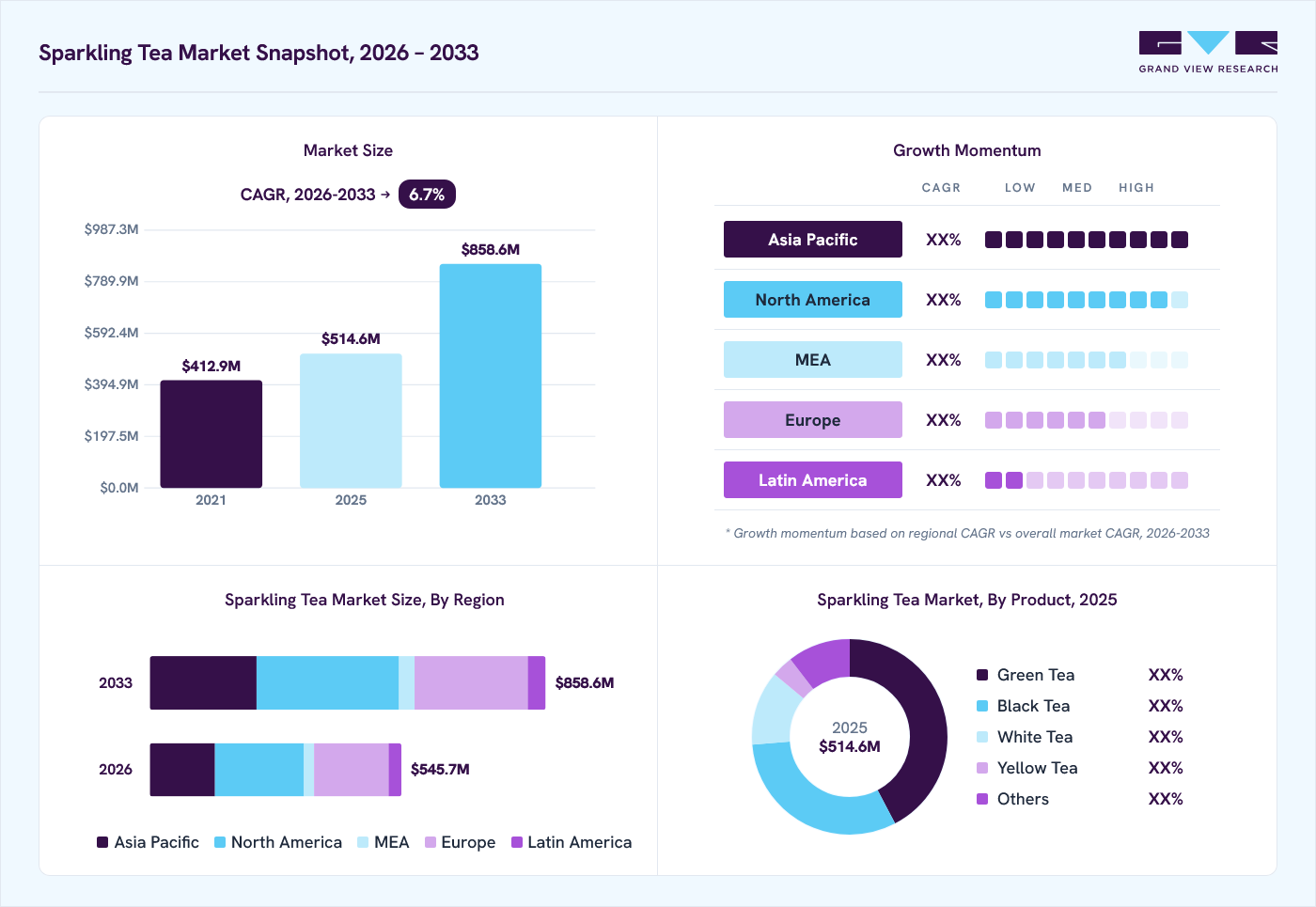
The global sparkling tea market size was valued at USD 514.6 million in 2025 and is projected to grow from USD 545.7 million in 2026 to USD 858.6 million by 2033, at a CAGR of 6.7% from 2026 to 2033. The market in North America dominated with a revenue share of 35.3% in 2025. Sparkling tea offers a unique blend of the refreshing effervescence found in carbonated drinks with the health benefits of tea, such as antioxidants, vitamins, and lower calorie content.
 Source: Grand View Research, IR Documents, Primary Interviews, Paid DatabasesTo learn more about this report,
 Download Free Sample Report
 Key Market Trends & Insights
- By category: No alcohol segment held the largest market share of 88.5% in 2025.
- By packaging: Glass bottles segment held the largest market share of 47.2% in 2025.
- By product: Green tea segment held the largest market share of 44.0% in 2025.
- By distribution channel: Supermarkets and hypermarkets segment held the largest market share of 43.7% in 2025.
Regional Highlights
- Largest regional market: North America (35.3% revenue share, 2025)
- Fastest-growing regional market: Asia Pacific (highest CAGR, 2026-2033)
- By country: The U.S. held the largest market share in 2025.
Market Size & Forecast
- Market size in 2025: USD 514.6 Million
- Estimated market size in 2026: USD 545.7 Million
- Projected market size by 2033: USD 858.6 Million
- CAGR (2026-2033): 6.7%
Three ways to get this report
Buy it, customize it, or ask a question.Ask an Analyst
Analyst response in 1 business day
- AccessReport author, directly
- Reply timeWithin 1 working day
- No sales callDirect answer only
- FormatEmail reply
- CostFree, no cost
Get the Full Report
What the study covers
- FormatsPDF · Excel · Dashboard
- Timeline2026–2033 annual, 2025 base
- Coverage20+ countries, 5 regions
- Companies10+ key players profiled
Customize the Report
20% free customization
- IncludeCountries, segments, points
- TailorTo your product definition
- ExtendDeeper competitor detail
- OrA fully bespoke study
- Turnaround5–10 working days
This appeal is particularly strong among millennials and Generation Z, who prioritize wellness and are willing to explore niche drinks that align with their lifestyle choices. Furthermore, the rise of plant-based diets and clean-label products has positioned sparkling tea as an attractive option.As consumers increasingly seek healthier options, the appeal of sparkling tea, which typically combines the refreshing qualities of traditional tea with the enthusiasm of carbonated drinks, has significantly increased. This segment has particularly attracted health-oriented consumers who are moving away from sugary sodas and other carbonated beverages that lack nutritional benefits. With a range of natural ingredients, including herbal blends and fruit infusions, sparkling teas offer not only flavor but also perceived health benefits, further fueling consumer interest.
 To learn more about this report, Download Free Sample Report
 Social media platforms, influencer partnerships, and health-focused campaigns have become instrumental in promoting the benefits and versatility of sparkling beverages. As consumers are increasingly influenced by lifestyle trends and peer recommendations, brands that effectively utilize digital platforms can enhance their visibility and engagement with potential buyers. In addition, the expansion of distribution channels, including online retail and specialty grocery stores, has made it easier for consumers to access a diverse range of carbonated tea products.
Major participants in the market are focusing on sustainable practices, including the use of organic ingredients, environmentally-friendly packaging, and fair-trade sourcing. The rise of RTD sparkling tea products has contributed to its accessibility, allowing consumers to enjoy this refreshing beverage on the go. Moreover, the ability to incorporate sparkling tea into cocktails and mocktails has opened up new avenues for consumption, appealing to both alcohol and non-alcohol drinkers. This adaptability has made sparkling tea a popular choice among innovative mixologists and home enthusiasts who are exploring new concoctions and flavor pairings.
Major brands are actively experimenting with unique flavor combinations and functional ingredients to capture the attention of consumers. They are introducing a diverse array of options, such as floral-infused sparkling teas, fruit- and spice-infused variations, and those enriched with adaptogens and probiotics, which cater to the evolving taste preferences of the modern consumer. Moreover, technological advancements in manufacturing and flavor extraction are allowing brands to create high-quality sparkling beverages that preserve the delicate aromas and flavors of tea while achieving the desired fizziness. This has led to the emergence of artisanal brands that focus on small-batch production, often employing traditional brewing techniques coupled with modern carbonation methods, thereby elevating the consumer experience.
Market Dynamics
Sparkling tea is emerging as a premium beverage category positioned between traditional ready-to-drink tea, flavored sparkling water, and alcoholic alternatives. The category benefits from changing consumption patterns that favor beverages with lower sugar content, natural ingredients, and more sophisticated flavor profiles. Manufacturers are increasingly incorporating specialty tea varieties, botanical extracts, fruit infusions, and fermentation techniques to create differentiated products. Expanding distribution through supermarkets, specialty retailers, online platforms, and foodservice channels is improving product visibility and supporting market penetration across developed and emerging economies.
The rising demand for healthier carbonated beverages is a key driver of growth in the sparkling tea market. Consumers are increasingly seeking alternatives to traditional soft drinks that contain high levels of sugar, artificial additives, and synthetic flavorings. Sparkling tea offers a distinctive combination of natural tea extracts, light carbonation, and lower-calorie formulations, making it an attractive option for individuals focused on balanced nutrition and healthier lifestyle choices. The presence of naturally occurring antioxidants in tea further enhances the product’s appeal among wellness-oriented consumers.
Changing beverage consumption habits are also contributing to market expansion. As awareness of diet-related health concerns continues to grow, consumers are actively replacing sugary sodas with beverages perceived as cleaner and more functional. Sparkling tea manufacturers are responding by introducing products with organic ingredients, reduced sugar content, and natural flavor profiles derived from fruits, herbs, and botanicals. Retailers are expanding shelf space for better-for-you beverages, while cafés and foodservice establishments are incorporating sparkling tea into their offerings to meet evolving consumer preferences. These factors are collectively strengthening demand and supporting the continued growth of the sparkling tea category.
The sparkling tea market faces challenges from limited consumer awareness and market penetration, particularly in mainstream beverage segments. Many consumers are still unfamiliar with sparkling tea's flavor profile, health benefits, and premium positioning, which restricts broader market adoption. Although the category has gained traction among health-conscious consumers seeking alternatives to carbonated soft drinks and alcoholic beverages, its recognition remains relatively low among the broader consumer base. Additionally, sparkling tea products are often priced higher than conventional ready-to-drink teas and soft drinks due to the use of premium tea ingredients, specialized production processes, and sustainable packaging. Distribution is also concentrated in specialty retailers, cafés, and premium foodservice outlets, limiting product accessibility in several regions. Furthermore, intense competition from established beverage categories such as flavored water, kombucha, energy drinks, and carbonated soft drinks continues to challenge market expansion. As a result, limited awareness, restricted availability, and premium pricing may hinder widespread consumer adoption and overall market growth.
The expansion of low-sugar and clean-label drink consumption is creating significant growth opportunities for the sparkling tea market. Consumers are increasingly seeking beverages made with natural ingredients, reduced sugar content, and transparent labeling as health and wellness awareness continues to rise. Sparkling tea aligns with these preferences by offering a refreshing alternative to traditional carbonated soft drinks while providing tea-based antioxidants and clean-label appeal. Manufacturers are expanding their product portfolios with organic ingredients, botanical infusions, natural sweeteners, and functional formulations to attract health-conscious consumers. The growing demand for premium, better-for-you beverages is further supporting category growth across both retail and foodservice channels. Additionally, increasing product availability through supermarkets, specialty stores, cafés, and e-commerce platforms is improving consumer access and awareness. As consumers continue to prioritize healthier beverage choices, the adoption of low-sugar and clean-label sparkling tea products is expected to accelerate, creating substantial opportunities for market expansion.
Analyst Perspective
The sparkling tea market is emerging as a premium niche within the broader ready-to-drink beverage industry, supported by changing consumer preferences toward healthier and more sophisticated drink options. The category benefits from growing interest in low-sugar beverages, clean-label ingredients, and alcohol-free alternatives that offer a premium consumption experience. While current market penetration remains relatively limited, increasing product visibility across retail, e-commerce, and foodservice channels is gradually improving consumer awareness. From an industry perspective, the strongest growth opportunities lie in flavor innovation and the development of products that appeal to both wellness-oriented consumers and the growing sober-curious population. Companies that successfully balance authentic tea quality, product differentiation, and wider distribution are expected to capture a larger share of the market as the category continues to mature.
Product Insights
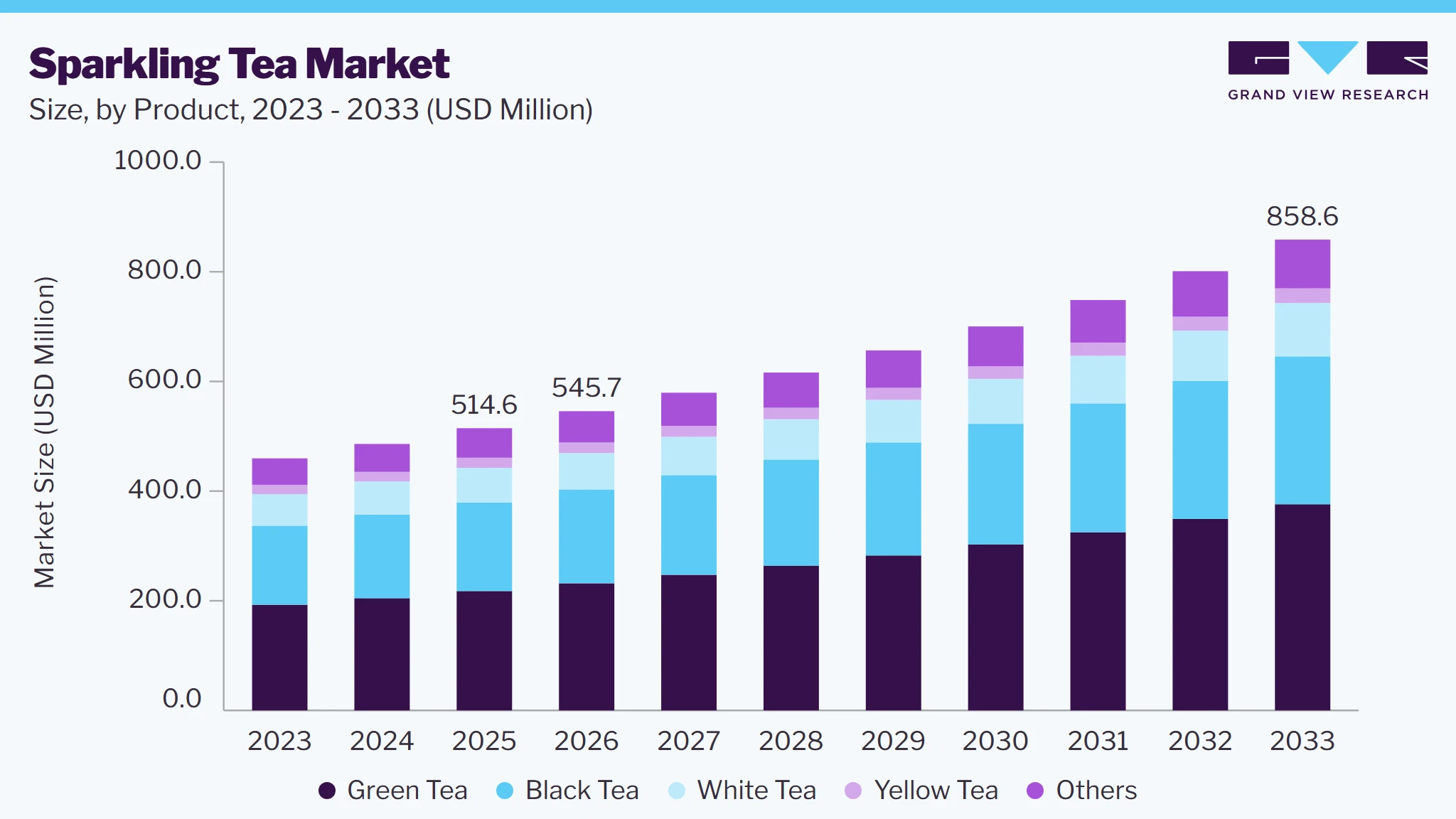
Based on product, the green tea segment led the market with the largest revenue share of 44.0% in 2025 and is expected to grow at the fastest CAGR over the forecast period. Green tea, renowned for its rich antioxidant content and numerous health advantages such as improved metabolism, enhanced mental clarity, and reduced risk of chronic diseases, aligns perfectly with the rising inclination towards healthier lifestyle choices. Moreover, the growing awareness of the health benefits associated with green tea, particularly its rich antioxidant properties and potential metabolic advantages, is driving the segment growth. As consumers increasingly seek beverages that not only satisfy thirst but also promote well-being, sparkling green tea offers a unique combination of refreshment and health benefits.
The black tea segment is anticipated to witness a CAGR of 6.7% from 2026 to 2033. Black tea, known for its rich antioxidant properties and potential cardiovascular benefits, resonates well with health-focused individuals who are keen on making informed dietary choices. The incorporation of sparkling elements into black tea not only enhances its appeal by adding a lively and refreshing twist but also aligns with the clean-label movement that emphasizes transparency and natural ingredients. Moreover, the versatility of black sparkling tea in flavor combinations and blends contributes significantly to its market appeal.
Category Insights
Based on category, no alcohol segment led the market with the largest revenue share of 88.5% in 2025, driven by the increasing popularity of low-calorie and no-calorie beverages. The no-alcohol segment is particularly prominent, appealing to those who seek sophisticated flavors without the adverse effects of alcohol. This segment targets health-conscious consumers, millennials, and Generation Z, who are increasingly opting for beverages that align with their wellness-oriented lifestyles. As restaurants and bars continue to diversify their non-alcoholic offerings, the demand for sparkling teas is likely to gain further traction over the coming years.
The alcohol-based sparkling tea segment is estimated to grow at a CAGR of 8.2% from 2026 to 2033. Bartenders and home mixologists are increasingly experimenting with carbonated tea as a base ingredient, creating a myriad of cocktails that cater to diverse palates. The versatility of sparkling tea allows for endless combinations, from blending it with spirits like gin, vodka, or rum to using it as a refreshing mixer in cocktails. This trend has led to the positioning of sparkling tea not just as a beverage but as an experience, where the emphasis is on craft, flavor profiles, and presentation. Manufacturers are capitalizing on this trend by launching ready-to-drink sparkling tea cocktails and hard-carbonated RTD tea variants, effectively tapping into the evolving social drinking culture that emphasizes quality, creativity, and health.
Packaging Insights
Based on packaging, the glass bottles segment led the market with the largest revenue share of 47.2% in 2025. Glass is known for its excellent barrier properties, which help maintain the quality and consistency of sparkling tea by avoiding the leaching of chemicals, unlike some plastic bottles. This characteristic is increasingly important to health-conscious consumers who are wary of harmful substances that could impact their well-being. Moreover, glass packaging is perceived as premium and eco-friendly, aligning with the growing consumer preference for sustainable products. Besides, the shift towards on-the-go consumption among consumers has led to the introduction of various sizes and formats in glass packaging.
The aluminum cans packaged sparkling tea are estimated to grow at a CAGR of 8.0% from 2026 to 2033. Aluminum cans are widely recognized for their recyclability and lightweight nature, making them an eco-friendly option compared to traditional glass or plastic bottles. Moreover, cans are renowned for their ability to preserve the freshness and carbonation of beverages, which is crucial for products like sparkling tea that rely on effervescence to provide a refreshing experience. In addition, aluminum cans are less prone to breakage compared to glass bottles, making them a more convenient option for on-the-go consumption. The portable nature of cans appeals to busy consumers who seek quality beverages that fit into their fast-paced lifestyles.
Distribution Channel Insights
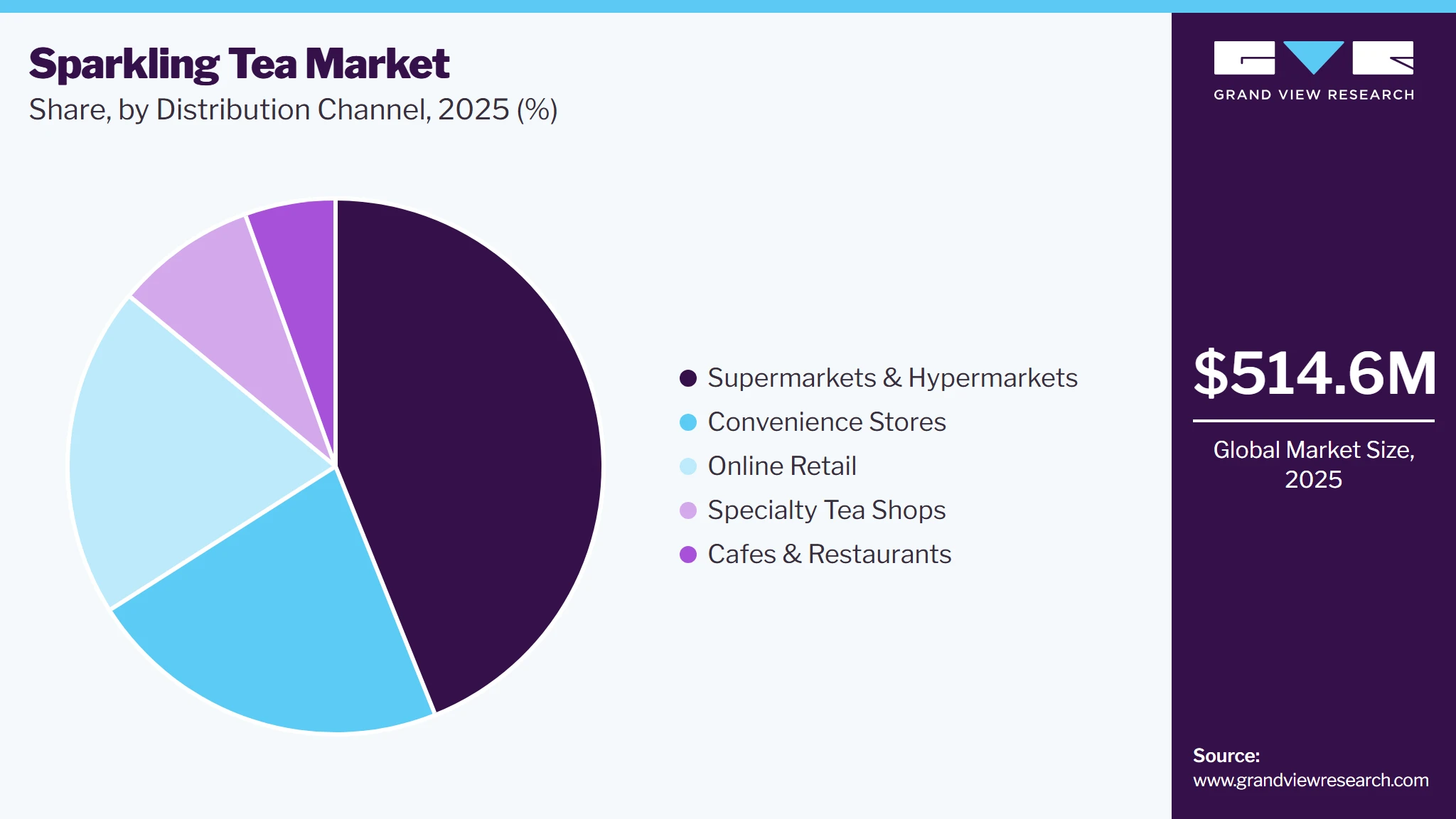
Based on distribution channel, the supermarkets and hypermarkets segment led the market with the largest revenue share of 43.7% in 2025. Supermarkets and hypermarkets serve as primary retail environments where consumers can easily access a wide array of sparkling tea products. These large retail outlets benefit from their extensive reach and convenience, attracting health-conscious shoppers who seek alternatives to sugary sodas and carbonated drinks. Moreover, several retail outlets in supermarkets and hypermarkets are implementing dedicated sections for sparkling teas to enhance product visibility and encourage exploration among shoppers seeking alternatives to traditional sugary sodas and energy drinks. Besides, promotions, discounts, and in-store tastings are often leveraged by brands to enhance awareness and propel sales, driving the demand even further.
 To learn more about this report, Download Free Sample Report
 The online retail segment is estimated to grow at a CAGR of 7.4% from 2026 to 2033. The increasing penetration of smartphones and the internet, coupled with the rise of e-commerce platforms, has empowered consumers to access a wide variety of sparkling tea brands and products from the comfort of their homes. This digital convenience offers a level of accessibility and choice that traditional brick-and-mortar stores often cannot provide, fostering a more personalized shopping experience. In addition, online retailers are able to present detailed information about the nutritional benefits, ingredient sourcing, and unique flavors of sparkling teas, which educates consumers and drives interest.
Regional Insights
North America dominated the sparkling tea market with the largest revenue share of 35.3% in 2025, driven by increasing consumer preference for health-conscious beverages. A growing segment of the population is shifting away from sugary sodas and traditional soft drinks, leading to a rising demand for healthier alternatives that still deliver refreshment and effervescence. This trend is further supported by a heightened awareness of health and wellness, as well as the rise of the wellness movement, which emphasizes natural ingredients and functional benefits. Besides, key manufacturers in the region are introducing a wide variety of sparkling tea options infused with botanicals, superfoods, and natural flavors, catering to diverse tastes and preferences.
 To learn more about this report, Download Free Sample Report
 U.S. Sparkling Tea Market Trends
The sparkling tea market in the U.S. held the largest share in the North America region in 2025. The rising demand for sparkling tea is indicative of a broader shift toward healthier options, with many consumers opting for beverages that provide not only refreshment but also functional benefits. In metropolitan areas such as New York, Los Angeles, and Chicago, the demand for premium and artisanal sparkling teas has seen significant growth in niche markets and specialty retailers. This is largely due to an increasing number of health-conscious consumers who are willing to pay a premium for products that offer unique flavors, high-quality organic ingredients, and innovative brewing methods.
Europe Sparkling Tea Market Trends
The sparkling tea market in Europe is expected to grow at a CAGR of 6.2% from 2026 to 2033. This region is characterized by a diverse demographic, with an array of consumers ranging from health-minded individuals to adventurous millennials seeking innovative beverage options. The surge in demand for low-calorie, naturally flavored drinks has led to the rise of sparkling tea as an appealing alternative to traditional sugary sodas and alcoholic beverages. European consumers are increasingly favoring beverages that offer both refreshment and wellness benefits, which has prompted many beverage companies to innovate and introduce new sparkling tea blends infused with botanicals, fruits, and herbal ingredients.
Asia Pacific Sparkling Tea Market Trends
The sparkling tea market in the Asia Pacific is expected to grow at the fastest CAGR of about 7.3% from 2026 to 2033, driven by the region’s rich tea culture and the increasing popularity of tea-based beverages. Countries like Japan, Taiwan, and China have a long-standing tradition of tea consumption, and the infusion of bubbles into traditional tea is being embraced as an innovative twist. Millennials and Gen Z in this region are particularly drawn to novel beverage experiences, leading to a flourishing market for sparkling teas that are not only refreshing but also offer unique flavor combinations and health benefits. Besides, rapid urbanization and a fast-paced lifestyle have prompted a greater interest in convenient, on-the-go beverage options, thus propelling the popularity of sparkling teas packaged in ready-to-drink formats.
Key Sparkling Tea Company Insights
The global sparkling tea industry is characterized by intense competition. Key manufacturers in the market are introducing a diverse array of new products that blend traditional tea with vibrant flavors and carbonation, appealing to a broad demographic, including millennials and health-forward consumers. Moreover, innovations such as organic, low-calorie, and adaptogenic ingredients are reshaping the landscape as brands seek to differentiate themselves in an increasingly crowded marketplace. Strategic mergers and expansions are also prevalent as companies aim to enhance their market presence and leverage synergies that enable them to deliver unique offerings. For instance, collaborations between tea companies and local artisanal producers not only foster regional flavors but also cater to the growing demand for locally sourced and sustainable products.
Key Sparkling Tea Companies
The following key companies have been profiled for this study on the sparkling tea market.
-
New Berlin Beverage Co.
-
Copenhagen Sparkling Tea Company
-
Fortnum & Mason
-
Nongfu Spring Co., Ltd.
-
DAVIDsTEA
-
Glamtì
-
Saicho Drinks
-
The Real Drinks Co.
-
Rita Food & Drink Co., Ltd.
-
WANA Beverage
Competitive Benchmarking
Category
Operating Strategies
Competitive Edge
Weakness
Established Players (Copenhagen Sparkling Tea Company, Fortnum & Mason, Nongfu Spring Co., Ltd., DAVIDsTEA, Saicho Drinks, The Real Drinks Co.)
- Expand product portfolios through premium tea blends, organic ingredients, low-sugar formulations, and international distribution partnerships.
- Strengthen retail presence across supermarkets, specialty stores, and foodservice channels while investing in brand positioning and product innovation.
- Strong brand recognition, established distribution networks, and greater financial resources. Ability to reach a broad consumer base through extensive retail partnerships and premium brand positioning.
- Higher operational and marketing costs associated with maintaining brand presence. Slower adaptation to niche consumer trends and emerging beverage innovations compared to smaller competitors.
Emerging Players (New Berlin Beverage Co., Glamtì, Rita Food & Drink Co., Ltd., WANA Beverage)
- Focus on innovative flavors, functional ingredients, clean-label formulations, and direct-to-consumer sales channels. Utilize digital marketing, social media engagement, and strategic partnerships to increase market visibility and consumer awareness.
- Greater flexibility in product development and faster response to changing consumer preferences.
- Ability to target niche segments with differentiated products and unique brand identities.
- Limited brand awareness, smaller distribution footprints, and lower marketing budgets. Challenges in scaling operations and competing with established players for retail shelf space and consumer loyalty.
Recent Developments
-
In July 2024, DAVIDsTEA launched its inaugural line of ready-to-drink (RTD) sparkling cold brewed iced teas featuring three enticing flavors: Organic Cream of Earl Grey, Organic Queen of Tarts, and Magic Potion. This initiative aims to diversify the company’s product offering and increase its presence in the growing sparkling tea industry.
-
In June 2023, The Real Drinks Co in the UK launched canned, ready-to-drink versions of its naturally fermented sparkling teas, Royal Flush and Dry Dragon. This initiative aims to expand the company's product range and increase its market presence in the UK
Sparkling Tea Market Report Scope
Report Attribute
Details
Market size in 2025
USD 514.6 million
Estimated market size in 2026
USD 545.7 million
Projected market size by 2033
USD 858.6 million
Growth rate
CAGR of 6.7% from 2026 to 2033
Base year for estimation
2025
Historical data
2021 - 2024
Forecast period
2026 - 2033
Quantitative units
Revenue in USD million/billion and CAGR from 2026 to 2033
Report coverage
Revenue forecast, company ranking, competitive landscape, growth factors, and trends
Segments covered
Product , category, packaging, distribution channel and region
Regional scope
North America; Europe; Asia Pacific; Latin America; MEA
Country scope
U.S.; Canada; Mexico; Germany; UK; France; Italy; Spain; Norway; Denmark; Sweden; Russia; Iceland; Finland; China; Japan; India; South Korea; Australia; Thailand; Singapore; Brazil; Argentina; Saudi Arabia; South Africa; UAE; Kuwait; Israel
Key companies profiled
New Berlin Beverage Co., Copenhagen Sparkling Tea Company, Fortnum & Mason, Nongfu Spring Co., Ltd., DAVIDsTEA, Glamtì, Saicho Drinks, The Real Drinks Co., Rita Food & Drink Co., Ltd., and WANA Beverage
Customization scope
Free report customization (equivalent up to 8 analysts' working days) with purchase. Addition or alteration to country, regional & segment scope.
Pricing and purchase options
Avail customized purchase options to meet your exact research needs. Explore purchase options
Global Sparkling Tea Market Report Segmentation
This report forecasts revenue growth at global, regional & country levels and provides an analysis of the industry trends in each of the sub-segments from 2021 to 2033. For this study, Grand View Research has segmented the global sparkling tea market report on the basis of product, category, packaging, distribution channel, and region:
-
Product Outlook (Revenue, USD Million, 2021 - 2033)
-
Green Tea
-
White Tea
-
Yellow Tea
-
Black Tea
-
Others
-
-
Category Outlook (Revenue, USD Million, 2021 - 2033)
-
No Alcohol
-
Alcohol-based
-
-
Packaging Outlook (Revenue, USD Million, 2021 - 2033)
-
Glass Bottles
-
Plastic Bottles
-
Aluminum Cans
-
Tetra Pak
-
-
Distribution Channel Outlook (Revenue, USD Million, 2021 - 2033)
-
Supermarkets and Hypermarkets
-
Convenience Stores
-
Online Retail
-
Specialty Tea Shops
-
Cafes and Restaurants
-
-
Regional Outlook (Revenue, USD Million, 2021 - 2033)
-
North America
-
U.S.
-
Canada
-
Mexico
-
-
Europe
-
UK
-
Germany
-
France
-
Italy
-
Spain
-
-
Asia Pacific
-
China
-
Japan
-
India
-
South Korea
-
Australia & New Zealand
-
-
Central & South America
-
Brazil
-
-
Middle East & Africa
-
South Africa
-
-
Research Methodology
The sparkling tea market figures in this report are based on a proven research process that combines executive interviews with secondary research from proprietary databases, company filings, and recognized regulatory and institutional sources. Market size is built through value-chain sizing - reconciling supply-side and demand-side estimates - and triangulated with bottom-up and top-down approaches. Every estimate passes multiple levels of expert validation before publication, with each sparkling tea segment quantified using the revenue-capture definitions in the table below.
Segment Definition
Segment - Product
Revenue capture definition
Green Tea
This segment includes the sales of sparkling tea beverages made using green tea extracts and infusions. Revenue is generated through retail and foodservice channels. Demand is supported by consumer preference for antioxidant-rich and wellness-focused beverages.
White Tea
This segment includes the sales of products formulated with white tea. Revenue is driven by premium offerings positioned around delicate flavors and natural ingredients. Growth is supported by increasing demand for sophisticated beverage options.
Yellow Tea
This segment includes the sales of sparkling tea beverages produced using yellow tea varieties. Revenue is generated from specialty and niche product offerings. Consumer interest in unique tea experiences supports segment demand.
Black Tea
This segment includes the sales of beverages based on black tea extracts and blends. Revenue is generated through mainstream and premium product offerings across multiple channels. Strong consumer familiarity supports consistent demand.
Others
This segment includes the sales of products made from herbal, oolong, fruit-infused, and specialty tea blends. Revenue is driven by product innovation and flavor diversification. Demand is supported by evolving consumer taste preferences.
Segment -Category
Revenue capture definition
No Alcohol
This segment includes the sales of non-alcoholic beverages. Revenue is generated through retail, online, and foodservice channels. Demand is driven by the growing preference for healthier beverage alternatives.
Alcohol-based
This segment includes the sales of beverages containing alcohol. Revenue is generated through hospitality venues, specialty retailers, and premium beverage outlets. Consumer demand is supported by interest in innovative alcoholic drinks.
Segment -Packaging
Revenue capture definition
Glass Bottles
This segment includes the sales of products packaged in glass bottles. Revenue is generated from premium and upscale beverage offerings. Demand is supported by strong product presentation and perceived quality.
Plastic Bottles
This segment includes the sales of products packaged in plastic bottles. Revenue is driven by convenience, affordability, and portability. These products are widely distributed through mass retail channels.
Aluminum Cans
This segment includes the sales of products packaged in aluminum cans. Revenue is generated from ready-to-drink formats preferred by on-the-go consumers. Sustainability and convenience support segment growth.
Tetra Pak
This segment includes the sales of products packaged in Tetra Pak containers. Revenue is supported by lightweight and efficient packaging solutions. Demand is driven by convenience and product protection benefits.
Segment -Distribution Channel
Revenue capture definition
Supermarkets and Hypermarkets
This segment includes the sales of products through supermarkets and hypermarkets. Revenue is generated from high-volume consumer purchases and broad product availability. Promotional activities further support sales growth.
Convenience Stores
This segment includes the sales of products through convenience stores. Revenue is driven by impulse purchases and immediate consumption occasions. Accessibility and convenience are key demand factors.
Online Retail
This segment includes the sales of products through e-commerce platforms and brand websites. Revenue is generated from direct-to-consumer purchases and digital promotions. Online channels expand product reach and availability.
Specialty Tea Shops
This segment includes the sales of products through specialty tea retailers. Revenue is driven by premium product offerings and consumer interest in unique tea varieties. These stores cater to tea enthusiasts and premium buyers.
Cafes and Restaurants
This segment includes the sales of products through cafés, restaurants, and other foodservice establishments. Revenue is generated from dine-in beverage consumption and menu offerings. Growing demand for premium refreshment options supports sales.
Estimation Model
Layer Name
Key Question
Description
Product Consumption Layer
Who consumes tea-based beverages?
Identify consumers of premium tea, ready-to-drink tea, functional beverages, and non-alcoholic alternatives to establish the potential consumer base.
Accessibility Layer
Who can access the products?
Assess retail availability across supermarkets, convenience stores, specialty stores, cafés, restaurants, and e-commerce platforms to determine the reachable market.
Adoption Layer
Who purchases sparkling tea?
Apply consumer adoption rates based on health-conscious beverage preferences, premium drink consumption, and repeat purchase behavior to estimate active buyers.
Monetisation Layer
How much revenue is generated?
Multiply annual consumer purchases by average spending per buyer and incorporate revenue from premium product variants, foodservice sales, and online retail channels to calculate total market revenue.
Delivered Customizations
This report has been delivered with the following In-depth customizations
Client Request
Customization Delivered
Value Adds
Sparkling Tea Product & Consumer Preference Trends
Conducted a focused analysis of sparkling tea consumption patterns covering green tea, white tea, black tea, alcohol-based and non-alcoholic variants, flavor innovation, premiumization trends, and health-conscious beverage preferences.
Helps stakeholders identify high-growth product segments, understand evolving consumer preferences, and evaluate opportunities in premium and functional beverage categories.
Distribution Channel & Packaging Assessment
Evaluated demand across supermarkets, convenience stores, online retail, specialty tea shops, and cafés, along with packaging trends in glass bottles, aluminum cans, plastic bottles, and Tetra Pak formats.
Provides insights into channel performance, packaging preferences, and route-to-market strategies to optimize product positioning and distribution expansion.
Premium Beverage & Non-Alcoholic Alternatives Opportunity Assessment
Assessed the impact of clean-label trends, low-sugar beverage demand, alcohol alternatives, sustainability initiatives, and premium beverage consumption on market growth.
Supports investment and expansion strategies by identifying emerging opportunities, consumer shifts, and competitive positioning within the global sparkling tea industry.
Frequently Asked Questions About This Report
The global sparkling tea market size was valued at USD 514.6 million in 2025 and is estimated at USD 545.7 million for 2026.
Key players include New Berlin Beverage Co., Copenhagen Sparkling Tea Company, Fortnum & Mason, Nongfu Spring Co., Ltd., DAVIDsTEA, Glamtì, Saicho Drinks, The Real Drinks Co., Rita Food & Drink Co., Ltd., and WANA Beverage
Asia Pacific is the fastest-growing region over the forecast period.
The green tea segment led with 44.0% revenue share in 2025.
The no alcohol segment led with a 88.5% revenue share in 2025.
Supermarkets and Hypermarkets held the largest revenue share in 2025.
North America dominated the market with a 35.3% revenue share in 2025.
Key factors include changing consumer taste preferences and growing interest in healthier beverage alternatives. Increasing demand for low-sugar and functional drinks is supporting market expansion. The growth of e-commerce channels is also improving product accessibility and market reach.
The glass bottles segment led with a 47.2% revenue share in 2025, while the tetra pak segment is the fastest-growing.
The global sparkling tea market is expected to grow at a CAGR of 6.7% from 2026 to 2033, reaching USD 858.6 million by 2033.
About the Author(s)
Consumer F&B Research Team
Consumer Goods · Consumer F&BThis report was authored by the consumer f&b research team at Grand View Research - comprising two research analysts, one senior research analyst, and one industry expert - with specialized expertise in the consumer f&b segment of the consumer goods industry. All findings are based on proprietary consumer goods databases, executive interviews, and regulatory analysis, subject to internal peer review prior to publication.
Last Updated:
Speak to Analyst

Customize this report to your needs - add regions, segments, or data points, with 20% free customization.
Or view our licence options:


ISO 9001:2015 & 27001:2022 Certified
We are GDPR and CCPA compliant! Your transaction & personal information is safe and secure. For more details, please read our privacy policy.


