
- Home
- »
- Petrochemicals
- »
-
Specialty Gas Market Size, Share And Trends Report, 2033GVR Report cover

Specialty Gas Market (2026 - 2033)
Size, Share & Trends Analysis Report By Product (Ultra-high Purity Gases, Carbon Gases), By Application (Electronics, Healthcare), By Region (Europe, Asia Pacific), And Segment Forecasts
Market Size, 2025
$13.6BMarket Estimate, 2026
$14.9BMarket Forecast, 2033
$32.6BCAGR, 2026–2033
11.8%Specialty Gas Market Summary
The global specialty gas market size was valued at USD 13.6 billion in 2025 and is projected to grow from USD 14.9 billion in 2026 to USD 32.6 billion by 2033, at a CAGR of 11.8% from 2026 to 2033. Asia Pacific dominated the market, accounting for a revenue share of 47.2% in 2025. The increasing adoption of specialty gases in electronics, manufacturing, and healthcare applications is anticipated to drive market growth.
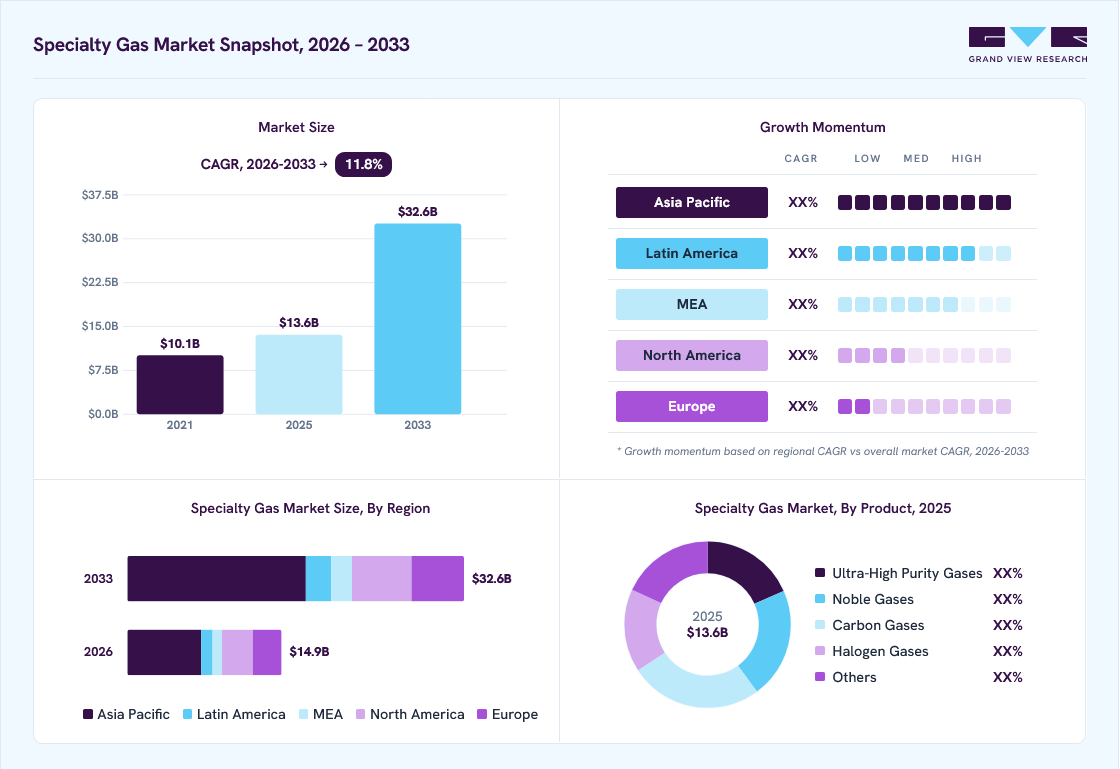 Source: Grand View Research, IR Documents, Primary Interviews, Paid DatabasesTo learn more about this report,
 Download Free Sample Report
Key Market Trends & Insights
- By product: Carbon gases segment dominated the product segment with a market share of 25.9% in 2025.
- By application: Healthcare segment accounted for the largest market share of 26.2% in 2025.
Regional Highlights
- Largest regional market: Asia Pacific (47.2% revenue share, 2025)
- By country: China held the largest market share in 2025.
Market Size & Forecast
- Market size in 2025: USD 13.6 Billion
- Estimated market size in 2026: USD 14.9 Billion
- Projected market size by 2033: USD 32.6 Billion
- CAGR (2026-2033): 11.8%
Three ways to get this report
Buy it, customize it, or ask a question.Ask an Analyst
Analyst response in 1 business day
- AccessReport author, directly
- Reply timeWithin 1 working day
- No sales callDirect answer only
- FormatEmail reply
- CostFree, no cost
Get the Full Report
What the study covers
- FormatsPDF · Excel · Dashboard
- Timeline2026–2033 annual, 2025 base
- Coverage20+ countries, 5 regions
- Companies10+ key players profiled
Customize the Report
20% free customization
- IncludeCountries, segments, points
- TailorTo your product definition
- ExtendDeeper competitor detail
- OrA fully bespoke study
- Turnaround5–10 working days
The expanding markets for semiconductors and displays play a significant role in increasing the usage of specialty gases in electronics applications. Moreover, the growing healthcare industry and advances in clinical treatments are driving the market growth. The specialty gas industry supplies different sectors, such as petrochemical, oil & gas, analytical research, and consumer electronics.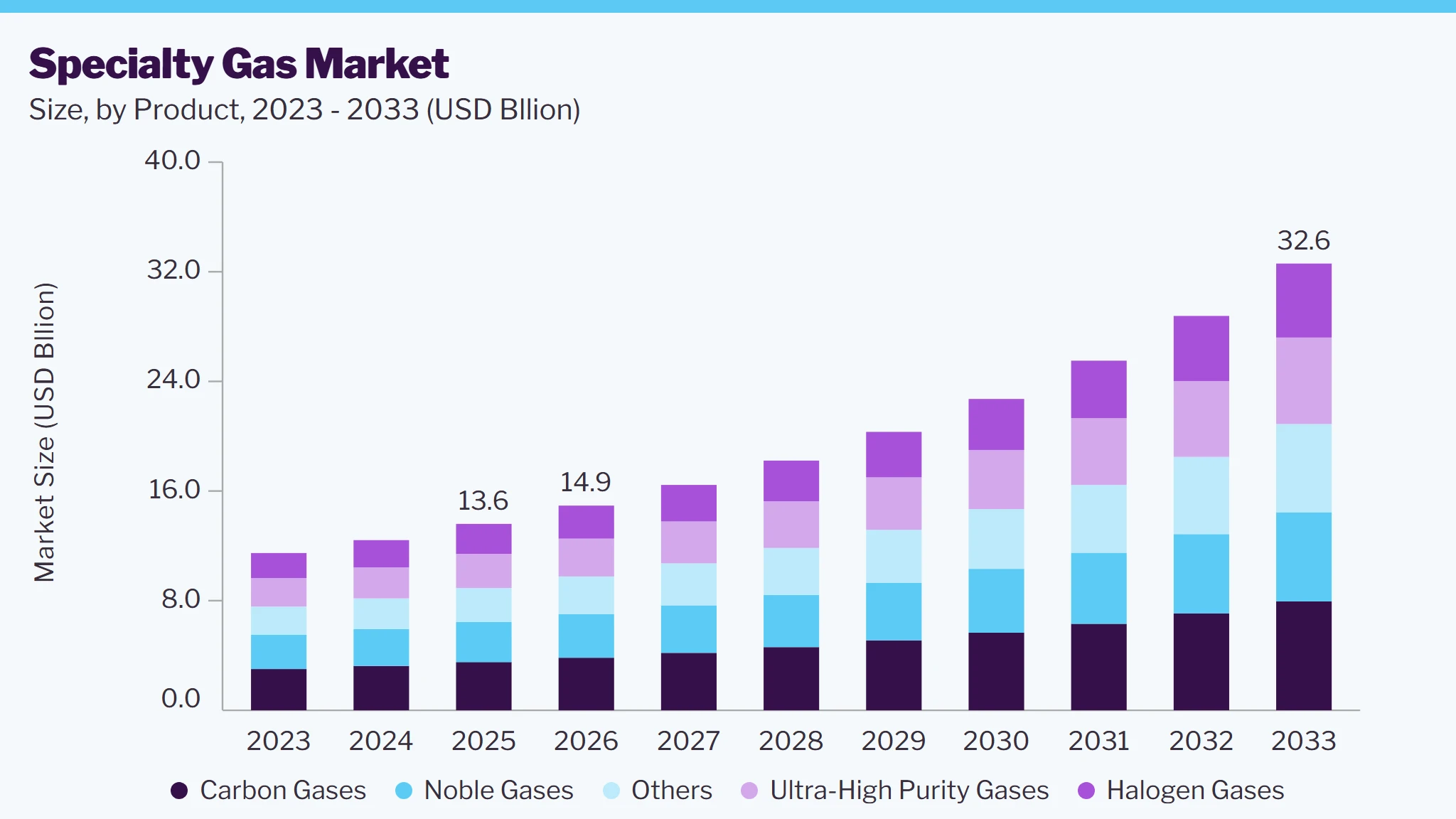 To learn more about this report, Download Free Sample Report
The recent increase in demand for specialty gases can be largely attributed to a rise in the demand for semiconductors and LEDs. The semiconductor industry is one of the world’s most dynamic, competitive, and sophisticated industries. As it expands, so does the demand for ultra-pure gases and chemicals. Moreover, high-purity gases are crucial in the manufacturing processes for consumer electronics as well. The recent growth of the consumer electronics industry helps propel the growth of the specialty gas industry.
The COVID-19 pandemic had a negative impact on the overall market. The pandemic led to disruption of the supply chain related to different industries, such as consumer electronics, oil & gas, petrochemicals, and manufacturing. The manufacturing industry was impacted in several ways due to the pandemic, which resulted in low-scale operations and, eventually, a detrimental impact on output levels. Index for Industrial Production (IIP) in India fell to -1.40% for the year 2019-20. The negative impact of the pandemic on various end-use industries also impacted the demand for specialty gases.
Market Dynamics
The specialty gas market is witnessing sustained growth due to increasing demand for high-purity gases across precision-driven industries such as electronics, healthcare, advanced manufacturing, and research institutions. The rapid expansion of semiconductor fabrication, coupled with rising investments in electronics manufacturing, is significantly driving the consumption of ultra-high purity and specialty process gases. Growing healthcare infrastructure and the increasing use of specialty gas mixtures for medical diagnostics, laboratory analysis, and pharmaceutical production are further supporting market expansion. Technological advancements in gas purification, packaging, and distribution systems are enhancing product reliability while enabling suppliers to meet stringent quality and regulatory standards. Rising investments in research and development activities, clean energy technologies, and industrial automation are creating new opportunities for specialty gas manufacturers. However, the market continues to face challenges associated with complex handling requirements, high production and transportation costs, and strict compliance with safety and environmental regulations.
The rapid expansion of the global semiconductor and electronics industry is a primary driver of the specialty gas market. Specialty gases such as ultra-high purity nitrogen, argon, hydrogen, and fluorinated process gases are essential for wafer fabrication, thin-film deposition, etching, chamber cleaning, and quality testing. As semiconductor manufacturing advances toward smaller process nodes and more complex chip architectures, manufacturers require gases with exceptionally low impurity levels to maintain process precision, improve production yields, and ensure product reliability. The increasing production of integrated circuits, memory devices, sensors, and advanced electronic components is therefore driving sustained demand for high-performance specialty gases.
Growing investments in semiconductor fabrication facilities across Asia Pacific, North America, and Europe are strengthening long-term market prospects. Government incentives aimed at enhancing domestic semiconductor production and reducing supply chain dependence are encouraging capacity expansions and new manufacturing plants. The rising adoption of artificial intelligence, cloud computing, electric vehicles, 5G infrastructure, and consumer electronics is further increasing semiconductor demand, thereby creating consistent growth opportunities for specialty gas suppliers that can deliver reliable, high-purity gas solutions supported by advanced distribution and quality assurance systems.
The specialty gas market is significantly influenced by supply chain disruptions and the limited availability of certain raw materials required for gas production and purification. Many specialty gases, particularly noble gases and high-purity process gases, depend on complex extraction, separation, and refining processes that are concentrated in a limited number of production facilities worldwide. Any disruptions caused by geopolitical tensions, energy price volatility, transportation bottlenecks, or production outages can impact the consistent supply of these gases, leading to longer lead times and price fluctuations. Such uncertainties make procurement planning more challenging for both manufacturers and end users.
The growing healthcare and life sciences sector presents a significant opportunity for the specialty gas market as hospitals, diagnostic laboratories, pharmaceutical manufacturers, and biotechnology companies increasingly depend on high-purity gases for critical applications. Specialty gases are widely used in medical diagnostics, calibration of analytical instruments, pharmaceutical manufacturing, sterilization processes, cryogenic preservation, and laboratory research. Rising healthcare expenditure, expanding diagnostic capabilities, and increasing investments in biotechnology research are driving greater demand for specialized gas mixtures that meet stringent quality and regulatory requirements.
Analyst Perspective
The specialty gas market is driven by expanding semiconductor manufacturing, advanced healthcare applications, and increasing demand for high-purity industrial processes. Technological advancements in electronics and analytical instrumentation continue to elevate quality requirements, supporting premium product demand. Market participants are focusing on capacity expansion, customized gas solutions, and supply chain resilience to strengthen their competitive position. While stringent regulatory standards and supply chain complexities remain key challenges, sustained investments in semiconductor fabrication, life sciences, and research infrastructure are expected to create significant growth opportunities. Companies with strong purification capabilities, application expertise, and reliable distribution networks are likely to gain a competitive advantage.
Product Insights
Carbon Gases segment dominated the product segment with a market share of 25.9% in 2025. Based on product, the market has been segmented into ultra-high purity gases, noble gases, carbon gases, halogen gases, and others. The carbon gases segment accounted for the largest revenue share of 30.2% in 2022 and is expected to retain its dominance over the forecast period. Carbon gases are widely used in medical equipment, such as nuclear magnetic resonance imaging, magnetic resonance imaging, ophthalmology, and others. The demand for carbon gases is high in sectors, such as electronics, manufacturing, healthcare, and chemicals.
The growing application scope of carbon gases for instrument calibration is propelling the carbon gas demand. The ultra-high purity gases segment is expected to grow at the highest CAGR of 8.5% over the forecast period. Ultra-high purity gases are used for insulation, lighting, and cooling in various industries, such as electronics, metal processing, chemical, and oil & gas. Also, ultra-high purity gases play a major role in the manufacturing of semiconductors. The expansion of the semiconductor industry is expected to drive the demand for ultra-high purity gases.
Application Insights
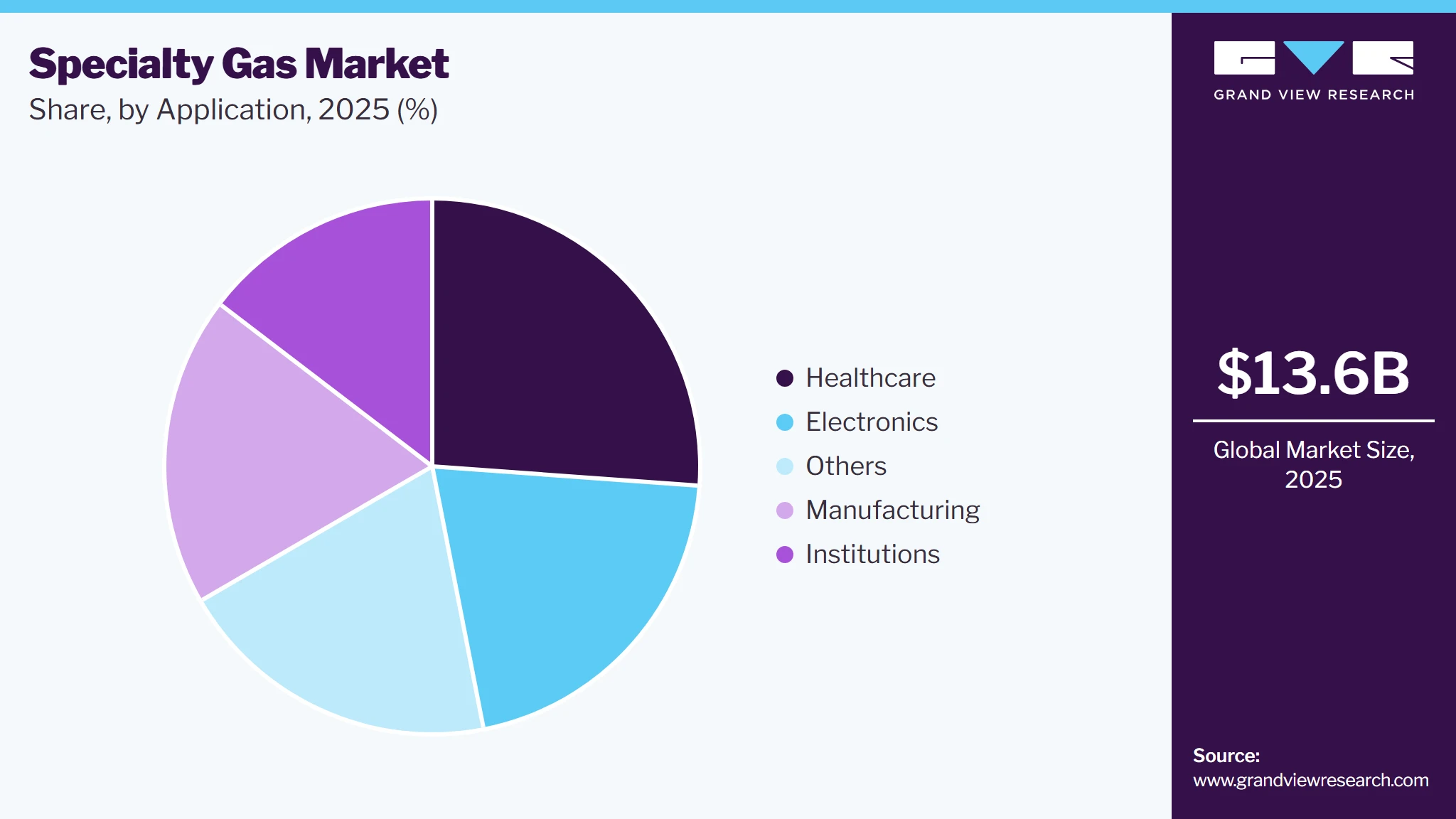
Based on application, the market has been segmented into manufacturing, electronics, healthcare, institutions, and others. Healthcare segment projected the largest share of 26.2% in 2025 and is expected to retain its dominance over the forecast period. The healthcare sector uses different specialty gases, such as oxygen, medical nitrous oxide, medical air, and medical helium. The increased healthcare expenditure by governments across the globe and the utilization of improved medical technologies are expected to be the major driving factors for the market.
 To learn more about this report, Download Free Sample Report
The electronics segment is expected to grow at a CAGR of 8.3% over the forecast period. A variety of specialty gases, such as nitrogen trifluoride, tungsten hexafluoride, and hydrogen chloride, are used in the electronics industry. These gases are used in the production of a variety of electronic devices and components, including semiconductors, display devices, LED panels, and solar panels. Apart from traditional electronic devices, the specialty gas market is likely to be driven by new-age product innovations, such as wearables, connected homes, control systems, and connected industrial systems.
Regional Insights
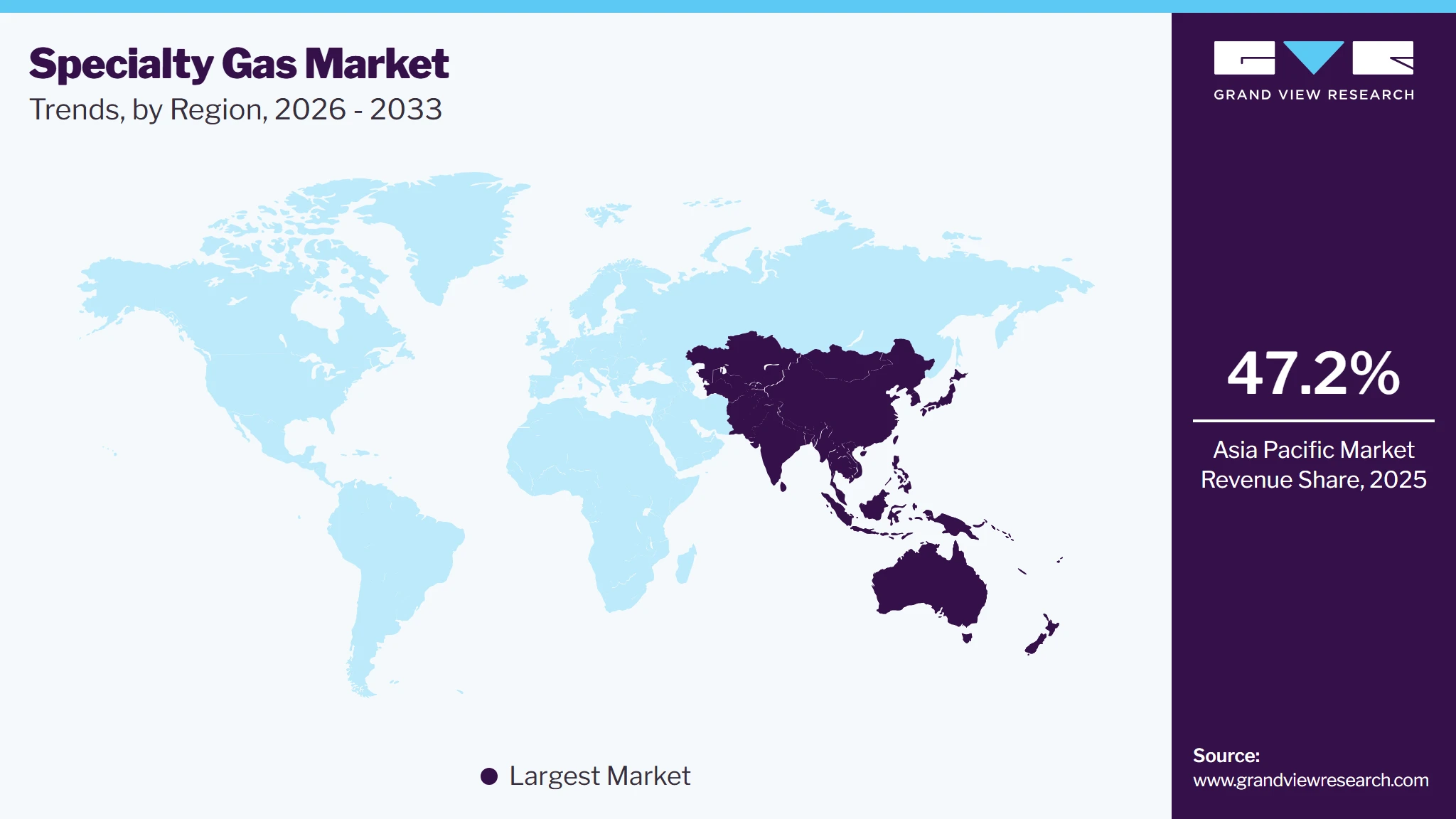
Asia Pacific accounted for 47.2% of the specialty gas market revenue in 2025, making it the largest regional market. China held the highest market revenue share of the Asia Pacific in 2025. The region is home to many electronic manufacturing hubs situated in China, Japan, and India. Also, local governments are supporting the growth of various end-use industries, such as consumer electronics, oil & gas, manufacturing, and healthcare, in the region through Production-Linked Incentives (PLI), subsidies, and favorable Foreign Direct Investment (FDI) policies. All these factors are contributing to the growth and dominance of the specialty gas industry in the region.
 To learn more about this report, Download Free Sample Report
In January 2023, Taiyo Nippon Sanso Corporation announced the establishment of a business site and a logistics site for specialty gases in Kumamoto, Japan, to boost its logistics activities for specialty gases in the Kyushu area. Europe is expected to grow at the second-fastest CAGR of 7.9% over the forecast period. The region is focusing on increasing its production capacity to cater to the growing demand from different end-use industries. Also, the growing investments in the healthcare & pharmaceutical sectors are expected to boost the product demand in the region. In June 2021, the French government announced USD 8.33 billion public funding plan for the healthcare sector to advance the healthcare system in the country.
Key Companies & Market Share Insights
The market is highly competitive as it features various global and regional players. The world’s leading companies are undertaking partnerships, collaborations, acquisitions, mergers, and agreements as strategies to withstand the intense competition and increase their market share. Moreover, specialty gas manufacturers are spending extensively to increase production capacities to cater to the growing product demand. For instance, in December 2022, Air Products and Chemicals, Inc. and AES Corporation announced USD 4.0 billion investment to develop the first mega-scale green hydrogen production facility in Texas, U.S. This plant is being developed to meet the growing requirement for zero-carbon-intensity fuels from the transportation and industrial sectors of the country.
Key Specialty Gas Companies
The following key companies have been profiled for the study on the global specialty gas market.
-
Air Products and Chemicals, Inc.
-
Air Liquide
-
Messer Group GmbH
-
Linde plc
-
Taiyo Nippon Sanso Corporation
-
MESA Specialty Gases & Equipment
-
Weldstar
-
Norco Inc.
-
Coregas
-
Showa Denko K.K.
Competitive Benchmarking
Category
Operating Strategies
Competitive Edge
Weakness
Established Players ( Air Products and Chemicals, Inc., Air Liquide, Linde plc, Messer Group GmbH, Taiyo Nippon Sanso Corp., Showa Denko K. K.)
- Invest heavily in ultra-high purity gas production, purification technologies, and large-scale manufacturing infrastructure.
- Maintain long-term supply agreements with semiconductor, healthcare, and industrial manufacturing customers.
- Expand global distribution networks through strategically located production plants, filling stations, and logistics hubs.
- Focus on continuous product innovation, regulatory compliance, and digital monitoring solutions to enhance operational efficiency.
- Strong global brand recognition and well-established customer relationships across diverse end-use industries.
- Extensive production capacity is supported by integrated manufacturing and supply chain capabilities.
- Broad product portfolios covering specialty gases, gas mixtures, and value-added technical services.
- Significant financial resources enabling investments in advanced technologies, acquisitions, and capacity expansion.
- High capital expenditure requirements for production facilities and distribution infrastructure.
- Complex organizational structures can slow decision-making and market responsiveness.
- Greater exposure to fluctuations in industrial production and global economic cycles.
- Higher operating costs are associated with maintaining worldwide manufacturing and service networks.
Emerging & Regional Players ( MESA Specialty Gases & Equipment, Weldstar, Norco Inc., Coregas)
- Focus on regional markets and niche applications requiring customized specialty gas solutions.
- Differentiate through flexible production, personalized technical support, and faster customer response.
- Strengthen partnerships with local distributors, research institutions, and industrial customers.
- Expand capabilities by investing in specialty gas blending, cylinder services, and application-specific offerings.
- Greater operational flexibility to address specialized customer requirements and smaller order volumes.
- Strong regional presence with better understanding of local regulatory and customer needs.
- Faster commercialization of customized gas mixtures for emerging applications.
- Competitive pricing strategies supported by lean operational structures.
- Limited manufacturing capacity compared with multinational industry leaders.
- Smaller geographic footprint restricts access to global customer contracts.
- Lower investment capability for advanced purification technologies and large-scale expansion.
- Greater vulnerability to supply chain disruptions and fluctuations in raw material availability.
Specialty Gas Market Report Scope
Report Attribute
Details
Market size in 2025
USD 13.6 billion
Estimated market size in 2026
USD 14.9 billion
Projected market size by 2033
USD 32.6 billion
Growth rate
CAGR of 11.8% from 2026 to 2033
Base year for estimation
2025
Historical data
2021 - 2024
Forecast period
2026 - 2033
Quantitative units
Revenue in USD billion/billion and CAGR from 2026 to 2033
Report coverage
Revenue forecast, company ranking, competitive landscape, growth factors, and trends
Segments covered
product, application, region
Regional scope
North America; Europe; Asia Pacific; Latin America; MEA
Country scope
U.S.; Canada; Mexico; Germany; UK; France; China; India; Japan; South Korea; Brazil; Argentina; Saudi Arabia; UAE
Key companies profiled
Air Products and Chemicals, Inc.; Air Liquide; Messer Group GmbH; Linde plc; Taiyo Nippon Sanso Corp.; MESA Specialty Gases & Equipment; Weldstar; Norco Inc.; Coregas; Showa Denko K. K.
Customization scope
Free report customization (equivalent up to 8 analysts' working days) with purchase. Addition or alteration to country, regional & segment scope.
Pricing and purchase options
Avail customized purchase options to meet your exact research needs. Explore purchase options
Global Specialty Gas Market Report Segmentation
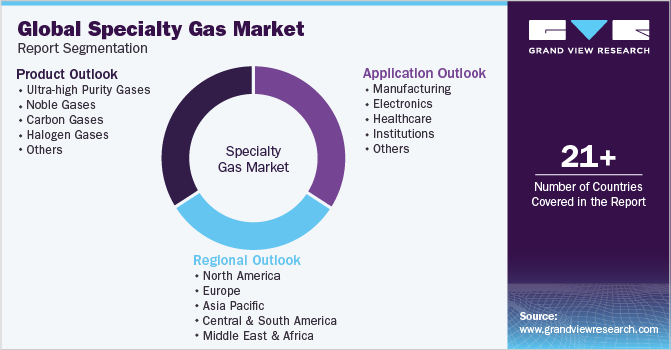
This report forecasts revenue growth and provides an analysis of the latest trends in each of the sub-segments from 2021 to 2033. For this report, Grand View Research has segmented the global specialty gas market based on product, application, and region:
 To learn more about this report, Download Free Sample Report
-
Product Outlook (Revenue, USD Million, 2021 - 2033)
-
Ultra-high Purity Gases
-
Noble Gases
-
Carbon Gases
-
Halogen Gases
-
Others
-
-
Application Outlook (Revenue, USD Million, 2021 - 2033)
-
Manufacturing
-
Electronics
-
Healthcare
-
Institutions
-
Others
-
-
Regional Outlook (Revenue, USD Million, 2021 - 2033)
-
North America
-
U.S.
-
Canada
-
Mexico
-
-
Europe
-
UK
-
Germany
-
France
-
-
Asia Pacific
-
China
-
India
-
Japan
-
South Korea
-
-
Central & South America
-
Brazil
-
Argentina
-
-
Middle East & Africa
-
Saudi Arabia
-
UAE
-
-
Research Methodology
The specialty gas market figures in this report are based on a proven research process that combines executive interviews with secondary research from proprietary databases, company filings, and recognized regulatory and institutional sources. Market size is built through value-chain sizing - reconciling supply-side and demand-side estimates - and triangulated with bottom-up and top-down approaches. Every estimate passes multiple levels of expert validation before publication, with each specialty gas segment quantified using the revenue-capture definitions in the table below.
Segment Definition
Segment - Product
Revenue capture definition
Ultra-High Purity Gases
Includes revenue generated from ultra-high purity gases supplied for semiconductor manufacturing, analytical laboratories, pharmaceutical production, and other precision applications requiring exceptionally low impurity levels.
Noble Gases
Represents income derived from the sale of argon, helium, neon, krypton, xenon, and related specialty gases used in electronics manufacturing, healthcare, scientific research, and advanced industrial processes.
Carbon Gases
Covers revenue from specialty-grade carbon dioxide, carbon monoxide, and other carbon-based gases utilized in calibration, food processing, medical applications, chemical synthesis, and research activities.
Halogen Gases
Accounts for sales generated by fluorine-, chlorine-, and other halogen-based specialty gases employed in semiconductor fabrication, chemical processing, environmental monitoring, and laboratory applications.
Other Products
Encompasses earnings from specialty gas mixtures, calibration gases, rare gas blends, and other customized gas formulations developed for industrial, scientific, environmental, and medical requirements.
Segment - Application
Revenue capture definition
Manufacturing
Captures revenue from specialty gases supplied for metal fabrication, chemical processing, automotive production, additive manufacturing, and other industrial manufacturing operations requiring controlled gas environments.
Electronics
Represents sales generated from specialty gases used in semiconductor fabrication, display panel production, photovoltaic cell manufacturing, and electronic component processing.
Healthcare
Includes revenue from specialty gases utilized in medical imaging, respiratory therapy, pharmaceutical manufacturing, laboratory diagnostics, and biotechnology research applications.
Institutions
Covers income from specialty gases supplied to research laboratories, universities, testing facilities, calibration centers, and government institutions conducting scientific and analytical work.
Other Applications
Encompasses revenue generated from specialty gases used across food and beverage processing, environmental monitoring, energy production, aerospace, and other niche industrial and commercial applications.
Estimation Model
Layer Name
Key Question
Description
Specialty Gas Production Layer
What forms is the supply base?
Identify the global production capacity of specialty gases by evaluating air separation units, gas purification facilities, specialty gas blending plants, cylinder filling operations, bulk packaging infrastructure, ultra-high purity processing capabilities, and manufacturing capacities for noble, carbon, halogen, and customized gas mixtures across key producing regions.
Application Adoption Layer
Where are specialty gases utilized?
Estimate the distribution of specialty gas demand across manufacturing, electronics, healthcare, research institutions, and other industrial sectors by analyzing production activity, technology adoption, process requirements, regulatory standards, and end-use industry expansion across major regional markets.
Consumption Intensity Layer
How much specialty gas is consumed?
Assess specialty gas consumption across key end-use industries by evaluating production volumes, semiconductor fabrication capacity, laboratory utilization, healthcare infrastructure, industrial processing intensity, and application-specific gas requirements to estimate annual demand across major geographic markets.
Revenue Layer
How is market revenue generated?
Market revenue is generated through the supply of specialty gases, ultra-high purity gases, calibration gas mixtures, and customized gas solutions to manufacturing facilities, electronics producers, healthcare organizations, research institutions, laboratories, and other industrial customers through direct sales, distributors, bulk supply contracts, and cylinder-based delivery networks worldwide.
Delivered Customizations
This report has been delivered with the following In-depth customizations
Client Request
Customization Delivered
Value Adds
Regional segmentation
The study provides comprehensive country-level analysis across major specialty gas production and consumption markets. The assessment covers production capacities, demand by end-use industry, manufacturing infrastructure, regulatory landscape, import-export dynamics, and future growth outlook.
Enables informed market entry and expansion strategies by identifying high-growth countries, investment hotspots, supply-demand trends, and region-specific business opportunities.
Competitive Benchmarking
Comparative evaluation of leading specialty gas manufacturers based on product portfolio, ultra-high purity gas capabilities, manufacturing footprint, purification technologies, distribution network, geographic presence, strategic partnerships, R&D investments, and recent business developments across major markets.
Supports competitive positioning by highlighting technology leadership, operational capabilities, market reach, product differentiation, and strategic initiatives of key industry participants.
Opportunity Assessment
Comprehensive assessment of emerging opportunities driven by semiconductor fabrication expansion, healthcare infrastructure development, research and laboratory investments, advanced manufacturing, and increasing demand for high-purity specialty gases across developing and developed economies.
Assists strategic planning by identifying high-growth applications, attractive investment areas, emerging demand centers, and long-term business expansion opportunities.
Frequently Asked Questions About This Report
The global specialty gas market size was estimated at USD 13.6 billion in 2025 and is expected to reach USD 14.9 billion in 2026.
The global specialty gas market, in terms of revenue, is expected to grow at a compound annual growth rate of 11.8% from 2026 to 2033 to reach USD 32.6 billion by 2033.
Asia Pacific accounted for 47.2% of the specialty gas market revenue in 2025, making it the largest regional market. Rapid expansion of semiconductor manufacturing, electronics production, and industrial infrastructure across China, Japan, South Korea, and India continues to reinforce the region's market leadership.
Some of the key players operating in the specialty gas market include Air Products and Chemicals, Inc.; Air Liquide; Messer Group GmbH; Linde plc; Taiyo Nippon Sanso Corp. and others.
The specialty gas market is primarily driven by rising demand from the semiconductor and electronics industry, where ultra-high purity gases are essential for precision manufacturing processes. Growth in healthcare, pharmaceutical production, and scientific research, along with increasing investments in advanced manufacturing technologies, is further supporting market expansion.
Carbon Gases segment dominated the product segment with a market share of 25.9% in 2025. Increasing adoption of carbon dioxide and carbon monoxide in healthcare, food processing, chemical manufacturing, and analytical applications has reinforced the segment's leading position in the global specialty gas market.
Healthcare segment projected the largest share of 26.2% in 2025, driven by the growing use of high-purity gases in medical diagnostics, pharmaceutical manufacturing, laboratory testing, and respiratory care applications.
About the Author(s)
Petrochemicals Research Team
Bulk Chemicals · PetrochemicalsThis report was authored by the petrochemicals research team at Grand View Research - comprising two research analysts, one senior research analyst, and one industry expert - with specialized expertise in the petrochemicals segment of the bulk chemicals industry. All findings are based on proprietary bulk chemicals databases, executive interviews, and regulatory analysis, subject to internal peer review prior to publication.
Last Updated:
Speak to Analyst

Customize this report to your needs - add regions, segments, or data points, with 20% free customization.
Or view our licence options:


ISO 9001:2015 & 27001:2022 Certified
We are GDPR and CCPA compliant! Your transaction & personal information is safe and secure. For more details, please read our privacy policy.


