
- Home
- »
- Advanced Interior Materials
- »
-
Split HVAC Systems Market Size & Share Report, 2026-2033GVR Report cover

Split HVAC Systems Market (2026 - 2033)
Size, Share & Trends Analysis Report By Product Type (Air Conditioners, Heat Pump), By End Use (Residential, Commercial, Industrial), By Installation (New Construction, Retrofit/Replacement), By Region, And Segment Forecasts
Market Size, 2025
$54.5BMarket Estimate, 2026
$60.0BMarket Forecast, 2033
$106.2BCAGR, 2026–2033
8.5%Split HVAC Systems Market Summary
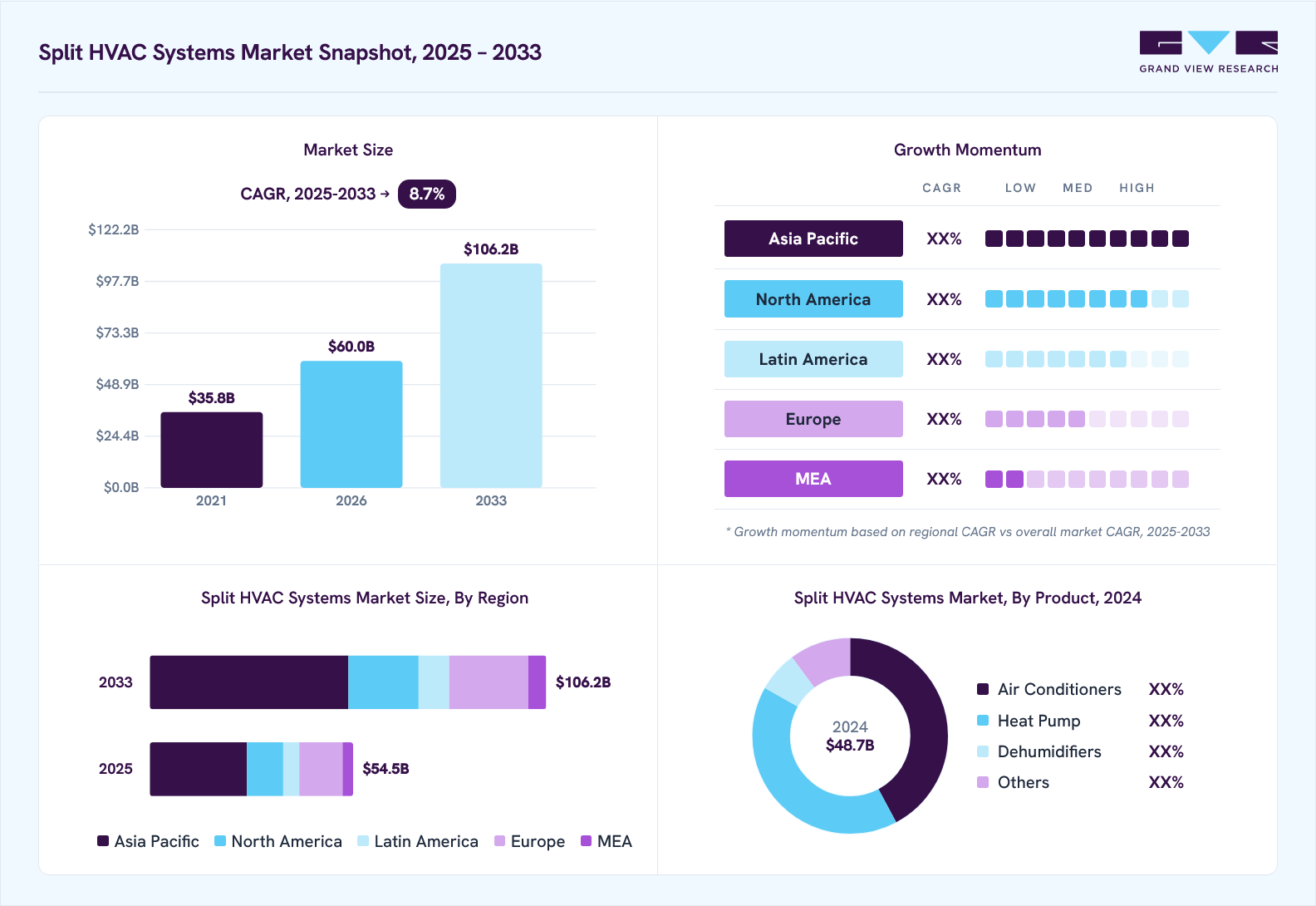
The global split HVAC systems market size was valued at USD 54.5 billion in 2025 and is projected to grow from USD 60.0 billion in 2026 to USD 106.2 billion by 2033, at a CAGR of 8.5% from 2026 to 2033. Asia Pacific dominated the split HVAC systems market with the largest revenue share of 47.8% in 2025. The rapid pace of urbanization is increasing the demand for residential and commercial buildings, driving the need for efficient cooling and heating solutions.
 Source: Grand View Research, IR Documents, Primary Interviews, Paid DatabasesTo learn more about this report,
 Download Free Sample Report
 Key Market Trends & Insights
- By product type: Air conditioners segment held the largest market share of 41.8% in 2025.
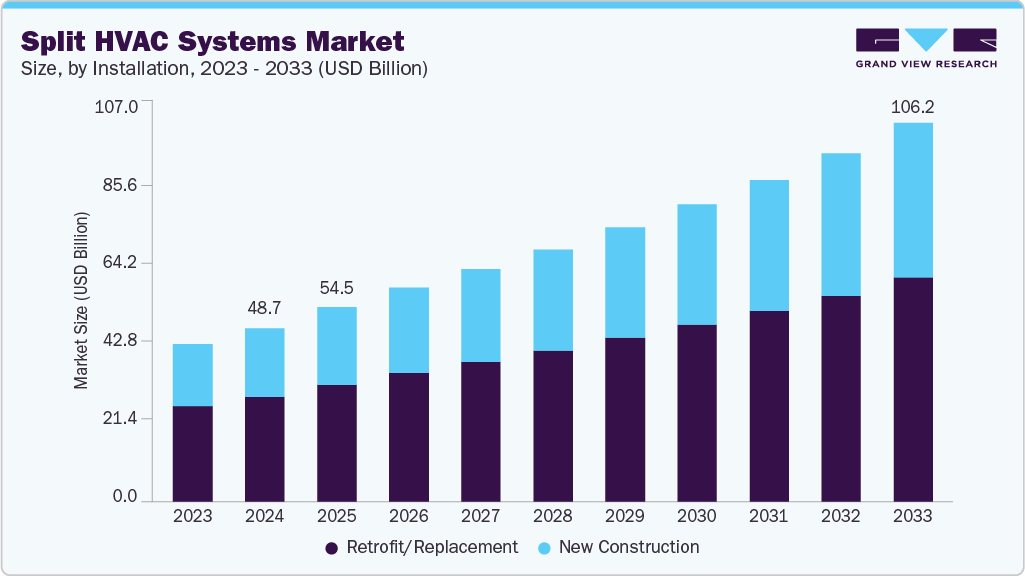
- By installation: Retrofit/replacement segment held the largest market share of 60.2% in 2025.
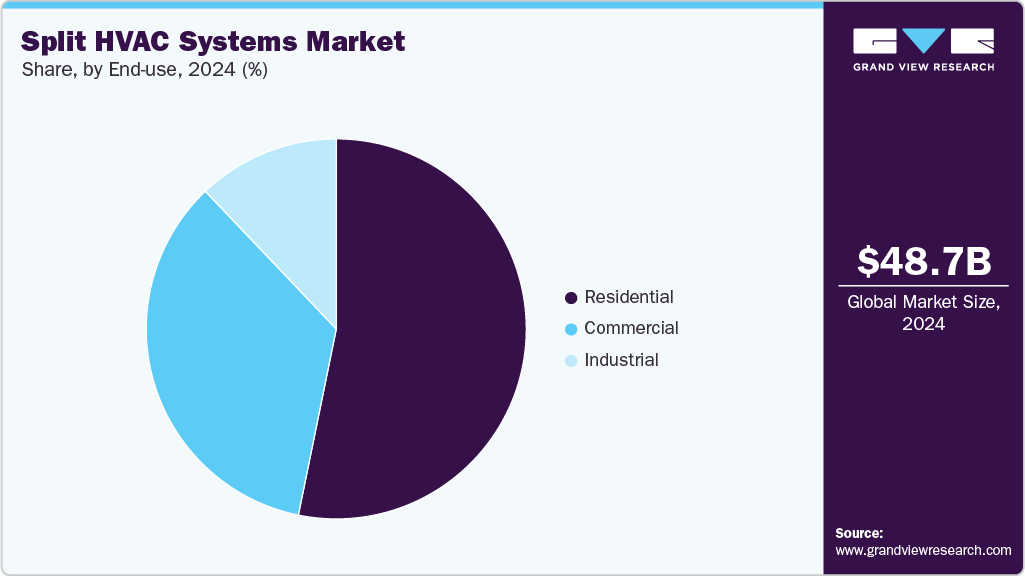
- By end use: Residential segment held the largest market share of 53.4% in 2025.
Regional Highlights
- Largest regional market: Asia Pacific (47.8% revenue share, 2025)
- By country: China held the largest market share in 2025
Market Size & Forecast
- Market size in 2025: USD 54.5 Billion
- Estimated market size in 2026: USD 60.0 Billion
- Projected market size by 2033: USD 106.2 Billion
- CAGR (2026-2033): 8.5%
Three ways to get this report
Buy it, customize it, or ask a question.Ask an Analyst
Analyst response in 1 business day
- AccessReport author, directly
- Reply timeWithin 1 working day
- No sales callDirect answer only
- FormatEmail reply
- CostFree, no cost
Get the Full Report
What the study covers
- FormatsPDF · Excel · Dashboard
- Timeline2026–2033 annual, 2025 base
- Coverage20+ countries, 5 regions
- Companies10+ key players profiled
Customize the Report
20% free customization
- IncludeCountries, segments, points
- TailorTo your product definition
- ExtendDeeper competitor detail
- OrA fully bespoke study
- Turnaround5–10 working days
Split HVAC systems, being compact and versatile, are ideal for such developments. Rising disposable incomes are also enabling homeowners to invest in modern HVAC solutions. This trend is particularly strong in emerging economies where new housing projects are expanding rapidly. Increasing focus on energy-efficient appliances is pushing the adoption of split HVAC systems that consume less power. Innovations such as inverter technology and smart controls enhance performance while reducing electricity bills. Environmental regulations encouraging low-emission equipment further support market growth. Consumers are increasingly prioritizing eco-friendly solutions without compromising comfort.
 To learn more about this report, Download Free Sample Report
 Market Dynamics
The split HVAC systems market is witnessing steady growth due to rising demand for energy-efficient climate control solutions across residential, commercial, and industrial sectors. Rapid urbanization, increasing construction of residential and commercial buildings, and growing awareness of indoor air quality are driving product adoption globally. Technological advancements such as inverter compressors, smart thermostats, IoT-enabled controls, and environmentally friendly refrigerants are improving system efficiency and reducing operating costs. In addition, supportive government regulations promoting energy-efficient buildings and low-emission HVAC equipment are encouraging replacement of conventional systems with advanced split HVAC systems.
The growing emphasis on reducing energy consumption and lowering carbon emissions is a major factor driving the split HVAC systems market. Governments worldwide are implementing stringent energy efficiency standards and incentive programs that encourage consumers and businesses to replace aging HVAC equipment with high-efficiency split systems. Features such as variable-speed compressors, inverter technology, and advanced heat pumps enable significant energy savings while maintaining indoor comfort.
Furthermore, increasing adoption of smart homes and intelligent commercial buildings is accelerating demand for connected split HVAC systems. Integration with IoT platforms, smart thermostats, and building management systems allows users to remotely monitor energy usage, optimize cooling and heating schedules, and perform predictive maintenance. These capabilities improve operational efficiency, reduce electricity costs, and enhance user convenience, making smart split HVAC systems an attractive investment. This trend is expected to remain a major driver of market growth throughout the forecast period.
Despite their long-term energy savings, split HVAC systems require a relatively high upfront investment for equipment purchase, installation, and system configuration, particularly for multi-zone and heat pump models. The need for professional installation, refrigerant piping, electrical work, and periodic maintenance can discourage adoption among cost-sensitive residential consumers and small businesses. In developing economies, budget constraints and the availability of lower-cost conventional cooling alternatives continue to limit widespread adoption of advanced split HVAC systems.
The global transition toward sustainable construction and building electrification presents significant opportunities for the split HVAC systems market. Governments, developers, and commercial property owners are increasingly investing in green buildings that prioritize energy efficiency, low carbon emissions, and occupant comfort. High-efficiency split air conditioners and heat pumps are becoming preferred solutions due to their lower energy consumption and compatibility with renewable electricity sources. As electrification policies continue to replace fossil fuel-based heating systems and demand for smart, environmentally compliant HVAC solutions grows, manufacturers have substantial opportunities to expand their product portfolios and strengthen their presence across both developed and emerging markets.
Market Concentration & Characteristics
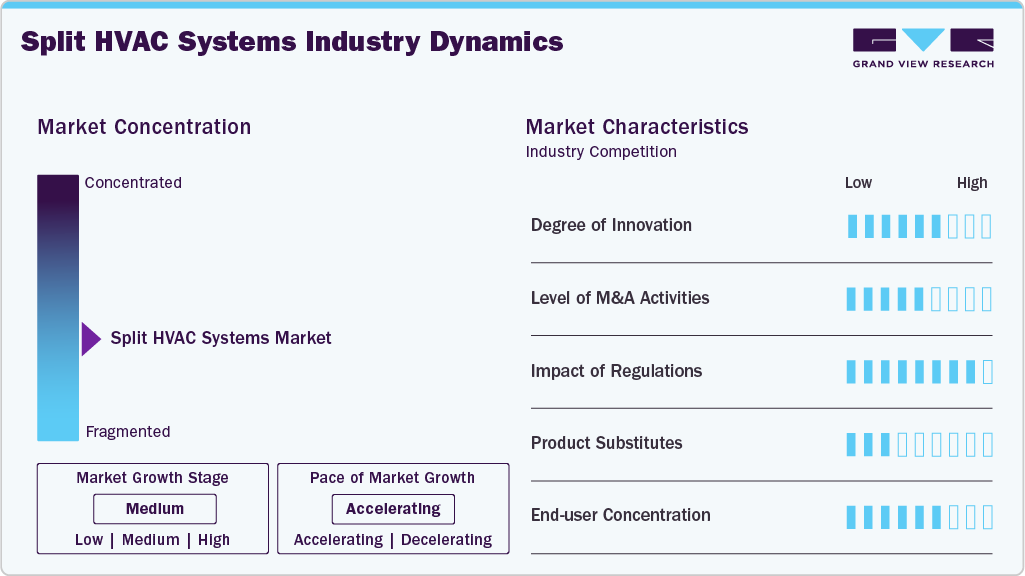
The global split HVAC systems market is moderately fragmented, with a mix of established multinational players and numerous regional manufacturers competing for market share. While top brands hold significant influence through advanced technology and strong distribution networks, smaller local players continue to grow by offering cost-effective solutions tailored to regional needs. This competitive structure encourages continuous innovation and service differentiation. As demand expands across emerging markets, the presence of diverse players is expected to sustain a dynamic and competitive landscape.
The split HVAC industry demonstrates strong innovation as manufacturers develop systems focused on energy savings and intelligent control. Solutions now often feature smart thermostats, inverter compressors, and environmentally friendly refrigerants to meet modern expectations. Continuous research efforts enable brands to differentiate their offerings. This drive for innovation supports competitiveness across both established and emerging regions.
 To learn more about this report, Download Free Sample Report
 M&A activity in the sector is moderate, with companies pursuing acquisitions to broaden product lines and expand into new regions. Such deals allow quick market entry and access to advanced technologies. Consolidation also improves production efficiency and strengthens market positioning. This approach is likely to persist as firms seek greater scale and strategic advantage.
Government regulations play a key role in shaping the market, particularly around energy consumption and environmental standards. Rules on refrigerants, emissions, and efficiency encourage manufacturers to adopt sustainable technologies. Compliance fosters innovation in eco-friendly designs and operational practices. Companies that align early with these standards gain long-term advantages and reduce regulatory risks.
Analyst Perspective
The split HVAC systems market is expected to maintain steady growth over the forecast period, supported by increasing demand for energy-efficient climate control solutions, rising urbanization, and continuous investment in residential and commercial construction. The transition toward smart buildings, inverter-based technologies, and heat pump adoption is reshaping product innovation, while stricter energy efficiency regulations are accelerating the replacement of conventional HVAC equipment. Asia Pacific is anticipated to remain the largest market due to rapid infrastructure development and expanding urban populations, whereas North America and Europe will continue to benefit from retrofit demand and sustainability initiatives. Manufacturers that focus on smart connectivity, environmentally compliant refrigerants, and high-efficiency systems while strengthening regional distribution and service networks are expected to gain a competitive advantage in the evolving global split HVAC systems market.
Drivers, Opportunities & Restraints
Rising demand for energy-efficient cooling and heating solutions is driving the split HVAC market growth. Urbanization and rapid residential and commercial construction are boosting adoption rates. Technological advancements, such as inverter compressors and smart controls, enhance system performance. Growing consumer awareness of comfort and cost savings further fuels market growth.
Emerging economies present significant growth opportunities due to increasing disposable incomes and expanding housing sectors. Integration of IoT and AI technologies enables innovative product offerings and smart home compatibility. Demand for eco-friendly refrigerants and green buildings is creating new market niches. Companies can also explore aftermarket services and maintenance solutions to strengthen customer engagement.
High initial investment and installation costs limit adoption among price-sensitive consumers. Strict regulatory requirements on refrigerants and emissions pose compliance challenges for manufacturers. Market growth is affected by competition from alternative cooling and heating solutions. Fluctuating raw material prices can impact manufacturing costs and profit margins.
Product type Insights
Based on product type, air conditioners segment led the market with the largest revenue share of 41.8% in 2025, due to their efficiency in joining complex components with precision. The air conditioner market is experiencing robust growth, driven by rising temperatures and increasing awareness of indoor air quality. With growing urbanization and changing lifestyles, more consumers are seeking efficient cooling solutions for their homes and businesses. Innovations in technology, such as variable refrigerant flow (VRF) systems, smart thermostats, and energy-efficient units, are enhancing the performance and energy savings of air conditioners.
The heat pump segment is gaining significant traction due to its energy efficiency and environmental benefits. Unlike traditional heating methods, heat pumps transfer heat rather than generating it, making them a more sustainable option for both heating and cooling needs. With rising energy costs and increasing awareness about climate change, consumers and businesses are increasingly turning to heat pumps as a viable alternative. The market is also being propelled by advancements in technology, such as smart controls and inverter-driven systems, which enhance performance and user experience.
Installation Insights
Based on installation, retrofit/replacement segment led the market with the largest revenue share of 60.2% in 2025, as businesses and homeowners upgrade aging HVAC systems for better efficiency. Increasing awareness of energy savings and reduced operational costs drives this trend. Older systems often lack modern features, making replacement an attractive option. Established infrastructure and service networks further support widespread adoption in this segment.
The new construction segment is expected to grow at the fastest CAGR over the forecast period, due to rapid urbanization and expanding residential and commercial developments. Developers are increasingly integrating split HVAC systems into modern building designs. Rising demand for energy-efficient and smart systems in new projects accelerates market growth. Emerging economies, with large-scale housing and commercial projects, are driving this surge.
End Use Insights
Based on end use, residential segment led the market with the largest revenue share of 53.4% in 2025 as homeowners increasingly prioritize comfort and energy efficiency. Rising disposable incomes and urban housing developments drive adoption of split HVAC systems. Compact designs and easy installation make them ideal for apartments and individual homes. Continuous demand for smart and eco-friendly solutions further strengthens this segment’s market position.
 To learn more about this report, Download Free Sample Report
 The commercial segment is growing significantly due to expanding office spaces, retail complexes, and hospitality infrastructure. Businesses are upgrading HVAC systems to reduce operational costs and meet sustainability goals. Advanced features like zoning controls and energy-efficient operation attract commercial buyers. Rapid urbanization and new construction projects in emerging markets are fueling this growth trend.
Regional Insights
The North America split HVAC systems market is expected to witness steady growth at a CAGR of 8.6% over the forecast period, as commercial and residential construction rebounds. Consumers increasingly prefer energy-efficient and eco-friendly HVAC systems to reduce utility costs. Advanced technological adoption, including smart controls and IoT integration, boosts market penetration. Stringent government regulations on energy efficiency further drive system upgrades and replacements.
U.S. Split HVAC Systems Market Trends
The U.S. dominates the North America split HVAC industry, due to high demand from both residential and commercial sectors. Strict energy efficiency regulations and government incentives drive upgrades to modern systems. Rising adoption of smart and IoT-enabled HVAC solutions enhances market growth. Strong infrastructure development and consumer preference for comfort further reinforce its leading position.
The Canada split HVAC systems market is witnessing steady growth as homeowners and businesses adopt energy-efficient heating and cooling solutions. Increasing urbanization and new construction projects fuel demand for split HVAC systems. Government initiatives promoting sustainability and low-carbon technologies support market expansion. Harsh winters and fluctuating temperatures encourage the adoption of reliable, high-performance HVAC units.
Europe Split HVAC Systems Market Trends
Europe’s split HVAC industry is expanding as countries implement strict environmental regulations and promote sustainable building practices. Demand for energy-efficient systems is rising across residential, commercial, and industrial applications. Technological advancements and upgrades of existing installations are driving market growth. Key contributors to this trend include Germany, France, and the UK, where adoption rates are particularly strong.
The Germany split HVAC systems market leads Europe, due to rigorous energy efficiency standards and high awareness among consumers. The country benefits from a strong HVAC manufacturing base and early adoption of advanced technologies. A focus on sustainable infrastructure and retrofitting older systems further fuels demand. Continuous construction and modernization projects reinforce Germany’s dominant position in the region.
The split HVAC systems market in the UK is witnessing steady growth with increasing uptake of energy-efficient and smart HVAC systems in homes and businesses. Expanding commercial and residential construction supports adoption. Government programs encouraging low-carbon and environmentally friendly buildings boost market opportunities. Consumers are prioritizing comfort, reliability, and energy cost savings, driving further demand.
Asia Pacific Split HVAC Systems Market Trends
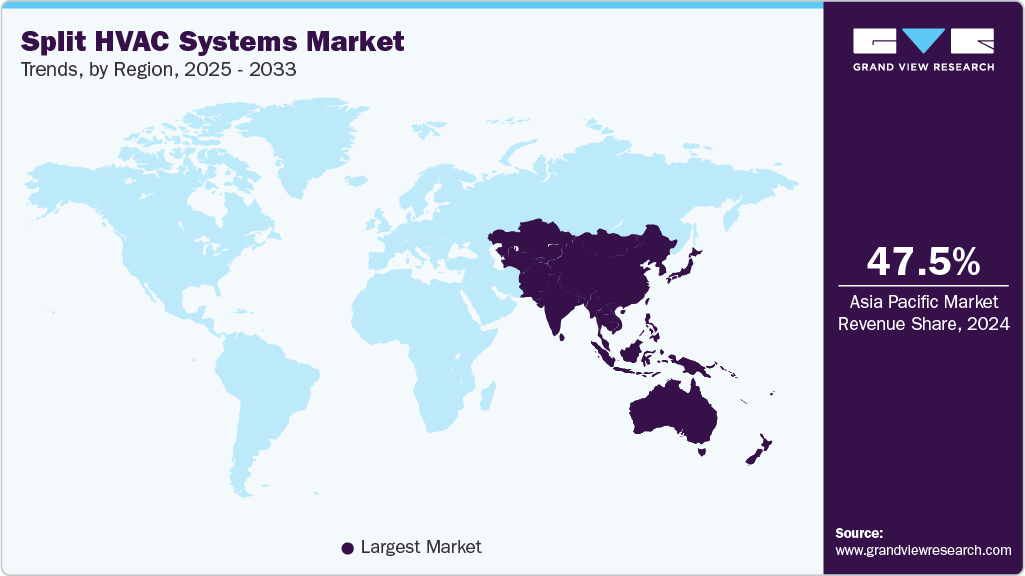
Asia Pacific dominated the split HVAC systems market with the largest revenue share of 47.8% in 2025. due to rapid urbanization, industrial growth, and expanding residential construction. High population density and rising disposable incomes drive demand for energy-efficient and smart HVAC solutions. Countries like China, India, and Japan are investing heavily in modern infrastructure. Strong manufacturing capabilities and local production further strengthen the region’s market leadership.
 To learn more about this report, Download Free Sample Report
 The split HVAC systems market in the China held the largest share in the Asia Pacific region in 2025. The China split HVAC systems market dominates Asia Pacific, due to rapid urbanization and large-scale residential and commercial construction. High population density and rising disposable incomes drive demand for energy-efficient and smart HVAC systems. Strong local manufacturing capabilities ensure wide availability and cost-effectiveness. Government incentives and environmental regulations further support adoption of modern HVAC solutions.
The split HVAC systems market in India is witnessing significant growth with increasing urbanization and expanding middle-class housing projects. Rising awareness of energy efficiency and comfort drives demand for split HVAC systems. Rapid industrialization and commercial infrastructure development create new market opportunities. The adoption of smart technologies and eco-friendly solutions accelerates market expansion in the country.
Middle East & Africa Split HVAC Systems Market Trends
The Middle East and Africa split HVAC systems industry is growing due to hot climates, increasing residential and commercial construction, and rising energy costs. Demand for reliable and efficient cooling solutions supports split HVAC adoption. Government initiatives promoting sustainable and energy-efficient buildings further enhance growth. Urbanization and tourism-related infrastructure projects contribute to market expansion across the region.
The Saudi Arabia split HVAC systems market is witnessing strong growth, due to rising residential and commercial construction projects. The country’s hot climate drives high demand for efficient cooling solutions. Government initiatives promoting energy-efficient buildings and sustainable infrastructure further support adoption. Increasing urbanization and investment in smart technologies are accelerating market expansion in the region.
Latin America Split HVAC Systems Market Trends
Latin America is experiencing growth driven by urbanization, rising middle-class populations, and infrastructure development. Increasing awareness of energy efficiency encourages adoption of modern HVAC solutions. Expansion in commercial complexes and residential projects fuels demand. Countries such as Brazil and Argentina are emerging as important markets in the region.
The Brazil split HVAC systems market is experiencing growth, driven by rapid urbanization and expanding residential and commercial projects. Rising disposable incomes and awareness of energy-efficient solutions are boosting adoption. The government’s focus on sustainable infrastructure and green building initiatives supports market expansion. Increasing demand for modern, reliable HVAC systems in both homes and businesses fuels further growth.
Key Split HVAC Systems Company Insights
Some of the key players operating in the market include Carrier, Johnson Controls, and Trane.
-
Carrier is a leading global provider of intelligent climate and energy solutions, offering a diverse range of heating, ventilation, air conditioning (HVAC), refrigeration, and fire and security equipment. The company serves residential, commercial, and industrial sectors with a focus on sustainable and energy-efficient technologies. Its products incorporate smart controls and innovative features to enhance performance and reduce energy consumption. Carrier continually invests in research and development to maintain technological leadership. The company’s solutions aim to improve comfort, safety, and operational efficiency across various applications.
-
Johnson Controls is a multinational company specializing in building technologies and integrated solutions. Its offerings include HVAC systems, building automation, security solutions, and fire detection equipment. The company has strategically focused on commercial and industrial markets while divesting certain residential and light commercial operations. Its OpenBlue platform emphasizes smart, connected, and sustainable building solutions. Johnson Controls drives innovation through digital technologies to enhance energy efficiency, safety, and operational performance in buildings worldwide.
Key Split HVAC Systems Companies
The following key companies have been profiled for this study on the split HVAC systems market.
-
Carrier
-
Johnson Controls
-
Trane
-
LG Electronics
-
Haier Group
-
Panasonic Corporation
-
AAON
-
Daikin
-
Samsung
-
Midea
-
Mitsubishi Electric
-
Fujitsu
-
Voltas
-
Lennox
-
GREE Comfort
Competitive Benchmarking
Category
Operating Strategies
Competitive Edge
Weakness
Established Players (e.g., Daikin, Carrier, Trane, Mitsubishi Electric, LG Electronics, Johnson Controls)
- Invest in advanced inverter, heat pump, and smart split HVAC technologies.
- Expand global manufacturing capacity and dealer networks.
- Focus on premium, energy-efficient products that comply with evolving environmental regulations.
- Strong global brand recognition and extensive distribution networks.
- Broad product portfolios serving residential, commercial, and industrial applications.
- High R&D investments that support continuous product innovation and technology leadership.
- Premium pricing compared to regional competitors.
- Higher manufacturing and operating costs.
- Slower response to niche regional market requirements due to large organizational structures.
Emerging & Regional Players (e.g., AAON, GREE Comfort, Midea, Voltas, Haier Group, Fujitsu)
- Compete through cost-effective and locally manufactured split HVAC systems.
- Expand presence in emerging markets through regional partnerships and distribution.
- Increase investments in smart and energy-efficient HVAC product development.
- Competitive pricing for residential and light commercial applications.
- Strong understanding of regional customer needs and regulations.
- Faster product launches and greater flexibility in addressing local market demand.
- Lower global brand recognition than leading multinational manufacturers.
- Limited presence in large-scale commercial and industrial HVAC projects.
- Smaller R&D budgets may limit the pace of technological innovation.
Recent Developments
-
In June 2025, Haier acquired KLIMA KFT, a Hungarian HVAC firm, to strengthen its market reach in Central and Eastern Europe. This acquisition boosts Haier’s capacity to offer sustainable heating and cooling solutions locally. Combining KLIMA’s expertise with Haier’s innovation, it supports enhanced customer service in the region.
-
In March 2025, Panasonic Canada partnered with EMCO HVAC to make its energy-efficient heat pumps more accessible across Canada. Through EMCO's extensive distribution network, Panasonic’s ducted and ductless heat pumps will reach residential markets nationwide. The partnership is now active, with products available through EMCO's branches across the country.
Split HVAC Systems Market Report Scope
Report Attribute
Details
Market size in 2025
USD 54.5 billion
Estimated market size in 2026
USD 60.0 billion
Projected market size by 2033
USD 106.2 billion
Growth rate
CAGR of 8.5% from 2026 to 2033
Base year for estimation
2025
Historical data
2021 - 2024
Forecast period
2026 - 2033
Quantitative units
Revenue in USD billion and CAGR from 2026 to 2033
Report coverage
Revenue forecast, company ranking, competitive landscape, growth factors, and trends
Segments covered
Product type, installation, orientation, end use, region.
Regional scope
North America; Europe; Asia Pacific; Latin America; Middle East & Africa
Country scope
U.S.; Canada; Mexico; UK; Germany; France; Spain; Italy; China; Japan; India; Australia; South Korea; Brazil; Argentina; Saudi Arabia; South Africa; UAE
Key companies profiled
Carrier; Johnson Controls; Trane; LG Electronics; Haier Group; Panasonic Corporation; AAON; Daikin; Samsung; Midea; Mitsubishi Electric; Fujitsu; Voltas; Lennox; GREE Comfort.
Customization scope
Free report customization (equivalent up to 8 analysts' working days) with purchase. Addition or alteration to country, regional & segment scope.
Pricing and purchase options
Avail customized purchase options to meet your exact research needs. Explore purchase options
Global Split HVAC Systems Market Report Segmentation
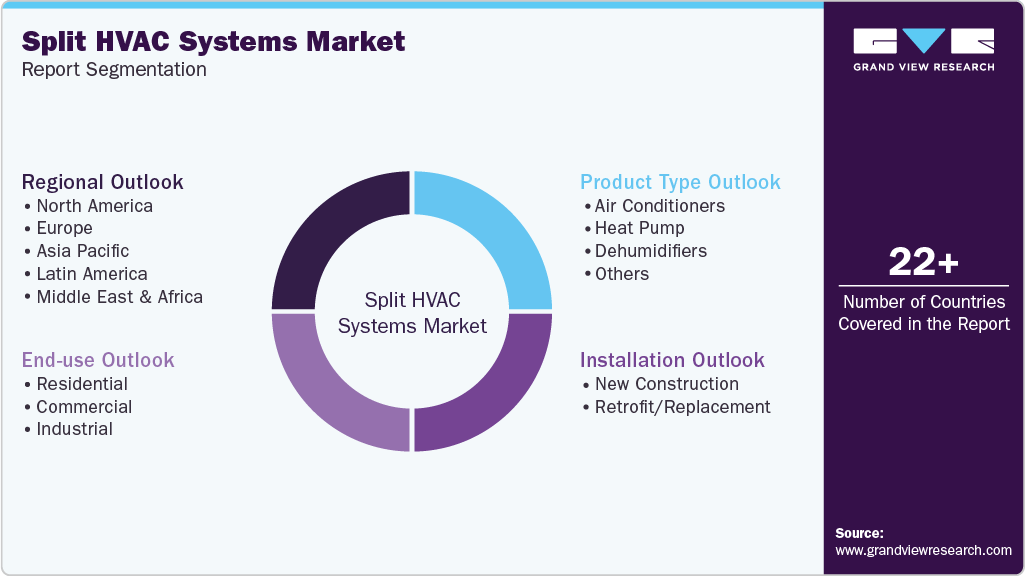
This report forecasts revenue growth at the global, regional, and country levels and provides an analysis of the latest industry trends in each of the sub-segments from 2021 to 2033. For this study, Grand View Research has segmented the global split HVAC systems market report based on product type, installation, end use, and region:
 To learn more about this report, Download Free Sample Report
 -
Product type Outlook (Revenue, USD Million, 2021 - 2033)
-
Air Conditioners
-
Heat Pump
-
Dehumidifiers
-
Others
-
-
Installation Outlook (Revenue, USD Million, 2021 - 2033)
-
New Construction
-
Retrofit/Replacement
-
-
End Use Outlook (Revenue, USD Million, 2021 - 2033)
-
Residential
-
Commercial
-
Industrial
-
-
Regional Outlook (Revenue, USD Million, 2021 - 2033)
-
North America
-
U.S.
-
Canada
-
Mexico
-
-
Europe
-
Germany
-
France
-
Italy
-
Spain
-
UK
-
-
Asia Pacific
-
China
-
India
-
Japan
-
South Korea
-
Australia
-
-
Latin America
-
Brazil
-
Argentina
-
-
Middle East and Africa
-
Saudi Arabia
-
UAE
-
South Africa
-
-
Research Methodology
The split HVAC systems market figures in this report are based on a proven research process that combines executive interviews with secondary research from proprietary databases, company filings, and recognized regulatory and institutional sources. Market size is built through value-chain sizing - reconciling supply-side and demand-side estimates - and triangulated with bottom-up and top-down approaches. Every estimate passes multiple levels of expert validation before publication, with each split HVAC systems segment quantified using the revenue-capture definitions in the table below.
Segment Definition
Product Type
Revenue Capture Definition
Air Conditioners
Revenue generated from the sale of split air conditioning systems, including wall-mounted, floor-mounted, ceiling cassette, and ducted units used for residential, commercial, and industrial cooling applications.
Heat Pump
Revenue generated from the sale of split heat pump systems that provide both heating and cooling for residential, commercial, and industrial buildings.
Dehumidifiers
Revenue generated from the sale of split dehumidification systems designed to control indoor humidity and improve air quality across residential, commercial, and industrial environments.
Others
Revenue generated from the sale of specialty split HVAC products, including multi-zone systems, ceiling-concealed units, floor-standing units, air purification-integrated systems, and other customized split climate control solutions.
Installation
Revenue Capture Definition
New Construction
Revenue generated from the sale of split HVAC systems installed in newly constructed residential, commercial, institutional, and industrial buildings.
Retrofit/Replacement
Revenue generated from the sale of split HVAC systems installed as replacements for existing equipment or during renovation and modernization projects to improve energy efficiency and building performance.
End Use
Revenue Capture Definition
Residential
Revenue generated from the sale of split HVAC systems for single-family homes, apartments, condominiums, villas, and other residential properties.
Commercial
Revenue generated from the sale of split HVAC systems for offices, retail stores, hotels, restaurants, healthcare facilities, educational institutions, and other commercial establishments.
Industrial
Revenue generated from the sale of split HVAC systems for manufacturing plants, warehouses, laboratories, pharmaceutical facilities, food processing units, and other industrial applications requiring reliable temperature and humidity control.
Estimation Model
Layer No.
Layer Name
Key Question
Description
01
Building & Infrastructure Base
Where are split HVAC systems installed?
Estimate the number of new construction and retrofit projects across residential, commercial, and industrial buildings requiring split HVAC systems.
02
Split HVAC System Adoption
What percentage of projects adopt split HVAC systems?
Assess the adoption rate of split HVAC systems by product type (air conditioners, heat pumps, dehumidifiers, and others) across installation and end-use segments.
03
Unit Demand Assessment
How many split HVAC systems are sold?
Estimate annual demand based on new installations, replacement cycles, construction activity, energy-efficiency upgrades, and regional adoption trends.
04
Revenue
What is the total market revenue generated?
Calculate total market revenue based on the sales volume of split HVAC systems across product types, installation types, end-use industries, and regions.
Delivered Customizations
This report has been delivered with the following In-depth customizations
Client Request
Customization Delivered
Value Adds
Regional Segmentation
Delivered an in-depth regional analysis of the Split HVAC Systems Market across North America, Europe, Asia Pacific, Latin America, and the Middle East & Africa, including country-level demand trends, market size estimates, growth drivers, regulatory landscape, construction activity, climate conditions, and adoption of energy-efficient split HVAC systems.
Enabled the client to identify high-growth regional markets, prioritize expansion strategies, understand regional demand variations, and align investments with construction and energy-efficiency trends.
Competitive Benchmarking
Delivered a comprehensive assessment of leading manufacturers, including product portfolio benchmarking, technology comparison, strategic developments, competitive positioning, innovation focus, distribution capabilities, and market participant categorization across the global split HVAC systems market.
Provided actionable competitive intelligence to benchmark market leaders, identify product differentiation opportunities, evaluate competitor strengths and weaknesses, and support strategic business planning.
Opportunity Assessment
Delivered a detailed evaluation of emerging growth opportunities by analyzing smart HVAC adoption, inverter and heat pump penetration, green building developments, retrofit demand, refrigerant transition, and high-growth end-use industries across key regions.
Helped the client identify future revenue opportunities, prioritize investment areas, develop targeted market entry strategies, and capitalize on evolving technology and sustainability trends in the split HVAC systems market.
Frequently Asked Questions About This Report
The air conditioners segment dominated the split HVAC systems market, accounting for the largest revenue share of 41.8% in 2025. The segment's growth was driven by rising demand for energy-efficient cooling solutions across residential and commercial buildings, increasing urbanization, and the adoption of inverter-based technologies.
The residential segment accounted for the largest revenue share of 53.4% in 2025. Increasing housing construction, rising consumer preference for energy-efficient climate control, and higher adoption of smart home technologies supported strong demand from the residential sector.
Asia Pacific dominated the global split HVAC systems market, capturing the largest revenue share of 47.8% in 2025. Rapid urbanization, expanding residential and commercial construction, rising disposable incomes, and strong manufacturing activity across countries such as China, India, Japan, and Southeast Asia drove regional market leadership.
Asia Pacific is projected to be the fastest-growing region during the forecast period. Continued infrastructure development, increasing adoption of energy-efficient HVAC systems, supportive government policies promoting sustainable buildings, and rising demand for smart climate control solutions are expected to accelerate market growth across the region.
The global split HVAC systems market size was estimated at USD 54.5 billion in 2025 and is projected to grow from USD 60.0 billion in 2026.
The global split HVAC systems market is expected to grow at a CAGR of 8.5% from 2026 to 2033, reaching USD 106.2 billion by 2033.
The retrofit and replacement segment dominates the market and accounted for a share of 60.2% in 2025 as businesses and homeowners upgrade aging HVAC systems for better efficiency. Increasing awareness of energy savings and reduced operational costs drives this trend. Older systems often lack modern features, making replacement an attractive option.
Some of the key players operating in the global split HVAC systems market include Carrier, Johnson Controls, Trane, LG Electronics, Haier Group, Panasonic Corporation, AAON, Daikin, Samsung, Midea, Mitsubishi Electric, Fujitsu, Voltas, Lennox, and GREE Comfort.
The global split HVAC systems market is driven by rising demand for energy-efficient and smart cooling solutions. Rapid urbanization and growth in residential and commercial construction fuel adoption. Technological advancements and government incentives for sustainable buildings further support market expansion.
About the Author(s)
Advanced Interior Materials Research Team
Advanced Materials · Advanced Interior MaterialsThis report was authored by the advanced interior materials research team at Grand View Research - comprising two research analysts, one senior research analyst, and one industry expert - with specialized expertise in the advanced interior materials segment of the advanced materials industry. All findings are based on proprietary advanced materials databases, executive interviews, and regulatory analysis, subject to internal peer review prior to publication.
Last Updated:
Speak to Analyst

Customize this report to your needs - add regions, segments, or data points, with 20% free customization.
Or view our licence options:


ISO 9001:2015 & 27001:2022 Certified
We are GDPR and CCPA compliant! Your transaction & personal information is safe and secure. For more details, please read our privacy policy.


