
- Home
- »
- Next Generation Technologies
- »
-
Sports Digital Twin Market Size & Share Report, 2026-2033GVR Report cover

Sports Digital Twin Market (2026 - 2033)
Size, Share, & Trends Analysis Report By Component (Software, Services), By Technology, By Deployment (Cloud, On-premise), By Application, By End Use, By Region, And Segment Forecasts
Market Size, 2025
$965.5MMarket Estimate, 2026
$1,198.2MMarket Forecast, 2033
$5,983.2MCAGR, 2026–2033
25.8%Sports Digital Twin Market Summary
The global sports digital twin market size was valued at USD 965.5 million in 2025 and is projected to grow from USD 1,198.2 million in 2026 to USD 5,983.2 million by 2033, at a CAGR of 25.8% from 2026 to 2033. North America dominated the market, accounting for a revenue share of 31.3% in 2025. The increasing use of motion capture and biomechanics analysis systems is driving market growth.
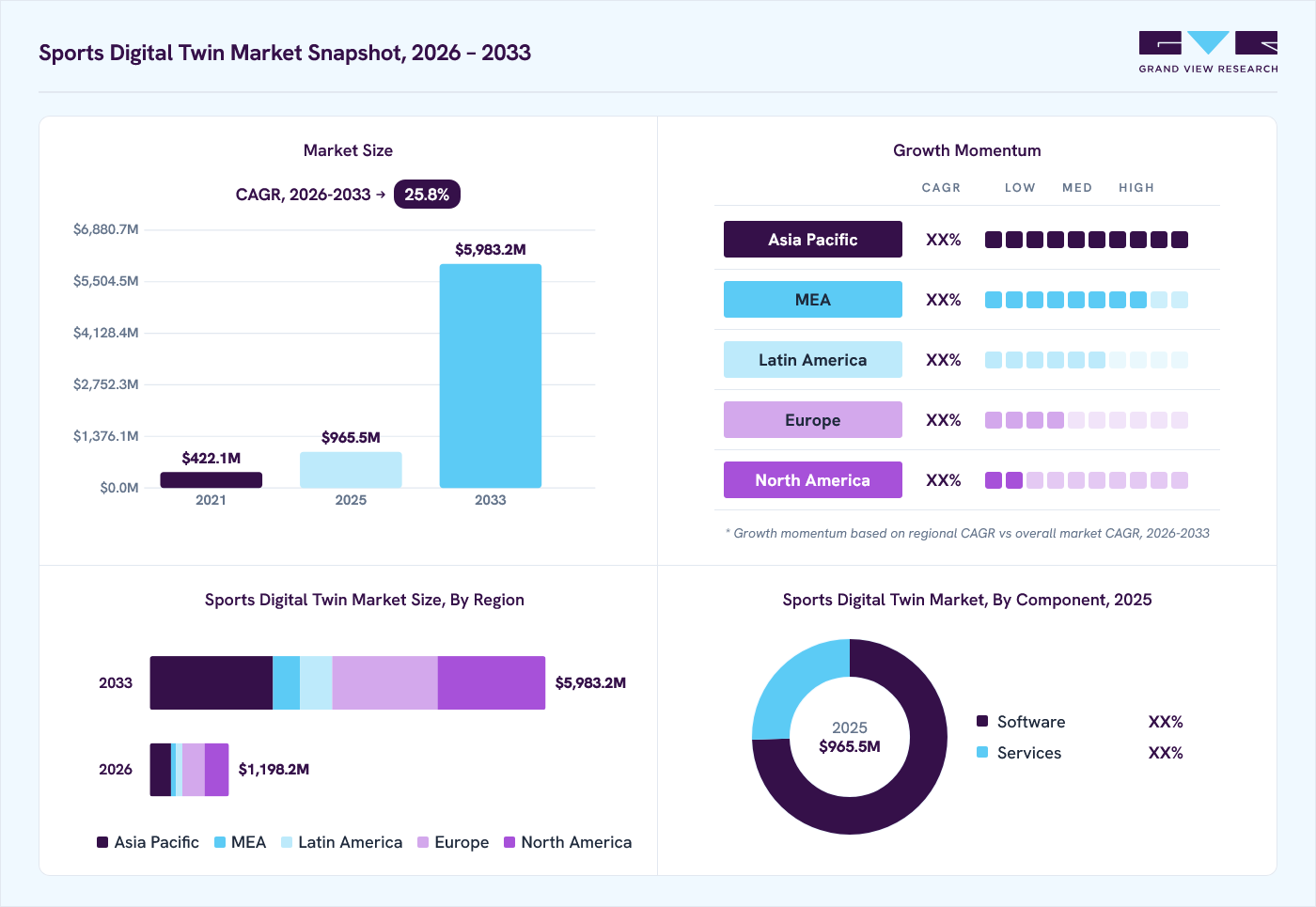 Source: Grand View Research, IR Documents, Primary Interviews, Paid DatabasesTo learn more about this report,
 Download Free Sample Report
Key Market Trends & Insights
- By component: The software segment dominated the market, with a revenue share of 74.5% in 2025.
- By technology: The artificial intelligence & machine learning segment led the market and accounted for a share of 33.6% in 2025.
- By deployment: The cloud segment dominated the market, with a revenue share of 67.7% in 2025.
- By application: The athlete performance analysis segment dominated the market, with a revenue share of 32.9% in 2025.
- By end use: The sports teams & clubs segment held the largest revenue share of 46.5% in 2025.
Regional Highlights
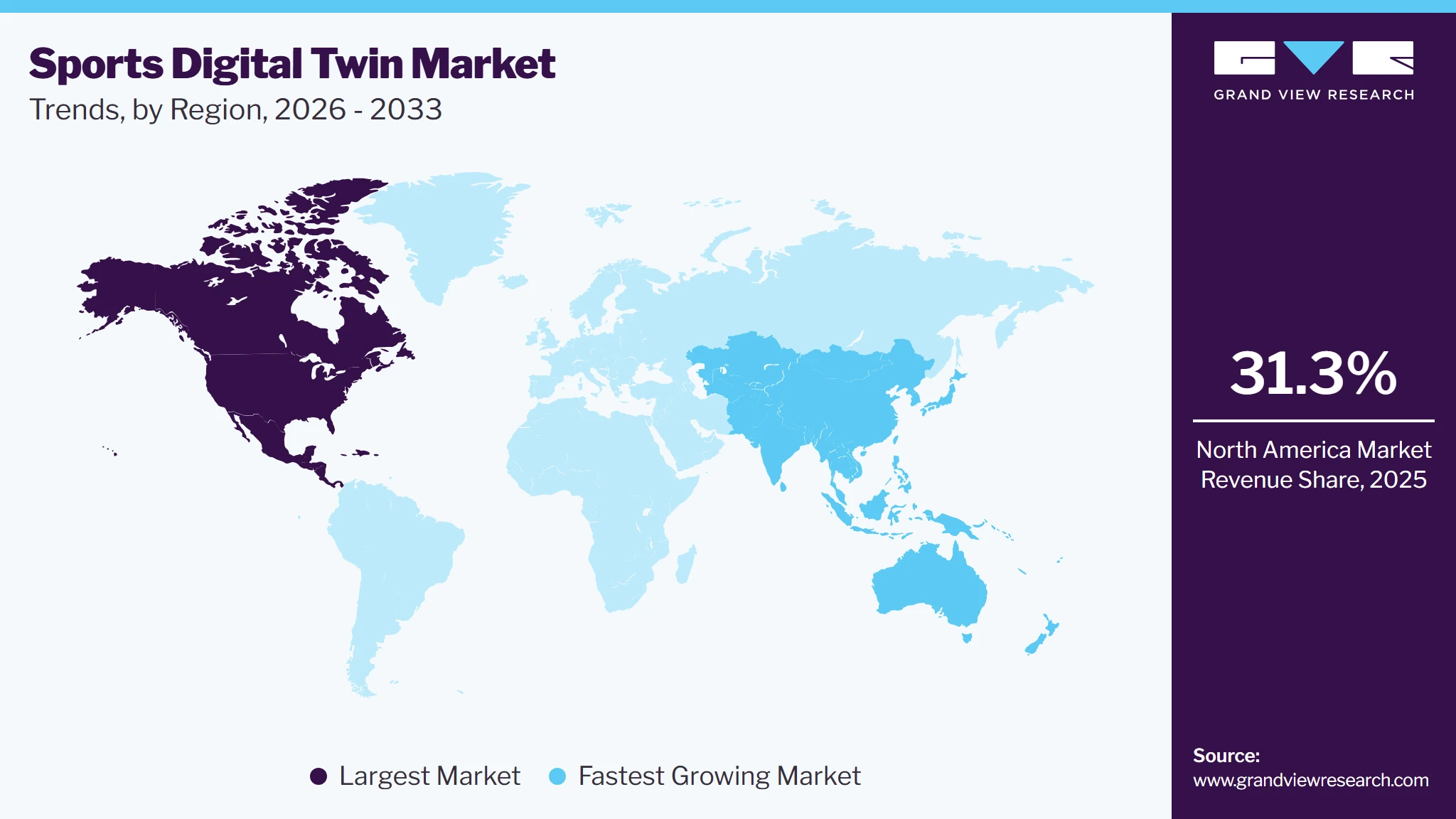
- Largest regional market: North America (31.3% revenue share, 2025)
- Fastest-growing regional market: Asia Pacific (highest CAGR, 2026-2033)
- By country: The U.S. held the largest market share in 2025.
Market Size & Forecast
- Market size in 2025: USD 965.5 Million
- Estimated market size in 2026: USD 1,198.2 Million
- Projected market size by 2033: USD 5,983.2 Million
- CAGR (2026-2033): 25.8%
Prism AI by Grand View Research Free to tryAsk a question about the sports digital twin marketTry asking✓Every figure cited from GVR research Prefer the report? Download free sample →
The growing emphasis on injury prevention and athlete health management is propelling market growth within the sports digital twin market. Athletic organizations increasingly require technologies capable of simulating physical stress, monitoring fatigue accumulation, evaluating movement mechanics, assessing joint loading patterns, and predicting physiological responses under varying training conditions. Digital twin systems increasingly provide virtual environments where coaches and medical staff can model training intensity, recovery schedules, rehabilitation protocols, workload distribution, and biomechanical adjustments before implementing them in real-world athletic programs.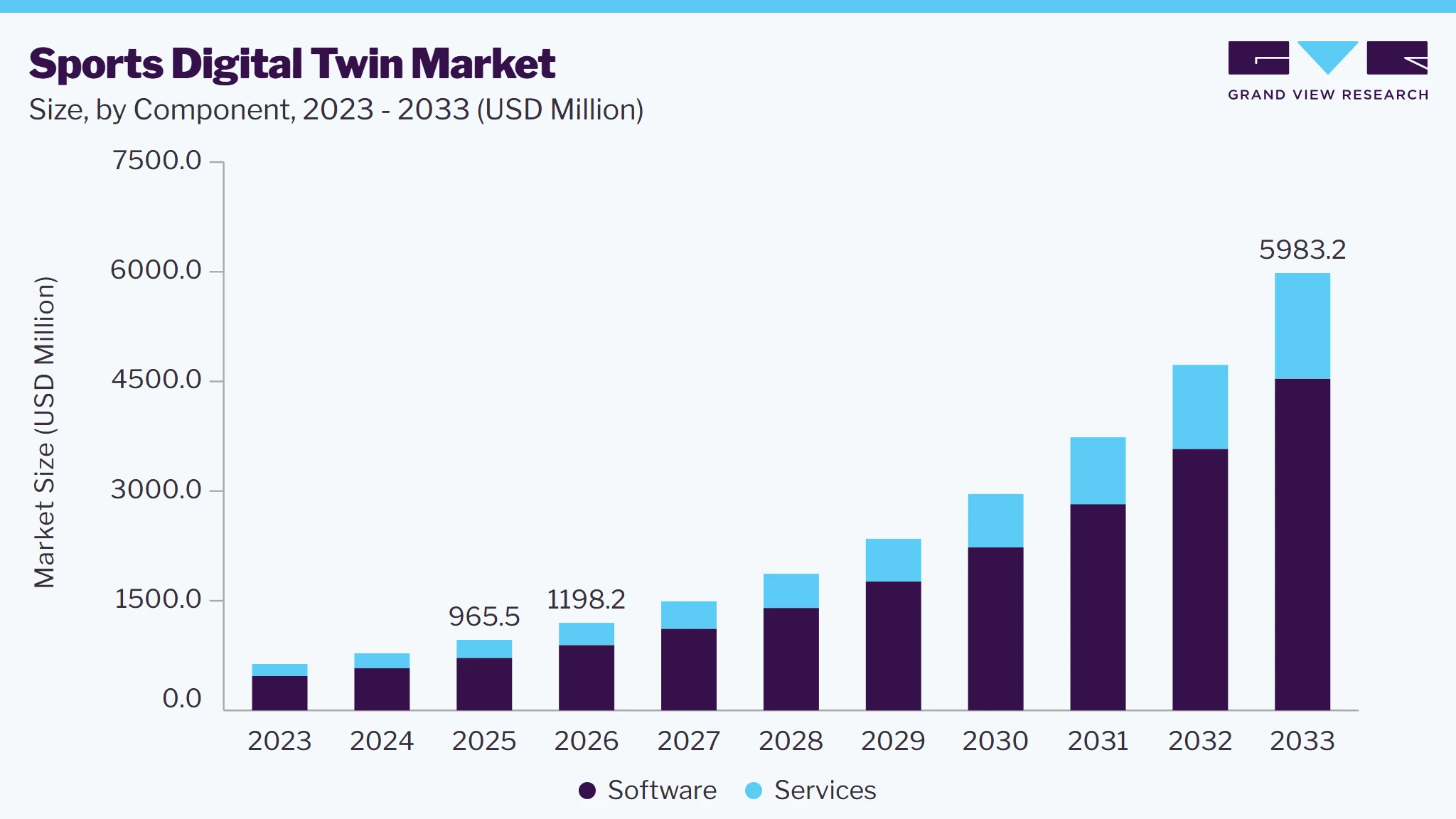 To learn more about this report, Download Free Sample Report
The growing demand for personalized athlete development programs is driving market growth within the sports digital twin market. Athletes increasingly require individualized training strategies that account for unique biomechanics, physiological characteristics, injury history, performance goals, recovery capacity, technical skills, and tactical responsibilities. Digital twin platforms increasingly enable highly customized virtual athlete models, allowing coaches to design personalized conditioning programs, skill development plans, movement optimization strategies, nutrition protocols, and recovery schedules tailored to each athlete's specific profile.
The increasing commercialization of sports analytics and performance technology is driving market growth across the sports digital twin market. Professional sports leagues, clubs, academies, performance centers, broadcasters, sponsors, and sports technology companies increasingly recognize advanced analytics as valuable competitive and commercial assets that enhance player valuation, talent identification, fan engagement, broadcasting content, sponsorship activation, and organizational decision-making. Digital twin platforms increasingly generate highly detailed performance insights, simulation data, tactical visualizations, and predictive analytics that support both competitive operations and commercial applications across the sports industry.
The expansion of connected sports infrastructure is driving growth in the sports digital twin market. Stadiums, training facilities, arenas, practice fields, performance laboratories, rehabilitation centers, and sports venues increasingly incorporate IoT sensors, smart equipment, environmental monitoring systems, connected cameras, automated tracking technologies, and digital infrastructure that generate continuous operational and performance data. Digital twin platforms increasingly create virtual replicas of both athletes and sports environments, allowing organizations to simulate facility operations, crowd movement, environmental conditions, equipment performance, and training configurations alongside athlete performance models.
The increasing use of simulation-based coaching and tactical planning is driving market growth across the sports digital twin industry. Coaches increasingly seek technologies that allow them to model match scenarios, evaluate strategic alternatives, simulate opponent behavior, analyze player positioning, test formation adjustments, and optimize game plans before competition begins. Digital twin platforms increasingly provide highly realistic virtual environments where teams can experiment with tactical decisions, substitution strategies, training drills, set-piece execution, defensive structures, and offensive coordination without disrupting actual competition schedules.
Market Dynamics
The sports digital twin market is gaining momentum as sports organizations, professional teams, training institutions, and venue operators increasingly adopt virtual replicas of athletes, equipment, facilities, and gameplay environments to enhance performance, strategy, and operational decision-making. Digital twin technology enables real-time monitoring, simulation, injury risk assessment, tactical analysis, training optimization, and fan engagement by integrating data from wearables, cameras, sensors, motion tracking systems, and performance analytics platforms. The growing use of advanced analytics in professional sports, increasing investment in athlete performance optimization, and rising demand for immersive sports technologies are encouraging broader adoption of digital twin solutions across training, competition, rehabilitation, and venue management applications. In addition, advancements in artificial intelligence, computer vision, IoT connectivity, and cloud computing are improving the accuracy and scalability of sports digital twin platforms.
The increasing use of wearable sensors and athlete-tracking technologies is driving growth in the sports digital twin market, as professional teams, training academies, sports federations, and performance centers increasingly require continuous streams of physiological and biomechanical data to construct accurate virtual representations of athletes. Wearable devices capable of measuring heart rate, oxygen consumption, acceleration, deceleration, body orientation, joint movement, muscle activity, and positional coordinates generate detailed datasets that allow digital twin platforms to mirror athlete behavior with high precision. These technologies increasingly transform isolated performance measurements into continuously updated digital models that reflect changes in fitness, fatigue, recovery, movement efficiency, and tactical positioning throughout training sessions and competitive events. Digital twin systems increasingly rely on wearable sensor ecosystems to maintain synchronized virtual replicas that evolve in real time alongside the athlete.
High implementation costs of advanced sports digital twin systems are restraining market growth in the sports digital twin market, as organizations must acquire a combination of specialized hardware, software platforms, sensor ecosystems, computing infrastructure, and technical expertise before meaningful deployment becomes possible. Comprehensive digital twin environments often require wearable tracking devices, motion capture systems, high-speed cameras, biomechanical analysis tools, cloud computing resources, artificial intelligence engines, and customized simulation software that operate as integrated components rather than standalone products. Sports organizations frequently incur substantial upfront costs for system integration, infrastructure preparation, software customization, calibration, testing, and operational deployment across training facilities and competitive environments. The financial complexity of implementing fully functional digital twin ecosystems slows adoption among many organizations operating under constrained budgets or uncertain technology return expectations.
The expansion of digital twins for sports venue and stadium management is creating a major opportunity in the sports digital twin market as operators increasingly require intelligent virtual representations of entire sports facilities rather than focusing solely on athlete performance. Modern stadiums function as highly complex operational environments that include seating systems, crowd movement corridors, security infrastructure, lighting networks, HVAC systems, digital signage, concession areas, parking facilities, transportation access points, and event management operations, all of which must be coordinated continuously during sporting events and large public gatherings. Digital twin platforms increasingly create comprehensive virtual models of stadium infrastructure, enabling operators to simulate venue operations, monitor real-time conditions, evaluate infrastructure performance, optimize maintenance schedules, and improve event logistics across large sports complexes.
Market Concentration & Characteristics
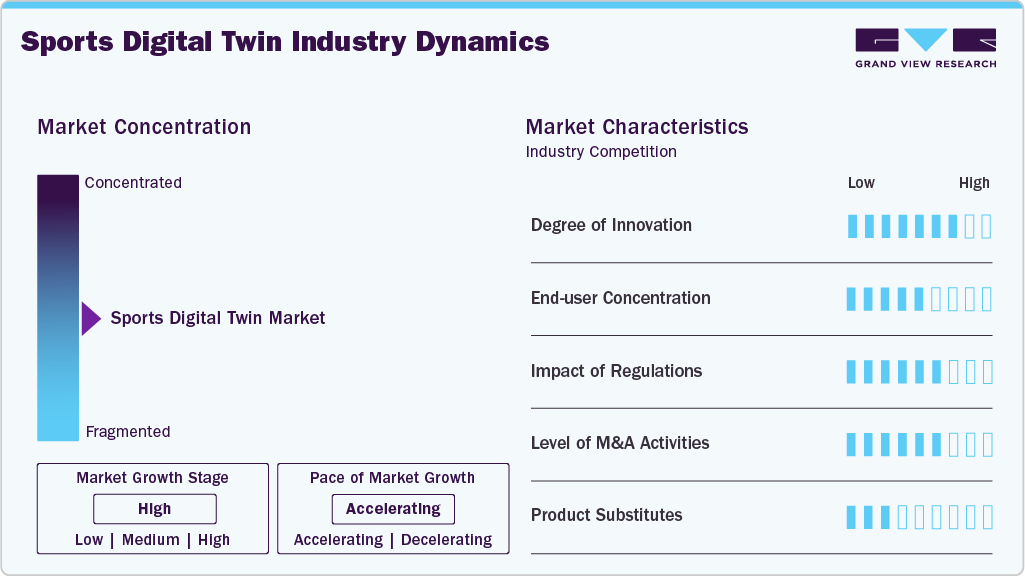
The sports digital twin market is moderately fragmented, with a combination of sports technology companies, analytics providers, stadium technology vendors, and specialized digital twin developers competing across professional sports, stadiums, training facilities, and athlete performance applications. The market has moderate entry barriers, driven by the need to combine real-time sensor data, computer vision, IoT connectivity, 3D modeling, analytics, and sports-specific expertise, while established providers benefit from relationships with sports leagues, clubs, stadium operators, and technology partners. Innovation is high as vendors increasingly integrate artificial intelligence, real-time simulation, predictive analytics, wearable data, and immersive visualization to improve athlete performance, venue operations, and fan engagement. Partnerships and collaborations are also relatively high, particularly between sports organizations, technology providers, sensor manufacturers, cloud platforms, and analytics companies.
 To learn more about this report, Download Free Sample Report
The market is in a high-growth stage, supported by the increasing digitization of sports operations and the growing demand for data-driven athlete management, facility optimization, and enhanced spectator experiences. End-user adoption remains relatively limited compared with conventional sports management technologies because implementation requires substantial data infrastructure, specialized expertise, and integration with existing stadium and team systems. Demand is expanding as professional sports organizations seek to optimize player performance, simulate game scenarios, monitor facility conditions, improve energy efficiency, and create personalized fan experiences. The availability of substitutes is moderate, as conventional analytics platforms, performance-monitoring systems, facility management software, and standalone simulation tools can address individual use cases without requiring a complete digital twin environment.
Analyst Perspective
The sports digital twin market is evolving from isolated performance analytics tools into a comprehensive decision-support ecosystem that connects athletes, coaches, medical staff, and sports organizations through continuously updated virtual models. Competitive differentiation is increasingly determined by the ability to integrate biomechanical data, physiological monitoring, tactical intelligence, and environmental conditions into predictive simulations that support real-time coaching, injury prevention, and long-term athlete development. Vendors that can demonstrate measurable improvements in performance optimization, rehabilitation outcomes, tactical planning, and operational efficiency are likely to strengthen their position as sports organizations seek data-driven competitive advantages. As professional and elite sports become increasingly technology-intensive, digital twins are expected to serve as a foundational infrastructure layer supporting athlete performance management, facility operations, fan experiences, and strategic decision-making.
Component Insights
The software segment accounted for the largest market share of 74.5% in 2025. The increasing demand for interoperable sports technology ecosystems is boosting market growth across the software segment of the sports digital twin market. Athletic organizations increasingly operate diverse collections of performance-tracking software, athlete-management platforms, medical-record systems, video-analysis tools, wearable-sensor networks, and tactical-analytics applications that must function together within integrated digital environments. Digital twin software increasingly serves as the central orchestration platform that connects multiple previously independent systems via APIs, middleware frameworks, standardized data models, and unified analytical workflows. Software interoperability is increasingly enabling organizations to eliminate fragmented data silos and create comprehensive virtual athlete and team representations across entire performance ecosystems. The growing need for integrated sports technology platforms drives sustained demand for interoperable digital twin software solutions.
The services segment is anticipated to grow at a significant CAGR during the forecast period. The rising demand for sports-specific digital twin customization is fostering growth in the services segment. Different sports require fundamentally different biomechanical models, tactical simulations, environmental variables, performance metrics, and athlete monitoring methodologies, making standardized digital twin configurations insufficient for many organizations. Service providers increasingly develop customized digital twin architectures for football, basketball, cricket, tennis, athletics, swimming, cycling, motorsports, and other sports disciplines, tailored to the unique performance requirements and competitive structures of each sport. Customization services increasingly include sport-specific simulation models, athlete profiling frameworks, tactical analytics configurations, training environment optimization, and competition scenario modeling.
Technology Insights
The artificial intelligence & machine learning segment accounted for the largest market share of 33.6% in 2025. The expanding demand for personalized predictive modeling augurs growth for the segment. Every athlete exhibits unique physiological characteristics, movement patterns, adaptation rates, recovery capacity, and performance trajectories that require individualized modeling approaches rather than standardized analytical frameworks. Machine learning algorithms increasingly develop highly personalized predictive models capable of forecasting training responses, competition readiness, performance progression, biomechanical adaptation, and physiological development for individual athletes over extended time horizons.
The 3D modeling & simulation segment is expected to register the fastest CAGR from 2026 to 2033. The increasing use of motion capture technologies is bolstering growth in the 3D modeling and simulation segment of the sports digital twin market. Modern motion capture systems increasingly generate detailed skeletal movement data, joint trajectories, body segment rotations, limb coordination patterns, and full-body kinematic information that can be used to create highly accurate three-dimensional athlete models. Digital twin platforms increasingly use motion capture outputs to reconstruct complex athletic techniques, repetitive movement sequences, sport-specific actions, and biomechanical variations across different performance conditions with remarkable visual fidelity. Three-dimensional simulation environments increasingly allow analysts to compare technical execution across athletes, training sessions, competitive events, and developmental stages using consistent virtual representations.
Deployment Insights
The cloud segment dominated the sports digital twin market with a revenue share of 67.7% in 2025. The increasing demand for elastic computing resources is driving market growth within the cloud segment. Digital twin simulations increasingly require substantial computational power for artificial intelligence processing, biomechanical modeling, physics-based simulation, video rendering, predictive analytics, machine learning training, and three-dimensional visualization across multiple athletes and competition scenarios. Cloud infrastructure increasingly allows sports organizations to scale computational resources dynamically based on training schedules, tournament periods, analytical workloads, and simulation complexity without maintaining permanently oversized local hardware infrastructure. Elastic cloud computing increasingly enables organizations to run intensive digital twin simulations during peak operational periods while optimizing infrastructure efficiency during lower-demand intervals.
The on-premises segment is expected to register a significant CAGR from 2026 to 2033. The increasing emphasis on uninterrupted operational reliability is driving market growth within the on-premises segment of the sports digital twin market. Professional sports organizations increasingly require digital twin environments that remain fully operational during training camps, tournament preparations, championship events, international competitions, and high-intensity performance periods, regardless of external internet connectivity conditions or cloud service availability. On-premises systems increasingly provide organizations with direct control over infrastructure redundancy, backup systems, local network reliability, hardware maintenance schedules, and operational continuity planning across mission-critical athletic environments. Local deployment increasingly supports continuous performance analysis even in isolated training facilities, secure research laboratories, and specialized performance centers with restricted external network access.
Application Insights
The athlete performance analysis segment accounted for the largest market share of 32.9% in 2025. The increasing integration of cognitive and decision-making analysis is ramping up market growth across the athlete performance analysis segment. Athletic performance increasingly depends not only on physical ability but also on reaction speed, spatial awareness, tactical recognition, decision quality, anticipation, concentration, and cognitive processing under competitive pressure. Digital twin platforms increasingly incorporate cognitive performance indicators alongside physiological and biomechanical data to create more complete virtual representations of athlete behavior during training and competition. Performance analysis increasingly evaluates how athletes perceive game situations, respond to tactical changes, execute decisions under fatigue, and adapt to dynamic competitive environments across multiple sports disciplines.
The training & coaching optimization segment is expected to register the fastest CAGR from 2026 to 2033. The increasing need for individualized training prescriptions is driving growth in the segment. Athletes increasingly require personalized conditioning programs, skill-development pathways, technical-refinement strategies, recovery schedules, and workload-progression plans that reflect their unique physiological characteristics, biomechanical profiles, injury history, performance goals, and competitive responsibilities. Digital twin platforms increasingly allow coaches to create individualized virtual training programs that simulate how each athlete may respond to different training intensities, exercise combinations, technical drills, tactical responsibilities, and recovery interventions across multiple performance scenarios. Coaching optimization increasingly focuses on maximizing individual athlete development rather than applying standardized training templates across entire teams.
End Use Insights
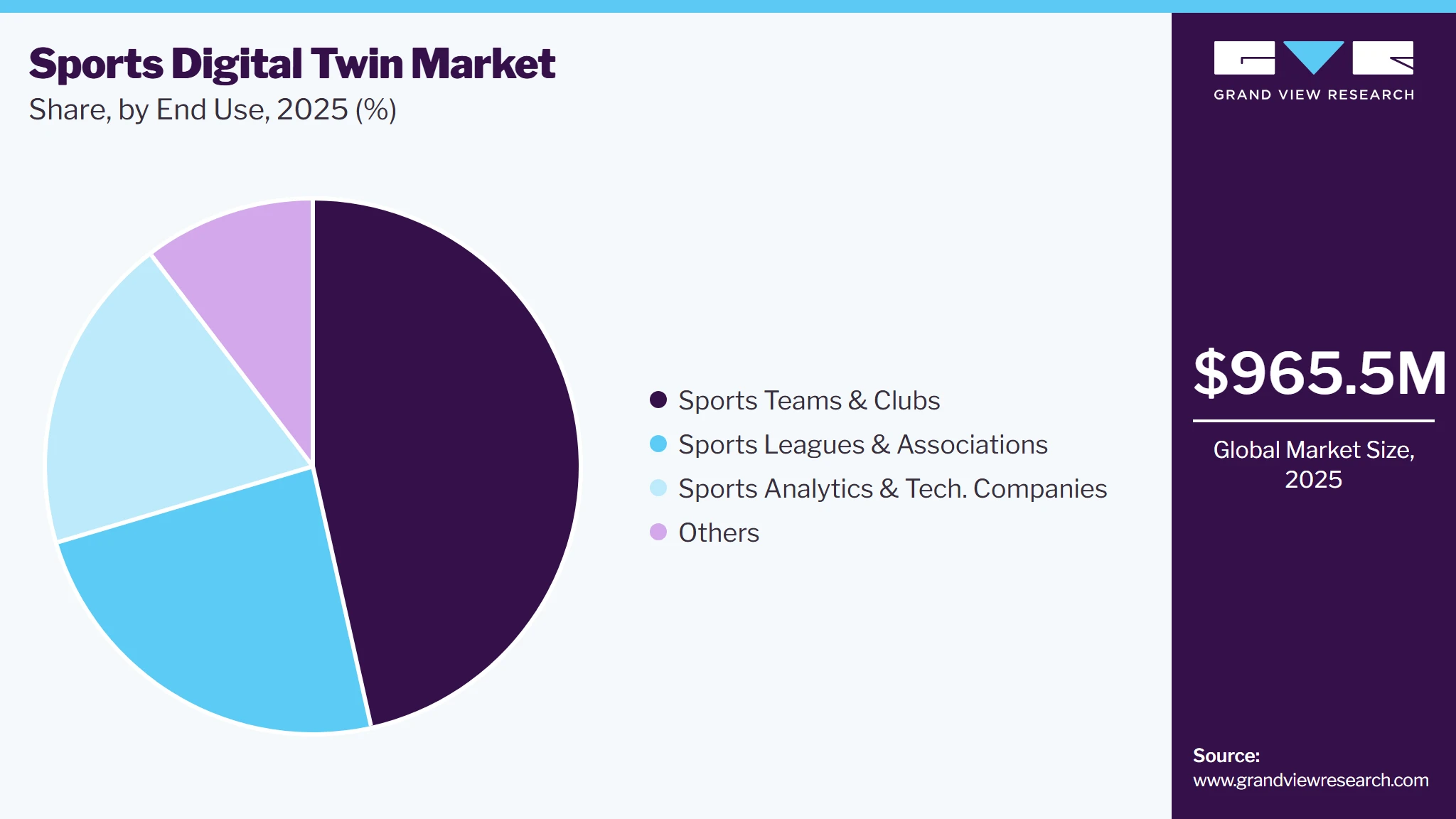
The sports teams & clubs segment accounted for the largest market share of 46.5% in 2025. The expanding demand for integrated football operations and performance departments is fostering market growth within the sports teams and clubs segment. Modern clubs increasingly organize coaching, sports science, medical services, nutrition, psychology, biomechanics, analytics, rehabilitation, and performance management into coordinated multidisciplinary departments that require unified digital infrastructure. Digital twin platforms increasingly provide shared virtual environments where multiple specialists can collaborate around continuously updated player models, training simulations, injury assessments, tactical scenarios, and performance forecasts across the entire organization. Club operations increasingly depend on integrated digital intelligence rather than isolated departmental workflows.
 To learn more about this report, Download Free Sample Report
The sports analytics & technology companies segment is anticipated to register the fastest CAGR during the forecast period. The increasing expansion of sports broadcasting and digital media analytics is driving market growth across the sports analytics and technology companies segment. Technology companies increasingly develop advanced visualization platforms, virtual replay systems, augmented broadcast graphics, immersive fan experiences, tactical animations, player movement reconstructions, and interactive media content that depend on highly accurate digital twin representations of athletes, teams, and sporting environments. Digital twin technologies increasingly support sophisticated visual storytelling, broadcast enhancement, sponsorship integration, audience engagement, and digital content creation across live sports media ecosystems. Analytics companies increasingly use digital twins to create richer media products and more immersive digital sports experiences for broadcasters, streaming platforms, and sports media organizations.
Regional Insights
North America dominated the sports digital twin industry, accounting for 31.3% of revenue in 2025. North America's extensive collegiate sports infrastructure is fueling market growth as universities and collegiate athletic programs increasingly adopt advanced performance technologies across football, basketball, baseball, track and field, swimming, soccer, and numerous other competitive sports. Large collegiate athletic departments increasingly operate sports science laboratories, biomechanics facilities, performance research centers, medical departments, and technology-driven training environments that require sophisticated digital modeling and simulation capabilities. Digital twin platforms increasingly support athlete development, recruitment analysis, injury rehabilitation, workload management, and performance optimization across highly competitive collegiate sports programs.
 To learn more about this report, Download Free Sample Report
U.S. Sports Digital Twin Market Trends
The sports digital twin industry in the U.S. is projected to grow significantly during the forecast period. The growth is attributed to the increasing demand for commercial sports technology platforms that serve multiple stakeholders simultaneously, including professional teams, collegiate programs, private training centers, sports medicine organizations, equipment manufacturers, broadcasters, betting companies, fantasy sports platforms, and performance analytics providers. Digital twin technologies increasingly serve as scalable enterprise platforms that support diverse commercial applications across player development, tactical analysis, equipment optimization, venue simulation, media production, and fan engagement. Technology companies are increasingly developing modular digital twin architectures that can be deployed across multiple sports industries and customer segments in the U.S. market.
Asia Pacific Sports Digital Twin Market Trends
The sports digital twin industry in the Asia Pacific is expected to grow at the fastest CAGR from 2026 to 2033. The growth is mainly due to the increasing investment in national sports development and international competition programs, where governments, Olympic organizations, sports authorities, and elite training institutions increasingly prioritize advanced performance technologies to improve competitiveness across global sporting events. National sports programs increasingly require sophisticated digital environments capable of modeling athlete physiology, biomechanics, technical execution, tactical preparation, and environmental adaptation across multiple Olympic and professional sports disciplines. Digital twin platforms increasingly support evidence-based athlete development, competition simulation, rehabilitation management, and long-term performance planning across elite national sports systems.
The China sports digital twin industry is projected to grow significantly during the forecast period. The projection comes on the back of the increasing development of smart sports venues, intelligent stadium infrastructure, and digitally connected training facilities that increasingly incorporate IoT systems, environmental monitoring, operational analytics, connected equipment, and integrated performance technologies into unified sports ecosystems. Digital twin platforms increasingly create virtual representations of sports facilities that support infrastructure optimization, crowd management, maintenance planning, training environment control, and athlete performance integration across large-scale sports complexes. Sports organizations increasingly require technologies that connect facility operations with advanced athlete development systems.
The sports digital twin industry in India is projected to grow significantly during the forecast period. The growth is primarily associated with the increasing modernization of cricket performance infrastructure, where professional teams, academies, state associations, national training programs, and private development organizations increasingly require highly detailed digital models capable of analyzing batting mechanics, bowling biomechanics, fielding movement, workload management, tactical positioning, and match simulation across different playing conditions. Digital twin platforms increasingly support individualized player development, technical refinement, injury prevention, and competition preparation through continuously evolving virtual athlete environments tailored specifically for cricket performance. Sports organizations increasingly seek technologies that enhance precision and scientific rigor across elite cricket development systems.
Europe Sports Digital Twin Market Trends
The sports digital twin industry in Europe is anticipated to grow steadily from 2026 to 2033. The growth is being driven through the increasing adoption of advanced coaching education and professional development systems, where national coaching organizations, football associations, Olympic committees, rugby unions, cycling federations, and elite coaching academies increasingly integrate digital simulation technologies into technical instruction, tactical education, athlete development methodologies, and coaching certification programs. Digital twin platforms increasingly provide immersive environments where coaches can analyze movement mechanics, tactical structures, performance simulations, and individualized athlete models as part of structured coaching education frameworks. Sports organizations increasingly require technologies that enhance coaching quality through advanced analytical and simulation capabilities.
The UK sports digital twin industry is expected to grow significantly during the forecast period. The regional growth comes on the heel of the increasing commercialization of sports analytics and performance intelligence across professional leagues, broadcasters, betting companies, fantasy sports platforms, media organizations, sponsorship agencies, and fan engagement providers. Digital twin technologies increasingly generate advanced performance simulations, player visualizations, tactical reconstructions, predictive analytics, and immersive digital content that extend beyond coaching applications into broader commercial sports operations. Sports organizations increasingly require technologies that enhance media production, digital storytelling, audience engagement, and commercial performance intelligence across multiple sports industries.
The sports digital twin industry in Germany is expected to grow significantly during the forecast period. The growth is primarily due to the country's leadership in Industry 4.0 and intelligent automation technologies, which increasingly influence sports facility operations, athlete monitoring infrastructure, equipment integration, and connected performance environments. Digital twin platforms increasingly connect smart training facilities, automated performance laboratories, sensor-enabled equipment, environmental monitoring systems, and intelligent operational infrastructure into unified virtual ecosystems that support both athlete performance analysis and facility optimization. Sports organizations increasingly require technologies that integrate physical sports environments with advanced digital intelligence across training and competition operations.
Key Sports Digital Twin Company Insights
Some prominent players in the sports digital twin market include NTT DATA Group Corporation and CATAPULT, among others.
-
NTT DATA Group Corporation is a global information technology and digital transformation company. NTT DATA develops digital twin and smart sports solutions that create virtual representations of athletes, teams, venues, and sporting operations by integrating real-time sensor data, performance analytics, IoT devices, and cloud-based processing platforms. The solutions enable sports organizations to monitor athlete performance, analyze training effectiveness, simulate competitive scenarios, optimize venue operations, and enhance fan engagement through real-time digital representations of physical sports environments.
-
CATAPULT is a global sports technology company. Its key sports digital twin products and platforms include Vector, ClearSky, Thunder, Catapult One, and athlete performance analytics platforms. These solutions collect and integrate data from wearable GPS devices, inertial sensors, local positioning systems, video feeds, physiological measurements, and training activities to build comprehensive digital profiles of athletes and teams, supporting performance optimization and strategic decision-making.
Key Sports Digital Twin Companies
The following key companies have been profiled for this study on the sports digital twin market.
-
CATAPULT
-
Hawk-Eye Innovations Ltd.
-
Infinite Athlete, Inc.
-
Iventis
-
Motion Analysis
-
NTT DATA Group Corporation
-
Preditwins Lab
-
Simio
-
Svexa
-
VALD Performance
Competitive Benchmarking
Operating Strategies
Competitive Edge
Weakness
Mature Players: CATAPULT, NTT DATA Group Corporation, Hawk-Eye Innovations Ltd.
- Established players focus on enterprise-scale digital twin platforms that support athlete performance modeling, venue operations, fan engagement analytics, and sports infrastructure optimization.
- They invest in cloud computing, AI, IoT integration, and advanced simulation technologies to create real-time virtual replicas that improve decision-making across professional sports organizations and major sporting venues.
- These companies benefit from extensive enterprise technology portfolios, strong analytics capabilities, and established relationships with large sports organizations and infrastructure operators.
- Their ability to integrate digital twins with cloud, AI, and operational management systems enables scalable, data-driven solutions for the sports ecosystem.
- Developing highly accurate sports digital twins requires significant investment in data integration, simulation models, and sensor infrastructure.
- Long implementation cycles and the need for large-scale organizational adoption can also increase deployment complexity and project costs.
Emerging Players: Iventis; Preditwins Lab; Simio
- Emerging players focus on specialized digital twin applications for athlete biomechanics, injury and, prediction.
- They emphasize wearable integration, computer vision, AI-driven analytics, and cloud-native platforms that provide real-time insights for coaches, teams, and sports performance professionals.
- These companies offer specialized expertise in sports science, athlete analytics, and real-time performance optimization, enabling highly targeted digital twin applications.
- Their agile development approaches and strong focus on wearable and AI technologies support faster innovation and customized sports performance solutions.
- Smaller customer bases and limited financial resources can restrict expansion across professional leagues and international sports organizations.
- Dependence on continuous data collection, wearable adoption, and validation of predictive performance models may also slow broader commercial adoption.
Recent Developments
-
In July 2026, Hawk-Eye Innovations Ltd. partnered with Ekstraklasa and Live Park to deploy several of its advanced football technologies across Poland’s top professional football league. As part of the agreement, Hawk-Eye will implement its SkeleTRACK player and ball tracking system, which captures real-time skeletal movement data and delivers performance insights to clubs and media partners through the company’s Data Analytics Platform. The partnership also includes the deployment of Hawk-Eye’s AI-powered Automated Tactical Camera, which produces continuous 4K broadcast-quality footage for enhanced tactical and performance analysis.
-
In July 2026, Hawk-Eye Innovations Ltd. signed a multi-year agreement to provide advanced Video Assistant Referee services across Croatia’s premier football competitions. The partnership extends Hawk-Eye’s extensive experience in delivering elite VAR solutions for major FIFA and UEFA tournaments and strengthens its portfolio of long-term collaborations with leading domestic football leagues and federations, including the Premier League, Serie A, Ligue 1, the Eredivisie, the Brazilian Football Confederation, and the Saudi Arabian Football Federation.
-
In October 2025, Exos acquired Infinite Athlete and its subsidiary, Biocore, with both organizations now operating under the Exos brand. This strategic acquisition represents a major milestone in Exos’s evolution, combining its human performance expertise with AI-powered and data-driven capabilities to transform performance optimization. The integrated company will accelerate the development of advanced technology-enabled products and services across industries, reshaping how human performance is measured, enhanced, and sustained.
Sports Digital Twin Market Report Scope
Report Attribute
Details
Market size in 2025
USD 965.5 million
Estimated market size in 2026
USD 1,198.2 million
Projected market size by 2033
USD 5,983.2 million
Growth rate
CAGR of 25.8% from 2026 to 2033
Actual data
2021 - 2025
Forecast period
2026 - 2033
Quantitative units
Revenue in USD million and CAGR from 2026 to 2033
Report coverage
Revenue forecast, company share, competitive landscape, growth factors, and trends
Segments covered
Component, technology, deployment, application, end use, region
Regional scope
North America; Europe; Asia Pacific; Latin America; MEA
Country scope
U.S.; Canada; Mexico UK; Germany; France; China; India; Japan; Australia; South Korea; Brazil; UAE; Saudi Arabia; South Africa
Key companies profiled
CATAPULT; Hawk-Eye Innovations Ltd.; Infinite Athlete, Inc.; Iventis; Motion Analysis; NTT DATA Group Corporation; Preditwins Lab; Simio; Svexa; VALD Performance
Customization scope
Free report customization (equivalent to 8 analysts working days) with purchase. Addition or alteration to country, regional & segment scope.
Pricing and purchase options
Avail customized purchase options to meet your exact research needs. Explore purchase options
Global Sports Digital Twin Market Report Segmentation
This report forecasts revenue growth at global, regional, and country levels and provides an analysis of the latest industry trends in each of the sub-segments from 2021 to 2033. For this study, Grand View Research has segmented the global sports digital twin market report based on component, technology, deployment, application, end use, and region.
-
Component Outlook (Revenue, USD Million, 2021 - 2033)
-
Software
-
Services
-
-
Technology Outlook (Revenue, USD Million, 2021 - 2033)
-
Artificial Intelligence & Machine Learning
-
Computer Vision
-
3D Modeling & Simulation
-
AR/VR Integration
-
Others
-
-
Deployment Outlook (Revenue, USD Million, 2021 - 2033)
-
Cloud
-
On-premise
-
-
Application Outlook (Revenue, USD Million, 2021 - 2033)
-
Athlete Performance Analysis
-
Team Strategy & Tactical Simulation
-
Training & Coaching Optimization
-
Stadium & Venue Operations
-
Others
-
-
End Use Outlook (Revenue, USD Million, 2021 - 2033)
-
Sports Teams & Clubs
-
Sports Leagues & Associations
-
Sports Analytics & Technology Companies
-
Others
-
-
Regional Outlook (Revenue, USD Million, 2021 - 2033)
-
North America
-
U.S.
-
Canada
-
Mexico
-
-
Europe
-
Germany
-
UK
-
France
-
-
Asia Pacific
-
China
-
India
-
Japan
-
South Korea
-
Australia
-
-
Latin America
-
Brazil
-
-
Middle East & Africa
-
UAE
-
Saudi Arabia
-
South Africa
-
-
Research Methodology
The sports digital twin marketfigures in this report are based on a proven research process that combines executive interviews with secondary research from proprietary databases, company filings, and recognized regulatory and institutional sources. Market size is built through value-chain sizing-reconciling supply-side and demand-side estimates-and triangulated with bottom-up and top-down approaches. Every estimate passes multiple levels of expert validation before publication, with eachsports digital twin segment quantified using the revenue-capture definitions in the table below.
Segment Definition
Component
Revenue capture definition
Software
The largest component segment, capturing value through digital twin platforms that model athletes, teams, venues, and sporting environments using real-time sensor data, simulation engines, analytics dashboards, and predictive intelligence. Vendors monetize through SaaS subscriptions, enterprise licensing, performance analytics modules, and continuous software enhancements tailored to professional sports organizations.
Services
Commercial opportunities arise from implementation, system integration, data engineering, simulation consulting, custom model development, performance optimization, technical support, and managed digital twin operations. Sports organizations increasingly engage specialized providers to build accurate digital representations of athletes, facilities, and competitive environments.
Technology
Revenue capture definition
Artificial Intelligence & Machine Learning
The largest technology segment, generating value through predictive performance modeling, injury risk assessment, tactical optimization, player development analytics, and automated decision support. AI-driven digital twins help organizations identify performance patterns and optimize training strategies with increasing precision.
Computer Vision
Market value is created through video-based tracking, player movement analysis, pose estimation, ball trajectory modeling, and automated event detection. Sports organizations invest in computer vision technologies to generate accurate digital representations of athletes and gameplay without relying solely on wearable sensors.
3D Modeling & Simulation
Commercial demand is driven by realistic digital recreation of athletes, equipment, venues, and competitive scenarios for performance analysis and tactical experimentation. Simulation technologies enable coaches and analysts to evaluate strategies, environmental conditions, and training outcomes before real-world implementation.
AR/VR Integration
Value is captured through immersive training environments, virtual coaching, player visualization, fan engagement experiences, and scenario-based simulation. Growing adoption of mixed-reality technologies is expanding digital twin applications across athlete preparation and sports entertainment.
Others
This category includes IoT sensor integration, digital biomechanics, edge computing, motion capture, and advanced data synchronization technologies. Continuous innovation in sports technology is creating new opportunities for more accurate and responsive digital twin ecosystems.
Deployment
Revenue capture definition
Cloud
The dominant deployment model is supported by scalable computing resources, remote collaboration, real-time data synchronization, and integration with wearable devices, video systems, and analytics platforms. Cloud deployment enables teams and leagues to process large volumes of performance data while supporting distributed coaching and operational workflows.
On-Premise
Investment is concentrated among organizations requiring direct control over sensitive athlete data, proprietary tactical models, and high-performance computing infrastructure. This deployment model remains important for elite teams and institutions with strict data security, competitive confidentiality, and regulatory requirements.
Application
Revenue capture definition
Athlete Performance Analysis
The largest application segment is driven by demand for detailed monitoring of biomechanics, workload, recovery, movement efficiency, and physiological performance. Digital twins enable personalized performance optimization by combining real-time data with predictive modeling and insights into long-term athlete development.
Team Strategy & Tactical Simulation
Commercial value is created through simulation of formations, player positioning, opposition behavior, match scenarios, and tactical decision-making. Teams increasingly utilize digital twins to evaluate strategic options and improve competitive performance before games and tournaments.
Training & Coaching Optimization
Market activity centers on optimizing training intensity, skill development, recovery planning, and individualized coaching programs through digital simulations and performance analytics. Coaches leverage digital twins to make data-driven adjustments that improve athlete development and reduce the risk of overtraining.
Stadium & Venue Operations
Demand is supported by digital twin applications for crowd management, facility maintenance, energy optimization, security monitoring, and event operations across sports venues. Venue operators use real-time digital models to improve operational efficiency and enhance spectator experiences during major sporting events.
Others
This segment includes injury rehabilitation, talent identification, officiating analysis, fan engagement, sports broadcasting, and equipment performance simulation. Expanding use of digital twins across the broader sports ecosystem continues to create specialized commercial opportunities.
End Use
Revenue capture definition
Sports Teams & Clubs
The largest end-use segment is with professional teams deploying digital twins to improve player performance, tactical preparation, injury prevention, and training efficiency. Competitive pressure and the increasing use of data analytics in elite sports continue to drive significant investment in digital twin technologies.
Sports Leagues & Associations
Leagues and governing bodies invest in digital twins for competition analysis, officiating support, venue management, athlete development programs, and operational planning across multiple teams and events. Centralized digital infrastructure helps improve consistency, scheduling, and long-term performance management across organized sports.
Sports Analytics & Technology Companies
Technology providers utilize digital twin platforms to develop advanced performance products, simulation services, AI-driven sports analytics, and integrated software solutions for teams, leagues, broadcasters, and training organizations. Commercial growth is supported by increasing demand for data-rich sports intelligence platforms.
Others
This category includes training academies, universities, research institutions, broadcasters, venue operators, fitness organizations, and sports medicine providers. These organizations adopt digital twin technologies to support athlete research, performance evaluation, operational optimization, rehabilitation, and immersive sports experiences.
Estimation Model
Layer
Question
Analysis
Performance Modeling Layer
What sports assets and activities can be digitally replicated?
Identify the entities that can be represented through digital twins, including athletes, teams, stadiums, training facilities, sports equipment, playing surfaces, and competition environments. This layer defines the market by evaluating how real-world sports data can be transformed into dynamic digital models that support performance analysis, tactical simulation, injury prevention, facility optimization, and fan engagement across professional, collegiate, and elite training ecosystems.
Data Capture & Synchronization Layer
What enables accurate sports digital twin creation and continuous updating?
Assess the technologies required to build and maintain sports digital twins, including wearable sensors, GPS trackers, motion capture systems, computer vision, video analytics, IoT devices, biomechanics platforms, and cloud-based data synchronization. The effectiveness of a sports digital twin depends on data accuracy, latency, interoperability, and the ability to continuously synchronize physical performance with virtual representations in real time.
Simulation & Decision Intelligence Layer
How are sports digital twins integrated into coaching, training, and operational workflows?
Analyze how teams, coaches, sports scientists, and venue operators use digital twins for tactical simulations, workload management, rehabilitation planning, performance forecasting, venue crowd management, equipment testing, and training optimization. These systems increasingly integrate with AI models, analytics platforms, and real-time performance dashboards to support faster and more informed decisions during both training sessions and live competitions.
Competitive & Commercial Value Layer
How is value generated within the sports digital twin ecosystem?
Evaluate revenue streams from software platforms, simulation engines, AI analytics subscriptions, digital twin implementation services, performance consulting, stadium operations solutions, and fan engagement applications. Additional value is created through improved athlete performance, reduced injury risk, optimized facility utilization, enhanced broadcast and sponsorship opportunities, and recurring revenues from cloud-based analytics, monitoring, and digital performance management services.
Delivered Customization
This report has been delivered with the following In-depth customizations
CLIENT REQUEST
CUSTOMIZATION DELIVERED
VALUE ADDS
Athlete Performance Modeling & Digital Twin Training Trends
Conducted a focused analysis of sports digital twin adoption across professional teams, training academies, sports science centers, and elite athlete development programs, covering biomechanical modeling, movement simulation, performance optimization, and individualized training scenarios.
Helps stakeholders identify high-value athlete performance applications, evaluate digital twin adoption trends, and assess commercialization opportunities in data-driven sports performance technologies.
Injury Risk Prediction, Rehabilitation & Workload Optimization Adoption Trends
Evaluated adoption trends for wearable sensor integration, musculoskeletal digital twins, fatigue monitoring, injury prediction models, rehabilitation simulation, and return-to-play assessment tools supporting athlete health and performance management.
Provides insights into injury prevention priorities, medical performance optimization opportunities, and commercially attractive digital twin capabilities supporting sports medicine and athlete longevity.
Smart Sports Infrastructure & Fan Engagement Opportunity Assessment
Assessed demand for digital twins of stadiums, training facilities, and sporting venues, along with real-time match simulation, tactical analysis platforms, immersive fan experiences, and AI-driven sports analytics ecosystems, including challenges related to data integration, simulation accuracy, privacy, and deployment costs.
Supports investment and expansion strategies by identifying emerging sports technology opportunities, evaluating organizational readiness, and strengthening long-term growth potential in connected sports ecosystems and intelligent performance environments.
Frequently Asked Questions About This Report
The software segment dominated the market, with a revenue share of 74.5% in 2025 and hardware segment it is the fastest-growing segment.
The cloud segment led with an 67.7% revenue share in 2025 and on-premises segment is the fastest-growing segment.
The artificial intelligence & machine learning segment accounted for the largest market share of 33.6% in 2025. The expanding demand for personalized predictive modeling augurs growth for the segment.
The global sports digital twin market size was estimated at USD 965.5 million in 2025 and is expected to reach USD 1,198.2 million in 2026.
The global sports digital twin market is expected to grow at a compound annual growth rate of 25.8% from 2026 to 2033 to reach USD 5,983.2 million by 2033.
Key factors include increasing use of motion capture and biomechanics analysis systems, the growing emphasis on injury prevention and athlete health management, and growing demand for personalized athlete development programs.
North America dominated the market with 31.3% revenue share in 2025.
Asia Pacific is the fastest-growing region over the forecast period.
Key players operating in the sports digital twin market include CATAPULT, Hawk-Eye Innovations Ltd., Infinite Athlete, Inc., Iventis, Motion Analysis, NTT DATA Group Corporation, Preditwins Lab, Simio, Svexa, VALD Performance.
About the Author(s)
Next Generation Technologies Research Team
Technology · Next Generation TechnologiesThis report was authored by the next generation technologies research team at Grand View Research - comprising two research analysts, one senior research analyst, and one industry expert - with specialized expertise in the next generation technologies segment of the technology industry. All findings are based on proprietary technology databases, executive interviews, and regulatory analysis, subject to internal peer review prior to publication.
Last Updated:
Speak to Analyst

Customize this report to your needs - add regions, segments, or data points, with 20% free customization.
Or view our licence options:


ISO 9001:2015 & 27001:2022 Certified
We are GDPR and CCPA compliant! Your transaction & personal information is safe and secure. For more details, please read our privacy policy.


