
- Home
- »
- Paints, Coatings & Printing Inks
- »
-
Spray Paints Market Size, Share & Trends Report 2026-2033GVR Report cover

Spray Paints Market (2026 - 2033)
Size, Share & Trends Analysis Report By Product (Acrylic, Alkyd Epoxy), By Technology (Water-based, Solvent-based, Powder Coatings), By End Use (Automotive & Transportation, Building and Construction) By Region, And Segment Forecasts
Market Size, 2025
$11.0BMarket Estimate, 2026
$11.5BMarket Forecast, 2033
$16.9BCAGR, 2026–2033
5.6%Spray Paints Market Summary
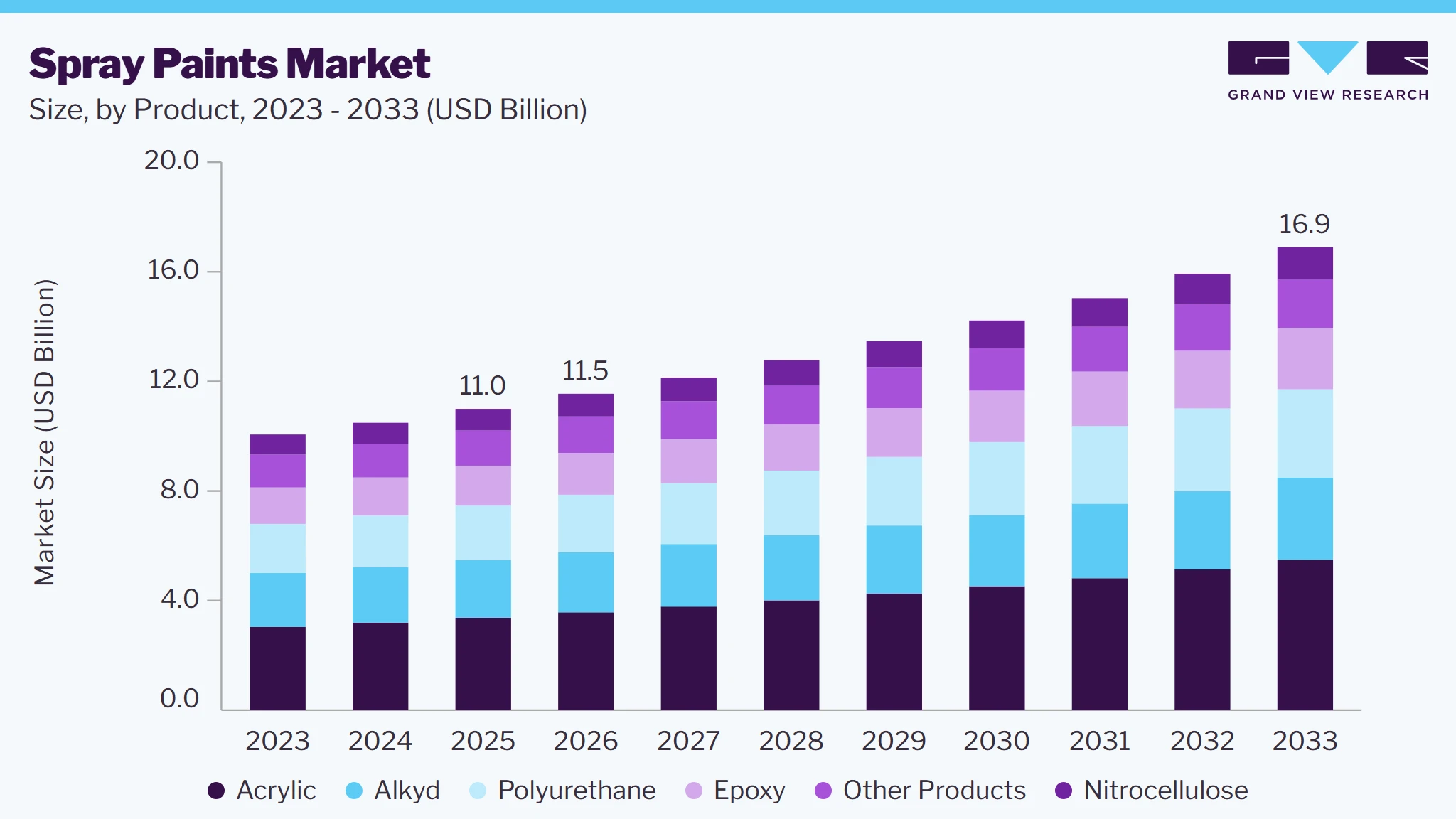
The global spray paints market size was valued at USD 11.0 billion in 2025 and is projected to grow from USD 11.5 billion in 2026 to USD 16.9 billion by 2033, at a CAGR of 5.6% from 2026 to 2033. Asia Pacific dominated the market, accounting for a revenue share of 32.5% in 2025. Market expansion is supported by growing demand for convenient surface finishing solutions across automotive, construction, consumer goods, furniture, and industrial manufacturing sectors, rising preference for quick-drying coatings that simplify application and maintenance, and increasing adoption of water-based formulations driven by stricter environmental requirements and the need to reduce volatile organic compound (VOC) emissions.
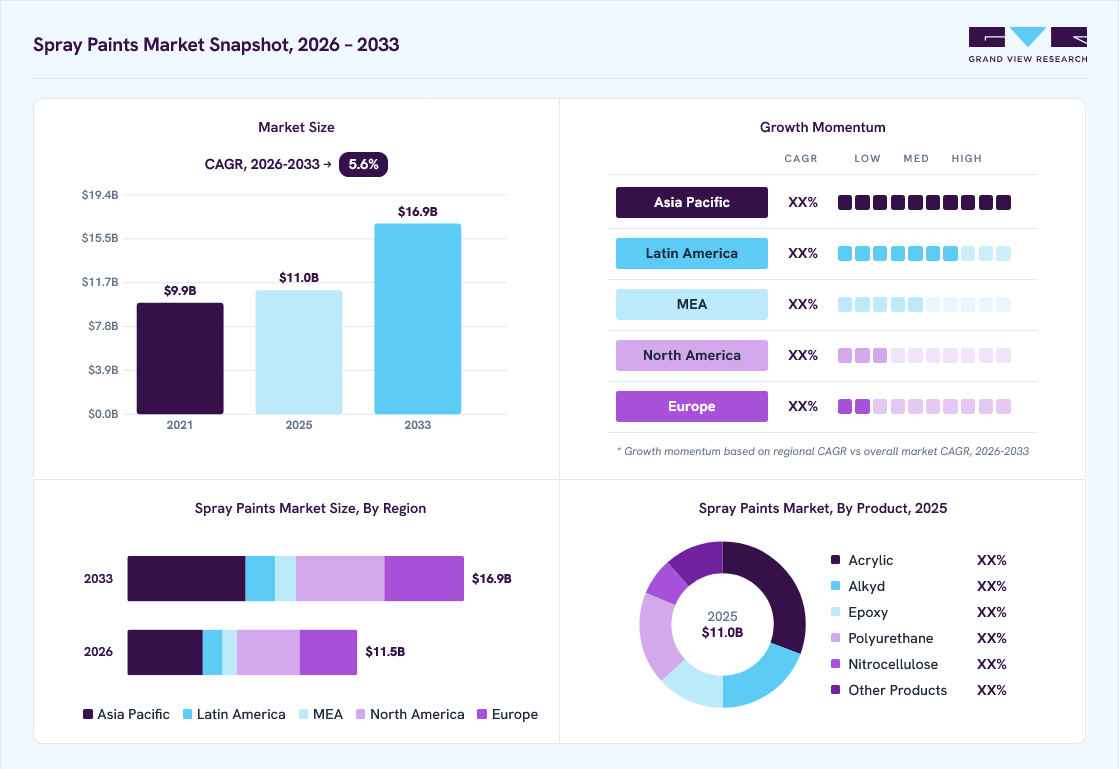 Source: Grand View Research, IR Documents, Primary Interviews, Paid DatabasesTo learn more about this report,
 Download Free Sample Report
Key Market Trends & Insights
- By product: Acrylic segment emerged as the leading product segment, accounting for a revenue share of 30.7% in 2025.
- By technology: Solvent-based formulations segment dominated the technology segment, representing 70.2% of the global spray paints market revenue in 2025.
- By end use: Automotive and transportation segment held the largest share, capturing 23.5% of market revenue in 2025.
Regional Highlights
- Largest regional market: Asia Pacific (32.5% revenue share, 2025)
- By country: China held the largest market share in 2025
Market Size & Forecast
- Market size in 2025: USD 11.0 Billion
- Estimated market size in 2026: USD 11.5 Billion
- Projected market size by 2033: USD 16.9 Billion
- CAGR (2026-2033): 5.6%
Three ways to get this report
Buy it, customize it, or ask a question.Ask an Analyst
Analyst response in 1 business day
- AccessReport author, directly
- Reply timeWithin 1 working day
- No sales callDirect answer only
- FormatEmail reply
- CostFree, no cost
Get the Full Report
What the study covers
- FormatsPDF · Excel · Dashboard
- Timeline2026–2033 annual, 2025 base
- Coverage20+ countries, 5 regions
- Companies10+ key players profiled
Customize the Report
20% free customization
- IncludeCountries, segments, points
- TailorTo your product definition
- ExtendDeeper competitor detail
- OrA fully bespoke study
- Turnaround5–10 working days
 To learn more about this report, Download Free Sample Report
Rising demand for efficient surface finishing and increasing preference for convenient coating solutions are supporting the adoption of spray paints across diverse industries. Applications in automotive and transportation, building and construction, consumer goods, furniture and woodworking, and industrial manufacturing are expanding as users seek faster application, consistent surface coverage, improved finish quality, and durable protection against wear, moisture, and environmental exposure.Market Dynamics
The global spray paints market is influenced by rising demand for efficient surface finishing across automotive and transportation, building and construction, consumer goods, furniture and woodworking, and industrial manufacturing applications. Increasing preference for convenient coating methods, faster application, and consistent finish quality is encouraging the use of spray-applied formulations across professional and consumer settings. Developments in acrylic, polyurethane, and other resin-based products are improving adhesion, durability, surface appearance, and resistance to environmental exposure across varied substrates. At the same time, stricter environmental requirements and growing interest in lower-VOC formulations are prompting manufacturers to refine water-based technologies and expand product offerings for diverse application needs.
The growing need for efficient surface finishing across automotive, construction, consumer goods, furniture, and industrial manufacturing applications is supporting the expansion of the global spray paints market. Automotive refinishing relies on spray-applied coatings to achieve uniform coverage, restore vehicle appearance, and protect body surfaces against weathering and wear. In building and construction, spray paints are used for decorative finishes, maintenance, and coating metal structures, fixtures, and other building components.
Industrial manufacturing also contributes to market growth through the coating of machinery, metal components, tools, and equipment that require surface protection and a consistent finish. Demand across these applications is shaped by ease of application, drying time, adhesion, finish quality, and resistance to abrasion and environmental exposure. Growing vehicle maintenance needs, renovation activity, furniture production, and industrial equipment use are sustaining consumption across established markets. These varied requirements are expected to support continued demand for spray paints, with growth influenced by end use activity, product performance needs, and the increasing preference for convenient coating solutions.
Compliance with environmental regulations and product performance requirements presents a challenge for the global spray paints market. Solvent-based spray paints often contain volatile organic compounds (VOCs) that contribute to air pollution and ground-level ozone formation, resulting in restrictions on their use across certain applications and jurisdictions. Compliance requirements related to VOC emissions, product labeling, chemical composition, workplace exposure, and safe handling can increase product testing and regulatory compliance costs.
The transition toward lower-emission formulations also involves practical considerations related to drying time, adhesion, surface compatibility, finish quality, and durability. Water-based spray paints may require different application conditions and substrate preparation compared with conventional solvent-based products, potentially limiting their suitability for certain specialized uses. In addition, aerosol products require appropriate packaging, storage, transportation, and handling procedures because of pressurized containers and flammable ingredients in some formulations. These factors can increase application complexity and influence purchasing decisions, particularly in price-sensitive consumer and industrial segments.
The increasing focus on environmental compliance, indoor air quality, and safer coating applications presents a significant opportunity for the global spray paints market. Demand for lower-emission products is gaining importance across building and construction, consumer and household, automotive refinishing, and industrial manufacturing applications. Water-based spray paints offer opportunities in settings where reduced solvent emissions and easier cleanup are valued, including residential maintenance, furniture finishing, and decorative projects.
Advancements in formulation chemistry, spray application systems, and coating performance are also expanding the potential uses of low-VOC products. Improvements in adhesion, drying characteristics, finish consistency, and resistance to wear can help address performance requirements across different substrates and application environments. Opportunities extend to interior fixtures, furniture, metal components, building elements, and selected automotive applications where environmental considerations influence product selection. As regulatory requirements and customer preferences increasingly favor lower-emission alternatives, demand for water-based spray paints and other compliant formulations is expected to create growth opportunities across established and emerging markets.
Market Concentration & Characteristics
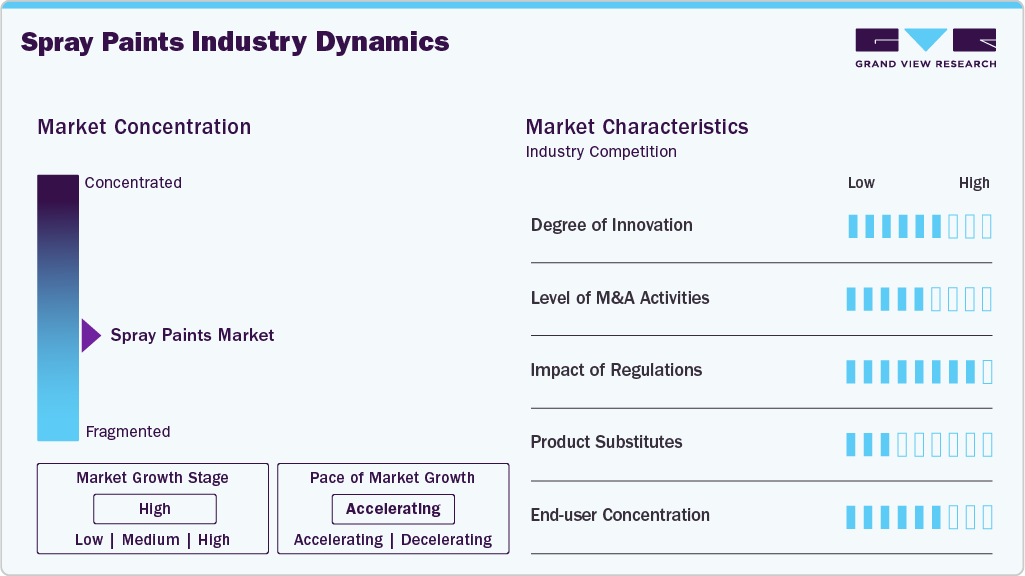
The global spray paints market features competition based on product performance, resin chemistry, formulation quality, application versatility, pricing, brand recognition, and distribution reach. Market participants serve diverse requirements across automotive and transportation, building and construction, consumer and household, furniture and woodworking, and industrial manufacturing applications. Differences in drying time, surface adhesion, finish quality, durability, and resistance to environmental exposure influence product selection across end use categories. The availability of aerosol formats, conventional spray-applied products, and specialized formulations also shapes purchasing decisions, while environmental compliance and demand for lower-VOC alternatives continue to influence competition across regional markets.
 To learn more about this report, Download Free Sample Report
Competition is also shaped by product portfolio expansion, distribution partnerships, formulation improvements, and the availability of application-specific solutions across regional markets. Demand varies according to substrate type, surface preparation requirements, drying conditions, finish preferences, and exposure to moisture, chemicals, and abrasion. Automotive refinishing, furniture production, household projects, and industrial equipment maintenance each require distinct coating characteristics, influencing product selection and purchasing patterns.
Analyst Perspective
The global spray paints market is supported by sustained demand for convenient surface finishing and protective coating solutions across automotive, construction, consumer, furniture, and industrial applications. Increasing requirements for consistent finishes, application efficiency, durability, and resistance to environmental exposure are shaping product preferences across end use sectors. Growth in water-based formulations, improvements in resin performance, and rising interest in lower-VOC products are influencing technology adoption and creating opportunities for spray paint applications across established and emerging markets.
Product Insights
The acrylic paints segment accounted for the largest revenue share of 30.7% in 2025. Their widespread use across automotive refinishing, decorative applications, furniture finishing, and household projects supports demand for acrylic-based spray paints. Favorable drying characteristics, adhesion across multiple surfaces, finish versatility, and availability in a broad range of colors make acrylic formulations suitable for both consumer and professional applications. Their use across metal, wood, plastic, and other substrates further strengthens the segment's position in the global spray paints market.
Polyurethane spray paints are projected to grow at a CAGR of 6.3% from 2026 to 2033, matching the growth rate of acrylic products. Demand is supported by requirements for durable finishes, abrasion resistance, weatherability, and surface protection across automotive, industrial manufacturing, furniture, and other applications. Their ability to provide a lasting finish under demanding use conditions supports adoption where appearance retention and coating durability are important considerations. Continued demand for high-performance finishes across professional and industrial applications is expected to contribute to segment expansion.
Technology Insights
The solvent-based formulations segment accounted for the largest revenue share of 70.2% in 2025, reflecting their established use across automotive refinishing, industrial manufacturing, furniture finishing, and maintenance applications. Their quick-drying characteristics, strong adhesion, smooth finish, and compatibility with various surfaces support demand across professional and industrial settings. The ability to deliver consistent coverage on metal, wood, and other substrates further reinforces the position of solvent-based spray paints, particularly in applications requiring reliable finish quality and resistance to wear and environmental exposure.
Water-based spray paints are projected to be the fastest-growing technology segment, expanding at a CAGR of 7.2% from 2026 to 2033. Growth is supported by increasing attention to volatile organic compound (VOC) emissions, indoor air quality, and environmental compliance across residential, commercial, and industrial applications. Their lower solvent content and easier cleanup make these formulations suitable for selected decorative, furniture, and household uses. As demand for lower-emission coating alternatives increases, water-based spray paints are expected to gain traction across applications where environmental considerations and finish performance influence purchasing decisions.
End Use Insights
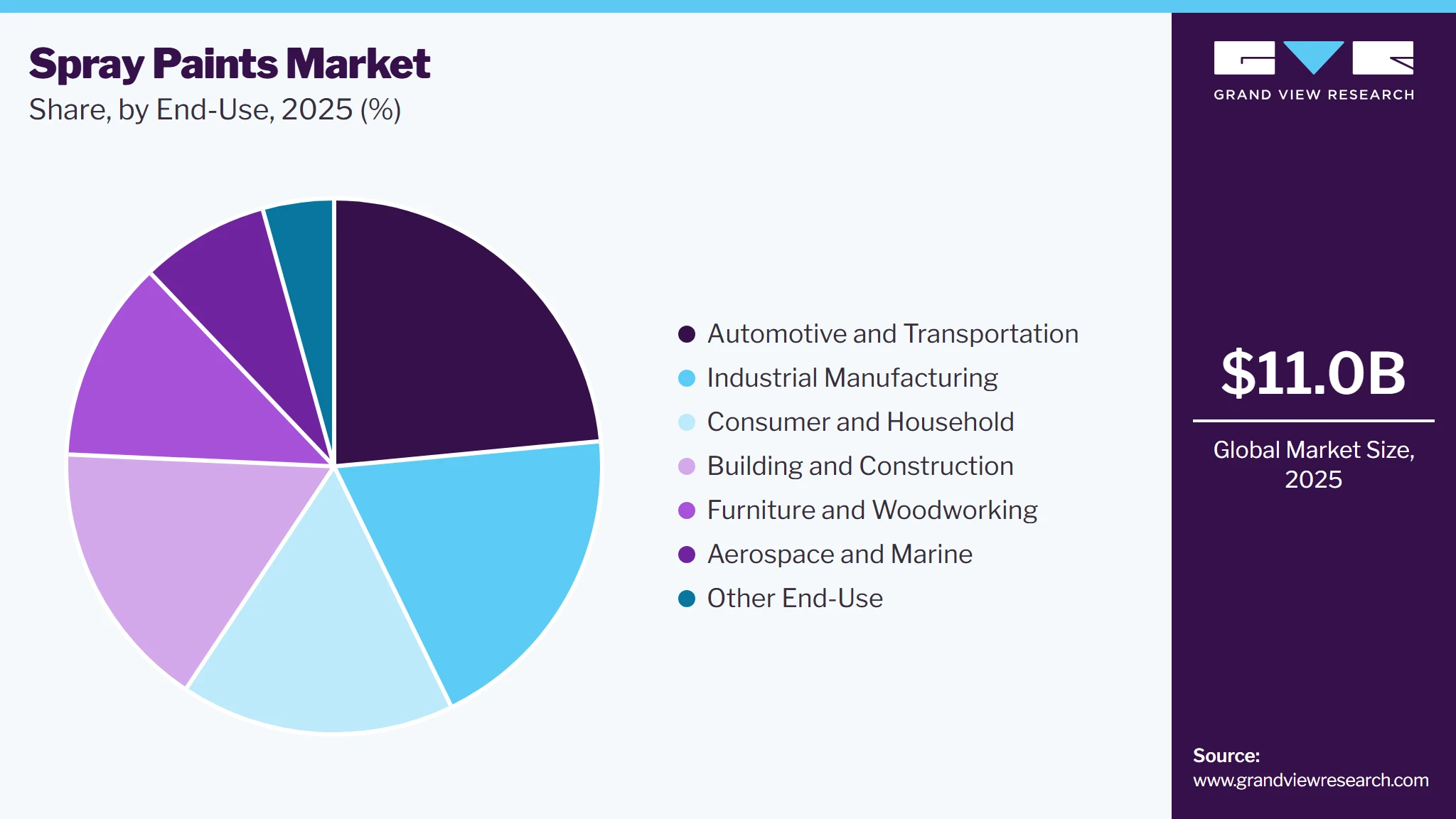
The automotive and transportation segment accounted for the largest revenue share of 23.5% in 2025, supported by demand for surface finishing and protective coatings across vehicle refinishing, automotive components, and transportation equipment. Spray paints are used to restore vehicle appearance, provide uniform coverage, and protect surfaces against weathering, abrasion, and routine wear. Demand for maintenance and refinishing, alongside coating requirements for metal and plastic components, continues to support adoption across automotive and transportation applications.
 To learn more about this report, Download Free Sample Report
Aerospace and marine is projected to be the fastest-growing end use segment, with a CAGR of 6.4% from 2026 to 2033. Demand is supported by coating requirements for aircraft components, vessels, and marine equipment, where finish quality and resistance to environmental exposure are important considerations. Exposure to moisture, saltwater, ultraviolet radiation, and demanding operating conditions creates a need for durable coatings suited to specialized substrates. Continued maintenance of transportation assets and demand for protective and decorative finishes are expected to support spray paint adoption across aerospace and marine applications.
Regional Insights
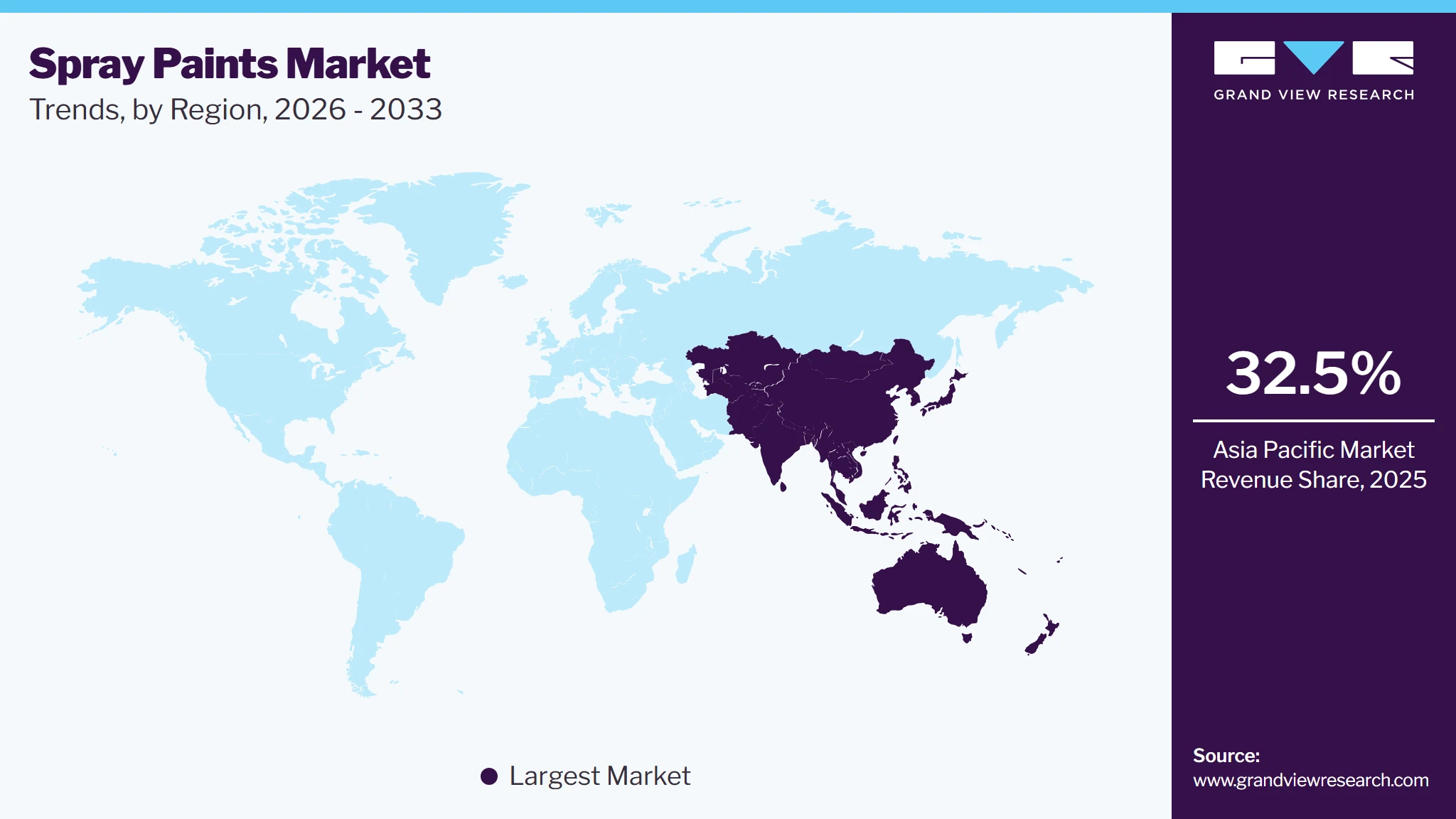
The Asia Pacific spray paints market accounted for the largest revenue share of 32.5% in 2025, supported by expanding manufacturing activities, infrastructure development, automotive production, and rising consumer spending across the region. The region represents a significant market due to rapid industrialization, growing construction activities, increasing vehicle production, and rising demand for protective and decorative coatings. China dominates the Asia Pacific market, supported by its large manufacturing base, extensive construction activities, expanding automotive production, and growing demand for advanced coating solutions.
 To learn more about this report, Download Free Sample Report
The spray paints market in China represents the leading market within the Asia Pacific landscape, supported by extensive manufacturing activities, rapid urbanization, and continued investments in infrastructure, automotive production, and industrial development. Growing demand for protective and decorative coatings across automotive and transportation, building and construction, furniture and woodworking, and industrial manufacturing applications has fueled product adoption. Increasing investments in manufacturing capacity, coating innovation, and environmentally oriented formulations, together with the need to improve surface finish, durability, and application efficiency, are further supporting market growth in China.
North America Spray Paints Market Trends
The spray paints market in North America is supported by increasing emphasis on surface protection, product durability, coating performance, and application efficiency across industrial and consumer applications. The region represents a significant market due to established automotive manufacturing, developed construction infrastructure, and sustained demand for high-performance coating solutions. Rising adoption of spray paints across automotive and transportation, industrial manufacturing, furniture and woodworking, and building and construction applications is supporting market growth.
U.S. Spray Paints Market Trends
The spray paints market in the U.S. is a leading sector within North America, underpinned by established automotive manufacturing, advanced industrial capabilities, and sustained demand for high-performance coating solutions. Increasing investments in coating technologies, product innovation, and application efficiency are encouraging manufacturers and end users to adopt specialized spray paints across diverse surfaces. Robust demand from industrial manufacturing, automotive and transportation, building and construction, furniture and woodworking, and other consumer applications is further contributing to market development.
Europe Spray Paints Market Trends
The spray paints market in Europe has gained ground due to the increasing emphasis on surface protection, product durability, and advanced coating performance across major industries. The region represents a significant market due to established manufacturing infrastructure, stringent environmental requirements, and growing investments in sustainable coating technologies. Increasing adoption of water-based spray paints, alongside continued utilization of acrylic, polyurethane, and other high-performance formulations across automotive and transportation, industrial manufacturing, building and construction, and furniture and woodworking applications, is supporting market growth.
Latin America Spray Paints Market Trends
The spray paints market in Latin America is supported by increasing demand for protective and decorative coatings, expanding industrial activities, and growing emphasis on surface durability. The region is witnessing wider utilization of spray paints across automotive and transportation, building and construction, furniture and woodworking, and consumer applications. In addition, investments in manufacturing infrastructure, construction projects, vehicle production, and industrial coating technologies are creating new growth opportunities for spray paints across diverse end use applications.
Middle East & Africa Spray Paints Market Trends
The spray paints market in the Middle East & Africa is projected to grow at a CAGR of 5.3% from 2026 to 2033, bolstered by increasing construction activity, infrastructure development, and demand for protective and decorative coatings across industrial applications. The region is witnessing growing demand for spray paints as manufacturers and end users seek to improve surface durability, achieve consistent finishes, and enhance application efficiency. Increasing investments in building and construction, industrial manufacturing, transportation infrastructure, and commercial development across the region are supporting market growth.
Key Spray Paints Company Insights
Companies in the global spray paints market are strengthening their market presence through portfolio diversification, formulation improvements, product launches, and distribution expansion. Competition is shaped by demand for quick-drying finishes, convenient application, surface protection, and specialized coatings across automotive, construction, household, woodworking, and industrial applications. Manufacturers are also focusing on low-VOC formulations and water-based alternatives to address evolving environmental standards and customer preferences.
-
The Sherwin-Williams Company maintains a broad presence in the paints and coatings industry, serving residential, commercial, and industrial customers through an extensive range of coating products. Its portfolio includes protective finishes and specialty formulations designed for different substrates, performance requirements, and application conditions. Strong distribution capabilities, technical expertise, and continued investment in product development support the company in meeting demand for durable finishes across construction, manufacturing, maintenance, and related markets.
-
Rust-Oleum Corporation specializes in protective paints, aerosol spray paints, primers, and specialty finishes for residential, commercial, and industrial use. Its product range addresses applications such as metal protection, surface restoration, decorative finishing, and equipment maintenance. The company differentiates its offerings through application-specific formulations, convenient spray delivery, and solutions developed for varied surfaces and project requirements, supporting its presence across consumer, automotive, woodworking, and industrial coating applications.
Key Spray Paints Companies
The following key companies have been profiled for the study on the global spray paints market.
-
The Sherwin-Williams Company
-
Rust-Oleum Corporation
-
Nippon Paint Holdings Co., Ltd.
-
PPG Industries, Inc.
-
Akzo Nobel N.V. (Dulux)
-
RPM International Inc
-
BASF Coatings
-
Axalta Coating Systems
-
Montana Colors S.L.
-
Peter Kwasny GmbH
Competitive Benchmarking
Operating Strategies
Competitive Edge
Weaknesses
Mature Players: The Sherwin-Williams Company, Rust-Oleum Corporation, Nippon Paint Holdings Co., Ltd., PPG Industries, Inc., Akzo Nobel N.V. (Dulux), RPM International Inc., BASF Coatings, Axalta Coating Systems
- Prioritize product development, formulation enhancements, and portfolio diversification to address demand for decorative, protective, and specialty spray paints across consumer and industrial applications.
- Expand market reach through distribution partnerships, acquisitions, product launches, and stronger retail and industrial supply networks across established and emerging markets.
- Invest in low-VOC formulations, water-based technologies, and application-specific coatings to align product offerings with changing environmental requirements and customer preferences.
- Extensive product portfolios and established brand recognition support market penetration across consumer, automotive, construction, and industrial applications.
- Strong manufacturing infrastructure, distribution networks, and technical capabilities facilitate product availability and customized coating solutions for diverse customer requirements.
- Established customer relationships, financial resources, and broad geographic coverage reinforce competitiveness across multiple spray paint categories.
- Exposure to fluctuations in raw material prices, packaging costs, and distribution expenses can affect margins and product pricing.
- Compliance with changing environmental regulations and investment in lower-emission formulations can increase research, manufacturing, and reformulation costs.
- Competition from regional manufacturers, private-label products, and specialized aerosol brands can intensify pricing pressure and challenge market share expansion.
Emerging Players: Montana Colors S.L., Peter Kwasny GmbH
- Focus on specialized aerosol products, distinctive color ranges, and application-oriented formulations to serve automotive refinishing, graffiti art, creative projects, and professional users.
- Expand distribution through e-commerce, specialist retailers, automotive supply channels, and partnerships with regional distributors to improve customer access.
- Strengthen product differentiation through color innovation, spray application technology, packaging improvements, and formulations tailored to specific surfaces and user requirements.
- Specialized expertise in aerosol paints and application-specific product development supports differentiation within targeted market niches.
- Focused product portfolios and responsive product development enable adaptation to changing preferences in decorative, artistic, automotive, and specialty coating applications.
- Established niche brands and targeted distribution relationships help build customer loyalty among professional users, artists, and do-it-yourself consumers.
- Comparatively narrower product portfolios and geographic reach may limit competition with multinational coatings manufacturers across broader end use categories.
- Dependence on specific customer groups and specialized applications can expose sales to changing consumer preferences and fluctuations in discretionary spending.
- Expansion into new markets may require additional investment in distribution, regulatory compliance, brand promotion, and local product adaptation.
Recent Developments
-
In August 2026, Krylon, a brand of The Sherwin-Williams Company, launched Krylon Harmony, a premium water-based spray paint designed for year-round use across indoor and outdoor projects. Its versatile application, durable finish, and ability to address traditional limitations of spray painting are expected to expand consumer adoption, supporting spray paints market growth through product innovation and increased application flexibility.
-
In March 2025, Rust-Oleum introduced Rust-O, its first spray paint line specifically designed for artists, expanding its product portfolio to address the growing demand for creative and specialized coatings. This launch strengthens the availability of vibrant, artist-focused spray paints, supporting market growth through product innovation and increasing adoption across urban art, graffiti, and creative applications.
Spray Paints Market Report Scope
Report Attribute
Details
Market size in 2025
USD 11.0 billion
Estimated market size in 2026
USD 11.5 billion
Projected market size by 2033
USD 16.9 billion
Growth rate
CAGR of 5.6% from 2026 to 2033
Base year for estimation
2025
Historical data
2021 - 2024
Forecast period
2026 - 2033
Quantitative units
Revenue in USD million, Volume in Kilotons and CAGR from 2026 to 2033
Report coverage
Revenue forecast, volume forecast, company ranking, competitive landscape, growth factors, and trends
Segments covered
Product, technology, end use, region
Country scope
U.S.; Canada; Mexico; Germany; UK; France; Italy; Spain; China; India; Japan; South Korea; Brazil; Argentina; Saudi Arabia; South Africa
Key companies profiled
The Sherwin-Williams Company; Rust-Oleum Corporation; Nippon Paint Holdings Co., Ltd.; PPG Industries; Inc.; Akzo Nobel N.V. (Dulux); RPM International Inc.; BASF Coatings; Axalta Coating System; Montana Colors S.L.; Peter Kwasny GmbH
Customization scope
Free report customization (equivalent up to 8 analysts’ working days) with purchase. Addition or alteration to country, regional & segment scope.
Pricing and purchase options
Avail customized purchase options to meet your exact research needs. Explore purchase options
Global Spray Paints Market Report Segmentation
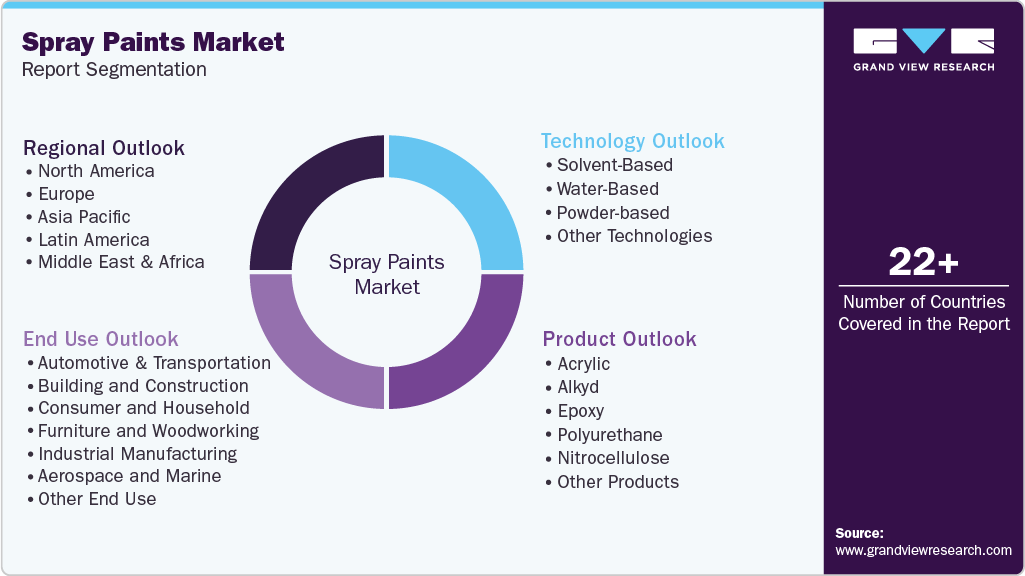
This report forecasts volume & revenue growth at global, regional, and country levels and provides an analysis of the latest industry trends in each of the sub-segments from 2021 to 2033. For this study, Grand View Research has segmented the global spray paints market report based on product, technology, end use, and region:
 To learn more about this report, Download Free Sample Report
-
Product Outlook (Volume, Kilotons; Revenue, USD Billion, 2021 - 2033)
-
Acrylic
-
Alkyd
-
Epoxy
-
Polyurethane
-
Nitrocellulose
-
Other Products
-
-
Technology Outlook (Volume, Kilotons; Revenue, USD Billion, 2021 - 2033)
-
Solvent-Based
-
Water-Based
-
Powder-based
-
Other Technologies
-
-
End Use Outlook (Volume, Kilotons; Revenue, USD Billion, 2021 - 2033)
-
Automotive and Transportation
-
Building and Construction
-
Consumer and Household
-
Furniture and Woodworking
-
Industrial Manufacturing
-
Aerospace and Marine
-
Other End Use
-
-
Region Outlook (Volume, Kilotons; Revenue, USD Billion, 2021 - 2033)
-
North America
-
U.S.
-
Canada
-
Mexico
-
-
Europe
-
Germany
-
UK
-
France
-
Italy
-
Spain
-
-
Asia Pacific
-
China
-
India
-
Japan
-
South Korea
-
-
Latin America
-
Brazil
-
Argentina
-
-
Middle East & Africa
-
Saudi Arabia
-
South Africa
-
-
Research Methodology
The spray paints marketfigures in this report are based on a proven research process that combines executive interviews with secondary research from proprietary databases, company filings, and recognized regulatory and institutional sources. Market size is built through value-chain sizing-reconciling supply-side and demand-side estimates-and triangulated with bottom-up and top-down approaches. Every estimate passes multiple levels of expert validation before publication, with eachspray paintssegment quantified using the revenue-capture definitions in the table below.
Segment Definition
Product
Revenue capture definition
Acrylic
Market value is generated through acrylic-based spray paints used to deliver color consistency, adhesion, weather resistance, and decorative finishes across diverse surfaces. Demand from automotive refinishing, household projects, construction, and industrial applications supports adoption due to their versatility and fast-drying properties.
Alkyd
Revenue is generated through alkyd-based spray paints that provide surface coverage, adhesion, gloss retention, and protective finishes across wood, metal, and other substrates. Their established use in maintenance, furniture finishing, and general-purpose painting supports demand across residential, commercial, and industrial applications.
Epoxy
Market value is created through epoxy-based spray paints formulated to provide strong adhesion, chemical resistance, abrasion protection, and durable surface finishes. Demand for protective coatings on machinery, equipment, metal components, and industrial surfaces supports adoption in applications requiring resistance to demanding operating conditions.
Polyurethane
Revenue is generated through polyurethane-based spray paints that offer abrasion resistance, flexibility, gloss retention, and weather protection. Their suitability for automotive refinishing, furniture, machinery, and specialty finishing applications supports demand for durable coatings with high-quality surface appearance and performance
Nitrocellulose
Market value is generated through nitrocellulose-based spray paints used for rapid drying, smooth finishes, and decorative surface treatments. Their established application in furniture finishing, woodworking, automotive refinishing, and specialty products supports demand where quick application and finishing efficiency are important.
Other Products
Revenue is generated through spray paints formulated using product chemistries outside acrylic, alkyd, epoxy, polyurethane, and nitrocellulose categories. These formulations serve specialized requirements involving surface appearance, substrate compatibility, heat resistance, or other performance characteristics across consumer and industrial applications.
Technology
Revenue capture definition
Solvent Based
Market value is generated through solvent-based spray paints that use organic solvents to facilitate application, film formation, and surface coverage. Their established performance across metal, automotive, industrial, and general-purpose applications supports demand for coatings requiring rapid drying, adhesion, and durable finishes, although emissions requirements influence formulation choices.
Water-Based
Revenue is generated through water-based spray paints that use water as the primary carrier to deliver decorative and protective finishes with reduced reliance on organic solvents. Increasing preference for lower-VOC formulations, improved workplace conditions, and environmentally oriented coating solutions supports adoption across household, construction, furniture, and selected industrial applications.
Powder-Based
Market value is created through powder-based coating technologies applied using spray equipment, typically followed by a curing process to form a protective film. Their ability to provide uniform finishes, mechanical durability, and low solvent emissions supports use in metal components, appliances, furniture, and industrial manufacturing, particularly where compatible application and curing infrastructure is available.
Other Technologies
Revenue is generated through spray paint application technologies outside conventional solvent-based, water-based, and powder-based categories. These technologies address specialized coating requirements through alternative formulation or delivery approaches, supporting surface finishing and protection across selected consumer, commercial, and industrial applications.
End Use
Revenue capture definition
Automotive and Transportation
Market value is generated through spray paints used on vehicle bodies, automotive components, motorcycles, commercial vehicles, and transportation equipment. Demand for refinishing, color customization, scratch concealment, and protective surface finishes supports adoption across vehicle manufacturing, repair, restoration, and maintenance activities.
Building and Construction
Revenue is generated through spray paints applied to building interiors, exterior surfaces, metal structures, concrete, and other construction materials. Increasing construction activity, renovation projects, and demand for decorative finishes and surface protection support utilization across residential, commercial, and institutional buildings.
Consumer and Household
Market value is created through spray paints purchased for do-it-yourself projects, home improvement, decorative crafts, furniture updates, and general household maintenance. Convenient application, broad color availability, quick-drying formulations, and suitability for multiple surfaces support demand among individual consumers and hobbyists.
Furniture and Woodworking
Revenue is generated through spray paints used to finish furniture, cabinets, wooden fixtures, decorative products, and other woodworking items. Demand for smooth coverage, consistent color, improved appearance, and protective finishes supports adoption across furniture manufacturing, restoration, interior furnishing, and custom woodworking activities.
Industrial Manufacturing
Market value is generated through spray paints applied to machinery, metal components, fabricated products, equipment housings, and manufactured goods. Requirements for surface protection, product identification, appearance, and production-line finishing support consumption across manufacturing facilities, equipment producers, and industrial maintenance operations.
Aerospace and Marine
Revenue is generated through spray paints used on aircraft components, aviation equipment, ships, boats, and associated structures. Demand for specialized finishes, environmental resistance, surface durability, and maintenance coatings supports application across aerospace maintenance, marine equipment manufacturing, vessel refinishing, and related repair activities.
Other End Use
Market value is generated through spray paints utilized in applications outside automotive and transportation, building and construction, consumer and household, furniture and woodworking, industrial manufacturing, and aerospace and marine. Demand from sectors such as arts and crafts, sporting goods, signage, and specialized maintenance contributes to revenue across additional applications.
Estimation Model
Layer Name
Key Question
Description
Product & Formulation Layer
What constitutes the spray paints product base?
Identify the development, formulation, manufacturing, and commercial availability of spray paints across acrylic, alkyd, epoxy, polyurethane, nitrocellulose, and other product categories. Evaluate resin composition, pigment selection, propellant systems, formulation characteristics, drying time, adhesion, surface finish, durability, and application-specific performance to assess product availability across global markets.
Technology Adoption Layer
Which application technologies drive spray paints consumption?
Assess the adoption of solvent-based, water-based, powder-based, and other spray paint technologies across consumer and industrial applications. The assessment considers formulation characteristics, application equipment, drying and curing requirements, substrate compatibility, VOC emissions, environmental compliance, production efficiency, and increasing demand for convenient and high-performance surface finishing solutions.
End Use Demand Layer
Where are spray paints utilized?
Analyze spray paint consumption across automotive and transportation, building and construction, consumer and household, furniture and woodworking, industrial manufacturing, aerospace and marine, and other end use applications. The assessment considers manufacturing output, construction activity, vehicle production, renovation spending, product finishing requirements, maintenance cycles, consumer preferences, and demand for decorative and protective coatings to estimate annual consumption across global markets.
Revenue Layer
How is market revenue generated?
Market revenue is generated through the manufacturing, distribution, and commercial sale of spray paints across global end use industries. Revenue growth is influenced by construction and manufacturing activity, automotive refinishing, household improvement expenditure, demand for specialized finishes, product innovation, formulation advancements, and the adoption of water-based and other lower-emission technologies across relevant applications.
Delivered Customizations
This report has been delivered with the following In-depth customizations
Client Request
Customization Delivered
Value Adds
Regional segmentation
The assessment includes country-level market sizing and forecasts, with demand patterns analyzed by product, technology, and end use. Coverage includes acrylic, alkyd, epoxy, polyurethane, nitrocellulose, and other spray paints; solvent-based, water-based, powder-based, and other technologies; and automotive and transportation, building and construction, consumer and household, furniture and woodworking, industrial manufacturing, aerospace and marine, and other end uses.
Supports market entry planning, competitor evaluation, and geographic expansion by providing visibility into country-level demand, product preferences, technology adoption, and end use opportunities. Helps identify attractive markets, prioritize investments, optimize distribution strategies, and align product portfolios with regional customer requirements and regulatory conditions.
Opportunity Assessment
Detailed evaluation of emerging growth opportunities across acrylic, alkyd, epoxy, polyurethane, nitrocellulose, and other spray paint products, alongside solvent-based, water-based, powder-based, and other technologies. The assessment examines demand for decorative and protective finishes, low-VOC formulations, advanced aerosol delivery, specialty coatings, and application-specific products across automotive, construction, household, furniture, industrial manufacturing, aerospace, and marine applications.
Enables prioritization of high-growth product categories, application areas, and coating technologies while identifying opportunities across the global spray paints value chain. Supports product development, portfolio diversification, technology investments, distribution expansion, and strategic partnerships through insights into evolving customer preferences, regulatory requirements, and long-term demand trends.
Competitive Benchmarking
Comparative assessment of leading global spray paints manufacturers based on product portfolios, formulation technologies, brand positioning, geographic presence, distribution networks, customer segments, research and development capabilities, manufacturing infrastructure, product innovation, and expansion strategies. The benchmarking evaluates capabilities across major product categories and application technologies, including their presence in automotive refinishing, construction, household projects, furniture finishing, industrial manufacturing, and specialty coating applications.
Supports competitor benchmarking by identifying strengths and gaps in product offerings, technology capabilities, geographic coverage, distribution channels, and customer reach. Enables informed decisions regarding product differentiation, portfolio expansion, strategic partnerships, manufacturing investments, channel development, and customer targeting to strengthen competitive positioning in the global spray paints market.
Frequently Asked Questions About This Report
The global spray paints market size was valued at USD 11.0 billion in 2025 and is estimated at USD 11.5 billion in 2026.
The global spray paints market is expected to grow at a CAGR of 5.6% from 2026 to 2033, reaching USD 16.9 billion by 2033.
Asia Pacific held the highest revenue share of 32.5% in 2025,
The spray paints market is driven by rising demand for convenient surface finishing solutions across automotive refinishing, building and construction, furniture manufacturing, household improvement, and industrial applications. Increasing construction activity, vehicle production, product innovation, and demand for specialized finishes and lower-VOC formulations further support market expansion.
Some of the key players operating in the global spray paints market include The Sherwin-Williams Company; Rust-Oleum Corporation; Nippon Paint Holdings Co., Ltd.; PPG Industries, Inc.; Akzo Nobel N.V.; RPM International Inc.; BASF Coatings; Axalta Coating Systems; Montana Colors S.L.; and Peter Kwasny GmbH.
The acrylic segment dominated the market with a revenue share of 30.7% in 2025, supported by its versatility, adhesion, and weather resistance. Its widespread use across automotive refinishing, construction, household projects, and industrial applications continues to underpin demand.
The automotive and transportation segment dominated with the largest revenue share of 23.5% in 2025 and aerospace and marine segment is second fastest growing market
The solvent-based formulations segment accounted for the largest revenue share of 70.2% in 2025, reflecting their established use across automotive refinishing, industrial manufacturing, furniture finishing, and maintenance applications.
About the Author(s)
Paints, Coatings & Printing Inks Research Team
Bulk Chemicals · Paints, Coatings & Printing InksThis report was authored by the paints, coatings & printing inks research team at Grand View Research - comprising two research analysts, one senior research analyst, and one industry expert - with specialized expertise in the paints, coatings & printing inks segment of the bulk chemicals industry. All findings are based on proprietary bulk chemicals databases, executive interviews, and regulatory analysis, subject to internal peer review prior to publication.
Last Updated:
Speak to Analyst

Customize this report to your needs - add regions, segments, or data points, with 20% free customization.
Or view our licence options:


ISO 9001:2015 & 27001:2022 Certified
We are GDPR and CCPA compliant! Your transaction & personal information is safe and secure. For more details, please read our privacy policy.


