
- Home
- »
- Homecare & Decor
- »
-
Stainless Steel Cookware Market Size Report, 2026-2033GVR Report cover

Stainless Steel Cookware Market (2026 - 2033)
Size, Share & Trends Analysis Report By Product (Pots & Pans, Pressure Cookers, Bakeware, Cooking Tools), By Application (Residential, Commercial), By Distribution Channel, By Region, And Segment Forecasts
Market Size, 2025
$9.2BMarket Estimate, 2026
$9.8BMarket Forecast, 2033
$14.8BCAGR, 2026–2033
6.1%Stainless Steel Cookware Market Summary
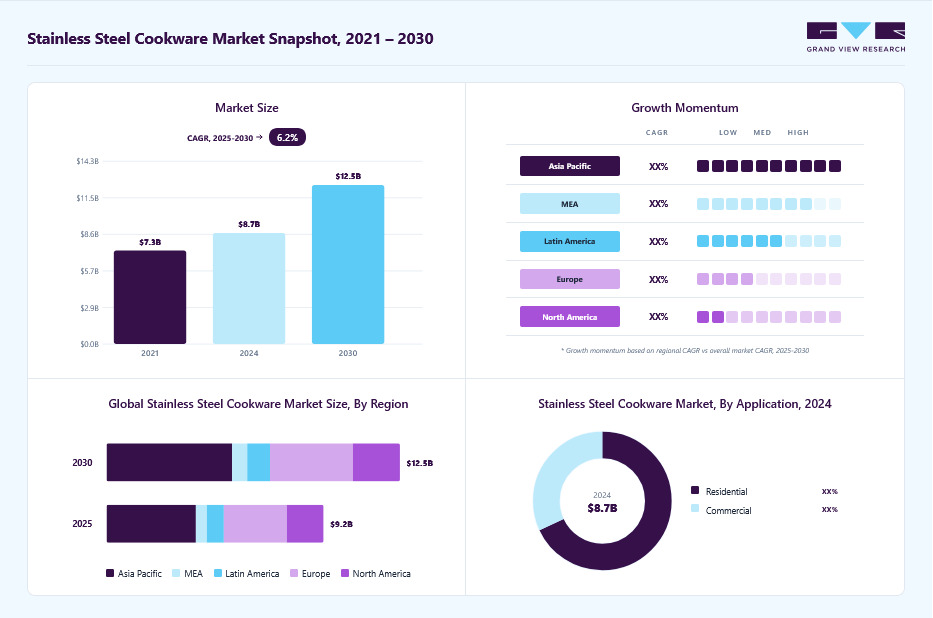
The global stainless steel cookware market size was valued at USD 9.2 billion in 2025 and is projected to grow from USD 9.8 billion in 2026 to USD 14.8 billion by 2033, at a CAGR of 6.1% from 2026 to 2033. Asia Pacific dominated the stainless steel cookware market with the largest revenue share of 41.2% in 2025. Driven by increasing consumer demand for durable, high-quality cookware, rising awareness of health benefits associated with stainless steel over other materials, and a growing preference for eco-friendly, sustainable kitchen products.
 Source: Grand View Research, IR Documents, Primary Interviews, Paid DatabasesTo learn more about this report,
 Download Free Sample Report
Key Market Trends & Insights
- By product: Pots and pans segment dominated the market, with a revenue share of 42.0% in 2025.
- By application: Residential segment held the largest market share of 66.2% in 2025.
- By distribution channel: Supermarkets & hypermarkets segment held the largest revenue share of 43.8% in 2025.
Regional Highlights
- Largest regional market: Asia Pacific (41.2% revenue share, 2025)
- By country: The U.S. held the largest market share in 2025.
Market Size & Forecast
- Market size in 2025: USD 9.2 Billion
- Estimated market size in 2026: USD 9.8 Billion
- Projected market size by 2033: USD 14.8 Billion
- CAGR (2026-2033): 6.1%
Three ways to get this report
Buy it, customize it, or ask a question.Ask an Analyst
Analyst response in 1 business day
- AccessReport author, directly
- Reply timeWithin 1 working day
- No sales callDirect answer only
- FormatEmail reply
- CostFree, no cost
Get the Full Report
What the study covers
- FormatsPDF · Excel · Dashboard
- Timeline2026–2033 annual, 2025 base
- Coverage20+ countries, 5 regions
- Companies10+ key players profiled
Customize the Report
20% free customization
- IncludeCountries, segments, points
- TailorTo your product definition
- ExtendDeeper competitor detail
- OrA fully bespoke study
- Turnaround5–10 working days
In addition, the surge in home cooking trends and the expansion of e-commerce channels have further boosted market demand, while innovations in cookware design and technology are expected to support continued growth. Stainless steel cookware, made by adding chromium and nickel to steel, is highly valued for its durability and resistance to reactions with food, particularly 18/10 stainless steel, which is known for its superior quality. While stainless steel is a poor heat conductor, innovations such as bonding layers of stainless steel with conductive materials such as copper and aluminum have made stainless-steel clad cookware highly practical and versatile. In addition, impact bonding heavy gauge aluminum disks to the bottom of a thinner stainless steel vessels offers a more affordable option, providing decent performance and durability, further driving the market growth.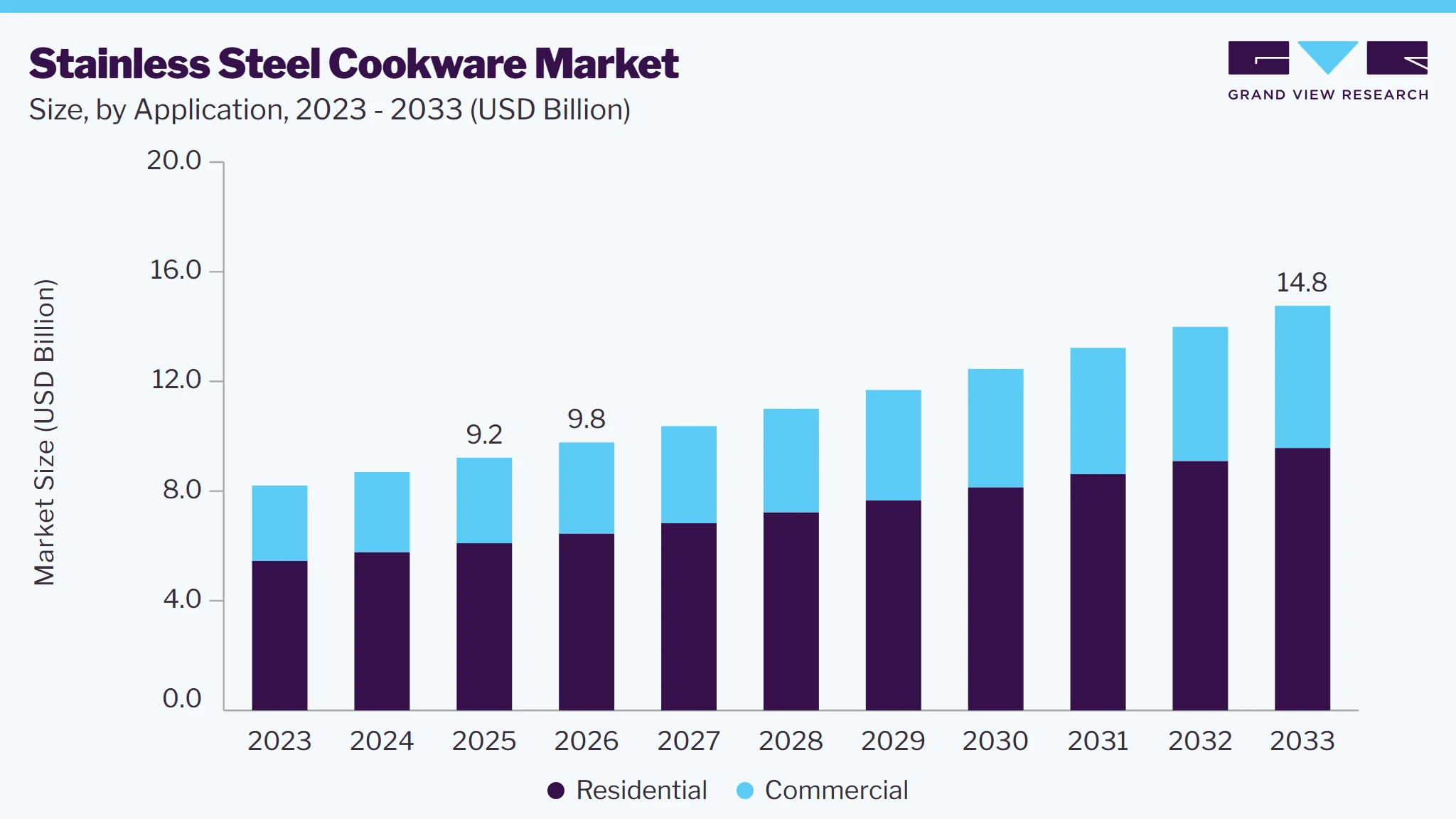 To learn more about this report, Download Free Sample Report
Stainless steel cookware has evolved significantly since its invention, becoming a popular choice for modern kitchens due to its durability, versatility, and health benefits. Initially considered a luxury material, it is now recognized for its ability to handle heat efficiently, making it ideal for both everyday use and special occasions. Households are increasingly investing in stainless steel cookware sets, drawn to their long lifespan compared to non-stick pans and cast iron skillets. In addition, stainless steel cookware offers superior food storage solutions with multiple container sizes for optimal kitchen organization.
The market for stainless steel cookware has expanded over the years, with key milestones such as the introduction of multi-layered construction in the 1960s for improved heat distribution and the advent of induction-compatible cookware in the 2000s. Continuous innovation, including ergonomic handles, glass lids, and stackable sets, keeps stainless steel cookware relevant for both home cooks and professional chefs. Its non-reactive properties, easy maintenance, and ability to maintain the natural flavor of food contribute to its widespread popularity.
Market Dynamics
The stainless steel cookware market is experiencing steady growth, driven by rising consumer preference for durable, nonreactive, long-lasting cookware for everyday cooking. The rising adoption of induction cooktops, the growing demand for multi-ply and clad stainless steel cookware that offer superior heat distribution, and increasing awareness of PFAS-free and non-toxic cooking alternatives are supporting market expansion. Furthermore, continuous product innovations, including ergonomic handles, dishwasher-safe designs, and compatibility with multiple heat sources, along with growing premiumization in home kitchens and the expansion of foodservice infrastructure, are expected to sustain market growth. The increasing availability of premium cookware through e-commerce platforms and direct-to-consumer channels is further accelerating market adoption.
Consumers are increasingly choosing premium multi-ply and clad stainless steel cookware because it delivers faster, more even heating than single-layer alternatives. In home kitchens, this matters for searing, simmering, and sauce preparation, where hot spots can ruin results. The growing popularity of induction cooking has further strengthened demand, since clad stainless steel performs reliably across modern cooktops. Buyers also value the professional feel, polished finish, and long service life, making these products a preferred upgrade from basic cookware sets today.
Premiumization is also being driven by consumers seeking cookware that enables healthier, more controlled cooking without sacrificing durability. Multi-ply construction with aluminum or copper cores improves responsiveness, helping cooks manage delicate recipes and high-heat techniques with greater precision. As households replace low-cost nonstick pans more frequently, stainless steel-clad cookware stands out as a better long-term investment. Strong demand from gifting, culinary enthusiasts, and aspirational buyers is encouraging brands to expand premium collections and justify higher price points globally.
Fluctuations in the prices of stainless steel, nickel, and chromium significantly affect manufacturing costs across the cookware industry. Premium cookware relies on high-grade stainless steel and multi-ply construction incorporating aluminum or copper cores, making producers particularly vulnerable to commodity price movements. Frequent cost increases reduce manufacturers' pricing flexibility and often result in higher retail prices, limiting adoption among price-sensitive consumers. Smaller manufacturers face additional pressure due to lower purchasing power and limited long-term supply contracts. Rising transportation, energy, and labor costs further compress margins, making it challenging to maintain product quality while remaining competitive in both developed and emerging markets.
Increasing consumer concerns regarding the long-term durability and safety of conventional nonstick cookware are creating significant opportunities for stainless steel cookware manufacturers. As nonstick coatings wear over time and require replacement, consumers are increasingly investing in stainless steel products that offer extended service life and chemical-free cooking surfaces. This replacement trend is particularly evident among premium households, health-conscious consumers, and younger buyers furnishing new kitchens. Manufacturers are capitalizing on this shift by introducing professionally inspired cookware sets, hybrid stainless steel collections, and value-added features such as measurement markings, stay-cool handles, and stackable designs, expanding their addressable customer base.
Analyst Perspective
The stainless steel cookware market is increasingly shaped by premium kitchen modernization, evolving cooking preferences, and demand for high-performance cookware across both residential and commercial applications. The market's strongest competitive advantage is expected to favor manufacturers that differentiate themselves through advanced materials engineering rather than compete solely on price. Brands offering multi-ply clad construction, induction-optimized bases, ergonomic designs, and cookware collections tailored to specific cooking techniques are likely to strengthen customer loyalty and pricing power. Furthermore, integrating cookware into coordinated kitchen ecosystems through matching cookware sets, specialty accessories, and premium kitchenware collections is expected to increase average transaction values. As consumers increasingly view cookware as a long-term investment rather than a disposable purchase, manufacturers emphasizing durability, professional-grade performance, and lifetime value are expected to capture higher-margin market opportunities.
Consumer Insights
Consumers have become increasingly aware of environmental issues, leading to a shift in preferences toward sustainable and responsibly sourced products. In addition, there is a global movement within industries to reduce carbon emissions and adopt eco-friendly practices.
In February 2023, Guardini, a European brand specializing in bakeware, in collaboration with partners ArcelorMittal, Cooper Coated Coil (CCC), and coating manufacturer ILAG, unveiled XBake, an eco-friendly steel cookware range. This sustainable product is made from ArcelorMittal's XCarb green steel and features a per- and polyfluoroalkyl substances (PFAS) free non-stick coating developed by ILAG and applied to steel coils by CCC. The innovative XBake range was introduced at the Ambiente fair in Frankfurt, Germany, and marks a significant step toward environmentally conscious stainless steel cookware production. Such innovations and a greener approach to cookware manufacturing are projected to drive the stainless steel cookware industry growth.
 To learn more about this report, Download Free Sample Report
The stainless steel cookware market has seen significant growth, driven by increasing consumer demand for durable and versatile cookware across various age groups. Millennials and Gen X consumers, in particular, have emerged as a key demographic, valuing stainless steel for its longevity, health benefits, and modern aesthetics. This growth is largely influenced by rising disposable incomes and shifting preferences toward premium kitchen appliances in households, especially in regions such as Asia Pacific.
According to a 2019 Private Label Manufacturers Association (PLMA) Consumer Report, consumers increasingly prefer to purchase cookware at mass merchandisers such as Walmart and Target, with 82% of consumers in the U.S. purchasing kitchenware and cookware at these locations. This reflects their broad appeal due to factors such as competitive pricing, convenience, and widespread availability. For example, Walmart’s vast network of over 4,700 U.S. stores makes it a go-to destination for household essentials, contributing to its strong presence in the cookware market.
 To learn more about this report, Download Free Sample Report
Product Insights
Based on product, pots and pans led the market with the largest revenue share of 42.0% in 2025, driven by their durability, resistance to corrosion, and aesthetic appeal. The market's dominance is attributed to increased consumer demand for high-quality, long-lasting cookware that retains heat efficiently and is non-reactive to acidic ingredients, making it ideal for a variety of cooking techniques. This trend is supported by the growing preference for healthier cooking methods, as stainless steel pots and pans are often favored for its ability to cook food evenly without the need for excessive oil.
Stainless steel pressure cooker sales are projected to grow at a CAGR of 7.2% from 2025 to 2033, reflecting a rising global shift toward energy-efficient and time-saving cooking solutions. This growth is fueled by the pressure cooker's ability to significantly reduce cooking times while preserving nutrients, a feature increasingly valued by health-conscious consumers. The expansion is particularly noticeable in regions such as Asia Pacific, where traditional cooking methods often involve long hours of boiling or simmering. In addition, technological advancements, such as the integration of smart features such as timers and multi-cooking functions, have broadened the appeal of stainless steel pressure cookers, especially in urban households where convenience is a priority.
Application Insights
Based on application, the residential segment led the market with the largest revenue share of 66.2% in 2025, driven by several factors, including a rising preference for premium, durable kitchenware among home cooks. The pandemic-induced surge in home cooking has played a significant role in increasing demand for stainless steel cookware, as consumers invested in high-quality kitchen essentials. According to a survey by the Food Marketing Institute, over 79% of U.S. households prepared more meals at home in the past year, a trend that spurred sales in the cookware segment.
In terms of unit sales, stainless steel cookware in residential settings accounted for a share of over 76% in 2024. The shift toward healthier cooking practices, where stainless steel’s non-reactive and toxin-free properties are essential, further fueled adoption of stainless steel cookware in residential settings. The material’s easy maintenance and aesthetic appeal have also contributed to its popularity among home cooks looking for professional-grade cookware.
Stainless steel cookware revenue in commercial applications is projected to grow at a CAGR of 6.7% from 2025 to 2033, driven by the increasing demand for durable, high-performance cookware in restaurants, hotels, and foodservice establishments. The commercial sector values stainless steel cookware for its resistance to wear and tear, its ability to withstand high heat, and its non-reactive qualities, essential for preparing a wide range of dishes. 304/304L (also known as 18/8 or 18/10) is the most popular grade of stainless steel found in restaurants, commercial kitchens, and food service environments today due to its balance of cost and performance.
Distribution Channel Insights
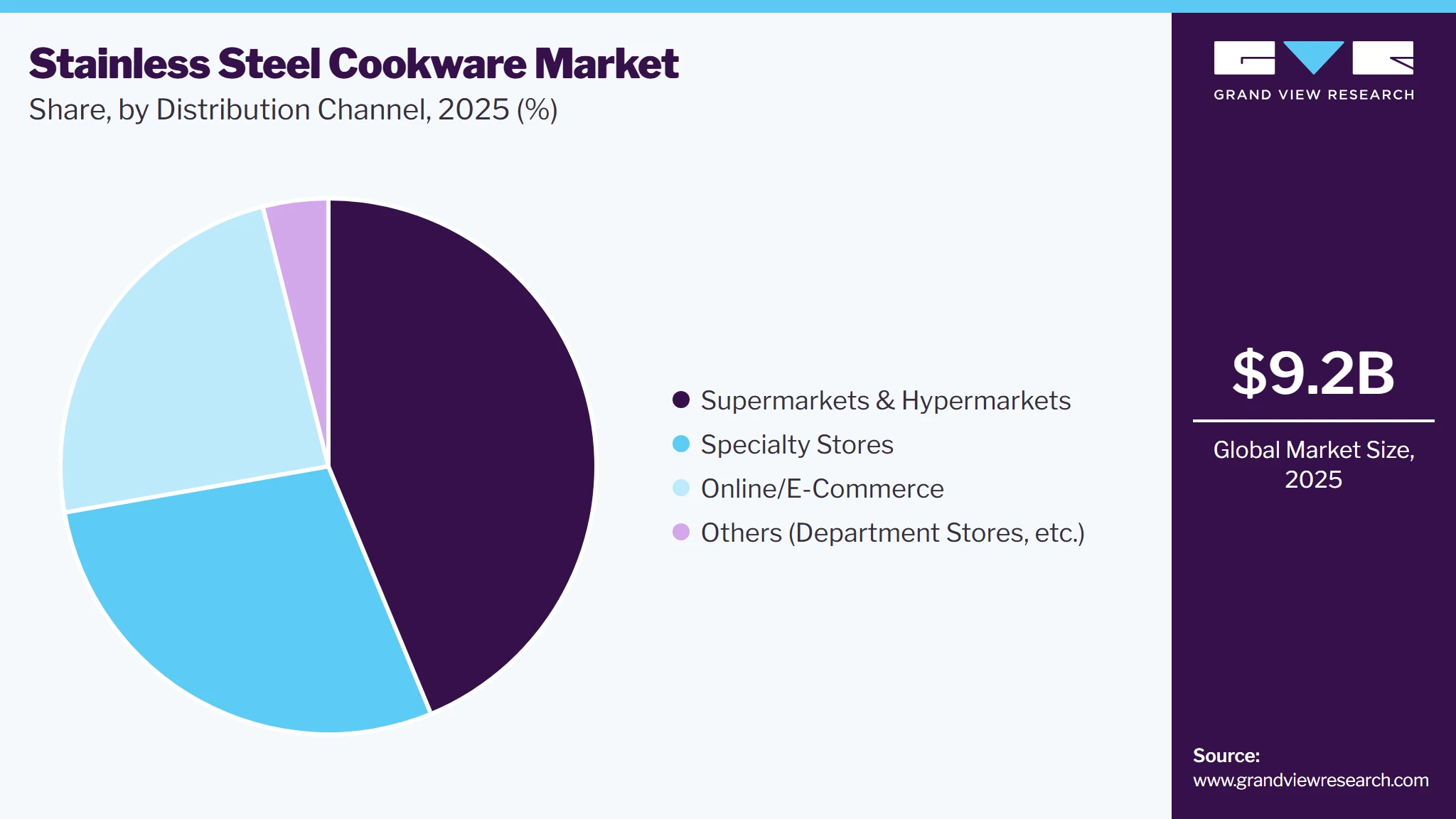
Based on distribution channel, the supermarkets & hypermarkets segment led the market with the largest revenue share of 43.8% in 2025. These retail channels are popular for their wide product variety, competitive pricing, and the ability to offer customers a hands-on shopping experience. With consumers increasingly seeking convenience, supermarkets and hypermarkets serve as one-stop shops where buyers can compare different cookware brands and make immediate purchases. In the U.S., for instance, large chains like Walmart and Target have heavily invested in cookware sections, catering to both budget-conscious and premium buyers. In addition, seasonal promotions and discounts frequently drive higher sales in these outlets, positioning them as the preferred destination for cookware shopping among many residential consumers.
 To learn more about this report, Download Free Sample Report
Online stainless-steel cookware sales are projected to grow at a CAGR of 7.7% from 2025 to 2033, reflecting the growing preference for e-commerce shopping. The convenience of browsing a wide range of cookware options, reading reviews, and comparing prices has made online platforms such as Amazon, Wayfair, and specialty retailers increasingly popular among consumers. Furthermore, the ability to deliver directly to consumers' homes and the growing trend of purchasing products during online sales events such as Black Friday and Prime Day further fuel this growth. As consumers continue to embrace the convenience and wide selection available online, the demand for stainless-steel cookware on these platforms is projected to rise steadily.
Regional Insights
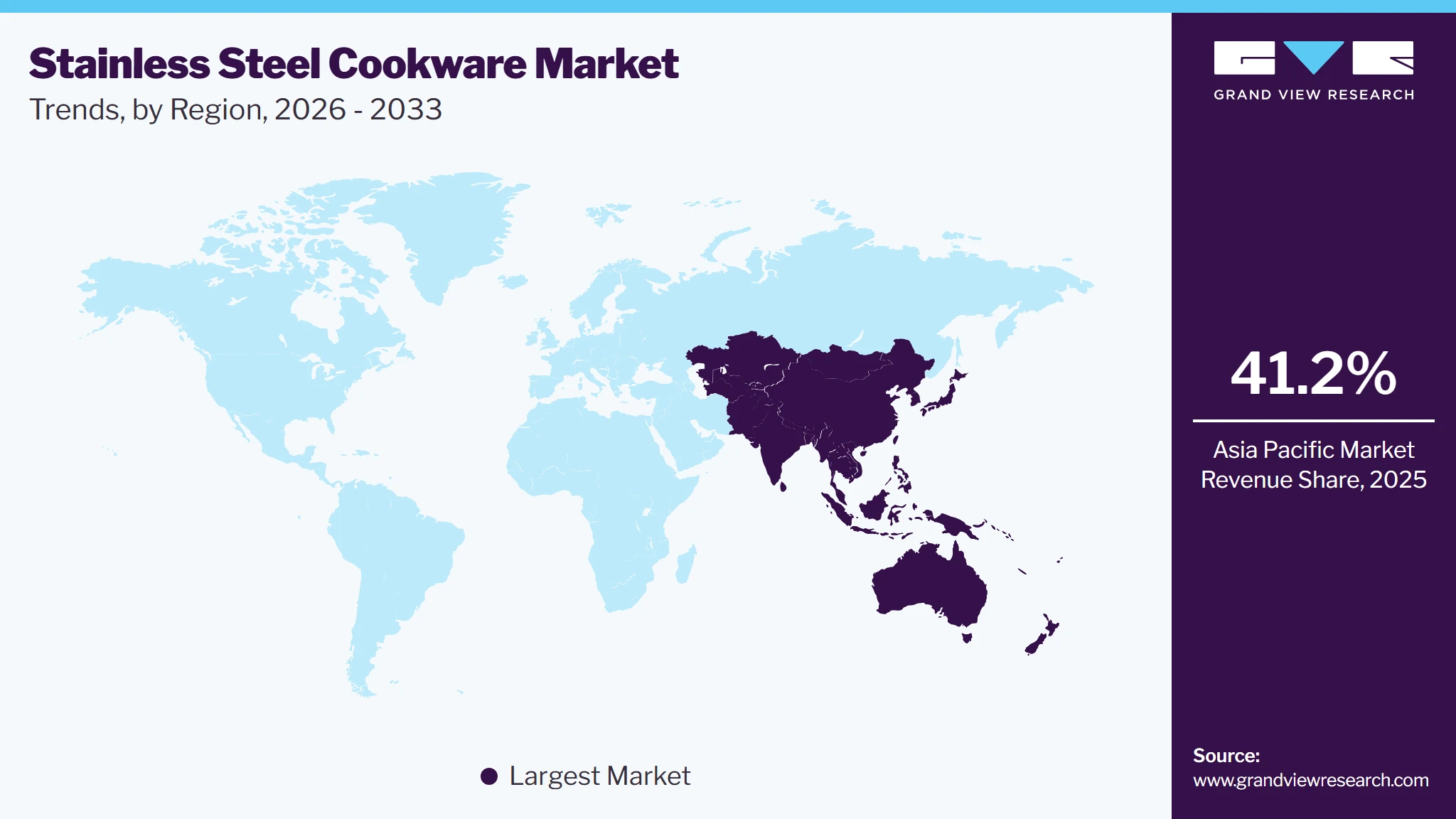
Asia Pacific dominated the stainless steel cookware market with the largest revenue share of 41.2% in 2025, driven by a combination of residential expansion and commercial food service growth. The increasing number of households and major home improvement projects have boosted demand for premium cookware, with consumers inclined to invest in high-end products that complement kitchen décor. In addition, the commercial food service segment, supported by a growing number of restaurants and eateries, has significantly contributed to the market’s expansion. Trends in North America favor durable stainless steel cookware with riveted handles, darker colors, and features such as non-stick surfaces and quick-heating capabilities. Brands such as All-Clad and USA PAN remain popular, alongside innovative entrants such as Our Place.
 To learn more about this report, Download Free Sample Report
U.S. Stainless Steel Cookware Market Trends
The stainless steel cookware market in the U.S. held the largest share in the North America region in 2025, driven by rising consumer interest in premium and durable kitchenware. The increasing preference for high-quality cookware that offers long-term value is encouraging demand, especially among millennials investing in home upgrades. In addition, innovations like non-stick stainless steel surfaces and ergonomic handle designs cater to consumers seeking convenience and safety.
Europe Stainless Steel Cookware Market Trends
Stainless steel cookware market in Europe accounted for a share of over 29% of the global market revenue in 2024.The region’s leading markets, such as Germany, France, and the UK, are seeing an increased focus on multi-ply construction cookware for better heat distribution. Furthermore, the rise of home cooking, fueled by wellness trends, is boosting sales of durable, aesthetically appealing stainless steel sets that complement modern kitchen designs.
Asia Pacific Stainless Steel Cookware Market Trends
The stainless steel cookware market in Asia Pacific is expected to grow at a CAGR of 7.0% from 2025 to 2033, led by rapid urbanization, rising disposable incomes, and expanding middle-class populations in countries such as China and India. The growing awareness of stainless steel’s health benefits, such as its non-reactive nature and durability, is attracting consumers looking for long-lasting, high-quality cookware. The region also witnesses strong demand for induction-compatible stainless steel products due to the increasing adoption of modern cooktops.
Key Stainless Steel Cookware Company Insights
The global stainless steel cookware industry is moderately fragmented and is characterized by the presence of a large number of international and local players. Key players in the global stainless steel cookware market are employing various strategies to strengthen their market positions and capture a larger share of the industry. Leading brands such as All-Clad, Le Creuset, and Calphalon focus on premium product offerings, targeting affluent consumers who prioritize quality and durability. All-Clad, for instance, continues to leverage its reputation for high-performance cookware by introducing innovative products such as multi-ply bonded stainless steel sets with better heat distribution and durability.
To stay competitive, many international brands are also emphasizing eco-friendly manufacturing processes and materials, aligning with growing consumer demand for sustainable cookware options.In addition, local players in emerging markets such as India and China are intensifying competition by offering cost-effective alternatives to global brands. TTK Prestige, a major player in India, focuses on affordable, durable stainless steel cookware designed for the growing middle class.
Key Stainless Steel Cookware Companies
The following key companies have been profiled for this study on the stainless steel cookware market.
-
All-Clad
-
Meyer Group Ltd.
-
Groupe SEB
-
Zwilling J.A. Henckels LLC
-
Le Creuset
-
Fissler
-
Lagostina
-
Cuisinart
-
Calphalon
-
KitchenAid
Competitive Benchmarking
Category
Operating Strategies
Competitive Edge
Weakness
Established Players (Groupe SEB; Meyer Group Ltd.; Zwilling J.A. Henckels LLC; Le Creuset; KitchenAid; Cuisinart)
Expand premium cookware portfolios through multi-ply innovations, induction-compatible products, sustainable manufacturing, omnichannel distribution, chef collaborations, and international expansion.
Strong brand recognition, advanced manufacturing, extensive distribution, premium product quality, and loyal customer bases support pricing power, innovation, and global market leadership.
High production costs, fluctuations in stainless steel prices, intense competition, counterfeit products, and reliance on discretionary consumer spending may affect profitability and growth.
Emerging Players (All-Clad; Fissler; Lagostina; Calphalon)
Focus on direct-to-consumer sales, sustainable production, premium multi-ply cookware, digital marketing, and customer-centric innovations to strengthen brand visibility and expand niche markets.
Agile product development, competitive pricing, strong online engagement, premium craftsmanship, and quick adaptation to consumer preferences support differentiation and market expansion.
Limited global presence, smaller distribution networks, lower brand recognition, and constrained manufacturing scale may restrict growth and intensify competition with established brands.
Recent Developments
-
In January 2021, All-Clad launched its new "FusionTec" cookware line, which combines the durability of stainless steel with a scratch-resistant, high-performance coating. The launch was aimed at targeting health-conscious consumers by offering non-toxic, easy-to-clean cookware without compromising on quality or aesthetics.
-
In February 2023, Guardini, a European brand specializing in bakeware, in collaboration with partners ArcelorMittal, Cooper Coated Coil (CCC), and coating manufacturer ILAG, launched XBake, an eco-friendly steel cookware range. This sustainable product is made from ArcelorMittal's XCarb green steel and features a per- and polyfluoroalkyl substances (PFAS) free non-stick coating developed by ILAG and applied to steel coils by CCC.
Stainless Steel Cookware Market Report Scope
Report Attribute
Details
Market size in 2025
USD 9.2 billion
Estimated market size in 2026
USD 9.8 billion
Projected market size by 2033
USD 14.8 billion
Growth rate
CAGR of 6.1% from 2026 to 2033
Base year for estimation
2025
Historical data
2021 - 2024
Forecast period
2026 - 2033
Quantitative units
Revenue in USD million/billion and CAGR from 2026 to 2033
Report coverage
Revenue forecast, company ranking, competitive landscape, growth factors, and trends
Segments covered
Product, application, distribution channel, region
Regional scope
North America; Europe; Asia Pacific; Latin America; MEA
Country scope
U.S.; Canada; Mexico; Germany; UK; France; Italy; Spain; China; Japan; India; Australia; South Korea; Brazil; South Africa
Key companies profiled
All-Clad; Meyer Group Ltd.; Groupe SEB; Zwilling J.A. Henckels LLC; Le Creuset; Fissler; Lagostina; Cuisinart; Calphalon; KitchenAid
Customization scope
Free report customization (equivalent to up to 8 analysts' working days) with purchase. Addition or alteration to country, regional & segment scope.
Pricing and purchase options
Avail customized purchase options to meet your exact research needs. Explore purchase options
Global Stainless Steel Cookware Market Report Segmentation
This report forecasts revenue growth at the global, regional, and country levels and provides an analysis of the latest industry trends and opportunities in each of the sub-segments from 2021 to 2033. For the purpose of this study, Grand View Research has segmented the global stainless steel cookware market on the basis of product, application, distribution channel, and region:
 To learn more about this report, Download Free Sample Report
-
Product Outlook (Volume, Million Units; Revenue, USD Million, 2021 - 2033)
-
Pots & pans
-
Pressure cookers
-
Bakeware
-
Cooking Tools
-
Others
-
-
Application Outlook (Volume, Million Units; Revenue, USD Million, 2021 - 2033)
-
Residential
-
Commercial
-
-
Distribution Channel Outlook (Volume, Million Units; Revenue, USD Million, 2021 - 2033)
-
Supermarkets & Hypermarkets
-
Specialty Stores
-
Online/E-Commerce
-
Others
-
-
Regional Outlook (Volume, Million Units; Revenue, USD Million, 2021 - 2033)
-
North America
-
U.S.
-
Canada
-
Mexico
-
-
Europe
-
Germany
-
UK
-
France
-
Italy
-
Spain
-
-
Asia Pacific
-
China
-
India
-
Japan
-
Australia
-
South Korea
-
-
Latin America
-
Brazil
-
-
Middle East & Africa
-
South Africa
-
-
Research Methodology
The stainless steel cookware market figures in this report are based on a proven research process that combines executive interviews with secondary research from proprietary databases, company filings, and recognized regulatory and institutional sources. Market size is built through value-chain sizing-reconciling supply-side and demand-side estimates-and triangulated with bottom-up and top-down approaches. Every estimate passes multiple levels of expert validation before publication, with each stainless steel cookware segment quantified using the revenue-capture definitions in the table below.
Segment Definition
Application
Revenue capture definition
Residential
As the largest application segment, revenue is generated from stainless steel cookware purchased for household cooking, with consumers using pots, pans, and specialty items for everyday meal preparation. The segment includes products sold through retail stores, supermarkets, specialty kitchen outlets, and e-commerce platforms.
Commercial
Revenue is generated from stainless steel cookware used in professional foodservice environments, where durability and high-performance cooking are essential for large-scale operations. The segment includes cookware supplied to restaurants, hotels, catering services, institutional kitchens, and other commercial establishments.
Estimation Model
Layer No.
Layer Name
Key Question
Description
01
Household & Foodservice User Base Layer
Who has the potential to use stainless steel cookware?
Identify households, restaurants, hotels, catering services, institutional kitchens, and foodservice operators requiring durable, hygienic, and high-performance cookware.
02
Cookware Expenditure Layer
Who can afford stainless steel cookware?
Focus on middle- and high-income households, hospitality businesses, professional chefs, and consumers investing in premium, long-lasting kitchen essentials.
03
Replacement & Upgrade Layer
Who actively replaces stainless steel cookware?
Target consumers upgrading cookware, replacing worn utensils, renovating kitchens, or purchasing premium multi-piece sets for durability and cooking performance.
04
Revenue Generation Layer
How much revenue is generated?
Estimate revenue from new cookware purchases, replacement demand, premium collections, commercial kitchen contracts, cookware accessories, and recurring household upgrades.
Delivered Customizations
This report has been delivered with the following In-depth customizations
Client Request
Customization Delivered
Value Adds
Product Performance Benchmarking & Material Grade Assessment for Stainless Steel Cookware
Conducted a comprehensive evaluation of stainless steel cookware performance across major brands and product categories. Assessed cookware based on stainless steel grades, multi-ply construction (tri-ply, five-ply, seven-ply), heat distribution, induction compatibility, durability, corrosion resistance, handle ergonomics, and cooking efficiency. Benchmarked premium and mass-market product specifications to identify key differentiating features.
Identified opportunities for product innovation and portfolio optimization. Enabled benchmarking of material quality and functional performance across price segments. Supported product development strategies focused on premiumization and enhanced cooking performance.
Foodservice, Hospitality & Institutional Procurement Assessment
Conducted an in-depth assessment of stainless steel cookware demand across restaurants, hotels, catering companies, institutional kitchens, healthcare facilities, and educational establishments. Evaluated procurement criteria including cookware durability, NSF certification requirements, replacement cycles, bulk purchasing behavior, maintenance practices, and preferred cookware configurations. Analyzed purchasing patterns across commercial end-user segments and regional markets.
Identified high-growth commercial demand opportunities beyond household consumers. Supported B2B sales strategies by prioritizing institutional procurement channels. Enabled product portfolio optimization based on commercial performance requirements and purchasing preferences.
Manufacturing Technology, Production Footprint & Supply Chain Assessment
Conducted a detailed examination of manufacturing processes including stamping, bending, die-casting, polishing, welding, polishing technologies, automation levels, and quality assurance practices. Assessed global production footprints, raw material sourcing strategies, manufacturing capacities, supplier ecosystems, and process optimization initiatives. Supported key recommendations to enhance future scalability and operational efficiency.
Identified manufacturing optimization opportunities and supply chain resilience strategies. Supported sourcing and capacity expansion decisions aligned with global demand growth. Enabled cost optimization and process efficiency improvements to strengthen competitiveness.
Frequently Asked Questions About This Report
The global stainless steel cookware market size was valued at USD 9.2 billion in 2025 and is estimated to reach USD 9.8 billion in 2026.
Key factors include increasing consumer demand for durable, high-quality cookware, rising awareness of the health benefits of stainless steel compared with other materials, and a growing preference for eco-friendly, sustainable kitchen products.
The pots and pans segment led with a 42.0% revenue share in 2025, while the pressure cooker segment is the fastest-growing product.
Some of the key players include All-Clad, Meyer Group Ltd., Groupe SEB, Zwilling J.A. Henckels LLC, Le Creuset, Fissler, Lagostina, Cuisinart, Calphalon, and KitchenAid.
Asia Pacific dominated with a 41.2% revenue share in 2025.
The supermarkets & hypermarkets channel segment held the largest revenue share of 43.8% in 2025, while the online channel segment is the fastest-growing.
Residential segment led the market with the largest revenue share of 66.2% in 2025, driven by several factors, including a rising preference for premium, durable kitchenware among home cooks.
The global stainless steel cookware market is expected to grow at a CAGR of 6.1% from 2026 to 2033, reaching USD 14.8 billion by 2033.
About the Author(s)
Homecare & Decor Research Team
Consumer Goods · Homecare & DecorThis report was authored by the homecare & decor research team at Grand View Research - comprising two research analysts, one senior research analyst, and one industry expert - with specialized expertise in the homecare & decor segment of the consumer goods industry. All findings are based on proprietary consumer goods databases, executive interviews, and regulatory analysis, subject to internal peer review prior to publication.
Last Updated:
Speak to Analyst

Customize this report to your needs - add regions, segments, or data points, with 20% free customization.
Or view our licence options:


ISO 9001:2015 & 27001:2022 Certified
We are GDPR and CCPA compliant! Your transaction & personal information is safe and secure. For more details, please read our privacy policy.


