
- Home
- »
- Biotechnology
- »
-
Stem Cell Expansion Technologies Market Report Size, 2033GVR Report cover

Stem Cell Expansion Technologies Market (2026 - 2033) Size, Share & Trends Analysis Report By Cell Type (MSCs, HSCs), By Technology, By Product (Consumables, Bioreactors & Expansion Systems, Culture Media & Reagents), By Application, By End-user, By Region, And Segment Forecasts
Market Size, 2025
$2.2BMarket Estimate, 2026
$2.4BMarket Forecast, 2033
$4.9BCAGR, 2026–2033
10.9%Stem Cell Expansion Technologies Market Summary
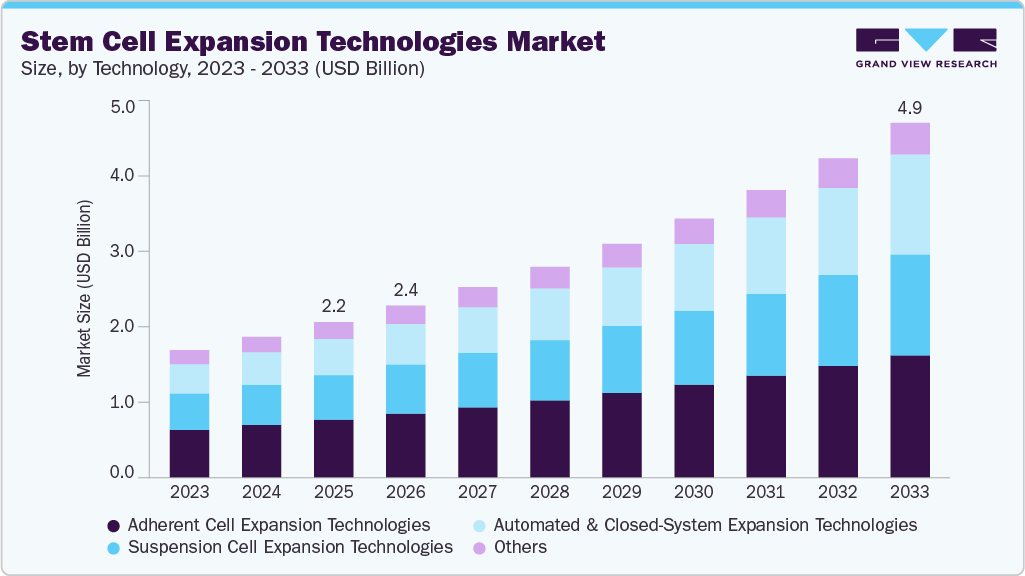
The global stem cell expansion technologies market size was valued at USD 2.2 billion in 2025 and is projected to grow from USD 2.4 billion in 2026 to USD 4.9 billion by 2033, at a CAGR of 10.9% from 2026 to 2033. The North America held the largest share of 44.8% of the global market in 2025. The market is driven by rising demand for stem cell therapies, increasing regenerative medicine research, and advancements in automated cell expansion technologies.
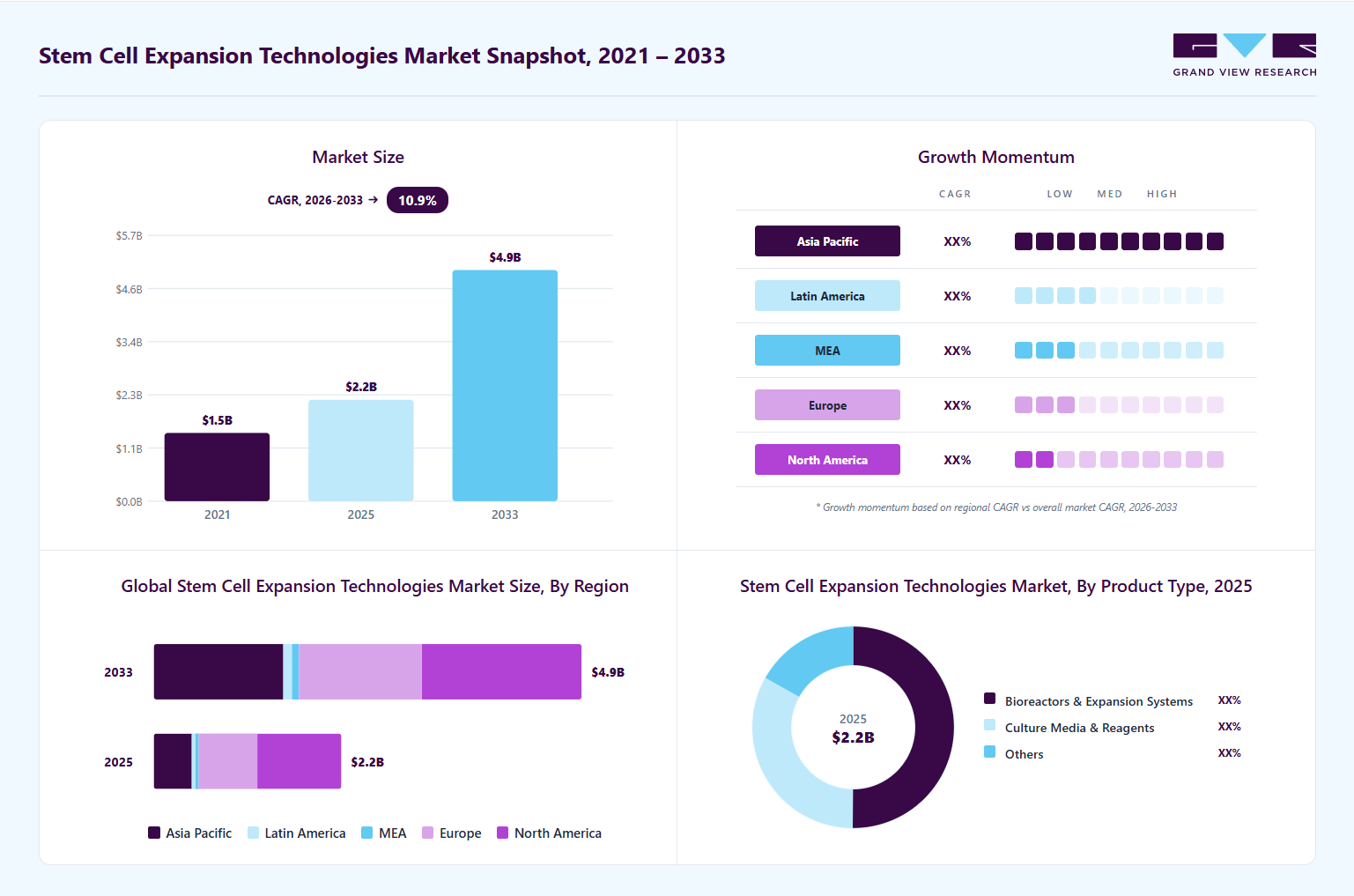 Source: Grand View Research, IR Documents, Primary Interviews, Paid DatabasesTo learn more about this report,
 Download Free Sample Report
 Key Market Trends & Insights
- By technology: Adherent cell expansion technologies segment held the largest market share of 37.4% in 2025.
- By product: Consumables segment held the largest market share of 39.9% in 2025.
- By cell type: Mesenchymal Stem Cells (MSCs) segment held the largest market share of 39.7% in 2025.
- By application: Regenerative medicine segment accounted for the largest market share of 37.5% in 2025.
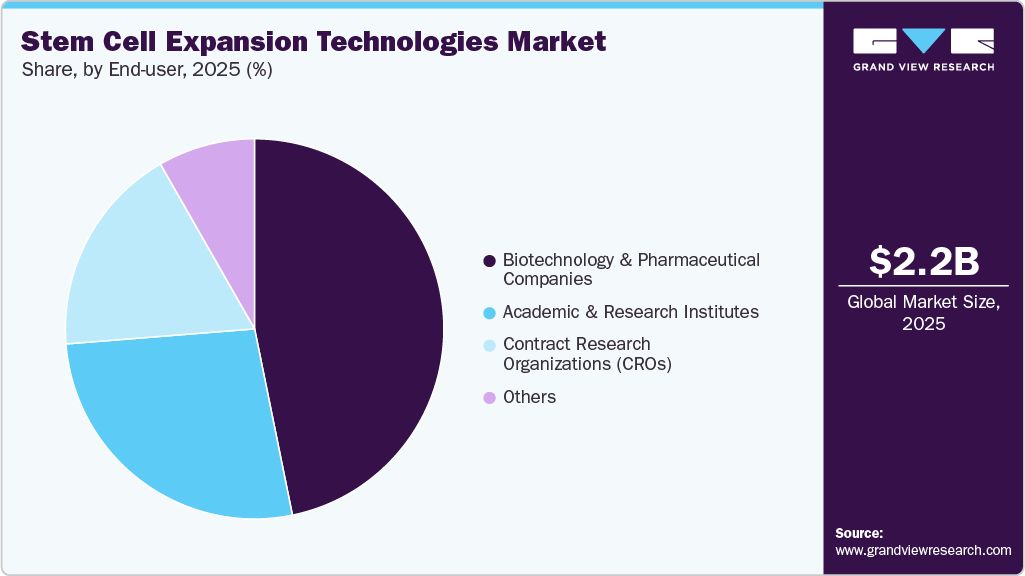
- By end user: Biotechnology & pharmaceutical companies segment held the largest market share of 46.8% in 2025.
Regional Highlights
- Largest regional market: North America (44.8% revenue share, 2025)
- Fastest-growing regional market: Asia Pacific (highest CAGR, 2026-2033)
- By country: The U.S. held the largest market share in 2025.
Market Size & Forecast
- Market size in 2025: USD 2.2 Billion
- Estimated market size in 2026: USD 2.4 Billion
- Projected market size by 2033: USD 4.9 Billion
- CAGR (2026-2033): 10.9%
Three ways to get this report
Buy it, customize it, or ask a question.Ask an Analyst
Analyst response in 1 business day
- AccessReport author, directly
- Reply timeWithin 1 working day
- No sales callDirect answer only
- FormatEmail reply
- CostFree, no cost
Get the Full Report
What the study covers
- FormatsPDF · Excel · Dashboard
- Timeline2026–2033 annual, 2025 base
- Coverage20+ countries, 5 regions
- Companies10+ key players profiled
Customize the Report
20% free customization
- IncludeCountries, segments, points
- TailorTo your product definition
- ExtendDeeper competitor detail
- OrA fully bespoke study
- Turnaround5–10 working days
 To learn more about this report, Download Free Sample Report
 Market Dynamics
The rising adoption of stem cell therapies in regenerative medicine is driving demand for stem cell expansion technologies. Stem cells are increasingly used in the treatment of chronic, degenerative, and autoimmune diseases due to their regenerative capabilities. The growing number of clinical trials and stem cell-based therapies has increased the need for scalable technologies capable of producing large volumes of high-quality stem cells.
Current Landscape of FDA Stem Cell Approvals and Trials 2023-2025
Product / Therapy
Stem Cell Type / Platform
Omisirge
Allogeneic nicotinamide-modified cord blood-derived hematopoietic progenitor cells
Lyfgenia
Autologous genetically modified hematopoietic stem cells
Ryoncil
Allogeneic bone marrow-derived mesenchymal stromal cells (MSCs)
Fertilo
iPSC-derived ovarian support cells (OSCs)
OpCT-001
iPSC-derived photoreceptor cell therapy
FT819
Off-the-shelf iPSC-derived CAR-T cells
CYP-001
iPSC-derived mesenchymal stromal cells (iMSCs)
FT536
Gene-edited hiPSC-derived NK cells
MyoPAXon
iPSC-derived CD54+ allogeneic muscle progenitor cells
Autologous iPSC-derived Dopaminergic Neural Progenitor Cells.
Autologous iPSC-derived dopaminergic neural progenitor cells
Moreover, advancements in bioreactors, cell culture systems, and serum-free media are supporting large-scale stem cell manufacturing. Increasing investments from pharmaceutical and biotechnology companies, along with growing focus on personalized medicine and regenerative research, are further accelerating market growth.
The high cost of stem cell expansion technologies remains a major restraint on market growth. Stem cell expansion processes require sophisticated infrastructure, including automated bioreactors, cell culture systems, specialized media, growth factors, and stringent cleanroom environments to ensure cell quality and sterility. In addition, manufacturers must comply with Good Manufacturing Practice (GMP) standards, which further increase operational and validation expenses. The need for highly skilled personnel, continuous quality monitoring, and advanced storage and handling systems also contributes to elevated production costs. These financial barriers can limit technology adoption among small and mid-sized biotechnology companies, research institutes, and emerging startups, thereby restraining large-scale commercialization and broader market penetration.
Market Concentration & Characteristics
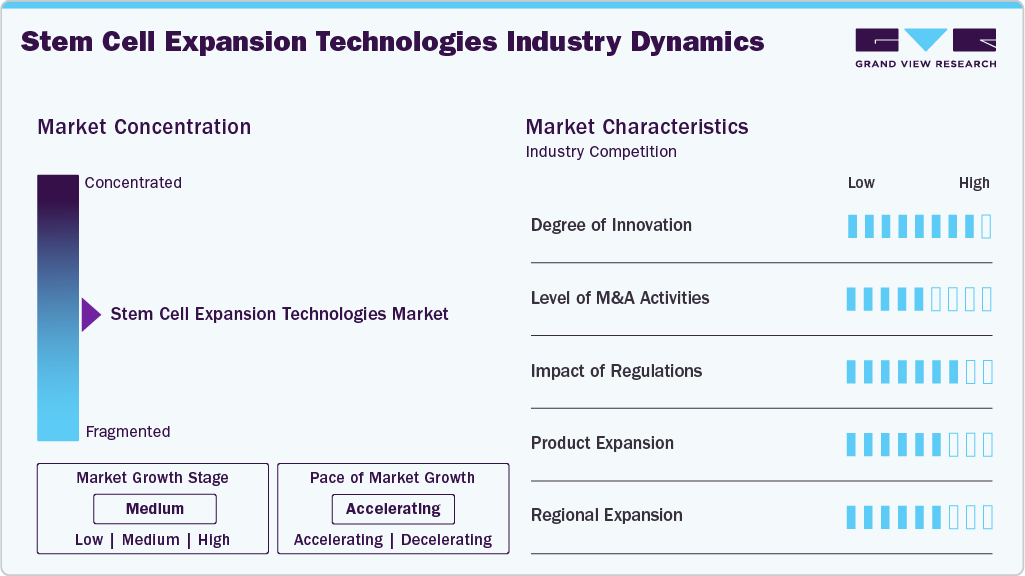
The stem cell expansion technologies industry is highly innovative, driven by advances in bioreactors, automation, and cell culture systems. Key developments such as 3D cultures, microcarriers, and serum-free media improve cell yield and quality. AI-based monitoring and automated systems further enhance efficiency and enable scalable production for cell therapy and regenerative medicine.
The stem cell expansion technologies industry is witnessing moderate to high M&A activity, driven by companies aiming to strengthen capabilities in bioprocessing and cell manufacturing. Major players are acquiring or partnering with specialized firms to access advanced expansion platforms, bioreactor systems, and automation technologies. These deals support the faster commercialization of scalable, GMP-compliant solutions for cell therapy and regenerative medicine. For instance, in December 2023, U.S.-based Replay and Germany-based Miltenyi Biotec entered an exclusive licensing and GMP manufacturing agreement to develop scalable NK cell therapies using automated CliniMACS Prodigy manufacturing technology.
 To learn more about this report, Download Free Sample Report
 Regulations significantly impact the stem cell expansion technologies industry by enforcing strict GMP, safety, and quality standards for clinical applications. Regulatory agencies require high cell purity, consistency, and traceability, increasing compliance costs and development timelines. However, clear regulatory frameworks also support clinical adoption and drive demand for standardized, compliant expansion technologies.
Product expansion in the stem cell expansion technologies industry is increasing as companies introduce advanced bioreactors, automated culture systems, serum-free media, and scalable cell expansion platforms. Market players are expanding their portfolios to support large-scale manufacturing, improve cell yield and consistency, and meet growing demand from regenerative medicine and cell therapy applications.
Regional expansion in the stem cell expansion technologies industry is growing as companies strengthen their presence in emerging and developed markets through new facilities, partnerships, and distribution networks. Increasing investments in regenerative medicine research, rising healthcare infrastructure, and growing clinical trial activities in regions such as Asia-Pacific and Europe are encouraging market players to expand their global footprint.
Case Study: Large-Scale Expansion of Human iPSC-Derived Islets Using Bioreactor Technology
Overview
A 2025 study published in Nature npj Regenerative Medicine demonstrated the use of Vertical Wheel® bioreactor technology for the large-scale expansion and differentiation of human induced pluripotent stem cell (iPSC)-derived islets. The study aimed to address major manufacturing challenges in regenerative medicine, including low scalability, cell loss, and process variability during stem cell production.
Objective
The primary objective of the study was to develop a scalable and reproducible stem cell expansion platform capable of producing clinically relevant quantities of high-quality iPSC-derived islets for diabetes and regenerative therapy applications.
Technology Used
-
Vertical Wheel bioreactor system
-
Human induced pluripotent stem cells (iPSCs)
-
Scalable suspension culture process
-
Automated stem cell differentiation workflow
Key Challenges Addressed
-
Limited scalability of traditional stem cell culture systems
-
High variability in stem cell manufacturing
-
Maintaining cell viability and functionality during large-scale expansion
-
Need for cost-effective and reproducible production methods
Results
-
Achieved approximately 5-fold scale-up in bioreactor volume
-
Generated nearly 12-fold higher islet yield compared to conventional approaches
-
Maintained high cell viability and functional integrity
-
Produced glucose-responsive insulin-secreting islets
-
Successfully demonstrated diabetes reversal in preclinical models
Market Impact
This case study highlights the growing importance of advanced stem cell expansion technologies and scalable bioreactor platforms in regenerative medicine manufacturing. The successful scale-up of iPSC-derived cell production demonstrates the growing commercial potential of automated, closed-system expansion technologies for cell therapy, tissue engineering, and personalized medicine applications.
Conclusion
The study demonstrates how advanced bioreactor-based stem cell expansion systems can improve manufacturing efficiency, scalability, and product consistency. Such developments are expected to accelerate the commercialization of stem cell therapies and drive market growth.
Technology Insights
The adherent cell expansion technologies segment accounted for the largest market share of 37.4% in 2025, driven by its extensive use in stem cell research, regenerative medicine, and cell therapy manufacturing. These technologies provide an optimal surface for cell attachment and proliferation, particularly for anchorage-dependent stem cells such as MSCs and iPSCs. Growing adoption of microcarrier-based bioreactors and scalable culture systems, along with increasing investments in stem cell-based therapeutics, further supported segment growth.
The automated & closed-system expansion technologies segment is expected to grow at the fastest CAGR during the forecast period, driven by rising demand for scalable, contamination-free, and standardized stem cell manufacturing. Increasing adoption of automated bioreactors and closed-system platforms to improve process efficiency and regulatory compliance is further fueling market growth.
Product Insights
The consumables segment accounted for the largest market share of 39.9% in 2025, driven by the recurring demand for culture media, sera, reagents, microcarriers, and disposables used in stem cell expansion processes. Increasing stem cell research activities, rising cell therapy production, and the need to continuously replenish consumables across laboratories and biomanufacturing facilities supported segment growth.
The bioreactors & expansion systems segment is expected to grow at the fastest CAGR during the forecast period. The growth is driven by rising demand for scalable, automated stem cell manufacturing solutions. Rising adoption of advanced bioreactor systems for large-scale cell expansion, improved process control, and enhanced production efficiency is further supporting segment growth.
Cell Type Insights
Mesenchymal Stem Cells (MSCs) accounted for the largest market share of 39.7% in 2025, driven by their extensive use in regenerative medicine, tissue engineering, and cell therapy applications. MSCs possess strong self-renewal, immunomodulatory, and differentiation capabilities, making them highly preferred for clinical research and therapeutic development. Increasing clinical trials and rising demand for MSC-based therapies further supported segment growth.
Induced Pluripotent Stem Cells (iPSCs) is expected to grow at the fastest CAGR during the forecast period, driven by increasing applications in disease modeling, drug discovery, regenerative medicine, and personalized therapies. Their ability to differentiate into multiple cell types and advancements in reprogramming technologies are further accelerating segment growth.
Application Insights
The regenerative medicine segment dominated the market in 2025 with a 37.5% share, driven by the increasing use of stem cells in tissue repair, wound healing, and treatment of chronic and degenerative diseases. Rising investments in cell-based therapies and growing clinical research activities further supported segment growth.
The cell & gene therapy segment is expected to grow at the fastest CAGR during the forecast period. The market growth is driven by increasing clinical adoption of advanced therapies, rising investments in personalized medicine, and growing demand for scalable stem cell manufacturing technologies for therapeutic applications.
End-user Insights
The biotechnology & pharmaceutical companies segment dominated the market in 2025 with a share of 46.8%, owing to increasing investments in stem cell research, rising development of cell & gene therapies, and growing adoption of advanced cell expansion technologies for drug discovery and regenerative medicine applications.
 To learn more about this report, Download Free Sample Report
 The Contract Research Organizations (CROs) segment is expected to grow at the fastest CAGR during the forecast period, driven by biotechnology and pharmaceutical companies outsourcing stem cell research, clinical studies, and cell therapy development activities to reduce costs and accelerate product development timelines. The growing demand for specialized research expertise, scalable manufacturing support, and regulatory compliance services is further driving segment growth.
Regional Insights
North America dominated the stem cell expansion technologies market with a 44.8% share in 2025, owing to the strong presence of biotechnology companies, advanced cell therapy manufacturing capabilities, and high R&D spending. The region benefits from increasing commercialization of stem cell therapies and favorable funding support for regenerative medicine research.
 To learn more about this report, Download Free Sample Report
 U.S Stem Cell Expansion Technologies Market Trends
The stem cell expansion technologies market in the U.S. leads due to strong commercialization of cell therapies, high biopharmaceutical R&D expenditure, and the presence of leading regenerative medicine companies. Ongoing clinical trials and advanced manufacturing infrastructure continue to support market growth.
Europe Stem Cell Expansion Technologies Market Trends
The stem cell expansion technologies market in Europe is driven by strong academic research, supportive regulatory initiatives, and growing collaborations between research institutes and biopharmaceutical companies. Demand for scalable and GMP-compliant expansion systems is increasing across major countries, including Germany, the UK, and France.
The UK stem cell expansion technologies marketis driven by growing investments in stem cell research, supportive innovation programs, and expanding cell therapy development activities. Government-backed research initiatives and the presence of specialized biotech firms contribute to market expansion.
The stem cell expansion technologies market in Germany is a key European market supported by its well-established biotechnology sector, strong research ecosystem, and increasing focus on precision and regenerative medicine. The country also benefits from collaborations between academic institutions and life science companies.
Asia Pacific Stem Cell Expansion Technologies Market Trends
The stem cell expansion technologies market in Asia-Pacific is expected to grow at the fastest pace, with a CAGR of 16.8% over the forecast period, driven by expanding biotechnology industries, rising healthcare investments, and increasing focus on stem cell-based research and therapies. Countries such as China, Japan, South Korea, and India are emerging as important hubs for regenerative medicine development.
China stem cell expansion technologies market is emerging as a major market with rapidly expanding biotechnology capabilities, rising healthcare investments, and increasing stem cell research activities. Government support for biopharmaceutical innovation and large-scale manufacturing development is strengthening market growth.
The stem cell expansion technologies market in Japanis experiencing strong growth driven by its early adoption of regenerative medicine and a favorable regulatory environment for stem cell-based therapies. The country’s focus on innovation and aging population is further accelerating demand for advanced cell expansion technologies.
Middle East & Africa Stem Cell Expansion Technologies Market Trends
The stem cell expansion technologies market in MEA is gradually expanding with improving healthcare infrastructure and rising interest in advanced therapeutic technologies. Growing investments in medical research and increasing adoption of innovative treatment approaches are contributing to market development across the region.
Kuwait stem cell expansion technologies market is gradually adopting these technologies through investments in healthcare modernization and advanced medical research. Growing interest in regenerative medicine and efforts to enhance specialized treatment capabilities are supporting market development in the country.
Key Stem Cell Expansion Technologies Company Insights
Leading companies operating in the market, including Thermo Fisher Scientific, Merck KGaA, Sartorius AG, Corning Incorporated, Miltenyi Biotec, Takara Bio Inc., Terumo BCT, STEMCELL Technologies, Lonza Group, and Danaher Corporation, are actively focusing on expanding their stem cell processing portfolios through technological advancements, strategic partnerships, and investments in automated and scalable cell expansion systems. These companies are emphasizing the development of serum-free media, closed-system bioprocessing platforms, and GMP-compliant manufacturing solutions to meet the growing demand for regenerative medicine, cell therapy, and biopharmaceutical research.
Key Stem Cell Expansion Technologies Companies:
The following key companies have been profiled for this study on the stem cell expansion technologies market.\
- Thermo Fisher Scientific
- Merck KGaA
- Sartorius AG
- Corning Incorporated
- Miltenyi Biotec
- Takara Bio Inc.
- Terumo BCT
- STEMCELL Technologies
- Lonza Group
- Danaher Corporation
Competitive Benchmarking
Operating Strategies
Competitive Edge
Weaknesses
Mature Players: Thermo Fisher Scientific
- Expansion of stem cell culture media, bioprocessing, and cell therapy manufacturing portfolios.
- Strategic partnerships and acquisitions to strengthen regenerative medicine capabilities.
- Strong global manufacturing and distribution infrastructure.
- Broad portfolios covering cell culture, bioprocessing, and life science solutions.
- High production and operational costs associated with advanced cell therapy technologies.
- Complex regulatory approval processes for regenerative medicine products.
Emerging Players: Miltenyi Biotec
- Focus on specialized stem cell isolation, expansion, and cell processing technologies.
- Development of customized solutions for cell therapy and regenerative medicine applications.
- Specialized expertise in stem cell and cell therapy workflows.
- Agile innovation and strong focus on niche regenerative medicine applications.
- Comparatively smaller global commercial footprint.
- Limited financial scale relative to multinational life science corporations.
Recent Developments
-
In March 2026, TheWell Bioscience launched RocketCell hMSC Xeno-Free Complete Growth Medium to support scalable and clinically compliant human mesenchymal stem cell expansion. The launch reflects rising market demand for xeno-free, reproducible, and large-scale cell culture solutions that support cell therapy manufacturing and regenerative medicine applications.
"The industry is rapidly transitioning toward defined, xeno-free bioprocessing systems."
-John Huang, Ph.D., CEO of TheWell Bioscience.
-
In November 2025, Japan-based Alfresa Holdings launched its Korean subsidiary Jenecell in South Korea to accelerate global expansion in stem cell research, regenerative medicine, and stem cell culture-based technologies.
Stem Cell Expansion Technologies Market Report Scope
Report Attribute
Details
Market size in 2025
USD 2.2 billion
Estimated market size in 2026
USD 2.4 billion
Projected market size by 2033
USD 4.9 billion
Growth rate
CAGR of 10.9% from 2026 to 2033
Historical data
2021 - 2025
Forecast period
2026 - 2033
Quantitative units
Revenue in USD million/billion, and CAGR from 2026 to 2033
Report coverage
Revenue forecast, company ranking, competitive landscape, growth factors, and trends
Segments covered
Technology, product, cell type, application, end-user, region
Regional scope
North America; Europe; Asia Pacific; Latin America; MEA
Country scope
U.S.; Canada; Mexico; UK; Germany; France; Italy; Spain; Denmark; Sweden; Norway; India; China; Japan; Australia; South Korea; Thailand; Brazil; Argentina; Saudi Arabia; UAE; South Africa; Kuwait
Key companies profiled
Thermo Fisher Scientific; Merck KGaA; Sartorius AG; Corning Incorporated; Miltenyi Biotec; Takara Bio Inc.; Terumo BCT; STEMCELL Technologies; Lonza Group; Danaher Corporation
Customization scope
Free report customization (equivalent up to 8 analyst’s working days) with purchase. Addition or alteration to country, regional & segment scope.
Pricing and purchase options
Avail customized purchase options to meet your exact research needs. Explore purchase options
Global Stem Cell Expansion Technologies Market Report Segmentation
This report forecasts revenue growth and provides an analysis of the latest trends in each of the sub-segments from 2021 to 2033. For this report, Grand View Research has segmented the global stem cell expansion technologies market report based on technology, product, cell type, application, end-user, and region:
-
Technology Outlook (Revenue, USD Million, 2021 - 2033)
-
Adherent Cell Expansion Technologies
-
Suspension Cell Expansion Technologies
-
Automated & Closed-System Expansion Technologies
-
Others
-
-
Product Outlook (Revenue, USD Million, 2021 - 2033)
-
Consumables
-
Bioreactors & Expansion Systems
-
Culture Media & Reagents
-
Others
-
-
Cell Type Outlook (Revenue, USD Million, 2021 - 2033)
-
Mesenchymal Stem Cells (MSCs)
-
Hematopoietic Stem Cells (HSCs)
-
Induced Pluripotent Stem Cells (iPSCs)
-
Others
-
-
Application Outlook (Revenue, USD Million, 2021 - 2033)
-
Regenerative Medicine
-
Cell & Gene Therapy
-
Drug Discovery & Development
-
Others
-
-
End-user Outlook (Revenue, USD Million, 2021 - 2033)
-
Biotechnology & Pharmaceutical Companies
-
Academic & Research Institutes
-
Contract Research Organizations (CROs)
-
Others
-
-
Regional Outlook (Revenue, USD Million, 2021 - 2033)
-
North America
-
U.S.
-
Canada
-
Mexico
-
-
Europe
-
Germany
-
UK
-
France
-
Italy
-
Spain
-
Denmark
-
Sweden
-
Norway
-
-
Asia Pacific
-
China
-
Japan
-
India
-
South Korea
-
Australia
-
Thailand
-
-
Latin America
-
Brazil
-
Argentina
-
-
MEA
-
South Africa
-
Saudi Arabia
-
UAE
-
Kuwait
-
-
Delivered Customizations
This report has been delivered with the following In-depth customizations
Client Request
Customization Delivered
Value Adds
Cell Expansion Workflow Analysis
Delivered detailed assessment of stem cell expansion workflows, including media optimization, automated culture systems, bioreactors, and closed-system manufacturing technologies used across research and clinical production settings.
Helps clients improve process efficiency, evaluate technology adoption trends, and identify workflow optimization opportunities.
Clinical & Commercial Pipeline Assessment
Developed analysis of stem cell therapy pipelines and commercialization activities driving demand for expansion technologies across regenerative medicine, oncology, and tissue engineering applications.
Enables clients to align business strategies with emerging therapeutic trends and future market demand.
CDMO & Manufacturing Capacity Evaluation
Delivered assessment of global CDMO capabilities, manufacturing expansion activities, and facility investments supporting large-scale stem cell expansion and cell therapy production.
Supports strategic planning by identifying manufacturing partners, outsourcing opportunities, and regional production expansion trends.
Frequently Asked Questions About This Report
The global stem cell expansion technologies market size was estimated at USD 2.2 billion in 2025 and is expected to reach USD 2.4 billion in 2026.
The global stem cell expansion technologies market is expected to grow at a compound annual growth rate of 10.9% from 2026 to 2033 to reach USD 4.9 billion by 2033.
Asia Pacific is the fastest-growing region over the forecast period.
Thermo Fisher Scientific; Merck KGaA; Sartorius AG; Corning Incorporated; Miltenyi Biotec; Takara Bio Inc.; Terumo BCT; STEMCELL Technologies; Lonza Group; Danaher Corporation
The market is driven by rising demand for stem cell therapies, increasing regenerative medicine research, and advancements in automated cell expansion technologies.
The adherent cell expansion technologies segment led with a 37.4% market share in 2025, while the automated & closed-system expansion technologies segment is the fastest-growing.
The consumables segment held the largest market share of 39.9% in 2025, while the bioreactors & expansion systems segment is the fastest-growing.
Mesenchymal Stem Cells (MSCs) held the largest market share of 39.7% in 2025, while Induced Pluripotent Stem Cells (iPSCs) are expected to grow at the fastest CAGR.
North America dominated the market with a 44.8% revenue share in 2025.
About the Author(s)
Biotechnology Research Team
Healthcare · BiotechnologyThis report was authored by the biotechnology research team at Grand View Research - comprising two research analysts, one senior research analyst, and one industry expert - with specialized expertise in the biotechnology segment of the healthcare industry. All findings are based on proprietary healthcare databases, executive interviews, and regulatory analysis, subject to internal peer review prior to publication.
Last Updated:
Speak to Analyst

Customize this report to your needs - add regions, segments, or data points, with 20% free customization.
Or view our licence options:


ISO 9001:2015 & 27001:2022 Certified
We are GDPR and CCPA compliant! Your transaction & personal information is safe and secure. For more details, please read our privacy policy.


