
- Home
- »
- Next Generation Technologies
- »
-
Storm Tracking Apps Market Size & Share Report, 2026-2033GVR Report cover

Storm Tracking Apps Market (2026 - 2033) Size, Share & Trends Analysis Report By Platform (iOS, Android, Web Based), By Application (Weather Monitoring & Forecasting, Disaster Management), By Deployment Mode, By End Use, By Region, And Segment Forecasts
Market Size, 2025
$1.5BMarket Estimate, 2026
$1.6BMarket Forecast, 2033
$2.7BCAGR, 2026–2033
7.3%Storm Tracking Apps Market Summary
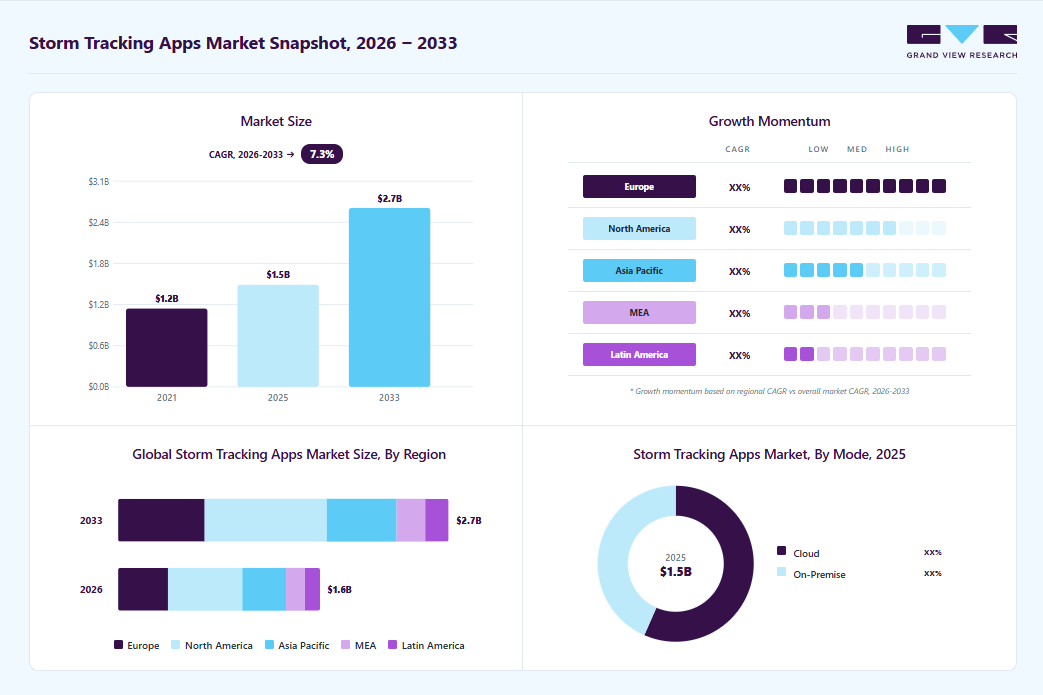
The global storm tracking apps market size was valued at USD 1.5 billion in 2025 and is projected to grow from USD 1.6 billion in 2026 to USD 2.7 billion by 2033, at a CAGR of 7.3% from 2026 to 2033. The market in North America dominated with a revenue share of 36.8% in 2025. The industry is growing due to the increasing frequency of extreme weather events and the rising need for real-time weather monitoring and early warning systems.
 Source: Grand View Research, IR Documents, Primary Interviews, Paid DatabasesTo learn more about this report,
 Download Free Sample Report
 Key Market Trends & Insights
- By platform: Android segment held the largest market share of 58.7% in 2025.
- By deployment mode: Cloud segment held the largest market share of 56.6% in 2025.
- By end use: Individual consumers segment held the largest market share of 55.3% in 2025.
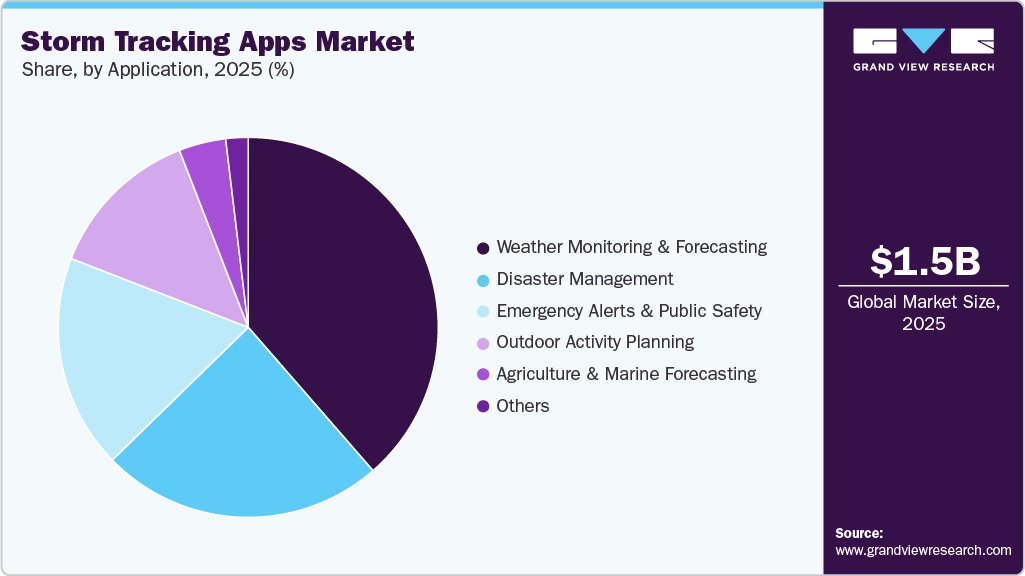
- By application: Weather monitoring & forecasting segment held the largest market share of 38.6% in 2025.
Regional Highlights
- Largest regional market: North America (36.8% revenue share, 2025)
- Fastest-growing regional market: Europe (highest CAGR, 2026-2033)
- By country: The U.S. held the largest market share in 2025
Market Size & Forecast
- Market size in 2025: USD 1.5 Billion
- Estimated market size in 2026: USD 1.6 Billion
- Projected market size by 2033: USD 2.7 Billion
- CAGR (2026-2033): 7.3%
Three ways to get this report
Buy it, customize it, or ask a question.Ask an Analyst
A direct answer, usually in 1 working day
- AccessReport author, directly
- Reply timeWithin 1 working day
- No sales callDirect answer only
- FormatEmail reply
- CostFree, no cost
Get the Full Report
What the study covers
- FormatsPDF · Excel · Dashboard
- Timeline2026–2033 annual, 2025 base
- Coverage20+ countries, 5 regions
- Companies10+ key players profiled
Customize the Report
20% free customization
- IncludeCountries, segments, points
- TailorTo your product definition
- ExtendDeeper competitor detail
- OrA fully bespoke study
- Turnaround5–10 working days
As climate change intensifies storms, hurricanes, floods, and cyclones, individuals, businesses, and governments are increasingly relying on mobile-based storm tracking applications for timely alerts and risk mitigation. The demand for storm tracking applications is increasing as individuals, enterprises, and government agencies seek to monitor and respond to rapidly changing weather conditions and minimize the impact of extreme weather events. Users are increasingly adopting storm tracking apps to access real-time weather data, radar imagery, and predictive storm path analysis, which support timely decision-making and risk mitigation. Additionally, the rising frequency of hurricanes, floods, cyclones, and severe storms is driving the need for accurate and location-based weather intelligence delivered through mobile platforms. Advancements in satellite technology, weather modeling, and GPS-enabled devices are further enhancing the precision and usability of these applications. Storm tracking apps also help improve disaster preparedness, operational planning, and public safety, making them an essential component of modern weather monitoring and early warning ecosystems.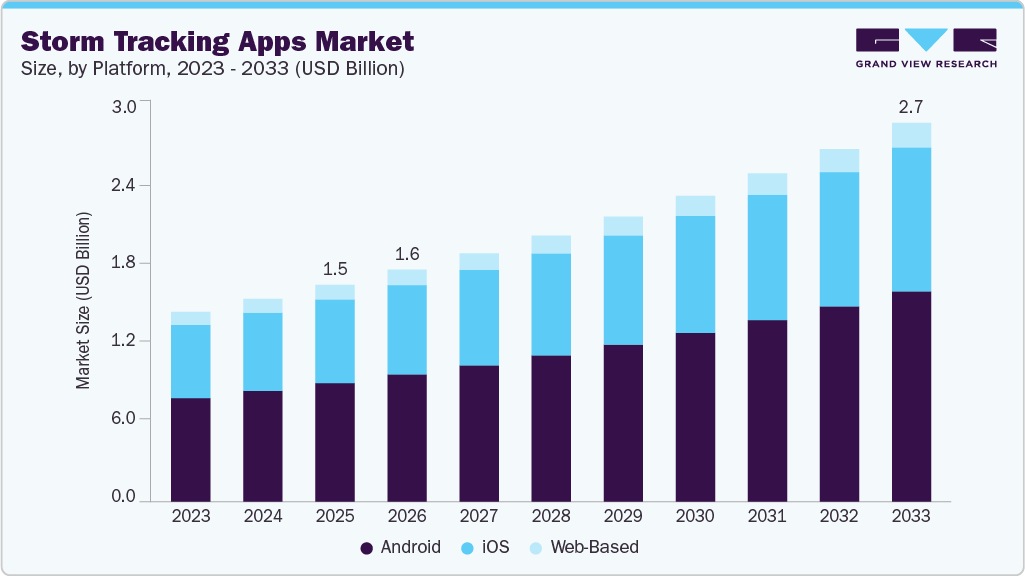 To learn more about this report, Download Free Sample Report
 The Android segment dominates the storm tracking apps industry due to its widespread global adoption and accessibility across both developed and emerging economies. The large Android user base, particularly in regions prone to extreme weather such as Asia-Pacific and Latin America, drives higher download volumes of storm tracking applications. Additionally, Android devices offer seamless integration with GPS-enabled real-time tracking, location-based alerts, and push notification systems, which are critical for early warning and disaster preparedness. The availability of a wide range of free and freemium apps on the Google Play Store further accelerates user adoption. Moreover, continuous advancements in mobile connectivity, cloud-based data synchronization, and real-time weather analytics enhance app performance and user experience, strengthening Android’s leading position in the market.
Market Dynamics
The industry is being driven by the increasing frequency and intensity of severe weather events such as hurricanes, cyclones, tornadoes, thunderstorms, and flash floods across the globe. Rising concerns regarding public safety, property protection, and disaster preparedness are encouraging consumers, businesses, and government agencies to adopt storm tracking applications that provide real-time weather monitoring, radar visualization, GPS-based alerts, and predictive forecasts. These applications process vast amounts of data from weather satellites, Doppler radar systems, ground-based sensors, ocean buoys, and numerical weather prediction models to deliver accurate and timely storm information.
The growing adoption of smartphones, smartwatches, connected vehicles, and other mobile devices is further increasing demand for location-based weather alerts and hyperlocal forecasting services. In addition, advancements in artificial intelligence (AI), machine learning, and geospatial analytics are improving the accuracy of storm path predictions and enabling personalized notifications. Cloud computing infrastructure allows developers to process and distribute weather data at scale, while increasing investments by meteorological agencies and private weather technology providers are enhancing data availability and forecasting precision. Overall, rising climate-related risks, increasing awareness of disaster preparedness, and continuous innovation in mobile and weather intelligence technologies are accelerating the growth of the global industry.
Despite strong growth prospects, the industry faces several challenges related to forecast reliability, operational costs, and infrastructure limitations. Developing highly accurate storm tracking applications requires access to premium meteorological datasets, advanced forecasting algorithms, geospatial analytics tools, and scalable cloud infrastructure, which can involve substantial licensing and operational expenses. These costs can be particularly burdensome for smaller developers and emerging companies with limited financial resources.
Another major restraint is the dependence on stable internet and mobile network connectivity, which may be disrupted during severe weather events when access to alerts is most critical. Forecast uncertainty, false alarms, and delayed notifications can reduce user confidence and negatively impact long-term adoption. In addition, integrating multiple data sources and maintaining compatibility across different devices and operating systems can be technically complex. Concerns related to battery consumption, location privacy, and subscription costs may also limit user engagement. The shortage of skilled meteorologists, data scientists, and geospatial analysts further constrains innovation and product development in the market.
The rapid advancement of AI-driven predictive analytics, hyperlocal weather intelligence, and connected emergency response systems is creating substantial opportunities in the industry. Developers are increasingly leveraging machine learning algorithms to improve storm path prediction, estimate potential damage zones, and provide personalized preparedness recommendations based on real-time user location and historical weather patterns. Hyperlocal forecasting supported by IoT sensors, satellite imagery, and crowd-sourced weather observations is significantly enhancing the precision and relevance of alerts.
At the same time, the growing integration of storm tracking applications with government warning systems, insurance platforms, aviation and maritime tools, and enterprise risk management solutions is expanding commercial opportunities. Public agencies are adopting advanced mobile weather platforms to improve citizen communication, evacuation planning, and disaster response coordination. Leading weather technology companies such as The Weather Company, AccuWeather, and Tomorrow.io are continuously enhancing forecasting capabilities through AI and satellite-based analytics. Furthermore, increasing investments in climate resilience, geospatial intelligence, and mobile technologies are expected to unlock significant long-term opportunities for the industry.
Market Concentration & Characteristics
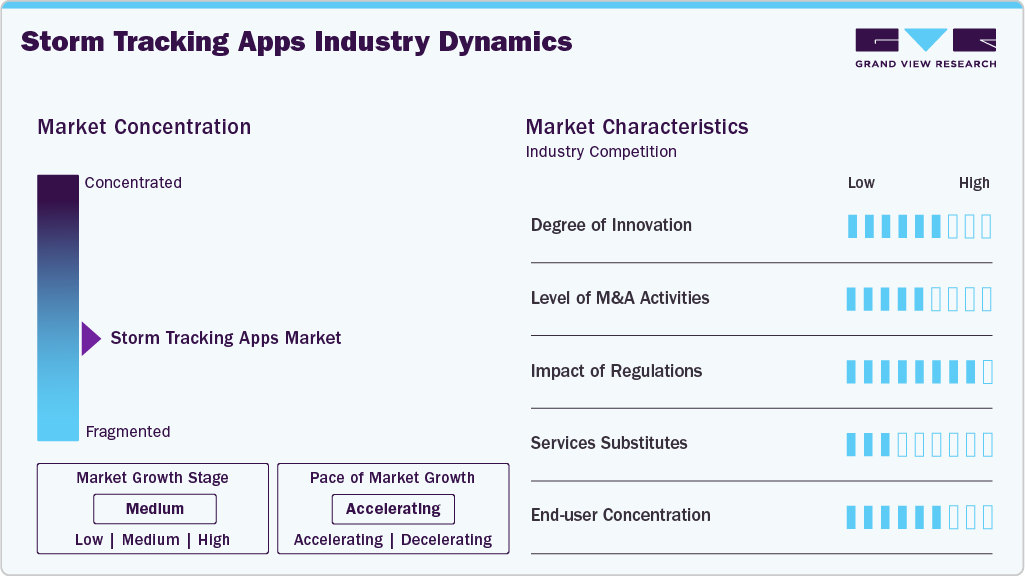
The industry is moderately fragmented, with competition led by a combination of established weather technology companies, mobile application developers, meteorological service providers, and emerging startups specializing in AI-driven forecasting and geospatial analytics. The market is dominated by leading companies such as The Weather Company, AccuWeather, Tomorrow.io, Weather Underground, and Windy.com, which benefit from extensive meteorological datasets, advanced forecasting technologies, strong brand recognition, and large global user bases. At the same time, the market includes a growing number of specialized startups focused on hyperlocal forecasting, AI-based storm prediction, crowd-sourced weather intelligence, and enterprise weather risk management solutions.
 To learn more about this report, Download Free Sample Report
 In addition, increasing collaboration with government meteorological agencies, emergency response organizations, insurance providers, and transportation companies is expanding the scope and functionality of storm tracking applications. Overall, rising climate-related risks, growing smartphone penetration, and continuous investment in weather intelligence technologies are intensifying competition and shaping the evolving dynamics of the industry.
Platform Insights
The Android segment dominates the industry in 2025, due to its widespread global adoption and accessibility across both developed and emerging economies. The large Android user base, particularly in regions prone to extreme weather such as Asia-Pacific and Latin America, drives higher download volumes of storm tracking applications. Additionally, Android devices offer seamless integration with GPS-enabled real-time tracking, location-based alerts, and push notification systems, which are critical for early warning and disaster preparedness. The availability of a wide range of free and freemium apps on the Google Play Store further accelerates user adoption. Moreover, continuous advancements in mobile connectivity, cloud-based data synchronization, and real-time weather analytics enhance app performance and user experience, strengthening Android’s leading position in the market.
The iOS segment is witnessing significant growth due to the increasing adoption of premium smartphones and the higher spending capacity of iOS users on subscription-based weather services. iOS users tend to prefer high-accuracy, ad-free, and feature-rich applications, driving demand for advanced storm tracking solutions. Additionally, Apple’s strong ecosystem supports real-time notifications, location-based services, and seamless app performance, enhancing user experience.
Deployment Mode Insights
The cloud segment dominated the market with a share of 56.6% in 2025, driven by the growing need for scalable and real-time weather data processing infrastructure. Cloud deployment enables storm tracking applications to collect, store, and analyze large volumes of data from satellites, radar systems, and IoT sensors without relying on extensive on-premise infrastructure. It also allows seamless integration with AI-driven forecasting models, geospatial analytics, and real-time alert systems, enhancing accuracy and responsiveness. In addition to this, cloud platforms support high scalability, continuous updates, and rapid data dissemination, making them highly suitable for delivering real-time storm insights to a large user base.
The on-premises segment is witnessing significant growth due to the increasing demand for data security, control, and reliability among government agencies and critical industries. Organizations such as defense, aviation, and energy prefer on-premises solutions to ensure secure handling of sensitive meteorological and operational data. These deployments offer greater control over system performance and reduce dependency on internet connectivity, which is crucial during severe weather events. Additionally, on-premises infrastructure supports customized integrations with internal systems and legacy platforms, enabling better operational alignment.
End Use Insights
The individual consumers segment dominated the market with a share of 55.3% in 2025, driven by the widespread adoption of smartphones and the growing need for real-time weather updates and severe weather alerts. Consumers increasingly rely on storm tracking apps for daily weather monitoring, emergency notifications, and location-based alerts, especially in regions prone to extreme weather events. The availability of free and freemium applications with user-friendly interfaces has significantly boosted mass adoption. Additionally, advancements in GPS tracking, push notifications, and real-time radar visualization enhance user experience and accessibility.
The government & meteorological agencies segment is witnessing significant growth due to increasing investments in disaster management, early warning systems, and public safety infrastructure. Governments are actively adopting storm tracking applications to enhance real-time weather monitoring, emergency response coordination, and risk communication during extreme weather events. The rising frequency of hurricanes, floods, and cyclones is driving the need for accurate forecasting and timely alerts to minimize economic and human losses.
Application Insights
The weather monitoring & forecasting segment dominated the market with a share of 38.6% in 2025, driven by the increasing demand for real-time weather insights and accurate storm prediction capabilities. These applications enable users to track severe weather events such as hurricanes, cyclones, and thunderstorms through advanced radar visualization and predictive modeling tools. The growing frequency of extreme weather conditions has significantly increased reliance on continuous monitoring and early warning systems for timely decision-making. Furthermore, advancements in satellite imaging, AI-driven forecasting, and geospatial analytics have enhanced the accuracy and reliability of weather predictions. The ability of these solutions to deliver location-based alerts, real-time updates, and actionable insights is further contributing to the segment’s leading position in the market.
 To learn more about this report, Download Free Sample Report
 The disaster management segment is witnessing significant growth due to the increasing need for early warning systems and real-time risk mitigation amid the rising frequency of extreme weather events. Governments and emergency response agencies are increasingly adopting storm tracking apps to improve disaster preparedness, response coordination, and public safety communication. These applications enable timely evacuation planning and resource allocation through real-time alerts, geospatial tracking, and predictive analytics.
Regional Insights
The North America storm tracking apps market led with a share of 36.8% in 2025, driven by the strong presence of leading weather technology providers and advanced weather forecasting and meteorological infrastructure in the region. Users across the U.S. and Canada are increasingly adopting storm tracking applications to monitor severe weather events such as hurricanes, tornadoes, and winter storms. The region benefits from high smartphone penetration and widespread use of real-time weather forecasting, weather alerts, radar visualization, and location-based tracking features, which support app adoption. Furthermore, growing awareness of disaster preparedness and early warning systems, along with frequent extreme weather events, is accelerating market growth.
 To learn more about this report, Download Free Sample Report
 U.S. Storm Tracking Apps Market Trends
The storm tracking apps market in the U.S. led North America in 2025 due to its strong ecosystem of leading weather technology providers, advanced meteorological infrastructure, and high adoption of digital weather solutions. The country is home to major players such as The Weather Company (IBM), AccuWeather, and DTN, which actively develop and deploy advanced storm tracking and forecasting applications. Additionally, U.S. consumers and organizations are early adopters of real-time weather analytics, AI-driven forecasting, machine learning models, geospatial analytics, satellite imaging, Doppler radar systems, and mobile-based alert systems, which have accelerated the adoption of storm tracking apps.
Europe Storm Tracking Apps Market Trends
The storm tracking apps market in Europe is witnessing steady growth, driven by the increasing frequency of extreme weather events and the rising adoption of advanced weather monitoring technologies across industries. Countries such as Germany, the U.K., and France are increasingly investing in real-time weather intelligence, early warning systems, and digital forecasting solutions to enhance disaster preparedness and risk management.
Strong regulatory frameworks and government initiatives focused on climate resilience and public safety are further encouraging the adoption of storm tracking applications. Furthermore, Europe’s growing emphasis on digital transformation and smart infrastructure is accelerating the integration of storm tracking apps with AI-driven forecasting, satellite data, and geospatial analytics. Industries such as transportation, energy, and agriculture are increasingly relying on these applications for operational planning and weather risk mitigation.
Asia-Pacific Storm Tracking Apps Market Trends
The storm tracking apps market in Asia Pacific is experiencing rapid growth, driven by the increasing frequency of extreme weather events such as typhoons, cyclones, and monsoons across emerging economies. Countries such as China, India, Japan, and South Korea are investing heavily in weather forecasting infrastructure, satellite monitoring, and digital weather intelligence solutions, which are accelerating the adoption of storm tracking applications. The expanding use of smartphones and mobile internet across the region is enabling wider access to real-time weather alerts, radar tracking, and location-based notifications.
The growing expansion of industries such as agriculture, transportation, and energy is increasing the need for accurate weather monitoring and risk mitigation tools to support operational planning. The rising adoption of cloud-based platforms, AI-driven forecasting models, and geospatial analytics is encouraging organizations and consumers to rely on storm tracking apps for improved decision-making and disaster preparedness.
Key Storm Tracking Apps Company Insights
The storm tracking apps market features several key players that significantly shape its global landscape through advanced weather forecasting technologies, real-time data analytics, and scalable mobile platforms.
-
AccuWeather Inc. is one of the prominent providers of digital weather intelligence, widely recognized for its highly accurate forecasts, severe weather alerts, and radar-based storm tracking capabilities. The company leverages proprietary weather data, AI-driven forecasting models, and mobile-first platforms to enable users to monitor evolving weather conditions and make informed decisions. Its strong presence across consumer and enterprise segments supports applications in industries such as media, aviation, energy, and transportation.
-
DTN is a global provider of advanced weather intelligence and storm tracking solutions, offering real-time monitoring, predictive forecasting, and actionable insights through its cloud-based platforms. The company supports a wide range of industries, including agriculture, aviation, energy, and transportation, by enabling accurate storm tracking, risk mitigation, and operational planning. DTN’s strong capabilities in satellite data integration, AI-driven analytics, and industry-specific weather solutions allow organizations to respond proactively to severe weather events and enhance decision-making across critical operations.
Key Storm Tracking Apps Companies
The following key companies have been profiled for this study on the storm tracking apps market.
-
The Weather Company (IBM)
-
AccuWeather Inc.
-
DTN
-
Windy (Windy.com)
-
MyRadar (ACME AtronOmatic LLC)
-
WeatherBug
-
Weather Underground
-
Clime
-
Weather & Radar (WetterOnline)
-
Flowx Weather App
-
1Weather
-
Carrot Weather
-
Meteored
Competitive Benchmarking
Operating Strategies
Competitive Edge
Weaknesses
Mature Players: AccuWeather, WeatherBug, DTN, Meteored
- Expand storm tracking capabilities through acquisitions, strategic partnerships, and the development of industry-specific weather intelligence and alerting solutions.
- Invest in advanced AI forecasting models, satellite data integration, Doppler radar analytics, geospatial technologies, and scalable cloud infrastructure.
- Strong global presence, extensive consumer and enterprise user networks, and comprehensive portfolios spanning mobile weather applications, forecasting services, and weather intelligence platforms.
- Ability to deliver scalable storm tracking solutions with real-time alerts & hyperlocal forecasting.
- Dependence on legacy forecasting systems, traditional meteorological data infrastructures, and established software platforms can slow the adoption of emerging AI-based weather prediction technologies.
- Complex organizational structures and large operational frameworks may reduce agility and delay the rollout of innovative storm tracking capabilities.
Emerging Players: Windy.com, MyRadar, Flowx Weather App, CARROT Weather
- Develop specialized and cost-effective storm tracking solutions targeting niche applications
- Focus on agility, customization, and rapid innovation to address evolving requirements for hyperlocal forecasting, AI-based storm prediction, and real-time severe weather alerts
- Faster development cycles enable rapid adoption of emerging technologies such as AI-based forecasting, satellite analytics, and hyperlocal weather intelligence.
- Flexible and customer-centric approaches help differentiate solutions in niche segments such as aviation weather, marine forecasting & outdoor safety
- Limited financial resources and smaller market presence
- Lower brand recognition and a smaller consumer base can hinder market penetration and partnership opportunities.
Recent Developments
-
In February 2024, The Weather Company LLC unveiled a new experience for The Weather Channel App, enhancing its capabilities in the storm tracking and weather intelligence market. The updated app introduces a customizable interface with AI-derived weather insights, enabling users to better understand how weather conditions impact their daily routines, health, and well-being. It combines data from over 100 forecast models with proprietary AI and human expertise to deliver highly accurate and personalized forecasts in real time.
-
In May 2023, DTN launched its new Storm Risk Dashboard at the E-world event held in Essen, Germany, strengthening its capabilities in the weather intelligence and storm tracking solutions market. The platform is designed to help utilities better anticipate and respond to severe weather events by combining advanced forecasting technology with real-time global weather data and customizable risk thresholds. It enables organizations to monitor weather conditions, receive alerts up to seven days in advance, and visualize potential hazards through interactive mapping tools.
Storm Tracking Apps Market Report Scope
Report Attribute
Details
Market size in 2025
USD 1.5 billion
Estimated market size in 2026
USD 1.6 billion
Projected market size by 2033
USD 2.7 billion
Growth rate
CAGR of 7.3% from 2026 to 2033
Actual data
2021 - 2025
Forecast period
2026 - 2033
Quantitative units
Revenue in USD million/billion and CAGR from 2026 to 2033
Report coverage
Revenue forecast, company ranking, competitive landscape, growth factors, and trends
Segments covered
Platform, application, deployment mode, end use, region
Regional scope
North America; Europe; Asia Pacific; Latin America; MEA
Country scope
U.S.; Canada; Mexico; Germany; UK; France; China; India; Japan; Australia; South Korea; Brazil; UAE; South Africa; KSA
Key companies profiled
The Weather Company (IBM); AccuWeather Inc.; DTN; Windy (Windy.com); MyRadar (ACME AtronOmatic LLC); WeatherBug (Earth Networks); Weather Underground; Clime (NOAA Weather Radar); WetterOnline GmbH; Flowx Weather App; 1Weather (OneLouder Apps); Carrot Weather; Meteored
Customization scope
Free report customization (equivalent up to 8 analysts working days) with purchase. Addition or alteration to country, regional & segment scope.
Pricing and purchase options
Avail customized purchase options to meet your exact research needs. Explore purchase options
Global Storm Tracking Apps Market Report Segmentation
This report forecasts revenue growth at global, regional, and country levels and provides an analysis of the latest industry trends in each of the sub-segments from 2021 to 2033. For this study, Grand View Research has segmented the global storm tracking apps market report based on platform, deployment mode, application, end use, and region:
-
Platform Outlook (Revenue, USD Billion, 2021 - 2033)
-
Android
-
iOS
-
Web-Based
-
-
Application Outlook (Revenue, USD Billion, 2021 - 2033)
-
Weather Monitoring & Forecasting
-
Disaster Management
-
Emergency Alerts & Public Safety
-
Outdoor Activity Planning
-
Agriculture & Marine Forecasting
-
Others
-
-
Deployment Mode Outlook (Revenue, USD Billion, 2021 - 2033)
-
Cloud
-
On-Premises
-
-
End Use Outlook (Revenue, USD Billion, 2021 - 2033)
-
Individual Consumers
-
Government & Meteorological Agencies
-
Transportation & Logistics
-
Agriculture Sector
-
Energy & Utilities
-
Media & Broadcasting
-
Others
-
-
Regional Outlook (Revenue, USD Billion, 2021 - 2033)
-
North America
-
U.S.
-
Canada
-
Mexico
-
-
Europe
-
UK
-
Germany
-
France
-
-
Asia Pacific
-
China
-
Japan
-
India
-
Australia
-
South Korea
-
-
Latin America
-
Brazil
-
-
Middle East and Africa (MEA)
-
KSA
-
UAE
-
South Africa
-
-
Delivered Customizations
This report has been delivered with the following In-depth customizations
Client Request
Customization Delivered
Value Adds
Storm Tracking App Market Entry and Growth Strategy for a Weather Technology Company or Mobile App Developer
Analysis of demand for storm tracking applications across consumer, enterprise, aviation, marine, and public safety segments
Benchmarking of leading app providers, forecasting technologies, monetization models, and subscription pricing strategies
Identified high-growth user segments and regional expansion opportunities
Supported product positioning, pricing, and go-to-market strategy development
AI-Powered Storm Forecasting and Hyperlocal Alert Solution Assessment for a Software Company or Meteorological Service Provider
Assessment of AI, machine learning, satellite data, Doppler radar, and geospatial analytics used in storm prediction and hyperlocal forecasting
Analysis of customer requirements for real-time alerts, personalized notifications, and predictive risk insights
Identified high-value technology investments and feature priorities
Optimized product development and technology roadmap planning
Frequently Asked Questions About This Report
The global storm tracking apps market size was valued at USD 1.5 billion in 2025 and is estimated at USD 1.6 billion in 2026.
The global storm tracking apps market is expected to grow at a CAGR of 7.3% from 2026 to 2033, reaching USD 2.7 billion by 2033.
North America dominated the market with a 36.8% revenue share in 2025.
Europe is the fastest-growing region over the forecast period.
Key factors include increasing frequency of extreme weather events, rising demand for real-time weather monitoring and early warning systems.
The Android segment led the market with a 58.7% revenue share in 2025.
The weather monitoring & forecasting segment dominated the market with a 38.6% revenue share in 2025.
The cloud segment held the largest market share of 56.6% in 2025, while on-premises segment is the significant growing mode.
The individual consumers segment dominated the market with a revenue share of 55.3% in 2025.
Key players include The Weather Company (IBM); AccuWeather Inc.; DTN; Windy (Windy.com); MyRadar (ACME AtronOmatic LLC); WeatherBug (Earth Networks); Weather Underground; Clime (NOAA Weather Radar); WetterOnline GmbH; Flowx Weather App; 1Weather (OneLouder Apps); Carrot Weather; and Meteored.
About the Author(s)
Next Generation Technologies Research Team
Technology · Next Generation TechnologiesThis report was authored by the next generation technologies research team at Grand View Research - comprising two research analysts, one senior research analyst, and one industry expert - with specialized expertise in the next generation technologies segment of the technology industry. All findings are based on proprietary technology databases, executive interviews, and regulatory analysis, subject to internal peer review prior to publication.
Last Updated:
Speak to Analyst

Customize this report to your needs - add regions, segments, or data points, with 20% free customization.
Or view our licence options:


ISO 9001:2015 & 27001:2022 Certified
We are GDPR and CCPA compliant! Your transaction & personal information is safe and secure. For more details, please read our privacy policy.


