
- Home
- »
- Advanced Interior Materials
- »
-
Thermal Ceramic Market Size, Share, Industry Report, 2033GVR Report cover
![Thermal Ceramic Market Size, Share & Trends Report]()
Thermal Ceramic Market (2026 - 2033) Size, Share & Trends Analysis Report By Application (Industrial, Transportation, Petrochemical & Chemical), By Region (North America, Europe, Asia Pacific, Latin America, Middle East & Africa), And Segment Forecasts
- Report ID: GVR-4-68038-432-1
- Number of Report Pages: 105
- Format: PDF
- Historical Range: 2021 - 2024
- Forecast Period: 2026 - 2033
- Industry: Advanced Materials
- Report Summary
- Table of Contents
- Segmentation
- Methodology
- Download FREE Sample
-
 Download Sample Report
Thermal Ceramic Market Summary
The global thermal ceramic market size was estimated at USD 6.0 billion in 2025 and is projected to reach USD 9.6 billion by 2033, growing at a CAGR of 5.8% from 2026 to 2033. Thermal ceramics offer superior properties, including high thermal resistance, mechanical strength, corrosion resistance, and electrical insulation, making them essential for applications in semiconductors, medical implants, and energy systems.
Key Market Trends & Insights
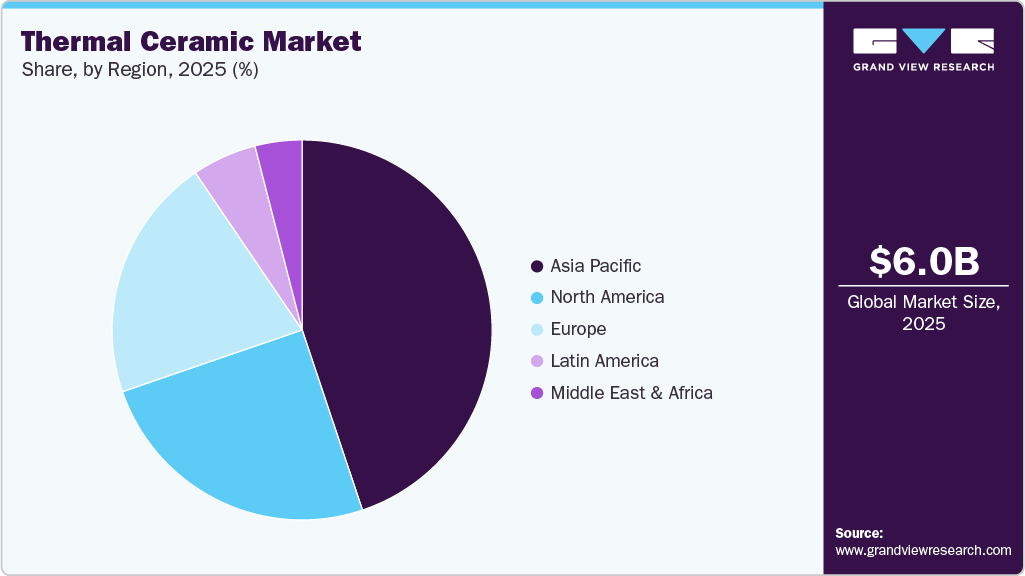
- In 2025, Asia Pacific emerged as the leading regional market, contributing the highest revenue share of 44.9%.
- China represents the largest market in the Asia Pacific region.
- Based on application, the industrial segment held the dominant revenue share of 63.8% in 2025.
Market Size & Forecast
- 2025 Market Size: USD 6.0 Billion
- 2033 Projected Market Size: USD 9.6 Billion
- CAGR (2026-2033): 5.8%
- Asia Pacific: Largest market in 2025
Sustainability considerations play a crucial role in shaping market dynamics by driving energy efficiency, emissions reduction, and longer product lifecycles. These materials are increasingly being utilized in environmentally friendly applications, including catalytic converters, thermal insulation systems, and clean energy technologies. Their ability to withstand extreme conditions while reducing energy consumption aligns well with global decarbonization goals and regulatory standards.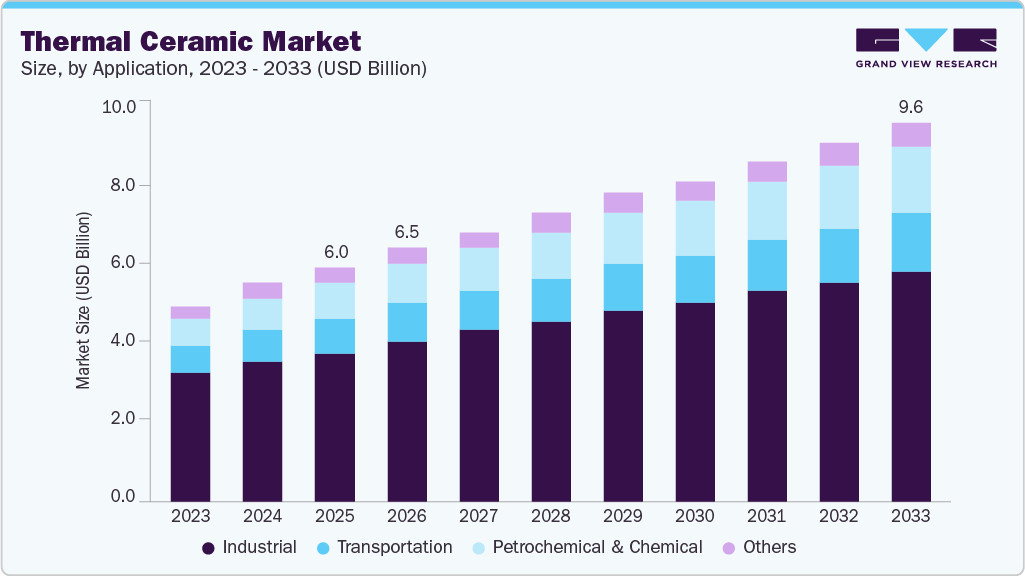
The preference for it is also rising due to its reliability and performance advantages over traditional materials such as metals and polymers. Industries are shifting toward these materials to achieve higher operational efficiency, lower maintenance costs, and longer product lifespans. Furthermore, ongoing research and development activities are leading to the introduction of innovative ceramic composites and multifunctional materials, enhancing their applicability across a broader range of high-growth sectors.
Drivers, Opportunities & Restraints
The growth of the thermal ceramic industry is largely supported by the increasing need for high-temperature insulation solutions that enhance energy efficiency across heavy industries such as iron & steel, petrochemicals, and power generation. As governments and regulatory bodies intensify efforts to reduce industrial emissions, companies are adopting advanced insulation materials to minimize thermal losses and optimize operational efficiency. A notable development occurred in November 2025, when Morgan Advanced Materials expanded its production of low-bio-persistent (LBP) fibers in Europe, reflecting the shift toward safer, regulation-compliant materials. Additionally, the transition toward electrified industrial heating systems, highlighted by initiatives such as the UK’s electric arc furnace upgrades in 2025, is further strengthening demand for advanced thermal insulation materials.
Emerging applications linked to the global energy transition and next-generation technologies are creating substantial growth opportunities for them. These materials are increasingly used in hydrogen production systems, where resistance to extreme temperatures and chemical reactivity are essential; for example, in December 2025, NewHydrogen advanced its ThermoLoop technology, which relies on high-performance ceramic materials. The expanding electric vehicle ecosystem is also contributing to demand, particularly for thermal management and fire-resistant components, as seen in ProLogium’s lithium-ceramic battery innovation introduced in January 2025.
Market expansion is somewhat constrained by fluctuations in raw material costs and tightening regulatory frameworks. Essential inputs such as alumina and silica are exposed to supply chain disruptions and price volatility, which can affect production economics. In parallel, health concerns associated with conventional refractory ceramic fibers (RCFs) have led to stricter safety standards, compelling manufacturers to transition to alternative materials such as bio-soluble fibers. This shift, which gained momentum during recent years due to evolving regulatory guidelines, requires additional capital investment and technological upgrades.
Application Insights
The industrial segment accounted for the largest share of 63.8% of the thermal ceramic market in 2025, supported by extensive usage across sectors such as iron & steel, cement, glass, and power generation. These industries require reliable high-temperature insulation solutions to maintain process stability, improve energy efficiency, and reduce operational costs. The continued modernization of manufacturing facilities, along with increasing emphasis on reducing heat loss and emissions, has reinforced the dominance of this segment. Additionally, large-scale infrastructure development and steady demand from heavy industries, particularly in the Asia Pacific, have further strengthened its leading position.
The petrochemical & chemical segment is projected to grow at the fastest CAGR over the forecast period, driven by expanding refining capacities, rising demand for specialty chemicals, and increasing investments in LNG and hydrogen infrastructure. These applications involve extreme temperatures and corrosive environments, requiring advanced materials with superior thermal resistance and durability. Growth is further supported by the global shift toward cleaner energy and the development of next-generation processing technologies, where efficient heat management is critical to improving performance and safety.
Regional Insights
Asia Pacific holds the largest share of 44.9% in 2025 of the global thermal ceramic industry, supported by rapid industrialization, expanding manufacturing activities, and strong growth in sectors such as steel, cement, and petrochemicals. China and India are major contributors, driven by large-scale infrastructure development and increasing energy demand. The region also benefits from cost-competitive production and the presence of numerous regional manufacturers. Rising investments in energy and industrial capacity, along with export-oriented manufacturing, continue to drive robust growth.
China Thermal Ceramic Market Trends
China represents the largest market in the Asia Pacific region, driven by its extensive industrial base and dominant position in sectors such as iron & steel, cement, and petrochemicals. The country benefits from large-scale manufacturing capacity, strong domestic demand, and the presence of numerous local producers, making it a key supply hub globally. Ongoing investments in infrastructure development, energy projects, and industrial upgrades, along with government initiatives focused on efficiency and emission reduction, continue to support steady market growth.
North America's Thermal Ceramic Market Trends
North America represents a mature yet technologically advanced market, driven by strong demand from industries such as petrochemicals, power generation, and aerospace. The region benefits from stringent environmental regulations that encourage the adoption of high-performance insulation solutions to improve energy efficiency and reduce emissions. Ongoing investments in industrial modernization and the transition toward cleaner energy systems, particularly in the U.S. and Canada, continue to support steady demand. Additionally, the presence of key manufacturers and ongoing innovation in materials science further strengthens the region’s position.
The U.S. thermal ceramic industry dominates the North American landscape, supported by a well-established industrial base and early adoption of advanced materials across high-temperature applications. Growth is driven by increasing investments in refining, LNG infrastructure, and electric vehicle manufacturing, where efficient heat management is critical. Regulatory frameworks focused on workplace safety and emissions reduction are also driving the shift toward safer, more sustainable insulation materials. Furthermore, technological advancements and strong R&D capabilities contribute to the country’s leadership in high-performance material applications.
Europe Thermal Ceramic Market Trends
Europe is characterized by strict environmental and safety standards, which are accelerating the transition to sustainable, low-emission industrial processes. Countries such as Germany, France, and the UK are investing in energy-efficient manufacturing and green technologies, driving demand for advanced insulation solutions. The region is also witnessing a gradual shift toward bio-soluble and environmentally friendly materials due to regulatory pressures. Additionally, initiatives to decarbonize and industrialize are expected to play a key role in shaping future demand.
Latin America Thermal Ceramic Market Trends
Latin America is an emerging market, with its growth primarily driven by expanding oil & gas, mining, and power generation industries. Countries such as Brazil and Mexico are witnessing increased investments in industrial infrastructure, which is creating demand for efficient high-temperature solutions. While the market remains relatively smaller compared to other regions, gradual industrial development and energy sector expansion are expected to support steady growth over the forecast period.
Middle East & Africa Thermal Ceramic Market Trends
The Middle East & Africa thermal ceramic industry is experiencing growth driven by the strong activity in the oil & gas and petrochemical sectors, particularly in countries such as Saudi Arabia and the UAE. Large-scale refinery expansions and energy projects are driving demand for materials capable of operating under extreme conditions. Additionally, increasing focus on industrial diversification and infrastructure development in the region is contributing to market expansion. Africa, though at a nascent stage, is expected to witness gradual growth supported by industrialization and energy investments.
Key Thermal Ceramic Company Insights
Some of the key market players include Alkegen and Morgan Advanced Materials plc.
-
Alkegen, established in 2021, is a leading global manufacturer of specialty materials with a strong focus on thermal ceramics, including ceramic fiber products used for high-temperature insulation. The company offers a comprehensive portfolio of thermal management solutions, including blankets, modules, boards, and papers, serving industries such as petrochemical & chemical, transportation, power generation, and industrial processing. Alkegen is recognized for its advanced materials science capabilities, global manufacturing footprint, and focus on sustainability and energy efficiency in extreme-temperature environments.
-
Morgan Advanced Materials plc, established in 1856, is a prominent UK-based advanced materials company with a well-established presence in the thermal ceramic market. The company provides a wide range of high-temperature insulation products, including ceramic fibers, insulating firebricks, and engineered thermal systems used in industrial, petrochemical & chemical, and energy applications. Morgan Advanced Materials is known for its strong R&D capabilities, global customer base, and expertise in delivering high-performance materials for demanding thermal and mechanical environments.
-
Luyang Energy-Saving Materials Co., Ltd., established in 1984, is a major Chinese manufacturer specializing in ceramic fiber and energy-saving insulation materials. The company produces a broad range of thermal ceramic products, including refractory ceramic fibers, modules, and microporous insulation materials, catering to industries such as iron & steel, petrochemical, power generation, and transportation. Luyang is recognized for its cost-competitive manufacturing, large-scale production capacity, strong presence in Asia Pacific, and expanding global exports.
Key Thermal Ceramic Companies:
The following key companies have been profiled for this study on the thermal ceramic market.
- Alkegen
- BNZ Materials, Inc.
- Isolite Insulating Products Co., Ltd.
- Luyang Energy-Saving Materials Co., Ltd.
- Morgan Advanced Materials plc
- Nutec Group
- Rath Group
- Shandong Heat Insulation Materials Co., Ltd.
- Yeso Insulating Products Co., Ltd.
- Zircar Ceramics, Inc.
Recent Development
-
In October 2025, Morgan Advanced Materials plc announced the sale of a significant portion of its Molten Metal Systems business to Vesuvius for approximately USD 108.7 million, as part of its strategic portfolio optimization. The move aims to streamline operations and strengthen focus on core segments, including thermal ceramic and high-performance materials, enhancing the company’s position in high-temperature insulation and advanced industrial applications.
-
In 2025, Morgan Advanced Materials plc announced the commercial start-up of its expanded Yixing manufacturing facility in China, increasing production capacity by over 50% for thermal ceramic and insulation materials. This expansion supports rising demand from industrial and petrochemical sectors across Asia Pacific and strengthens the company’s global supply capabilities in high-temperature applications.
-
In 2025, Alkegen was selected by Jaguar Land Rover to supply advanced thermal protection materials for next-generation electric vehicle battery systems. This development highlights Alkegen’s growing role in transportation and energy storage applications, particularly in providing high-performance thermal insulation solutions for EV safety and efficiency.
Thermal Ceramic Market Report Scope
Report Attribute
Details
Market size value in 2026
USD 6.5 billion
Revenue forecast in 2033
USD 9.6 billion
Growth Rate
CAGR of 5.8% from 2026 to 2033
Base year for estimation
2025
Historical data
2021 - 2024
Forecast period
2026 - 2033
Quantitative Units
Revenue in USD million/billion and CAGR from 2026 to 2033
Report coverage
Revenue forecast, competitive landscape, growth factors, and trends
Segments covered
Application, region
Regional scope
North America; Europe; Asia Pacific; Latin America; Middle East & Africa
Country scope
U.S.; Canada; Mexico; Germany; France; UK; China; India; Japan; Brazil; Saudi Arabia
Key companies profiled
Alkegen; BNZ Materials, Inc.; Isolite Insulating Products Co., Ltd.; Luyang Energy-Saving Materials Co., Ltd.; Morgan Advanced Materials plc; Nutec Group; Rath Group; Shandong Heat Insulation Materials Co., Ltd.; Yeso Insulating Products Co., Ltd.; Zircar Ceramics, Inc.
Customization scope
Free report customization (equivalent up to 8 analysts working days) with purchase. Addition or alteration to country, regional & segment scope.
Pricing and purchase options
Avail customized purchase options to meet your exact research needs. Explore purchase options
Global Thermal Ceramic Market Report Segmentation
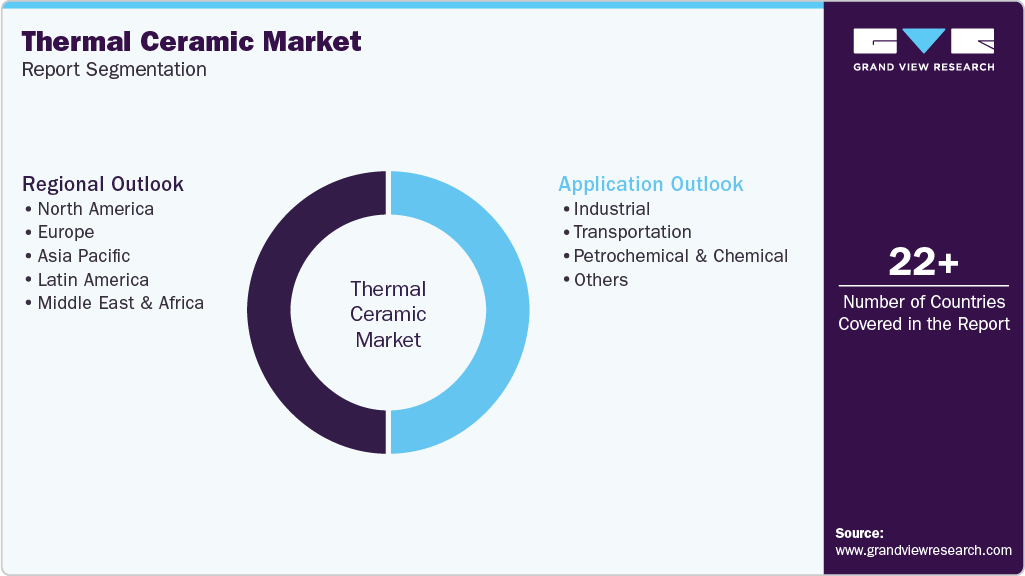
This report forecasts revenue growth at the global, regional & country levels and provides an analysis of the industry trends in each of the sub-segments from 2021 to 2033. For this study, Grand View Research has segmented the global thermal ceramic market report based on application and region:
-
Application Outlook (Revenue, USD Million, 2021 - 2033)
-
Industrial
-
Transportation
-
Petrochemical & Chemical
-
Others
-
-
Regional Outlook (Revenue, USD Million, 2021 - 2033)
-
North America
-
U.S.
-
Canada
-
Mexico
-
-
Europe
-
Germany
-
France
-
UK
-
-
Asia Pacific
-
China
-
India
-
Japan
-
-
Latin America
-
Brazil
-
-
Middle East & Africa (MEA)
-
Saudi Arabia
-
-
Frequently Asked Questions About This Report
b. The global thermal ceramic market size was estimated at USD 6.0 billion in 2025 and is expected to reach USD 6.5 billion in 2026.
b. Among applications, the industrial segment held the dominant position in 2025, accounting for 63.8% of total market revenue, driven by its extensive utilization across core industries such as iron & steel, cement, and glass, where maintaining high-temperature process efficiency and operational reliability is essential.
b. Some of the key players operating in the thermal ceramic market include Alkegen; BNZ Materials, Inc., Isolite Insulating Products Co., Ltd., Luyang Energy-Saving Materials Co., Ltd., Morgan Advanced Materials plc, Nutec Group, Rath Group, Shandong Heat Insulation Materials Co., Ltd., Yeso Insulating Products Co., Ltd., Zircar Ceramics, Inc., and others.
b. Market growth is primarily driven by rising demand for energy-efficient high-temperature insulation solutions across key industries such as iron & steel, petrochemicals, and power generation.
b. The global thermal ceramic market is expected to grow at a compound annual growth rate of 5.8% from 2026 to 2033, reaching USD 9.6 billion by 2033.


Share this report with your colleague or friend.
Need a Tailored Report?
Customize this report to your needs — add regions, segments, or data points, with 20% free customization.


ISO 9001:2015 & 27001:2022 Certified
We are GDPR and CCPA compliant! Your transaction & personal information is safe and secure. For more details, please read our privacy policy.
Trusted market insights - try a free sample
See how our reports are structured and why industry leaders rely on Grand View Research. Get a free sample or ask us to tailor this report to your needs.













