
- Home
- »
- Plastics, Polymers & Resins
- »
-
Tire Recycling Market Size & Forecast Report, 2026-2033GVR Report cover

Tire Recycling Market (2026 - 2033)
Size, Share & Trends Analysis Report By Product Type (Rubber, Tire-derived Fuel, Tire-derived Aggregate, Carbon Black, Steel Wires), By Application, By Region, And Segment Forecasts
Market Size, 2025
$7.1BMarket Estimate, 2026
$7.3BMarket Forecast, 2033
$9.8BCAGR, 2026–2033
5.2%Tire Recycling Market Summary
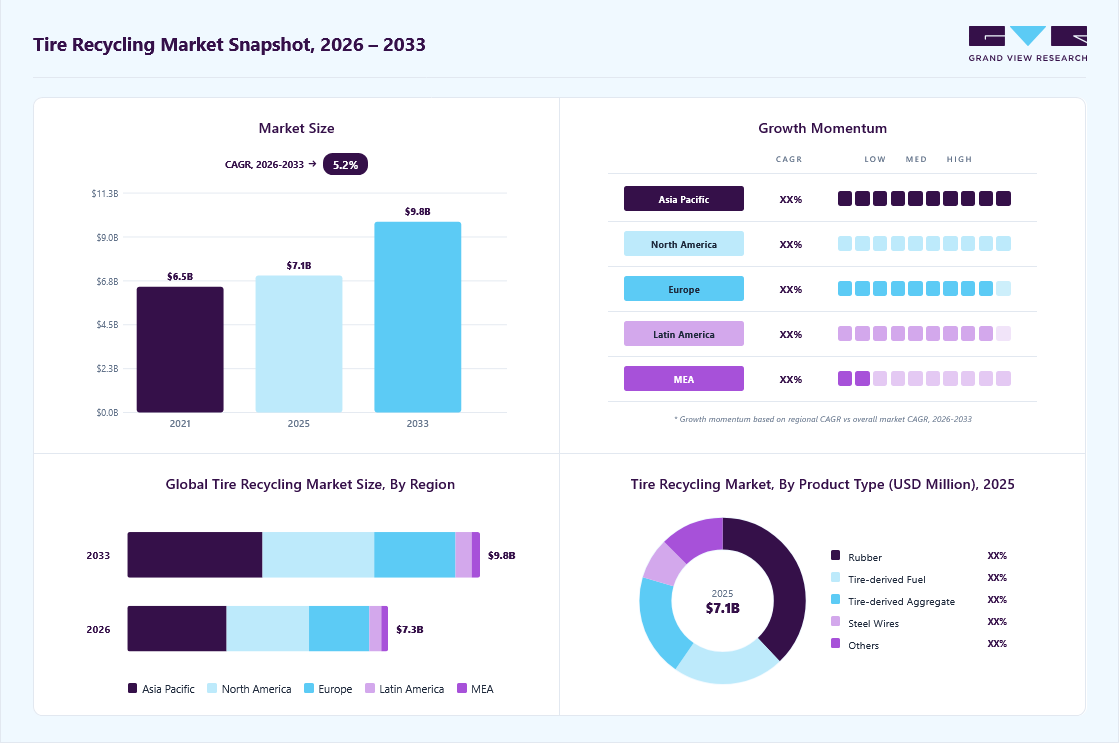
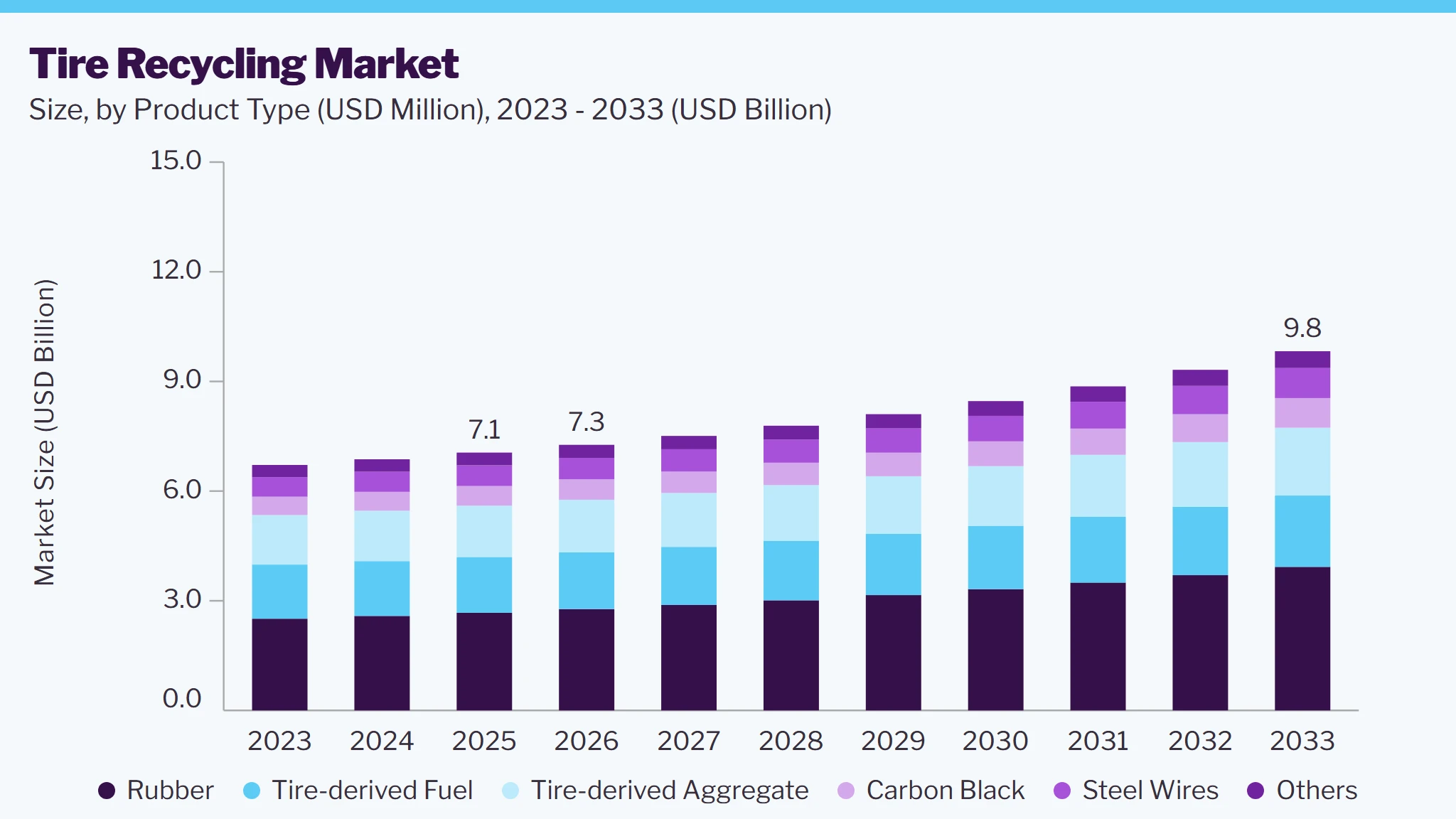
The global tire recycling market size was valued at USD 7.1 billion in 2025 and is projected to grow from USD 7.3 billion in 2026 to USD 9.8 billion by 2033, at a CAGR of 5.2% from 2026 to 2033. The market in Asia Pacific dominated with a revenue share of 38.0% in 2025. Increasing use of recycled tire materials across road paving, construction, sports surfaces, automotive components, and infrastructure applications is driving the tire recycling market growth. Rising demand for high-value tire-derived products further supports market expansion due to advances in rubber processing technologies, improved material quality, growing adoption of sustainable construction materials, and increasing investments in circular economy initiatives that promote recycled alternatives to virgin raw materials.
 Source: Grand View Research, IR Documents, Primary Interviews, Paid DatabasesTo learn more about this report,
 Download Free Sample Report
Key Market Trends & Insights
- By product type: Rubber segment held the largest market share of 37.9% in 2025.
- By application: Automotive segment held the largest market share of 42.8% in 2025.
Regional Highlights
- Largest regional market: Asia Pacific (38.0% revenue share, 2025)
- By country: China held the largest market share in 2025.
Market Size & Forecast
- Market size in 2025: USD 7.1 Billion
- Estimated market size in 2026: USD 7.3 Billion
- Projected market size by 2033: USD 9.8 Billion
- CAGR (2026-2033): 5.2%
Three ways to get this report
Buy it, customize it, or ask a question.Ask an Analyst
Analyst response in 1 business day
- AccessReport author, directly
- Reply timeWithin 1 working day
- No sales callDirect answer only
- FormatEmail reply
- CostFree, no cost
Get the Full Report
What the study covers
- FormatsPDF · Excel · Dashboard
- Timeline2026–2033 annual, 2025 base
- Coverage20+ countries, 5 regions
- Companies10+ key players profiled
Customize the Report
20% free customization
- IncludeCountries, segments, points
- TailorTo your product definition
- ExtendDeeper competitor detail
- OrA fully bespoke study
- Turnaround5–10 working days
The industry is witnessing a notable shift as recycled rubber finds increasing use in high-value applications, such as asphalt modification, automotive components, and sports surfaces. This shift is driven by advancements in processing technologies, which enable finer and more purified rubber powders that meet stringent industry standards. Governments and private companies are actively investing in research to enhance the performance of recycled rubber, making it a viable alternative to virgin materials. As sustainability gains prominence, manufacturers in sectors like construction and transportation are integrating recycled rubber into their products to reduce environmental impact while maintaining performance, further driving demand for innovative tire-derived materials.
 To learn more about this report, Download Free Sample Report
Market Dynamics
The tire recycling market is shaped by steady scrap tire generation, rising demand for recycled rubber, recovered carbon black, tire-derived fuel, and tire-derived aggregate, and tighter end-use adoption in construction and industrial manufacturing. Revenue is concentrated in regions with dense vehicle fleets, mature collection systems, and policy-backed circular economy programs, especially Asia Pacific, North America, and Europe. The commercial structure remains fragmented, with value captured across collection, shredding, processing, and downstream material sales, while product quality, regional logistics, and offtake contracts continue to determine margin depth and customer stickiness.
Stricter waste management rules are the most important demand driver for tire recycling, as governments continue to restrict landfilling and push extended producer responsibility programs. In Europe, the Waste Framework Directive and Green Deal framework strengthen lifecycle accountability, while U.S. state and federal programs encourage sustainable tire disposal and recycling practices. The Tire Recycling Foundation, launched in 2024, also reflects a wider industry push to close supply chain gaps and improve end-of-life tire recovery rates. The same policy pressure is expanding downstream demand for recycled tire materials in road paving, sound barriers, turf, and alternative fuel applications. Construction buyers are using tire-derived products to improve durability and lower lifecycle cost, while automotive and industrial users are adopting recycled rubber and recovered carbon black to support circular sourcing targets. China’s tighter waste control regime and rising pyrolysis investment, together with North American technology funding, are widening the commercial base for higher-value tire-derived outputs.
The market remains constrained by the energy-intensive nature of tire processing and the capital requirement for advanced shredding, separation, devulcanization, and thermal conversion systems. Feedstock quality is inconsistent because tire compositions vary by vehicle class, age, and regional specification, which complicates standardization and limits use in high-performance applications. This reduces yield stability, weakens product uniformity, and makes it harder for smaller recyclers to scale profitably against better capitalized players.
Recovered carbon black, purified rubber powder, and advanced pyrolysis outputs are creating a clear upgrade path for the market. As buyers seek lower-carbon raw materials, recyclers that can deliver consistent, specification-grade output will move beyond basic disposal economics and capture stronger value in coatings, plastics, asphalt modification, and industrial compound markets.
Analyst Perspective
The tire recycling market is moving from a disposal-led model to a value-led circular materials market, where profitability will depend more on output quality, processing efficiency, and end-use specification than on scrap collection alone. Over the next 5 to 10 years, the strongest demand will come from construction, automotive, and industrial manufacturing, while recovered carbon black, devulcanized rubber, and advanced pyrolysis products should gain share as buyers seek lower-carbon inputs. Regulatory pressure, especially under EPR and landfill restrictions, will remain a structural support, but leaders will differentiate through feedstock access, integrated logistics, technology partnerships, and regional scale. Margin pressure will continue where quality inconsistency, energy intensity, and capital cost remain high, so operators with strong offtake contracts, cleaner recovery streams, and application-specific expertise are likely to outperform.
Product Type Insights & Trends
Based on product type, the rubber tire recycling segment led the market with the largest revenue share of 37.9% in 2025. The increasing demand for durable and cost-effective alternatives to virgin rubber is driving growth in the recycled rubber segment. Industries such as manufacturing, manufacturing, and defense are integrating high-performance recycled rubber into seals, gaskets, and vibration-damping components due to its improved resilience and sustainability benefits. Innovations in devulcanization technologies are further enhancing the quality of recycled rubber, making it comparable to virgin rubber in elasticity and durability. With global efforts to reduce dependence on fossil-based raw materials, companies are strategically investing in advanced recycling processes to meet the rising need for sustainable rubber solutions across industrial sectors.
The industry is seeing a surge in demand for recovered carbon black (rCB) as industries seek eco-friendly reinforcement materials for rubber and plastic applications. Regulatory pressures to reduce carbon emissions in manufacturing are pushing companies to replace virgin carbon black with rCB, which significantly cuts CO₂ output during production. Major tire and rubber manufacturers are forming partnerships with recyclers to integrate rCB into their supply chains, improving product sustainability while maintaining performance standards. Additionally, technological advancements in refining processes are enhancing the consistency and purity of rCB, making it a competitive alternative in high-performance applications such as coatings, plastics, and specialty chemicals.
Application Insights & Trends
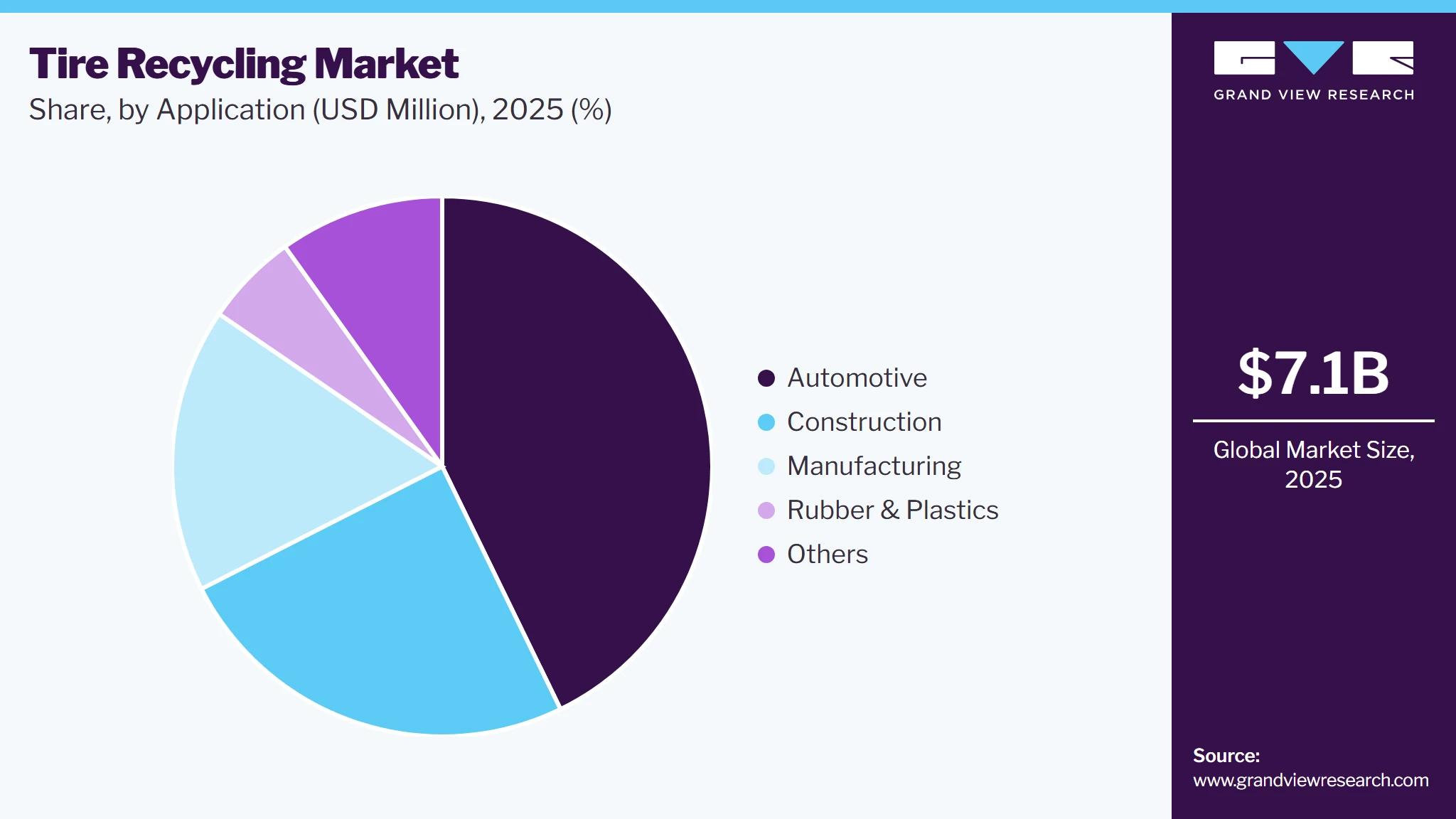
Based on application, the automotive segment led the market with the largest revenue share of 42.8% in 2025. The automotive industry is accelerating the use of recycled tire materials as part of its broader circular economy strategy. With leading automakers committed to reducing their environmental footprint, recycled rubber and carbon black are being incorporated into tire manufacturing, underbody components, and interior applications. Automakers are also responding to consumer demand for sustainable vehicles by integrating eco-friendly materials that enhance vehicle performance while reducing waste. Additionally, regulatory standards on vehicle emissions and sustainable sourcing are pushing suppliers to adopt tire-derived materials, ensuring a stable growth trajectory for recycled products within the automotive sector.
 To learn more about this report, Download Free Sample Report
The construction sector is experiencing a shift toward sustainable building practices, driving demand for tire-derived materials in roadways, sound barriers, and insulation applications. Governments and infrastructure developers are incorporating recycled rubber into asphalt to improve road durability and reduce maintenance costs, while also lowering environmental impact. The noise reduction and shock-absorbing properties of recycled tire materials make them ideal for sports surfaces, pedestrian walkways, and structural reinforcements. With growing investments in green building initiatives, the use of recycled tire products in construction is expected to expand, offering long-term cost benefits and environmental advantages.
Regional Insights & Trends
North America tire recycling market is witnessing significant investments in next-generation tire recycling technologies, driven by the need for sustainable waste management solutions and circular economy initiatives. Governments and private companies are funding research into chemical and thermal recycling methods, such as pyrolysis and devulcanization, to extract high-value raw materials from end-of-life tires.
U.S. Tire Recycling Market Trends
The tire recycling market in the U.S. is driven by stringent federal and state-level policies that are pushing businesses toward sustainable tire disposal and recycling practices. The Environmental Protection Agency (EPA) and individual states have implemented regulations that encourage the use of recycled tire materials in infrastructure projects, including rubberized asphalt for road construction and artificial turf for sports fields. Additionally, government incentives and grants are fostering the development of waste-to-energy projects that convert scrap tires into alternative fuels, further strengthening the market. With increasing corporate sustainability commitments and a rising focus on carbon footprint reduction, major tire manufacturers and recyclers in the U.S. are actively integrating recycled materials into their production cycles to align with national and global sustainability goals.
Asia Pacific Tire Recycling Market Trends
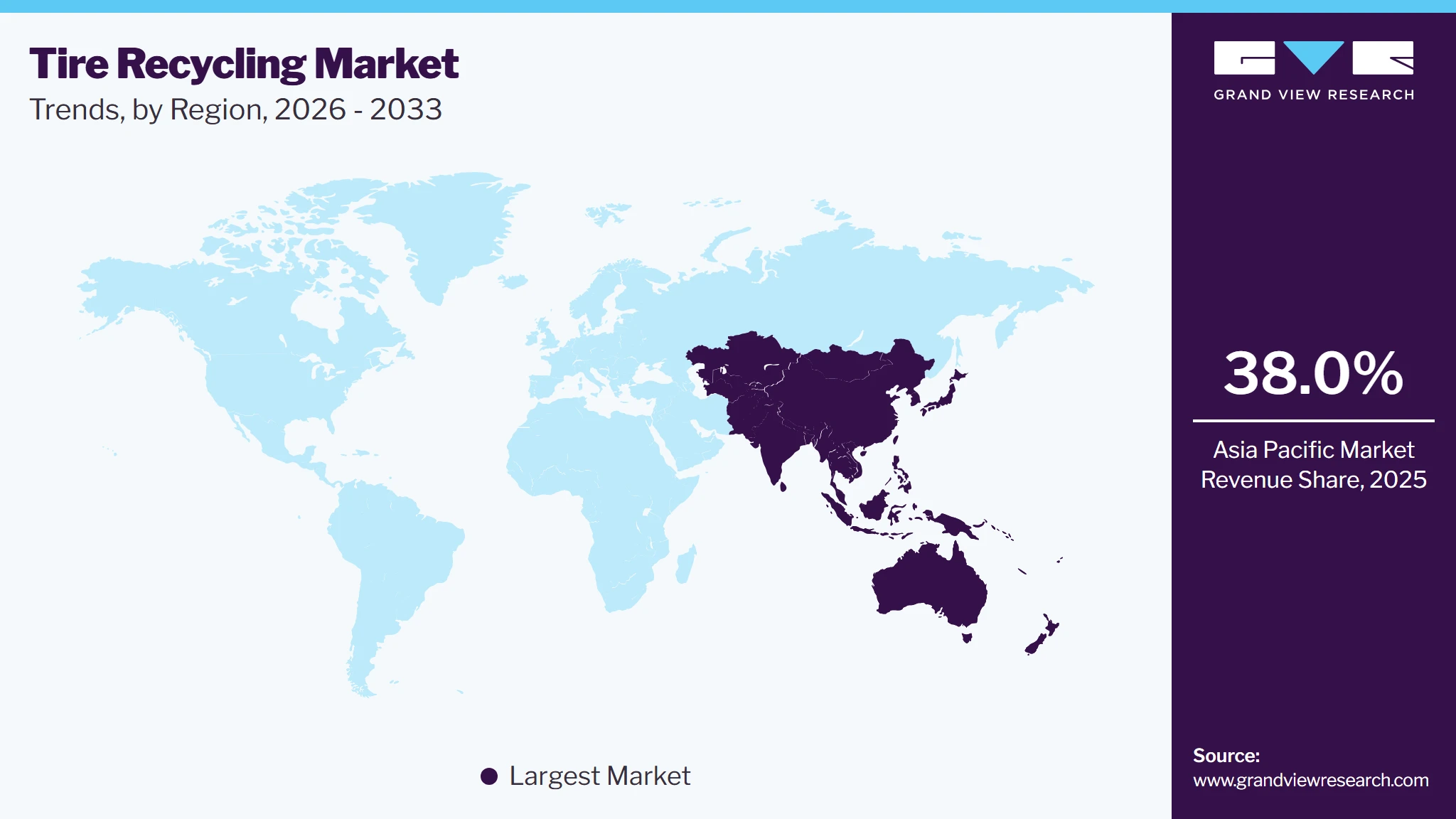
Asia Pacific dominated the tire recycling market with the largest revenue share of 38.0% in 2025. Asia Pacific is experiencing rapid growth in the tire recycling market, primarily driven by the booming automotive industry and increasing vehicle ownership. Countries such as India, Japan, and South Korea are witnessing rising demand for cost-effective and sustainable raw materials, leading manufacturers to integrate recycled rubber and tire-derived products into their supply chains.
 To learn more about this report, Download Free Sample Report
The tire recycling market in China accounted for the largest market revenue share in the Asia Pacific in 2025. China tire recycling market is expanding rapidly due to the government’s strict crackdown on illegal tire dumping and pollution control measures. The country’s latest environmental policies, including stricter waste management laws and incentives for green manufacturing, are pushing industries to adopt sustainable recycling practices. Additionally, China’s aggressive push toward electric vehicles (EVs) and sustainable mobility solutions is driving demand for eco-friendly materials, including recycled tire-derived products. The government is also investing in large-scale pyrolysis projects to extract valuable fuels and chemicals from scrap tires, creating new revenue streams for recyclers. With ongoing industrial reforms aimed at reducing carbon emissions and waste pollution, China’s tire recycling industry is set for substantial long-term growth.
Europe Tire Recycling Market Trends
The tire recycling market in Europe is driven by its strict circular economy policies and aggressive implementation of extended producer responsibility (EPR) programs. The European Union’s Waste Framework Directive and Green Deal initiatives mandate that tire manufacturers take responsibility for the entire lifecycle of their products, driving investments in recycling infrastructure and sustainable material recovery.
Key Tire Recycling Company Insights
The tire recycling market is highly competitive, with several key players dominating the landscape. Major companies include Davis Rubber Company Inc., TIRE DISPOSAL & RECYCLING LLC, Tyre Recycling Solution, Liberty Tire Recycling, Genan Holding A/S, ResourceCo, GRP LTD, and Lehigh Technologies, Inc. The tire recycling market is characterized by a competitive landscape with several key players driving innovation and market growth. Major companies in this sector are investing heavily in research and development to enhance the performance, cost-effectiveness, and sustainability of their types.
Key Tire Recycling Companies
The following key companies have been profiled for this study on the tire recycling market.
-
Davis Rubber Company Inc.
-
TIRE DISPOSAL & RECYCLING LLC
-
Tyre Recycling Solution
-
Liberty Tire Recycling
-
Genan Holding A/S
-
ResourceCo
-
GRP LTD
-
Lehigh Technologies, Inc.
Competitive Benchmarking
Category
Operating Strategies
Competitive Edge
Weakness
Established Players (Davis Rubber Company Inc., Liberty Tire Recycling, Genan Holding A/S, ResourceCo, Lehigh Technologies, Inc.)
Operate integrated collection and processing networks across multiple locations.
Secure long-term offtake contracts with construction, asphalt, and industrial buyers.
Invest in quality control for crumb rubber, recovered carbon black, and TDF.
Larger scale and wider geographic reach.
Stronger access to municipalities, collectors, and institutional buyers.
Better brand credibility and more consistent product quality.
Higher fixed costs and heavier capital exposure.
Greater sensitivity to feedstock and energy price volatility.
Slower response to niche or localized demand shifts.
Emerging Players (TIRE DISPOSAL & RECYCLING LLC, Tire Recycling Solution, GRP LTD)
Focus on regional collection routes and targeted end-use segments.
Build local partnerships with waste handlers, converters, and industrial buyers.
Use flexible, lower-capex processing models to enter underserved markets.
Faster deployment and stronger local responsiveness.
Lower overhead structure and quicker commercial decision-making.
Better ability to address fragmented regional demand.
Limited scale and narrower customer base.
Lower bargaining power with suppliers and large buyers.
Weaker technology depth and lower brand trust versus larger players.
Recent Developments
-
In May 2024, The U.S. Tire Manufacturers Association (USTMA) and the Tire Industry Association (TIA) launched the Tire Recycling Foundation to boost tire recycling efforts in the U.S. The goal is to achieve a 100% recycling rate for end-of-life tires by funding research and projects that address gaps in the tire recycling supply chain.
-
In February 2024, Michelin partnered with Antin and Enviro in a joint venture to build tire recycling plants across Europe. The first plant, located in Uddevalla, Sweden, is under construction and expected to be operational in 2025. It will recycle approximately 35,000 tons of used tires annually, creating about 40 local green jobs.
Tire Recycling Market Report Scope
Report Attribute
Details
Market size in 2025
USD 7.1 billion
Estimated market size in 2026
USD 7.3 billion
Projected market size by 2033
USD 9.8 billion
Growth rate
CAGR of 5.2% from 2026 to 2033
Base year for estimation
2025
Historical data
2021 - 2024
Forecast period
2026 - 2033
Quantitative units
Revenue in USD million/billion, volume in kilotons, and CAGR from 2026 to 2033
Report coverage
Revenue forecast, company ranking, competitive landscape, growth factors, and trends
Segments covered
Product type, application, and region
RegioFinal scope
North America; Europe; Asia Pacific; Central & South America; Middle East & Africa
Country scope
U.S., Canada; Mexico; Germany; UK; France; Italy; Spain, China; India; Japan; South Korea, Australia Brazil; Argentina, Saudi Arabia, UAE, South Africa
Key companies profiled
Davis Rubber Company Inc., TIRE DISPOSAL & RECYCLING LLC, Tire Recycling Solution, Liberty Tire Recycling, Genan Holding A/S, ResourceCo, GRP LTD, and Lehigh Technologies, Inc.
Customization scope
Free report customization (equivalent to up to 8 analysts' working days) with purchase-addition or alteration to country, regional & segment scope.
Pricing and purchase options
Avail customized purchase options to meet your exact research needs. Explore purchase options
Global Tire Recycling Market Report Segmentation
This report forecasts revenue growth at global, regional, and country levels and provides an analysis of the latest industry trends in each of the sub-segments from 2021 to 2033. For this study, Grand View Research has segmented the global tire recycling market report on the basis of product, application, and region:
 To learn more about this report, Download Free Sample Report
-
Product Outlook (Volume Kilotons; Revenue, USD Million, 2021 - 2033)
-
Rubber
-
Tire-derived Fuel
-
Tire-derived Aggregate
-
Carbon Black
-
Steel Wires
-
Others
-
-
Application Outlook (Volume Kilotons; Revenue, USD Million, 2021 - 2033)
-
Automotive
-
Construction
-
Manufacturing
-
Rubber & Plastics
-
Others
-
-
Regional Outlook (Volume Kilotons; Revenue, USD Million, 2021 - 2033)
-
North America
-
U.S.
-
Canada
-
Mexico
-
-
Europe
-
Germany
-
UK
-
France
-
Italy
-
Spain
-
-
Asia Pacific
-
China
-
India
-
Japan
-
South Korea
-
Australia
-
-
Central & South America
-
Brazil
-
Argentina
-
-
Middle East & Africa
-
Saudi Arabia
-
UAE
-
South Africa
-
-
Research Methodology
The tire recycling market figures in this report are based on a proven research process that combines executive interviews with secondary research from proprietary databases, company filings, and recognized regulatory and institutional sources. Market size is built through value-chain sizing - reconciling supply-side and demand-side estimates - and triangulated with bottom-up and top-down approaches. Every estimate passes multiple levels of expert validation before publication, with each tire recycling segment quantified using the revenue-capture definitions in the table below.
Segment Definition
Segment - Product Type
Revenue capture definition
Rubber
Revenue is captured through the sale of crumb rubber, granules, and devulcanized rubber to asphalt modifiers, molded goods makers, mat producers, and compounders seeking lower-cost recycled feedstock.
Tire-derived Fuel
Revenue is generated from processed tire chips and pellets sold to cement kilns, industrial boilers, and waste-to-energy users as a high-heat alternative fuel.
Tire-derived Aggregate
Revenue is captured through civil engineering sales for lightweight fill, drainage layers, road embankments, sound barriers, and landfill applications where volume and load relief matter.
Carbon Black
Revenue is earned from recovered carbon black sold to rubber, plastics, ink, coating, and masterbatch producers that need reinforcement filler and lower-carbon input material.
Steel Wires
Revenue is captured from recovered steel wire and bead wire sales to steel mills, foundries, and scrap processors after magnetic and physical separation.
Others
Revenue includes pyrolysis oil, by-products, collection services, toll processing, and specialty recovery streams that do not fit the main commercial product lines.
Segment - Application
Revenue capture definition
Automotive
Revenue is captured through the supply of recycled tire materials into tire parts, underbody components, vibration-damping products, and vehicle-related circular material programs.
Construction
Revenue is generated from road paving, asphalt modification, flooring, insulation, drainage, landscaping, and safety surface applications that absorb large recycled volumes.
Manufacturing
Revenue is captured through industrial procurement of recycled rubber, carbon black, and fuel substitutes for process input, molding, and material substitution.
Rubber & Plastics
Revenue is generated from compounders and polymer processors that blend recycled tire output into seals, mats, molded goods, masterbatches, and reinforcement systems.
Others
Revenue covers agriculture, sports surfaces, municipal works, utilities, and niche industrial uses that purchase recycled tire materials on a project basis.
Estimation Model
Layer Name
Key Question
Description
Feedstock Layer
Why assess tire availability?
Scrap tire generation and collection coverage set the recoverable base, so this layer anchors tonnage availability before processing losses and regional allocation.
Conversion Layer
Why evaluate processing yields?
Shredding, devulcanization, pyrolysis, and steel recovery determine output mix, conversion yield, and the share of material that becomes monetizable product.
End-Use Layer
Why measure application demand?
Construction, automotive, manufacturing, and rubber and plastics demand determine realized revenue, because different buyers absorb distinct recycled grades at different price points.
Price Layer
Why estimate revenue realization?
Product mix, contamination levels, offtake terms, and regional pricing spreads define revenue capture, especially for rubber, recovered carbon black, and TDF.
Delivered Customizations
This report has been delivered with the following In-depth customizations
Client Request
Customization Delivered
Value Adds
Regional outlook
Expanded the analysis with region-wise demand drivers across North America, Europe, Asia Pacific, Central & South America, and the Middle East & Africa, highlighting policy intensity, collection infrastructure, and end-use concentration.
Supports geographic prioritization and market entry planning.
Product mix analysis
Included a deeper split across rubber, TDF, TDA, carbon black, steel wires, and other recovered streams, with clear monetization logic for each product path.
Clarifies revenue pools and downstream attractiveness.
Company coverage
Added competitive profiling for the named recyclers, focusing on scale, processing integration, offtake structure, and technology positioning.
Improves benchmarking and partner screening.
Frequently Asked Questions About This Report
Increasing use of recycled tire materials across road paving, construction, sports surfaces, automotive components, and infrastructure applications is driving the tire recycling market growth. Rising demand for high-value tire-derived products further supports market expansion due to advances in rubber processing technologies, improved material quality, growing adoption of sustainable construction materials, and increasing investments in circular economy initiatives that promote recycled alternatives to virgin raw materials.
The Asia Pacific tire recycling market accounted for the largest share of 38.0% market size in 2025.
India was the leading tire recycling market and is expected to grow at a compound annual growth rate of 5.6%.
Based on application, the automotive segment accounted for the largest share of 42.8% market size in 2025. Growing vehicle production, increasing replacement tire generation, and rising automotive sustainability initiatives, together with advances in devulcanization and recycled rubber processing technologies, are accelerating recycled tire rubber adoption for automotive components, vibration control products, seals, mats, underbody parts, and lightweight material applications.
The key players in the tire recycling market are Davis Rubber Company Inc., TIRE DISPOSAL & RECYCLING LLC, Tyre Recycling Solution, Liberty Tire Recycling, Genan Holding A/S, ResourceCo, GRP LTD, and Lehigh Technologies, Inc.
The global tire recycling market size was valued at USD 7.1 billion in 2025 and is estimated at USD 7.3 billion for 2026.
The global tire recycling market is expected to grow at a CAGR of 5.2% from 2026 to 2033, reaching USD 9.8 billion by 2033.
The rubber tire recycling industry led the tire recycling product type market in 2025 with a 37.9% share. Growing demand from road construction, automotive, sports infrastructure, construction, and molded rubber product industries, coupled with advances in grinding, devulcanization, and rubber purification technologies, is accelerating the adoption of recycled rubber for high-performance asphalt modification, impact-absorbing surfaces, industrial products, vibration control components, and sustainable material applications.
The carbon black segment is the fastest-growing over the forecast period.
About the Author(s)
Plastics, Polymers & Resins Research Team
Bulk Chemicals · Plastics, Polymers & ResinsThis report was authored by the plastics, polymers & resins research team at Grand View Research - comprising two research analysts, one senior research analyst, and one industry expert - with specialized expertise in the plastics, polymers & resins segment of the bulk chemicals industry. All findings are based on proprietary bulk chemicals databases, executive interviews, and regulatory analysis, subject to internal peer review prior to publication.
Last Updated:
Speak to Analyst

Customize this report to your needs - add regions, segments, or data points, with 20% free customization.
Or view our licence options:


ISO 9001:2015 & 27001:2022 Certified
We are GDPR and CCPA compliant! Your transaction & personal information is safe and secure. For more details, please read our privacy policy.


