
- Home
- »
- Homecare & Decor
- »
-
Trading Card Games Market Size And Share Report, 2033GVR Report cover

Trading Card Games Market (2026 - 2033)
Size, Share & Trends Analysis Report By Market Type (Primary Market, Secondary Market), By Format (Physical Trading Card Games, Digital Trading Card Games), By Game Franchise (Pokémon Trading Card Game, Disney Lorcana) By Region, And Segment Forecasts
Market Size, 2025
$18.5BMarket Estimate, 2026
$19.7BMarket Forecast, 2033
$32.1BCAGR, 2026–2033
7.2%Trading Card Games Market Summary
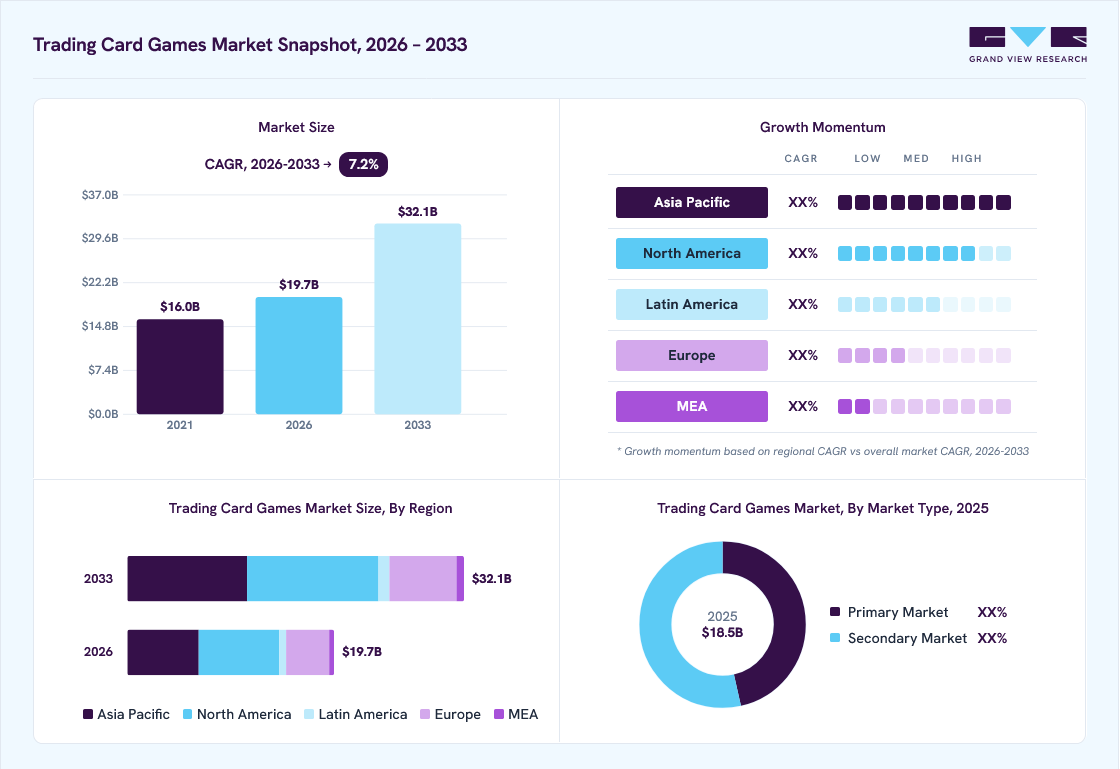
The global trading card games market size was valued at USD 18.5 billion in 2025 and is projected to grow from USD 19.7 billion in 2026 to USD 32.1 billion by 2033, at a CAGR of 7.2% from 2026 to 2033. North America dominated the market, accounting for 38.9% of revenue in 2025. Market growth is being driven by increasing consumer interest in collectible hobbies, competitive gameplay, and franchise-based entertainment.
 Source: Grand View Research, IR Documents, Primary Interviews, Paid DatabasesTo learn more about this report,
 Download Free Sample Report
Key Market Trends & Insights
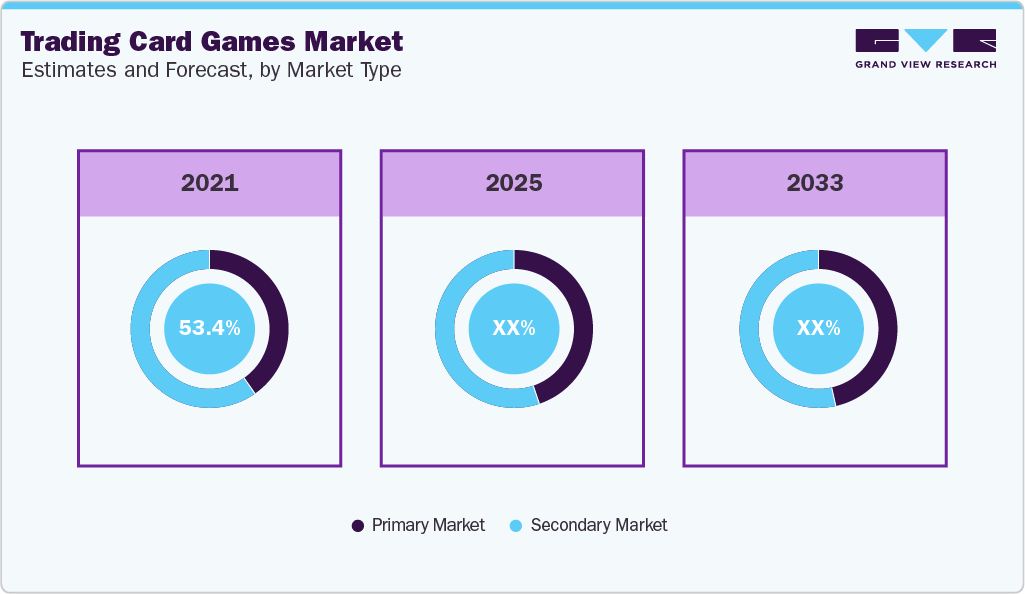
- By market type: The secondary market accounted for a market share of 53.6% in 2025
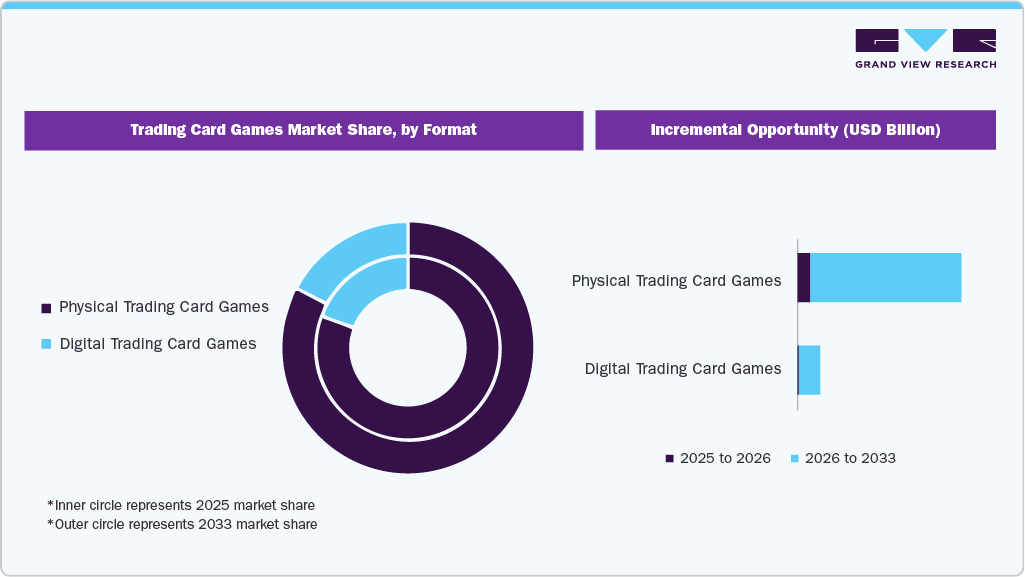
- By format: Physical trading card games accounted for a market share of 82.0% in 2025.
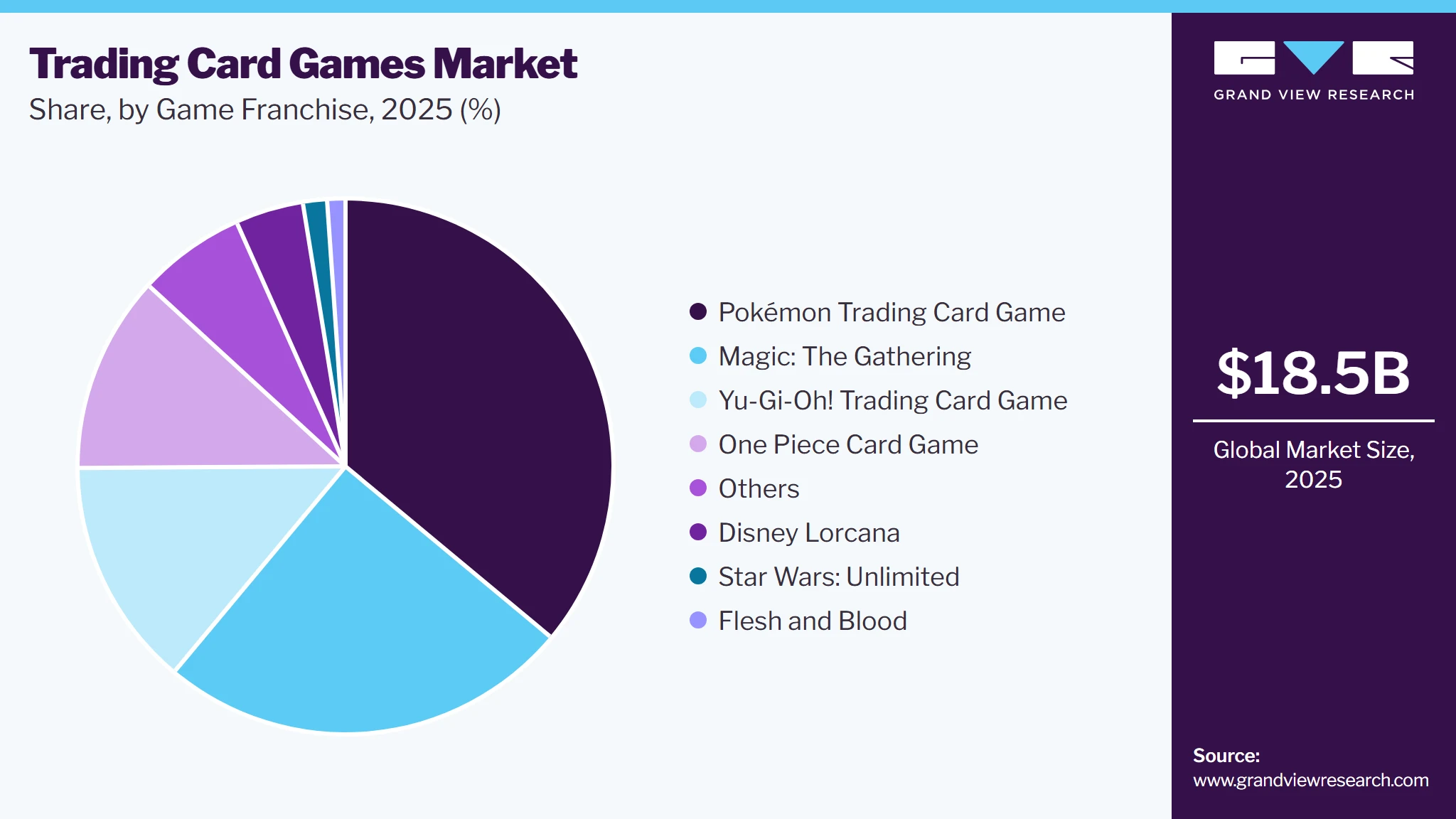
- By game franchise: Pokémon trading card game accounted for a market share of 36.0% in 2025.
Regional Highlights
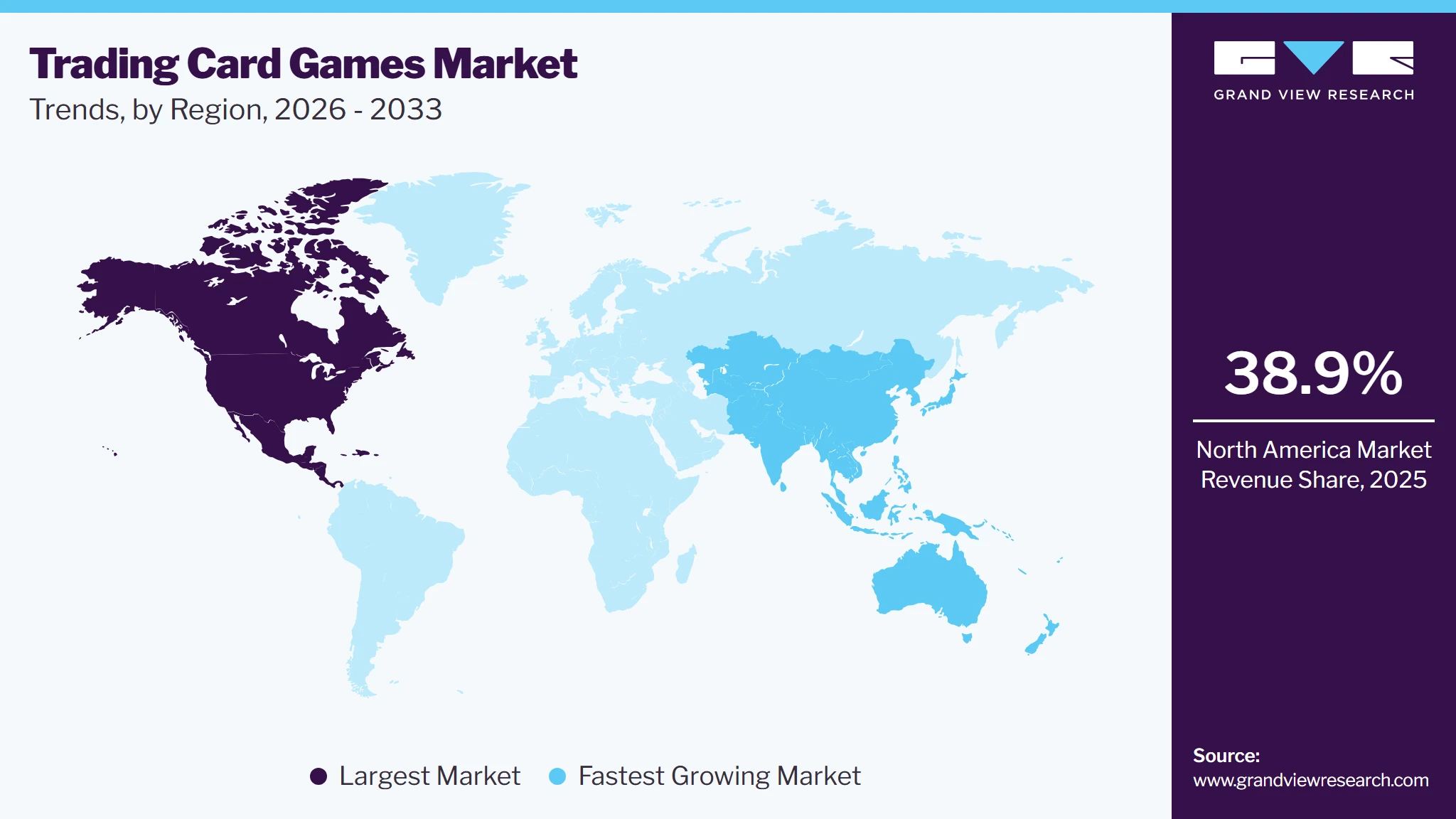
- Largest regional market: North America (38.9% revenue share, 2025)
- Fastest-growing regional market: Asia Pacific (highest CAGR, 2026-2033)
- By country: The U.S. held the largest market share in 2025.
Market Size & Forecast
- Market Size in 2025: USD 18.5 Billion
- Estimated Market Size in 2026: USD 19.7 Billion
- Projected Market Size in 2033: USD 32.1 Billion
- CAGR (2026-2033): 7.2%
Prism AI by Grand View Research Free to tryAsk a question about the trading card games marketTry asking✓Every figure cited from GVR research Prefer the report? Download free sample →
Strong fan engagement across popular trading card game brands such as Pokémon, Magic: The Gathering, Yu-Gi-Oh! One Piece Card Game and Disney Lorcana continue to attract both players and collectors. The expansion of organized tournaments, local game store networks, and online communities is further supporting demand across physical and competitive trading card game segments.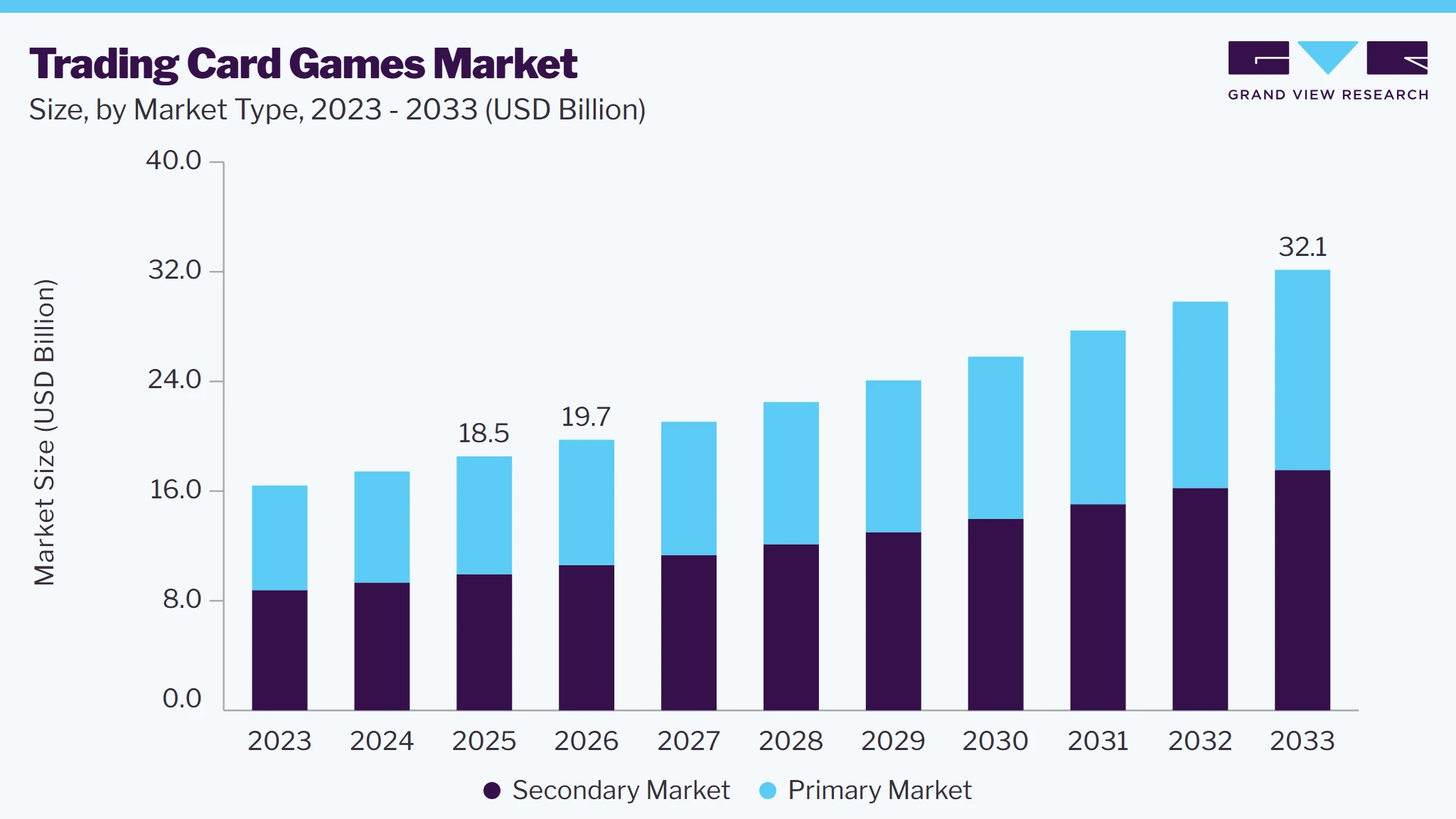 To learn more about this report, Download Free Sample Report
The market is also witnessing growing demand for premium and limited-edition card products designed for collectors and enthusiasts. Publishers are increasingly introducing special rarity cards, anniversary releases, franchise collaborations, and localized product offerings to strengthen consumer engagement and drive repeat purchases. In September 2025, The Pokémon Company released the Mega Evolution expansion for the Pokémon Trading Card Game, introducing new Mega Evolution Pokémon ex cards and enhanced gameplay mechanics. This reflects a broader industry trend toward continuous content innovation, collector-focused product strategies, and franchise expansion to sustain long-term consumer interest and market growth.
Growing consumer interest in collectible hobbies, competitive gameplay, and franchise-based entertainment is significantly driving demand in the global trading card games market. Consumers increasingly view trading card games as a combination of strategic gameplay, social interaction, collecting, and fandom engagement, resulting in higher participation across both casual and competitive player communities. This trend is supporting demand for booster packs, starter decks, collector boxes, special edition releases, and promotional cards. Consumers are also showing a strong preference for products featuring popular intellectual properties such as Pokémon, Magic: The Gathering, and Yu-Gi-Oh! One Piece and Disney Lorcana are contributing to sustained purchasing activity and repeat engagement.
The global trading card games market is also witnessing a strong shift toward premiumization and collector-focused product innovation as consumers increasingly seek rarity, exclusivity, and long-term collectible value. Publishers are introducing alternate-art cards, serialized cards, anniversary editions, crossover collaborations, and limited-edition releases to enhance product appeal. Demand for high-rarity cards and premium sealed products continues to rise among collectors and investors, while organized play programs and competitive tournament ecosystems encourage ongoing purchases of products. Manufacturers are also focusing on expanding game mechanics, introducing new card sets, and supporting balanced gameplay to improve player retention and franchise longevity.
Furthermore, changing consumer demographics and evolving entertainment preferences are expanding the customer base within the global trading card games market. Younger consumers, women, family-oriented players, and first-time hobby participants are increasingly engaging with trading card games through local game stores, conventions, community events, and digital content platforms. This trend is encouraging publishers to develop beginner-friendly products, simplified game formats, localized language offerings, and accessible onboarding experiences. Consumers are also increasingly influenced by streaming content, influencer communities, esports-style competitions, and popular media franchises, driving broader market participation and brand engagement.
Market Dynamics
The growing popularity of organized play programs, competitive tournaments, and community-driven gaming events is emerging as a major driver for the global trading card games market. Consumers are increasingly participating in local tournaments, regional championships, trading events, and hobby store activities, driving demand for booster packs, starter decks, expansion sets, collector boxes, and promotional cards. The expansion of organized play ecosystems across leading franchises such as Pokémon Trading Card Game, Magic: The Gathering, and Yu-Gi-Oh! One Piece Card Game and Disney Lorcana are further increasing consumer engagement, particularly among younger players, collectors, and competitive gaming communities.
In addition, advancements in digital companion platforms, event management systems, and online community engagement are improving accessibility and enhancing the overall trading card game experience. Consumers are increasingly investing in new card releases, deck customization, and competitive gameplay strategies to participate in organized events and improve performance. Social media content, livestreamed tournaments, content creators, and franchise-based fan communities are also encouraging greater consumer participation and product purchases. This growing culture of collecting, trading, deck building, and competitive play is supporting recurring purchases of trading card game products and contributing significantly to the growth of the global trading card games market.
The high costs associated with collection and competitive participation remain a key factor constraining the growth of the global trading card games market. Consumers often face significant expenses related to booster packs, premium collector products, tournament entry fees, card protection accessories, and the acquisition of high-rarity or competitive cards. Building tournament-ready decks frequently requires the purchase of multiple expansion sets and sought-after singles, increasing overall participation costs. In addition, fluctuations in secondary market prices and the limited availability of certain cards can create affordability challenges for new and budget-conscious players. The combination of rising product prices, premiumization trends, and ongoing investment required to remain competitive continues to limit broader consumer adoption and poses a challenge to long-term market expansion.
Analyst Perspective
The trading card games market is evolving from a niche hobby category into mainstream entertainment and collectible ecosystem driven by the convergence of gameplay, collecting, and franchise fandom. Consumer engagement is increasingly supported by organized play programs, competitive tournaments, premium collector products, and continuous expansion releases from leading franchises such as Pokémon Trading Card Game, Magic: The Gathering, and Yu-Gi-Oh! One Piece Card Game and Disney Lorcana. Demand for limited-edition cards, alternate-art releases, and high-rarity collectibles continues to strengthen the secondary market, while professional grading and authentication services are improving buyer confidence and supporting long-term collectible value. Digital platforms, online marketplaces, and community-driven content are expanding market accessibility and transaction volumes, while younger consumers increasingly view trading card games as both a social gaming activity and a collectible investment category.
Brand/Company Market Share Insights
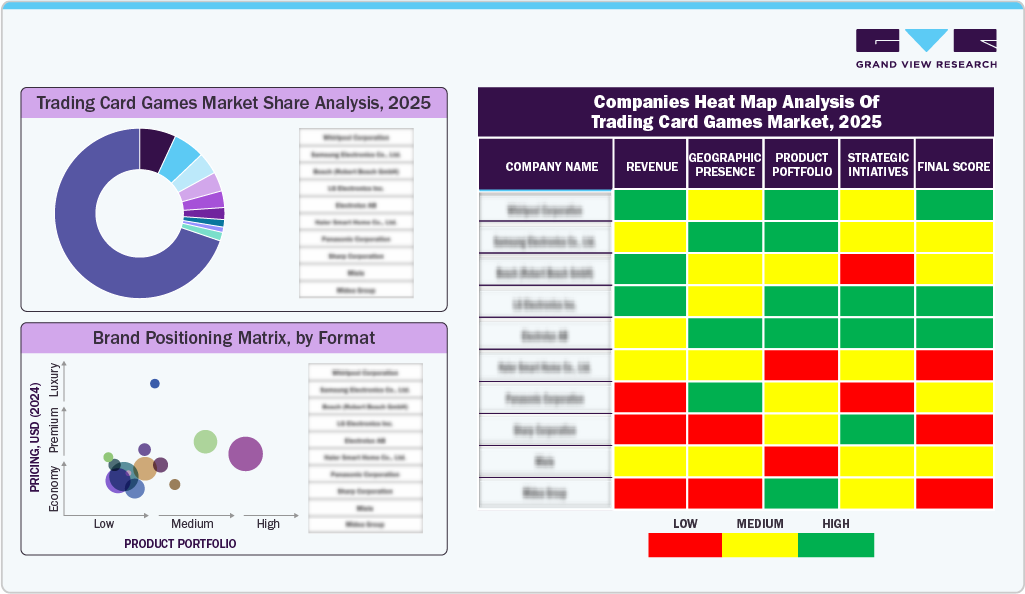
The global trading card games market is highly competitive, driven by continuous product innovation, expansion releases, organized play initiatives, and franchise-based consumer engagement. Major companies such as The Pokémon Company, Hasbro, Inc., Konami Group Corporation, Bandai Co., Ltd., and Ravensburger AG compete by frequently launching new card sets, premium collector products, tournament programs, and strategic intellectual property partnerships. Competition is increasingly centered on expanding player communities, strengthening organized play ecosystems, introducing innovative gameplay mechanics, and maintaining long-term engagement through regular content updates and franchise development.
 To learn more about this report, Download Free Sample Report
The market is also witnessing rising demand for premium collectible products, limited-edition releases, alternate-art cards, and high-rarity offerings targeted at collectors and enthusiasts. Companies such as Bushiroad Inc., Legend Story Studios Limited, Fantasy Flight Games, Upper Deck Company, and Panini S.p.A. are focusing on differentiated game mechanics, licensed entertainment properties, community-driven marketing, and collector-focused product strategies to strengthen their market positions. In addition, the expansion of digital companion platforms, online marketplaces, professional card-grading services, and influencer-led content is increasing consumer participation and supporting growth across both the gameplay and collectible segments of the trading card games market.
Consumer Insights
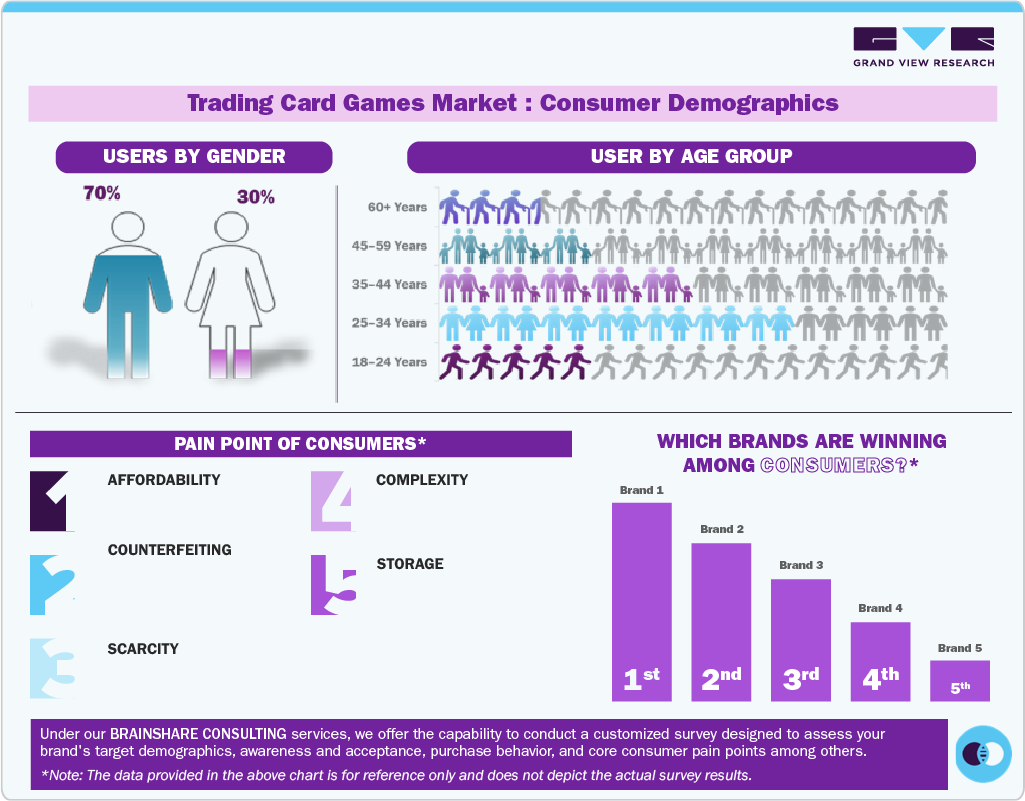
Consumer behavior in the global trading card games market is increasingly centered on collectability, franchise engagement, and competitive gameplay, with buyers prioritizing products that offer unique card designs, strategic depth, and long-term collectible value over simple entertainment purchases. Consumers are actively seeking premium products such as limited-edition releases, alternate-art cards, serialized cards, and special collector sets, driving demand for offerings that combine gameplay utility with scarcity and exclusivity. This trend reinforces trading card games as a category in which franchise popularity, card rarity, and community engagement directly influence purchasing decisions.
 To learn more about this report, Download Free Sample Report
At the same time, purchasing behavior in the global trading card games market is strongly influenced by multi-product consumption and recurring purchase patterns. Consumers regularly purchase booster packs, expansion sets, starter decks, collector boxes, protective accessories, and individual cards to build collections and optimize competitive decks. Organized play events, local tournaments, online deck-building communities, and content-creator recommendations are accelerating product discovery and encouraging repeat purchases. This behavior drives consumers to maintain multiple decks, collect cards across different franchises, and continuously invest in new releases, supporting higher transaction values and consistent repurchase rates. The combination of collecting culture, competitive participation, and continuous content releases is reinforcing sustained demand growth within the global trading card games market.
Format Insights
Physical trading card games accounted for the largest market share of 82.0% in 2025, supported by strong consumer demand for collectible cards, organized play events, local game store participation, and franchise-driven fandom. Players and collectors continue to value the tangible ownership, trading experience, and long-term collectible appeal that physical cards offer. Demand is further strengthened by the continuous release of expansion sets, premium collector products, limited-edition cards, and tournament-exclusive promotions from leading franchises such as Pokémon Trading Card Game, Magic: The Gathering, Yu-Gi-Oh!, One Piece Card Game, and Disney Lorcana. The growth of professional grading services and secondary market activity also supports sustained purchasing and collecting behavior.
 To learn more about this report, Download Free Sample Report
Digital trading card games are anticipated to grow at a CAGR of 6.5% from 2026 to 2033, driven by increasing adoption of mobile gaming, cross-platform accessibility, and online competitive play. Consumers are increasingly engaging with digital card game ecosystems that offer convenient gameplay, regular content updates, online matchmaking, and lower barriers to entry compared to physical collecting. The expansion of titles is further accelerating market growth. In addition, growing integration with esports, livestreaming platforms, digital communities, and in-game monetization models is encouraging broader consumer participation and supporting recurring revenue generation across the digital trading card games segment.
Market Type Insights
The secondary market accounted for the largest market share of 53.6% in 2025, supported by strong demand for rare, graded, discontinued, and highly sought-after trading cards. Collectors and investors actively participate in secondary market transactions to acquire limited-edition cards, alternative-art variants, serialized releases, and historically significant collectibles that are no longer readily available through primary distribution channels. The growing adoption of professional grading and authentication services is improving buyer confidence, while online marketplaces, auction platforms, and specialized trading platforms are increasing market transparency and accessibility. As collectible value becomes an increasingly important purchasing factor, secondary market activity continues to play a critical role in overall market expansion.
 To learn more about this report, Download Free Sample Report
The primary market is anticipated to grow at a CAGR of 6.9% from 2026 to 2033, driven by continuous expansion releases, organized play initiatives, franchise collaborations, and new player acquisition strategies. Leading publishers, including The Pokémon Company, Hasbro, Inc., Konami, Bandai, and Ravensburger, regularly introduce booster packs, starter decks, collector boxes, and promotional products that encourage recurring purchases. The growing popularity of competitive tournaments, local game store events, and franchise-based entertainment ecosystems is further supporting demand for newly released products. In addition, rising consumer participation in trading card games across emerging markets is expected to bolster long-term growth in the primary market segment.
Game Franchise Insights
Pokémon Trading Card Game accounted for the largest market share, at 36.0% in 2025, supported by its extensive global player base, strong collector demand, and ongoing expansion releases. The franchise benefits from a highly developed, organized play ecosystem, regular product launches, and broad retail availability across hobby stores, mass retailers, and e-commerce channels. Demand is further strengthened by premium collector products, special illustration cards, promotional releases, and international tournament programs. The combination of competitive gameplay, collectible appeal, and strong brand recognition continues to reinforce the Pokémon TCG's leadership position in the global trading card game market.
 To learn more about this report, Download Free Sample Report
One Piece Card Game is anticipated to grow at the fastest CAGR of 7.9% from 2026 to 2033, driven by the expanding global popularity of the One Piece franchise, increasing organized play participation, and strong demand for collector-focused releases. The game continues to attract both existing trading card game players and anime fans through frequent expansion launches, premium card designs, and competitive tournament programs. Growing international distribution, community engagement initiatives, and rising participation are expected to support the franchise's expansion. Its ability to combine collectible appeal with competitive gameplay is expected to support sustained growth throughout the forecast period.
Regional Insights
The North America trading card games market accounted for the largest share, at 38.9%, in 2025. North America is one of the world's most mature and influential markets for trading card games (TCGs), driven by a well-established collector community, organized competitive play, specialty hobby stores, conventions, and strong licensing partnerships. Consumers in the region increasingly view trading cards as both an entertainment product and a collectible asset. While competitive gameplay remains a major purchase driver, collecting limited-edition cards, alternate artwork, graded cards, and franchise-exclusive releases has become equally important.
 To learn more about this report, Download Free Sample Report
Bandai announced BANDAI CARD GAMES Fest 25-26, with two major North American events scheduled in Dallas, Texas (September 20-21, 2025) and Las Vegas, Nevada (February 14-15, 2026). The events bring together Bandai's major trading card game franchises, including One Piece Card Game, Digimon Card Game, Dragon Ball Super Card Game, Fusion World, Union Arena, and Gundam Card Game. According to the official event website, attendees can participate in championship tournaments, side events, product sales, and activities designed for both beginners and experienced players. Competitive events encourage players to buy booster packs, expansion sets, and accessories to build tournament-ready decks, while on-site retail areas and commemorative merchandise stimulate additional spending among collectors. Bandai also expands awareness of its trading card game portfolio and supports the growth of player communities across North America.
U.S. Trading Card Games Market Trends
The trading card games industry in the U.S. accounted for around 84.1% of the North America market in 2025. The U.S. represents one of the largest and most influential trading card game (TCG) markets in North America, supported by a strong ecosystem of publishers, hobby stores, organized tournaments, conventions, and collector communities. Trading card games have evolved beyond traditional gameplay and are increasingly viewed as collectible entertainment products, with consumers actively purchasing booster packs, premium collections, alternate-art cards, and limited-edition releases. The market benefits from a broad consumer base that includes competitive players, casual hobbyists, collectors, and investors.
The Mexico trading card games market is expected to grow at a CAGR of 8.9% from 2026 to 2033. Mexico represents a growing trading card game (TCG) market, supported by increasing consumer interest in collectible hobbies, expanding organized play communities, and rising availability of localized products. Popular franchises such as Pokémon Trading Card Game, Yu-Gi-Oh! Trading Card Game, One Piece Card Game, and Magic: The Gathering continue to attract both players and collectors across the country. The market benefits from a growing network of hobby stores, regional tournaments, gaming conventions, and online marketplaces that facilitate access to products and community engagement. In addition, the increasing popularity of anime, gaming culture, and franchise-based entertainment is encouraging participation among younger consumers, supporting demand for booster packs, expansion sets, collector products, and premium card releases.
Asia Pacific Trading Card Games Market Trends
The Asia Pacific trading card games industry is expected to grow at a CAGR of 7.7%from 2026 to 2033. Asia Pacific remains the global center of the trading card games industry, driven by the presence of major publishers, frequent product launches, and highly engaged player communities. The region benefits from a culture of collectible hobbies, with consumers actively participating in card collecting, trading, deck building, and competitive tournaments. Countries such as Japan, China, South Korea, and Australia have well-developed hobby retail networks that support both casual players and competitive enthusiasts. One of the most significant trends in the region is the growing popularity of franchise-driven trading card games. Publishers are responding by releasing new expansions, promotional cards, and exclusive products that maintain consumer interest and encourage repeat purchases. In addition, digital platforms and social media communities have made it easier for players to follow new releases, share deck strategies, and participate in organized play activities.
Bandai launched the ONE PIECE CARD GAME Championship 25-26 as the official competitive circuit for its ONE PIECE CARD GAME, bringing together players from across Asia through regional qualifiers, regional finals, and the Asia Final. According to the official event website, winners from the regional finals qualify for the World Final in Japan, where top players compete for the world championship title. The championship is conducted under the official tournament rules and forms a key part of Bandai's organized play program. By encouraging players to build competitive decks and participate in official tournaments, the event supports recurring demand for booster packs, expansion sets, and tournament-legal cards while strengthening consumer engagement within the trading card game community.
The trading card games market in Japan accounted for around 42.5% of the Asia-Pacific market in 2025. Japan's trading card market continues to evolve beyond traditional entertainment franchises, with trading cards increasingly being used to strengthen community engagement and attract new audiences. Alongside globally popular franchises such as Pokémon and Yu-Gi-Oh!, locally themed trading card games are gaining attention by combining collectible gameplay with regional culture. Japanese consumers continue to value trading cards not only as competitive games but also as a medium for social interaction, collecting, and preserving local identity. As interest grew, the cards evolved into a playable trading card game in which local volunteers, craftsmen, and community leaders were assigned game attributes and special abilities inspired by their real-world expertise. The project gained widespread attention in 2025 for its innovative use of the trading card format to encourage social interaction and community participation. The success of the initiative highlights how trading cards in Japan are valued not only as entertainment products but also as cultural and social engagement tools that connect people through collecting, trading, and gameplay.
The China trading card games market is expected to grow at a CAGR of 8.3% from 2026 to 2033. China represents the fastest-growing trading card game (TCG) market, supported by a rapidly expanding collector community, increasing interest in anime and gaming culture, and rising consumer spending on hobby-related products. Popular franchises such as Pokémon Trading Card Game, One Piece Card Game, and Yu-Gi-Oh! Trading Card Game, and Magic: The Gathering continue to gain traction among both competitive players and collectors. The market benefits from the growth of specialty hobby stores, online marketplaces, livestream commerce platforms, and trading card exhibitions that improve product accessibility and consumer engagement. In addition, the increasing popularity of card collecting as a lifestyle hobby and alternative collectible asset is driving demand for premium products, limited-edition releases, and high-rarity cards, supporting continued market expansion across the country.
Europe Trading Card Games Market Trends
The European trading card games market accounted for a revenue share of 21.0% of the global market in 2025. Europe represents one of the most established trading card game (TCG) markets, supported by a strong network of hobby stores, organized play programs, gaming conventions, and an expanding collector community. Consumers across the region increasingly view trading cards as both a strategic tabletop game and a long-term collectible. While competitive gameplay remains a key purchase driver, there is growing demand for premium collector products, alternate-art cards, limited-edition releases, and franchise-based trading card games such as Pokémon, Magic: The Gathering, Disney Lorcana, One Piece Card Game, and Yu-Gi-Oh!. The 2025 Pokémon Europe International Championships (EUIC) were held at ExCeL London, England, from 21-23 February 2025 as part of the official Play! Pokémon Championship Series. The event featured competitions in the Pokémon Trading Card Game (TCG), as well as Pokémon video games, Pokémon GO, and Pokémon UNITE. According to The Pokémon Company International, the championship awarded Championship Points, direct invitations to the 2025 Pokémon World Championships, and more than US$500,000 in total prizes across all competition categories.
The trading card games market in Germany accounted for around 25.0% of the European market's revenue in 2025. Germany is one of Europe's largest trading card game markets, benefiting from a mature tabletop gaming industry, a high concentration of specialty hobby retailers, and strong consumer participation in organized play. German consumers show a strong preference for Pokémon, Magic: The Gathering, Disney Lorcana, and One Piece Card Game, with demand driven by both competitive players and collectors. Large gaming exhibitions and official championships continue to strengthen consumer engagement and provide publishers with platforms to showcase new products and expansions.
Spain's trading card games market is expected to grow at a CAGR of 7.4% from 2026 to 2033. Spain has emerged as an important trading card game hub in Southern Europe, driven by a strong culture of tabletop gaming, collectible hobbies, and fandom-driven entertainment. Consumer demand is supported by active participation in local gaming clubs, regional championships, and hobby-focused retail stores that promote competitive and social gameplay experiences. The market is also benefiting from growing interest in Japanese anime, fantasy franchises, and licensed entertainment properties, which continue to attract new players and collectors. Furthermore, increasing availability of Spanish-language products, expansion sets, and community-led events is strengthening market accessibility and encouraging long-term engagement across both casual and dedicated trading card game audiences.
Central & South America Trading Card Games Market Trends
The Central & South America trading card games industry is expected to grow at a CAGR of 7.0% from 2026 to 2033. Central & South America are emerging markets for trading card games, supported by a growing network of organized tournaments, hobby stores, and active player communities. Consumers in the region increasingly participate in competitive play while also collecting cards from globally recognized franchises such as Pokémon Trading Card Game, Yu-Gi-Oh! Trading Card Game, Magic: The Gathering, and One Piece Card Game. Organized play has become a major growth driver, with publisher-led regional championships and local store events encouraging repeat purchases of booster packs, expansion sets, and tournament-ready decks. The expansion of official competitive circuits and localized community initiatives continues to strengthen consumer engagement across the region.
The trading card games market in Brazil accounted for approximately 55.9% of revenue in 2025. Brazil is one of the largest and most developed trading card games markets in Central & South America. The country hosts the Pokémon Latin America International Championships (LAIC), one of the four official International Championships in the Play! Pokémon competitive circuit. Brazil also has an extensive network of hobby stores and regional tournaments that support competitive play and card collecting. The Pokémon Latin America International Championships (LAIC) 2026 took place in São Paulo, Brazil, from 21-23 November 2025, serving as the opening International Championship of the 2026 Play! Pokémon Championship Series. The event featured official competitions for the Pokémon Trading Card Game, as well as Pokémon video games, Pokémon GO, and Pokémon UNITE. Players competed for Championship Points, invitations to the 2026 Pokémon World Championships, and prize money. In addition to competitive play, the event included spectator activities, a Pokémon Center, and fan experiences, reinforcing Brazil's position as the leading hub for organized trading card game events in Latin America.
Middle East & Africa Trading Card Games Market Trends
The Middle East & Africa trading card games market is expected to grow at a CAGR of 6.2% from 2026 to 2033. The Middle East & Africa trading card games market is witnessing gradual growth as global publishers increase the availability of officially licensed trading card products and expand their distribution networks across the region. Consumers are showing rising interest in franchise-based trading card games inspired by anime and entertainment brands, with collecting increasingly viewed as both a hobby and a long-term investment. Another emerging trend is the adoption of digital platforms for tournament registration and community engagement, making it easier for players to access official events and connect with local trading card game communities. These developments are strengthening the market's foundation and supporting wider participation across the region.
The trading card games market in the UAE accounted for around 30.0% of revenue in 2025. The UAE has become a key destination for trading card game enthusiasts in the Middle East, driven by a strong culture of pop-culture consumption and collectible hobbies. Consumers increasingly view trading cards not only as gameplay products but also as collectible assets, particularly for rare, alternate-art, and limited-edition cards. The market is also benefiting from the growth of destination retail and entertainment venues that host card trading meetups, product launches, and fan gatherings. As global franchises continue to expand their presence in the region, the UAE is emerging as an important entry point for trading card game brands seeking to reach consumers across the Gulf Cooperation Council (GCC) countries.
Key Trading Card Games Companies:
The following key companies have been profiled for this study on the trading card games market.
-
The Pokémon Company
-
Hasbro, Inc.
-
Konami Group Corporation
-
Ravensburger AG
-
Bandai Co., Ltd.
-
Bushiroad Inc.
-
Legend Story Studios Limited
-
Upper Deck Company
-
Panini S.p.A.
-
Fantasy Flight Games
Competitive Benchmarking
Category
Operating Strategies
Competitive Edge
Weakness
Established Players (The Pokémon Company, Hasbro/Wizards of the Coast, Konami Group Corporation, Bandai Co., Ltd.)
Expand flagship franchises through regular expansion releases, organized play programs, global tournaments, premium collector products, digital integrations, and licensing partnerships. Strengthen retail distribution across hobby stores, mass retailers, and e-commerce channels while leveraging popular entertainment IPs to sustain player engagement and recurring purchases.
Strong brand recognition, large, loyal player communities, extensive organized-play ecosystems, established global distribution networks, and decades of franchise equity. The ability to continuously monetize through expansion sets, premium collectibles, competitive events, and multimedia IP ecosystems supports long-term market leadership.
High dependence on a limited number of flagship franchises, significant development and marketing costs, balancing gameplay mechanics across large player bases, and growing pressure to continually release new content. Larger organizational structures may also reduce flexibility in responding to rapidly evolving consumer preferences and emerging competitors.
Emerging Players (Ravensburger AG, Bushiroad Inc., Legend Story Studios Limited, Upper Deck Company, Panini S.p.A., Fantasy Flight Games)
Focus on differentiated gameplay experiences, franchise-specific communities, premium collector offerings, and targeted organized play initiatives. Expand through direct-to-consumer channels, specialty hobby stores, influencer marketing, convention participation, and strategic licensing partnerships to increase market visibility and player acquisition.
Faster product innovation cycles, greater flexibility in introducing new game mechanics, strong niche community engagement, and the ability to capitalize on emerging entertainment franchises and underserved player segments. Specialized product positioning allows stronger differentiation from larger competitors.
Smaller player bases and tournament ecosystems, lower brand recognition in mainstream markets, narrower distribution footprints, and greater dependence on specific franchises or product launches. Limited marketing budgets and reduced economies of scale can constrain global expansion and long-term competitive positioning.
Recent Developments:
-
In June 2026, The Pokémon Company International announced the product lineup for its 30th Celebration expansion, marking three decades since the Pokémon TCG's 1996 debut. The set introduces a new card rarity, Futuristic rare, alongside foil-only booster packs and reprinted classic cards, including the original Charizard. The expansion launches simultaneously worldwide on September 16, 2026 — the first time a Pokémon TCG set has debuted on the same day in every region, including Japan. This launch reinforces Pokémon's collector- and nostalgia-driven strategy and global distribution ambitions, reflecting a shift toward synchronized international releases rather than staggered regional rollouts.
-
In June 2026, Legend Story Studios launched Usurp the Shadow Throne, its 20th Flesh and Blood set, teased via a YouTube video titled "Wrath of the Monarch." The set continues the game's Light and Shadow hero storyline, featuring a mysterious character who exploits dark omens across the world of Rathe. Card previews begin July 16, 2026, ahead of a worldwide release on September 25, 2026. This launch reinforces LSS's strategy of sustaining its structured quarterly set and ongoing narrative continuity, rather than introducing a standalone or unrelated storyline.
Trading Card Games Market Report Scope
Report Attribute
Details
Market size in 2025
USD 18.5 billion
Estimated market size in 2026
USD 19.7 billion
Projected market size in 2033
USD 32.1 billion
Growth rate
CAGR of 7.2% from 2026 to 2033
Base year for estimation
2025
Historical data
2021 - 2024
Forecast period
2026 - 2033
Quantitative units
Revenue in USD billion and CAGR from 2026 to 2033
Report coverage
Revenue forecast, company ranking, competitive landscape, growth factors, and trends
Segments covered
Market type, format, game franchise, region
Regional scope
North America; Europe; Asia Pacific; Central & South America; Middle East & Africa
Country scope
U.S.; Canada; Mexico; UK; Germany; France; Italy; Spain; China; India; Japan; South Korea; Australia & New Zealand; Brazil; Argentina; South Africa; UAE
Key companies profiled
The Pokémon Company; Hasbro, Inc.; Konami Group Corporation; Ravensburger AG; Bandai Co., Ltd.; Bushiroad Inc.; Legend Story Studios Limited; Upper Deck Company; Panini S.p.A.; and Fantasy Flight Games.
Customization scope
Free report customization (equivalent to up to 8 analyst working days) with purchase. Addition or alteration to country, regional & segment scope.
Pricing and purchase options
Avail customized purchase options to meet your exact research needs. Explore purchase options
Global Trading Card Games Market Segmentation
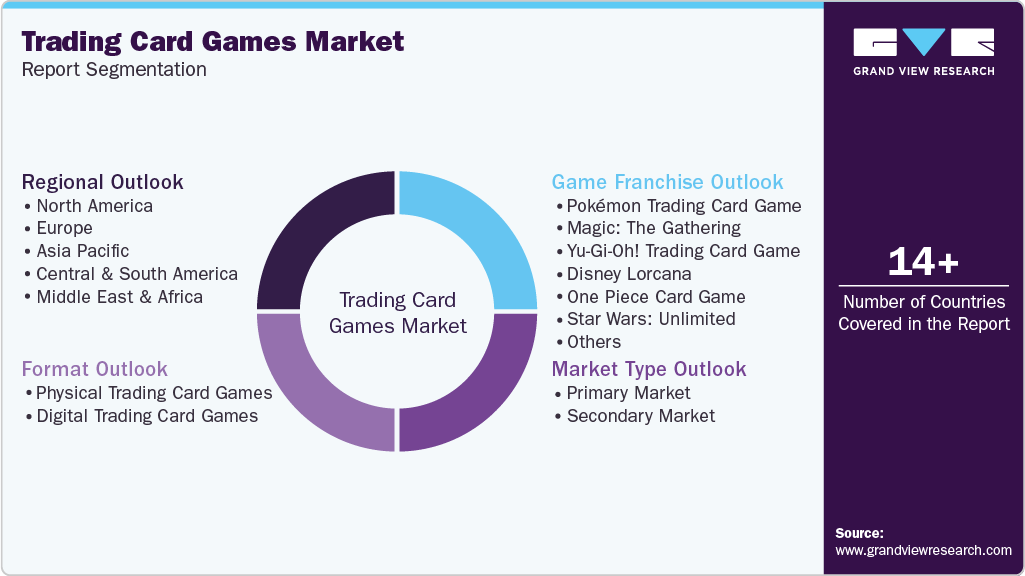
This report forecasts revenue growth at the global, regional & country levels and provides an analysis of the latest trends and opportunities in each sub-segment from 2021 to 2033. For this study, Grand View Research has segmented the trading card games market based on market type, format, game franchise, and region.
 To learn more about this report, Download Free Sample Report
-
Game Franchise Outlook (Revenue, USD Million, 2021 - 2033)
-
Pokémon Trading Card Game
-
Magic: The Gathering
-
Yu-Gi-Oh! Trading Card Game
-
Disney Lorcana
-
One Piece Card Game
-
Star Wars: Unlimited
-
Flesh and Blood
-
Others
-
-
Market Type Outlook (Revenue, USD Million, 2021 - 2033)
-
Primary Market
-
Secondary Market
-
-
Format Outlook (Revenue, USD Million, 2021 - 2033)
-
Physical Trading Card Games
-
Digital Trading Card Games
-
-
Regional Outlook (Revenue, USD Million, 2021 - 2033)
-
North America
-
U.S.
-
Canada
-
Mexico
-
-
Europe
-
UK
-
Germany
-
France
-
Italy
-
Spain
-
-
Asia Pacific
-
China
-
India
-
Japan
-
South Korea
-
Australia & New Zealand
-
-
Central & South America
-
Brazil
-
Argentina
-
-
Middle East & Africa
-
South Africa
-
UAE
-
-
Research Methodology
The trading card games market figures in this report are based on a proven research process that combines executive interviews with secondary research from proprietary databases, company filings, and recognized regulatory and institutional sources. Market size is built through value-chain sizing-reconciling supply-side and demand-side estimates-and triangulated with bottom-up and top-down approaches. Every estimate passes multiple levels of expert validation before publication, with each trading card games segment quantified using the revenue-capture definitions in the table below.
Segment Definition
Segment - Format
Revenue capture definition
Physical Trading Card Games
This segment covers the revenues generated through the trading card games market from the sale of physical card-based products that are collected, traded, and used for in-person gameplay. These products typically include booster packs, starter decks, collector boxes, tournament kits, promotional cards, and expansion sets sold through hobby stores, mass retailers, specialty gaming stores, and e-commerce channels. Growth in this segment is supported by organized play events, collector demand, competitive tournaments, and franchise-based fan communities.
Digital Trading Card Games
This segment covers the revenues generated through the trading card games market from digitally distributed card games that enable players to collect, build decks, and compete through online platforms, mobile applications, and PC-based gaming ecosystems. Revenue is generated through digital card packs, in-game purchases, season passes, virtual currencies, expansion content, and premium subscriptions. The segment benefits from growing adoption of digital gaming, cross-platform accessibility, online tournaments, and integration with esports and streaming communities.
Estimation Model
Layer
Key Question
Description
Trading Card Game Player & Collector Base Layer
Who participates in trading card games?
Begin with the global base of trading card game participants, including competitive players, casual players, collectors, hobby enthusiasts, anime fans, and franchise followers. Apply participation rates across key franchises such as Pokémon, Magic: The Gathering, Yu-Gi-Oh!, One Piece, Disney Lorcana, and Flesh and Blood to estimate the total addressable TCG consumer ecosystem.
Product Accessibility & Distribution Layer
Who has access to trading card game products?
Filter the eligible consumer base using penetration of hobby stores, specialty game retailers, mass merchants, e-commerce platforms, direct-to-consumer channels, and organized play networks. Account for factors such as retail availability, product localization, franchise popularity, online accessibility, and distribution infrastructure to estimate the addressable TCG market.
Active Purchasing & Engagement Layer
Who actively purchases trading card game products?
Apply purchasing and engagement rates among collectors, competitive players, casual consumers, investors, and repeat buyers. Consider factors such as tournament participation, expansion set releases, collecting behavior, deck-building requirements, rarity demand, secondary market activity, and franchise loyalty to estimate the number of active consumers participating in the trading card games market.
Monetisation Layer
How much revenue is generated?
Multiply annual transaction volumes by blended average spending across booster packs, starter decks, collector boxes, premium products, accessories, digital TCG content, and secondary market transactions. Include revenue generated through physical trading card sales, digital trading card games, organized play participation, and marketplace transactions to estimate total trading card games market revenue.
Delivered Customizations
This report has been delivered with the following In-depth customizations
Client Request
Customization Delivered
Value Adds
Market Type Analysis
Developed a detailed assessment of consumer spending and transaction behavior across primary and secondary TCG markets. The study evaluated demand drivers for newly released products, including booster packs, starter decks, and expansion sets, and assessed secondary market activity for graded cards, rare collectibles, limited-edition releases, and investor-driven purchases.
Enables stakeholders to understand the distribution of revenue between new product sales and resale activity, identify growth opportunities in collectibles and graded cards, and evaluate the impact of scarcity, pricing dynamics, and collector demand on market performance.
Format Analysis
Delivered a customized evaluation of consumer engagement across physical and digital trading card game formats. The analysis assessed purchasing behavior for physical cards, participation in organized play, collecting trends, and digital adoption via online gameplay platforms, mobile applications, in-game purchases, and digital card ecosystems.
Provides actionable insights into shifting consumer preferences, format adoption trends, digital monetization opportunities, and long-term growth potential across physical and digital TCG ecosystems, to support investment and product development decisions.
Game Franchise Analysis
Conducted a focused assessment of franchise-level demand, evaluating player engagement, collector activity, organized play ecosystems, expansion release strategies, and brand loyalty across leading TCG franchises. The analysis also assessed competitive positioning, market share dynamics, franchise growth trajectories, and consumer migration between game ecosystems.
Supports strategic planning by identifying high-growth franchises, competitive threats, expansion opportunities, and long-term revenue drivers. Helps stakeholders prioritize investments, optimize franchise portfolios, and align product strategies with evolving consumer demand across the global trading card games market.
Frequently Asked Questions About This Report
The trading card games market size was estimated at USD 18.5 billion in 2025 and is expected to reach USD 19.7 billion in 2026.
The trading card games market is expected to grow at a compound annual growth rate of 7.2% from 2026 to 2033, reaching USD 32.1 billion by 2033.
The secondary market accounted for the largest market share of 53.6% in 2025.
The North America regional market accounted for the largest market share, with a revenue share of 38.9% in 2025.
Asia Pacific is the fastest-growing region over the forecasted period.
Consumers increasingly view trading cards as both entertainment products and collectible assets. Limited-edition releases, rare cards, and premium collections encourage repeat purchases and long-term collecting among children, teenagers, and adults. Publishers continue to invest in local tournaments, regional championships, and international competitions that strengthen player communities. Organized events encourage continuous deck upgrades, expansion pack purchases, and higher player retention.
Key players in the trading card games market are The Pokémon Company, Hasbro, Inc., Konami Group Corporation, Ravensburger AG, Bandai Co., Ltd., Bushiroad Inc., Legend Story Studios Limited, Upper Deck Company, Panini S.p.A., and Fantasy Flight Games.
Physical trading card games accounted for the largest market share of 82.0% in 2025, while digital trading card games segment is fastest growing format.
The Pokémon Trading Card Game accounted for the largest game-franchise share, at 36.0% in 2025.
About the Author(s)
Homecare & Decor Research Team
Consumer Goods · Homecare & DecorThis report was authored by the homecare & decor research team at Grand View Research - comprising two research analysts, one senior research analyst, and one industry expert - with specialized expertise in the homecare & decor segment of the consumer goods industry. All findings are based on proprietary consumer goods databases, executive interviews, and regulatory analysis, subject to internal peer review prior to publication.
Last Updated:
Speak to Analyst

Customize this report to your needs - add regions, segments, or data points, with 20% free customization.
Or view our licence options:


ISO 9001:2015 & 27001:2022 Certified
We are GDPR and CCPA compliant! Your transaction & personal information is safe and secure. For more details, please read our privacy policy.


