
- Home
- »
- Automotive & Transportation
- »
-
Truck And Bus Radial Tire Market Size, Share Report, 2033GVR Report cover

Truck And Bus Radial Tire Market (2026 - 2033)
Size, Share & Trends Analysis Report By Application (Trucks, Buses), By Sales Channel (Aftermarket, OEMs), By Region (North America, Europe, Asia Pacific, Latin America), And Segment Forecasts
Market Size, 2025
$20.6BMarket Estimate, 2026
$21.6BMarket Forecast, 2033
$37.7BCAGR, 2026–2033
8.3%Truck And Bus Radial Tire Market Summary
The global truck and bus radial tire market size was valued at USD 20.6 billion in 2025 and is projected to grow from USD 21.6 billion in 2026 to USD 37.7 billion by 2033, growing at a CAGR of 8.3% from 2026 to 2033. Asia Pacific dominated the global market with the largest revenue share of 49.9% in 2025. The growing demand for trucks and buses across various industries is a major factor driving the truck & bus radial (TBR) tire market.
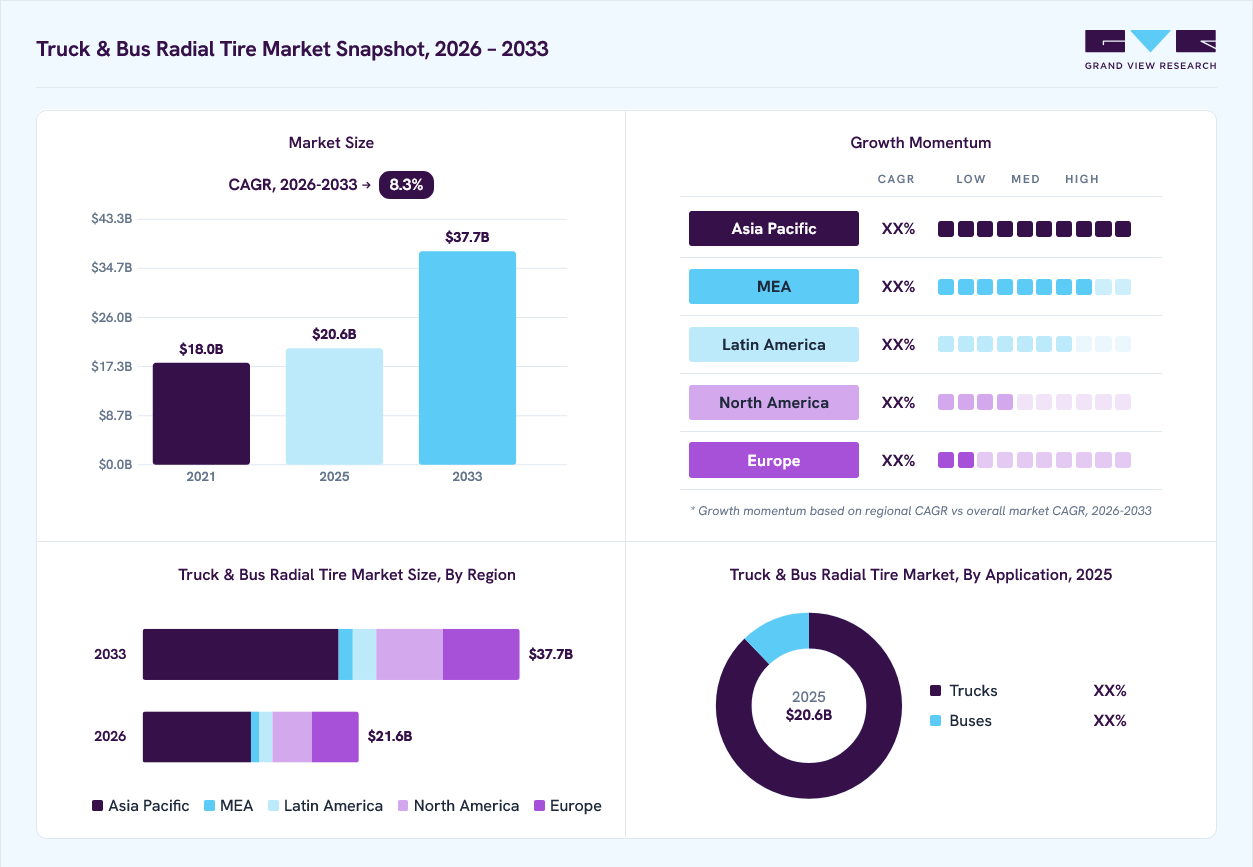 Source: Grand View Research, IR Documents, Primary Interviews, Paid DatabasesTo learn more about this report,
 Download Free Sample Report
Key Market Trends & Insights
- By application: Trucks segment led the market, with a revenue share of 87.7% in 2025.
- By sales channel: Aftermarket segment held the largest market share of 74.4% in 2025.
Regional Highlights
- Largest regional market: Asia Pacific (49.9% revenue share, 2025)
- By country: The China held the largest market share in 2025.
Market Size & Forecast
- Market size in 2025: USD 20.6 Billion
- Estimated market size in 2026: USD 21.6 Billion
- Projected market size by 2033: USD 37.7 Billion
- CAGR (2026-2033): 8.3%
Prism AI by Grand View Research Free to tryAsk a question about the truck and bus radial tire marketTry asking✓Every figure cited from GVR research Prefer the report? Download free sample →
The rapid expansion of e-commerce, urbanization, and globalization has significantly increased the need for efficient transportation and logistics services. With more goods being transported across cities and countries, fleet operators are investing in new commercial vehicles to meet the rising freight demand.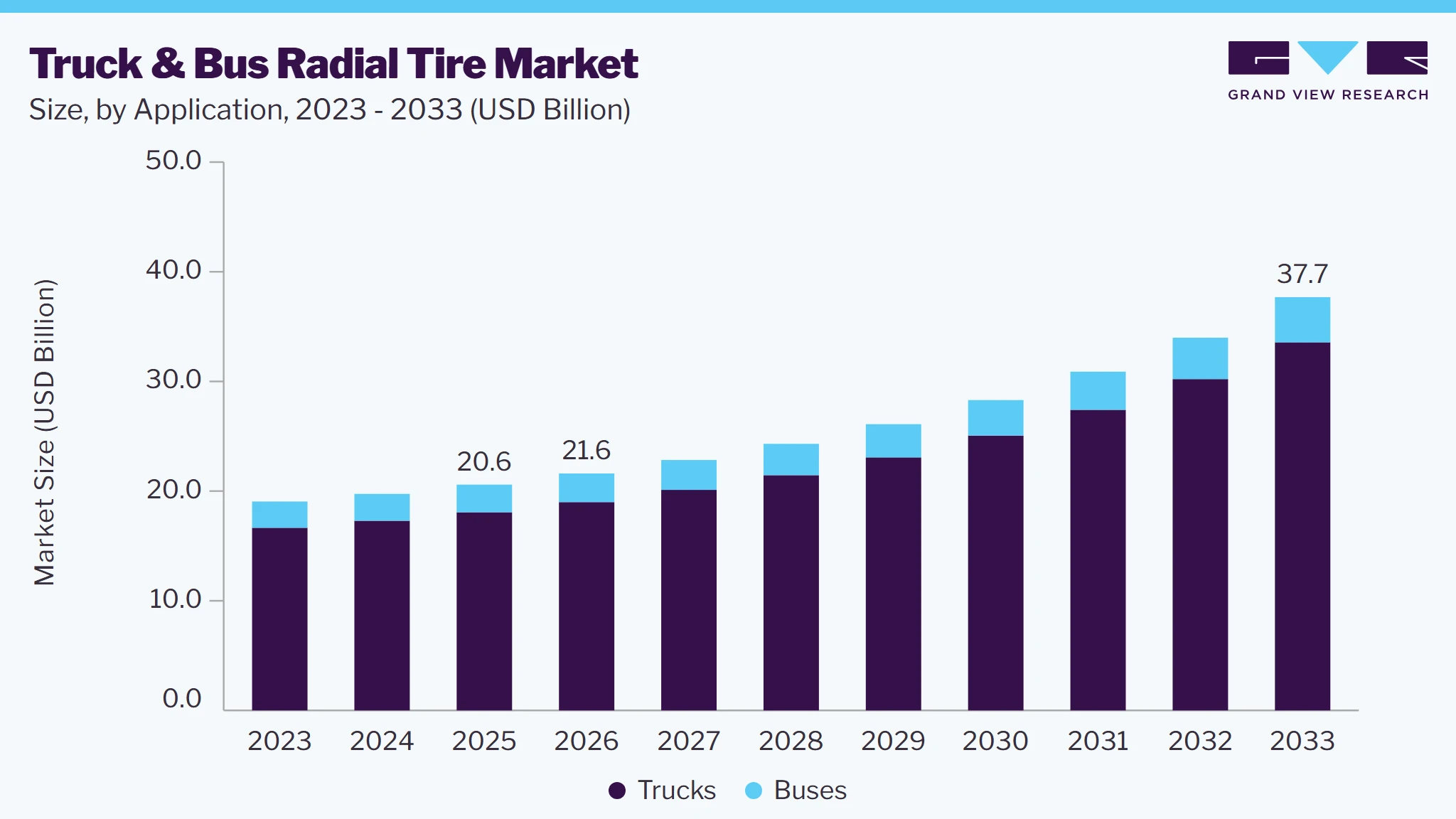 To learn more about this report, Download Free Sample Report
In addition, the public transportation sector is witnessing substantial growth due to increased urban population and government initiatives promoting mass transit systems to reduce traffic congestion and pollution. Many cities are expanding their bus fleets to improve public transport accessibility, further boosting demand for TBR tires. Since radial tires offer benefits like enhanced fuel efficiency, longer lifespan, and better load-carrying capacity, they have become the preferred choice for fleet owners and transportation companies.
The expansion of the aftermarket and retreading services also drives growth of the market. The aftermarket for TBR tires is witnessing steady growth, driven by the increasing preference for tire retreading services among fleet operators. Radial tires have a longer tread life and can be retreaded multiple times, making them a cost-effective solution for commercial vehicle owners. The expanding network of tire retreading services and the growing availability of high-quality aftermarket TBR tires are contributing to overall market expansion.
Furthermore, many countries are investing in large-scale infrastructure projects, including road construction, highway expansion, and transportation networks. Improved road connectivity increases the demand for heavy-duty commercial vehicles, directly boosting the need for durable and high-performance radial tires. In developing economies such as India, China, and Brazil, government-led initiatives to modernize transport infrastructure are accelerating the adoption of TBR tires for long-haul and intercity transportation.
However, the high initial cost of radial tires restrains the growth of the market. Radial tires are more expensive due to their advanced construction, superior materials, and enhanced durability. For small fleet operators and budget-conscious businesses, the upfront investment in radial tires can be a deterrent, leading them to opt for lower-cost alternatives. This price sensitivity is particularly evident in developing economies, where cost considerations often outweigh long-term benefits.
Market Dynamics
The truck & bus radial tire market is shaped by expanding freight movement, rising demand for public transportation, and increasing focus on fleet efficiency and total cost of ownership. Macroeconomic trends such as infrastructure development, urbanization, and cross-border trade continue to support sustained demand for commercial vehicles, directly influencing radial tire consumption. Technological advances in tire compounds, tread design, and casing durability are shifting preference toward radial tires due to their longer lifespan and improved fuel efficiency. Moreover, the market is moving toward performance-optimized, durable, and digitally enabled tire solutions.
Fleet operators face persistent pressure from fuel price volatility, regulatory compliance costs, and rising vehicle maintenance expenses. Tires represent a significant share of fleet operating costs, particularly for long-haul trucks and high-utilization buses. As logistics companies and public transport operators prioritize lifecycle cost reduction, demand has intensified for products that can deliver longer mileage, lower rolling resistance, and reduced downtime.
Truck & Bus Radial tires address this challenge through advanced tread compounds, optimized sidewall construction, and retread-friendly casing designs. These features enable lower fuel consumption, extended service life, and improved retread ability, directly supporting fleet cost-efficiency goals. As a result, TBR tires are increasingly adopted across high-mileage applications, accelerating revenue growth in both OEM and aftermarket channels.
Despite long-term economic benefits, truck & bus radial tires involve higher upfront costs than conventional bias tires. This price differential poses a significant barrier to adoption for cost-sensitive fleet operators, particularly in developing economies where capital expenditure decisions are heavily constrained. Small fleet owners and independent transporters often prioritize immediate cost savings over long-term efficiency.
The impact of this restraint is more pronounced in emerging markets across Asia, Africa, and parts of Latin America, where bias tires continue to dominate replacement demand. Price sensitivity is especially high in short-haul trucking and rural bus operations, which is slowing the adoption of radial tires. This dynamic moderate’s overall market growth despite strong long-term value propositions.
The growing acceptance of tire retreading and service-based fleet management solutions presents a significant opportunity for the TBR tire market. Improvements in casing durability and retread technology have enhanced the economic viability of multi-life tire usage. Fleet operators increasingly view tires as managed assets rather than consumables.
This shift creates strong growth potential for manufacturers offering retread-compatible designs, digital monitoring, and service contracts. Vendors with established service networks and advanced casing technologies are best positioned to capture this opportunity, particularly in large fleet segments such as long-haul trucking and intercity bus transportation.
Analyst Perspective
The truck & bus radial tire market is currently characterized by steady, replacement-driven demand supported by expanding freight activity, infrastructure development, and rising fleet utilization across both developed and emerging economies. Key growth forces include increasing emphasis on fuel efficiency, lower total cost of ownership, and regulatory pressure to improve vehicle performance and emissions efficiency. Technology trends such as advanced tread compounds, enhanced casing durability, and the growing adoption of retread optimized and digitally monitored tires are reshaping product differentiation. Moreover, investment is expected to remain focused on R&D for high-mileage radial tires and smart tire technologies, as well as the expansion of service-oriented business models. Competitive dynamics are shifting toward integrated solutions, with manufacturers increasingly combining products, data, and fleet services to strengthen long-term customer engagement and defend aftermarket share.
Application Insights
Based on application, the trucks segment led the market with the largest revenue share of 87.7% in 2025. The enhanced durability and longevity offered by radial tires drive its adoption in trucks. Radial tires offer significantly higher durability and longevity compared to bias-ply tires, making them an attractive choice for truck operators. The radial construction allows for better heat dissipation, reducing the risk of blowouts and excessive wear. This extended lifespan translates to lower replacement frequency, reducing overall operating costs for fleet operators.
The bus segment is expected to grow at a significant CAGR over the forecast period. Improved ride comfort and passenger safety offered by radial tires drive its adoption in buses. Radial tires are designed with a flexible sidewall and independent tread, which results in better shock absorption and reduced vibrations. This leads to a smoother and more comfortable ride for passengers, which is especially important for long-distance and public transit buses.
Sales Channel Insights
Based on sales channel, the aftermarket segment led the market with the largest revenue share of 74.4% in 2025. The rising number of trucks and buses in operation, coupled with an aging fleet, is a major factor driving the growth of the aftermarket TBR tire segment. As commercial vehicles accumulate higher mileage, their tires experience wear and tear, necessitating frequent replacements. Many fleet operators prefer aftermarket radial tires as a cost-effective alternative to OEM tires while still ensuring safety and performance. This growing demand for replacement tires fuels the expansion of the TBR aftermarket.
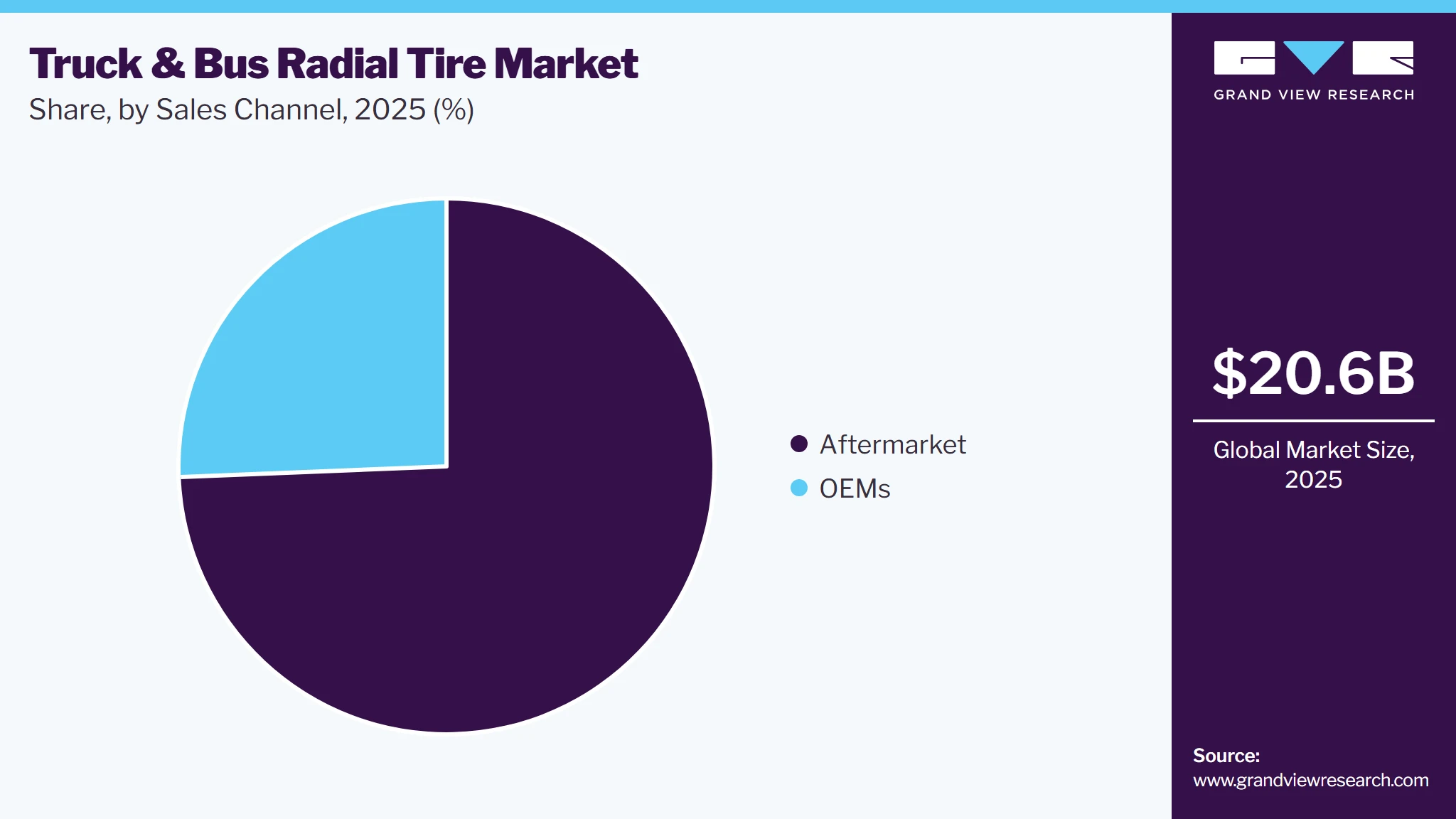 To learn more about this report, Download Free Sample Report
The OEM segment is expected to grow at a significant CAGR during the forecast period. Increasing production of commercial vehicles drives the growth of the segment. The demand for OEM truck and bus radial (TBR) tires is directly linked to the growth of commercial vehicle production. As economies expand and urbanization increases, the need for trucks and buses for freight transportation, public transit, and logistics has surged. Leading truck and bus manufacturers are equipping their vehicles with high-quality radial tires to enhance performance, durability, and fuel efficiency. This increasing production rate is significantly driving the growth of the segment.
Regional Insights
The North America truck & bus radial tire market held a significant share in 2025. North America has a robust presence of original equipment manufacturers (OEMs) supplying commercial trucks and buses, creating a steady demand for TBR tires. Leading truck manufacturers such as Freightliner, Kenworth, and Peterbilt equip their vehicles with high-performance radial tires, driving the market forward.
U.S. Truck & Bus Radial Tire Market Trends
The truck & bus radial (TBR) tire industry in the U.S. held a dominant position in 2025 due to the increasing shift toward electric and autonomous trucks. As major logistics companies and fleet operators invest in electric trucks for sustainable transportation, the need for advanced radial tires designed for electric vehicles is growing. Radial tires with lower rolling resistance are particularly beneficial for electric trucks, as they help extend battery life and improve energy efficiency.
Europe Truck & Bus Radial Tire Market Trends
The truck & bus radial (TBR) tire industry in Europe was identified as a lucrative region in 2025. European countries have some of the strictest environmental regulations globally, pushing the commercial vehicle industry toward sustainable practices. Regulations such as the Euro 6 emissions standards and the EU Green Deal encourage fleet operators to adopt fuel-efficient solutions, including radial tires. TBR tires help reduce fuel consumption and lower CO₂ emissions, making them an attractive option for companies looking to comply with environmental standards while optimizing operational costs.
The U.K. truck & bus radial (TBR) tire market is expected to grow rapidly in the coming years due to the growth of public transportation and the electrification of bus fleets. The U.K.’s public transport sector is undergoing significant modernization, with cities such as London, Manchester, and Birmingham investing in electric and hybrid buses. The government’s push towards zero-emission bus fleets, supported by funding initiatives such as the ZEBRA (Zero Emission Bus Regional Areas) program, is increasing demand for specialized radial tires designed for electric buses.
The truck & bus radial (TBR) tire industry in Germany held a substantial market share in 2025 owing to the rising adoption of telematics and smart fleet management. Fleet operators in Germany are heavily investing in telematics and predictive maintenance technologies, integrating solutions such as Tire Pressure Monitoring Systems (TPMS) and intelligent tire sensors. These advancements increase demand for high-quality TBR tires that can withstand long-distance travel while providing real-time performance data. The rise of digital fleet management solutions is pushing fleet owners to choose premium radial tires to optimize costs and improve vehicle efficiency.
Asia Pacific Truck & Bus Radial Tire Market Trends
Asia Pacific dominated the global truck & bus radial tire market with the largest revenue share of 49.9% in 2025. Rising demand for retreaded and cost-effective tires drives the growth of the market in the regions fleet operators seek cost-effective and sustainable tire solutions. Retreading extends the lifespan of radial tires, reducing overall operational costs while maintaining safety and performance standards.
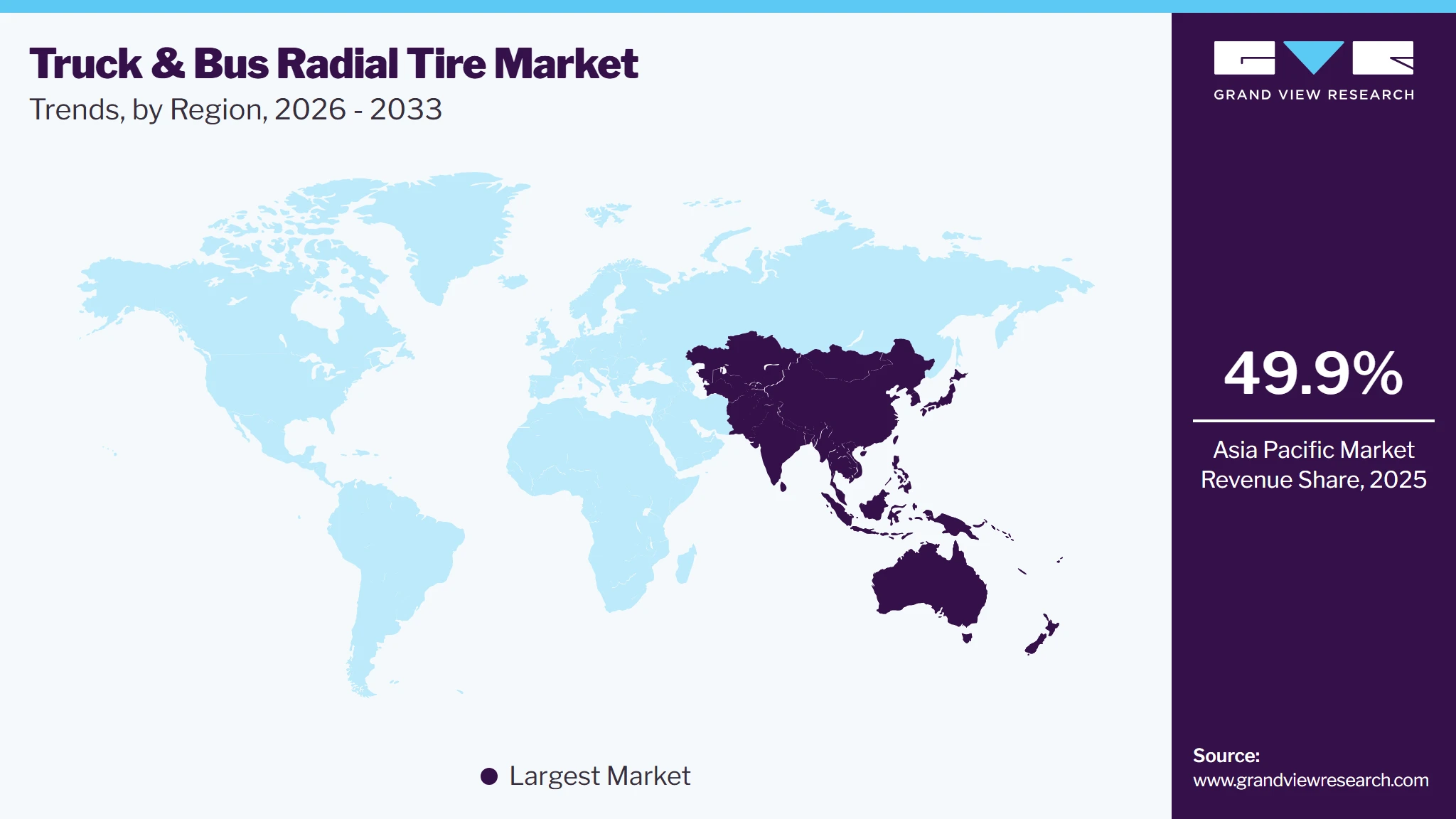 To learn more about this report, Download Free Sample Report
Japan truck & bus radial (TBR) tire market is expected to grow rapidly over the forecast period. Japan is at the forefront of automotive technology and innovation, and this extends to the TBR tire market. Fleet operators are increasingly adopting smart tires equipped with sensors for real-time monitoring of pressure, temperature, and tread wear. Companies such as Bridgestone and Yokohama are developing intelligent radial tires integrated with telematics and fleet management systems, allowing operators to enhance vehicle performance and safety while reducing operational costs.
The truck & bus radial (TBR) tire market in India held a substantial market share in 2025 owing to the expansion of public transportation networks and infrastructure projects. Cities across India are investing in modernizing their public bus fleets with fuel-efficient and durable tires to improve performance and reduce maintenance costs. Moreover, infrastructure development, including road expansions, highway improvements, and the rise of smart city initiatives, is supporting the growth of commercial vehicles, further driving the demand for TBR tires.
Key Truck & Bus Radial Tire Company Insights
Some of the key companies in the truck & bus radial (TBR) tire market include MICHELIN, Apollo Tires, Yokohoma Rubber Corporation, Bridgestone Corporation, Continental AG, and others. Organizations are focusing on increasing customer base to gain a competitive edge in the industry. Therefore, key players are taking several strategic initiatives, such as mergers and acquisitions, and partnerships with other major companies.
-
Michelin is a tire manufacturer headquartered in Clermont-Ferrand, France. Founded in 1889, the company is recognized for its innovative and high-performance tires for a wide range of vehicles, including passenger cars, trucks, buses, motorcycles, bicycles, and specialty vehicles used in agriculture, construction, and aviation. Michelin is a pioneer in radial tire technology and continues to invest in research and development to enhance tire durability, fuel efficiency, and sustainability. The company also focuses on mobility solutions, including digital fleet management services and sustainable mobility initiatives.
-
Apollo Tyres is a tire manufacturer headquartered in Gurugram, India. Established in 1972, the company specializes in producing a wide range of tires for passenger cars, commercial vehicles, two-wheelers, off-highway vehicles, and retreading applications. Apollo Tyres operates under two key brands-Apollo and Vredestein-catering to diverse market segments across Asia, Europe, and other international markets.
Key Truck & Bus Radial Tire Companies:
The following are the leading companies in the truck & bus radial tire market.
-
MICHELIN
-
Apollo Tires
-
Yokohoma Rubber Corporation
-
Bridgestone Corporation
-
Sumitomo Rubber Industries, Ltd.
-
Continental AG
-
Balkrishna Industries Limited (BKT)
-
Giti Tire
-
The Goodyear Tire & Rubber Company
-
Kumho Tir
Competitive Benchmarking
Category
Operating Strategies
Competitive Edge
Weakness
Established Players (MICHELIN, Bridgestone Corporation, The Goodyear Tire & Rubber Company, Continental AG, Yokohama Rubber Corporation)
- These players are focused on premium TBR portfolios, strong OEM partnerships, and integrated fleet solutions. Heavy investment in R&D and global service networks.
- These players have strong brand equity, advanced casing technology, and retreading ecosystems.
- Higher price points limit penetration in cost-sensitive markets.
Emerging Players (Apollo Tyres, Balkrishna Industries Limited)
- These players are focused on expansion through value-focused products, regional manufacturing, and selective OEM tie-ups.
- These players have competitive pricing, growing distribution footprint, and improving product quality.
- Limited premium portfolio depth and global service coverage.
Recent Developments
-
In January 2025, Continental Tires launched a new range of premium vehicle and truck radial tires in India, including the PremiumContact 6 (PC6) and Gen3 truck radial tires. The PC6 tires are designed with advanced technologies such as Macroblock technology for superior grip and cornering performance, making them suitable for SUVs and premium cars. They feature a silica compound that enhances wet and dry grip, along with an asymmetric tread pattern for improved stiffness.
-
In September 2024, CEAT, an Indian tire manufacturer, inaugurated a new production line for Truck Bus Radial (TBR) tires at its Chennai manufacturing facility. This strategic move is part of CEAT's broader global expansion strategy, aiming to enhance its presence in international markets, particularly in Europe and the US. The new TBR line is expected to increase production capacity to 1,500 tires per day over the next 12 months, significantly bolstering CEAT's manufacturing capabilities.
Truck & Bus Radial Tire Market Report Scope
Report Attribute
Details
Market size value in 2025
USD 20.6 billion
Market size value in 2026
USD 21.6 billion
Revenue forecast in 2033
USD 37.7 billion
Growth rate
CAGR of 8.3% from 2026 to 2033
Base year for estimation
2025
Historical data
2021 - 2024
Forecast period
2026 - 2033
Quantitative units
Revenue in USD billion, and CAGR from 2026 to 2033
Report coverage
Revenue forecast, company market share, competitive landscape, growth factors, and trends
Segments covered
Application, sales channel, region
Regional scope
North America; Europe; Asia Pacific; Latin America; MEA
Country scope
U.S.; Canada; Mexico; Germany; U.K.; France; China; Japan; India; South Korea; Australia; Brazil; Saudi Arabia; UAE; South Africa
Key companies profiled
MICHELIN; Apollo Tires; Yokohoma Rubber Corporation; Bridgestone Corporation; Sumitomo Rubber Industries, Ltd.; Continental AG; Balkrishna Industries Limited (BKT); Giti Tire; The Goodyear Tire & Rubber Company; Kumho Tir
Customization scope
Free report customization (equivalent up to 8 analysts' working days) with purchase. Addition or alteration to country, regional & segment scope.
Pricing and purchase options
Avail customized purchase options to meet your exact research needs. Explore purchase options
Global Truck & Bus Radial Tire Market Report Segmentation
This report forecasts revenue growth at global, regional, and country levels and provides an analysis of the latest industry trends in each of the sub-segments from 2021 to 2033. For this study, Grand View Research has segmented the global truck & bus radial tire market report based on application, sales channel, and region.
 To learn more about this report, Download Free Sample Report
-
Application Outlook (Revenue, USD Billion, 2021 - 2033)
-
Trucks
-
Buses
-
-
Sales Channel Outlook (Revenue, USD Billion, 2021 - 2033)
-
Aftermarket
-
OEMs
-
-
Regional Outlook (Revenue, USD Billion, 2021 - 2033)
-
North America
-
U.S.
-
Canada
-
Mexico
-
-
Europe
-
Germany
-
U.K.
-
France
-
-
Asia Pacific
-
China
-
Japan
-
India
-
South Korea
-
Australia
-
-
Latin America
-
Brazil
-
-
Middle East and Africa (MEA)
-
Saudi Arabia
-
UAE
-
South Africa
-
-
Research Methodology
The truck and bus radial tire market figures in this report are based on a proven research process that combines executive interviews with secondary research from proprietary databases, company filings, and recognized regulatory and institutional sources. Market size is built through value-chain sizing - reconciling supply-side and demand-side estimates - and triangulated with bottom-up and top-down approaches. Every estimate passes multiple levels of expert validation before publication, with each truck and bus radial tire segment quantified using the revenue-capture definitions in the table below.
Segment Definition
Segment - Application
Revenue capture definition
Trucks
Revenue generated from original equipment and replacement radial tires used in light, medium, and heavy-duty commercial trucks, including long-haul, regional haul, and construction-related trucking fleets.
Buses
Revenue derived from radial tires supplied for city buses, intercity coaches, and school buses, covering both OEM fitment and recurring aftermarket replacement cycles.
Segment - Sales Channel
Revenue capture definition
Aftermarket
Sales of replacement truck & bus radial tires through dealers, distributors, and fleet service contracts, including retread-ready casings and value-added tire services.
OEMs
Revenue from direct supply of TBR tires to truck and bus manufacturers for factory-installed fitment on new commercial vehicles.
Estimation Model
Layer Name
Key Question
Description
Vehicle Parc Base
How many trucks and buses are in operation?
This layer estimates the active commercial vehicle population by region and application. It forms the foundation for replacement demand assessment by accounting fleet size, utilization intensity, and vehicle age distribution.
Tire Fitment & Replacement Rate
How many radial tires are required per vehicle annually?
This layer evaluates average tire fitment per vehicle and replacement frequency based on mileage, road conditions, and operating cycles. Radial tire lifespan and retread cycles are incorporated.
Channel & Price Realization
What is the revenue captured per tire?
This layer applies average selling prices across OEM and aftermarket channels, accounting for regional price variation, premiumization, and service bundling.
Market Aggregation
What is the total market value?
The final layer aggregates volume and pricing across applications, channels, and regions to derive total truck & bus radial tire market revenue.
Delivered Customizations
This report has been delivered with the following In-depth customizations
Client Request
Customization Delivered
Value Adds
Regional Truck & Bus Radial Tire Market Opportunity Assessment
Country/region-wise market sizing and forecasts
Analysis of demand, adoption trends, and regulatory landscape
Identification of high-growth regions and investment hotspots
Identified region-specific growth opportunities
Supported expansion and go-to-market strategy
Enabled informed regional investment decisions
Cross-Segmentation Analysis for the Truck & Bus Radial Tire Market
Criss-cross market analysis by application and sales channel
Demand and adoption assessment across key segments
Segment attractiveness and growth potential benchmarking
Identified high-potential market segments
Supported targeted product positioning and marketing strategy
Improved customer and segment prioritization
Competitive Benchmarking and Strategic Positioning in the Truck & Bus Radial Tire Market
Benchmarking of key competitors across products, pricing, partnerships, and innovation
Comparative assessment of market share, capabilities, and strategies
Analysis of competitive strengths, gaps, and differentiation areas
Identified competitive white spaces and growth gaps
Supported strategic positioning and differentiation
Enabled data-driven competitive strategy development
Frequently Asked Questions About This Report
Trucks segment dominated the market, with a revenue share of 87.7% in 2025. The enhanced durability and longevity offered by radial tires drive its adoption in trucks.
The global truck & bus radial tire market size was valued at USD 20.6 billion in 2025 and is estimated at USD 21.6 billion in 2026.
The global truck & bus radial tire market is expected to grow at a compound annual growth rate of 8.3% from 2026 to 2033, reaching USD 37.7 billion by 2033.
Some key players operating in the truck & bus radial tire market include MICHELIN; Apollo Tires; Yokohoma Rubber Corporation; Bridgestone Corporation; Sumitomo Rubber Industries, Ltd.; Continental AG; Balkrishna Industries Limited (BKT); Giti Tire; The Goodyear Tire & Rubber Company; Kumho Tir.
Asia Pacific dominated the global market with the largest revenue share of 49.9% in 2025. Rising demand for retreaded and cost-effective tires drives the growth of the market in the regions where fleet operators seek cost-effective and sustainable tire solutions.
The China held the largest market share in 2025.
Aftermarket segment held the largest market share of 74.4% in 2025, and it is the fastest growing region over the forecast period.
The rising number of trucks and buses in operation, coupled with an aging fleet, is driving the growth of the aftermarket TBR tire segment.
The growing demand for trucks and buses across various industries is driving the growth of the truck & bus radial (TBR) tire market.
About the Author(s)
Automotive & Transportation Research Team
Technology · Automotive & TransportationThis report was authored by the automotive & transportation research team at Grand View Research - comprising two research analysts, one senior research analyst, and one industry expert - with specialized expertise in the automotive & transportation segment of the technology industry. All findings are based on proprietary technology databases, executive interviews, and regulatory analysis, subject to internal peer review prior to publication.
Last Updated:
Speak to Analyst

Customize this report to your needs - add regions, segments, or data points, with 20% free customization.
Or view our licence options:


ISO 9001:2015 & 27001:2022 Certified
We are GDPR and CCPA compliant! Your transaction & personal information is safe and secure. For more details, please read our privacy policy.


