
- Home
- »
- Automotive & Transportation
- »
-
Truck Market Size, Share, Growth And Analysis Report, 2033GVR Report cover
![Truck Market (2026 - 2033)Report]()
Truck Market (2026 - 2033)
Size, Share & Trends Analysis Report By Vehicle Type, By Tonnage Capacity, By Fuel Type (Diesel, Petrol, CNG/LNG, Electric) By Application (Logistics, Construction, Agriculture, Mining, Utility), By Region, And Segment Forecasts
Market Size, 2025
$950.4BMarket Estimate, 2026
$1,011.9BMarket Forecast, 2033
$1,620.7BCAGR, 2026–2033
7.0%Truck Market Summary
The global truck market size was valued at USD 950.4 billion in 2025 and is projected to grow from USD 1,011.9 billion in 2026 to USD 1,620.7 billion by 2033, at a CAGR of 7.0% from 2026 to 2033. The market in Asia Pacific dominated with a revenue share of 60.2% in 2025. The continued expansion of e-commerce, organized retail, manufacturing, and cross-border trade is increasing demand for trucks across regional and long-haul transportation networks.

Key Market Trends & Insights
- By vehicle type: Light duty segment held the largest market share of 57.1% in 2025.
- By tonnage capacity: 3.5-7.5 Tons segment held the largest market share of 49.3% in 2025.
- By fuel type: Diesel segment held the largest market share of 80.1% in 2025.
- By application: Logistics segment held the largest market share of 50.5% in 2025.
Regional Highlights
- Largest regional market: Asia Pacific (60.2% revenue share, 2025)
- By country: China held the largest market share in 2025
Market Size & Forecast
- Market size in 2025: USD 950.4 Billion
- Estimated market size in 2026: USD 1,011.9 Billion
- Projected market size by 2033: USD 1,620.7 Billion
- CAGR (2026-2033): 7.0%
Growth in online retail is generating higher volumes of last-mile, middle-mile, and distribution-center transportation, supporting demand for light- and medium-duty trucks. At the same time, globalization and regionalization of manufacturing supply chains are increasing the movement of raw materials, components, and finished goods. Emerging economies are investing in highways, logistics parks, ports, and multimodal freight infrastructure, improving the efficiency and reach of road-based freight transportation.
The rapid development of manufacturing hubs in countries such as India, Mexico, Vietnam, and other Southeast Asian markets is creating additional demand for commercial freight vehicles. Truck utilization is also increasing as fleet operators seek to accommodate higher freight volumes and optimize delivery schedules. The expansion of cold-chain logistics, food distribution, and pharmaceutical transportation is further creating demand for specialized truck configurations. These trends are particularly beneficial for heavy- and medium-duty trucks used in intercity and industrial freight applications. Consequently, sustained growth in freight volumes and logistics infrastructure is expected to remain a fundamental driver of global truck demand through 2033.
Market Dynamics
Increasingly stringent emission, fuel-efficiency, and vehicle-safety regulations are accelerating the replacement of older truck fleets with newer, more efficient vehicles. Governments across North America, Europe, China, and other major markets are introducing tighter CO₂ and pollutant-emission requirements for commercial vehicles. These regulations are encouraging fleet operators to replace aging diesel trucks with vehicles incorporating cleaner engines, alternative fuels, and zero-emission powertrains. The transition toward battery-electric, fuel-cell, CNG/LNG, and other low-emission trucks is also expanding the technology addressable market.
Electric truck adoption is accelerating, particularly in urban delivery, regional haulage, utility, and high-utilization fleet applications where charging can be centralized, and vehicle routes are relatively predictable. Fleet operators are increasingly evaluating vehicles based on total cost of ownership, with lower energy and maintenance costs improving the business case for alternative powertrains.
The high upfront acquisition cost of new trucks remains a significant restraint, particularly for small and medium-sized fleet operators in price-sensitive emerging markets. Advanced trucks equipped with electric powertrains, automated transmissions, telematics, ADAS, and other technologies typically require higher initial investment than conventional vehicles. The cost differential is particularly significant for electric trucks because batteries account for a substantial portion of vehicle cost. Limited availability of commercial-vehicle financing and higher interest rates can further increase the financial burden on fleet operators. Although lower fuel and maintenance costs can improve the long-term economics of alternative-powertrain trucks, the payback period remains dependent on vehicle utilization, energy prices, route characteristics, and the availability of charging infrastructure. In developing markets, operators may therefore continue to purchase lower-cost conventional diesel trucks rather than invest in newer technologies. Residual-value uncertainty for electric and technologically advanced trucks can also make fleet owners cautious about large-scale replacement.
The transition toward electric, connected, and software-enabled trucks presents a significant growth opportunity for truck manufacturers and component suppliers through 2033. Increasing regulatory pressure to reduce commercial-vehicle emissions is encouraging fleet operators to evaluate battery-electric and other zero-emission trucks. Urban delivery, regional logistics, municipal services, mining, and other predictable-duty-cycle applications offer particularly attractive opportunities for electric trucks. Improvements in battery energy density, charging speed, vehicle range, and battery durability are progressively expanding the range of applications suitable for electrification. At the same time, connected-truck technologies such as telematics, predictive maintenance, fleet-management platforms, and real-time vehicle monitoring are enabling operators to improve utilization and reduce operating costs. Advanced driver-assistance systems and autonomous-driving technologies can further improve safety and productivity, particularly in controlled logistics, mining, and industrial environments. The integration of electrification with connected technologies creates opportunities for OEMs to generate additional revenue through software, digital services, energy-management solutions, and aftermarket offerings.
Market Concentration & Characteristics
The truck industry is moderately fragmented, characterized by large global truck OEMs, regional manufacturers, commercial-vehicle specialists, and emerging electric-truck companies competing across diverse vehicle classes and applications. Companies are actively focusing on developing fuel-efficient heavy-duty trucks, electric and alternative-fuel vehicles, advanced driver-assistance systems, connected trucks, autonomous driving technologies, and application-specific vocational vehicles. The market is benefiting from the ongoing expansion of logistics, e-commerce, construction, mining, agriculture, and infrastructure activities, which are creating demand for light-, medium-, and heavy-duty trucks across developed and emerging economies. Continuous advancements in battery technology, electric powertrains, automated transmissions, telematics, fleet-management systems, sensors, connectivity, and vehicle software are further intensifying competition among manufacturers. Growing demand for lower operating costs, higher payload capacity, improved vehicle uptime, enhanced safety, and compliance with increasingly stringent emission regulations is also encouraging manufacturers to expand their conventional and alternative-powertrain truck portfolios.
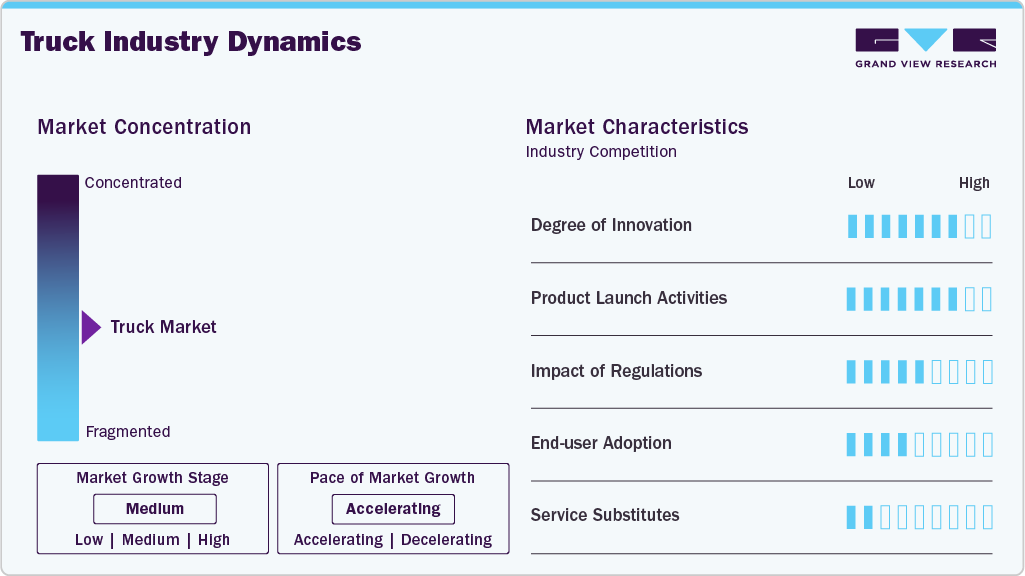
Fragmentation in the market is further supported by the presence of established truck manufacturers such as Daimler Truck, Volvo Group, PACCAR, Tata Motors, and TRATON GROUP, as well as regional manufacturers and emerging electric commercial vehicle companies. These participants offer broad portfolios covering light-, medium-, and heavy-duty trucks, tractor-trailers, vocational trucks, electric trucks, and specialized vehicles for logistics, construction, mining, agriculture, and utility applications. Market participants primarily compete on vehicle payload and GVW range, fuel efficiency, powertrain performance, total cost of ownership, reliability, safety technologies, connectivity, autonomous driving capabilities, customization, pricing, financing, dealer networks, and after-sales service, rather than on dominance by a single manufacturer.
Analyst Perspective
The market is transitioning from conventional internal-combustion powertrains toward more efficient, electrified, connected, and automated vehicle platforms. Growing investments in logistics, e-commerce, construction, mining, agriculture, manufacturing, and urban transportation are creating sustained demand for technologically advanced trucks. Fuel efficiency, total cost of ownership, payload optimization, vehicle uptime, safety, and emissions reduction are increasingly becoming key areas of competitive differentiation. Battery-electric powertrains, alternative fuels, telematics, automated transmissions, and advanced driver-assistance systems are enabling more connected and efficient truck operations. Future investments are expected to focus on higher-density batteries, faster charging, extended range, lightweight architectures, advanced safety systems, and autonomous-driving capabilities. Demand is also increasing for application-specific trucks designed for logistics, urban delivery, mining, construction, waste management, and other heavy-duty applications. Connected technologies such as predictive maintenance, fleet monitoring, route optimization, and remote diagnostics are becoming increasingly important for improving fleet utilization and reducing operating costs. Strategic partnerships among truck OEMs, battery manufacturers, charging infrastructure providers, technology companies, and fleet operators are expected to support the development of integrated commercial vehicle ecosystems. Overall, the convergence of electrification, connectivity, automation, and digital fleet management is expected to significantly influence technology development and competitive positioning in the market.
Vehicle Type Insights
The light duty trucks segment accounted for the largest share of 57.1% in 2025. The rapid growth of e-commerce, quick commerce, and omnichannel retail is increasing demand for light-duty trucks for last-mile and urban distribution. Growing delivery volumes require flexible vehicles capable of operating efficiently in congested urban environments. Light-duty trucks are particularly suitable for parcel delivery, food distribution, retail replenishment, and small-load transportation. The expansion of urban fulfillment centers is further increasing demand for smaller commercial vehicles with frequent stop-start operating cycles.
The heavy duty trucks segment is projected to grow at the fastest CAGR over the forecast period. The expansion of long-distance freight transportation, manufacturing, international trade, and large-scale logistics networks is driving demand for heavy-duty trucks. Increasing movement of raw materials, components, and finished goods requires vehicles capable of carrying high payloads over long distances. Growth in e-commerce and regional distribution networks is also increasing the volume of freight transported between ports, warehouses, distribution centers, and industrial facilities. Heavy-duty trucks remain essential for applications where high payload capacity, long driving range, and high vehicle utilization are critical.
Tonnage Capacity Insights
The 3.5-7.5 Tons segment accounted for the largest share of 49.3% of global revenue in 2025. These vehicles provide an effective balance between payload capacity, maneuverability, fuel efficiency, and operating cost for urban and regional delivery routes. Increasing same-day and next-day delivery requirements are encouraging logistics operators to expand their light commercial truck fleets. The growth of urban fulfillment centers is also increasing demand for vehicles capable of frequent loading and unloading operations. Their relatively compact dimensions allow operators to navigate congested city roads more efficiently than larger trucks. These trucks are also increasingly used for refrigerated transport, retail distribution, parcel delivery, and service applications. As urban freight volumes continue to increase, demand for 3.5-7.5-ton trucks is expected to remain strong.
The 16-30 Tons truck segment is projected to grow at the fastest CAGR over the forecast period. Increasing investment in roads, bridges, commercial buildings, industrial facilities, and urban infrastructure is driving demand for trucks in the 16-30-ton capacity range. These trucks provide the payload capacity needed to transport aggregates, construction materials, machinery, and other heavy loads while offering greater operating flexibility than the largest heavy-duty trucks. Infrastructure development across emerging economies is particularly supporting demand for medium- and heavy-duty rigid trucks. Growing urbanization is also increasing the requirements for construction material transportation within and around major cities.
Fuel Type Insights
The diesel segment led the market, accounting for 80.1% of global revenue share in 2025. The continued expansion of long-haul freight, heavy logistics, construction, mining, and industrial transportation is sustaining demand for diesel trucks. Diesel powertrains deliver high torque and strong pulling power, making them well-suited for high-payload applications and demanding operating conditions. Their relatively high energy density enables longer operating ranges with fewer refueling stops, which remains important for long-distance freight operators.
The electric segment is projected to grow at the fastest CAGR over the forecast period. Increasingly stringent CO₂ and pollutant-emission regulations are accelerating the transition from conventional diesel trucks toward electric powertrains. Governments and regulatory authorities across Europe, China, North America, and other major markets are introducing tighter emission targets for commercial vehicles. Fleet operators are therefore increasingly evaluating zero-emission trucks to reduce regulatory exposure and meet corporate decarbonization targets. Electric trucks produce zero tailpipe emissions, making them particularly attractive for urban logistics, municipal transportation, and other applications operating in emission-restricted areas
Application Insights
The logistics segment led the market, accounting for a global revenue share of 50.5% in 2025. The continued growth of e-commerce, quick commerce, organized retail, and omnichannel distribution is increasing freight volumes and creating sustained demand for trucks used in logistics operations. Rising online order volumes require frequent movement of goods between fulfillment centers, warehouses, distribution hubs, stores, and customers. The expansion of same-day and next-day delivery services is further increasing vehicle utilization and the need for flexible logistics fleets.

The mining application is projected to grow at the fastest CAGR over the forecast period. Rising demand for copper, lithium, nickel, iron ore, and other critical minerals is driving investment in new mines and the expansion of existing mining operations. The energy transition is increasing demand for minerals used in batteries, electric vehicles, renewable energy systems, and power infrastructure. Higher mining output requires transportation of ore, overburden, equipment, fuel, and other materials across mines and processing facilities. This is creating sustained demand for high-payload trucks capable of operating under demanding off-road conditions.
Regional Insights
The Asia Pacific truck market dominated with the largest global revenue share of 60.2% in 2025. Asia Pacific's continued industrialization, urbanization, and infrastructure investment are generating strong demand for commercial trucks across logistics, construction, manufacturing, mining, and agriculture. China, India, Southeast Asia, and other emerging economies are investing heavily in highways, industrial parks, ports, warehouses, and logistics infrastructure. Expansion of manufacturing activities is increasing the movement of raw materials, components, and finished goods across domestic and regional supply chains. The rapid growth of e-commerce is further increasing demand for trucks used in regional distribution and last-mile delivery.

China Truck Market Trends
The truck market in China held a significant share in the Asia Pacific. China's large manufacturing base, extensive e-commerce ecosystem, and expanding domestic distribution networks continue to generate strong demand for trucks. Growth in online retail and express delivery is increasing freight movement between manufacturers, warehouses, distribution centers, and consumers. China's position as a major global manufacturing and export hub also creates significant demand for medium- and heavy-duty trucks supporting industrial and port logistics.
Japan truck market is expected to grow at a high CAGR over the forecast period. The continued expansion of e-commerce, parcel delivery, food distribution, and urban logistics is supporting demand for trucks in Japan. Increasing delivery volumes are placing greater emphasis on efficient regional and last-mile transportation. Japan's dense urban areas require trucks that can operate efficiently on congested roads while maintaining high delivery frequency. The growth of automated warehouses and distribution centers is also increasing the movement of goods between logistics hubs.
North America Truck Market Trends
The truck market in North America led the global market and accounted for a significant share of the global revenue in 2025. The continued growth of e-commerce, retail distribution, manufacturing, and cross-border trade is increasing freight volumes across North America. The US-Canada-Mexico supply chain is generating sustained demand for trucks moving goods between manufacturing facilities, warehouses, distribution centers, ports, and retail locations. Nearshoring and the expansion of manufacturing capacity in Mexico are further increasing regional freight transportation requirements.
The U.S. truck market is expected to grow significantly from 2026 to 2033. The expansion of freight transportation, e-commerce, retail distribution, and domestic manufacturing is increasing demand for trucks across the US. The country’s extensive road-freight network supports the movement of goods between manufacturing facilities, ports, distribution centers, warehouses, and retailers. Growth in online retail is increasing demand for light- and medium-duty trucks for last-mile and regional deliveries, while long-haul freight continues to support heavy-duty truck demand.
Europe Truck Market Trends
The truck market in Europe is poised for significant growth from 2026 to 2033. The expansion of road freight, e-commerce, manufacturing, and cross-border trade is supporting demand for trucks across Europe. Trucks remain essential for transporting goods between manufacturing facilities, ports, distribution centers, warehouses, and retail networks. Growth in e-commerce is increasing demand for light- and medium-duty trucks for urban and regional distribution, while international road freight continues to support demand for heavy-duty vehicles. Europe's integrated road network and extensive cross-border trade further increase truck utilization across multiple countries.
The UK truck market held a moderate share in Europe. The continued growth of e-commerce, retail distribution, warehousing, and domestic freight transportation is supporting demand for trucks across the UK. Increasing parcel volumes and same-day delivery requirements are driving demand for light- and medium-duty trucks in urban and regional logistics. Heavy-duty trucks remain essential for transporting goods between ports, distribution centers, warehouses, manufacturing facilities, and major cities. The expansion of logistics and fulfillment centers is further increasing the frequency and distance of freight movements.
The truck market in Germany held a substantial share of the European market. Germany's large automotive, machinery, chemicals, manufacturing, and industrial sectors generate substantial demand for road-based freight transportation. Its central location in Europe makes Germany a major hub for cross-border movement of components, raw materials, and finished products. The extensive integration of German manufacturers into European supply chains supports the sustained demand for medium- and heavy-duty trucks.
Key Truck Company Insights
Key players in the market include Daimler Truck, Volvo Group, PACCAR, TRATON GROUP, Tata Motors, Isuzu Motors, Hino Motors, and Ashok Leyland, as well as other regional and emerging commercial-vehicle manufacturers. Key players are investing heavily in the development of fuel-efficient heavy-duty trucks, battery-electric and alternative-fuel vehicles, connected truck platforms, advanced driver-assistance systems, autonomous driving technologies, and application-specific vocational trucks. For example, Daimler Truck is developing autonomous-ready platforms targeting SAE Level 4 operations, while Mercedes-Benz Trucks is expanding its battery-electric portfolio across distribution, long-haul, and construction applications.
-
Daimler Truck AG is a global commercial-vehicle manufacturer with a broad portfolio spanning light-, medium-, and heavy-duty trucks for logistics, construction, mining, municipal, and long-haul applications. The company operates major truck brands including Mercedes-Benz Trucks, Freightliner, Western Star, FUSO, and BharatBenz, giving it a strong presence across North America, Europe, and emerging markets. Its product portfolio includes conventional diesel trucks as well as battery-electric and other alternative-powertrain vehicles, addressing urban distribution, regional transport, long-haul freight, and vocational applications. Daimler Truck is investing heavily in battery-electric trucks, hydrogen fuel-cell technology, autonomous driving, connected-vehicle platforms, and digital fleet management solutions. The company is also developing modular vehicle architectures and scalable electric platforms to support different operating ranges and payload requirements.
-
Volvo Group is a major global manufacturer of commercial vehicles, offering heavy-, medium-, and light-duty trucks through brands including Volvo Trucks, Mack Trucks, Renault Trucks, and UD Trucks. The company serves diverse applications, including long-haul transportation, regional distribution, construction, mining, waste management, and urban logistics across Europe, North America, Asia, and other international markets. Volvo Trucks has developed a broad portfolio of battery-electric trucks covering distribution, construction, refuse collection, and regional and long-haul transportation applications. The company is also investing in hydrogen fuel cell technology, renewable fuels, connected services, autonomous driving, and advanced driver assistance systems to reduce emissions and improve truck productivity.
Key Truck Companies
The following key companies have been profiled for this study on the truck market.
-
Daimler Truck AG
-
Volvo Group
-
Traton SE
-
Paccar Inc.
-
Dongfeng Motor Corp.
-
CNH Industrial (Iveco)
-
Tata Motors Ltd.
-
Isuzu Motors Ltd.
-
Hino Motors Ltd.
-
FAW Jiefang Group
Competitive Benchmarking
Operating Strategies
Competitive Edge
Weaknesses
Mature Players: Daimler Truck AG, Volvo Group, PACCAR, TRATON GROUP
- Mature players in the market are focusing on expanding light-, medium-, and heavy-duty truck portfolios, developing fuel-efficient and alternative-powertrain vehicles, integrating connectivity and advanced driver-assistance systems, and providing application-specific solutions across logistics, construction, mining, agriculture, and municipal transportation.
Mature players gain a competitive advantage through strong brand recognition, broad vehicle portfolios, extensive global manufacturing and dealer networks, established fleet and OEM relationships, advanced powertrain capabilities, application engineering expertise, financing solutions, and comprehensive after-sales support.
- These companies face challenges related to high R&D and manufacturing costs, large organizational structures, complex global supply chains, lengthy product development cycles, and significant investments in electrification and autonomous technologies.
Emerging Players: Isuzu Motors Ltd., Hino Motors Ltd., FAW Jiefang Group
- Emerging players in the market are focusing on electric and alternative-fuel trucks, application-specific vehicle platforms, connected solutions, autonomous-driving technologies, and cost-efficient powertrain architectures. These companies are targeting rapidly growing applications such as urban logistics, regional freight, zero-emission delivery, and specialized commercial transportation.
- Emerging players gain market traction through technology specialization, faster product development, flexible vehicle architectures, competitive total cost of ownership, advanced software capabilities, and the ability to address specific electrification and automation requirements.
- Emerging players face limitations such as smaller manufacturing footprints, lower brand recognition, limited dealer and service networks, restricted financial resources, narrower product portfolios, and smaller installed fleet bases.
Recent Developments
-
In May 2026, Volvo announced the launch of a new product, a range of new powertrains to reduce CO2 emissions and accelerate decarbonization. An all-new fuel-saving combustion engine platform made for multiple renewable fuels, including future hydrogen applications, as well as new electric drivelines with ranges of up to 700 km, will future-proof Volvo’s trucks in all markets and all transport segments.
-
In October 2025, Blue Energy Motors announced the launch of electric heavy-duty trucks equipped with battery swapping technology. This product launch will help the company strengthen its position in the electric segment.
Truck Market Report Scope
Report Attribute
Details
Market size in 2025
USD 950.4 billion
Estimated market size in 2026
USD 1,011.9 billion
Projected market size by 2033
USD 1,620.7 billion
Growth rate
CAGR of 7.0% from 2026 to 2033
Historical data
2021 - 2025
Forecast period
2026 - 2033
Quantitative units
Revenue in USD billion and CAGR from 2026 to 2033
Report coverage
Revenue forecast, company ranking, competitive landscape, growth factors, and trends
Segments covered
Vehicle type, tonnage capacity, fuel type, application, region
Regional scope
North America; Europe; Asia Pacific; Latin America; MEA
Country scope
U.S.; Canada; Mexico; Germany; UK; France; China; Japan; India; South Korea; Australia; Brazil; Saudi Arabia; UAE; South Africa
Key companies profiled
Daimler Truck AG; Volvo Group; Traton SE; Paccar Inc.; Dongfeng Motor Corp.; CNH Industrial (Iveco); Tata Motors Ltd.; Isuzu Motors Ltd.; Hino Motors Ltd.; FAW Jiefang Group
Customization scope
Free report customization (equivalent up to 8 analysts working days) with purchase. Addition or alteration to country, regional & segment scope.
Pricing and purchase options
Avail customized purchase options to meet your exact research needs. Explore purchase options
Global Truck Market Report Segmentation
The report forecasts revenue growth at global, regional, and country levels and provides an analysis of the latest industry trends in each of the sub-segments from 2021 to 2033. For this study, Grand View Research has segmented the truck market based on vehicle type, tonnage capacity, fuel type, application, and region:
-
Vehicle Type Outlook (Revenue, USD Billion, 2021 - 2033)
-
Light Duty
-
Medium Duty
-
Heavy Duty
-
-
Tonnage Capacity Outlook (Revenue, USD Billion, 2021 - 2033)
-
3.5-7.5 Tons
-
7.5-16 Tons
-
16-30 Tons
-
Above 30 Tons
-
-
Fuel Type Outlook (Revenue, USD Billion, 2021 - 2033)
-
Diesel
-
Petrol
-
CNG / LNG
-
Electric
-
-
Application Outlook (Revenue, USD Billion, 2021 - 2033)
-
Logistics
-
Construction
-
Agriculture
-
Mining
-
Utility
-
Others
-
-
Regional Outlook (Revenue, USD Billion, 2021 - 2033)
-
North America
-
U.S.
-
Canada
-
Mexico
-
-
Europe
-
Germany
-
UK
-
France
-
-
Asia Pacific
-
China
-
India
-
Japan
-
South Korea
-
Australia
-
-
Latin America
-
Brazil
-
-
Middle East & Africa (MEA)
-
UAE
-
Kingdom of Saudi Arabia (KSA)
-
South Africa
-
-
Research Methodology
The truck market figures in this report are based on a proven research process that combines executive interviews with secondary research from proprietary databases, company filings, and recognized regulatory and institutional sources. Market size is built through value-chain sizing-reconciling supply-side and demand-side estimates-and triangulated with bottom-up and top-down approaches. Every estimate passes multiple levels of expert validation before publication, with each truck segment quantified using the revenue-capture definitions in the table below.
Segment Definition
Vehicle Type
Revenue capture definition
Light Duty
Revenue generated from the sale of light-duty trucks designed for relatively low-payload commercial transportation, including urban delivery, last-mile logistics, service operations, retail distribution, and light vocational applications.
Medium Duty
Revenue generated from the sale of medium-duty trucks designed for intermediate payload and operating requirements, including regional freight, construction, distribution, utility, agriculture, and vocational transportation applications.
Heavy Duty
Revenue generated from the sale of heavy-duty trucks designed for high-payload, long-distance, and demanding operating conditions, including long-haul logistics, construction, mining, heavy industrial transportation, and specialized vocational applications
Control Type
Revenue capture definition
3.5-7.5 Tons
Revenue generated from trucks with a gross vehicle weight/payload classification within the 3.5-7.5-ton range, primarily used for urban delivery, regional distribution, small-scale construction, retail, service, and utility applications.
7.5-16 Tons
Revenue generated from trucks within the 7.5-16-ton capacity range, including medium-capacity rigid trucks used for regional logistics, construction-material transportation, agriculture, utility services, and general freight applications.
16-30 Tons
Revenue generated from trucks within the 16-30-ton capacity range, primarily used for higher-payload logistics, industrial transportation, construction, agriculture, mining support, and other demanding vocational applications.
Above 30 Tons
Revenue generated from trucks exceeding 30 tons in gross vehicle weight/payload classification, including heavy-duty tractor units, haulage trucks, mining trucks, and specialized high-capacity vehicles used for long-haul freight, mining, construction, and heavy industrial transportation.
Fuel Type
Revenue capture definition
Diesel
Revenue generated from trucks powered by diesel internal-combustion engines, including light-, medium-, and heavy-duty vehicles used across logistics, construction, agriculture, mining, utility, and other commercial applications.
Petrol
Revenue generated from trucks powered by petrol/gasoline internal-combustion engines, primarily covering light-duty and selected medium-duty trucks used for urban delivery, service, utility, agriculture, and other commercial transportation applications.
CNG / LNG
Revenue generated from trucks powered by compressed natural gas (CNG) or liquefied natural gas (LNG), including vehicles used in logistics, municipal transportation, regional freight, long-haul transportation, and other applications where lower-emission alternative fuels are preferred.
Electric
Revenue generated from battery-electric and other externally electrically powered trucks, including vehicles using electric motors and onboard battery systems for logistics, urban delivery, construction, utility, mining, and other commercial applications.
Application
Revenue capture definition
Logistics
Revenue generated from trucks used for freight transportation, distribution, warehousing support, e-commerce, last-mile delivery, regional haulage, and long-distance logistics, including transportation of consumer goods, industrial products, food, parcels, and other cargo.
Construction
Revenue generated from trucks used in construction and infrastructure activities, including transportation of aggregates, concrete, cement, construction materials, machinery, equipment, and other project-related loads. This includes dump trucks, mixer trucks, tipper trucks, and other construction-oriented truck configurations.
Agriculture
Revenue generated from trucks used in agricultural and farming operations, including transportation of crops, livestock, fertilizers, seeds, agricultural inputs, equipment, and other farm-related materials between farms, processing facilities, storage locations, and markets.
Mining
Revenue generated from trucks used in mining and mineral-extraction operations, including transportation of ore, overburden, minerals, equipment, fuel, and other materials within and around mining sites. This includes heavy-duty and specialized trucks designed for high-payload and demanding off-road operating conditions.
Utility
Revenue generated from trucks used by municipal, public-service, energy, telecommunications, waste-management, emergency, and infrastructure-service operators, including service trucks, maintenance vehicles, waste collection trucks, utility-body trucks, and other specialized commercial vehicles.
Others
Revenue generated from trucks used in specialized applications not classified under logistics, construction, agriculture, mining, or utility, including recreational, defense, emergency response, rental, forestry, oil & gas, mobile workshops, and other niche commercial applications.
Estimation Model
Layer Name
Key Question
Description
Application & End-use Demand Assessment
Which applications and industries require trucks?
Assesses demand across industrial automation, medical equipment, automotive, agriculture, material handling, furniture, and other end-use applications.
Actuator Configuration & Technology Adoption Analysis
Which actuator configurations and technologies are being adopted?
Evaluates actuator types, drive mechanisms, motor technologies, force capacity, stroke length, speed, precision, and smart/connected features.
Revenue Opportunity & Pricing Assessment
Where is commercial value generated?
Assesses revenue from actuators, installation, maintenance, and aftermarket services, including ASP variations by technology and application.
Competitive Intelligence & Market Validation
Which manufacturers are best positioned to capture market growth?
Evaluates manufacturers based on product portfolio, technology, application coverage, geographic presence, customization, distribution, and OEM relationships.
Delivered Customization
This report has been delivered with the following In-depth customizations
Client Request
Customization Delivered
Value Adds
Regional Truck Market Opportunity Assessment
Country/region-wise market sizing and forecasts across NA, EU, APAC, LA, and MEA.
Analysis of truck demand, fleet replacement, freight activity, infrastructure development, and regulatory landscape.
Identification of high-growth countries and regional investment hotspots.
Identified region-specific growth opportunities.
Supported geographic expansion and go-to-market strategy.
Enabled informed regional investment and market-entry decisions.
Cross-Segmentation Analysis for the Truck Market
Cross-segment market analysis by vehicle type, tonnage capacity, fuel type, and application.
Assessment of demand and adoption across Light Duty, Medium Duty, and Heavy Duty trucks.
Evaluation of market attractiveness and growth potential across Diesel, Petrol, CNG/LNG, and Electric trucks.
Identified high-growth vehicle, fuel, tonnage, and application segments.
Supported targeted product portfolio and application positioning.
Improved segment prioritization and resource allocation.
Competitive Benchmarking and Strategic Positioning in the Truck Market
Benchmarking of key truck manufacturers across vehicle portfolios, vehicle classes, tonnage capacity, fuel types, applications, pricing, technologies, partnerships, and geographic presence.
Comparative assessment of market share, product capabilities, manufacturing footprint, electrification strategies, and distribution networks.
Analysis of competitive strengths, portfolio gaps, technology adoption, and differentiation strategies.
Identified competitive white spaces and product portfolio gaps.
Supported competitive positioning and differentiation strategy.
Enabled benchmarking of OEM capabilities and regional presence.
Supported data-driven product development and strategic planning.
Frequently Asked Questions About This Report
The global truck market is expected to grow at a CAGR of 7.0% from 2026 to 2033, reaching USD 1,620.7 billion by 2033.
The global truck market size was valued at USD 950.4 billion in 2025 and is estimated at USD 1,011.9 billion for 2026.
Some key players operating in the truck market include Daimler Truck AG, Volvo Group, Traton SE, Paccar Inc., Dongfeng Motor Corp., CNH Industrial (Iveco), Tata Motors Ltd., Isuzu Motors Ltd., Hino Motors Ltd., and FAW Jiefang Group
Asia Pacific dominated the truck market with a share of 60.2% in 2025. Rapid infrastructure development, industrialization, and expansion of manufacturing and trade networks across China, India, and Southeast Asia are increasing demand for trucks for construction, freight movement, and industrial logistics.
The rapid growth of e-commerce and last-mile logistics is strengthening demand for light- and medium-duty trucks, while fleet replacement and government-led infrastructure investments are supporting heavy-duty truck sales positively impacting the market growth.
The U.S. truck market size was valued at USD 118.6 billion in 2025.
The diesel segment dominated the global truck market with the market share of 80.1% in 2025
The light duty segment dominated the global truck market with a market share of 57.1% in 2025
The logistics segment dominated the global truck market with a market share of 50.5% in 2025
About the Author(s)
Automotive & Transportation Research Team
Technology · Automotive & TransportationThis report was authored by the automotive & transportation research team at Grand View Research - comprising two research analysts, one senior research analyst, and one industry expert - with specialized expertise in the automotive & transportation segment of the technology industry. All findings are based on proprietary technology databases, executive interviews, and regulatory analysis, subject to internal peer review prior to publication.
Last Updated:
Speak to Analyst


Customize this report to your needs — add regions, segments, or data points, with 20% free customization.
Or view our licence options:


ISO 9001:2015 & 27001:2022 Certified
We are GDPR and CCPA compliant! Your transaction & personal information is safe and secure. For more details, please read our privacy policy.


