
- Home
- »
- Next Generation Technologies
- »
-
TuringBots Market Size And Share, Industry Report, 2030GVR Report cover

TuringBots Market (2025 - 2030) Size, Share & Trends Analysis Report By Function (Design, Code Generation), By Technology (Machine Learning, Generative AI), By User, By Application (Educational Tools, Rapid Prototyping), By Region, And Segment Forecasts
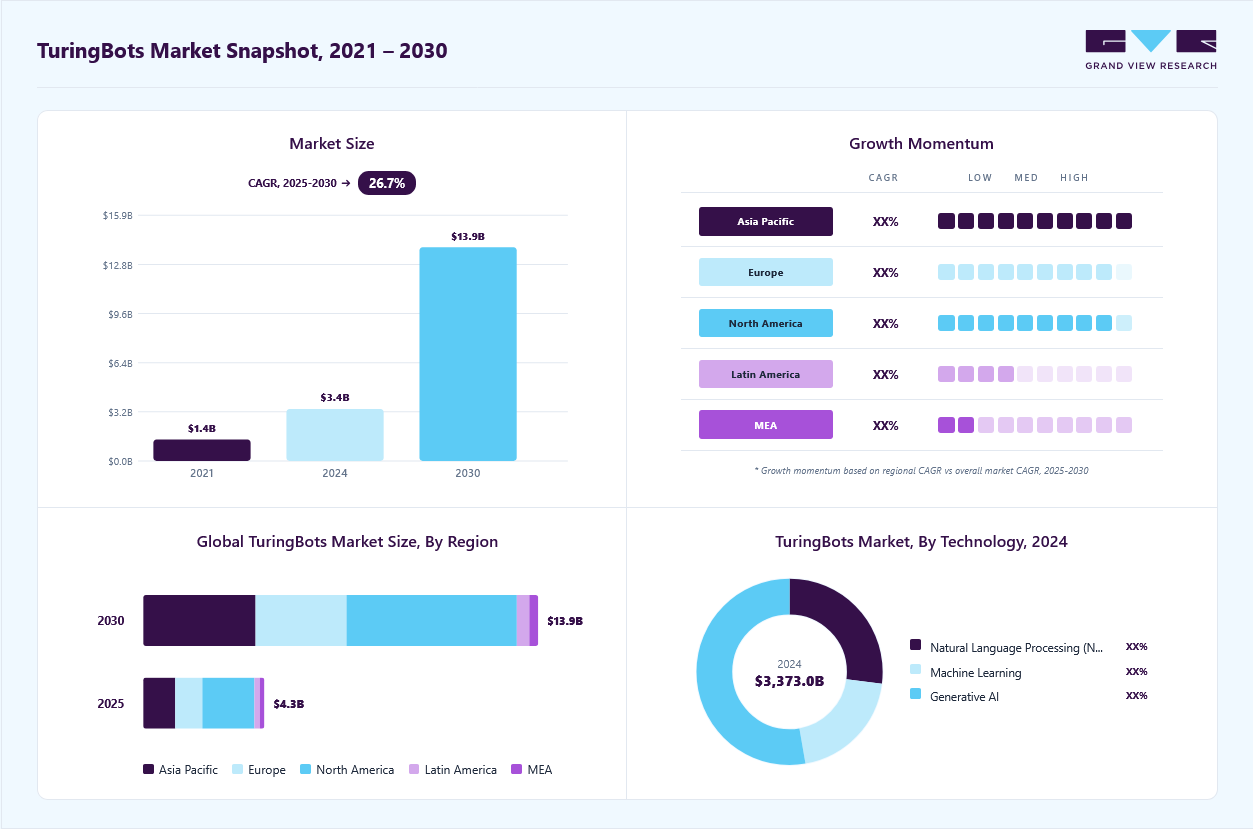
Market Size, 2024
$3.4BMarket Estimate, 2026
$4.3BMarket Forecast, 2030
$13.9BCAGR, 2025–2030
26.7%TuringBots Market Size & Trends
The global TuringBots market size was valued at USD 3.37 billion in 2024 and is expected to grow at a CAGR of 26.7% from 2025 to 2030. This growth is driven by the increasing demand for faster, more efficient software development processes. Organizations are under pressure to accelerate digital transformation, and TuringBots AI-driven agents that assist in coding, testing, and maintaining software are emerging as essential tools to meet these demands. Advancements in machine learning, natural language processing, and code generation technologies are significantly enhancing the capabilities of TuringBots, making them more reliable and scalable.
 Source: Grand View Research, IR Documents, Primary Interviews, Paid DatabasesTo learn more about this report,
 Download Free Sample Report
 Additionally, the growing shortage of skilled software developers is encouraging businesses to adopt intelligent automation solutions to bridge the talent gap. As enterprises prioritize innovation, cost-efficiency, and time-to-market, the adoption of TuringBots is expected to rise steadily across industries.
 To learn more about this report, Download Free Sample Report
 The global TuringBots industry is witnessing strong momentum as enterprises across industries increasingly prioritize automation to streamline software development lifecycles. TuringBots, powered by advancements in AI and machine learning, are capable of not only generating code but also performing tasks such as debugging, testing, and maintenance with minimal human intervention. This significantly reduces development time, lowers operational costs, and improves overall software quality. Companies facing mounting pressure to innovate quickly are leveraging these tools to achieve faster product rollouts and maintain a competitive edge. Moreover, the adoption of agile and DevOps practices is further accelerating the integration of intelligent development assistants into mainstream workflows.
A major driver of market growth is the shortage of skilled software developers globally. As the demand for digital solutions outpaces the availability of talent, organizations are increasingly turning to AI-powered coding assistants to fill the gap. TuringBots can augment human developers by automating repetitive coding tasks, recommending optimizations, and even autonomously fixing vulnerabilities. This not only enhances developer productivity but also enables smaller teams to handle larger and more complex projects. Additionally, educational institutions and coding boot camps are beginning to integrate TuringBots into their curriculum to better prepare students for AI-augmented development environments, further boosting awareness and adoption.
Technological advancements are also playing a pivotal role in propelling the TuringBots market forward. The evolution of foundation models, transformers, and Large Language Models (LLMs) has significantly improved the contextual understanding and code generation capabilities of these bots. Innovations in explainable AI and responsible AI frameworks are addressing concerns around transparency, bias, and trust, making enterprises more comfortable with adopting such technologies at scale. Furthermore, sector-specific TuringBots designed for fields such as finance, healthcare, and cybersecurity are opening up new specialized opportunities.
Function Insights
The design segment led the market and accounted for over 41% of the global revenue in 2024, due to the increasing demand for intelligent assistance in early-stage software development. Designing efficient, user-centric software requires extensive iteration, prototyping, and validation, all of which can be significantly accelerated with AI-driven design tools. TuringBots, specializing in design, helps automate wireframing, UI/UX prototyping, and architecture suggestions, allowing teams to move faster from concept to product. Additionally, as organizations prioritize customer experience and seamless digital interactions, there is growing investment in design-driven development workflows. By reducing manual design cycles and enhancing creativity through AI collaboration, TuringBots is transforming the way software products are conceptualized and built, fueling rapid adoption in this segment.
The debugging/optimization segment is anticipated to grow at the highest CAGR during the forecast period, driven by the rising complexity of software applications and the increasing demand for faster, more reliable code delivery. Traditional debugging processes are time-consuming and heavily reliant on human expertise, often leading to project delays and higher costs. TuringBots offers an intelligent, automated approach to identifying bugs, performance bottlenecks, and inefficiencies early in the development cycle. As businesses aim to enhance application performance, security, and user experience, the need for AI-driven debugging and continuous optimization tools is becoming necessary. Moreover, with the growing adoption of agile and DevOps practices, where rapid iterations are essential, automated debugging and optimization capabilities are seen as key to maintaining development speed without compromising quality.
Application Insights
The enterprise automation segment dominated the market in 2024 as businesses across industries strengthened efforts to streamline operations, reduce costs, and accelerate digital transformation. TuringBots are increasingly being deployed to automate complex, repetitive tasks such as code generation, testing, system integration, and maintenance within large enterprise environments. By embedding AI into their automation strategies, enterprises achieve greater efficiency, minimize human error, and improve scalability. The rise of hyper-automation initiatives, where organizations integrate artificial intelligence (AI), machine learning, and Robotic Process Automation (RPA) for end-to-end business process automation, has further fueled demand for TuringBots.
The educational tools segment is poised for significant growth as TuringBots are increasingly being integrated into learning platforms to enhance how coding and software development are taught. Educational institutions, coding boot camps, and online learning providers are leveraging AI-driven tools to offer personalized learning experiences, automated feedback, and real-time coding assistance. TuringBots help students and learners quickly understand complex programming concepts, practice coding more effectively, and build stronger problem-solving skills. The growing global emphasis on digital literacy and the need to equip future workforces with AI-augmented development skills are major drivers behind this trend. Additionally, the rise of self-paced and remote learning models is creating a strong demand for intelligent educational tools that can replicate the guidance traditionally provided by human instructors.
Technology Insights
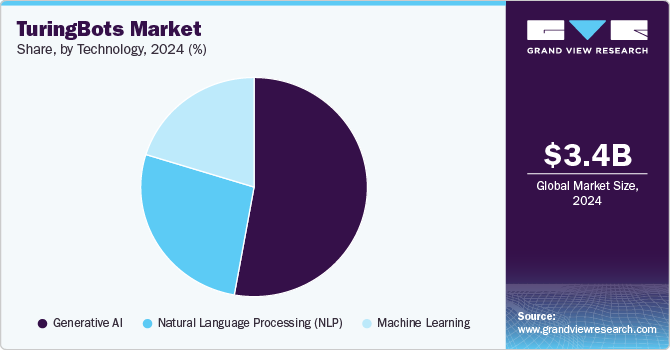
The generative AI segment accounted for the largest market revenue share in 2024, due to its transformative impact on automating and accelerating software development tasks. Generative AI technologies, such as Large Language Models (LLMs), enable TuringBots to create high-quality code, documentation, test cases, and even software designs with minimal human input. This capability reduces development time and costs while improving scalability and innovation speed for organizations. The increasing trust in generative AI tools, supported by advances in model accuracy, explainability, and security, has led to widespread enterprise adoption across industries. As companies race to gain competitive advantages through faster product development and digital transformation initiatives, the demand for generative AI-driven TuringBots continues to grow.
 To learn more about this report, Download Free Sample Report
 The Natural Language Processing (NLP) segment is poised for substantial growthas it forms the backbone of how TuringBots interpret, generate, and respond to human language inputs. With software development becoming increasingly collaborative and user-driven, the ability for developers to interact with AI tools through natural language commands is transforming productivity and accessibility. Advances in NLP models have significantly improved the understanding of context, intent, and technical jargon, enabling TuringBots to translate human instructions into accurate, functional code. Moreover, the expansion of multilingual and domain-specific NLP capabilities is opening new opportunities for global adoption across diverse industries and regions.
User Insights
The large enterprises segment accounted for the largest market revenue share in 2024due to their greater capacity to invest in advanced AI technologies like TuringBots. These organizations face complex development needs, manage vast software ecosystems, and demand high levels of scalability, making TuringBots a valuable solution for improving efficiency and reducing time-to-market. Large enterprises are also leading digital transformation initiatives, prioritizing automation and AI integration to stay competitive in rapidly evolving markets. With greater resources, these companies are able to pilot, deploy, and scale TuringBot solutions across multiple departments and geographies.
The small & medium enterprises segment is positioned for significant growth as TuringBots are becoming increasingly accessible and affordable, allowing smaller businesses to leverage AI capabilities once reserved for large corporations. SMEs often face resource constraints, including limited development teams and tighter budgets, making intelligent automation tools highly attractive for boosting productivity and accelerating product development. TuringBots help SMEs automate coding, debugging, testing, and optimization tasks, enabling them to innovate faster and compete more effectively against larger players. The rise of cloud-based TuringBot solutions and flexible pricing models is further lowering the barrier to entry for SMEs.
Regional Insights
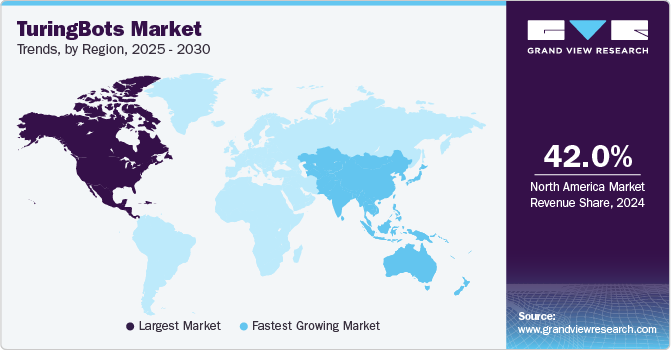
North America represented a significant market share of over 42% in 2024, driven by the region’s strong technological infrastructure, high levels of digital adoption, and substantial investment in AI and automation. The presence of leading tech companies and startups in the U.S. and Canada, along with the rapid development of cutting-edge solutions such as TuringBots, has positioned North America as a global leader in AI-driven innovation. The region’s businesses, ranging from enterprises to SMEs, are increasingly adopting TuringBots to streamline their software development processes and stay competitive.
 To learn more about this report, Download Free Sample Report
 U.S. TuringBots Market Trends
The TuringBots market in the U.S. is expected to grow substantially over the forecast period, driven by the country’s leadership in technological innovation, AI research, and digital transformation initiatives. The U.S. has a robust tech ecosystem, with many startups and established companies at the forefront of AI advancements, contributing to the widespread adoption of TuringBots in software development, debugging, and optimization processes. Additionally, the rapid growth of cloud computing, SaaS platforms, and AI-as-a-service offerings makes these technologies more accessible to a broader range of organizations.
Europe TuringBots Market Trends
The TuringBots industry in Europe is expected to witness significant growth over the forecast period,fueled by the region’s strong commitment to digital transformation and AI innovation. European companies across industries such as automotive, finance, healthcare, and manufacturing are increasingly adopting AI-driven automation tools such as TuringBots to streamline development processes, enhance productivity, and reduce costs. The European Union’s supportive policies and initiatives, such as the Digital Europe Programme and AI strategies, are creating a favorable environment for the adoption of advanced AI solutions.
Asia Pacific TuringBots Market Trends
The TuringBots industry in the Asia Pacific region is anticipated to register the highest CAGR over the forecast period, driven by the rapid digitalization of industries, strong government support for AI adoption, and the increasing demand for automation in software development. APAC countries, mainly China, India, Japan, and South Korea, are at the forefront of AI research and development, creating significant opportunities for the deployment of TuringBots in various sectors such as technology, e-commerce, finance, and manufacturing. The region's rapidly growing tech startup ecosystem, combined with a large pool of skilled developers and engineers, is accelerating the adoption of AI-driven tools to optimize development processes and enhance operational efficiency. Additionally, governments in the APAC region are implementing favorable policies and investments in AI technology, further supporting the market growth.
Key TuringBots Company Insights
Some key companies in the TuringBots industry are Amazon Web Services, Inc., IBM Corporation, and Red Hat, Inc.
-
Amazon Web Services, Inc., a global provider of cloud computing services, plays a key role in the TuringBots market by offering AI and machine learning tools that automate software development tasks. Amazon Web Services, Inc. services such as CodeGuru streamline code reviews by detecting bugs, optimizing performance, and identifying security issues similar to TuringBot functions. Amazon SageMaker allows businesses to build and deploy custom AI models for code generation and debugging, while AWS Lambda supports serverless computing for automating development workflows. Additionally, tools such as Amazon Polly and Amazon Lex enhance user interaction through natural language processing.
-
IBM Corporation, a global leader in technology and innovation, is deeply involved in the development and application of artificial intelligence and automation tools, positioning itself as a significant player in the TuringBots market. Through its IBM Watson platform, IBM offers a suite of AI-powered services that automate and enhance software development processes, aligning closely with the functions of TuringBots. IBM Watson's AI capabilities, such as natural language processing, machine learning, and advanced analytics, can be integrated into development workflows to automate tasks such as code review, debugging, and optimization key functionalities of TuringBots. Additionally, IBM's Cloud Pak for Automation leverages AI to streamline enterprise processes, offering intelligent automation tools that help businesses accelerate software development and improve productivity.
Key TuringBots Companies:
The following are the leading companies in the turingbots market. These companies collectively hold the largest market share and dictate industry trends.
- Amazon Web Services, Inc.
- Cognizant
- GitHub, Inc.
- Google LLC
- IBM Corporation
- JetBrains s.r.o.
- Microsoft
- Salesforce, Inc
- Tabnine
- UiPath
Three ways to get this report
Buy it, customize it, or ask a question.Ask an Analyst
Analyst response in 1 business day
- AccessReport author, directly
- Reply timeWithin 1 working day
- No sales callDirect answer only
- FormatEmail reply
- CostFree, no cost
Get the Full Report
What the study covers
- FormatsPDF · Excel · Dashboard
- Timeline2025–2030 annual, 2024 base
- Coverage20+ countries, 5 regions
- Companies10+ key players profiled
Customize the Report
20% free customization
- IncludeCountries, segments, points
- TailorTo your product definition
- ExtendDeeper competitor detail
- OrA fully bespoke study
- Turnaround5–10 working days
Recent Developments
-
In February 2025, GitHub, Inc. Copilot introduced several new features to enhance developer productivity; these include Agent Mode, which allows Copilot to implement changes across multiple files, and Next Edit Suggestions, which automatically predict and execute the next logical edit. GitHub, Inc. also unveiled an autonomous software engineering agent and launched Copilot Edits, enabling seamless code editing and enhancements. Additionally, Google's Gemini 2.0 Flash and OpenAI's o3-mini were integrated into Copilot Chat and Edits. At the same time, Copilot Workspace now supports enterprise-level deployment, allowing businesses to enable organization-wide access for faster code-to-production cycles at scale.
-
In February 2025, Google LLC introduced the preview of Gemini Code Assist, a free AI-powered coding assistant available to individuals worldwide. This tool supports all programming languages in the public domain and features AI-driven code completion, code generation, and chat capabilities. It is compatible with popular IDEs such as Visual Studio Code, JetBrains, Firebase, and Android Studio, providing up to 180,000 monthly code completions. Google LLC has also introduced Gemini Code Assist for GitHub, an AI-powered tool designed to perform code reviews for both public and private repositories. It identifies issues and bugs while offering suggestions for fixes. Developers can use natural language to generate, explain, and enhance code. The tool supports a large context window of up to 128,000 input tokens, making it suitable for working with extensive files and local codebases.
-
In April 2024, Amazon Web Services, Inc. announced the launch of Amazon Q, a generative AI-powered assistant designed to accelerate software development. Amazon Q tests, debugs, generates highly accurate code, but also handles complex tasks like multi-step planning and reasoning. It can transform and implement new code based on developer requests, such as upgrading Java versions. Additionally, Amazon Q enables employees to quickly access and analyze business data from various repositories, including company policies, product information, and business results, providing summarized insights and facilitating data-driven conversations.
-
In June 2024, Intezer Labs Inc., a pioneer in AI-driven security operations automation, announced a new partnership with RSM US LLP, a leader in the professional services industry. This collaboration aims to fully automate and enhance RSM US LLP's alert triage and incident response processes. By utilizing Intezer's technology, RSM Defense's experienced cybersecurity practitioners receive a detailed analysis of every alert, enabling them to uncover hidden cyberattacks and swiftly protect clients worldwide.
-
In May 2024, Swimlane Inc., a prominent provider of TuringBots, unveiled the Swimlane Marketplace, the first comprehensive modular marketplace for TuringBots. The new marketplace simplifies automation and enables seamless integration, empowering organizations to streamline security operations across any use case or technology stack with customized solutions.
-
In April 2024, Cypago Security Ltd., a Cyber GRC software company, introduced a new automation solution for risk management, AI governance, and compliance. This solution incorporates the implementation of ISO/IEC 42001 and NIST AI RMF, the latest AI security and governance frameworks. As more companies integrate AI tools into their daily operations, business processes, and customer-facing products and services, ensuring the safe use of AI has become a crucial challenge.
TuringBots Market Report Scope
Report Attribute
Details
Market size value in 2025
USD 4.25 billion
Revenue forecast in 2030
USD 13.87 billion
Growth Rate
CAGR of 26.7% from 2025 to 2030
Actual data
2018 - 2024
Forecast period
2025 - 2030
Quantitative units
Revenue in USD million/billion and CAGR from 2025 to 2030
Report coverage
Revenue forecast, company ranking, competitive landscape, growth factors, and trends
Segments covered
Function, technology, application, user, region
Regional scope
North America; Europe; Asia Pacific; Latin America; MEA
Country scope
U.S.; Canada; Mexico; Germany; UK; France; China; India; Japan; Australia; South Korea; Brazil; UAE; South Africa; KSA
Key companies profiled
Amazon Web Services, Inc.; Cognizant; GitHub, Inc.; Google LLC; IBM Corporation; JetBrains s.r.o.; Microsoft; Salesforce, Inc; Tabnine; UiPath
Customization scope
Free report customization (equivalent up to 8 analysts working days) with purchase. Addition or alteration to country, regional & segment scope.
Pricing and purchase options
Avail customized purchase options to meet your exact research needs. Explore purchase options
Global TuringBots Market Report Segmentation
This report forecasts revenue growth at global, regional, and country levels and provides an analysis of the latest industry trends in each of the sub-segments from 2018 to 2030. For this study, Grand View Research has segmented the global TuringBots market report based on the function, technology, application, user, and region:
-
Function Outlook (Revenue, USD Million; 2018 - 2030)
-
Design
-
Code Generation
-
Automated Testing
-
Debugging/Optimization
-
Deployment/DevOps
-
Analytics & Maintenance
-
-
Technology Outlook (Revenue, USD Million; 2018 - 2030)
-
Natural Language Processing (NLP)
-
Machine Learning
-
Generative AI
-
-
Application Outlook (Revenue, USD Million; 2018 - 2030)
-
Rapid Prototyping
-
Educational Tools
-
Enterprise Automation
-
-
User Outlook (Revenue, USD Million; 2018 - 2030)
-
Large Enterprises
-
Small & Medium Enterprises
-
Individual Users
-
-
Regional Outlook (Revenue, USD Million; 2018 - 2030)
-
North America
-
U.S.
-
Canada
-
Mexico
-
-
Europe
-
UK
-
Germany
-
France
-
-
Asia Pacific
-
China
-
India
-
Japan
-
Australia
-
South Korea
-
-
Latin America
-
Brazil
-
-
MEA
-
UAE
-
South Africa
-
KSA
-
-
Frequently Asked Questions About This Report
The global TuringBots market size was estimated at USD 3.37 billion in 2024 and is expected to reach USD 4.25 billion in 2025.
The global TuringBots market is expected to grow at a compound annual growth rate of 26.7% from 2025 to 2030 to reach USD 13.87 billion by 2030.
North America dominated the market in 2024, accounting for over 42.0% share of the global revenue, driven by the region’s strong technological infrastructure, high levels of digital adoption, and substantial investment in AI and automation.
Some key players operating in the TuringBots market includeKey companies profiled Amazon Web Services, Inc.; Cognizant; GitHub, Inc.; Google LLC; IBM Corporation; JetBrains s.r.o.; Microsoft; Salesforce, Inc; Tabnine; UiPath
Key factors driving the TuringBots market growth include high Return on Investment (ROI) and advancements in generative AI has enhanced the capabilities of TuringBots
About the Author(s)
Next Generation Technologies Research Team
Technology · Next Generation TechnologiesThis report was authored by the next generation technologies research team at Grand View Research - comprising two research analysts, one senior research analyst, and one industry expert - with specialized expertise in the next generation technologies segment of the technology industry. All findings are based on proprietary technology databases, executive interviews, and regulatory analysis, subject to internal peer review prior to publication.
Last Updated:
Speak to Analyst -

Customize this report to your needs - add regions, segments, or data points, with 20% free customization.
Or view our licence options:


ISO 9001:2015 & 27001:2022 Certified
We are GDPR and CCPA compliant! Your transaction & personal information is safe and secure. For more details, please read our privacy policy.


