
- Home
- »
- Clothing, Footwear & Accessories
- »
-
UK Lingerie Market Size, Share & Growth Report, 2026-2033GVR Report cover

UK Lingerie Market (2026 - 2033)
Size, Share & Trends Analysis Report By Product Type (Briefs, Shapewear, Bras), By Distribution Channel (Online, Offline), Consumer Behavior And Competitive Analysis And Segment Forecasts
Market Size, 2025
$4.7BMarket Estimate, 2026
$4.9BMarket Forecast, 2033
$8.0BCAGR, 2026–2033
7.3%UK Lingerie Market Summary
The UK lingerie market size was valued at USD 4.7 billion in 2025 and is projected to grow from USD 4.9 billion in 2026 to USD 8.0 billion by 2033, at a CAGR of 7.3% from 2026 to 2033. The rising demand for comfort-driven, inclusive, and fashion-forward intimate apparel, along with the expanding reach of offline retail stores and e-commerce platforms catering to diverse consumer preferences is driving growth.
Key Market Trends & Insights
- By product type: Briefs led the market and accounted for a share of 57.8% in 2025.
- By distribution channel: Offline sales held the highest market share of 63.3% in 2025.
Market Size & Forecast
- Market size in 2025: USD 4.7 Billion
- Estimated market size in 2026: USD 4.9 Billion
- Projected market size by 2033: USD 8.0 Billion
- CAGR (2026-2033): 7.3%
Prism AI by Grand View Research Free to tryAsk a question about the UK lingerie market✓Every figure cited from GVR research Prefer the report? Download free sample →
The market is witnessing steady growth, supported by evolving consumer preferences toward comfort, inclusivity, premium designs, and sustainable products across the women’s innerwear market. Market expansion is being fueled by increasing demand for everyday comfort-focused lingerie, including wireless bras, seamless underwear, and adaptive fits, as consumers increasingly prioritize functionality, flexibility, and aesthetics.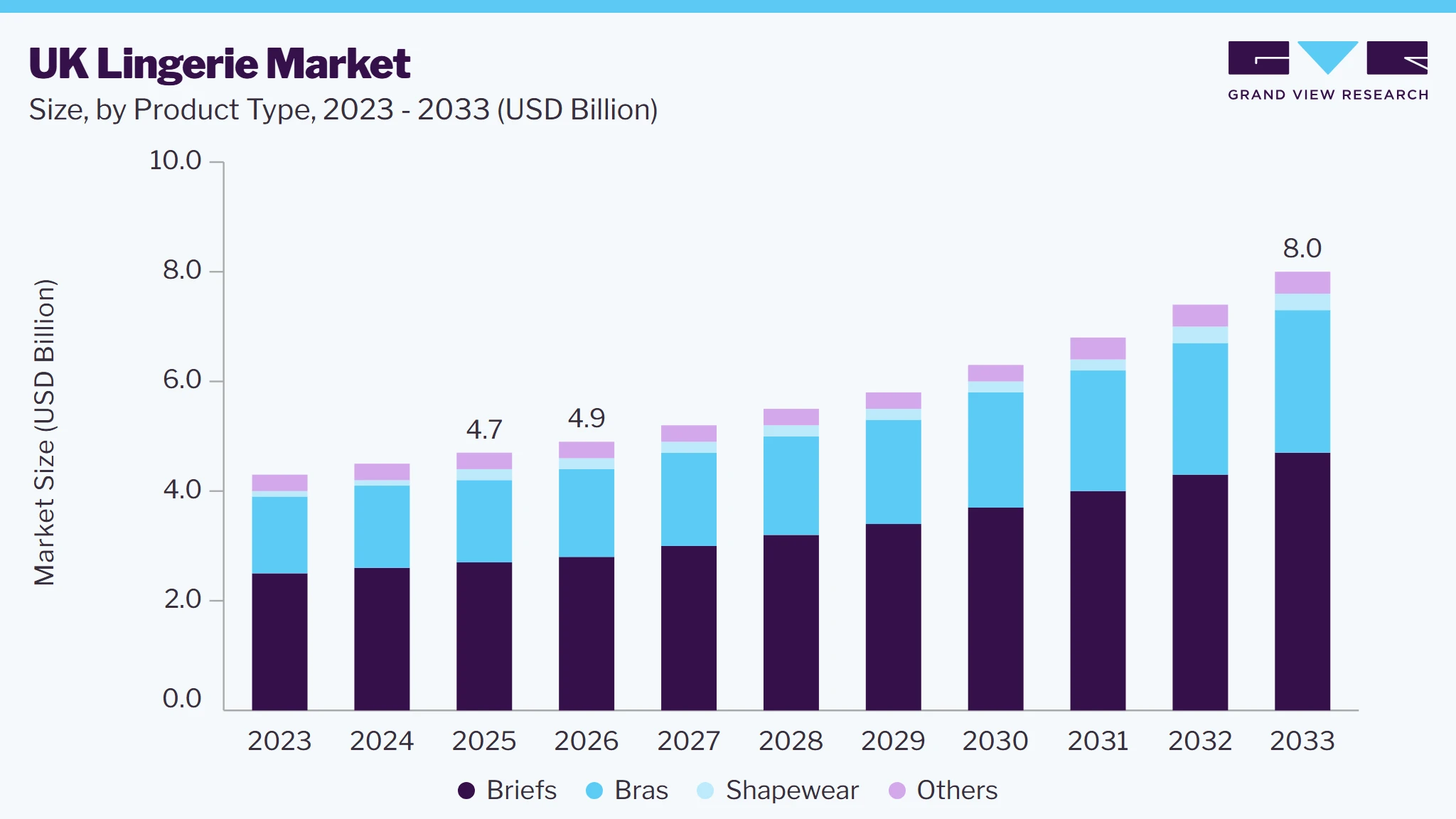 Source: Grand View Research, IR Documents, Primary Interviews, Paid DatabasesTo learn more about this report,
 Download Free Sample Report
The growing influence of body positivity and size inclusivity has encouraged brands to expand product offerings across diverse body types, while younger consumers are increasingly seeking lingerie that reflects personal style, confidence, and self-expression. The growth of e-commerce platforms and direct-to-consumer brands has further improved accessibility, enabling consumers to explore a wider variety of styles, sizes, and personalized product options.
The UK lingerie market is also experiencing a shift toward sustainable materials, innovative designs, and multifunctional intimate apparel solutions. Consumers are showing increasing interest in lingerie manufactured using recycled fabrics, organic cotton, and responsibly sourced materials, encouraging brands to introduce eco-conscious collections. In addition, the market is witnessing rising demand for complementary categories within the sleepwear & loungewear market, as consumers increasingly prefer comfortable, versatile, and premium-quality apparel suitable for both relaxation and everyday wear. Advancements in fabric technology, including moisture-wicking, breathable, temperature-regulating, and seamless construction techniques, are enhancing product performance, durability, and comfort. These innovations are encouraging brands to develop products that combine style, wellness, and functionality, further supporting growth across the UK intimate apparel sector. In February 2025, Marks & Spencer expanded its lingerie portfolio with improved comfort-led designs under its popular Flexifit range, focusing on stretch fabrics, enhanced support, and inclusive sizing to address changing consumer expectations. Similarly, brands such as Victoria's Secret and Boux Avenue have continued to introduce collections emphasizing everyday wearability, body diversity, and modern aesthetics, reflecting the broader transition of the UK lingerie market toward personalized, comfort-driven, and digitally influenced shopping experiences.
A notable trend in the UK lingerie market is the structural reorientation toward functionally optimized everyday lingerie positioned as a premium necessity, rather than discretionary fashion. This is evidenced by brands such as Marks and Spencer expanding technically advanced bra ranges with fit-specific engineering, while digitally native players such as Lounge, Stripe, and Stare emphasize fabric science, repeat wear durability, and core silhouettes over seasonal styling.
The trend reflects a post pandemic recalibration of consumption in which lingerie purchasing is driven by bodily comfort, work from home routines and long-term value perception, signaling a shift from symbolic consumption toward utility centered intimacy apparel within the UK retail ecosystem.
The growing emphasis on body positivity is significantly reshaping the UK lingerie market, with inclusivity in sizing and styles becoming a central driver of consumer demand. Modern consumers are increasingly looking for lingerie that not only delivers aesthetic appeal but also offers comfort and support across a wide range of body types. The availability of extended size ranges and adaptive fits allows more women to feel represented and catered to, strengthening trust and loyalty toward brands that prioritize inclusivity. At the same time, marketing strategies that showcase diverse models across size, age, and ethnicity are reinforcing this cultural shift and broadening market appeal.
For instance, In Feb 2025, Marks and Spencer launched its “Make an Understatement” underwear campaign, its first to jointly promote women’s and men’s intimates and the first dedicated men’s underwear push in over a decade. Backed by its 39.5 percent share in bras and 19.2 percent share in men’s underwear, the campaign highlights comfort, contemporary design and 360 Flex technology, reaching around 183 million people across VOD, billboards, digital and social media.
Another major driver in the UK lingerie market is the mainstreaming of size inclusivity and body realism, which is widening the addressable consumer base across age and body profiles. Rather than relying on simplified sizing, UK retailers emphasise extensive band and cup matrices, with strong penetration in fuller bust, petite and post maternity segments, reflecting long standing consumer expectations around fit accuracy.
Players such as Marks and Spencer, Bravissimo, and Boux Avenue have expanded inclusive size ranges using in-store fit data and online demand signals, while virtual fitting tools and size recommendation engines integrated into UK e-commerce platforms are helping reduce return friction and improve online conversion, directly supporting revenue growth in intimates.
A key driver in the lingerie market is the strong consumer reliance on established domestic retailers for fit consistency and product reliability. Shoppers tend to favour brands with long-standing expertise, extensive size ranges and widespread store networks, as in person fitting and easy returns remain critical in lingerie purchasing. This behaviour supports steady demand for core, everyday intimates and gives scale driven British retailers a structural advantage in influencing market growth patterns.
Market Dynamics
The lingerie market is being driven by increasing consumer demand for comfort-focused, inclusive, and functional intimate apparel. Consumers are increasingly prioritizing wireless bras, seamless underwear, soft fabrics, and adaptive fits that provide all-day comfort without compromising style. The growing influence of body positivity and size inclusivity has encouraged brands to expand collections across a wider range of sizes, skin tones, and body shapes, strengthening growth in the women’s innerwear market. In addition, rising awareness of sustainability is encouraging consumers to purchase products made from organic cotton, recycled fibers, and responsibly sourced materials. The rapid expansion of e-commerce platforms, virtual fitting tools, and direct-to-consumer brands has further enhanced product accessibility and personalized shopping experiences. Growing demand for coordinated collections across the sleepwear & loungewear market is also supporting higher consumer spending on premium and multifunctional intimate apparel, contributing significantly to the expansion of the UK market.
The increasing cost of premium lingerie and intense competition among established and emerging brands remain key challenges for the lingerie market. High-quality products incorporating sustainable fabrics, advanced seamless construction, and innovative comfort technologies are often priced at a premium, limiting adoption among price-sensitive consumers. In addition, inflationary pressures and rising living costs have encouraged many consumers to prioritize value-oriented purchases, reducing discretionary spending on premium intimate apparel. The availability of low-cost alternatives from fast-fashion retailers and private-label brands further intensifies price competition, making it difficult for premium manufacturers to maintain margins. Frequent promotional campaigns and discount-driven purchasing behavior also influence consumer buying decisions across the women’s innerwear market, while evolving fashion trends require continuous product innovation and inventory refreshes. These factors pose challenges to sustain revenue growth across both the lingerie market and the sleepwear & loungewear market.
The UK lingerie market presents significant opportunities through the growing demand for personalized, sustainable, and premium intimate apparel. Consumers are increasingly seeking customized fit solutions, AI-enabled virtual fitting technologies, and lingerie collections tailored to diverse body types and lifestyles, creating opportunities for brands to enhance customer engagement and reduce return rates. Rising interest in eco-friendly products made from recycled fabrics, organic cotton, and biodegradable materials is encouraging manufacturers to expand sustainable product portfolios. In addition, the growing popularity of premium sleepwear, athleisure-inspired intimate wear, and direct-to-consumer subscription models is enabling brands to strengthen customer loyalty and increase recurring sales. Collaborations with fashion influencers, digital-first marketing strategies, and expansion across online retail channels are further expected to support long-term growth in the UK lingerie market.
Brand Market Share Analysis
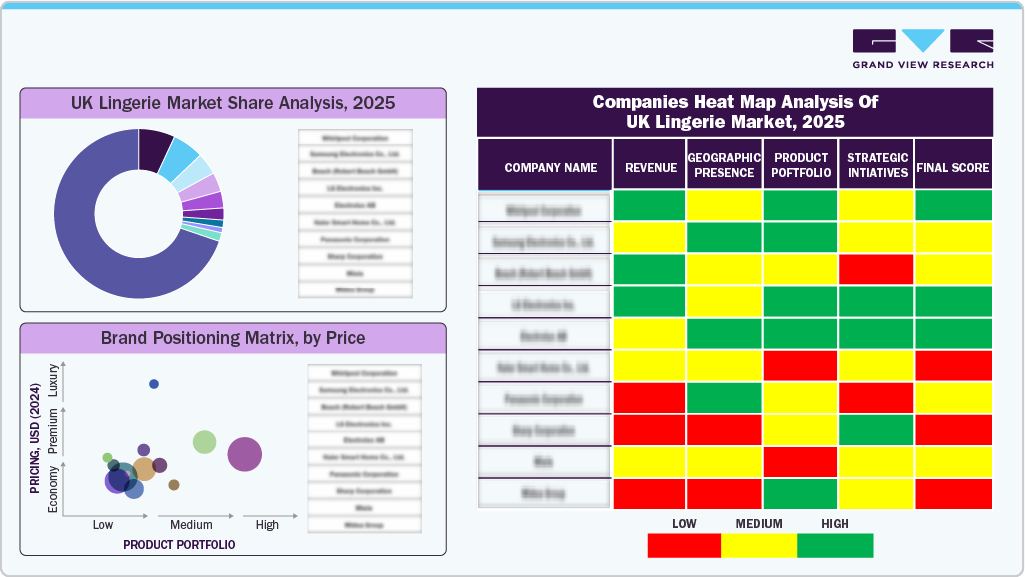
Brand share in the UK lingerie market is led by large domestic retailers with scale, where Marks and Spencer hold a dominant position due to its extensive size matrix, broad pricing and nationwide store presence, while Next and Matalan contribute meaningful volume through value driven everyday basics sold via high street and online channels.
 To learn more about this report, Download Free Sample Report
Alongside these leaders, specialist brands such as Bravissimo, Boux Avenue, Pour Moi and Figleaves capture focused share by addressing fit intensive segments, particularly fuller bust and mid premium consumers, supported by strong fitting credentials and loyal repeat customers.
At the same time, fashion and digital first players including Primark, H&M, Lounge Underwear and selected international DTC brands are expanding their share through trend led assortments, aggressive pricing or social media driven online sales, increasing competitive intensity without displacing established incumbents.
Consumer Insights
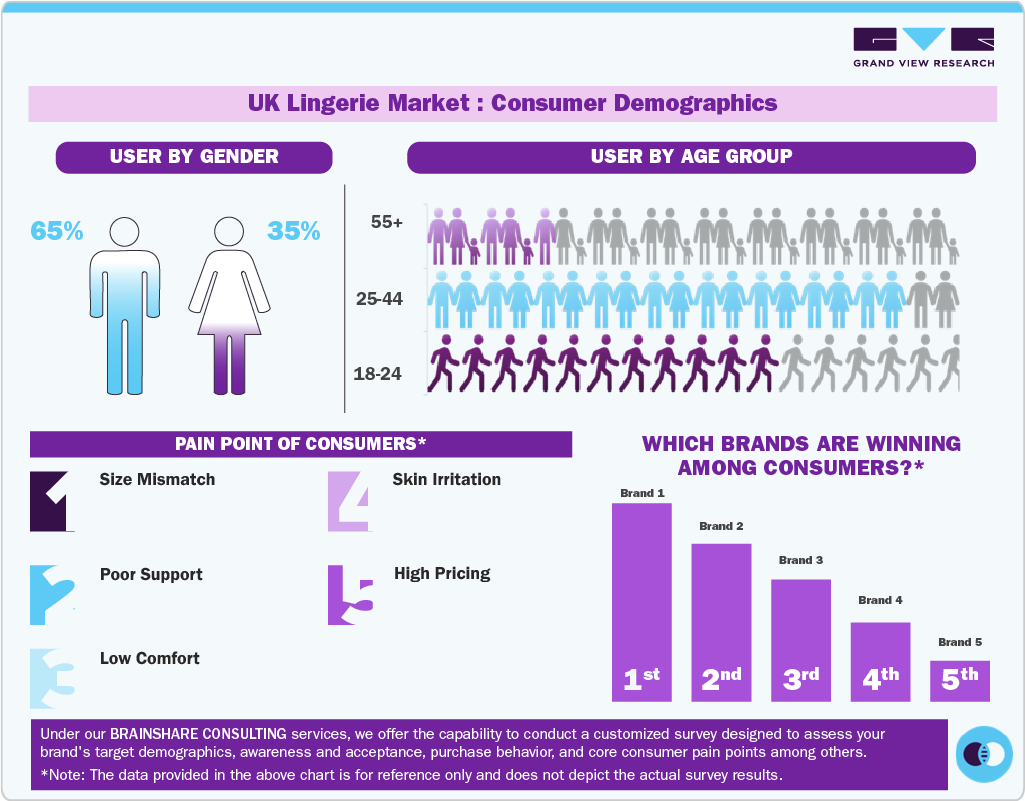
In the UK lingerie market, about 65% of consumers purchase from the value and essentials segment, showing that affordability and everyday wear dominate, while 35% prefer premium and aspirational lingerie, indicating demand for high-end, design-focused products.
 To learn more about this report, Download Free Sample Report
Consumers aged 25-44 form the largest group, followed by 18-24 and 45+, suggesting that working-age shoppers drive most purchases and influence trends and brand choices across the market.
Common consumer pain points include size mismatch, poor support, low comfort, skin irritation, and high pricing, emphasizing the need for accurate sizing, quality fabrics, and practical designs to meet shopper expectations.
Marks & Spencer ranks first among UK consumers, followed by Bravissimo, Boux Avenue, H&M, and Lounge Underwear, showing a balance between heritage retailers, specialist fit-focused brands, and fashion or digitally driven players in shaping consumer preference.
Consumers in the lingerie market are increasingly prioritizing comfort, fitness, and functionality over traditional fashion-focused purchases, driving strong demand across the women's innerwear market for wireless bras, seamless underwear, and size-inclusive collections. Sustainability is also influencing purchasing decisions, with shoppers showing greater preference for products made from organic cotton, recycled fibers, and responsibly sourced materials. Digital channels continue to shape consumer behavior, such as online shopping, AI-powered sizing tools, virtual fit guidance, and customer reviews improve purchase confidence and convenience. In addition, consumers are increasingly purchasing coordinated products across the sleepwear & loungewear market, favoring versatile, premium-quality apparel that supports both relaxation and everyday wear, while younger demographics continue to seek brands that promote body positivity, inclusivity, and personalized shopping experiences.
Analyst Perspective
The UK lingerie market is evolving toward a comfort-first, inclusive, and sustainability-driven landscape, with consumers increasingly prioritizing high-quality products that combine functionality, style, and personalized fit. Demand for seamless bras, wireless lingerie, adaptive designs, and eco-friendly materials is accelerating growth across the women's innerwear market, while premium and everyday collections continue to gain traction through both physical stores and digital retail channels. Brands are leveraging AI-powered sizing tools, virtual fitting technologies, and direct-to-consumer platforms to enhance the shopping experience and improve customer confidence. At the same time, growing consumer interest in coordinated collections across the sleepwear & loungewear market is encouraging brands to expand multifunctional product portfolios, positioning comfort, innovation, and inclusive sizing as key competitive differentiators in the UK market.
Product Type Insights
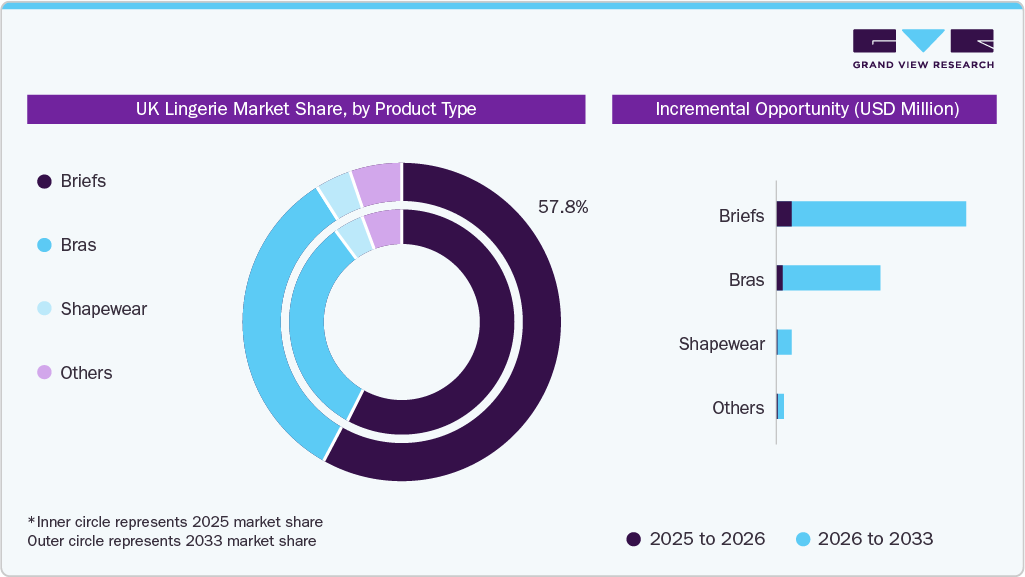
Briefs accounted for a 57.8% share of the revenue in 2025, driven by strong consumer demand for comfortable, versatile, and everyday essentials across the women's innerwear market. Growing preference for seamless designs, high-waist silhouettes, breathable fabrics, and sustainable materials has reinforced the popularity of briefs among consumers of all age groups. The increasing focus on body positivity and inclusive sizing has also encouraged brands to diversify their product portfolios with comfort-led collections. For instance, in February 2026, Marks & Spencer introduced its new BODY collection, featuring an expanded range of briefs with enhanced comfort, improved fits, and inclusive sizing, reinforcing the brand's focus on everyday wear and premium-quality intimate apparel
 To learn more about this report, Download Free Sample Report
Shapewear is anticipated to grow at a CAGR of 7.8% from 2026 to 2033, supported by increasing consumer demand for body-contouring garments that combine comfort, flexibility, and functionality. Advancements in seamless knitting, four-way stretch fabrics, moisture-wicking materials, and lightweight compression technologies have significantly improved wearability, encouraging consumers to incorporate shapewear into their daily wardrobes. Demand is also rising for multifunctional products that bridge the women's innerwear market and sleepwear & loungewear market, offering support without compromising comfort. For instance, in August 2025, Shapermint officially launched its dedicated UK online store, expanding access to its comfort-focused shapewear and intimates, including wireless bras, shaping camisoles, shorts, leggings, and inclusive size offerings for British consumers.
Distribution Channel Insights
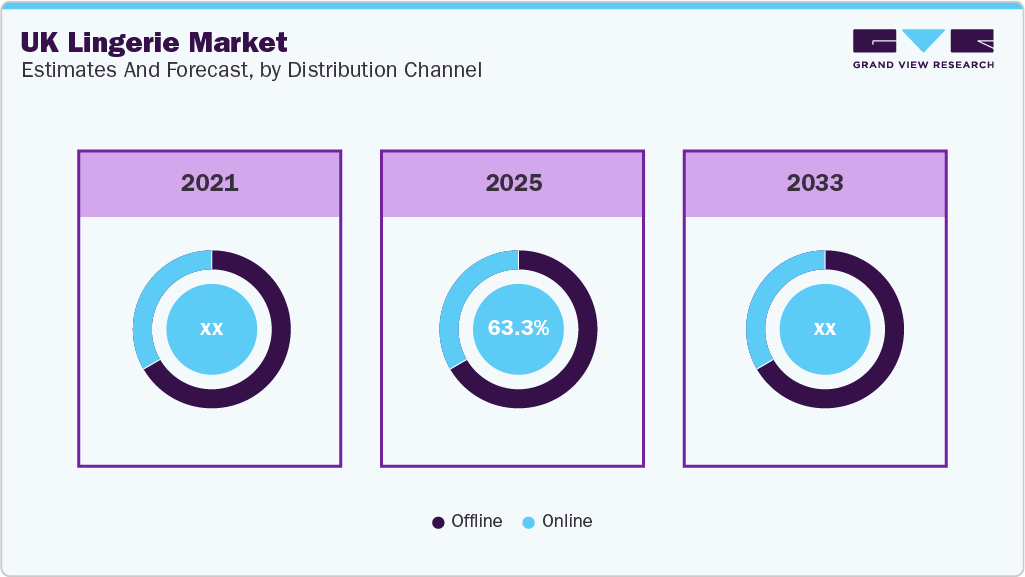
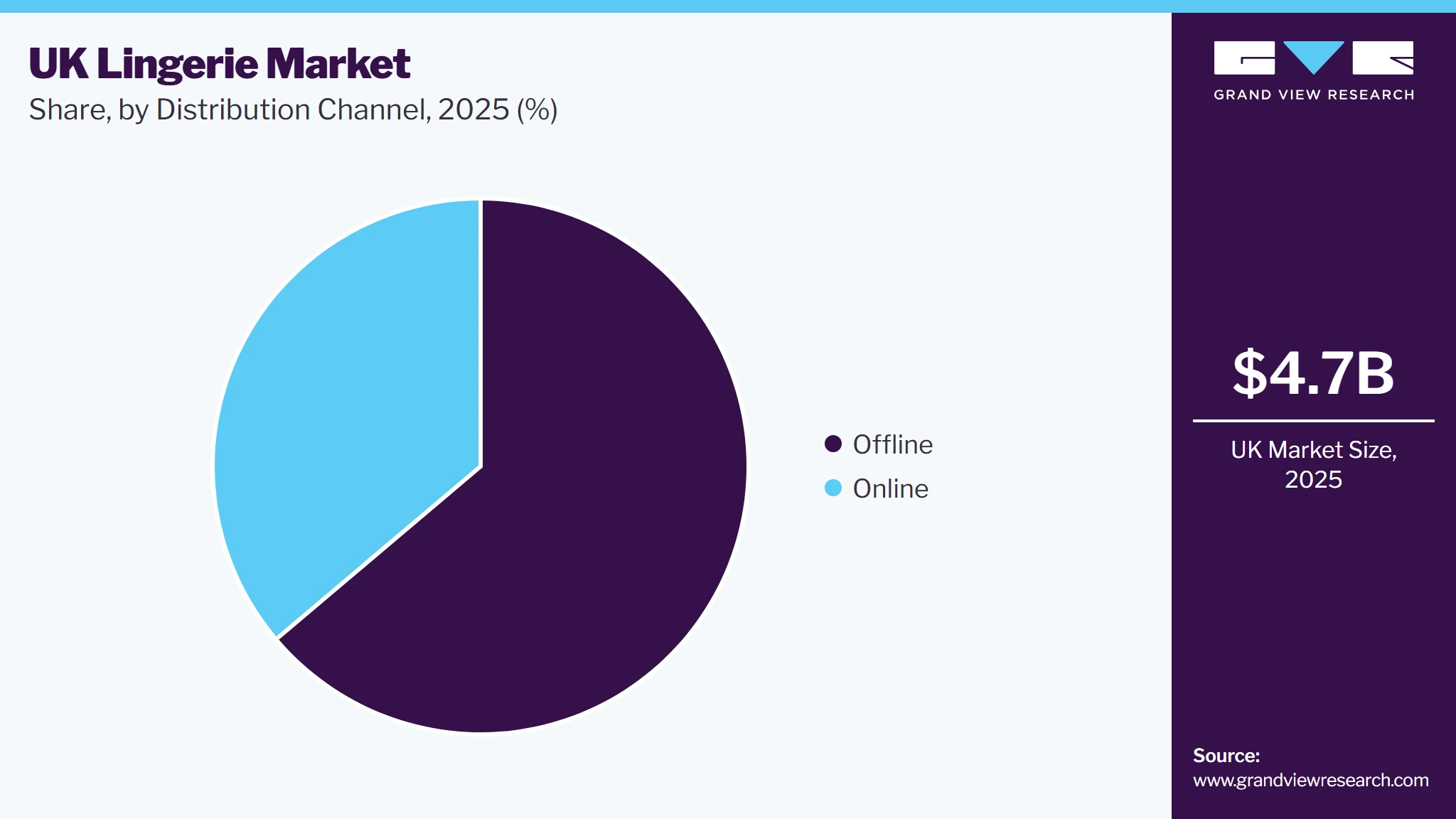
The sale of lingerie through offline channels accounted for 63.3% of the market. This strong performance is driven by the continued popularity of in-store experiences, where consumers can try products for fit and comfort, benefit from personalized assistance, and access premium or luxury lingerie brands. Retailers such as Marks & Spencer, John Lewis, and Boux Avenue remain key contributors, offering a wide range of styles from everyday briefs to high-end designer collections that emphasize tactile quality and design. In addition, physical stores enable consumers to receive professional bra-fitting services, compare fabric quality, and make informed purchasing decisions, particularly for premium products across the lingerie market and women's innerwear market. The presence of exclusive in-store collections, seasonal promotions, and omnichannel services such as click-and-collect further strengthens footfall and customer engagement. Furthermore, the growing availability of coordinated collections spanning the sleepwear & loungewear market has encouraged consumers to purchase complementary products during in-store visits, supporting higher average transaction values and reinforcing the importance of offline retail in the UK market.
 To learn more about this report, Download Free Sample Report
The sale of lingerie through the online channel is expected to grow at a CAGR of 7.7% from 2026 to 2033. This growth is fueled by increasing consumer comfort with e-commerce, the rise of direct-to-consumer brands such as Shapermint, Third Love, and Adore Me offering inclusive sizing and sustainable options, and technological innovations such as virtual fit tools and AI-driven recommendations that make online shopping more convenient and personalized. The expansion of mobile shopping applications, flexible payment options, and faster delivery services has further enhanced the online purchasing experience. Consumers are also increasingly influenced by social media campaigns, influencer collaborations, and customer reviews when selecting products across the lingerie market. In addition, online platforms offer a broader assortment of exclusive collections, extended size ranges, and coordinated products within the sleepwear & loungewear market, enabling consumers to conveniently compare styles, prices, and features while accessing brands that may not be widely available through physical retail channels.
 To learn more about this report, Download Free Sample Report
Country Insights
UK Lingerie Market Trends
The UK lingerie market is expected to grow at a CAGR of 7.3% from 2026 to 2033. The market is driven by increasing consumer demand for comfort-oriented, inclusive, and sustainable intimate apparel, along with rising preference for premium products that combine functionality and style. Consumers in the UK are increasingly choosing wireless bras, seamless briefs, bralettes, and adaptive lingerie that offer enhanced comfort for everyday wear, supporting growth across the women's innerwear market. Demand is also rising for premium fabrics such as organic cotton, recycled fibers, and moisture-wicking materials, reflecting growing awareness of sustainability and product quality.
In addition, consumers are increasingly embracing digital-first shopping experiences, with AI-powered size recommendations, virtual fitting tools, and omnichannel retail strategies improving purchase confidence and convenience. Coordinated collections spanning the sleepwear & loungewear market are also gaining popularity as consumers seek versatile apparel suitable for both relaxation and everyday use. Furthermore, brands are expanding inclusive sizing, introducing innovative fabric technologies, and launching comfort-focused collections to meet evolving consumer preferences, reinforcing long-term growth in the UK lingerie market.
Key UK Lingerie Companies:
-
Marks & Spencer
-
Boux Avenue
-
Ann Summers
-
Wacoal UK
-
Triumph UK
-
La Senza UK
-
H&M Lingerie
-
Primark Lingerie
-
Shapermint UK
-
ThirdLove UK
Recent Developments
-
In May 2025, British lingerie retailer LittleWomen.com partnered with AI fit‑tech firm Brarista to launch the world’s first AI‑powered bra fitting service tailored specifically for small bust sizes (A, AA, AAA). The Brarista AI Fit Chatbot, part of LittleWomen.com’s Lingerie Angels Fitting Service, uses a large database and vision AI to give personalised fit recommendations, style advice, and care guidance online 24/7, helping small‑busted shoppers find the right bra without in‑store visits and reducing costly returns due to poor fit.
-
In February 2026, Next collaborated with Kelly Brook to launch its first DD-K fuller-bust lingerie collection, featuring 22 lingerie sets designed with inclusive sizing, enhanced support, and fashion-forward styles for fuller-bust consumers. The collection includes bras and matching briefs in cup sizes ranging from DD to K, reflecting the growing industry focus on body inclusivity, personalized fit, and comfort-led innovation within the UK Lingerie Market and Women's Innerwear Market. The launch also highlights increasing demand for premium intimate apparel that combines functionality with contemporary design, further strengthening Next's position in the expanding Lingerie Market.
-
In June 2026, British lingerie brand Lounge launched a new 34-piece Essentials Collection featuring everyday bras, briefs, and intimates engineered with comfort-focused designs, premium fabrics, and inclusive fits. The collection was introduced as part of the brand's strategy to strengthen its position in the premium everyday lingerie segment amid intensifying competition in the UK lingerie market. The launch reflects the industry's growing emphasis on comfort-led innovation, minimalist aesthetics, and versatile products that cater to evolving consumer preferences across the Women's Innerwear Market.
UK Lingerie Market Report Scope
Report Attribute
Details
Market size in 2025
USD 4.7 billion
Estimated market size in 2026
USD 4.9 billion
Projected market size by 2033
USD 8.0 billion
Growth rate (Revenue)
CAGR of 7.3% from 2026 to 2033
Actuals
2021 - 2025
Forecast period
2026 - 2033
Quantitative units
Revenue in USD million/billion, and CAGR from 2026 to 2033
Report coverage
Revenue forecast, company ranking, competitive landscape, growth factors, and trends
Segments covered
Product type, distribution channel, country
Key companies profiled
Marks & Spencer; Boux Avenue; Ann Summers; Wacoal UK; Triumph UK; La Senza UK; H&M Lingerie; Primark Lingerie; Shapermint UK; and ThirdLove UK
Customization scope
Free report customization (equivalent up to 8 analysts working days) with purchase. Addition or alteration to country, regional & segment scope.
Pricing and purchase options
Avail customized purchase options to meet your exact research needs. Explore purchase options
UK Lingerie Market Report Segmentation
This report forecasts revenue growth at the country level and provides an analysis of the latest industry trends and opportunities in each of the sub-segments from 2021 to 2033. For this study, Grand View Research has segmented the UK lingerie market report on the basis of product type, distribution channel, and region.
-
Product Type Outlook (Revenue, USD Million, 2021 - 2033)
-
Briefs
-
Bras
-
Shapewear
-
Others
-
-
Distribution Channel (Revenue, USD Million, 2021 - 2033)
-
Online
-
Offline
-
Research Methodology
The UK lingerie market figures in this report are based on a proven research process that combines executive interviews with secondary research from proprietary databases, company filings, and recognized regulatory and institutional sources. Market size is built through value-chain sizing—reconciling supply-side and demand-side estimates—and triangulated with bottom-up and top-down approaches. Every estimate passes multiple levels of expert validation before publication, with each UK lingerie segment quantified using the revenue-capture definitions in the table below.
Segment Definition
Segment - Product Type
Revenue capture definition
Briefs
This segment covers the revenues generated through the sales of Lingerie Market products, specifically Women's Innerwear Market products such as briefs designed to provide everyday comfort, coverage, and hygiene. Briefs are available in various styles, including bikini briefs, hipsters, high-waist briefs, boyshorts, thongs, and seamless briefs, catering to different fit and style preferences. These products are widely used for daily wear and are increasingly manufactured using breathable, stretchable, and sustainable fabrics. Real-life examples: Marks & Spencer Flexifit™ Briefs, Victoria's Secret No-Show Briefs, Calvin Klein Modern Cotton Briefs, and Sloggi Zero Feel Briefs.
Bras
This segment covers the revenues generated through the sales of Lingerie Market products, specifically Women's Innerwear Market products such as bras that provide support, comfort, shaping, and enhanced fit for everyday wear, sports, maternity, and special occasions. The category includes T-shirt bras, wireless bras, push-up bras, balconette bras, sports bras, bralettes, nursing bras, and full-coverage bras. Growing consumer demand for comfort, seamless construction, and inclusive sizing continues to drive innovation within this segment. Real-life examples: Marks & Spencer Flexifit™ Bra, Victoria's Secret Body by Victoria Bra, Wacoal Basic Beauty Bra, and Bravissimo Millie Bra.
Shapeware
This segment covers the revenues generated through the sales of Lingerie Market products, specifically Women's Innerwear Market products such as shapewear designed to provide body contouring, support, and a smooth silhouette beneath clothing. Products include shaping briefs, bodysuits, waist cinchers, shaping shorts, slips, camisoles, and control leggings. Increasing demand for comfortable, breathable, and seamless compression garments is supporting growth in this segment. Real-life examples: SPANX Suit Your Fancy Bodysuit, SKIMS Sculpting Shorts, Marks & Spencer Firm Control Shapewear, and Maidenform Flexees Shaping Brief.
Others
This segment covers the revenues generated through the sales of Lingerie Market products and related categories across the Women's Innerwear Market and Sleepwear & Loungewear Market, including camisoles, slips, chemises, baby dolls, bustiers, corsets, thermal innerwear, lingerie accessories, and coordinated sleepwear and loungewear sets. These products address consumer demand for comfort, fashion, layering, and occasion-specific intimate apparel. Real-life examples: Marks & Spencer Satin Chemise, Bluebella Nova Chemise, Triumph Camisole, Victoria's Secret Satin Pajama Set, and Boux Avenue Lace Teddy.
Estimation Model
Section
Key Question
Description
Consumer Base Layer
Who purchase lingerie?
Identify the addressable consumer base by evaluating the adult female population, purchasing power, body positivity trends, fashion awareness, and demand for comfortable, premium, and inclusive lingerie products.
Retail Access Layer
Who can be reached through retail channels?
Assess consumers with access to department stores, specialty lingerie retailers, supermarkets, brand-owned stores, and rapidly growing e-commerce platforms to determine the digitally and physically reachable in the market.
Purchase Behavior Layer
Who actively buys branded lingerie?
Apply adoption rates for branded and premium lingerie by considering factors such as increasing body confidence, fashion-conscious purchasing, demand for comfort-focused products, and the growing preference for online shopping and omnichannel retail experiences.
Revenue Generation Layer
How much revenue is generated?
Estimate revenue by multiplying active lingerie buyers with average annual spending, considering purchase frequency, product mix, premiumization, and online/offline sales channels.
Delivered Customizations
This report has been delivered with the following In-depth customizations
Client Request
Customization Delivered
Value Adds
Brand & Consumer Preference Analysis Across the UK Lingerie Market
Comprehensive analysis of the UK lingerie market by evaluating leading domestic and international brands, consumer preferences, and purchasing behavior across England, Scotland, Wales, and Northern Ireland. The study assesses demand by product category (bras, briefs, shapewear, sleepwear, and intimate apparel), price segments (mass-market, mid-range, and premium), fabric preferences, body-inclusive sizing, and fashion-driven purchasing trends across key demographic groups. The analysis also captures the growing influence of comfort, sustainability, and premium lingerie in shaping consumer demand.
Helps identify high-demand brands, emerging product categories, premiumization opportunities, and evolving consumer preferences, enabling companies to strengthen product portfolios, improve market positioning, and capitalize on changing fashion and lifestyle trends.
Market Performance, Consumer Trends & Competitive Benchmarking
Detailed assessment of historical and current market performance, including sales trends, product innovation, sustainability initiatives, digital-first brand strategies, inclusive sizing, pricing dynamics, promotional activities, and competitive positioning of major lingerie manufacturers and retailers. The study benchmarks leading companies based on product assortment, innovation, brand perception, retail presence, and customer engagement across offline and online channels.
Enables businesses to benchmark competitors, identify emerging consumer trends, evaluate innovation strategies, and develop differentiated offerings that align with evolving customer expectations and market demand.
Distribution Channel & Retail Ecosystem Analysis
Comprehensive evaluation of the UK lingerie retail ecosystem covering specialty lingerie stores, department stores, supermarkets, brand-owned stores, e-commerce platforms, marketplaces, and omnichannel retail strategies. The analysis examines channel-wise sales performance, consumer shopping preferences, promotional effectiveness, inventory availability, digital adoption, and the growing role of online retail in driving market expansion.
Identifies the most effective sales channels, highlights opportunities across online and offline retail, supports distribution expansion strategies, and helps brands optimize channel investments to improve customer reach and revenue growth.
Frequently Asked Questions About This Report
Some key players operating in the UK lingerie market include Marks & Spencer; Boux Avenue; Ann Summers; Wacoal UK; Triumph UK; La Senza UK; H&M Lingerie; Primark Lingerie; Shapermint UK; and ThirdLove UK
Key factors that are driving the UK lingerie market growth include the increasing disposable income of women in the country, growing awareness about the best fit of the products, rising population of millennials are some of the growth driving factors for this market
By distribution channel, offline sales dominated the UK lingerie market, accounting for a 63.3% revenue share in 2025.
Shapewear has the fastest CAGR of 7.8% in the UK lingerie market.
Emerging trends in the UK lingerie market include comfort-first and seamless designs, inclusive sizing, sustainable materials, multifunctional shapewear, and lingerie-as-outerwear styles.
Online sales in the UK lingerie market are expected to grow at a CAGR of 7.7% during the forecast period.
Briefs dominated the UK lingerie market with a share of more than 57.8% in 2025. The growth can be attributed to the increasing acceptance of briefs in the European population, and the high-quality products sold by manufacturers in prime urban markets such as London, Birmingham, and Manchester among others.
The UK lingerie market size was estimated at USD 4.7 billion in 2025 and is expected to reach USD 4.9 billion in 2026.
The UK lingerie market is expected to grow at a compound annual growth rate of 7.3% from 2025 to 2033 to reach USD 8.0 billion by 2033.
About the Author(s)
Clothing, Footwear & Accessories Research Team
Consumer Goods · Clothing, Footwear & AccessoriesThis report was authored by the clothing, footwear & accessories research team at Grand View Research - comprising two research analysts, one senior research analyst, and one industry expert - with specialized expertise in the clothing, footwear & accessories segment of the consumer goods industry. All findings are based on proprietary consumer goods databases, executive interviews, and regulatory analysis, subject to internal peer review prior to publication.
Last Updated:
Speak to Analyst

Customize this report to your needs - add regions, segments, or data points, with 20% free customization.
Or view our licence options:


ISO 9001:2015 & 27001:2022 Certified
We are GDPR and CCPA compliant! Your transaction & personal information is safe and secure. For more details, please read our privacy policy.


