
- Home
- »
- Next Generation Technologies
- »
-
UK Trade Finance Market Size & Share, Industry Report 2033GVR Report cover
![UK Trade Finance Market Size, Share & Trends Report]()
UK Trade Finance Market (2025 - 2033) Size, Share & Trends Analysis Report By Instrument (Letter of Credit, Receivables Financing/ Invoice Discounting), By Service Provider, By Trade (Domestic, International), By Enterprise Size, By Industry, And Segment Forecasts
- Report ID: GVR-4-68040-718-9
- Number of Report Pages: 80
- Format: PDF
- Historical Range: 2021 - 2023
- Forecast Period: 2025 - 2033
- Industry: Technology
- Report Summary
- Table of Contents
- Segmentation
- Methodology
- Download FREE Sample
-
 Download Sample Report
UK Trade Finance Market Size & Trends
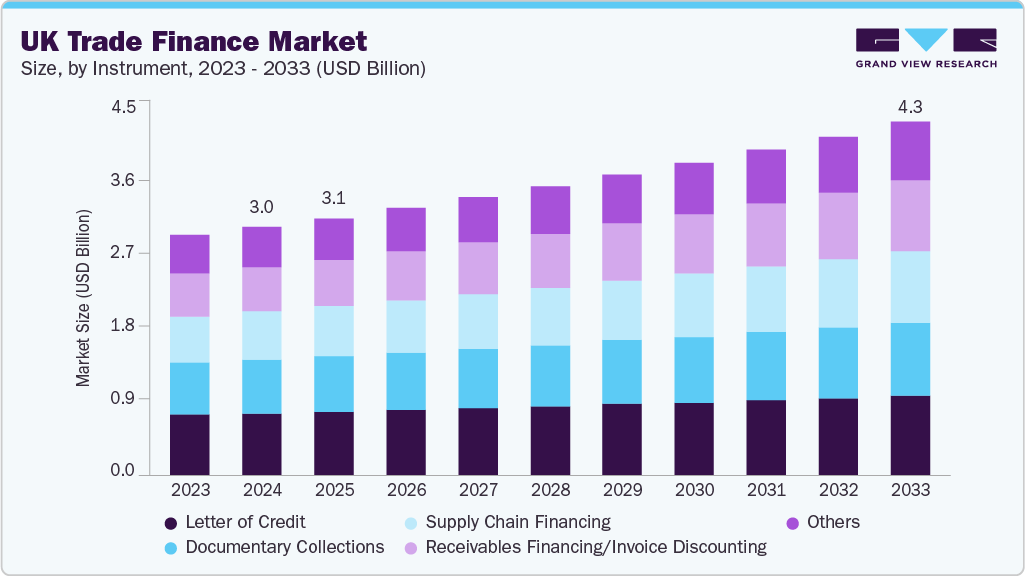
The UK trade finance market size was estimated at USD 3.00 billion in 2024 and is projected to reach USD 4.25 billion by 2033, growing at a CAGR of 4.0% from 2025 to 2033. The UK trade finance market has been driven by a combination of rising cross-border trade volumes, expanding small and medium enterprise (SME) participation in international markets, and growing demand for working capital optimization. As supply chains have become more complex, a greater need for tailored financial solutions has been observed, particularly among export-oriented industries. The post-Brexit trade environment has also contributed to shifting trade routes and partnerships, prompting businesses to seek more flexible and reliable financing instruments. Moreover, the growing emphasis on ESG-compliant trade practices has encouraged the adoption of sustainable trade finance mechanisms.
Blockchain technology is gaining traction in the UK trade finance sector due to its ability to offer secure, immutable, and real-time transaction tracking. Digitization of trade documents, the adoption of blockchain for secure and transparent transaction tracking, and the integration of artificial intelligence in risk assessment and compliance monitoring have been widely observed. In addition, smart contracts are being piloted to automate trade execution processes, such as payments, delivery confirmations, and document verification, thereby reducing fraud risk and lowering manual intervention.
Major banks and consortiums are investing in distributed ledger solutions that enhance transparency and trust among trade partners. Although adoption is still evolving, successful pilot programs and increased regulatory clarity are expected to boost the scalability of blockchain-based trade finance in the coming years. Thus, increasing integration of blockchain and smart contracts is expected to contribute to the growth of the market.
Significant investments have been directed toward modernizing trade finance infrastructure in the UK, with both public and private entities contributing to innovation. Funding has been channeled into digital platforms, supply chain finance ecosystems, and ESG-aligned trade finance solutions. Government-backed schemes, such as those under UK Export Finance (UKEF), have expanded access to trade credit insurance and guarantees, especially for SMEs. In addition, venture capital and strategic partnerships between banks and fintechs have supported the growth of new-age platforms designed to bridge the trade finance gap for underserved market segments.
Sustainable finance has gained prominence, with UK-based corporates and financiers aligning trade practices with environmental, social, and governance (ESG) standards. Green trade finance products, such as sustainability-linked loans and green guarantees, are increasingly being offered by banks to companies that meet certain ESG metrics. This trend is being driven by investor pressure, consumer expectations, and regulatory encouragement, especially considering the UK's climate commitments. Financial institutions are using ESG scoring models to assess borrower eligibility, thereby promoting environmentally responsible sourcing and production practices across the country’s trade networks.
The UK trade finance market faces several significant challenges that could hamper its growth and efficiency. A key challenge is the persistence of traditional, paper-based processes, which can lead to inefficiencies, delays, and increased operational costs, hindering the smooth flow of trade finance operations and making them susceptible to manual errors and fraud risks. Furthermore, geopolitical shifts, resurgent protectionism, and economic uncertainties are reshaping the international order, disrupting established trading rules and creating an environment where businesses face heightened credit, currency, and political risks. In addition, the inconsistency of regulatory standards across international trade partners could hinder the market's growth.
Instrument Insights
The letter of credit (LCs) segment dominated the market and accounted for the largest share of 25.0% in 2024. The segment’s growth is driven by an increased demand for risk mitigation in international transactions. Amid rising global geopolitical uncertainties and payment risks, UK exporters are turning to LCs to ensure guaranteed payment from overseas buyers through banking intermediaries. UK banks, supported by strong compliance frameworks and international correspondent networks, continue to position LCs as a trusted mechanism for mitigating counterparty and country risk. In addition, digitalization of LC processes, including the adoption of electronic documentation, has helped reduce processing time and enhanced the attractiveness of this instrument for large and mid-market exporters.
The receivables financing/invoice discounting segment is expected to witness the fastest CAGR over the forecast period. The segment’s growth is driven by increased working capital requirements among SMEs and mid-sized exporters. Amid tightening credit conditions and extended payment terms in global trade, businesses have sought faster liquidity solutions by leveraging outstanding invoices. The UK has seen a rise in fintech-led receivables finance platforms that offer quick access to funding through simplified, digital-first models, often with minimal collateral requirements. This segment is expected to continue expanding, particularly as demand grows for flexible, short-term financing options that align with the cash flow cycles of export-driven businesses.
Service Provider Insights
The banks segment dominated the market in 2024. The segment’s growth is driven by its established infrastructure, regulatory compliance capabilities, and access to global correspondent networks. UK-based banks have enhanced their trade finance offerings by integrating digital platforms, automating document processing, and adopting advanced risk assessment tools. In addition, the support of government-backed schemes such as those provided by UK Export Finance (UKEF) has strengthened the ability of banks to underwrite more trade finance deals by reducing credit risk.
The trading houses segment is expected to witness a notable CAGR over the forecast period. Trading houses operating in the UK have increasingly emerged as key enablers of trade finance, especially for complex cross-border transactions involving commodities, raw materials, and energy. These entities often bridge funding gaps by offering structured finance solutions and leveraging their global networks to provide access to new markets. UK-based trading houses benefit from the country's strategic position as a global trading hub and its well-established legal and financial services ecosystem, thereby driving its growth.
Trade Insights
The international segment dominated the market in 2024 and is expected to witness the fastest CAGR over the forecast period. The segment’s growth is supported by the country’s position as a global trading hub and its diversified export base. Post-Brexit trade realignments have led UK exporters to expand partnerships beyond the EU, creating new opportunities in regions such as Asia-Pacific, the Middle East, and North America. These shifts have heightened demand for trade finance instruments that mitigate cross-border risks and support longer, more complex supply chains.
The domestic segment is expected to witness a notable CAGR over the forecast period. The growth of domestic trade finance in the UK is being driven by the rising complexity of local supply chains and increased working capital requirements among businesses. Financial institutions are responding with greater participation in short-term credit solutions to support these needs. As companies engage in sourcing, manufacturing, and distribution within national borders, demand is growing for structured financing to manage transactions between buyers and suppliers operating on varying payment terms.
Enterprise Size Insights
The large enterprises segment dominated the market in 2024. Trade finance adoption among large enterprises in the UK continues to grow, driven by their extensive cross-border operations, complex supply chains, and need for bespoke financial solutions. The country’s advanced financial infrastructure, featuring global banks, export credit agencies such as UK Export Finance (UKEF), and specialized trade finance providers, enables large corporations to access a broad suite of instruments such as structured trade finance, syndicated facilities, and ESG-linked financing. The push for sustainable trade practices has incentivized large enterprises to integrate green financing mechanisms into their broader trade finance strategies.
The SME segment is expected to witness the fastest CAGR over the forecast period. SMEs in the UK are increasingly engaging in both domestic and international trade, creating strong demand for accessible, flexible trade finance solutions. Historically underserved due to high-risk perception and limited collateral, this segment is now being supported through fintech innovations, alternative lenders, and expanded government-backed programs such as those offered by UKEF. Improved awareness and digital literacy among SMEs are expected to accelerate trade finance adoption, driving significant growth in this segment.
Industry Insights
The construction segment dominated the market in 2024. The construction sector in the UK is experiencing increased reliance on trade finance due to rising material costs, extended payment cycles, and the need to maintain liquidity across complex project timelines. Large-scale infrastructure developments, such as housing, transport, and energy projects, often involve multiple subcontractors and cross-border procurement, creating demand for structured financing solutions such as performance guarantees, advance payment bonds, and receivables financing. Financial institutions and trade finance providers are offering tailored products to help construction firms manage working capital and mitigate counterparty risk, thereby driving the segment’s growth.
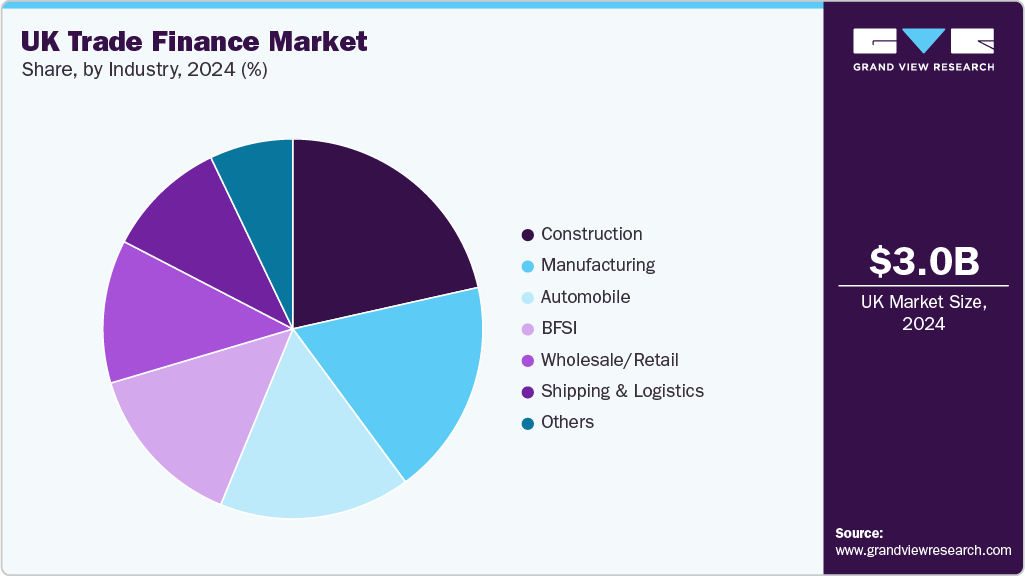
The shipping & logistics segment is expected to witness the fastest CAGR over the forecast period. The segment growth is driven by the expansion of global trade routes, post-Brexit customs complexities, and the need for agile supply chain financing. Companies in this sector are increasingly utilizing instruments such as letters of credit, supply chain finance, and freight invoice factoring to support the movement of goods and manage cash flow across transit cycles. The UK's strategic location and its major port infrastructure, including the Port of London and Port of Felixstowe, make it a vital logistics hub, strengthening demand for trade-related financial services.
Key UK Trade Finance Company Insights
Some key companies in the UK trade finance industry include Kriya Finance Limited, Lloyds Bank, and Royal Bank of Scotland plc, among others. These companies have established global networks and offer comprehensive trade finance services. In addition, these companies focus on offering digital, flexible solutions tailored to SMEs as well as large enterprises.
-
Lloyds Banking Group is a financial institution, serving over 30 million customers. It is a provider of banking and financial services, operating under various brands such as Lloyds Bank, Halifax, Bank of Scotland, and Scottish Widows. Lloyds Banking Group focuses on retail and commercial banking, insurance, pensions, and investment solutions, and holds a significant share of the UK mortgage market. It offers a range of products through both traditional branches and highly rated digital channels and has a strong commitment to sustainability and social impact.
-
Kriya Finance Limited, formerly known as MarketFinance Limited, is a British FinTech company specializing in B2B financing solutions such as invoice finance, business loans, and embedded finance products. The company’s mission is to make business payments frictionless and accessible, providing innovative solutions such as PayLater options for buyers, cash flow management tools, and flexible working capital loans.
Key UK Trade Finance Companies:
- Kriya Finance Limited
- Bibby Financial Services
- Aldermore Bank
- Novuna Business Finance
- Lloyds Bank Commercial Finance
- Close Brothers Invoice Finance
- RBS Invoice Finance (part of NatWest Group)
- Skipton Business Finance
- Ultimate Finance
- Touch Financial
Recent Developments
-
In April 2025, ODAS Global Consulting LTD, a prominent company in global investment and business advisory, announced the international rollout of its Letter of Credit services. This strategic initiative is designed to support companies, importers, and exporters across the globe by providing secure trade finance solutions in partnership with trusted financial institutions.
UK Trade Finance Market Report Scope
Report Attribute
Details
Market size value in 2025
USD 3.11 billion
Revenue forecast in 2033
USD 4.25 billion
Growth rate
CAGR of 4.0% from 2025 to 2033
Base year for estimation
2024
Historical data
2021 - 2023
Forecast period
2025 - 2033
Quantitative units
Revenue in USD billion and CAGR from 2025 to 2033
Report coverage
Revenue forecast, company ranking, competitive landscape, growth factors, and trends
Segments covered
Instrument, service provider, trade, enterprise size, industry
Country scope
UK
Key companies profiled
Kriya Finance Limited; Bibby Financial Services; Aldermore Bank; Novuna Business Finance; Lloyds Bank Commercial Finance; Close Brothers Invoice Finance; RBS Invoice Finance (part of NatWest Group); Skipton Business Finance; Ultimate Finance; Touch Financial
Customization scope
Free report customization (equivalent up to 8 analysts working days) with purchase. Addition or alteration to country, regional & segment scope.
Pricing and purchase options
Avail customized purchase options to meet your exact research needs. Explore purchase options
UK Trade Finance Market Report Segmentation
This report forecasts revenue growth at a country level and provides an analysis of the latest industry trends in each of the sub-segments from 2021 to 2033. For this study, Grand View Research has segmented the UK trade finance market report based on instrument, service provider, trade, enterprise size, and industry
-
Instrument Outlook (Revenue, USD Billion, 2021 - 2033)
-
Letter of Credit
-
Supply Chain Financing
-
Documentary Collections
-
Receivables Financing/Invoice Discounting
-
Others
-
-
Service Provider Outlook (Revenue, USD Billion, 2021 - 2033)
-
Banks
-
Financial Institutions
-
Trading Houses
-
Others
-
-
Trade Outlook (Revenue, USD Billion, 2021 - 2033)
-
Domestic
-
International
-
-
Enterprise Size Outlook (Revenue, USD Billion, 2021 - 2033)
-
Large Enterprises
-
SMEs
-
-
Industry Outlook (Revenue, USD Billion, 2021 - 2033)
-
BFSI
-
Construction
-
Wholesale/Retail
-
Manufacturing
-
Automobile
-
Shipping & Logistics
-
Others
-
Frequently Asked Questions About This Report
b. The UK trade finance market size was estimated at USD 3.00 billion in 2024.
b. The UK trade finance market is expected to grow at a compound annual growth rate of 4.0% from 2025 to 2033 to reach USD 4.25 billion by 2033.
b. The letter of credit (LCs) segment dominated the market in 2024 and accounted for the largest share of 25.0%. The segment’s growth is driven by an increased demand for risk mitigation in international transactions.
b. Some key players operating in the UK trade finance market include Kriya Finance Limited, Bibby Financial Services, Aldermore Bank, Novuna Business Finance, Lloyds Bank Commercial Finance, Close Brothers Invoice Finance, RBS Invoice Finance (part of NatWest Group), Skipton Business Finance, Ultimate Finance, and Touch Financial.
b. The UK trade finance market has been driven by a combination of rising cross-border trade volumes, expanding small and medium enterprise (SME) participation in international markets, and growing demand for working capital optimization.


Share this report with your colleague or friend.
Need a Tailored Report?
Customize this report to your needs — add regions, segments, or data points, with 20% free customization.


ISO 9001:2015 & 27001:2022 Certified
We are GDPR and CCPA compliant! Your transaction & personal information is safe and secure. For more details, please read our privacy policy.
Trusted market insights - try a free sample
See how our reports are structured and why industry leaders rely on Grand View Research. Get a free sample or ask us to tailor this report to your needs.













