
- Home
- »
- Plastics, Polymers & Resins
- »
-
ULTEM (Polyetherimide) 3D Printing Resins Market Size Report, 2025-2033GVR Report cover

ULTEM (Polyetherimide) 3D Printing Resins Market (2025 - 2033) Size, Share & Trends Analysis Report By Product (Filament, Pellets / Granules, Powder), By End-use, By Region, And Segment Forecasts
Market Size, 2024
$410.1MMarket Estimate, 2026
$503.5MMarket Forecast, 2033
$1,099.2MCAGR, 2025–2033
11.7%ULTEM (Polyetherimide) 3D Printing Resins Market Summary
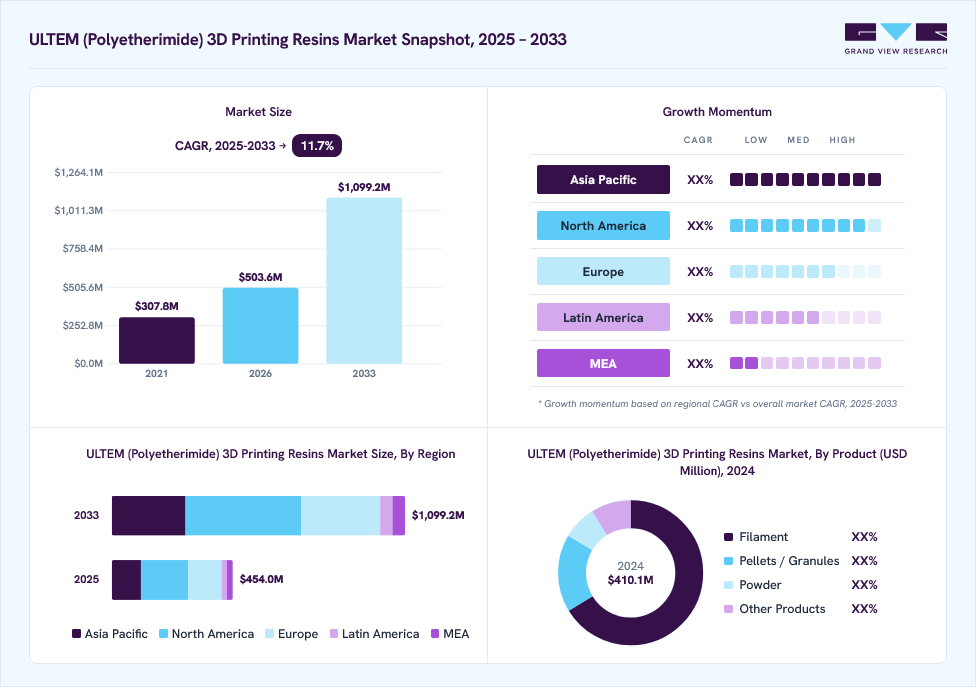
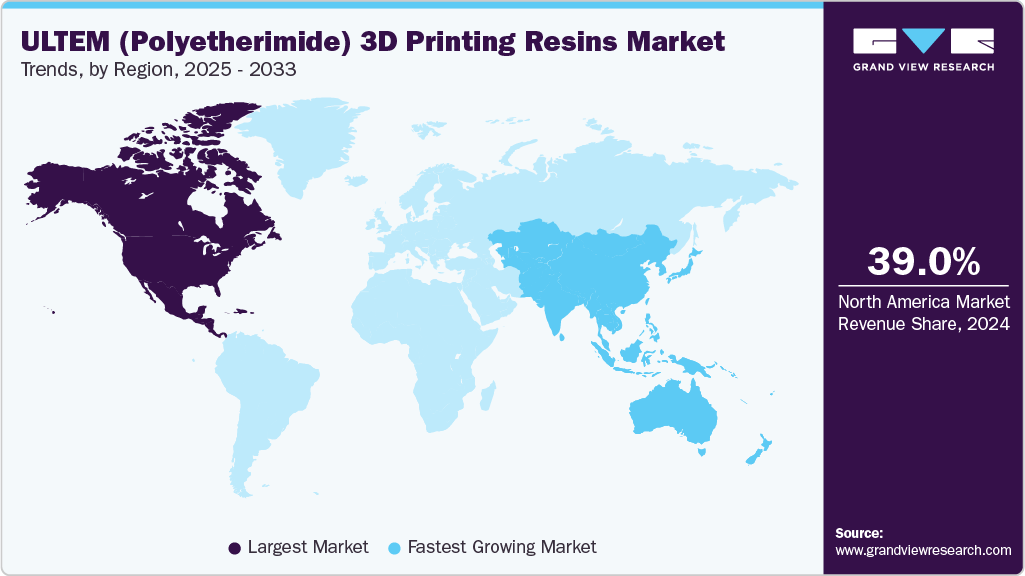
The global ULTEM (polyetherimide) 3d printing resins market size was valued at USD 410.1 million in 2024 and is projected to grow from USD 503.5 million in 2026 to USD 1099.2 million by 2033, at a CAGR of 11.7% from 2025 to 2033. North America dominated the market, accounting for a revenue share of 39.0% in 2024. The market is driven by growing demand for high-performance, heat-resistant materials in aerospace and automotive industries and the increasing adoption of additive manufacturing for lightweight, durable component production.
 Source: Grand View Research, IR Documents, Primary Interviews, Paid DatabasesTo learn more about this report,
 Download Free Sample Report
Key Market Trends & Insights
- The ULTEM (Polyetherimide) 3D printing resins market in Canada is expected to grow at a substantial CAGR of 12.8% from 2025 to 2033.
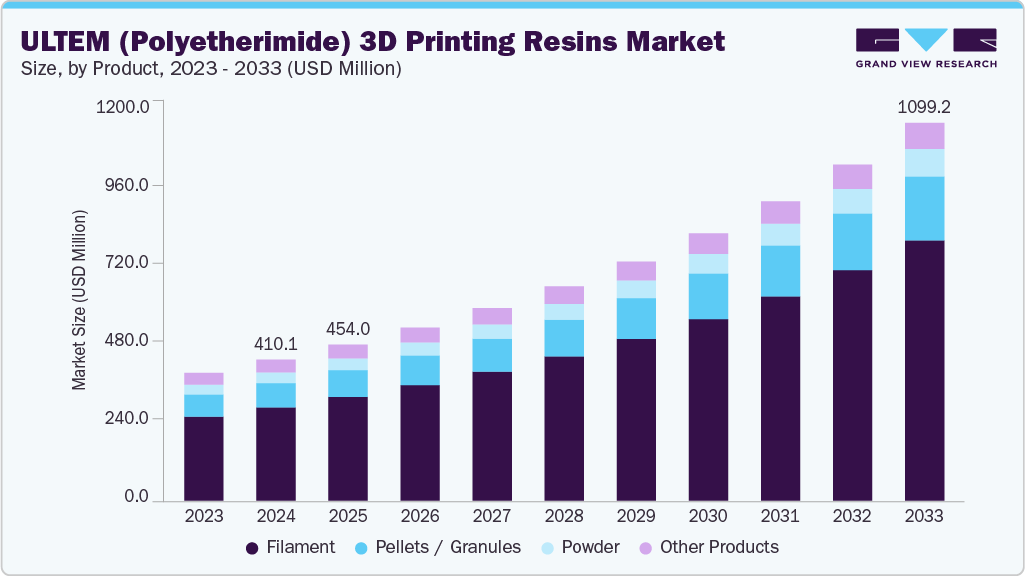
- By product, the filament segment is expected to grow at a considerable CAGR of 12.2% from 2025 to 2033 in terms of revenue.
- By end use, the industrial / manufacturing segment is expected to grow at a considerable CAGR of 12.4% from 2025 to 2033 in terms of revenue.
Market Size & Forecast
- 2024 Market Size: USD 410.1 Million
- 2033 Projected Market Size: USD 1,099.2 Million
- CAGR (2025-2033): 11.7%
- North America: Largest market in 2024
- Asia Pacific: Fastest growing market
Prism AI by Grand View Research Free to tryAsk a question about the ULTEM (Polyetherimide) 3D printing resins marketTry asking✓Every figure cited from GVR research Prefer the report? Download free sample →
ULTEM resins offer exceptional strength-to-weight ratios, flame retardancy, and resistance to high temperatures, making them ideal for producing lightweight, durable components such as ducting, brackets, and enclosures. Aerospace OEMs and MRO providers are shifting towards additive manufacturing to reduce part lead times, minimize waste, and enable on-demand production of certified components. For instance, Boeing and Airbus have increasingly used ULTEM 9085 filament, known for its FAR 25.853 compliance, in aircraft interiors and structural components. This trend is expected to continue as the aerospace sector embraces 3D printing for both prototyping and end-use production.Another major growth driver is the automotive industry’s focus on vehicle lightweighting to improve fuel efficiency and meet stringent emission standards. ULTEM 3D printing resins are being adopted to manufacture under-the-hood parts, structural prototypes, and customized components that can withstand high mechanical stress and thermal loads. Unlike conventional materials,
 To learn more about this report, Download Free Sample Report
ULTEM resins maintain stability at continuous service temperatures up to 170°C, making them suitable for demanding automotive environments. Automakers such as General Motors and BMW are leveraging additive manufacturing with ULTEM-based materials to accelerate design iteration, reduce tooling costs, and produce low-volume, high-performance parts. The shift toward electric vehicles (EVs) is further intensifying the need for heat-resistant, lightweight, and electrically insulating materials like ULTEM.
The growing industrial adoption of additive manufacturing across diverse sectors, including medical, electronics, and industrial equipment, is fueling the demand for ULTEM 3D printing resins. These industries benefit from ULTEM’s superior dimensional stability, chemical resistance, and biocompatibility. In the medical field, for example, ULTEM 1010 resin is used for surgical guides and sterilizable medical instruments.
Its ability to withstand autoclaving processes without deformation gives it a competitive edge over other engineering plastics. Similarly, industrial toolmakers and electronics manufacturers use ULTEM for customized jigs, fixtures, and insulative housings. The ability to print high-performance thermoplastic parts on-demand not only enhances operational efficiency but also supports supply chain flexibility, key advantages in modern, just-in-time manufacturing systems.
Market Concentration & Characteristics
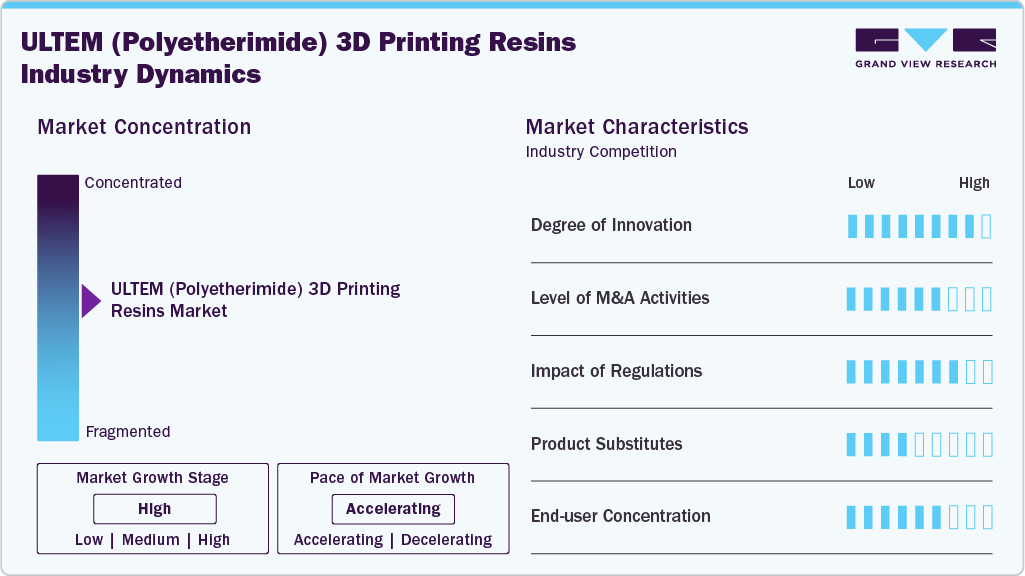
The ULTEM (Polyetherimide) 3D printing resins market is a highly specialized and technology-driven segment within the broader additive manufacturing industry. It is characterized by a focus on high-performance thermoplastics that combine superior mechanical strength, thermal stability, flame retardancy, and chemical resistance. Unlike commodity 3D printing materials such as PLA or ABS, ULTEM resins cater primarily to industrial and high-end applications in aerospace, defense, automotive, electronics, and medical sectors. The industry’s complexity arises from the stringent performance and certification requirements of these sectors, making material quality, process reliability, and regulatory compliance critical success factors.
 To learn more about this report, Download Free Sample Report
The industry exhibits moderate concentration with a mix of established multinational chemical companies and specialized material suppliers. Major players such as SABIC, Solvay, and Stratasys dominate the market with proprietary resin formulations, robust R&D capabilities, and global distribution networks. At the same time, niche suppliers and regional service bureaus play a crucial role by providing customized solutions and 3D printing services, often enabling smaller enterprises to access ULTEM technology without heavy capital investments in equipment. This blend of large and small players fosters both innovation and competitive pricing dynamics.
Product Insights
The filament segment recorded the largest market revenue share of over 66.0% in 2024 and is expected to grow at the fastest CAGR of 12.2% during the forecast period. Filament is the most widely used product form of ULTEM (Polyetherimide) 3D printing resins, particularly in Fused Deposition Modeling (FDM) and Fused Filament Fabrication (FFF) technologies. These filaments are extruded into fine thermoplastic strands that are fed into 3D printers to build components layer by layer.
The demand for ULTEM filaments is driven by the increasing adoption of high-temperature FDM printers, the growth of lightweight part manufacturing in aerospace and defense, and the rising demand for flame-retardant materials in electronic enclosures and transportation.
Pellets or granules represent the raw thermoplastic feedstock form of ULTEM resins, primarily used in pellet extrusion 3D printing and large-format additive manufacturing (LFAM) systems. These are less processed compared to filaments and offer cost efficiency, higher deposition rates, and scalability for industrial applications. Pellets are particularly advantageous in automotive tooling, aerospace molds, and structural prototypes, where large, dense parts are required. The growing need for rapid tooling and large component manufacturing in defense and energy sectors is boosting the utilization of pellet-based ULTEM 3D printing.
End-use Insights
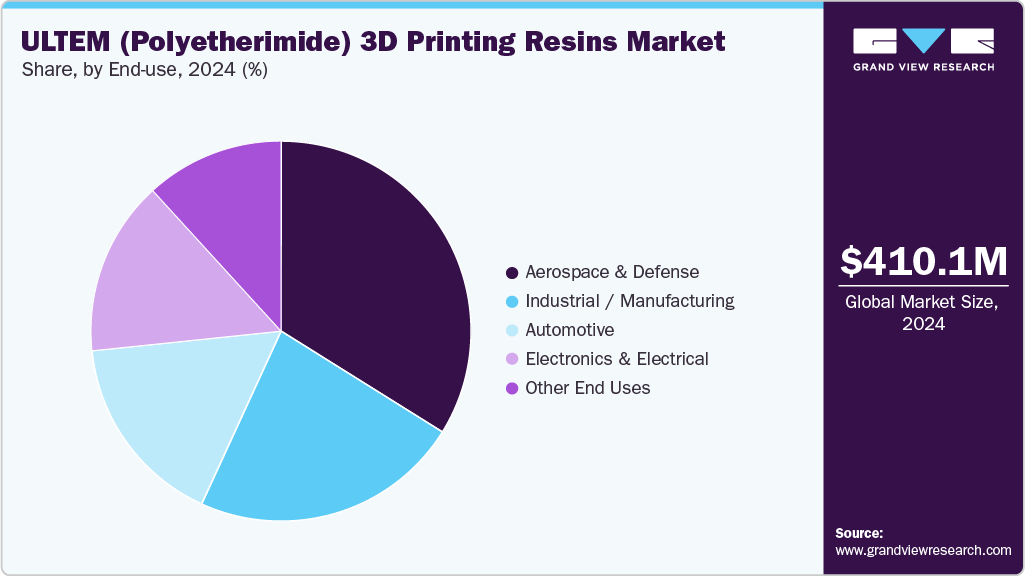
The aerospace & defense companies segment recorded the largest market share of over 33.0% in 2024. This outlook is due to the material’s exceptional strength-to-weight ratio, flame retardancy, dimensional stability, and high thermal resistance. ULTEM resins are extensively used for fabricating aircraft cabin components, ducting systems, clips, brackets, and interior panels.
In defense applications, they are utilized in lightweight housings, sensor mounts, and functional prototypes that require high heat resistance and low outgassing. The key driving forces for ULTEM’s use in aerospace and defense include the increasing demand for lightweight components to improve fuel efficiency, the rising adoption of additive manufacturing for low-volume, high-complexity parts, and strict safety and performance regulations in aviation.
 To learn more about this report, Download Free Sample Report
The industrial / manufacturing applications segment is projected to grow at the fastest CAGR of 12.4% during the forecast period. The industrial and manufacturing sector leverages ULTEM 3D printing resins for producing jigs, fixtures, molds, and end-use machine components. Its high dimensional accuracy, low creep, and excellent chemical resistance make it ideal for demanding manufacturing environments.
ULTEM’s ability to maintain mechanical integrity under stress and high temperatures ensures reliability in heavy-duty equipment. The rise of Industry 4.0, with its emphasis on automation, customization, and efficient material usage, further strengthens the use of ULTEM in manufacturing.
Region Insights
North America ULTEM (Polyetherimide) 3D printing resins market dominated the industry and accounted for the largest revenue share of 39.0% in 2024. This positive outlook is due to its advanced aerospace, defense, and healthcare sectors. Aerospace companies such as Boeing and Lockheed Martin increasingly rely on ULTEM resins for producing lightweight, heat-resistant components, functional prototypes, and tooling solutions. The region’s strong focus on innovation and adoption of advanced manufacturing technologies positions it as a key market for high-performance polymers such as ULTEM.
 To learn more about this report, Download Free Sample Report
U.S. ULTEM (Polyetherimide) 3D Printing Resins Market Trends
The U.S. government’s investments in defense and space programs further fuel the demand. ULTEM resins are widely used for high-performance applications, including aerospace structural components, automotive functional prototypes, and industrial tooling. For example, NASA and Boeing utilize ULTEM resins for parts that require heat resistance, flame retardancy, and mechanical durability, ensuring safety and performance in critical applications. The U.S. market benefits from strong R&D infrastructure, innovation-driven industries, and a favorable regulatory environment for additive manufacturing.
Europe ULTEM (Polyetherimide) 3D Printing Resins Market Trends
Europe’s growth in the market is due to its high adoption of additive manufacturing in aerospace, automotive, and industrial sectors. Countries such as Germany, France, and the UK have numerous aerospace manufacturing hubs that require heat-resistant, high-strength components, which ULTEM resins provide. German companies such as Siemens and BMW leverage ULTEM resins for functional prototyping, tooling, and end-use parts, enabling more efficient and sustainable manufacturing.
In addition, Europe’s well-established industrial research networks and collaborations between universities, research institutes, and manufacturers accelerate innovations in additive manufacturing. This ensures continued demand for ULTEM resins in precision engineering applications, particularly in aerospace and automotive sectors.
Asia Pacific ULTEM (Polyetherimide) 3D Printing Resins Market Trends
Asia Pacific is witnessing strong growth in the ULTEM (Polyetherimide) 3D printing resins market as it expected to grow at the fastest CAGR of 12.3% during the forecast period. This outlook is due to its rapidly growing industrial and manufacturing sectors. Countries such as China, Japan, and South Korea are increasingly adopting additive manufacturing technologies for aerospace, automotive, and electronics applications. The region’s large consumer electronics market, particularly in China and Japan, further boosts demand, as manufacturers use ULTEM resins for high-temperature-resistant components in devices and automotive electronic systems.
Key ULTEM (Polyetherimide) 3D Printing Resins Company Insights
The competitive environment of the ULTEM (Polyetherimide) 3D printing resins industry is characterized by a moderate to high level of rivalry, driven by a mix of established chemical manufacturers and specialized additive manufacturing players. Key global players such as SABIC, Stratasys, and Evonik dominate due to their strong R&D capabilities, proprietary resin formulations, and integrated 3D printing solutions, creating high entry barriers for new entrants.
The market also sees competition from emerging regional players offering cost-effective alternatives, particularly in Asia Pacific, intensifying price sensitivity. Innovation in high-performance, heat-resistant, and chemically stable resins, along with strategic collaborations with 3D printer manufacturers, serves as a key differentiator. In addition, customer demand for certification-compliant, aerospace- and automotive-grade materials forces continuous improvement, making brand reputation, product quality, and technical support crucial competitive factors.
-
In May 2025, SABIC launched a new ULTEM extrusion grade for high-voltage EV traction motors, ideal for magnet wire insulation in 800V systems. It enables up to 30% thinner insulation without primers, reduces weight and space, and allows single-pass mono-layer extrusion, boosting productivity. VOC-free and solvent-free, it meets regulatory standards and performs under high voltages, temperatures, and harsh conditions. The resin was showcased at PCIM Europe 2025 alongside high-temp EV inverter capacitors.
-
In July 2024, SABIC launched its new USD 170.0 million ULTEM resin manufacturing facility in Singapore, marking its first advanced specialty chemical plant in the Asia Pacific region. This strategic facility aims to meet the growing demand from high-tech and manufacturing industries in Asia Pacific, including Japan and China, by increasing SABIC’s global ULTEM resin production capacity by more than 50%.
Key ULTEM (Polyetherimide) 3D Printing Resins Companies:
The following are the leading companies in the ULTEM (polyetherimide) 3D printing resins market. These companies collectively hold the largest market share and dictate industry trends.
- SABIC
- Stratasys
- Trident Plastics, Inc
- Emco Industrial Plastics
- AON3D
- Ultrapolymers
- Polymer Resources
ULTEM (Polyetherimide) 3D Printing Resins Market Report Scope
Report Attribute
Details
Market size in 2024
USD 410.1 million
Estimated market size in 2026
USD 503.5 million
Projected market size by 2033
USD 1,099.2 million
Growth rate
CAGR of 11.7% from 2025 to 2033
Historical data
2021 - 2023
Forecast period
2025 - 2033
Quantitative units
Revenue in USD million/billion, volume in tons, and CAGR from 2025 to 2033
Report coverage
Revenue forecast, volume forecast, competitive landscape, growth factors, and trends
Segments covered
Product, end-use, region
States scope
North America; Europe; Asia Pacific; Latin America; Middle East & Africa
Key companies profiled
SABIC; Stratasys; Trident Plastics, Inc; Emco Industrial Plastics; AON3D; Ultrapolymers; Polymer Resources
Customization scope
Free report customization (equivalent up to 8 analyst’s working days) with purchase. Addition or alteration to country, regional, and segment scope.
Pricing and purchase options
Avail customized purchase options to meet your exact research needs. Explore purchase options
Global ULTEM (Polyetherimide) 3D Printing Resins Market Report Segmentation
This report forecasts revenue growth at a global level and provides an analysis of the latest industry trends in each of the sub-segments from 2021 to 2033. For this study, Grand View Research has segmented the global ULTEM (Polyetherimide) 3D printing resins market report based on product, end-use, and region:
 To learn more about this report, Download Free Sample Report
-
Product Outlook (Volume, Tons; Revenue, USD Million, 2021 - 2033)
-
Filament
-
Pellets / Granules
-
Powder
-
Other Products
-
-
End-use Outlook (Volume, Tons; Revenue, USD Million, 2021 - 2033)
-
Aerospace & Defense
-
Automotive
-
Industrial / Manufacturing
-
Electronics & Electrical
-
Other End Uses
-
-
Region Outlook (Volume, Tons; Revenue, USD Million, 2021 - 2033)
-
North America
-
U.S.
-
Canada
-
Mexico
-
-
Europe
-
Germany
-
France
-
UK
-
Italy
-
Spain
-
-
Asia Pacific
-
China
-
India
-
Japan
-
Australia
-
South Korea
-
-
Latin America
-
Brazil
-
Argentina
-
-
Middle East & Africa
-
South Africa
-
Saudi Arabia
-
UAE
-
-
Frequently Asked Questions About This Report
The global ULTEM (polyetherimide) 3d printing resins market size was valued at USD 410.1 million in 2024 and is estimated at USD 503.5 million for 2026.
The global ULTEM (polyetherimide) 3d printing resins market is expected to grow at a CAGR of 11.7% from 2025 to 2033, reaching USD 1099.2 million by 2033.
The aerospace & defense companies segment dominates the ULTEM (Polyetherimide) 3D printing resins market due to the material’s exceptional strength-to-weight ratio, flame retardancy, and thermal stability, which meet stringent industry safety and performance standards.
The key players in the ULTEM (Polyetherimide) 3D printing resins market include SABIC; Stratasys; Trident Plastics, Inc; Emco Industrial Plastics; AON3D; Ultrapolymers; and Polymer Resources.
The market is driven by the rising demand for high-performance, heat-resistant materials in aerospace, automotive, and industrial applications, coupled with advancements in additive manufacturing technologies.
About the Author(s)
Plastics, Polymers & Resins Research Team
Bulk Chemicals · Plastics, Polymers & ResinsThis report was authored by the plastics, polymers & resins research team at Grand View Research - comprising two research analysts, one senior research analyst, and one industry expert - with specialized expertise in the plastics, polymers & resins segment of the bulk chemicals industry. All findings are based on proprietary bulk chemicals databases, executive interviews, and regulatory analysis, subject to internal peer review prior to publication.
Last Updated:
Speak to Analyst

Customize this report to your needs - add regions, segments, or data points, with 20% free customization.
Or view our licence options:


ISO 9001:2015 & 27001:2022 Certified
We are GDPR and CCPA compliant! Your transaction & personal information is safe and secure. For more details, please read our privacy policy.


