
- Home
- »
- Renewable Energy
- »
-
Ultra-thin Solar Cells Market Size & Share Report, 2026-2033GVR Report cover

Ultra-thin Solar Cells Market (2026 - 2033)
Size, Share & Trends Analysis Report By Material (Cadmium Telluride, Copper Indium Gallium Selenide), By End Use (Residential, Commercial), By Region, And Segment Forecasts
Market Size, 2025
$28.2MMarket Estimate, 2026
$32.5MMarket Forecast, 2033
$158.7MCAGR, 2026–2033
25.4%Ultra-thin Solar Cells Market Summary
The global ultra-thin solar cells market size was valued at USD 28.2 million in 2025 and is projected to grow from USD 32.5 million in 2026 to USD 158.7 million by 2033, at a CAGR of 25.4% from 2026 to 2033. North America dominated the market, accounting for a revenue share of 34.9% in 2025. Ultra-thin solar cells are lightweight photovoltaic devices characterized by their minimal thickness, enabling flexible, portable, and versatile applications across various sectors.
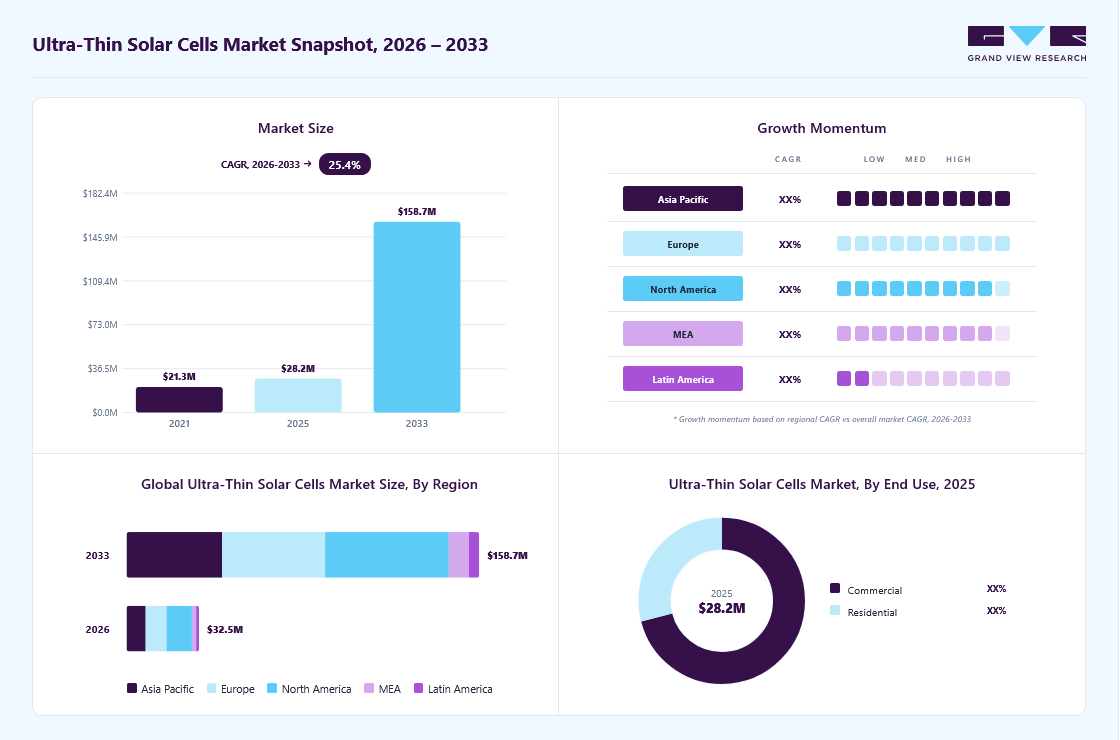 Source: Grand View Research, IR Documents, Primary Interviews, Paid DatabasesTo learn more about this report,
 Download Free Sample Report
 Key Market Trends & Insights
- By material: Cadmium telluride segment led the market with the largest revenue share of 34.2% in 2025
- By end use: Commercial segment led the market with the largest revenue share of 71.0% in 2025.
Regional Highlights
- Largest regional market: North America (34.9% revenue share, 2025)
- Fastest growing regional market: Asia Pacific (highest CAGR, 2026-2033)
- By country: China held the largest market share in 2025
Market Size & Forecast
- Market size in 2025: USD 28.2 Million
- Estimated market size in 2026: USD 32.5 Million
- Projected market size by 2033: USD 158.7 Million
- CAGR (2026-2033): 25.4%
Three ways to get this report
Buy it, customize it, or ask a question.Ask an Analyst
Analyst response in 1 business day
- AccessReport author, directly
- Reply timeWithin 1 working day
- No sales callDirect answer only
- FormatEmail reply
- CostFree, no cost
Get the Full Report
What the study covers
- FormatsPDF · Excel · Dashboard
- Timeline2026–2033 annual, 2025 base
- Coverage20+ countries, 5 regions
- Companies10+ key players profiled
Customize the Report
20% free customization
- IncludeCountries, segments, points
- TailorTo your product definition
- ExtendDeeper competitor detail
- OrA fully bespoke study
- Turnaround5–10 working days
These cells convert sunlight directly into electricity while offering advantages such as reduced material usage and enhanced integration into diverse surfaces. Rapid advancements in materials science and manufacturing processes, coupled with increasing demand for wearable electronics and building-integrated photovoltaics (BIPV), are driving market growth. Furthermore, supportive government initiatives promoting renewable energy adoption and sustainability goals are expected to accelerate the market expansion during the forecast period.
 To learn more about this report, Download Free Sample Report
 Ultra-thin solar cells are primarily used in applications where lightweight, flexibility, and space-saving are critical. While conventional solar panels are widely used for large-scale power generation, ultra-thin solar cells enable innovative deployments in wearable electronics, portable chargers, and building-integrated photovoltaics (BIPV). Their high flexibility and low material consumption make them suitable for integration into curved surfaces and even textiles. The growing shift towards sustainable and renewable energy solutions in developed and emerging markets such as the United States, Japan, India, and China, alongside supportive government incentives for solar adoption, is are key driver propelling the market’s expansion.
Market Dynamics
The ultra-thin solar cells market is witnessing steady growth due to the increasing demand for lightweight, flexible, and high-efficiency solar technologies across consumer electronics, building-integrated photovoltaics (BIPV), aerospace, and portable power applications. Advancements in thin-film materials and manufacturing processes are improving performance while reducing production costs. Growing investments in renewable energy and the need for space-saving solar solutions are further supporting market expansion. However, challenges such as lower durability compared to conventional solar panels and the high cost of advanced materials continue to influence market adoption.
The primary driver of the ultra-thin solar cells market is the growing demand for lightweight, flexible, and space-efficient solar technologies across industries such as consumer electronics, BIPV, transportation, aerospace, and portable power systems. Unlike conventional silicon solar panels, ultra-thin solar cells can be integrated into curved or weight-sensitive surfaces while maintaining efficient power generation. As industries increasingly seek compact renewable energy solutions without adding significant weight or requiring rigid installations, the adoption of ultra-thin solar cells continues to accelerate.
In April 2026, researchers from the Japan Aerospace Exploration Agency (JAXA) and The University of Tokyo developed ultrathin perovskite solar cells with a total thickness of less than 10 micrometers and enhanced radiation resistance for space applications. The innovation highlights the increasing focus on ultra-thin, lightweight solar technologies for next-generation aerospace and other weight-sensitive applications.
The growth of the ultra-thin solar cells market is restrained by the limited environmental durability of these cells. Many ultra-thin solar technologies, particularly those based on perovskite and organic materials, are highly sensitive to moisture, oxygen, heat, and prolonged UV exposure. Without advanced encapsulation, their performance degrades rapidly under outdoor conditions, reducing operational lifespan and increasing maintenance and packaging costs. These durability challenges continue to limit large-scale commercial adoption, especially in long-term outdoor and utility-scale applications.
The increasing deployment of indoor IoT devices and self-powered electronics presents a significant growth opportunity for the ultra-thin solar cells market. Printable organic photovoltaic (OPV) and other ultra-thin solar cells can efficiently harvest energy from low-intensity indoor lighting, making them well-suited for wireless sensors, smart home devices, electronic labels, keyboards, and remote monitoring systems. As industries seek sustainable alternatives to disposable batteries, the demand for lightweight, flexible, and maintenance-free indoor energy harvesting solutions is expected to drive the adoption of ultra-thin solar cells.
Analyst Perspective
The ultra-thin solar cells market is expected to witness strong long-term growth as industries increasingly seek lightweight, flexible, and space-efficient renewable energy solutions. While commercialization is still at an early stage for several technologies, continuous advancements in perovskite, organic photovoltaic, and copper indium gallium selenide materials are improving efficiency and scalability. A key trend shaping the market is the growing adoption of ultra-thin solar cells for indoor IoT devices, wearable electronics, and building-integrated photovoltaics, where conventional solar panels are less practical. Companies that can improve durability, lower production costs, and scale manufacturing are likely to gain a competitive advantage in the coming years.
Drivers, Opportunities & Restraints
The global market for ultra-thin solar cells is driven by the increasing demand for lightweight, flexible, and efficient photovoltaic solutions across diverse applications, including wearable technology, portable power devices, and building-integrated photovoltaics (BIPV). Growing environmental awareness and government initiatives promoting renewable energy adoption encourage investments in innovative solar technologies. The ability of ultra-thin solar cells to be integrated into unconventional surfaces and their potential for cost-effective production are key factors accelerating market growth.
Emerging opportunities in this market include advancements in materials such as perovskites and organic photovoltaics that promise higher efficiency and durability. Integrating ultra-thin solar cells into Internet of Things (IoT) devices and electric vehicles (EVs) presents new avenues for expansion. In addition, increasing demand for off-grid and decentralized power solutions in developing economies offers significant growth potential. However, the market faces challenges such as lower efficiency compared to traditional silicon-based solar panels, issues related to long-term stability, and the need for scalable manufacturing processes. High initial R&D costs and competition from established solar technologies also act as restraints in some regions.
Material Insights
The cadmium telluride segment led the market with a revenue share of 34.2% in 2025. This is supported by CdTe’s high light absorption capacity, which enables efficient solar energy conversion using extremely thin semiconductor layers. Its cost-effective manufacturing process, lower energy requirements, and scalable production capabilities further enhance its commercial appeal.The perovskite solar cell segment is expected to grow at the fastest CAGR of 26.0% from 2026 to 2033. This growth is driven by advancements in photovoltaic efficiency and the potential for cost-effective manufacturing. The lightweight and flexible nature of perovskite materials supports their use across diverse applications. Furthermore, the development of perovskite-silicon tandem cells to improve power conversion efficiency and ongoing investments in commercialization are expected to accelerate segment growth.End Use Insights
Based on end use, the commercial segment led the market with the largest revenue share of 71.0% in 2025. The rising demand for flexible and lightweight solar solutions in commercial spaces-such as office buildings, malls, hotels, and institutional infrastructures-is driving significant adoption. With growing emphasis on achieving energy efficiency and sustainability certifications, businesses increasingly integrate ultra-thin solar cells into building facades, windows, rooftops, and other structural elements through Building-Integrated Photovoltaics (BIPV). Their aesthetic adaptability and low installation footprint make them especially attractive in modern urban architecture.
 To learn more about this report, Download Free Sample Report
 The commercial segment is expected to expand robustly over the forecast period, supported by government incentives, green building mandates, and decreasing costs of advanced solar technologies. However, concerns about long-term durability and slightly lower efficiencies than traditional panels have made some commercial buyers cautious. Meanwhile, the industrial segment, including factories, warehouses, and data centers, is also witnessing increasing adoption of ultra-thin solar solutions due to their ease of integration and support for off-grid and supplemental power needs. This trend is further reinforced by energy cost savings and growing pressure to meet corporate sustainability goals.
Regional Insights
North America dominated the ultra-thin solar cells market with the largest revenue share of 34.9% in 2025. The North American ultra-thin solar cells industry is driven by the large-scale infrastructure modernization and an increasing focus on sustainable energy solutions. The region is steadily transitioning from traditional energy sources toward cleaner alternatives, with ultra-thin solar technologies gaining traction due to their lightweight design, ease of integration, and suitability for space-constrained applications. Government incentives, green building mandates, and decarbonization goals encourage utilities, commercial entities, and municipalities to invest in advanced photovoltaic systems, including building-integrated photovoltaics (BIPV) and portable solar solutions.
U.S. Ultra-Thin Solar Cells Market Trends
The ultra-thin solar cells market in the U.S. held the largest share in the North America region in 2025. The U.S. ultra-thin solar cells industry is gaining momentum due to strong federal support, technological innovation, and growing demand for flexible, space-efficient renewable energy solutions. As the country intensifies its shift away from fossil fuels, ultra-thin solar technologies are being embraced for applications like building-integrated photovoltaics (BIPV), electric vehicles, and portable power systems, thanks to their lightweight design and adaptability. Federal incentives, such as tax credits and manufacturing grants, have accelerated domestic production and R&D, while advancements in materials like perovskites and organic semiconductors are enhancing efficiency and reducing costs. Supported by a robust ecosystem of startups, research institutions, and solar manufacturers, these innovations are helping the U.S. meet its clean energy targets and address growing energy needs with scalable, next-generation solar solutions.
Asia Pacific Ultra-Thin Solar Cells Market Trends
The Asia Pacific ultra-thin solar cells industry is driven by large-scale adoption of renewable energy technologies and rapid industrial development in China, India, and South Korea. Regional governments are actively shifting away from conventional fossil fuels by promoting clean energy initiatives, with ultra-thin solar cells emerging as a preferred choice for their lightweight, flexible, and space-efficient characteristics. The region's push toward sustainable urban infrastructure and net-zero targets has further accelerated the deployment of these solar technologies across commercial buildings, transportation systems, and consumer electronics.
 To learn more about this report, Download Free Sample Report
 Ongoing infrastructure upgrades, national solar missions, and favorable policies supporting photovoltaic innovation propel market growth. In addition, APAC benefits from advanced manufacturing ecosystems and a strong base of material science research, particularly in China, Japan, and South Korea, enabling faster commercialization of next-generation solar materials like perovskites.
Europe Ultra-Thin Solar Cells Market Trends
The European ultra-thin solar cells industry is fueled by the region’s strong commitment to climate neutrality and its ambitious renewable energy goals under frameworks like the European Green Deal and REPowerEU. Ultra-thin solar cells are gaining traction as Europe pushes for more efficient and versatile solar solutions to support its energy transition. Their lightweight, flexible form makes them ideal for integration into urban infrastructure, building facades, and mobility applications-aligning well with Europe’s focus on decentralized, sustainable power generation.
Latin America Ultra-Thin Solar Cells Market Trends
The Latin American ultra-thin solar cells industry is gaining momentum as the region emphasizes energy diversification and sustainable development. Governments across Brazil, Mexico, and Chile are increasingly adopting solar technologies to reduce dependence on fossil fuels and meet rising electricity demand driven by urbanization and industrial growth. Ultra-thin solar cells offer a compelling solution due to their lightweight design, adaptability to varied surfaces, and potential for cost-effective deployment in off-grid and remote areas, which are common across the region.
Middle East & Africa Ultra-Thin Solar Cells Market Trends
The Middle East and Africa (MEA) ultra-thin solar cells industry is emerging as a vital component in the region’s broader push toward sustainable energy and reduced dependence on fossil fuels. With abundant solar irradiance and expanding energy access needs, ultra-thin solar technologies offer a lightweight, scalable, and cost-efficient solution for residential, commercial, and remote off-grid applications. These flexible cells are particularly attractive in arid and infrastructure-limited regions, where conventional solar panels face deployment challenges.
National strategies like Saudi Arabia’s Vision 2030 and the UAE’s clean energy roadmap are accelerating investments in innovative solar technologies, including perovskite and organic photovoltaic cells. Simultaneously, countries across Sub-Saharan Africa are exploring decentralized and mobile energy systems where ultra-thin solar cells can be easily integrated.
Key Ultra-thin Solar Cells Company Insights
Some of the key players operating in the Ultra-Thin Solar Cells industry include Greatcell Solar Limited, Oxford PV, Exeger Operations AB, Peccell Technologies, and Merck KGaA, among others. These companies invest in research and development to enhance cell efficiency, durability, and flexibility.
Key Ultra-thin Solar Cells Companies
The following key companies have been profiled for this study on the ultra-thin solar cells market.
-
Greatcell Solar Limited
-
Exeger Operations AB
-
Fujikura Europe Ltd.
-
G24 Power Ltd.
-
Konica Minolta Sensing Europe B.V.
-
Merck KGaA
-
Oxford PV
-
Peccell Technologies, Inc.
-
Sharp Corporation
-
Solaronix SA
Competitive Benchmarking
Category
Operating Strategies
Competitive Edge
Weakness
Established Players (Greatcell Solar Materials, Fujikura Group, G24 Power Ltd., Sharp Corporation, Solaronix SA, Ascent Solar Technologies, Inc.)
- Focus on expanding manufacturing capabilities and improving production efficiency for ultra-thin solar cell technologies.
- Invest in R&D to enhance cell efficiency, durability, and material performance while reducing production costs.
- Strengthen market presence through strategic partnerships with electronics, construction, and renewable energy companies to accelerate commercialization.
- Strong manufacturing expertise and established industry presence across global markets.
- Advanced R&D capabilities supported by extensive intellectual property and technical know-how.
- Well-established distribution networks and financial resources to support large-scale commercialization.
- High capital investment requirements for advanced manufacturing facilities and process upgrades.
- Slower commercialization of next-generation technologies due to legacy production infrastructure.
- Exposure to raw material price fluctuations and increasing competition from emerging technology developers.
Emerging Players (Exeger Operations AB, Oxford PV, Peccell Technologies, Inc., Saule Technologies)
- Focus on commercializing next-generation perovskite, organic, and printed ultra-thin solar cell technologies.
- Expand pilot-scale manufacturing through collaborations with research institutions and industrial partners.
- Target niche applications such as indoor IoT, wearable electronics, portable devices, and building-integrated photovoltaics (BIPV).
- Proprietary technologies with strong innovation in lightweight, flexible, and high-efficiency solar cells.
- Ability to rapidly develop products for emerging applications and specialized customer requirements.
- Agile business models that enable faster technology development and commercialization.
- Limited manufacturing scale and global market presence compared to established competitors.
- Dependence on external funding, strategic partnerships, and successful technology commercialization.
- Challenges in scaling production while maintaining long-term efficiency, durability, and cost competitiveness.
Recent Developments
-
In February 2025, Oxford PV announced the expansion of its ultra-thin solar cell manufacturing facility in Oxford, UK. The upgraded plant aims to boost the production capacity of high-efficiency perovskite-based solar cells designed for building-integrated photovoltaics and portable energy applications. This strategic investment supports the increasing global demand for lightweight, flexible, and cost-effective solar solutions, particularly as industries and consumers seek sustainable alternatives to traditional solar panels.
Ultra-thin Solar Cells Market Report Scope
Report Attribute
Details
Market Definition
The ultra-thin solar cells market comprises lightweight photovoltaic cells made from advanced materials, with revenue generated from the sale of cadmium telluride, CIGS, perovskite, organic photovoltaic (OPV), and other ultra-thin solar cells for residential and commercial applications.
Market size in 2025
USD 28.2 million
Estimated market size in 2026
USD 32.5 million
Projected market size by 2033
USD 158.7 million
Growth rate
CAGR of 25.4% from 2026 to 2033
Base year for estimation
2025
Historical data
2021 - 2024
Forecast period
2026 - 2033
Quantitative units
Revenue in USD million and CAGR from 2026 to 2033
Report coverage
Revenue forecast, company ranking, competitive landscape, growth factors, and trends
Segments covered
Material, end use, region
Regional scope
North America, Europe, Asia Pacific, Latin America, Middle East & Africa
Country scope
U.S., Canada, Mexico, Germany, UK, France, China, India, Japan, South Korea, Brazil, Saudi Arabia, UAE
Key companies profiled
Greatcell Solar Materials, Exeger Operations AB, Fujikura Group, G24 Power Ltd., Oxford PV, Peccell Technologies, Inc., Sharp Corporation, Solaronix SA, Saule Technologies, Ascent Solar Technologies, Inc.
Customization scope
Free report customization (equivalent up to 8 analysts' working days) with purchase. Addition or alteration to country, regional & segment scope.
Pricing and purchase options
Avail customized purchase options to meet your exact research needs. Explore purchase options
Global Ultra-Thin Solar Cells Market Report Segmentation
This report forecasts revenue growth at the global, regional, and country levels and provides an analysis of the latest industry trends in each of the sub-segments from 2021 to 2033. For this study, Grand View Research has segmented the global ultra-thin solar cells market report based on material, end use, and region.
 To learn more about this report, Download Free Sample Report
 -
Material Outlook (Revenue, USD Million, 2021 - 2033)
-
Cadmium Telluride
-
Copper Indium Gallium Selenide
-
Perovskite Solar Cell
-
Organic Photovoltaic
-
Others
-
-
End Use Outlook (Revenue, USD Million, 2021 - 2033)
-
Residential
-
Commercial
-
-
Regional Outlook (Revenue, USD Million, 2021 - 2033)
-
North America
-
U.S.
-
Canada
-
Mexico
-
-
Europe
-
Germany
-
UK
-
France
-
-
Asia Pacific
-
China
-
India
-
Japan
-
South Korea
-
-
Latin America
-
Brazil
-
-
Middle East & Africa
-
Saudi Arabia
-
UAE
-
-
Research Methodology
The ultra-thin solar cells market figures in this report are based on a proven research process that combines executive interviews with secondary research from proprietary databases, company filings, and recognized regulatory and institutional sources. Market size is built through value-chain sizing - reconciling supply-side and demand-side estimates - and triangulated with bottom-up and top-down approaches. Every estimate passes multiple levels of expert validation before publication, with each ultra-thin solar cells segment quantified using the revenue-capture definitions in the table below.
Segment Definition
Segment – Material
Revenue capture definition
Cadmium Telluride
Represents revenue generated from the sale of cadmium telluride (CdTe)-based ultra-thin solar cells used for lightweight and high-performance photovoltaic applications.
Copper Indium Gallium Selenide
Includes revenue from the sale of CIGS-based ultra-thin solar cells designed for flexible, lightweight, and building-integrated photovoltaic applications.
Perovskite Solar Cell
Comprises revenue from the sale of perovskite-based ultra-thin solar cells for residential, commercial, portable, and emerging photovoltaic applications.
Organic Photovoltaic
Represents revenue generated from the sale of organic photovoltaic ultra-thin solar cells used in indoor energy harvesting, wearable electronics, and low-light power generation.
Others
Includes revenue from the sale of other ultra-thin solar cell technologies, such as dye-sensitized, amorphous silicon, quantum dot, and other emerging photovoltaic materials.
Segment – Application
Revenue capture definition
Residential
Represents revenue generated from the sale of ultra-thin solar cells installed in residential buildings for rooftop systems, building-integrated photovoltaics, and distributed energy generation.
Commercial
Includes revenue from the sale of ultra-thin solar cells deployed in commercial buildings, offices, retail facilities, warehouses, and other non-residential infrastructure for on-site renewable power generation.
Estimation Model
Layer No.
Layer Name
Key Question
Description
01
Ultra-Thin Solar Cells Demand Layer
What drives the demand for ultra-thin solar cells?
Identify the key demand drivers for ultra-thin solar cells, including growing adoption of renewable energy, increasing demand for lightweight and flexible photovoltaic technologies, expansion of BIPV, and rising use of portable and wearable electronic devices. Assess the impact of advancements in solar materials and sustainability initiatives on market growth.
02
Ultra-Thin Solar Cells Material Layer
Which material technologies are widely adopted?
Analyze market adoption based on material type, including cadmium telluride (CdTe), copper indium gallium selenide (CIGS), perovskite solar cells, organic photovoltaics (OPV), and other emerging materials. Assess demand based on efficiency, flexibility, durability, manufacturing scalability, and end-use suitability.
03
Ultra-Thin Solar Cells End Use Layer
Where are ultra-thin solar cells primarily used?
Evaluate demand across residential and commercial applications. Assess adoption based on rooftop installations, BIPV, distributed energy systems, and integration into commercial buildings and other lightweight solar energy applications.
04
Revenue Layer
How is market revenue generated?
Market revenue is quantified through the sales of ultra-thin solar cells across different material technologies and residential and commercial applications. The overall market value is determined by revenue generated from the deployment of ultra-thin solar cells for lightweight, flexible, and energy-efficient photovoltaic solutions.
Delivered Customizations
This report has been delivered with the following In-depth customizations
Client Request
Customization Delivered
Value Adds
Competitive Landscape & Market Share Analysis
A comprehensive competitive assessment of leading ultra-thin solar cell manufacturers was conducted, evaluating product portfolios, technology focus, manufacturing capabilities, strategic partnerships, recent developments, and estimated market positioning.
Provides insights into the competitive landscape, identifies key market leaders, and highlights strategies adopted to strengthen market presence.
Material-wise Market Assessment
An in-depth analysis of ultra-thin solar cells by material type was carried out, covering cadmium telluride (CdTe), copper indium gallium selenide (CIGS), perovskite, organic photovoltaic (OPV), and other materials. The assessment compared commercial adoption, technology maturity, efficiency trends, and application potential across each material segment.
Identifies high-growth material segments and supports technology selection based on market potential and commercial readiness.
Cross-Segmentation Analysis
A detailed cross-segmentation analysis was performed to evaluate the adoption of each material type across residential and commercial applications. The analysis assessed deployment trends, end-use suitability, and commercial adoption patterns to identify the most promising material–application combinations.
Helps identify high-potential growth opportunities and supports strategic investment and product positioning across end-use markets.
Frequently Asked Questions About This Report
Asia Pacific is anticipated to register the fastest CAGR of 25.9% over the forecast period.
Based on material, the cadmium telluride segment accounted for the largest revenue share of 34.2% in 2025.
Based on end-use, the commercial segment accounted for the largest revenue share of 71.0% in 2025.
The key players operating in the ultra-thin solar cells market are Greatcell Solar Materials, Fujikura Group, G24 Power Ltd., Sharp Corporation, Solaronix SA, Ascent Solar Technologies, Inc., Exeger Operations AB, Oxford PV, Peccell Technologies, Inc., Saule Technologies, and others.
The key factors driving the ultra-thin solar cells market include increasing demand for lightweight and flexible photovoltaic technologies, rising adoption of building-integrated photovoltaics (BIPV), growth in wearable and IoT devices, and advancements in high-efficiency solar cell materials.
U.S. dominated the North America market with a revenue share of 88.8% in 2025.
The ultra-thin solar cells market size was estimated at USD 28.2 million in 2025 and is expected to reach USD 32.5 million in 2026.
The ultra-thin solar cells market is expected to grow at a CAGR of 25.4% from 2026 to 2033 to reach USD 158.7 million by 2033.
The North America region dominated the ultra-thin solar cells market with a revenue share of 34.9% in 2025.
About the Author(s)
Renewable Energy Research Team
Energy & Power · Renewable EnergyThis report was authored by the renewable energy research team at Grand View Research - comprising two research analysts, one senior research analyst, and one industry expert - with specialized expertise in the renewable energy segment of the energy & power industry. All findings are based on proprietary energy & power databases, executive interviews, and regulatory analysis, subject to internal peer review prior to publication.
Last Updated:
Speak to Analyst

Customize this report to your needs - add regions, segments, or data points, with 20% free customization.
Or view our licence options:


ISO 9001:2015 & 27001:2022 Certified
We are GDPR and CCPA compliant! Your transaction & personal information is safe and secure. For more details, please read our privacy policy.


