
- Home
- »
- Clothing, Footwear & Accessories
- »
-
Uniform And Brand Identity Apparel Market Size Report 2033GVR Report cover

Uniform And Brand Identity Apparel Market (2026 - 2033)
Size, Share, & Trend Analysis Report By Application (Corporate & Office, Luxury & Premium Retail, Hospitality & Food Services, Aviation, Transportation, Security), By Region, And Segment Forecasts
Market Size, 2025
$15.4BMarket Estimate, 2026
$16.2BMarket Forecast, 2033
$24.1BCAGR, 2026–2033
5.8%Uniform And Brand Identity Apparel Market Summary
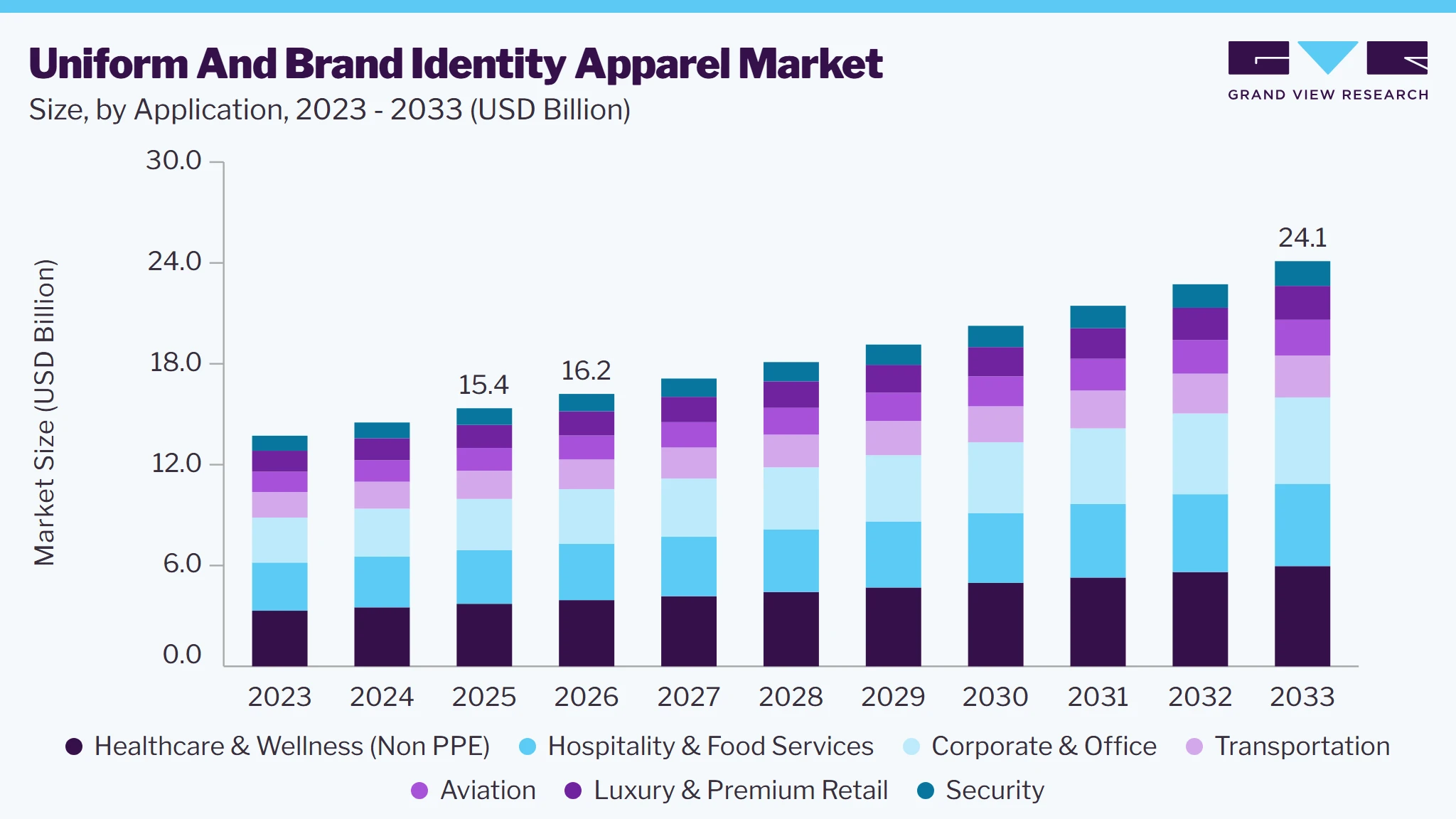
The global uniform and brand identity apparel market size was valued at USD 15.4 billion in 2025 and is projected to grow from USD 16.2 billion in 2026 to reach USD 24.1 billion by 2033, at a CAGR of 5.8% from 2026 to 2033. Asia Pacific dominated the market, accounting for a revenue share of 38.0% in 2025. The market is benefiting from sustained expansion in formal employment across healthcare, hospitality, aviation, logistics, retail, and corporate services, where standardized apparel is integral to daily operations.
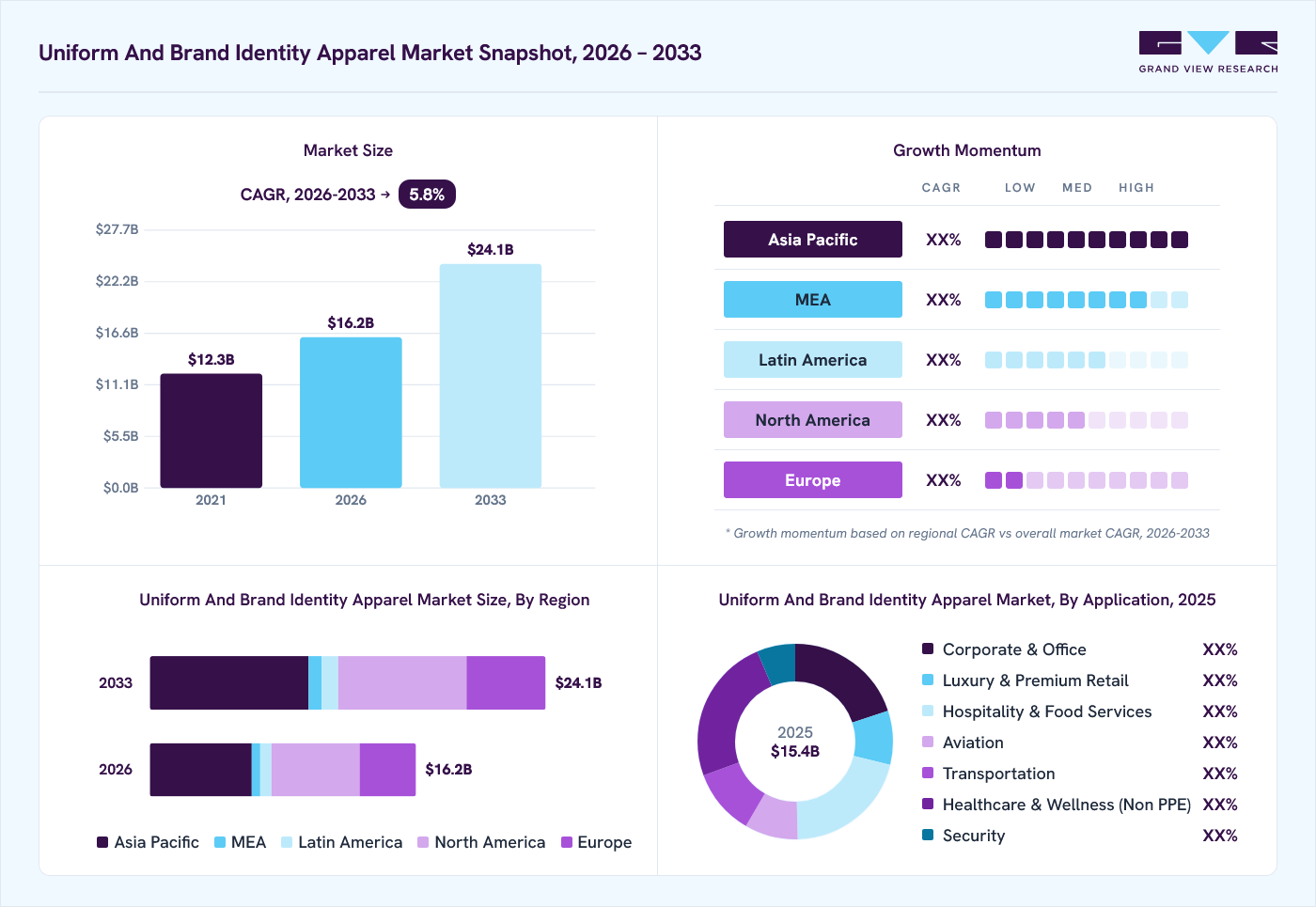 Source: Grand View Research, IR Documents, Primary Interviews, Paid DatabasesTo learn more about this report,
 Download Free Sample Report
Key Market Trends & Insights
- By application: Healthcare & wellness (non-PPE) segment accounted for the largest share of 24.2% in 2025.
Regional Highlights
- Largest regional market: Asia Pacific (38.0% revenue share, 2025)
- By country: The China held the largest market share in 2025.
Market Size & Forecast
- Market size in 2025: USD 15.4 Billion
- Estimated market size in 2026: USD 16.2 Billion
- Projected market size by 2033: USD 24.1 Billion
- CAGR (2026-2033): 5.8%
Prism AI by Grand View Research Free to tryAsk a question about the uniform and brand identity apparel market✓Every figure cited from GVR research Prefer the report? Download free sample →
Employers increasingly view uniforms as part of workforce branding, customer experience, and employee retention strategies rather than a compliance requirement. As service-sector workforces expand and organizations operate across multiple locations, demand for standardized, role-specific uniform programs continue to accelerate, particularly among large enterprises and franchise-based businesses.A major growth driver is the rapid shift toward outsourced uniform management. Organizations are increasingly adopting managed programs that combine garment supply, industrial laundering, repairs, inventory tracking, and scheduled replacement, reducing operational complexity and extending garment life. According to data posted by Textile Rental Services Association (TRSA) in 2026, the North American linen, uniform, and facility services industry supported 304,000 jobs, generated USD 37.3 billion in GDP, and supplies professionally maintained uniforms to more than 20 million workers, underscoring the scale and growing adoption of managed uniform services.
 To learn more about this report, Download Free Sample Report
Growth is also being supported by the rising procurement of performance-driven and sustainable uniforms across healthcare, hospitality, transportation, and industrial workplaces. Buyers increasingly specify industrial-launderable garments, recycled fabrics, high-visibility apparel, and reusable textile solutions to improve durability while meeting ESG objectives. Industry organizations have expanded certification programs such as Clean Green and Hygienically Clean, while reusable textile systems continue gaining traction due to their lower environmental impact and lifecycle cost advantages over disposable alternatives.
Market Dynamics
Increasing workforce diversity is prompting employers to redesign uniform and brand-identity apparel programs to include inclusive sizing, gender-specific fits, maternity options, adaptive garments, and culturally appropriate apparel. Industries such as healthcare, aviation, hospitality, retail, and security are moving away from unisex uniforms, recognizing that better-fitting garments improve employee comfort, mobility, and workplace satisfaction. According to the Professional Clothing Industry Association Worldwide (PCIAW) in 2023, women accounted for 40.1% of the global workforce, highlighting the need for uniform programs that accommodate a broader range of body types and functional requirements.
Manufacturers and corporate buyers are increasingly collaborating to develop inclusive uniform collections tailored to diverse workforces rather than simply scaling men's designs. In 2024, the Professional Clothing Industry Association Worldwide (PCIAW) launched its Designing Inclusive Professional Clothing initiative, bringing together uniform manufacturers, buyers, and inclusion specialists to establish best practices for gender-inclusive work wear. This industry-wide focus is accelerating replacement cycles and encouraging organizations to upgrade legacy uniform programs with more inclusive apparel options.
The rising cost of textiles and persistent labor shortages remain among the primary constraints on the growth of the uniform and brand-identity apparel market. Increasing prices of fabrics, trims, and garment manufacturing, combined with shortages of skilled sewing and production workers, are raising procurement costs and extending production lead times. According to the OECD's 2024 Employer Survey, 70-85% of firms across surveyed countries reported recruitment difficulties, while 15-35% faced severe labor shortages. These challenges reduce manufacturers' production capacity, delay large-scale uniform deliveries, and discourage frequent uniform replacement programs, particularly among cost-sensitive organizations.
The growing shift toward circular workwear programs presents a significant opportunity for the uniform and brand-identity apparel market. Organizations across healthcare, hospitality, transportation, and corporate sectors are increasingly replacing one-time garment purchases with reusable uniforms supported by repair, refurbishment, recycling, and end-of-life garment recovery services. This shift is creating demand for durable, recyclable, and sustainably manufactured uniforms while enabling suppliers to generate recurring revenue through lifecycle management services. Companies that invest in circular textile solutions, garment traceability, and closed-loop recycling capabilities are expected to strengthen customer retention and gain a competitive advantage in long-term institutional contracts.
Analyst Perspective
The uniform and brand identity apparel market is being driven by growing employer investment in workforce branding, employee retention, and standardized appearance across healthcare, hospitality, aviation, transportation, retail, and corporate workplaces. Procurement decisions are increasingly influenced by demand for durable, comfort-focused, and inclusive uniforms featuring performance fabrics, ergonomic designs, and sustainable materials. The market is also witnessing a shift toward managed uniform programs that integrate inventory tracking, laundering, repair, and replacement services to improve operational efficiency and reduce lifecycle costs. Going forward, companies that combine advanced textile innovation, digital uniform management platforms, circular manufacturing practices, and industry-specific customization will be best positioned to capitalize on long-term market growth.
Application Insights
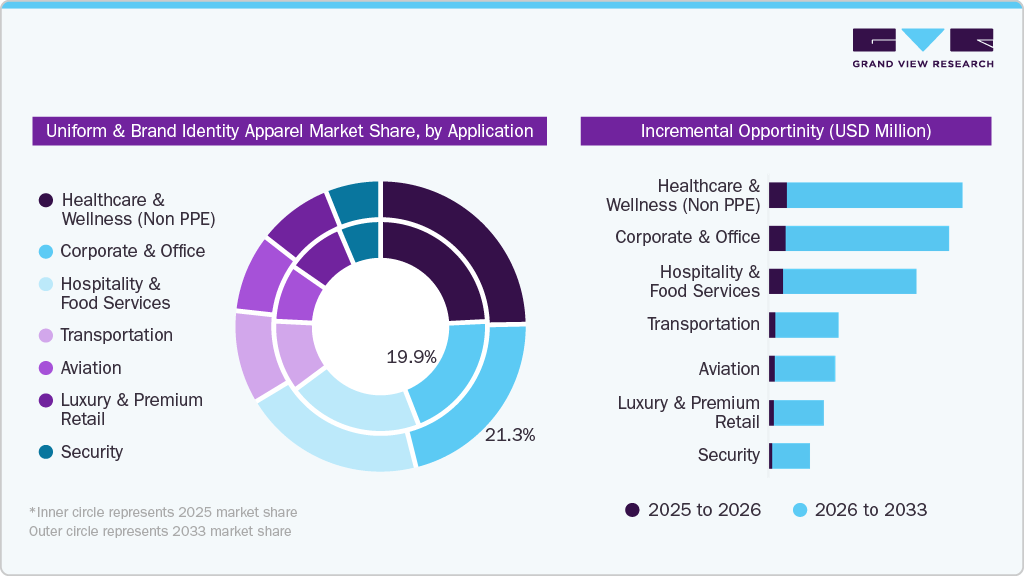
The healthcare & wellness (non-PPE) uniform and brand identity apparel market accounted for a share of 24.2% of the global revenue in 2025, driven by rising employment across outpatient care centers, dental clinics, diagnostic laboratories, and private healthcare facilities. Growing adoption of antimicrobial and fluid-resistant fabrics, stricter workplace appearance standards, and increasing demand for gender-inclusive, comfort-focused uniforms have further accelerated procurement. Frequent replacement cycles due to hygiene protocols and institutional laundering requirements also continue to support sustained market demand.
 To learn more about this report, Download Free Sample Report
The corporate & office uniform and brand identity apparel market is projected to grow at a CAGR of 6.8% from 2026 to 2033, supported by increasing workplace standardization among multinational enterprises, growing outsourcing of uniform procurement and garment lifecycle management, and rising investments in custom-branded apparel for customer-facing teams. Growth is further driven by the expansion of business process outsourcing (BPO), banking, aviation support, and premium retail office networks, where standardized attire strengthens brand consistency across distributed workforces.
Regional Insights
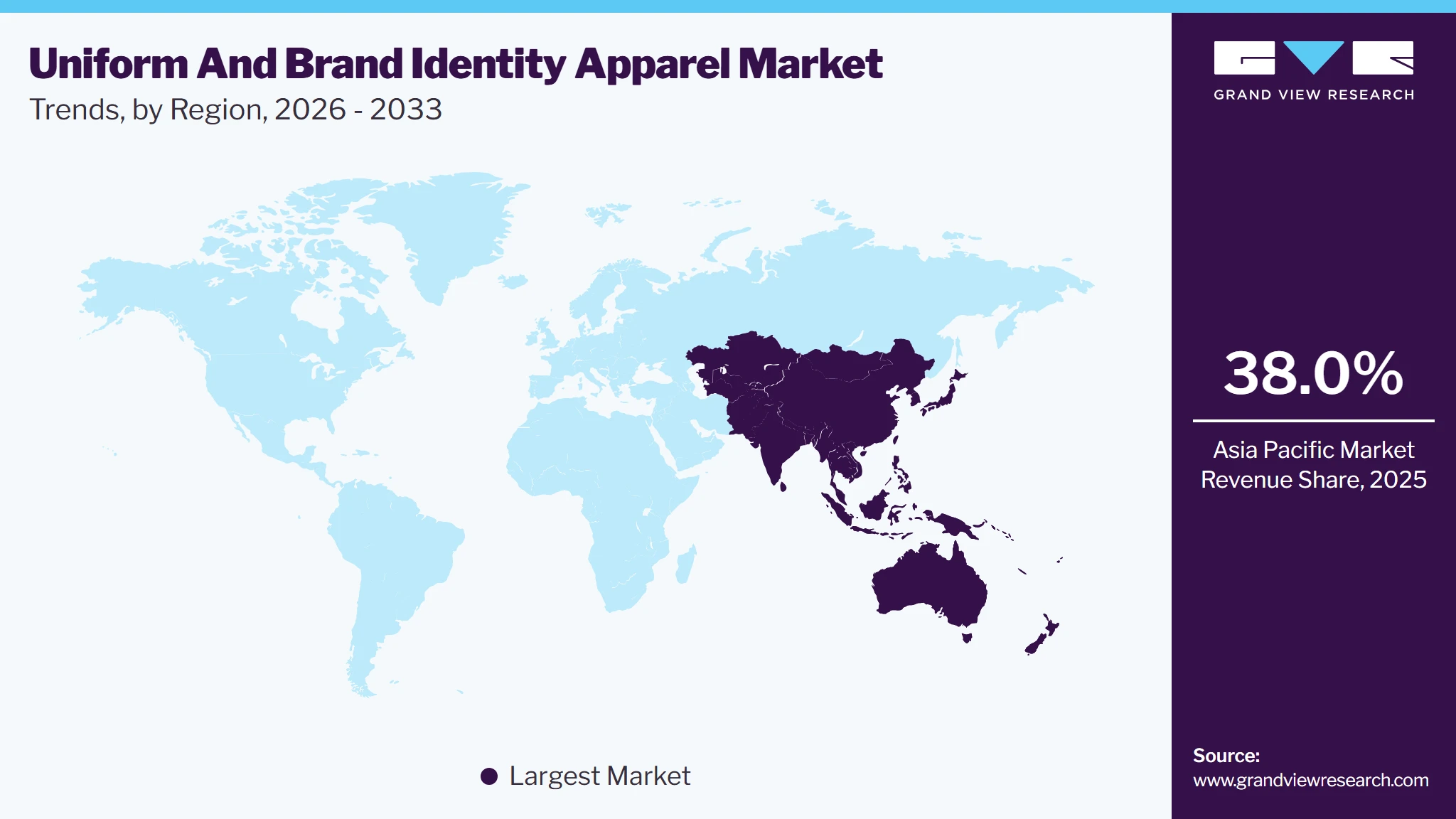
Asia Pacific dominated the market, accounting for a revenue share of 38.0% in 2025. The market is experiencing robust growth, driven by the rapid expansion of organized healthcare, hospitality, aviation, and modern retail sectors across China, India, and Southeast Asia. Rising manufacturing employment, increasing outsourcing of uniform management by multinational companies, and the expansion of airport, metro rail, and logistics infrastructure are further accelerating demand for industry-specific uniform and brand identity apparel across the region.
 To learn more about this report, Download Free Sample Report
China Uniform And Brand Identity Apparel Market Trends
China led the Asia Pacific uniform and brand identity apparel industry and accounted for 35.2% of the global market in 2025. The market is witnessing strong demand for uniform and brand identity apparel from the country's expanding healthcare, electronics manufacturing, logistics, and hospitality sectors. Growth is further supported by the large-scale adoption of standardized employee apparel by domestic enterprises, increasing investments in smart manufacturing, and the expansion of high-speed rail and commercial aviation networks, which require role-specific uniform programs.
North America Uniform and Brand Identity Apparel Market Trends
The uniform and brand identity apparel market in North America accounted for 33.2% of the global market in 2025. Consumers and employers continue to prioritize premium-quality, durable, and comfort-focused uniforms that enhance employee performance and reinforce brand identity. Strong adoption of managed uniform rental programs, high replacement rates across hospitality, healthcare, and industrial services, and increasing demand for sustainable and inclusive workwear continue to support regional market growth.
The uniform and brand identity apparel industry in the U.S. led the North America uniform and brand identity apparel market with the largest revenue share of around 65.7% in 2025. The U.S. uniform and brand identity apparel market is driven by the country's large managed uniform services industry, widespread outsourcing of uniform procurement by Fortune 500 companies, and stringent appearance standards across hospitality, healthcare, aviation, and facility management. Rising employment in food service, logistics, and private healthcare, coupled with increasing adoption of RFID-enabled inventory management and uniform rental programs, continues to support sustained demand.
The uniform and brand identity apparel market in India is projected to grow at a CAGR of 7.0% from 2026 to 2033. The market is expanding steadily, supported by rapid growth in organized healthcare, hospitality, aviation, retail, and business process outsourcing (BPO) sectors. Increasing formalization of the workforce, expansion of metro rail and airport infrastructure, and rising adoption of employer-funded uniforms by large enterprises and facility management companies are further driving demand for standardized professional apparel.
Europe Uniform and Brand Identity Apparel Market Trends
The uniform and brand identity apparel market in Europe led the global market, with the largest revenue share of 21.3% in 2025. The industry is driven by stringent workplace sustainability regulations, widespread adoption of circular textile procurement, and strong demand for premium, long-life uniforms across healthcare, public services, transportation, and hospitality. Public and private organizations are increasingly prioritizing recycled materials, traceable supply chains, and industrially launderable garments to meet ESG objectives.
For instance, in September 2024, Irish Rail launched a tender for a fully managed, sustainable corporate uniform program covering employees across Ireland, highlighting the region's growing emphasis on environmentally responsible uniform procurement.
The uniform and brand identity apparel market in Germany led the European market, with a revenue share of around 24.4% in 2025. The market is increasingly characterized by strong demand from the automotive, advanced manufacturing, logistics, and healthcare sectors, where employer-funded uniform programs are widely adopted. Growth is further supported by increased procurement of durable, industrial-launderable garments and rising investments in recycled-textile workwear to comply with corporate sustainability and circular-economy initiatives.
The uniform and brand identity apparel industry in France is projected to grow at a CAGR of 4.9% from 2026 to 2033, driven by a rising preference for premium hospitality and luxury retail uniforms that reinforce brand identity and enhance the customer experience. Growth is further supported by expanding procurement from high-end hotels, restaurants, fashion retailers, and healthcare providers, as well as increasing adoption of eco-designed uniforms made from recycled and low-impact textiles to meet corporate sustainability objectives.
Central & South America Uniform and Brand Identity Apparel Market Trends
The Central & South America uniform and brand identity apparel industry is projected to grow at a CAGR of 5.7% from 2026 to 2033, supported by expanding employment in food processing, mining, private healthcare, logistics, and hospitality sectors. Growth is further driven by the increasing formalization of labor markets, the rising outsourcing of facility management services, and the greater adoption of standardized corporate uniforms by multinational companies operating across Brazil, Chile, Colombia, and Mexico.
Middle East & Africa Uniform and Brand Identity Apparel Market Trends
The Middle East & Africa uniform and brand identity apparel market is projected to grow at a CAGR of 6.2% from 2026 to 2033. The market is driven by large-scale investments in hospitality, aviation, healthcare, and facility management across the GCC countries. Growth is further supported by expanding airport infrastructure, increasing employment in private security services, and rising procurement of standardized uniforms for mega projects, healthcare networks, and luxury tourism developments across Saudi Arabia and the UAE.
Key Uniform And Brand Identity Apparel Company Insights
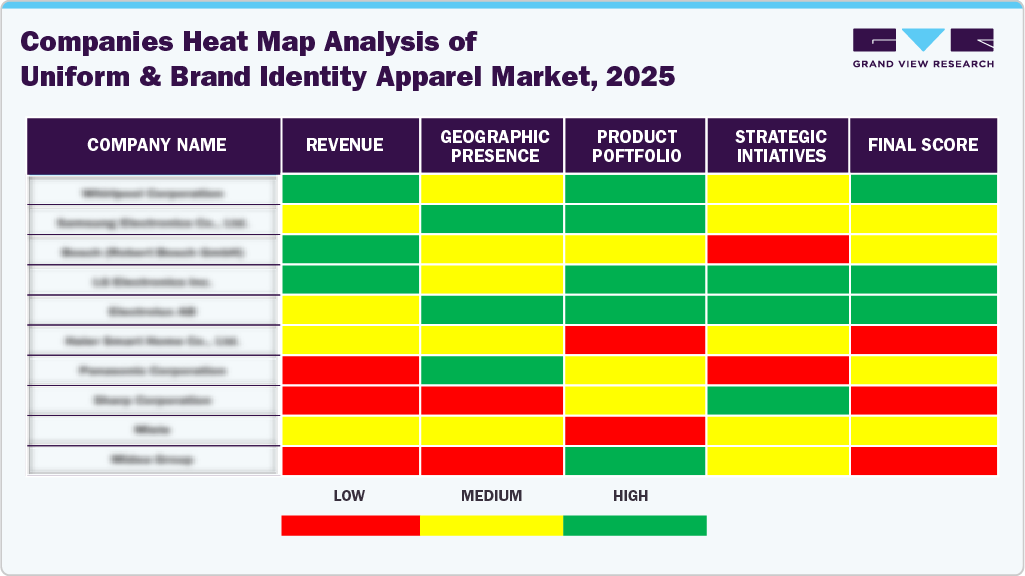
The global uniform and brand identity apparel market is highly competitive, with established workwear manufacturers, uniform rental providers, and specialized apparel companies competing on garment quality, durability, functionality, and customization capabilities. Leading companies are strengthening their market position by investing in advanced fabric technologies, ergonomic designs, sustainable materials, digital uniform management platforms, and automated inventory solutions to improve employee comfort and streamline uniform programs. Product differentiation is increasingly centered on industry-specific performance features, inclusive sizing, brand customization, moisture-management fabrics, and environmentally responsible manufacturing. Companies are also expanding rental and managed uniform services, e-commerce capabilities, and corporate partnerships to meet the evolving needs of organizations across corporate & office, hospitality, aviation, transportation, healthcare, retail, and security sectors.
-
Carhartt is one of the leading workwear brands in the uniform and brand identity apparel market, recognized for manufacturing durable, high-performance apparel for industries including transportation, utilities, construction, logistics, manufacturing, and corporate services. The company focuses on rugged fabric technologies, ergonomic designs, and enhanced comfort while expanding its product portfolio with lightweight, stretch, and performance-based workwear that supports demanding work environments.
-
Cintas Corporation is one of the world's largest providers of managed uniform programs, supplying customized workwear solutions to businesses across hospitality, healthcare, food services, transportation, manufacturing, retail, and corporate sectors. Through its integrated rental, laundering, repair, inventory management, and direct-delivery services, the company helps organizations improve brand consistency, employee safety, and operational efficiency while increasingly incorporating sustainable laundering processes and digital uniform management solutions.
 To learn more about this report, Download Free Sample Report
Key Uniform And Brand Identity Apparel Companies:
The following key companies have been profiled for this study on the uniform and brand identity apparel market.
-
Carhartt, Inc.
-
Ansell Limited
-
Williamson-Dickie Manufacturing Company (Dickies)
-
Würth MODYF GmbH & Co. KG
-
Cintas Corporation
-
Vestis Corporation
-
3M Company
-
Alsico Group
-
Alexandra plc
-
Wesfarmers Limited
Competitive Benchmarking
Category
Operating Strategies
Competitive Edge
Weakness
Established Players (Cintas Corporation; Carhartt, Inc.; Ansell Limited; 3M Company; Wesfarmers Limited)
- Expand global distribution through managed uniform programs, advanced textile technologies, sustainable manufacturing, and long-term contracts across healthcare, hospitality, transportation, industrial, retail, and corporate sectors.
- Extensive brand recognition, diversified product portfolios, global supply networks, strong R&D capabilities, and long-standing relationships with enterprise customers support consistent service quality and large-scale contract execution.
- High operating costs, dependence on large corporate contracts, exposure to raw material price fluctuations, labor shortages, and increasing sustainability compliance requirements across multiple global markets.
Emerging Players (Vestis Corporation; Williamson-Dickie Manufacturing Company (Dickies); Würth MODYF GmbH & Co. KG; Alsico Group; Alexandra plc)
- Focus on industry-specific uniforms, premium workwear, sustainable collections, digital ordering platforms, and customized solutions to strengthen presence in regional and international commercial uniform markets.
- Greater flexibility, specialized industry expertise, faster product innovation, and customized service offerings enable quicker response to evolving workplace requirements and customer-specific uniform programs.
- Smaller global footprint, lower economies of scale, limited distribution networks in some regions, and stronger competitive pressure from multinational uniform manufacturers and managed service providers.
Recent Developments
-
In March 2026, Cintas announced its acquisition of UniFirst in a USD 5.5 billion transaction, significantly strengthening its position in the uniform and brand identity apparel and workplace services market. The acquisition expands Cintas' service capabilities, customer base, and workday solutions portfolio while accelerating innovation and creating one of North America's largest uniform rental and managed apparel providers.
-
In February 2026, Ford Motor Company and Carhartt, in collaboration with Cintas, expanded their dealership technician uniform program as part of a multi-year partnership. The program provides durable workwear, including shirts, pants, jackets, and accessories, with options for managed rental, laundering, inspection, repair, or direct purchase through Cintas' nationwide service network.
-
In April 2024, Carhartt launched the Force Sun Defender Series, expanding its professional workwear portfolio with lightweight performance apparel designed for workers exposed to prolonged outdoor conditions. The collection features UPF 50+ sun protection, sweat-wicking Force and FastDry technologies, and lightweight fabrics that enhance comfort while maintaining durability for demanding jobsite environments.
Uniform And Brand Identity Apparel Market Report Scope
Report Attribute
Details
Market size in 2025
USD 15.4 billion
Estimated market size in 2026
USD 16.2 billion
Projected market size by 2033
USD 24.1 billion
Growth rate
CAGR of 5.8% from 2026 to 2033
Base year
2025
Actual data
2021 - 2025
Forecast period
2026 - 2033
Quantitative units
Revenue in USD billion/million and CAGR from 2026 to 2033
Report coverage
Revenue forecast, company ranking, competitive landscape, growth factors, and trends
Segments covered
Application, region
Regional scope
North America, Europe, Asia Pacific, Central & South America, Middle East & Africa
Country scope
U.S.; Canada; Mexico; Germany; UK; France; Italy; Spain; China; Japan; India; South Korea; Australia & New Zealand; Brazil; South Africa
Key companies profiled
Carhartt, Inc.; Ansell Limited; Williamson-Dickie Manufacturing Company (Dickies); Würth MODYF GmbH & Co. KG; Cintas Corporation; Vestis Corporation; 3M Company; Alsico Group; Alexandra plc; Wesfarmers Limited
Customization scope
Free report customization (equivalent up to 8 analysts’ working days) with purchase. Addition or alteration to country, regional & segment scope.
Pricing and purchase options
Avail customized purchase options to meet your exact research needs. Explore purchase options
Global Uniform and Brand Identity Apparel Market Report Segmentation
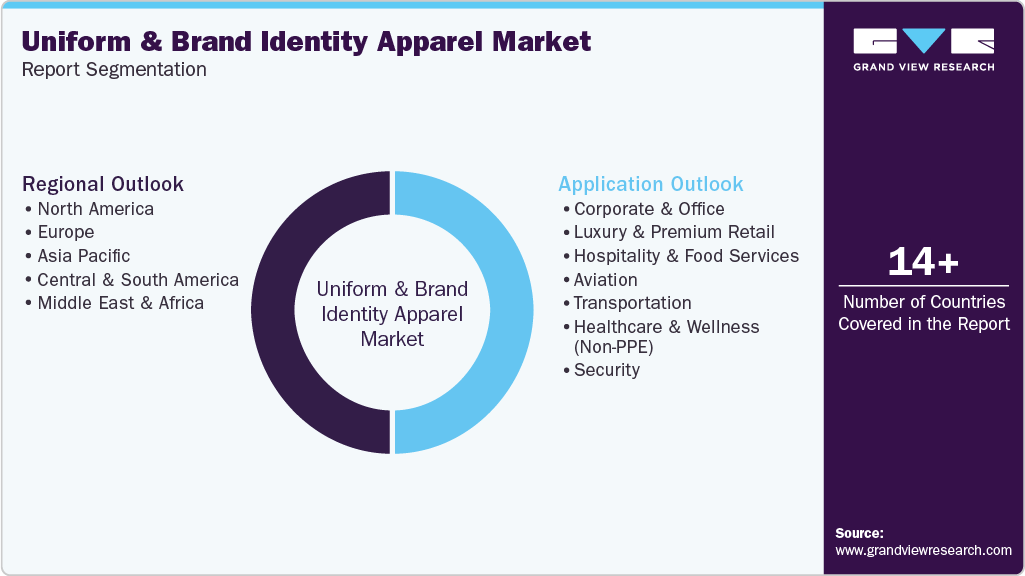
This report forecasts revenue growth at the global, regional & country levels and provides an analysis of the latest trends and opportunities in each sub-segment from 2026 to 2033. For the purposes of this study, Grand View Research has segmented the uniform and brand identity apparel market by application and region:
 To learn more about this report, Download Free Sample Report
-
Application Outlook (Revenue, USD Billion, 2021 - 2033)
-
Corporate & Office
-
Luxury & Premium Retail
-
Hospitality & Food Services
-
Aviation
-
Transportation
-
Healthcare & Wellness (Non-PPE)
-
Security
-
-
Regional Outlook (Revenue, USD Billion, 2021 - 2033)
-
North America
-
U.S.
-
Canada
-
Mexico
-
-
Europe
-
Germany
-
UK
-
France
-
Italy
-
Spain
-
-
Asia Pacific
-
China
-
Japan
-
India
-
South Korea
-
Australia & New Zealand
-
-
Central & South America
-
Brazil
-
-
Middle East & Africa
-
South Africa
-
-
Research Methodology
The uniform and brand identity apparel market figures in this report are based on a proven research process that combines executive interviews with secondary research from proprietary databases, company filings, and recognized regulatory and institutional sources. Market size is built through value-chain sizing-reconciling supply-side and demand-side estimates-and triangulated with bottom-up and top-down approaches. Every estimate passes multiple levels of expert validation before publication, with each uniform and brand identity apparel segment quantified using the revenue-capture definitions in the table below.
Segment Definition
Segment - Application
Revenue capture definition
Corporate & Office
Revenue is generated from the supply of branded uniforms and identity apparel for employees in corporate offices, financial institutions, business services, and customer-facing administrative roles to reinforce brand identity and professional appearance.
Luxury & Premium Retail
Revenue is generated from branded uniforms and identity apparel used by employees in luxury boutiques, premium retail stores, department stores, and flagship outlets to deliver a consistent brand image and elevated customer experience.
Hospitality & Food Services
Revenue is generated from branded uniforms and identity apparel supplied to hotels, restaurants, cafés, catering companies, resorts, and food service establishments for front-of-house, kitchen, and guest service personnel.
Aviation
Revenue is generated from branded uniforms and identity apparel used by airline cabin crew, ground handling staff, airport customer service personnel, and other aviation employees to maintain operational consistency and corporate branding.
Transportation
Revenue is generated from branded uniforms and identity apparel supplied to employees in railways, public transit, logistics, courier services, ports, and commercial transportation operations to support workforce identification and service standards.
Healthcare & Wellness (Non-PPE)
As the largest application segment, revenue is generated from branded uniforms and identity apparel used by healthcare professionals, wellness staff, caregivers, administrative personnel, and allied health workers, excluding personal protective equipment (PPE) and medical safety garments.
Security
Revenue is generated from branded uniforms and identity apparel supplied to private security personnel, surveillance teams, facility security staff, and event security providers to ensure professional identification and organizational representation.
Estimation Model
Layer
Key Question
Description
Workforce Demand Layer
Who requires uniform and brand identity apparel?
Begin with the global workforce across corporate offices, hospitality, aviation, healthcare, transportation, retail, and security requiring standardized professional attire for daily operations.
Market Accessibility Layer
Who can be served through uniform suppliers?
Filter organizations with access to uniform manufacturers, rental providers, distributors, procurement networks, and managed uniform services to estimate the addressable customer base.
Purchase & Usage Layer
Who actively purchases uniform and brand identity apparel?
Apply uniform adoption, replacement frequency, employee count, and procurement cycles across industries to estimate active organizational demand for uniform and brand identity apparel.
Monetisation Layer
How much revenue is generated?
Multiply active uniform users by annual spending on garments, customization, rental, laundering, and replacement services to estimate total market revenue.
Delivered Customizations
This report has been delivered with the following In-depth customizations
CLIENT REQUEST
CUSTOMIZATION DELIVERED
VALUE ADDS
Cross-Segmentation Analysis of Uniform Categories Across End-Use Industries and Procurement Models
Evaluated demand for formal wear, hospitality apparel, airline crew uniforms, transit uniforms, healthcare attire, security uniforms, and luxury retail apparel across direct purchase, managed rental, and distributor-led procurement.
Identified industry-specific uniform preferences, procurement models, and revenue opportunities, enabling targeted product development and customer acquisition strategies.
Industry Procurement Benchmarking & Replacement Cycle Assessment
Benchmarked uniform procurement policies, employee allotments, replacement frequencies, contract durations, laundering preferences, customization requirements, and purchasing criteria across corporate, hospitality, aviation, transportation, healthcare, security, and luxury retail sectors.
Supports contract bidding, production planning, pricing strategies, and long-term customer retention by aligning offerings with industry procurement practices.
Distribution Network & Uniform Service Provider Competitiveness Analysis
Assessed the competitive positioning of direct manufacturers, distributors, rental providers, online procurement platforms, and managed uniform service companies by industry, geography, and customer size.
Enables channel optimization, partnership identification, geographic expansion planning, and competitive positioning across high-growth uniform and brand identity apparel customer segments.
Frequently Asked Questions About This Report
The global uniform and brand identity apparel market was valued at USD 15.4 billion in 2025 and is estimated at USD 16.2 billion in 2026.
The global uniform and brand identity apparel market is expected to grow at a CAGR of 5.8% from 2026 to 2033, reaching USD 24.1 billion by 2033.
Asia Pacific dominated with a 38.0% revenue share in 2025.
Asia Pacific is the fastest-growing region over the forecast period.
Key factors include rising demand for professional workplace attire, increasing focus on brand visibility and corporate identity, expansion of service industries, growing workforce numbers, and higher adoption of customized uniforms.
Some of the key players operating in the uniform and brand identity apparel market include Carhartt, Inc.; Ansell Limited; Williamson-Dickie Manufacturing Company (Dickies); Würth MODYF GmbH & Co. KG; Cintas Corporation; Vestis Corporation; 3M Company; Alsico Group; Alexandra plc; and Wesfarmers Limited.
The healthcare & wellness (Non-PPE) segment led with a 24.2% revenue share in 2025, while the corporate & office segment is the fastest-growing application segment.
About the Author(s)
Clothing, Footwear & Accessories Research Team
Consumer Goods · Clothing, Footwear & AccessoriesThis report was authored by the clothing, footwear & accessories research team at Grand View Research - comprising two research analysts, one senior research analyst, and one industry expert - with specialized expertise in the clothing, footwear & accessories segment of the consumer goods industry. All findings are based on proprietary consumer goods databases, executive interviews, and regulatory analysis, subject to internal peer review prior to publication.
Last Updated:
Speak to Analyst

Customize this report to your needs - add regions, segments, or data points, with 20% free customization.
Or view our licence options:


ISO 9001:2015 & 27001:2022 Certified
We are GDPR and CCPA compliant! Your transaction & personal information is safe and secure. For more details, please read our privacy policy.


