
- Home
- »
- Advanced Interior Materials
- »
-
Unmanned Composites Market Size Report, 2026-2033GVR Report cover

Unmanned Composites Market (2026 - 2033) Size, Share & Trends Analysis Report By Product (Carbon Fiber Reinforced Polymer, Glass Fiber Reinforced Polymer), By Application (Interior, Exterior), By Region, And By Segment Forecasts
Market Size, 2025
$2.7BMarket Estimate, 2026
$3.1BMarket Forecast, 2033
$7.5BCAGR, 2026–2033
13.5%Unmanned Composites Market Summary
The global unmanned composites market size was valued at USD 2.7 billion in 2025 and is projected to grow from USD 3.1 billion in 2026 to USD 7.5 billion by 2033, at a CAGR of 13.5% from 2026 to 2033. North America dominated the market with the largest revenue share of 40.5% in 2025. The demand for unmanned composites is increasing rapidly as unmanned aerial vehicles (UAVs), autonomous underwater vehicles, and unmanned ground systems are adopted across the defense, commercial, and industrial sectors.
 Source: Grand View Research, IR Documents, Primary Interviews, Paid DatabasesTo learn more about this report,
 Download Free Sample Report
 Key Market Trends & Insights
- By product: Carbon fiber reinforced polymer (CFRP) segment dominated the market in 2025 with a revenue share of 42.1%.
- By application: The interior application segment accounted for the highest revenue share of 61.9% in 2025.
Regional Highlights
- Largest regional market: North America (40.5% revenue share, 2025)
- Fastest-growing regional market: Asia Pacific (highest CAGR, 2026-2033)
- By country: The U.S. is projected to grow at a CAGR of 13.5% over the forecast period.
Market Size & Forecast
- Market size in 2025: USD 2.7 billion
- Estimated market size in 2026: USD 3.1 billion
- Projected market size by 2033: USD 7.5 billion
- CAGR (2026-2033): 13.5%
Three ways to get this report
Buy it, customize it, or ask a question.Ask an Analyst
Analyst response in 1 business day
- AccessReport author, directly
- Reply timeWithin 1 working day
- No sales callDirect answer only
- FormatEmail reply
- CostFree, no cost
Get the Full Report
What the study covers
- FormatsPDF · Excel · Dashboard
- Timeline2026–2033 annual, 2025 base
- Coverage20+ countries, 5 regions
- Companies10+ key players profiled
Customize the Report
20% free customization
- IncludeCountries, segments, points
- TailorTo your product definition
- ExtendDeeper competitor detail
- OrA fully bespoke study
- Turnaround5–10 working days
Composite materials offer lightweight structures, superior strength-to-weight ratios, corrosion resistance, and enhanced durability, making them highly suitable for unmanned systems that require long operational endurance and fuel efficiency. The expansion of military modernization programs worldwide is another major driver of market growth. Defense organizations are emphasizing lightweight, radar-absorbing composite structures to improve the stealth and maneuverability of unmanned systems. Carbon fiber composites, glass fiber composites, and hybrid materials are increasingly being integrated into drone fuselages, propellers, radomes, and structural components. The growing use of swarm drones and long-endurance reconnaissance UAVs is further accelerating the need for advanced composites with high fatigue resistance and thermal stability.Governments across North America, Europe, and the Asia Pacific are actively investing in unmanned systems and indigenous aerospace manufacturing programs, which are significantly supporting the market. Defense modernization initiatives in countries such as the U.S., China, India, and Israel are increasing procurement of UAVs and autonomous defense platforms equipped with advanced composite structures. Several governments are also allocating substantial budgets for next-generation surveillance drones, loitering munitions, and autonomous naval systems to strengthen border security and military capabilities. The market is witnessing significant innovation in lightweight carbon fiber composites, thermoplastic composites, and multifunctional materials designed for autonomous platforms. Manufacturers are increasingly focusing on advanced materials that combine lightweight performance with electromagnetic shielding, impact resistance, and stealth properties. The adoption of hybrid composites and nano-enhanced materials is improving structural performance while reducing overall manufacturing costs and maintenance requirements.
 To learn more about this report, Download Free Sample Report
 Additive manufacturing and automated fiber placement technologies are transforming the production of unmanned composite structures by enabling faster prototyping and precision manufacturing. These technologies help reduce material wastage, improve structural consistency, and support mass production of drone components. The integration of AI-driven design optimization and digital twin technologies is also enabling manufacturers to develop aerodynamically efficient and structurally optimized composite platforms.
Sustainability is emerging as a major trend in the market, with increasing research focused on recyclable composites and bio-based resin systems for unmanned applications. Companies are exploring eco-friendly manufacturing processes and reusable composite materials to align with environmental regulations and sustainability goals. In addition, modular composite structures and multifunctional materials with embedded sensors are gaining traction in advanced defense and industrial unmanned systems.
Market Dynamics
One of the major drivers of the market is the growing demand for lightweight, fuel-efficient unmanned systems across the aerospace and defense industries. Composite materials significantly reduce the structural weight of UAVs and other unmanned vehicles while maintaining high mechanical strength, enabling longer flight endurance and greater payload capacity. Defense agencies are increasingly procuring advanced drones for intelligence, surveillance, reconnaissance, and combat applications, thereby driving demand for high-performance composites.
One of the major restraints affecting the market is the high production cost associated with advanced composite materials and manufacturing technologies. Carbon fiber composites, aerospace-grade resins, thermoplastic materials, and specialized reinforcement fibers are significantly more expensive than conventional metallic alternatives such as aluminum and steel.
The market also faces challenges related to manufacturing complexity, repairability, and supply chain constraints. Composite structures require highly skilled labor, strict quality control standards, and specialized testing procedures to ensure structural integrity and flight safety. Repairing damaged composite components is often more difficult and more expensive than with traditional materials, particularly in military and industrial unmanned systems operating in harsh environments.
Market Concentration & Characteristics
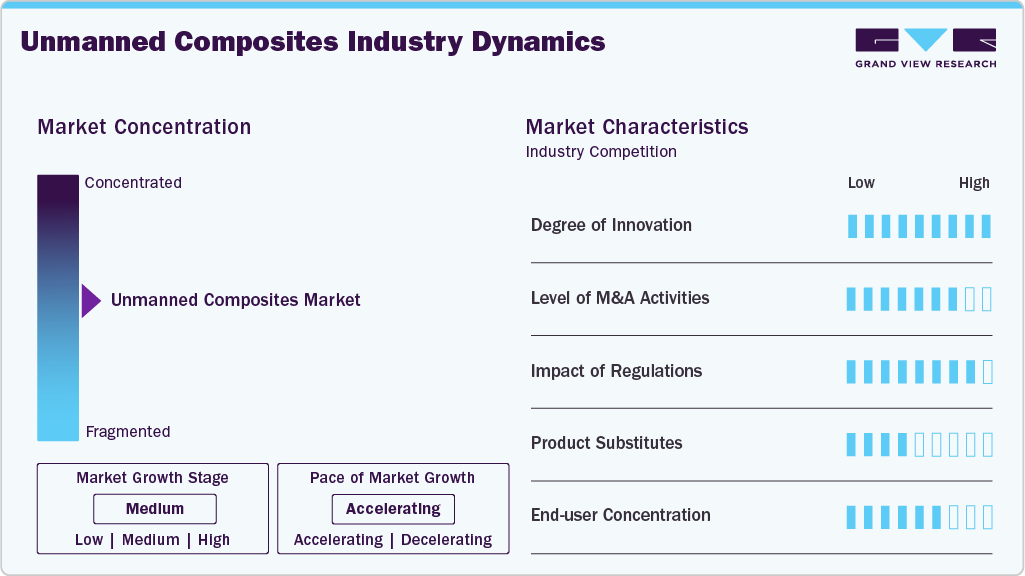
The unmanned composites industry is moderately consolidated, with a mix of global aerospace composite manufacturers and specialized unmanned system suppliers competing for market share. Large aerospace and defense companies dominate the high-performance military segment through extensive R&D capabilities, long-term defense contracts, and advanced manufacturing infrastructure. However, several emerging companies and regional manufacturers are entering the market with innovative lightweight composite solutions for commercial drones and autonomous systems.
Strategic partnerships, acquisitions, and collaborations between composite manufacturers and UAV developers are becoming increasingly common as companies aim to expand technological capabilities and strengthen supply chain integration. The market is characterized by continuous investment in advanced carbon fiber technologies, thermoplastic composites, and automated production systems to maintain a competitive advantage. Increasing demand from commercial industries is also encouraging smaller manufacturers to introduce cost-effective composite materials tailored for industrial drone applications.
 To learn more about this report, Download Free Sample Report
 Traditional metallic materials such as aluminum alloys, titanium, and high-strength steel remain substitutes for composite materials in certain unmanned applications. These materials offer lower initial production costs and established manufacturing processes, particularly in cost-sensitive defense and industrial projects. However, metallic structures generally increase system weight and reduce operational efficiency compared to advanced composites, limiting their long-term competitiveness in high-performance unmanned platforms.
In addition, some low-cost unmanned systems use plastic-based structures and polymer materials rather than advanced composites to reduce manufacturing costs. While these substitutes are suitable for entry-level and short-range applications, they often lack the durability, thermal resistance, and structural strength required for advanced military and industrial operations. As autonomous systems increasingly prioritize endurance, lightweight performance, and stealth capabilities, advanced composites are expected to maintain a strong competitive advantage despite the availability of substitutes.
Product Insights
Carbon fiber reinforced polymer (CFRP) dominated the market in 2025 with a revenue share of 42.1%. This is due to its characteristics, including a high strength-to-weight ratio, high temperature tolerance, high stiffness, low thermal expansion, and high chemical resistance. In both interior and exterior applications, sandwich structures made of carbon fiber-reinforced polymer composite materials are widely used in unmanned systems. The CFRP composites are lightweight and have a high tensile strength. They are more fuel-efficient, require less maintenance, and help OEMs comply with the strict environmental laws in Europe and North America.
The glass fiber reinforced polymer product segment is expected to grow at a CAGR of 13.3% over the forecast period. This growth is attributed to its durability and lightweight, which are essential for many unmanned systems. It can be molded into various sizes and shapes, broadening its range of applications and making it a preferred choice for manufacturing drone structural components. In addition, advances in production methods to improve the efficiency of GFRP in unmanned systems applications are likely to support its market growth.
Application Insights
The interior application segment accounted for the highest revenue share of 61.9% in 2025 and is expected to grow at the fastest rate over the forecast period. Composites are used in the manufacturing of structural components, insulation, panels, seatings, interior compartments, conduits, and control surfaces of unmanned systems. Properties of this material, such as its lightweight durability and ability to enhance the performance & safety of interior parts, are driving segment growth.
 To learn more about this report, Download Free Sample Report
 The exterior segment is expected to grow at a CAGR of 13.3% over the forecast period. This material is used in various exterior components of unmanned systems, including the fuselage, wings, control surfaces, rotor blades, landing gear components, external housings, engine cowlings, and external structural reinforcements. The use of composites helps construct lightweight parts with high strength, efficiency, and improved performance. Furthermore, external antennas and radomes are intended to be constructed from lightweight materials to avoid signal interference. This is expected to increase the use of this material in external applications of unmanned systems.
Regional Insights
North America dominated the unmanned composites market with a 40.5% revenue share in 2025, driven by substantial defense spending, technological innovation, and the presence of leading UAV manufacturers. The U.S. defense sector continues to invest heavily in advanced unmanned aerial and naval systems incorporating stealth composite technologies and lightweight structures. Commercial drone adoption in agriculture, infrastructure monitoring, and logistics is also expanding significantly across the region.
 To learn more about this report, Download Free Sample Report
 Strong R&D capabilities and advanced manufacturing technologies continue to support innovation in high-performance composite applications. This is due to various factors, such as high investments in defense and security, a strong technological and industrial base, and the rising use of unmanned systems in commercial applications, including logistics, environmental monitoring, and agriculture, which, in turn, is anticipated to fuel the market's growth in the region.
U.S. Unmanned Composites Market Trends
The unmanned composites market in the U.S. is projected to grow at a CAGR of 13.5% over the forecast period. Government initiatives and regulatory support for integrating drones across industries are expected to drive rising demand for advanced composites, as these materials are essential for manufacturing lightweight, high-strength unmanned vehicles that meet regulatory requirements.
Europe Unmanned Composites Market Trends
The unmanned composites market in Europe is experiencing steady growth due to increasing defense collaborations, aerospace innovation, and sustainability-focused manufacturing initiatives. European aerospace companies are developing advanced UAV platforms using recyclable composites and lightweight thermoplastic materials to improve environmental performance and operational efficiency. The region is also witnessing growing adoption of drones for border surveillance, environmental monitoring, and infrastructure inspection. Government support for aerospace R&D and autonomous mobility projects is further supporting market growth.
Germany unmanned composites market plays a significant role in Europe due to its strong engineering capabilities and advanced automotive and aerospace industries. German manufacturers are investing in lightweight composite technologies, automated manufacturing systems, and electric drone platforms for industrial and defense applications. The country’s emphasis on Industry 4.0 and sustainable manufacturing is encouraging the development of recyclable composite materials and energy-efficient production processes.
Asia Pacific Unmanned Composites Market Trends
The unmanned composites market in the Asia Pacific is expected to grow at the highest CAGR of 14.1% over the forecast period. This is due to rising defense spending, rapid expansion of UAV manufacturing, and strong investments in autonomous technologies across China, India, Japan, and South Korea. Regional governments are heavily investing in military drones, surveillance systems, and indigenous aerospace manufacturing capabilities, which is driving demand for lightweight composite structures. The presence of large electronics and aerospace manufacturing ecosystems further supports the production and innovation of composite materials. Growing commercial drone applications in agriculture, logistics, and infrastructure inspection are additionally contributing to regional market growth.
China unmanned composites market is one of the fastest-growing, driven by its large-scale UAV manufacturing industry and strong government support for autonomous technologies. Chinese companies are increasingly developing military drones, delivery drones, and industrial UAVs utilizing lightweight carbon fiber composites and advanced resin systems. The country’s investments in aerospace manufacturing, smart logistics, and defense modernization are accelerating demand for high-performance composite materials. Domestic production capabilities for carbon fiber and advanced polymers are also strengthening the regional supply chain.
Central & South America Unmanned Composites Market Trends
The unmanned composites market in CSA is witnessing growing adoption of unmanned systems for agriculture, mining, environmental monitoring, and border security applications, supporting demand for composite materials. Countries such as Brazil and Mexico are increasingly deploying drones for crop monitoring, mapping, and infrastructure inspection. Lightweight composite structures help improve drone endurance and operational efficiency in remote and large-scale geographic environments. Government initiatives supporting digital agriculture and surveillance technologies are expected to create additional growth opportunities for composite manufacturers in the region.
Middle East & Africa Unmanned Composites Market Trends
The unmanned composites market in MEA is experiencing strong demand driven by rising investments in defense modernization, border surveillance, and oil & gas inspection activities. Gulf countries are actively procuring advanced military UAVs and autonomous monitoring systems that incorporate lightweight composite materials to improve endurance and operational capability. The use of drones for infrastructure inspection, pipeline monitoring, and security applications is also expanding across the region. Growing investments in aerospace manufacturing and smart technology initiatives are expected to support long-term market development.
Key Unmanned Composites Company Insights
Some of the key players operating in the market include Teijin Ltd., Toray Industries, Inc., and PPG Industries, Inc.
-
Teijin Ltd. was earlier known as Jinzo Kenshi Co., Ltd. It is the holding company of the Teijin Group and operates through 169 subsidiaries and affiliates worldwide. The company provides a range of services and products across information & electronics, safety & protection, environment & energy, and healthcare. It operates its business across Europe, Asia, and the Americas. Its operations are classified into five segments, namely advanced fibers & composites, electronics materials & performance polymer products, healthcare, trading & retail, and others.
-
PPG Industries, Inc. has two business segments: Performance Coatings and Industrial Coatings. The performance Coatings business segment includes the refinish, automotive, aerospace, protective, marine, and architectural businesses. The Industrial Coatings business segment includes industrial coatings, packaging coatings, coatings services, and specialty coatings and materials. Its brands include COMEX, GLIDDEN, OLYMPIC, DULUX, SIKKENS, PPG PITTSBURGH PAINTS, MULCO, FLOOD, LIQUID NAILS, RENNER, TAUBMANS, WHITE KNIGHT, SICO, HOMAX, DEKORAL, TRILAK, GORI, BRISTOL, and BONDEX.
SGL Group, Hexcel Corporation, and Renegade Materials Corporation are some of the emerging participants in the market.
-
SGL Group is formed by the merger of Germany-based SIGRI and the U.S.-based Great Lakes Carbon. It is a publicly owned company with a broad shareholder structure. It has three business segments: Carbon Fibers, Composite Solutions, and Graphite Solutions, as well as Process Technology. It serves industries, including chemicals, textile fibers, industrial applications, energy, and mobility.
-
Hexcel Corporation manufactures composite materials and structural parts. It is one of the major producers of carbon fibers in the U.S. and works with more than 1,000 suppliers to provide raw materials, goods, and services. It operates in two business segments: Composite Materials and Engineered Products.
Key Unmanned Composites Companies:
The following key companies have been profiled for this study on the unmanned composites market.
- Teijin Ltd.
- Toray Industries, Inc.
- PPG Industries, Inc.
- SGL Group
- Hexcel Corporation
- Compagnie de Saint-Gobain S.A.
- Cytec Industries (Solvay, S.A.)
- Renegade Materials Corporation
- Unitech Aerospace
- Gurit
Competitive Benchmarking
Operating Strategies
Competitive Edge
Weakness
Mature Players: Teijin Ltd., Toray Industries, Inc., PPG Industries, Inc.
- Established players focus on long-term defense contracts, aerospace collaborations, and vertically integrated composite manufacturing capabilities to strengthen market position.
- Companies invest heavily in carbon fiber innovation, automated fiber placement, and thermoplastic composite technologies to improve lightweight performance and scalability.
- Strong global supply chains, advanced R&D infrastructure, and established relationships with UAV OEMs provide high entry barriers for competitors.
- Extensive production capacity and access to aerospace-grade raw materials enable consistent product quality and large-scale manufacturing efficiency.
- High dependence on aerospace and defense procurement cycles exposes companies to fluctuations in government budgets and project delays.
- High operational and manufacturing costs associated with advanced composite processing reduce flexibility in price-sensitive commercial markets.
Emerging Players: SGL Group, Hexcel Corporation, Renegade Materials Corporation
- Emerging companies focus on niche UAV applications, customized composite solutions, and lightweight structures for commercial drone manufacturers.
- Startups are increasingly adopting additive manufacturing, modular composite designs, and AI-driven engineering tools to reduce production costs.
- Greater flexibility, faster innovation cycles, and the ability to develop cost-effective solutions for industrial drone applications.
- Faster adoption of advanced manufacturing technologies enables rapid prototyping and reduced product development timelines.
- Limited financial resources and smaller production capacities restrict expansion into large-scale aerospace and defense contracts.
- Lack of global certifications and limited experience in aerospace-grade manufacturing can hinder adoption in regulated defense sectors.
Recent Developments
-
In January 2024, Toray expanded production capacity for TORAYCA T1100 carbon fiber at its Alabama facility to support rising demand from defense and aerospace programs, including advanced UAV and unmanned mobility systems.
-
In March 2024, Toray Advanced Composites launched Toray Cetex TC915 PA+, a strengthened thermoplastic composite material targeted for Urban Air Mobility (UAM) and Unmanned Aerial Systems (UAS) applications.
Unmanned Composites Market Report Scope
Report Attribute
Details
Market size in 2025
USD 2.7 billion
Estimated Market size in 2026
USD 3.1 billion
Projected Market size by 2033
USD 7.5 billion
Growth rate
CAGR of 13.5% from 2026 to 2033
Historical data
2021 - 2025
Forecast period
2026 - 2033
Quantitative units
Revenue in USD million/billion and CAGR from 2026 to 2033
Report coverage
Revenue forecast, competitive landscape, growth factors, and trends
Segments covered
Product, application, region
Regional scope
North America; Europe; Asia Pacific; CSA; MEA
Country scope
U.S.; Canada; Mexico; UK; Germany; France; Italy; Spain; China; India; Japan; South Korea; Brazil; Argentina
Key companies profiled
Teijin Ltd.; Toray Industries, Inc.; PPG Industries, Inc.; SGL Group; Hexcel Corporation; Compagnie de Saint-Gobain S.A.; Cytec Industries (Solvay, S.A.); Renegade Materials Corporation; Unitech Aerospace; Gurit
Customization scope
Free report customization (equivalent up to 8 analysts working days) with purchase. Addition or alteration to country, regional & segment scope.
Pricing and purchase options
Avail customized purchase options to meet your exact research needs. Explore purchase options
Global Unmanned Composites Market Report Segmentation
This report forecasts revenue growth at the regional & country levels and provides an analysis of the industry trends in each of the segments from 2021 to 2033. For this study, Grand View Research has segmented the global unmanned composites market report based on product, application, and region:
 To learn more about this report, Download Free Sample Report
 -
Product Outlook (Revenue, USD Million, 2021 - 2033)
-
Carbon Fiber Reinforced Polymer
-
Glass Fiber Reinforced Polymer
-
Aramid Fiber Reinforced Polymer
-
Other Products
-
-
Application Outlook (Revenue, USD Million, 2021 - 2033)
-
Interior
-
Exterior
-
-
Regional Outlook (Revenue, USD Million, 2021 - 2033)
-
North America
-
U.S.
-
Canada
-
Mexico
-
-
Europe
-
Germany
-
UK
-
France
-
Italy
-
Spain
-
-
Asia Pacific
-
China
-
Japan
-
India
-
South Korea
-
-
Central & South America
-
Brazil
-
Argentina
-
-
Middle East & Africa
-
Delivered Customizations
This report has been delivered with the following In-depth customizations
Client Request
Customization Delivered
Value Adds
Competitor Product Portfolio Analysis
Benchmarking of leading companies based on composite technologies, UAV integration capabilities, partnerships, and innovations.
Provides strategic insights for market positioning and competitive differentiation.
Regional Segmentation
Detailed regional analysis covering major regions with country-level breakdowns. Includes market size, composite demand trends, defense spending impact, UAV adoption rates, manufacturing hubs, and regulatory environment analysis.
Helps clients identify high-growth regions, optimize geographic expansion strategies, and prioritize investments based on regional demand and policy support.
Opportunity Assessment
Comprehensive assessment of emerging growth opportunities across autonomous aviation, urban air mobility (UAM), cargo drones, defense modernization programs, AI-integrated UAVs, recyclable composites, and advanced thermoplastic materials. Includes investment attractiveness analysis, demand forecasting, untapped regional opportunities, and future technology adoption trends.
Helps clients identify high-potential investment areas, develop long-term growth strategies, and capitalize on emerging technologies and unmet market demand.
Frequently Asked Questions About This Report
The key factors that are driving the market growth is the increasing use of composites in unmanned systems to reduce its overall weight and increase performance.
North America dominated with the largest revenue share of 40.5% in 2025.
Asia Pacific is the fastest-growing region over the forecast period.
Carbon fiber reinforced polymer (CFRP) dominated the market in 2025 with a revenue share of 42.1%.
The interior application segment accounted for the highest revenue share of 61.9% in 2025.
Key players include Teijin Ltd.; Toray Industries, Inc.; PPG Industries, Inc.; SGL Group; Hexcel Corporation; Compagnie de Saint-Gobain S.A.; Cytec Industries (Solvay, S.A.); Renegade Materials Corporation; Unitech Aerospace; and Gurit.
About the Author(s)
Advanced Interior Materials Research Team
Advanced Materials · Advanced Interior MaterialsThis report was authored by the advanced interior materials research team at Grand View Research - comprising two research analysts, one senior research analyst, and one industry expert - with specialized expertise in the advanced interior materials segment of the advanced materials industry. All findings are based on proprietary advanced materials databases, executive interviews, and regulatory analysis, subject to internal peer review prior to publication.
Last Updated:
Speak to Analyst

Customize this report to your needs - add regions, segments, or data points, with 20% free customization.
Or view our licence options:


ISO 9001:2015 & 27001:2022 Certified
We are GDPR and CCPA compliant! Your transaction & personal information is safe and secure. For more details, please read our privacy policy.


