
- Home
- »
- Biotechnology
- »
-
U.S. Analytical Instrumentation Market Size Report, 2033GVR Report cover

U.S. Analytical Instrumentation Market (2025 - 2033) Size, Share & Trends Analysis Report By Product (Instruments, Services, Software), By Technology (Polymerase Chain Reaction, Spectroscopy, Microscopy), By Application, And Segment Forecasts
U.S. Analytical Instrumentation Market Summary
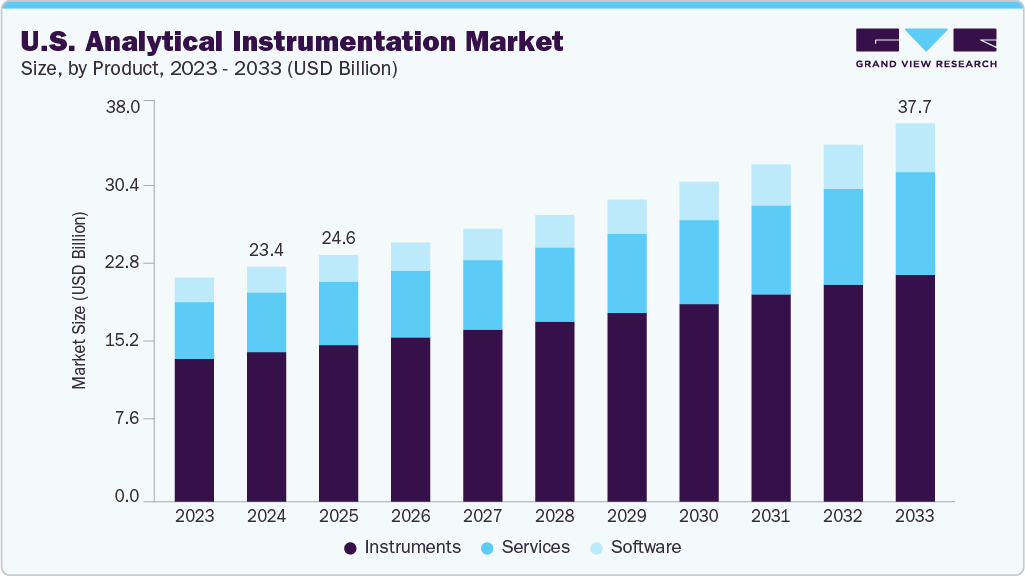
The U.S. analytical instrumentation market size was estimated at USD 23.40 billion in 2024 and is projected to reach USD 37.67 billion by 2033, growing at CAGR of 5.50% from 2025 to 2033. The growth is primarily driven by rising demand for advanced analytical solutions in pharmaceuticals, biotechnology, food & beverage testing, and environmental monitoring.
 Source: Grand View Research, IR Documents, Primary Interviews, Paid DatabasesTo learn more about this report,
 Download Free Sample Report
 Technological Innovations
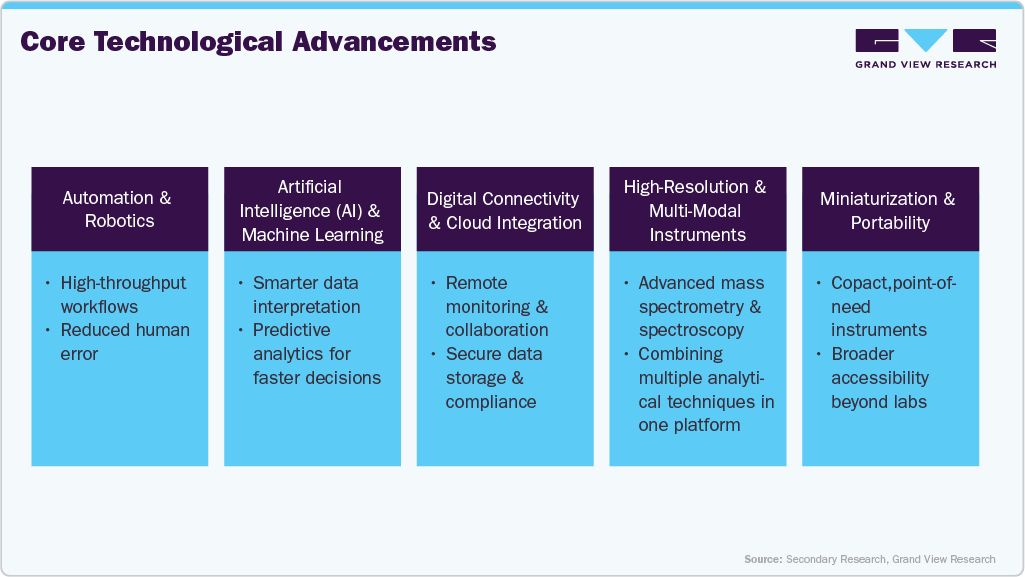
The rapid growth of the analytical instrumentation industry in the U.S. is largely attributed to the fast developments and incorporation of new technologies, including artificial intelligence (AI), automation, and digital/online platforms. Automation lowers the amount of manual handling, streamlines the processing of multiple samples, and minimizes human errors related to analysis. AI-based tools further enhance data interpretation, especially with more complicated applications such as genomics, proteomics, and metabolomics. Moreover, cloud platform technology allows for improved remote monitoring, management of large datasets, and regulatory compliance (which is more sought after within the pharmaceutical, biotechnology, and environmental monitoring industries). These benefits are causing research entities and industrial laboratories to invest in next-generation analytical systems.
 To learn more about this report, Download Free Sample Report
 Moreover, technological advancements are leading a shift towards multiplexed, multichannel, and integrated analytical instrumentation that support complex workflows. Digital transformation is particularly relevant in the U.S., where requirements for documentation, reproducibility, and validation from regulatory bodies, such as the FDA and EPA, are stringent. As a result, new analytical instrumentation that offers efficiency, scalability, and compliance capabilities is necessary, promoting sustained demand across multiple industries and applications, such as healthcare, life sciences, chemicals, food and beverages, and energy.
Advancements in Healthcare & Precision Medicine
The increasing focus on precision medicine and innovative healthcare initiatives is important to the U.S. demand for analytical instrumentation growth. Precision medicine often relies on molecular-level understanding to develop treatment plans tailored to each patient, resulting in a strong desire for high-performance instruments that provide accuracy, reproducibility, and high-throughput results. Analytical instruments - next-generation sequencing platforms, mass spectrometers, and chromatography - are essential for extracting complex biological information in genomic, proteomic, and metabolomic investigations. These tools allow researchers and clinicians to discover disease biomarkers, assess therapeutic responses, and design targeted therapies with improved efficacy and reduced side effects in a way that is likely to transform patient care and counseling.
At the same time, the healthcare system in the United States is stressed out to the max, using advanced diagnostic methodologies to assist in early disease detection and a personalized treatment path, which, again, supports the adoption of more advanced analytical instruments for diagnosing. With the increasing incidence of chronic diseases such as cancer, diabetes, and cardiovascular disease, there is heightened demand for biomarker testing and molecular diagnostics, both of which rely on analytical instrumentation. Backed by significant government funding pushed toward precision medicine initiatives and increased cooperation between academic research centers, biopharmaceutical companies, and clinical labs, we see strong, consistent demand for advanced analytical instruments in the U.S. healthcare and life sciences space.
Market Concentration & Characteristics
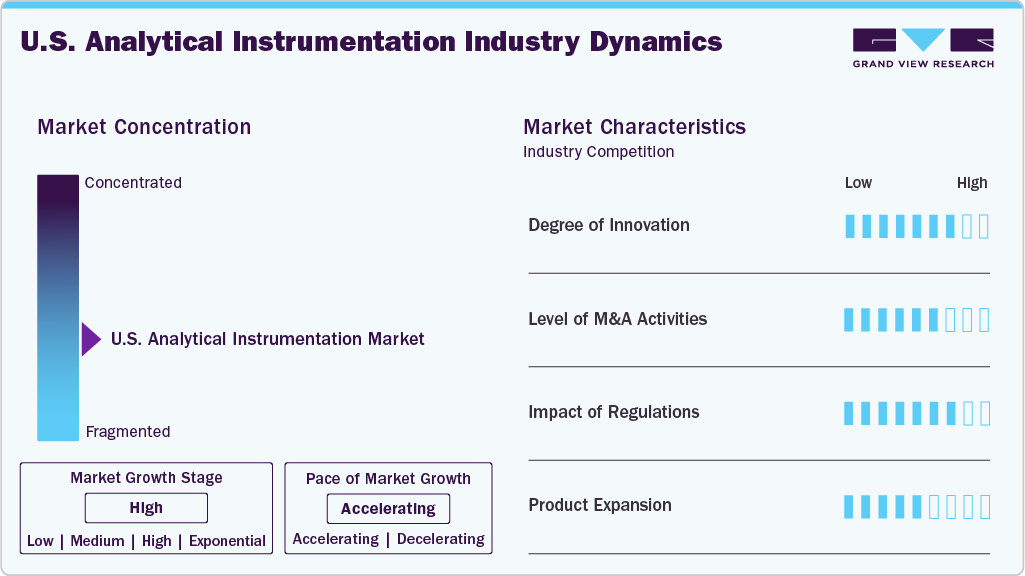
The U.S. analytical instrumentation industry is characterized by high levels of innovation, driven by evolving technologies and a strong investment in R&D. Manufacturers are increasingly incorporating artificial intelligence, machine learning, and automation into their analytical instruments to improve accuracy, speed, and efficiency while lowering operational costs. New multifunctional platforms that can conduct multiple analytical techniques or incorporate digital connectivity or cloud data portfolios also represent a new direction toward more connected and intelligent laboratories. The continuous innovation cycle ultimately creates a more competitive environment while stimulating broader market acceptance of next-generation analytical systems in the U.S.
The U.S. analytical instrumentation industry has experienced a moderate-to-high level of mergers and acquisitions (M&A) activity, as consolidation is expected due to the desire of market leaders to enhance and expand product offerings, technological offerings, and market presence. Large global firms acquire niche technology producers, specialized instrument manufacturers, and factory automation product lines to create complementary offerings with various advanced solutions such as automation, digital analytics, and AI solutions. The level of activity in M&A reflects a continued highly competitive nature of the market and the impact that M&A and strategic partnerships will have on U.S. analytical instrumentation. For instance,in August 2025, Innovative Lab Services LLC, headquartered in Ohio, acquired San Diego-based Prodigy Scientific, expanding its multi-vendor analytical instrumentation services and strengthening its presence in the market.
 To learn more about this report, Download Free Sample Report
 The U.S. analytical instrumentation industry is heavily influenced by regulations, primarily as a demand driver, by establishing stringent quality, safety, and compliance requirements in pharmaceuticals, biotechnology, food, and environmental markets. Agencies such as the FDA and EPA enforce the need for accurate and validated testing methods in laboratories, which require laboratories and manufacturers to constantly adopt new analytical instrumentation that provides the accuracy, traceability, and reproducibility that these regulations demand. While meeting these regulatory obligations does increase cost and complexity for instrument manufacturers, it can also lead to innovations, increased product reliability, and ongoing demand for high-performance solutions that address future compliance issues.
In the U.S. analytical instrumentation industry, product expansion is a prominent growth strategy for companies consistently expanding portfolios to anticipate the demands of end-user industries. New products, such as portable instruments, solid- and liquid-sampling workflows, cloud-enabled, micro-scale, or handheld analytical systems, provide greater flexibility and scalability, allowing for use and implementation outside traditional laboratory spaces, such as hospitals or healthcare and retail food establishments. The introduction of timely new products and updated technologies bolsters competitive advantage to ensure companies can deliver flexible, multi-analytical, rapid, and regulatory-approved solutions needed for clinical, research, and industrial use.
Product Insights
The instruments segment held the largest share of 63.88% in 2024 due to many companies offering different types of analytical instrumentation, such as chromatographs, mass spectrometers, microscopes, and sequencers. In addition, a focus on technological advancement is expected to drive the analytical instrumentation industry. According to Thermo Fisher’s report published in April 2025, Thermo Fisher Scientific announced an additional USD 2 billion investment in the U.S. over the next four years, with USD 1.5 billion directed toward expanding and upgrading its domestic manufacturing footprint and USD 500 million targeted at high-impact R&D, a strategic move to bolster American life‑sciences innovation and strengthen the healthcare supply chain.
The software segment is anticipated to grow at the fastest CAGR during the forecast years. Software is key in analyzing and interpreting data in many areas, including academic research and clinical diagnostics. For example, flow cytometry software helps users collect, manage, and analyze data and run statistical reports. These advanced features make the software highly valuable. They are expected to drive growth in this segment during the forecast period, supported by rising adoption of digital platforms, integration of AI, automation, cloud-based solutions, and demand for real-time advanced data insights. For instance, in March 2020, Thermo Fisher Scientific launched the Vanquish Core HPLC system in Germany, delivering enhanced precision, simplified method transfer, minimized downtime, and seamless CDS software integration to improve laboratory productivity.
Technology Insights
The polymerase chain reaction (PCR) segment held the largest share, 24.85%, in 2024. This segment is driven by its fast processing, accuracy, and wide-ranging applications, such as medical diagnostics for pathogen detection and forensics for DNA fingerprinting. PCR enables rapid amplification of DNA using small amounts of sample, further expanding the U.S. analytical instrumentation industry.
The sequencing segment is projected to grow at the fastest CAGR over the forecast period. Sequencing technology covering DNA, RNA, high-throughput, and methylation methods drives innovation in U.S. healthcare and research by unlocking the power of the genetic code across multiple fields. The technology for sequencing is used in various important areas, such as cancer research, microbiology, complex diseases, and reproductive health. In cancer research, next-generation sequencing (NGS) is used to examine DNA fragments from tumors, rare genetic mutations, and variants of cancer cells (also referred to as tumor heterogeneity). The use of sequencing as a support for multiple uses drives strong demand for analytical instruments across the U.S. market.
Application Insights
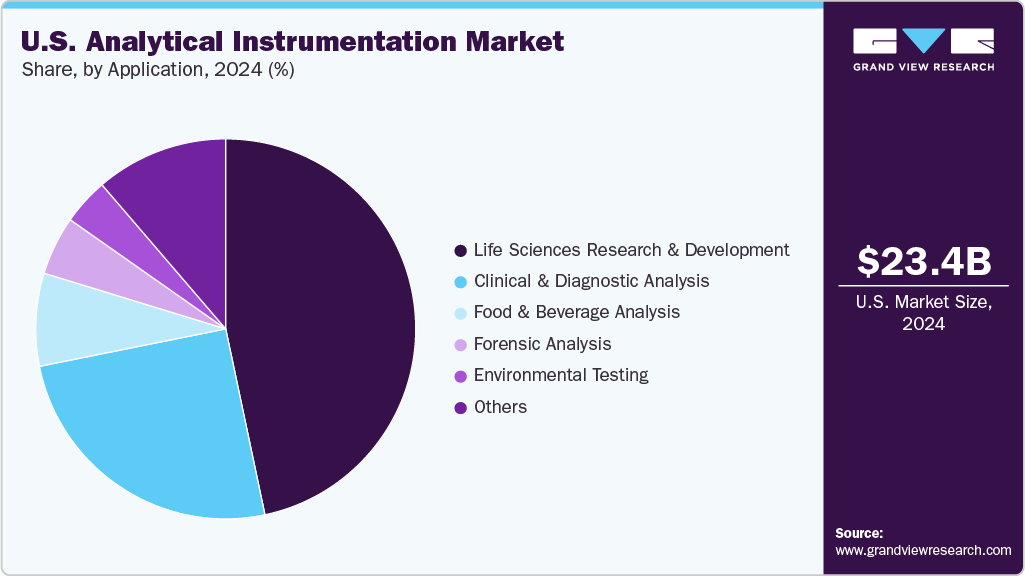
The life sciences research & development segment captured the largest share of 46.69% in 2024. The increasing prevalence of chronic and infectious diseases is the key factor leading to increased R&D activities by various life sciences industries to develop and manufacture novel biologics, such as monoclonal antibodies, vaccines, and therapeutic proteins. For instance, in July 2024, Danaher Corporation, a global science and technology innovator, teamed with Stanford University's Bioengineering Department to advance cancer drug screening using AI-driven smart microscopy.
 To learn more about this report, Download Free Sample Report
 The clinical & diagnostic analysis segment is expected to grow at the fastest CAGR during the forecast period. The growth is driven by the rising number of chronic disease cases and cancer, which is increasing the need for diagnostic testing. As a result, demand is rising for analytical instruments such as flow cytometers used in clinical labs. Moreover, the approval and launch of new testing equipment are expected to support this growth further.
Key U.S. Analytical Instrumentation Company Insights
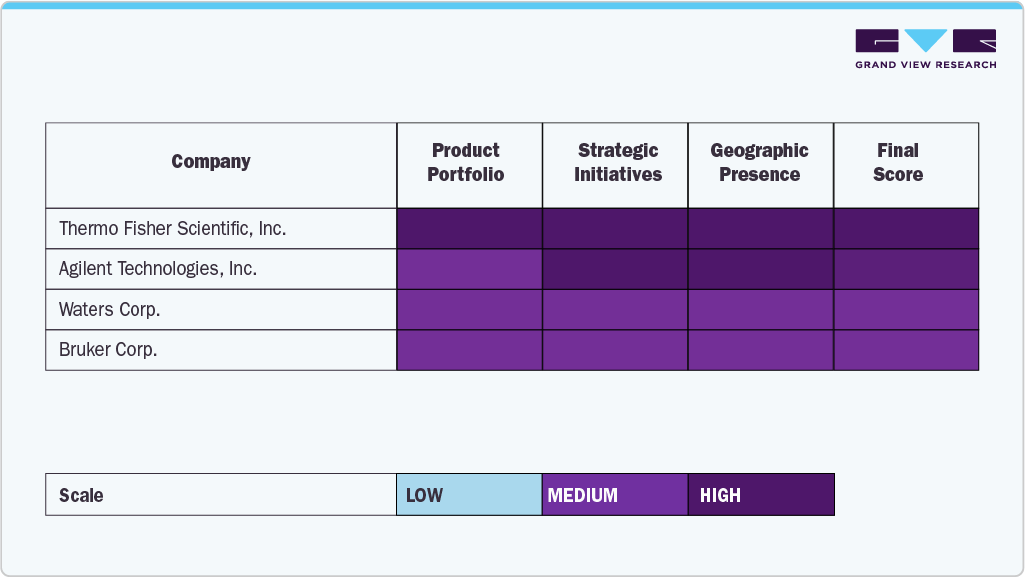
The U.S. analytical instrumentation industry is characterized by several established players who dominate through strong product portfolios, strategic collaborations, and consistent investments in research and development. Leading companies that dominate the market include Thermo Fisher Scientific, Inc., Waters Corporation, Shimadzu Corporation, Danaher, and Agilent Technologies, Inc., with their established analytical technologies, range of applications, and global distribution networks.
Companies such as Bruker Corporation, PerkinElmer, Inc., Mettler Toledo, among others are furthering their growth by providing innovative solutions and through customized instrumentation to address the increasing demand and needs from pharmaceutical companies, biotechnology companies, clinical labs, testing labs within food and beverage, and environmental monitoring. Their ambitions to incorporate automation, digital platforms, and AI-based analytics into analytical systems illustrate the market shift towards increased efficiency, accuracy, and scalability.
 To learn more about this report, Download Free Sample Report
 Companies have maintained their leadership in analytical instrumentation in response to the ever-increasing demand for accuracy, regulatory compliance, and data-driven insight generated in drug discovery, diagnostics, life sciences research, and industrial settings. The market is increasingly being shaped by industry-level goals of improved efficiency, sustainability, and sophisticated quality assurance; thus, the commitments to innovation, accessibility, and affordability.
The analytical instrumentation industry in the U.S. is a rapidly changing intersection of established knowledge and emerging solutions. Mergers and acquisitions, joint ventures, and new developments in automation, connectivity, and high-resolution analytical precision will create greater competition. Companies that effectively blend scientific innovativeness with solutions valued by their customers
Key U.S. Analytical Instrumentation Companies:
- Thermo Fisher Scientific, Inc.
- Waters Corp.
- Shimadzu Corp.
- Danaher
- Agilent Technologies, Inc
- Bruker Corp.
- PerkinElmer, Inc.
- Mettler Toledo
- Zeiss Group
- Bio-Rad Laboratories, Inc.
- Illumina, Inc.
- Eppendorf SE
- F. Hoffmann-La Roche AG
- Sartorius AG
- Avantor, Inc.
Three ways to get this report
Buy it, customize it, or ask a question.Ask an Analyst
Analyst response in 1 business day
- AccessReport author, directly
- Reply timeWithin 1 working day
- No sales callDirect answer only
- FormatEmail reply
- CostFree, no cost
Get the Full Report
What the study covers
- FormatsPDF · Excel · Dashboard
- Timeline2025–2033 annual, 2024 base
- Coverage20+ countries, 5 regions
- Companies10+ key players profiled
Customize the Report
20% free customization
- IncludeCountries, segments, points
- TailorTo your product definition
- ExtendDeeper competitor detail
- OrA fully bespoke study
- Turnaround5–10 working days
Recent Developments
-
In July 2025, Advanced Instruments announced a definitive agreement to acquire Nova Biomedical, merging into a global life science tools platform with expanded analytical capabilities under the Nova Biomedical name.
-
In June 2025, Bruker Corporation announced the acquisition of biocrates, expanding its multiomics strategy with advanced mass spectrometry-based metabolomics kits, assays, software, and research services.
-
In October 2024, Thermo Fisher Scientific launched the iCAP MX Series ICP-MS in the United States, offering advanced single and triple quadrupole systems to enhance trace element analysis across environmental, food, and industrial laboratories.
U.S. Analytical Instrumentation Market Report Scope
Report Attribute
Details
Market size value in 2025
USD 24.55 billion
Revenue forecast in 2033
USD 37.67 billion
Growth rate
CAGR of 5.50% from 2025 to 2033
Actual data
2021 - 2024
Forecast period
2025 - 2033
Quantitative units
Revenue in USD million/billion and CAGR from 2025 to 2033
Report coverage
Revenue forecast, company ranking, competitive landscape, growth factors, and trends
Segments covered
Product, technology, application.
Key companies profiled
Thermo Fisher Scientific, Inc.; Waters Corp.; Shimadzu Corp.; Danaher; Agilent Technologies, Inc; Bruker Corp.; PerkinElmer, Inc.; Mettler Toledo; Zeiss Group; Bio-Rad Laboratories, Inc.; Illumina, Inc.; Eppendorf SE; F. Hoffmann-La Roche AG; Sartorius AG; Avantor, Inc.
Customization scope
Free report customization (equivalent up to 8 analyst’s working days) with purchase. Addition or alteration to country, regional & segment scope.
Pricing and purchase options
Avail customized purchase options to meet your exact research needs. Explore purchase options
U.S. Analytical Instrumentation Market Report Segmentation
This report forecasts revenue growth and provides an analysis on the latest trends in each of the sub-segments from 2021 to 2033. For this report, Grand View Research has segmented the U.S. analytical instrumentation market report based on product, technology, and application:
-
Product Outlook (Revenue, USD Million, 2021 - 2033)
-
Instruments
-
Services
-
Software
-
-
Technology Outlook (Revenue, USD Million, 2021 - 2033)
-
Polymerase Chain Reaction
-
Spectroscopy
-
Microscopy
-
Chromatography
-
Flow Cytometry
-
Sequencing
-
Microarray
-
Others
-
-
Application Outlook (Revenue, USD Million, 2021 - 2033)
-
Life Sciences Research & Development
-
Clinical & Diagnostic Analysis
-
Food & Beverage Analysis
-
Forensic Analysis
-
Environmental Testing
-
Others
-
Frequently Asked Questions About This Report
The U.S. analytical instrumentation market size was estimated at USD 23.40 billion in 2024 and is expected to reach USD 24.55 billion in 2025.
The U.S. analytical instrumentation market is expected to grow at a compound annual growth rate of 5.50% from 2025 to 2033 to reach USD 37.67 billion by 2033.
The polymerase chain reaction segment dominated the market for U.S. analytical instrumentation and accounted for the largest revenue share of 24.85% in 2024.
Some key players operating in the U.S. analytical instrumentation market include Danaher; Thermo Fisher Scientific Inc.; Bio-Rad Laboratories, Inc.; Merck KGaA; Cell Signaling Technology, Inc.; BD; Novus Biologicals; OriGene Technologies, Inc.; Creative Diagnostics; GenScript.
Key factors driving the U.S. analytical instrumentation market growth include increasing demand for advanced analytical technologies in the pharmaceutical, biotechnology, and environmental testing industries. Additionally, continuous technological innovations and rising research and development investments further support market expansion.
About the Author(s)
Biotechnology Research Team
Healthcare · BiotechnologyThis report was authored by the biotechnology research team at Grand View Research - comprising two research analysts, one senior research analyst, and one industry expert - with specialized expertise in the biotechnology segment of the healthcare industry. All findings are based on proprietary healthcare databases, executive interviews, and regulatory analysis, subject to internal peer review prior to publication.
Last Updated:
Speak to Analyst

Customize this report to your needs - add regions, segments, or data points, with 20% free customization.
Or view our licence options:


ISO 9001:2015 & 27001:2022 Certified
We are GDPR and CCPA compliant! Your transaction & personal information is safe and secure. For more details, please read our privacy policy.


