U.S. Antibody Drug Conjugates Market Summary
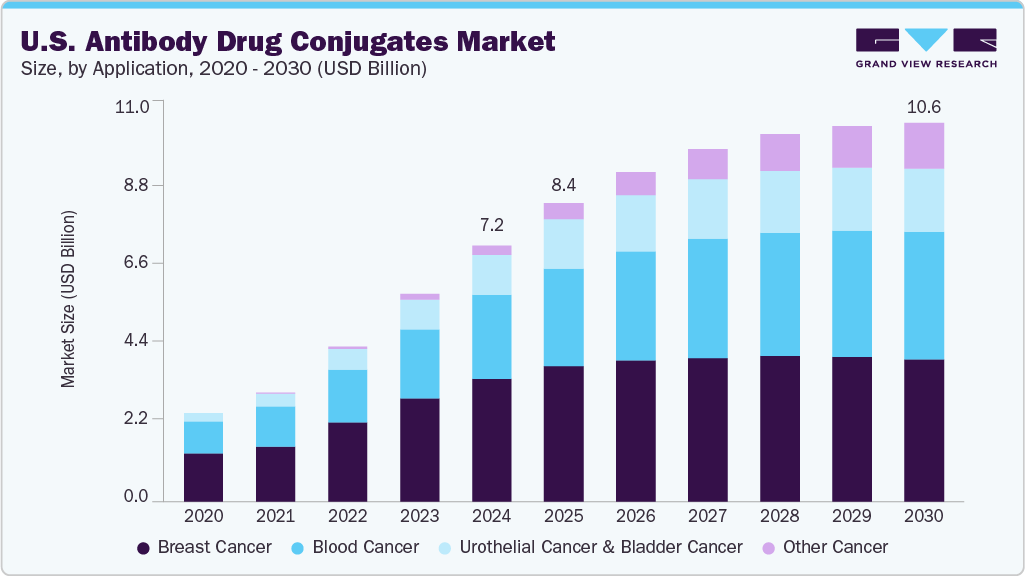
The U.S. antibody drug conjugates market size was valued at USD 7.15 billion in 2024 and is projected to reach USD 10.60 billion by 2030, growing at a CAGR of 4.9% from 2025 to 2030. This can be attributed to the increasing incidence of cancer cases and increased demand for low-toxicity & effective drugs.
Key Market Trends & Insights
- By application, the breast segment held the highest market share of 48.2% in 2024.
- By product, the kadcyla segment held the highest market share in 2024.
- By target, the HER2 or human epidermal growth factor receptor 2 target type segment held the largest market share in 2024.
Market Size & Forecast
- 2024 Market Size: USD 7.15 Billion
- 2030 Projected Market Size: USD 10.60 Billion
- CAGR (2025-2030): 4.9%
Also, pharmaceutical and biotech companies are investing heavily in researching and developing antibody drug conjugates (ADCs), propelling market growth. The growing number of cancer cases in the U.S. significantly fuels demand for targeted therapies like ADCs. According to the American Cancer Society Inc., in 2024, over 2 million new cancer cases were detected in the U.S. The number of cancer cases is rising due to various factors such as aging populations, lifestyle changes, and improved diagnostic capabilities. ADCs offer a highly focused approach that delivers cytotoxic drugs straight to cancer cells, reducing damage to healthy tissues. This accuracy makes ADCs preferred to traditional chemotherapy, especially for challenging cancers.
The rising funding is accelerating the development of ADCs across a wider range of indications beyond oncology. For instance, in March 2025, Callio Therapeutics, a biotechnology firm dedicated to multi-payload ADCs aimed at cancer treatment, declared its launch after securing USD 187 million in Series A funding led by Frazier Life Sciences. Callio intends to use the funds to progress clinical proof-of-concept for its HER2-targeted dual-payload ADC.
The rising technological innovations in antibody manufacturing, linker stability, and cytotoxic payloads have led to the development of effective and safer ADCs. In September 2024, Merck launched the Mobius ADC Reactor, a single-use reactor designed to manufacture ADCs that precisely target and eliminate tumor cells while leaving healthy tissue unharmed.
Mergers and acquisitions (M&A) are moderate, with prominent pharmaceutical companies focusing on acquiring companies with expertise in ADC technologies to improve their oncology portfolios. For instance, in March 2024, Johnson & Johnson Services, Inc. acquired Ambrx Biopharma, Inc. It has a proprietary synthetic biology technology platform to develop and design next-generation ADC. This is expected to deliver differentiated solid tumor treatment to improve the lives of patients’.
Application Insights
The breast cancer segment dominated the market with a revenue share of 48.2% in 2024. Breast cancer is one of the most diagnosed cancers among women in the U.S. According to the American Cancer Society, Inc., in 2024, breast cancer was diagnosed in over 310,000 women in the country. Factors such as the aging population, improved screening, and lifestyle changes contribute to rising cases.
The urothelial cancer & bladder cancer segment is expected to witness notable growth during the forecast period. The urothelial and bladder cancer segment is gaining momentum due to several important factors. One key driver is the high unmet medical need for advanced and metastatic urothelial carcinoma. Standard treatments, such as chemotherapy and immune checkpoint inhibitors, result in limited long-term survival benefits and frequent relapses. Additionally, the growing prevalence of bladder cancer in the U.S., among aging populations and smokers, is contributing to the increase in the number of patients and driving the need for advanced treatments. According to the Centers for Disease Control and Prevention (CDC), over 11% of U.S. adults were current cigarette smokers in 2022.
Product Insights
Based on product, the market is segmented into Kadcyla, Enhertu, Adcetris, Padcev, Trodelvy, Polivy, and Others. The Kadcyla segment is expected to held a significant revenue share in 2024. The surge in breast cancer cases, coupled with increased approvals for ADCs tailored for breast cancer treatment, propels the market's upward trajectory. In December 2023, Genentech (U.S.) announced updated long-term data from the KATHERINE trial showing that Kadcyla significantly improved overall survival compared to Herceptin in HER2-positive early breast cancer.
The Enhertu segment is expected to witness notable growth during the forecast period. DAIICHI SANKYO COMPANY, LIMITED. and AstraZeneca’s Enhertu has experienced a surge in sales projections following recent approvals. Particularly its groundbreaking approval for HER2-low breast cancer in August 2022, marking an industry-first achievement. In January 2025, AstraZeneca and Daiichi Sankyo received U.S. FDA approval for Enhertu to treat unresectable or metastatic HR-positive, HER2-low or HER2-ultralow breast cancer after endocrine therapy.
Target Insights
Based on the target, the market is segmented into HER2, CD22, CD30, and others. The HER2 segment held a significant market share in 2024. HER2, or human epidermal growth factor receptor 2 target, is a major factor in breast cancer treatment. ADCs are designed to target HER2 by delivering potent drugs directly to cancer cells, minimizing damage to healthy cells, and enhancing therapeutic efficacy. In April 2025, data from the U.S.-based Beamion LUNG-1 trial presented at AACR demonstrated that Zongertinib, an oral HER2-targeted tyrosine kinase inhibitor, provided durable clinical responses in patients with advanced, previously treated HER2-mutated non-small cell lung cancer. Owing to all such factors, its high adoption contributed to the segment’s industry dominance.
CD22 is expected to witness significant growth during the forecast period. This segment stands out for its high adoption in cancer therapy for indications such as leukemia, making it the fastest-growing niche within the space. According to the American Cancer Society, in 2024, there were over 23,000 deaths due to leukemia in the country. This has increased the demand for CD22-targeted therapies owing to their efficacy and limited side effects, making them an ideal choice among healthcare professionals and patients.
Technology Insights
The leavable linker technology segment had a significant revenue share in 2024. The linker is the key component of ADCs, connecting the antibody & cytotoxic payload. Linker technology ensures that cytotoxic payload remains stable in circulation and is released effectively once the ADC reaches the tumor site. Linker chemistry advancements enhance payload release timing, reducing premature systemic toxicity. This precise delivery improves the therapeutic index, enhances patient safety, and drives physician confidence and regulatory approvals in the U.S. market.
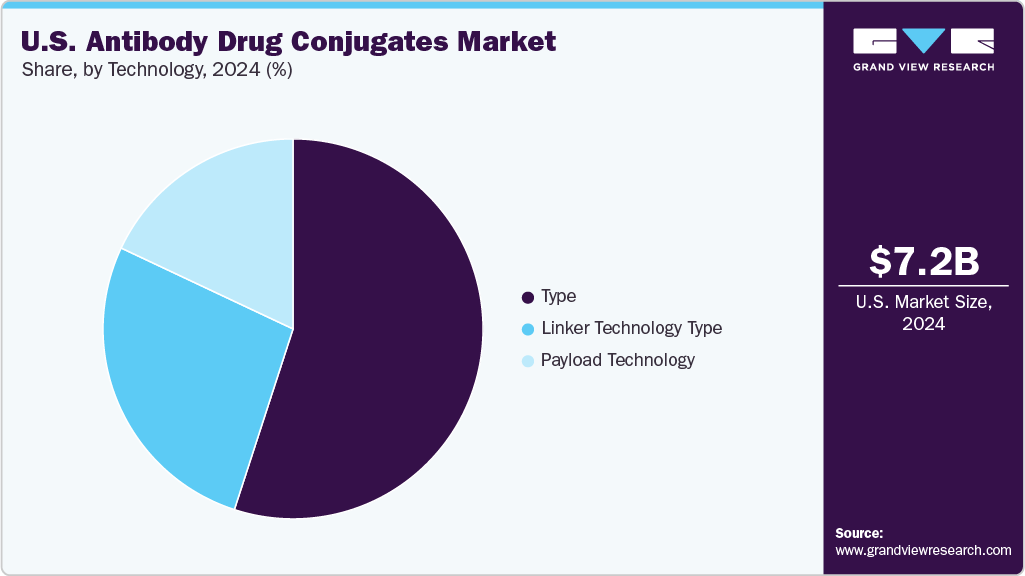
The payload technology segment is expected to grow notably during the forecast period. The payload technology segment in ADCs involves potent cytotoxic drugs that kill cancer cells at low concentrations. Payloads including MMAE, MMAF, DM4, and Camptothecin allow ADCs to achieve therapeutic efficacy with minimal dosage, reducing side effects. The development of novel payloads with various mechanisms of action expands treatment possibilities across different cancer types, driving the country's market growth.
Key U.S. Antibody Drug Conjugates Company Insights
Some key players operating in the market are Seagen, Inc., Takeda Pharmaceutical Company Ltd., and AstraZeneca.
-
Seagen focuses on innovation with its proprietary technology platforms, such as its optimized linker and payload systems, to create extremely targeted and powerful ADCs. The firm continues to actively grow its pipeline in multiple types of cancer and regularly licenses and collaborates with other firms (e.g., Merck and Genmab) to enrich its product portfolio and commercial footprint, most notably within the U.S. market.
-
AstraZeneca targets the expansion of its ADCs, such as Enhertu, across the broader clinical setting through extensive multi-indication clinical trials across several cancer types, such as HER2-low breast cancer and lung cancer.
Key U.S. Antibody Drug Conjugates Companies
- Seagen, Inc.
- Takeda Pharmaceutical Company Ltd.
- AstraZeneca
- F. Hoffmann-La Roche Ltd.
- Pfizer, Inc.
- Gilead Sciences, Inc.
- Daiichi Sankyo Company Ltd.
- GlaxoSmithKline Plc
- Astellas Pharma, Inc.
- ADC Therapeutics SA
Recent Developments
-
In April 2025, Synthetic Design Lab, a next-generation ADC company advancing its SYNTHBODY therapeutic platform against various cancer indications, raised USD 20 million in seed funding.
U.S. Antibody Drug Conjugates Market Report Scope
|
Report Attribute
|
Details
|
|
Revenue forecast in 2030
|
USD 10.60 billion
|
|
Growth rate
|
CAGR of 4.9% from 2025 to 2030
|
|
Base year for estimation
|
2024
|
|
Historical data
|
2018 - 2023
|
|
Forecast period
|
2025 - 2030
|
|
Quantitative units
|
Revenue in USD billion, and CAGR from 2025 to 2030
|
|
Report coverage
|
Revenue forecast, company ranking, competitive landscape, growth factors, and trends
|
|
Segments covered
|
Application, product, target, technology
|
|
Key companies profiled
|
Seagen, Inc., Takeda Pharmaceutical Company Ltd., AstraZeneca Plc, F. Hoffmann-La Roche Ltd., Pfizer, Inc., Gilead Sciences, Inc., Daiichi Sankyo Company Ltd., GlaxoSmithKline Plc, Astellas Pharma, Inc., ADC Therapeutics SA
|
|
Customization scope
|
Free report customization (equivalent up to 8 analysts working days) with purchase. Addition or alteration to country, regional & segment scope.
|
|
Pricing and purchase options
|
Avail customized purchase options to meet your exact research needs. Explore purchase options
|
U.S. Antibody Drug Conjugates Market Report Segmentation
This report forecasts revenue growth at country level and provides an analysis of the latest industry trends in each of the sub-segments from 2018 to 2030. For this study, Grand View Research has segmented the U.S. antibody drug conjugates market report based on application, product, target, and technology:
-
Application (Revenue, USD Million, 2018 - 2030)
-
Product Outlook (Revenue, USD Million, 2018 - 2030)
-
Kadcyla
-
Enhertu
-
Adcetris
-
Padcev
-
Trodelvy
-
Polivy
-
Others
-
Target Outlook (Revenue, USD Million, 2018 - 2030)
-
Technology Outlook (Revenue, USD Million, 2018 - 2030)
-
Type
-
Cleavable Linker
-
Non-cleavable Linker
-
Linkerless
-
Linker Technology Type
-
VC
-
Sulfo-SPDB
-
VA
-
Hydrazone
-
Others
-
Payload Technology
-
MMAE
-
MMAF
-
DM4
-
Camptothecin
-
Others

 Download Sample Report