
- Home
- »
- Automotive & Transportation
- »
-
U.S. Battery Electric Vehicle Market Size Report, 2026- 2033GVR Report cover

U.S. Battery Electric Vehicle Market (2026 - 2033) Size, Share & Trends Analysis Report By Vehicle Type (Scooters, Motorcycles, Three-Wheelers, Passenger Cars, Buses, Trucks), By Vehicle Speed, By Vehicle Range, By Battery Capacity, By End Use, And Segment Forecasts
U.S. Battery Electric Vehicle Market Summary
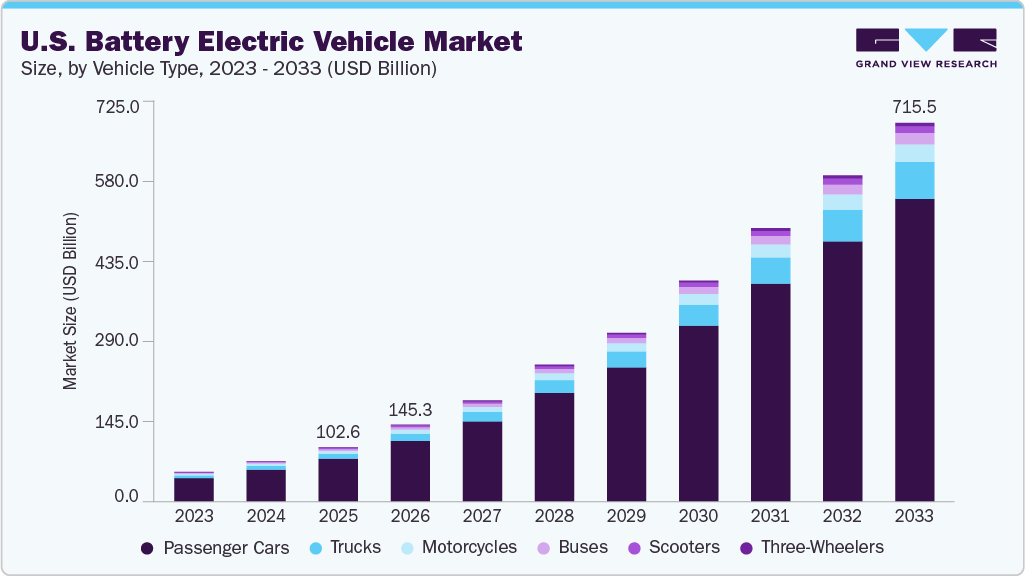
The U.S. battery electric vehicle market size was valued at USD 102.56 billion in 2025 and is projected to grow from USD 145.29 billion in 2026 to USD 715.50 billion by 2033, at a CAGR of 25.6% from 2026 to 2033. Supportive federal policies and government incentives are driving the growth of the U.S. battery electric vehicle industry. Tax credits, clean energy initiatives, and infrastructure funding programs are encouraging consumers and automakers to accelerate the adoption of battery electric vehicles.
Key Market Trends & Insights
- By vehicle type, the passenger cars segment accounted for the largest share of 79.0% in 2025.
- By vehicle speed, the 100mph to 125mph segment held the largest market share in 2025.
- By vehicle range, the above 300 km segment dominated the market in 2025.
- By battery capacity, the 50-100 kWh segment dominated the market in 2025.
- By end use, the personal segment dominated the market in 2025.
Market Size & Forecast
- 2025 Market Size: USD 102.56 Billion
- 2033 Projected Market Size: USD 715.50 Billion
- CAGR (2026-2033): 25.6%
Prism AI by Grand View Research Free to tryAsk a question about the U.S. battery electric vehicle marketTry asking✓Every figure cited from GVR research Prefer the report? Download free sample →
The market growth can be attributed to the expansion of EV charging infrastructure. Increasing development of public and private charging networks is improving charging accessibility and convenience, thereby supporting the wider adoption of battery electric vehicles across the U.S. For instance, as of February 2025, the U.S. had over 210,000 publicly available EV chargers across more than 76,000 charging stations, with nearly 1,000 new public chargers being installed every week through federal funding, tax incentives, state support, and private investments. Thus, the continuous expansion of charging infrastructure is expected to play a key role in supporting the long-term growth and widespread adoption of battery electric vehicles across the U.S.Technological innovation plays a critical role in driving the future growth of the U.S. battery electric vehicle market. Continuous advancements in lithium-ion battery technology, fast-charging systems, and energy management solutions are expected to improve vehicle performance, extend driving range, and reduce charging time. For instance, in May 2025, General Motors and LG Energy Solution announced plans to commercialize lithium manganese-rich (LMR) prismatic battery cells for future GM electric trucks and full-size SUVs in the U.S. Through their Ultium Cells joint venture, the companies plan to begin commercial production of LMR prismatic cells in the U.S. by 2028, with pre-production expected to start in late 2027. Such advancements are anticipated to improve driving range, lower battery costs, and support the long-term adoption of battery electric vehicles across the country.
 Source: Grand View Research, IR Documents, Primary Interviews, Paid DatabasesTo learn more about this report,
 Download Free Sample Report
Rising investments in domestic battery manufacturing and EV production facilities are driving the market growth. Various companies are increasingly investing in advanced battery technologies, localized EV production, and supply chain expansion to strengthen domestic manufacturing capabilities and meet the growing demand for electric vehicles. For instance, in August 2025, Ford Motor Company announced an investment of nearly USD 5 billion across its Louisville Assembly Plant and BlueOval Battery Park in Michigan to support a new EV platform, electric pickup production, and lithium iron phosphate (LFP) battery manufacturing in the U.S. The investment is expected to support the development of future affordable battery-electric vehicles and strengthen the country’s EV supply chain.
The regulatory framework plays a significant role in supporting the growth of the U.S. battery electric vehicle industry. The U.S. government is implementing stricter vehicle emissions standards, fuel-economy regulations, and clean transportation policies to reduce greenhouse gas emissions and accelerate the transition toward electric mobility. For instance, in 2025, the U.S. Environmental Protection Agency (EPA) continued the implementation of its multi-pollutant emissions standards for light-duty and medium-duty vehicles covering model years 2027-2032, targeting nearly a 50% reduction in light-duty vehicle CO₂ emissions compared to 2026 levels. These regulations are encouraging automakers to significantly increase the production of zero-emission vehicles, including battery electric vehicles.
The market faces several challenges, one of the major restraints being the high cost of battery electric vehicles. Despite ongoing price reductions and competitive pricing strategies, battery electric vehicles generally remain more expensive than traditional internal combustion engine vehicles, with batteries accounting for nearly 25%-50% of the total vehicle cost. In addition, the high cost of critical raw materials such as lithium, cobalt, and nickel further increases battery production expenses, thereby impacting vehicle affordability and limiting adoption among price-sensitive consumers.
Market Dynamics
Growing online retail orders and higher consumer expectations for faster delivery are driving logistics providers to expand operations. In response, companies are modernizing fleets with battery-electric vehicles to enhance delivery efficiency, maintain reliability in urban areas, and meet high-frequency transportation demands. Major operators such as Amazon and UPS are integrating electric vans and trucks into their urban fleets to achieve faster and more sustainable logistics in the U.S.
In addition, the industry is undergoing a structural transition toward cost optimization and sustainability. Rising fuel prices are significantly increasing operating expenses for fleet operators, thus making electric vehicles a more economical alternative over the long term due to lower energy and maintenance costs. Similarly, stricter emission regulations across several U.S. states are accelerating the shift toward zero-emission commercial transportation. Thus, logistics providers are increasingly integrating battery electric vehicles into their fleets to improve cost efficiency, meet regulatory requirements, and support sustainable transportation goals, thereby driving strong market growth.
Price sensitivity remains a major barrier in the market, as electric vehicles generally require a higher upfront investment than internal combustion engine vehicles. Despite long-term savings in fuel and maintenance, many consumers, particularly in the mid- and lower-income groups, remain cautious about the initial purchase cost. This limits mass-market penetration, as buyers often prioritize affordability and immediate financial impact over long-term operational benefits, thus slowing EV adoption.
Range anxiety is another significant barrier to market growth, as consumers are concerned about the driving range of electric vehicles and the availability of charging infrastructure. Uncertainty about charging station access, charging times, and travel reliability discourages potential buyers, particularly those who travel long distances. This lack of confidence in consistent mobility reduces the willingness to switch to battery-electric vehicles and slows overall market expansion.
The rapid expansion of battery manufacturing capacity in the U.S. presents a significant opportunity for the battery electric vehicle market. According to the Environmental Defense Fund, by 2027, battery manufacturing facilities in the U.S. will be capable of producing 1,099 GWh of EV battery capacity, which is sufficient to power approximately 12.3 million new electric vehicles. This substantial increase in production capacity reflects the ongoing localization of the EV supply chain and the strong policy push toward domestic clean energy manufacturing, thus supporting the long-term growth of the U.S. electric mobility ecosystem.
In addition, this expansion is expected to significantly improve supply chain resilience by reducing dependence on imported battery cells and components, while also helping stabilize production costs over time. The growing domestic manufacturing base is creating strong investment opportunities across the entire battery value chain, including cathode and anode materials and recycling technologies. Furthermore, increased scale of production is likely to drive technological advancements and cost efficiencies, making electric vehicles more affordable and accelerating adoption across both passenger and commercial segments in the U.S. market.
Market Concentration & Characteristics
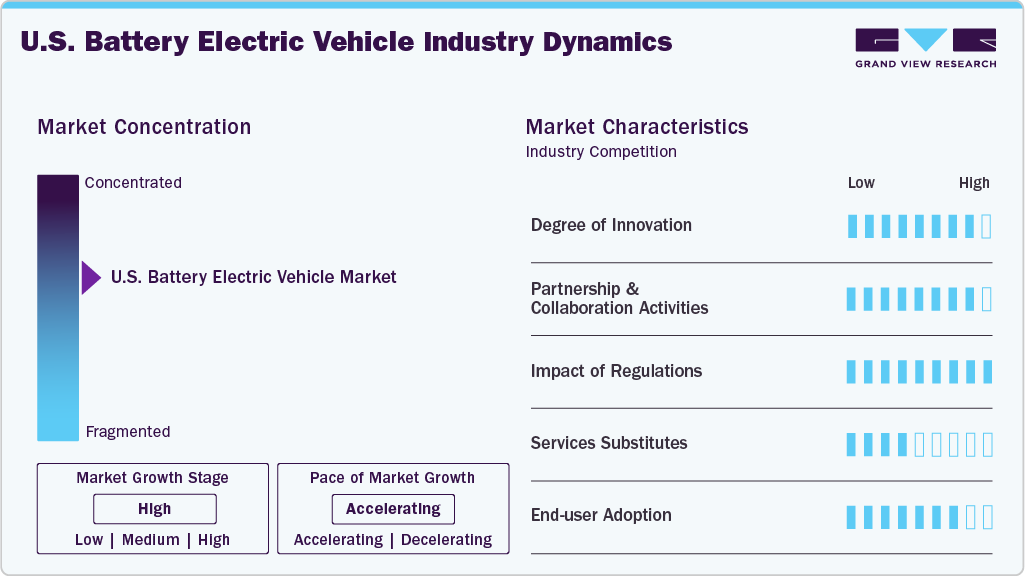
The U.S. battery electric vehicle market is moderately concentrated, with a few leading manufacturers holding a significant share of overall sales, while a growing number of new entrants continue to intensify competition. Established players such as Tesla, Inc., General Motors Company, Ford Motor Company, and Rivian Automotive dominate the market through strong product portfolios, advanced battery technologies, and well-developed charging and distribution ecosystems. However, the presence of multiple emerging electric vehicle manufacturers and continuous new model launches ensure a competitive, dynamic market structure.
 To learn more about this report, Download Free Sample Report
The market is characterized by rapid technological innovation, regulatory support, and increasing investment in electrification infrastructure. Continuous advancements in battery efficiency, driving range, software integration, and fast-charging capabilities are shaping product development across the industry. In addition, stringent emissions regulations, federal and state-level incentives, and growing consumer preference for sustainable mobility are accelerating the adoption of battery-electric vehicles.
Vehicle Type Insights
The passenger cars segment accounted for the largest share of 79.0% in 2025. The segment growth is primarily driven by strong consumer preference for electric SUVs and sedans, as buyers increasingly prefer vehicles with lower operating costs, advanced in-vehicle technology, and improved driving range. In addition, the rapid expansion of model availability from major U.S. automakers, such as Tesla Inc., Ford Motor Company, and General Motors, is making electric passenger cars more accessible across price segments, from mass-market models to premium offerings. These factors are accelerating the adoption of passenger battery electric cars across urban and suburban regions in the U.S.
The trucks segment is expected to grow at the substantial CAGR during the forecast period.The segment’s growth is attributed to increasing demand for electric pickup trucks in the U.S., as both individual and commercial users seek lower operating and maintenance costs compared to diesel trucks. In addition, fleet electrification by logistics companies and corporate users is accelerating adoption, as businesses aim to reduce carbon emissions, improve sustainability, and meet environmental targets. These factors are strengthening demand for electric trucks and supporting sustained market growth.
Vehicle Speed Insights
The 100mph to 125mph segment held the dominant share of the U.S. battery electric vehicle industry in 2025. The segment's growth is driven by its optimal balance of performance and efficiency, highway capability, and safety requirements. This speed range offers the best trade-off between performance and energy efficiency for both passenger and commercial electric vehicles, avoiding significantly higher battery energy consumption at speeds above 125 mph, while still delivering strong acceleration and usability. In addition, vehicles in this range are well-suited for U.S. highway driving conditions, as they comfortably meet standard speed limits and align with safety expectations, including regulatory crash testing and insurance considerations. These factors together make this segment highly practical for everyday use, thus supporting its strong adoption across the market.
The above 125mph segment is expected to grow at the fastest CAGR during the forecast period. The segment’s growth is supported by rising demand for high-performance electric vehicles and ongoing advancements in powertrain and battery technologies. Consumer interest in premium and sports-oriented EVs is increasing demand for vehicles with superior acceleration and higher top speeds, signaling a shift toward performance-focused mobility. In addition, enhanced high-voltage battery systems, dual- and tri-motor configurations, and improved thermal management now allow EVs to safely and efficiently maintain higher speeds. These innovations, along with greater consumer willingness to adopt luxury and performance EVs, are accelerating segment growth in the U.S. market.
Vehicle Range Insights
The above 300 km segment dominated the market in 2025. Strong consumer preference for long-range electric vehicles is driving the dominance of the segment. In the U.S., where intercity travel distances are relatively long and highway usage is extensive, EVs with greater driving range above 300 km are preferred, as they offer convenience, improved daily commuting usability, and reduced range anxiety. In addition, the expansion of fast-charging infrastructure has further strengthened adoption by reducing range anxiety and improving the overall usability of long-range EVs. This infrastructure development enables quicker and more accessible charging across highways, urban centers, and intercity routes, making long-range electric vehicles more practical for everyday and long-distance use.
The 150-300 km segment is projected to grow at the substantial CAGR over the forecast period. The segment’s growth is propelled by rising demand for affordable electric vehicles and increasing suitability for urban and fleet applications. This segment is gaining traction, offering a balanced solution for daily commuting while keeping vehicle costs lower due to smaller battery packs. In addition, it is well-suited for ride-hailing, delivery services, and short-to-medium-distance travel, where vehicles typically operate within a limited daily mileage. Thus, consumers and fleet operators are increasingly adopting this segment as a cost-efficient entry point into electric mobility, thereby supporting its steady growth.
Battery Capacity Insights
The 50-100 kWh segment dominated the U.S. battery electric vehicle market in 2025.The segment growth is driven by a strong balance between cost and range, improved battery efficiency, and expanded charging infrastructure. Battery capacities in this range provide adequate driving distance for daily use and moderate trips, while keeping vehicles more affordable than higher-capacity EVs. This makes them the preferred option for mainstream U.S. buyers who value practicality and cost-effectiveness. In addition, ongoing advancements in battery technology and the wider availability of fast-charging networks are further reducing charging times and increasing convenience, thereby emphasizing demand for the 50-100 kWh segment.
The > 100 kWh segment is expected to grow at the fastest CAGR over the forecast period.The segment growth is attributed to rising demand for long-range electric vehicles and increasing preference for high-performance and premium EV models. Larger battery capacities enable extended driving range and significantly reduce charging frequency, which is becoming more important in the U.S. due to long-distance travel requirements and higher highway usage. In addition, growing consumer inclination toward luxury and performance-oriented EVs is further supporting adoption, as these vehicles rely on higher-capacity battery packs to deliver superior acceleration, power output, and enhanced driving experience, thereby accelerating segment growth.
End Use Insights
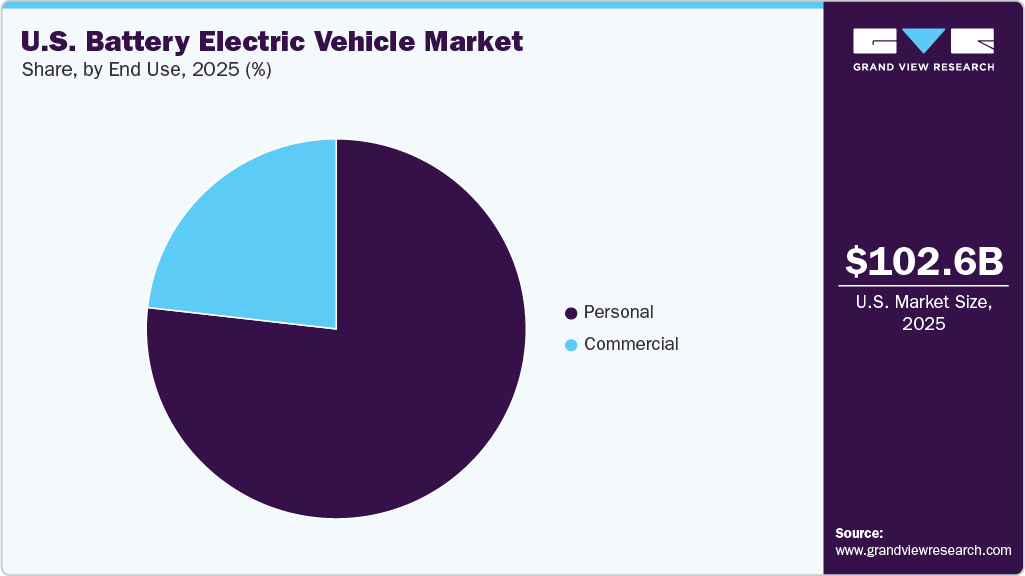
The personal segment held a significant share in the U.S. battery electric vehicle industry in 2025. The segment’s dominance is supported by rising consumer preference for electric mobility and the availability of diverse EV models. Increased environmental awareness is prompting a shift from internal combustion engine vehicles to electric personal vehicles, as consumers seek cleaner, more sustainable transportation that reduces emissions. Moreover, the growing availability of EV models across price points and performance levels is making electric vehicles more accessible, enabling buyers to find options that fit their budgets and needs, and further emphasizing demand in the personal segment.
 To learn more about this report, Download Free Sample Report
The commercial segment is projected to grow at a significant CAGR over the forecast period. The segment growth is propelled by lower operating costs and rising demand from e-commerce logistics and last-mile delivery services. Lower operating costs are a major factor, as businesses increasingly adopt electric commercial vehicles such as buses, vans, and trucks to reduce fuel consumption and minimize maintenance expenses. In addition, the rapid expansion of e-commerce in the U.S. has strengthened the need for efficient last-mile delivery solutions, where electric vehicles are preferred for their ability to operate efficiently in urban environments, meet zero-emission requirements, and enable faster and more sustainable delivery operations.
Key Companies & Market Share Insights
Some of the key companies in the U.S. battery electric vehicle market include Tesla, Inc.; General Motors Company; and Ford Motor Company. Organizations are focusing on increasing the customer base to gain a competitive edge in the industry. Therefore, key players are taking several strategic initiatives, such as mergers and acquisitions, and partnerships with other major companies.
-
Tesla Inc. is a manufacturer of electric vehicles and provides software-driven mobility and energy solutions. Its portfolio includes models such as the Model 3 and Model Y, featuring over-the-air updates and driver-assistance technologies. Tesla uses a direct sales model and operates Gigafactories to support vehicle and battery production across North America, Europe, and Asia. The company prioritizes technological innovation and charging infrastructure through its Supercharger network, while competing in a rapidly growing global EV market.
-
General Motors Company is an automotive manufacturer that operates through automotive brands including Chevrolet, Cadillac, GMC, and Buick. The company has been expanding its battery electric vehicle portfolio by introducing electric pickups, SUVs, and passenger vehicles under its Ultium battery platform strategy. The company focuses on advanced battery technologies, vehicle electrification, and software-enabled mobility solutions to strengthen its position in the growing electric vehicle market. GM also invests in domestic battery manufacturing and EV production facilities across North America to support long-term electrification goals and improve large-scale EV adoption in the U.S. market.
Key U.S. Battery Electric Vehicle Companies
-
Tesla, Inc.
-
General Motors Company
-
Ford Motor Company
-
Rivian Automotive, Inc.
-
Lucid Group, Inc.
-
Hyundai Motor Company
-
Volkswagen Group of America
-
BMW Group
-
Mercedes-Benz Group AG
-
Stellantis NV
Recent Developments
-
In April 2026, Tesla, Inc. announced plans to develop a smaller and more affordable electric SUV for the U.S. market to expand mass-market EV adoption and strengthen its presence in the affordable electric vehicle segment. The company stated that the upcoming vehicle would feature a smaller battery pack and cost-efficient vehicle architecture aimed at improving affordability while maintaining practical driving range and energy efficiency for U.S. consumers.
-
In June 2025, General Motors Company launched the 2026 Cadillac OPTIQ-V electric SUV in the U.S. market, featuring an 85-kWh lithium-ion battery pack capable of delivering an estimated driving range of 275 miles on a single charge. The vehicle also included dual-motor all-wheel drive, 519 horsepower, and native North American Charging Standard (NACS) support, providing direct access to Tesla Supercharger infrastructure across North America.
U.S. Battery Electric Vehicle Market Report Scope
Report Attribute
Details
Market size value in 2025
USD 102.56 billion
Market size value in 2026
USD 145.29 billion
Revenue forecast in 2033
USD 715.50 billion
Growth rate
CAGR of 25.6% from 2025 to 2033
Base year for estimation
2025
Historical data
2021 - 2025
Forecast period
2026 - 2033
Quantitative units
Revenue in USD billion and CAGR from 2026 to 2033
Report coverage
Revenue forecast, company ranking, competitive landscape, growth factors, and trends
Segments covered
Vehicle type, vehicle speed, vehicle range, battery capacity, and end use
Key companies profiled
Tesla, Inc.; General Motors Company; Ford Motor Company; Rivian Automotive, Inc.; Lucid Group, Inc.; Hyundai Motor Company; Volkswagen Group of America; BMW Group; Mercedes-Benz Group AG; Stellantis NV
Customization scope
Free report customization (equivalent up to 8 analysts working days) with purchase. Addition or alteration to country, regional & segment scope.
Pricing and purchase options
Avail customized purchase options to meet your exact research needs. Explore purchase options
U.S. Battery Electric Vehicle Market Report Segmentation
This report forecasts revenue growth at the country level and provides an analysis of the latest industry trends in each of the sub-segments from 2021 to 2033. For this study, Grand View Research has segmented the U.S. battery electric vehicle market report based on vehicle type, vehicle speed, vehicle range, battery capacity, and end use:
-
Vehicle Type Outlook (Revenue, USD Billion, 2021 - 2033)
-
Scooters
-
Motorcycles
-
Three-Wheelers
-
Passenger Cars
-
Buses
-
Trucks
-
-
Vehicle Speed Outlook (Revenue, USD Billion, 2021 - 2033)
-
Less Than 100 MPH
-
100MPH to 125MPH
-
Above 125 MPH
-
-
Vehicle Range Outlook (Revenue, USD Billion, 2021 - 2033)
-
Below 150 km
-
150–300 km
-
Above 300 km
-
-
Battery Capacity Outlook (Revenue, USD Billion, 2021 - 2033)
-
50 kWh
-
50–100 kWh
-
>100 kWh
-
-
End Use Outlook (Revenue, USD Billion, 2021 - 2033)
-
Personal
-
Commercial
-
Delivered Customization
We have successfully delivered the following deep-dive customizations
Client Request
Customization Delivered
Value Adds
U.S. Battery Electric Vehicle Market Opportunity Assessment
Analysis of demand, adoption trends, and regulatory landscape
Identification of high-growth states and investment hotspots
Identified state-specific growth opportunities
Supported expansion and go-to-market strategy
Enabled informed regional investment decisions
Cross-Segmentation Analysis for the U.S. Battery Electric Vehicle Market
Criss-cross market analysis by vehicle type, vehicle speed, vehicle range, battery capacity, end use
Demand and adoption assessment across key segments
Segment attractiveness and growth potential benchmarking
Identified high-potential market segments Supported targeted product positioning and marketing strategy
Improved customer and segment prioritization
Competitive Benchmarking and Strategic Positioning in the U.S. Battery Electric Vehicle Market
Benchmarking of key competitors across products, pricing, partnerships, and innovation
Comparative assessment of market share, capabilities, and strategies
Analysis of competitive strengths, gaps, and differentiation areas
Identified competitive white spaces and growth gaps
Supported strategic positioning and differentiation
Enabled data-driven competitive strategy development
Frequently Asked Questions About This Report
The U.S. battery electric vehicle market size was estimated at USD 102.56 billion in 2025 and is expected to reach USD 145.29 billion in 2026.
The U.S. battery electric vehicle market is expected to grow at a compound annual growth rate of 25.6% from 2026 to 2033 to reach USD 715.50 billion by 2033.
The passenger cars segment accounted for the largest share of 79.0% in 2025. The segment growth is primarily driven by strong consumer preference for electric SUVs and sedans, as buyers increasingly prefer vehicles with lower operating costs, advanced in-vehicle technology, and improved driving range.
Some key players operating in the U.S. battery electric vehicle market include Tesla, Inc.; General Motors Company; Ford Motor Company; Rivian Automotive, Inc.; Lucid Group, Inc.; Hyundai Motor Company; Volkswagen Group of America; BMW Group; Mercedes-Benz Group AG; Stellantis NV
Supportive federal policies and government incentives are driving the growth of the U.S. battery electric vehicle market. Tax credits, clean energy initiatives, and infrastructure funding programs are encouraging consumers and automakers to accelerate the adoption of battery electric vehicles.
About the Author(s)
Automotive & Transportation Research Team
Technology · Automotive & TransportationThis report was authored by the automotive & transportation research team at Grand View Research - comprising two research analysts, one senior research analyst, and one industry expert - with specialized expertise in the automotive & transportation segment of the technology industry. All findings are based on proprietary technology databases, executive interviews, and regulatory analysis, subject to internal peer review prior to publication.
Last Updated:
Speak to Analyst

Customize this report to your needs - add regions, segments, or data points, with 20% free customization.
Or view our licence options:


ISO 9001:2015 & 27001:2022 Certified
We are GDPR and CCPA compliant! Your transaction & personal information is safe and secure. For more details, please read our privacy policy.


