U.S. Dental Bone Grafts And Substitutes Market Summary
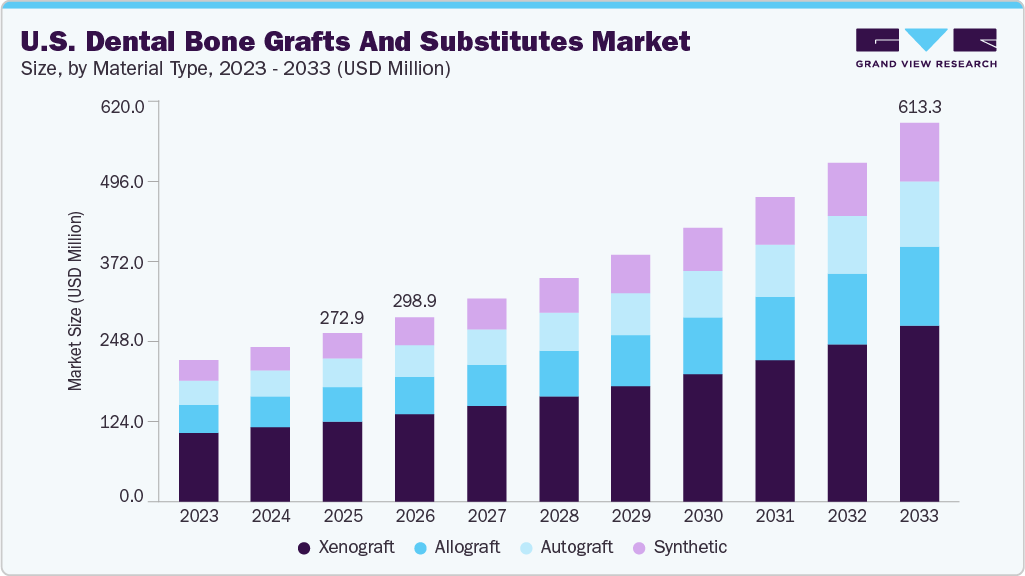
The U.S. dental bone grafts and substitutes market size was estimated at USD 272.96 million in 2025 and is projected to reach USD 613.31 million by 2033, growing at a CAGR of 10.82% from 2026 to 2033. The market growth is primarily driven by the rising adoption of dental implants and by increasing cases of periodontal disease, which lead to bone loss.
Key Market Trend & Insights
- By material type, the xenograft segment led the market with the largest revenue share in 2025.
- By application, the socket preservation segment led the market with the largest revenue share in 2025.
- By end use, the dental clinics segment led the market with the largest revenue share in 2025.
Market Size & Forecast
- 2025 Market Size: USD 272.96 Million
- 2033 Projected Market Size: USD 613.31 Million
- CAGR (2025-2033): 10.82%
Growing awareness of advanced restorative procedures and the expanding elderly population further support demand for bone regeneration solutions. In addition, advancements in biomaterials and minimally invasive techniques are encouraging wider clinical adoption.
The increasing prevalence of periodontal disease is a significant driver of the U.S. dental bone grafts and substitutes industry. Advanced gum disease often leads to alveolar bone loss, creating the need for regenerative procedures to restore bone structure before implant placement. As more patients seek treatment for tooth loss caused by chronic periodontitis, demand for bone graft materials continues to rise. This growing clinical need supports the market's significant expansion.
Age-Standardized Incidence Rate (ASIR) of Severe Periodontitis (per 100,000 population)
|
State
|
ASIR (per 100,000)
|
|
New York
|
1,089.60
|
|
North Carolina
|
983.68
|
|
Wisconsin
|
967.22
|
|
Iowa
|
748.67
|
Source: The Journal of the American Dental Association
Age-Standardized Prevalence Rate (ASIR) of Severe Periodontitis (per 100,000 population)
|
State
|
ASPR (per 100,000)
|
|
New York
|
12,122.96
|
|
North Carolina
|
10,054.15
|
|
Wisconsin
|
6,662.65
|
|
Iowa
|
7,395.46
|
Source: The Journal of the American Dental Association
The rising demand for cosmetic and restorative dentistry is driving significant growth in the U.S. dental bone grafts and substitutes market. Patients prefer long-lasting, natural-looking solutions such as implant-supported restorations over traditional dentures. Many of these procedures require bone augmentation to ensure implant stability and aesthetic outcomes. As a result, the growing focus on smile enhancement and functional restoration is driving higher utilization of dental bone graft materials.
For instance, Fountains Dental Care highlights that cosmetic dentistry continues to grow as patients seek naturally beautiful smiles and advanced restorative options such as implants, veneers, and bone regenerative procedures. This trend reflects greater interest in treatments that enhance aesthetics and improve oral function, often requiring supportive materials like dental bone grafts and substitutes. As dental practices adopt digital technologies and regenerative techniques to meet rising patient expectations, demand for related grafting solutions is also expanding.
Market Concentration & Characteristics
The degree of innovation in the U.S. dental bone grafts and substitutes market is moderate to high, driven by continuous improvements in biomaterials and regenerative technologies. Companies are developing advanced synthetic grafts, bioactive ceramics, and composite materials that enhance bone regeneration and reduce healing time. There is also growing use of growth-factor-infused matrices and collagen-based scaffolds to improve clinical outcomes. In addition, integration with digital dentistry and guided implant surgery enables more precise, predictable grafting procedures.
The level of merger and acquisition activity in the U.S. dental bone grafts and substitutes industry is moderate and strategically driven. Larger dental and biomaterials companies are acquiring smaller regenerative or specialty graft manufacturers to expand their product portfolios and strengthen their presence in implant dentistry. M&A activity is primarily focused on gaining access to innovative technologies, distribution networks, and biologic product pipelines. This consolidation trend supports competitive positioning and broader market reach.
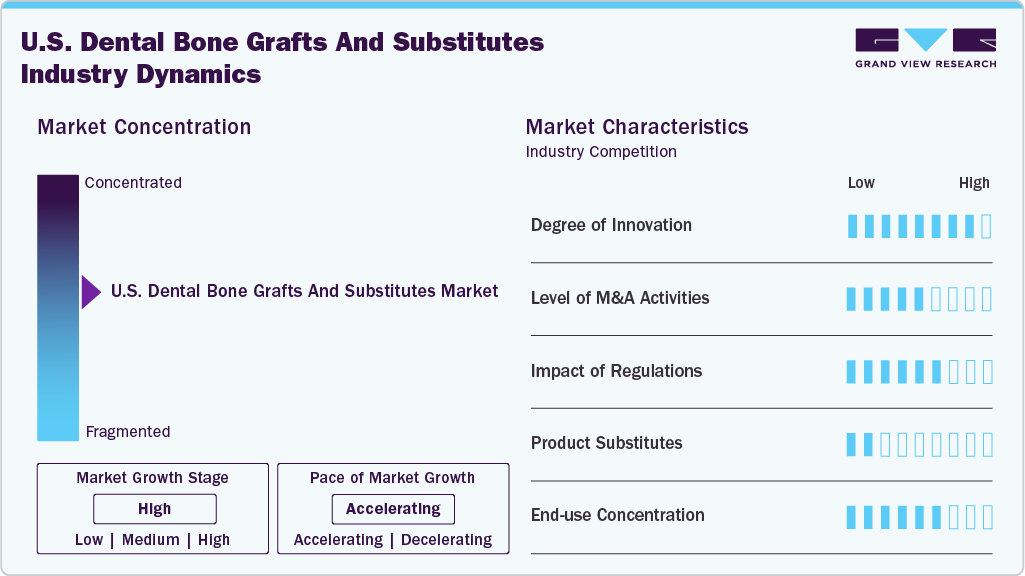
Regulations have a significant impact on the U.S. market for dental bone grafts and substitutes, as products must meet strict safety, quality, and manufacturing standards before commercialization. Tissue-based and biologic graft materials are subject to rigorous screening, processing, and traceability requirements, which increase compliance costs. Regulatory approvals can extend product development timelines, potentially delaying market entry for innovative materials. However, strong regulatory oversight also enhances clinician and patient confidence in product safety and effectiveness.
Product substitutes in the U.S. dental bone grafts and substitutes market mainly include treatment options that avoid the need for bone augmentation. Traditional removable dentures and dental bridges are lower-cost alternatives that do not require grafting procedures. In some cases, short implants or zygomatic implants may be used to bypass areas with limited bone volume. These alternatives can reduce demand for bone graft materials, especially among cost-sensitive or medically compromised patients.
Material Type Insights
The xenografts dominated the U.S. dental bone grafts and substitutes industry in 2025, due to their strong clinical acceptance and long track record in implant procedures. These materials are widely used in ridge preservation and sinus augmentation because they provide stable scaffolding and predictable healing outcomes. Dentists prefer xenografts for their ease of handling, availability, and cost-effectiveness compared to some premium biologic options. Their familiarity among clinicians has supported consistent demand across implant-focused practices.
The synthetic segment is expected to grow the fastest during the forecast period. This acceleration is driven by increasing clinician preference for off-the-shelf materials that avoid the ethical and biological concerns associated with human- or animal-derived grafts. Advances in biomaterials have made synthetic options more predictable in performance, easier to handle, and often more cost-effective, encouraging broader adoption. As dentists and patients seek simpler, safer, and more consistent regenerative solutions, synthetic grafts are gaining market share more rapidly than other material types.
Application Insights
The socket preservation segment dominated the U.S. dental bone grafts and substitutes market in 2025, due to its widespread use following tooth extraction to maintain bone volume for future implant placement. Dentists perform socket preservation as a preventive measure to avoid bone loss, thereby enhancing implant success and reducing the need for more extensive grafting later. The routine nature of this procedure and the growing adoption of implants supported its leading market share. As awareness of long-term oral function and aesthetic outcomes rises, socket preservation remains a core application driving material demand.
The sinus lift segment is expected to grow at the fastest CAGR during the forecast period, as more patients pursue implant solutions in the upper jaw, where natural bone volume is often limited. Sinus augmentation procedures are common because they create sufficient bone height for secure implant placement, especially in molar and premolar regions. Greater clinician expertise and patient demand for full-mouth restorations are supporting this trend. As awareness of the benefits of sinus lifts increases, this segment is poised to expand more rapidly than other applications.
End-use Insights
The dental clinics segment dominated the U.S. dental bone grafts and substitutes industry in 2025, as these clinics offer comprehensive implant and regenerative services. General dentists and specialist practices, such as periodontists and oral surgeons, perform a high volume of grafting procedures as part of routine implant workflows, making clinics the primary point of care. Their broader adoption of advanced graft materials and direct patient access helped this segment capture the largest share. Continued investment in clinic-level training and equipment further strengthened their leadership in the market.
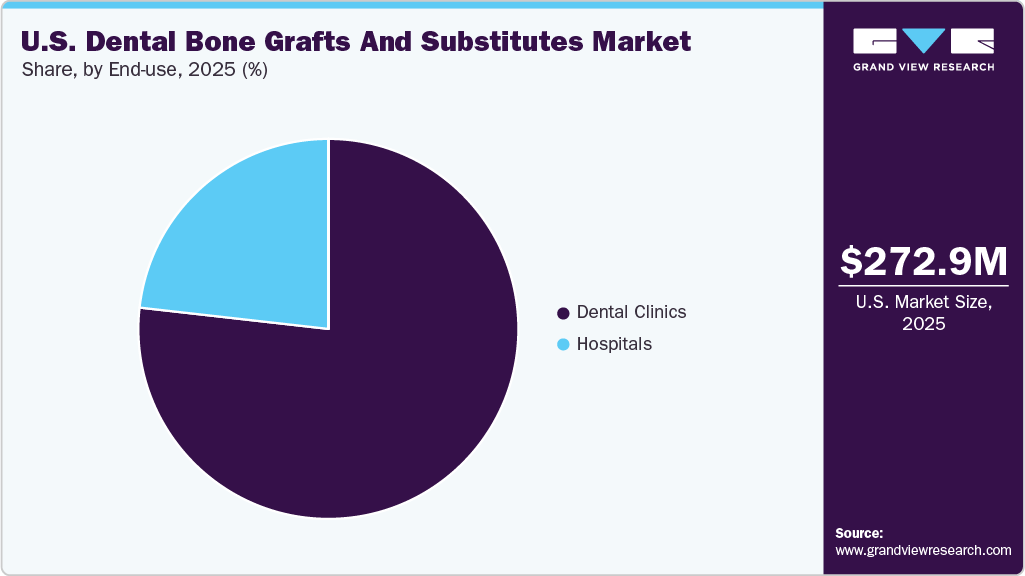
The hospitals segment is expected to grow at the fastest CAGR during the forecast period, as they handle complex cases that require multidisciplinary care. Patients with extensive bone loss, trauma, or medical conditions are more likely to receive grafting and implant procedures in hospital-affiliated dental departments or outpatient surgical centers. Additionally, growth in hospital-based oral surgery services and collaboration between dental specialists and medical teams are increasing procedural volumes. This trend is driving faster growth in the hospital segment than in traditional dental offices.
Key U.S. Dental Bone Grafts And Substitutes Company Insights
The U.S. dental bone grafts and substitutes market is moderately consolidated, with a few established dental biomaterial manufacturers holding a significant share due to strong brand recognition and wide distribution networks. In addition, several smaller and specialized companies compete by offering niche or innovative graft materials. Product performance, clinician preference, pricing strategies, and long-term relationships with dental clinics and implant specialists largely influence market share.
Key U.S. Dental Bone Grafts And Substitutes Companies:
The following key companies have been profiled for this study on the U.S. dental bone grafts and substitutes market.
- Avtec Surgical
- Dentsply Sirona
- Geistlich Pharma
- BioHorizons
- ZimVie Inc.
- Institut Straumann AG
- Osteogenics Biomedical
- botiss N.A. Inc (Straumann Group USA)
- Implant Direct Corporation
- DentiumUSA
- LifeNet Health
Recent Developments
-
In February 2025, LifeNet Health announced the launch of OraGen, described as the first viable dental bone allograft composed of cryopreserved corticocancellous bone containing endogenous lineage-committed bone cells combined with demineralized bone matrix. This advanced formulation integrates three critical properties for bone regeneration: osteogenicity, through lineage-committed bone cells that support new bone formation; osteoconductivity, by providing a biocompatible scaffold for cell attachment and growth; and osteoinduction, by retaining natural growth factors that help stimulate bone repair.
"We are thrilled to collaborate with Salvin Dental Specialties to introduce OraGen to the market," said Daniel Osborne, Chief Growth Officer at LifeNet Health. "This partnership reflects our commitment to delivering cutting-edge solutions that not only drive better patient outcomes but also advance the field of regenerative medicine. Together, we’re not just facilitating healing; we’re improving lives.”
-
In April 2023, ZimVie Inc., a global life sciences company focused on the dental and spine markets, announced the launch of two new products within its biomaterials portfolio. The company introduced the RegenerOss CC Allograft Particulate, a natural combination of cortical and cancellous bone particles designed to fill bony voids in various dental procedures, and the RegenerOss Bone Graft Plug, a convenient grafting option for extraction sockets and periodontal defects. Both products are commercially available across North America.
U.S. Dental Bone Grafts And Substitutes Market Report Scope
|
Report Attribute
|
Details
|
|
Market size value in 2026
|
USD 298.85 million
|
|
Revenue forecast in 2033
|
USD 613.31 million
|
|
Growth rate
|
CAGR of 10.82% from 2026 to 2033
|
|
Actual data
|
2021 - 2025
|
|
Forecast period
|
2026 - 2033
|
|
Quantitative units
|
Revenue in USD million and CAGR from 2026 to 2033
|
|
Segments covered
|
Material type, application, end-use
|
|
Regional scope
|
U.S.
|
|
Report coverage
|
Revenue, competitive landscape, growth factors, and trends
|
|
Key companies profiled
|
Avtec Surgical; Dentsply Sirona; Geistlich Pharma; BioHorizons; ZimVie Inc.; Institut Straumann AG; Osteogenics Biomedical; botiss N.A. Inc. (Straumann Group USA); Implant Direct Corporation; DentiumUSA; LifeNet Health
|
|
Customization scope
|
Free report customization (equivalent to 8 analysts working days) with purchase. Addition or alteration to country, regional & segment scope
|
|
Pricing and purchase options
|
Avail customized purchase options to meet your exact research needs. Explore purchase options
|
U.S. Dental Bone Grafts And Substitutes Market Report Segmentation
This report forecasts revenue growth at the country level and provides an analysis of the latest industry trends in each of the sub-segments from 2021 to 2033. For this study, Grand View Research has segmented the U.S. dental bone grafts and substitutes market report based on material type, application, and end-use:
-
Material Type Outlook (Revenue, USD Million, 2021 - 2033)
-
Autograft
-
Allograft
-
Xenograft
-
Synthetic
-
Application Outlook (Revenue, USD Million, 2021 - 2033)
-
End-use Outlook (Revenue, USD Million, 2021 - 2033)
Frequently Asked Questions About This Report
b. The U.S. dental bone grafts and substitutes market is expected to grow at a compound annual growth rate of 10.82% from 2026 to 2033 to reach USD 613.31 million by 2033.
b. The U.S. dental bone grafts and substitutes market size was estimated at USD 272.96 million in 2025 and is expected to reach USD 298.85 million in 2026.
b. Xenografts dominated the U.S. dental bone grafts and substitutes market with a share of 47.7% in 2025. This is attributable to their strong clinical acceptance and long track record in implant procedures. These materials are widely used in ridge preservation and sinus augmentation because they provide stable scaffolding and predictable healing outcomes.
b. Some key players operating in the U.S. dental bone grafts and substitutes market include Avtec Surgical, Dentsply Sirona, Geistlich Pharma, BioHorizons, ZimVie Inc., Institut Straumann AG, Osteogenics Biomedical, botiss N.A. Inc (Straumann Group USA), Implant Direct Corporation, DentiumUSA , LifeNet Health
b. Key factors that are driving the market growth include the rising adoption of dental implants and by increasing cases of periodontal disease, which lead to bone loss. Growing awareness of advanced restorative procedures and the expanding elderly population further support demand for bone regeneration solutions.

 Download Sample Report
















