
- Home
- »
- Automotive & Transportation
- »
-
U.S. Electric Golf Cart Market Size, Industry Report, 2033GVR Report cover

U.S. Electric Golf Cart Market (2025 - 2033) Size, Share & Trends Analysis Report By Propulsion (Battery Electric Vehicle, Plug-in Hybrid Electric Vehicle), By Seating Capacity, By Application (Golf Course, Personal Use, Commercial Use), And Segment Forecasts
U.S. Electric Golf Cart Market Summary
The U.S. electric golf cart market size was estimated at USD 529.4 million in 2024, and is projected to reach USD 886.7 million by 2033, growing at a CAGR of 6.2% from 2025 to 2033. The U.S. market is witnessing strong growth, driven by rising adoption in gated communities, private golf clubs, retirement villages, and resort towns where quiet, low-emission mobility is highly valued.
Key Market Trends & Insights
- By propulsion, the battery electric vehicle (BEV) segment accounted for the largest share of 72.5% in 2024.
- By seating capacity, the 1 to 4-seater segment held the largest market share in 2024.
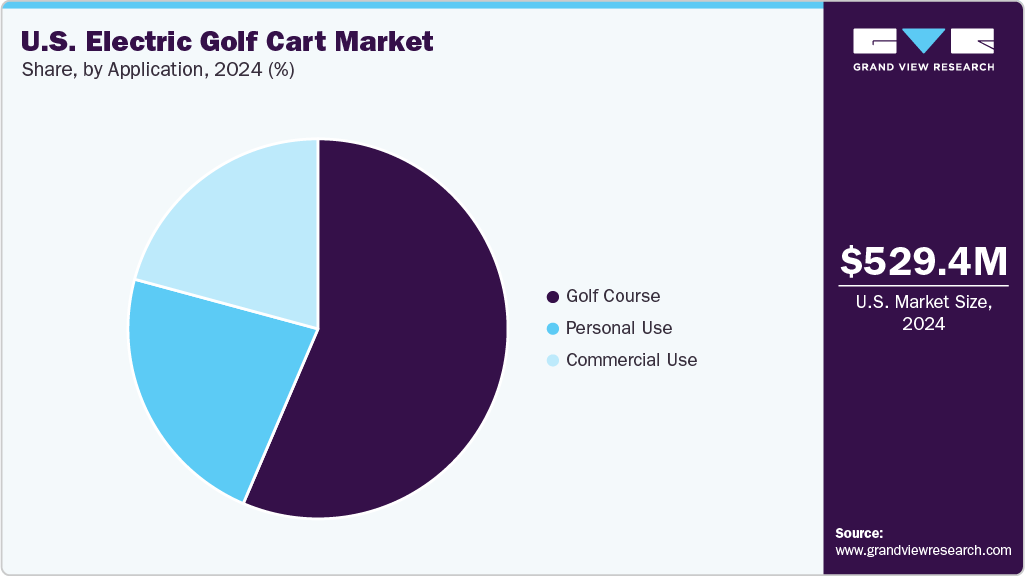
- By application, the golf course segment dominated the market in 2024.
Market Size & Forecast
- 2024 Market Size: USD 529.4 million
- 2033 Projected Market Size: USD 886.7 million
- CAGR (2025-2033): 6.2%
Three ways to get this report
Buy it, customize it, or ask a question.Ask an Analyst
Analyst response in 1 business day
- AccessReport author, directly
- Reply timeWithin 1 working day
- No sales callDirect answer only
- FormatEmail reply
- CostFree, no cost
Get the Full Report
What the study covers
- FormatsPDF · Excel · Dashboard
- Timeline2025–2033 annual, 2024 base
- Coverage20+ countries, 5 regions
- Companies10+ key players profiled
Customize the Report
20% free customization
- IncludeCountries, segments, points
- TailorTo your product definition
- ExtendDeeper competitor detail
- OrA fully bespoke study
- Turnaround5–10 working days
Advancements in lithium-ion battery systems are improving driving range, safety, and charging efficiency, making electric carts more attractive for both personal and commercial use. In addition, increased focus on replacing internal combustion vehicles in local government fleets and park services is reinforcing the shift toward electric models. Innovations in street-legal low-speed vehicle (LSV) design, along with growing demand for sustainable micro-mobility in planned communities, present significant opportunities for electric golf carts in neighborhood commuting and utility transport. However, regulatory inconsistencies across states regarding road legality and operational zones pose a challenge to uniform adoption.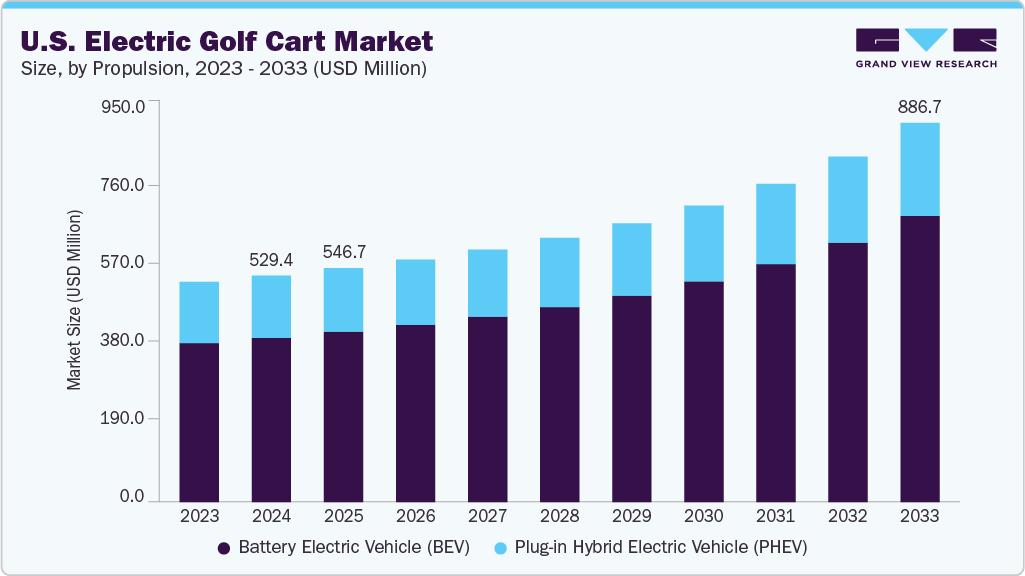 Source: Grand View Research, IR Documents, Primary Interviews, Paid DatabasesTo learn more about this report,
 Download Free Sample Report
 The rising adoption of electric golf carts in the U.S. across resorts, gated communities, and retirement villages is driven by the growing demand for quiet, eco-friendly, and user-friendly mobility solutions tailored to short-range travel. These environments increasingly emphasize sustainability, low operational noise, and ease of use, aligning with the advantages offered by electric carts over conventional gasoline-powered alternatives. The trend is also fueled by expanding investments in planned residential developments, leisure facilities, and active adult communities seeking to enhance intra-community mobility. For instance, in March 2025, Golf Carts and More partnered with ICON Electric Vehicles to distribute high-performance, street-legal electric golf carts across San Diego County. The collaboration includes a diverse portfolio of customizable electric carts for recreational, commercial, and luxury applications, along with full-service maintenance and support.
The shift toward high-capacity, fast-charging, and thermally stable battery systems is driving significant improvements in the operational efficiency of electric golf carts across the U.S. These advancements are enabling longer operational hours, reduced downtime, and improved user convenience. Battery innovations, particularly in lithium-ion and LiFePO₄ technologies, are enhancing energy density, safety, and charging speeds, making electric golf carts more suitable for demanding applications such as fleet use, commercial transport, and extended recreational drives.
Increasing demand for customizable, street-legal Low-Speed Vehicles (LSVs) that can be used for local commuting and neighborhood mobility is opening new growth avenues in the U.S. market. Consumers are increasingly seeking versatile vehicles that combine functionality, personalization, and compliance with local transportation laws. This shift is particularly visible in suburban and semi-urban communities where short-range travel is common and regulatory frameworks permit LSVs on public roads. The trend supports market expansion beyond traditional golf courses into residential, recreational, and utility-based applications, encouraging manufacturers to offer feature-rich, DOT-compliant models with enhanced safety, infotainment, and aesthetic upgrades.
Inconsistent state-level regulations and operational restrictions limit where electric golf carts and Low-Speed Vehicles (LSVs) can legally operate, slowing broader adoption in public areas. While states like Florida and California permit LSVs on roads with speed limits up to 35 mph, others impose tighter rules on road usage, registration, and required safety features. For example, according to a study by the Connecticut General Assembly, states such as Pennsylvania and New York have more restrictive LSV laws, creating compliance hurdles for manufacturers and limiting consumer access. This regulatory fragmentation complicates national expansion and necessitates region-specific product strategies.
Propulsion Insights
The battery electric vehicle (BEV) segment accounted for the largest share of 72.5% in 2024, driven by increasing consumer preference for eco-friendly transportation within gated communities, resorts, and commercial campuses. The growth is further supported by advancements in lithium-ion battery technologies, expanding federal and state-level clean vehicle incentives, and growing awareness of the long-term cost benefits of BEVs, including lower fuel and maintenance expenses.
The plug-in hybrid electric vehicle (PHEV) segment is expected to grow at the fastest CAGR from 2025 to 2033, driven by the need for extended driving range, especially in sprawling golf resorts, suburban neighborhoods, and municipal parks. PHEVs offer dual-source flexibility by combining electric drive with internal combustion backup, addressing range anxiety while supporting emissions reduction. These vehicles are gaining traction among fleet operators and municipalities seeking gradual transitions toward electrification in areas where full charging infrastructure is still under development.
Seating Capacity Insights
The 1 to 4-seater segment accounted for the largest share in 2024. These vehicles offer excellent maneuverability, low noise, and reduced operational costs, making them ideal for everyday leisure and utility use. U.S. manufacturers are increasingly incorporating advanced comfort features, upgraded suspensions, and smart digital displays to enhance user experience in this category. Factors such as strong demand for compact, energy-efficient electric golf carts in residential communities, retirement villages, and resort properties, increased recreational golf activity, combined with the preference for personalized, short-range mobility, have fueled the market growth.
The 5-seater and above segment is expected to grow at a significant CAGR during the forecast period. This growth is attributed to the rising demand for multi-passenger electric carts in large resorts, airports, amusement parks, and event venues. Their utility in guided tours, on-campus transportation, and light-duty hauling in industrial zones is also expanding. Also, the growing emphasis on eco-friendly group mobility is encouraging institutions and commercial operators to invest in larger-capacity electric golf carts.
Application Insights
The golf course segment held the largest revenue share in 2024, driven by the widespread replacement of gasoline-powered fleets with electric models, rising awareness of environmental sustainability, and growing participation in recreational and competitive golf. U.S. golf clubs are increasingly modernizing their cart fleets to reduce noise, improve energy efficiency, and align with green operation standards. This trend is further reinforced by state-level environmental initiatives and tax incentives encouraging electric fleet upgrades.
 To learn more about this report, Download Free Sample Report
 The commercial use segment is expected to register a notable CAGR from 2025 to 2033, supported by the expanding role of electric golf carts in airports, theme parks, resorts, educational campuses, and hospitality venues. These applications demand clean, quiet, and cost-efficient mobility solutions for short-distance transport, baggage handling, and guest movement. The rise in tourism and outdoor events, along with growing investments in campus mobility infrastructure, is accelerating commercial adoption.
Key U.S. Electric Golf Cart Company Insights
Some of the key companies in the U.S. Electric Golf Cart industry include CLUB CAR, Textron Specialized Vehicles Inc., Yamaha Motor Co., Ltd., American Custom Golf Cars Inc. (ACG), and others. The key participants focus on adopting strategies such as service differentiation, inclusion of customization and personalization in service offerings, and improved customer assistance to address growing competition.
-
Founded in 1958 and headquartered in Evans, Georgia, United States, Club Car specializes in the design and manufacture of zero-emission mobility vehicles, including battery electric vehicles (BEVs) and utility carts tailored for golf courses, commercial fleets, and personal transport. It offers a wide range of products under categories such as two-seater, four-seater, and multi-passenger configurations.
-
Founded in 1989 and headquartered in Corona, California, United States, American Custom Golf Cars Inc. (ACG) specializes in the design and manufacture of custom electric golf carts and low-speed vehicles (LSVs) tailored for personal, commercial, and recreational applications. The company offers a diverse portfolio of street-legal and luxury electric vehicles inspired by classic car designs, with configurations ranging from two-seater to multi-passenger models.
Key U.S. Electric Golf Cart Companies:
- Club Car
- Yamaha Motor Co., Ltd.
- Textron Specialized Vehicles Inc.
- Evolution Electric Vehicles
- ICON Electric Vehicles
- American Custom Golf Cars Inc. (ACG)
- Cruise Car, Inc.
- Kandi Technologies Group, Inc. (Kandi America)
- Polaris Inc.
- Bintelli Electric Vehicles
Recent Developments
- In May 2025, Kandi Technologies rolled out its first U.S.-assembled electric golf cart at its new manufacturing facility in Garland, Texas. This marks a key milestone in its North American expansion, enhancing delivery speed, local production capabilities, and overall competitiveness in the electric off-road vehicle market.
-
In July 2024, Kandi America partnered with Lowe’s to launch officially licensed NFL team electric golf carts. Featuring 48V lithium batteries, touch screens, and team branding for all 32 franchises, these limited-edition carts offer fans a stylish, high-performance option for game days and everyday use, available exclusively at Lowe’s.
-
In June 2024, Ozop Plus broadened its electric vehicle coverage by adding electric golf carts and related batteries through an extended partnership with Royal Administration. This new service contract focuses on golf courses, clubs, and private owners, addressing the growing demand for specialized EV warranty solutions in the golf cart market.
-
In December 2023, Vero Technologies launched a floorplan financing program in partnership with TrojanEV to support its dealer network and expand the distribution of electric golf carts. The initiative aims to boost sales and market reach for TrojanEV's eco-friendly golf carts by providing tailored wholesale financing solutions.
U.S. Electric Golf Cart Market Report Scope
Report Attribute
Details
Market size value in 2025
USD 546.7 million
Revenue forecast in 2033
USD 886.7 million
Growth rate
CAGR of 6.2% from 2025 to 2033
Base year for estimation
2024
Historical data
2021 - 2023
Forecast period
2025 - 2033
Quantitative units
Revenue in USD million and CAGR from 2025 to 2033
Report coverage
Revenue forecast, company market share, competitive landscape, growth factors, and trends
Segments covered
Propulsion, seating capacity, and application
Key companies profiled
CLUB CAR; Textron Specialized Vehicles Inc.; Yamaha Motor Co., Ltd.; Bintelli Electric Vehicles; Evolution Electric Vehicles; ICON Electric Vehicles; Polaris Inc.; American Custom Golf Cars Inc. (ACG); Cruise Car Inc.; Kandi Technologies Group, Inc. (Kandi America)
Customization scope
Free report customization (equivalent up to 8 analysts working days) with purchase. Addition or alteration to country, regional & segment scope.
Pricing and purchase options
Avail customized purchase options to meet your exact research needs. Explore purchase options
U.S. Electric Golf Cart Market Report Segmentation
This report forecasts revenue growth at the country level and provides an analysis of the latest industry trends in each of the sub-segments from 2021 to 2033. For this study, Grand View Research has segmented the U.S. electric golf cart market report based on propulsion, seating capacity, and application:
-
Propulsion Outlook (Revenue, USD Million, 2021 - 2033)
-
Battery Electric Vehicle (BEV)
-
Plug-in Hybrid Electric Vehicle (PHEV)
-
-
Seating Capacity Outlook (Revenue, USD Million, 2021 - 2033)
-
1 to 4 Seater
-
5 Seater and Above
-
-
Application Outlook (Revenue, USD Million, 2021 - 2033)
-
Golf Course
-
Personal Use
-
Commercial Use
-
Frequently Asked Questions About This Report
The U.S. electric golf cart market size was estimated at USD 529.4 million in 2024 and is expected to reach USD 886.7 million in 2033.
The U.S. electric golf cart market is expected to grow at a compound annual growth rate of 6.2% from 2025 to 2033 to reach USD 886.7 million by 2033.
The battery electric vehicle (BEV) segment accounted for the largest share of 72.5% in 2024 in the U.S. market, driven by increasing consumer preference for eco-friendly transportation within gated communities, resorts, and commercial campuses. The growth is further supported by advancements in lithium-ion battery technologies, expanding federal and state-level clean vehicle incentives, and growing awareness of the long-term cost benefits of BEVs, including lower fuel and maintenance expenses.
Some key players operating in the U.S. electric golf cart market include CLUB CAR, Textron Specialized Vehicles Inc., Yamaha Motor Co., Ltd., Bintelli Electric Vehicles, Evolution Electric Vehicles, ICON Electric Vehicles, Polaris Inc., American Custom Golf Cars Inc. (ACG), Cruise Car Inc., Kandi Technologies Group, Inc. (Kandi America)
Key factors that are driving the market growth include rising adoption in gated communities, private golf clubs, retirement villages, and resort towns where quiet, low-emission mobility is highly valued. Also, increased focus on replacing internal combustion vehicles in local government fleets and park services is reinforcing the shift toward electric models.
About the Author(s)
Automotive & Transportation Research Team
Technology · Automotive & TransportationThis report was authored by the automotive & transportation research team at Grand View Research - comprising two research analysts, one senior research analyst, and one industry expert - with specialized expertise in the automotive & transportation segment of the technology industry. All findings are based on proprietary technology databases, executive interviews, and regulatory analysis, subject to internal peer review prior to publication.
Last Updated:
Speak to Analyst

Customize this report to your needs - add regions, segments, or data points, with 20% free customization.
Or view our licence options:


ISO 9001:2015 & 27001:2022 Certified
We are GDPR and CCPA compliant! Your transaction & personal information is safe and secure. For more details, please read our privacy policy.


