
- Home
- »
- Beauty & Personal Care
- »
-
U.S. Facial Serum Market Size, Share & Trends Report, 2033GVR Report cover

U.S. Facial Serum Market (2026 - 2033)
Size, Share & Trends Analysis Report By Type (Anti-Aging Serums, Skin Brightening Serums, Acne Fighting Serums, Hydrating Face Serums), By End-user, By Price Tier, By Distribution Channel, And Segment Forecasts
Market Size, 2025
$2.9BMarket Estimate, 2026
$3.2BMarket Forecast, 2033
$4.8BCAGR, 2026–2033
6.2%U.S. Facial Serum Market Summary
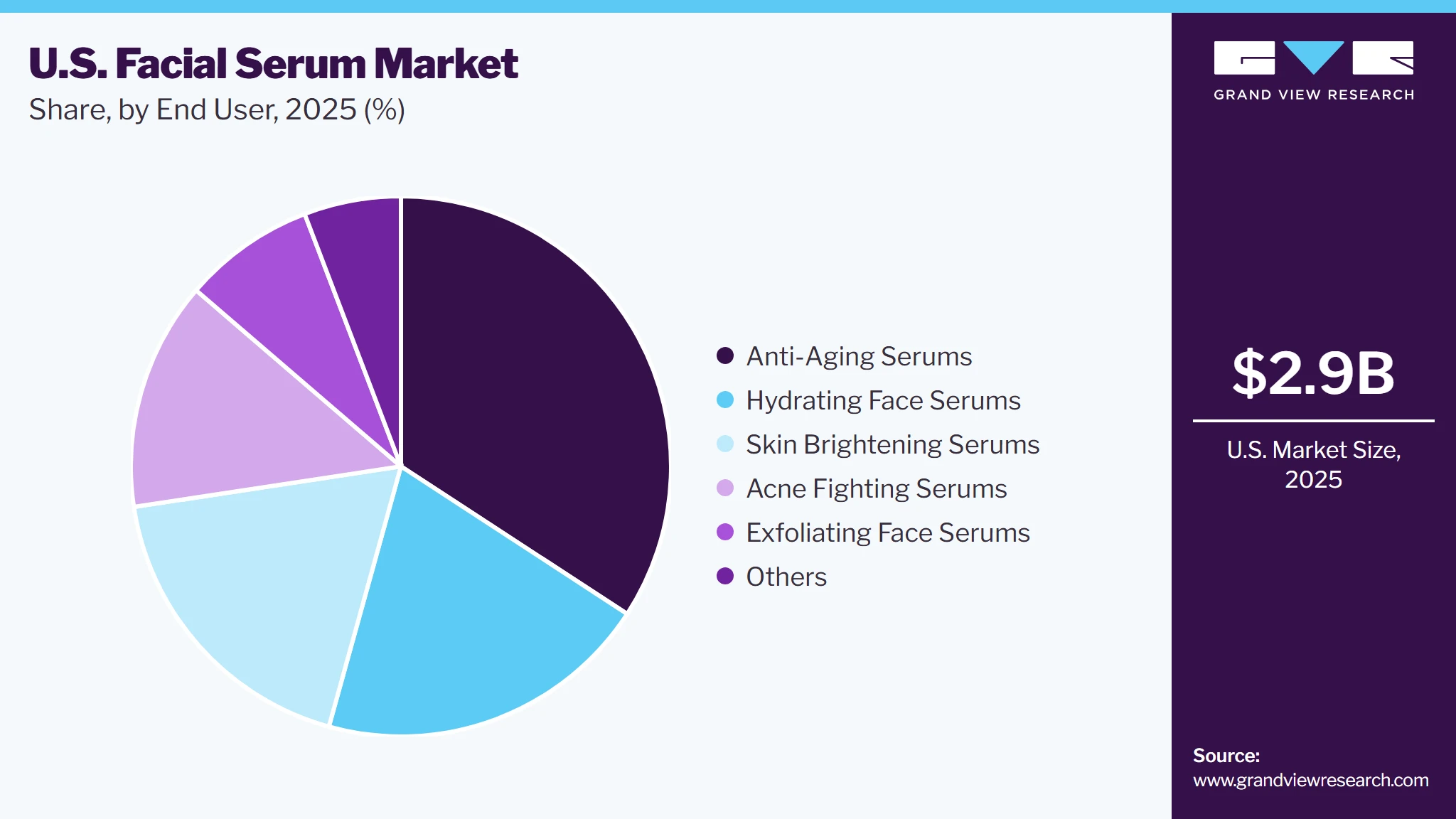
The U.S. facial serum market size was valued at USD 2.9 billion in 2025 and is projected to grow from USD 3.2 billion in 2026 to USD 4.8 billion in 2033, at a CAGR of 6.2% from 2026 to 2033. The market growth is driven by increasing consumer preference for concentrated, targeted skincare formulations addressing aging, hyperpigmentation, acne, dehydration, and skin-barrier concerns, alongside growing demand for clinically positioned products with high-performance active ingredients such as retinol, vitamin C, hyaluronic acid, peptides, and niacinamide.
Key Market Trends & Insights
- By type: Anti-aging serums held the largest revenue share of 34.2% in 2025.
- By type by end-user: Skin brightening serums for women held the largest revenue share of 75.2% in 2025.
- By type by price tier: Mass-market (below USD 20) held the largest revenue share of 45.5% in 2025.
- By type by distribution channel: Online marketplaces for acne-fighting serums held the largest revenue share of 48.5% in 2025.
Market Size & Forecast
- Market size in 2025: USD 2.9 Billion
- Estimated market size in 2026: USD 3.2 Billion
- Projected market size by 2033: USD 4.8 Billion
- CAGR (2026-2033): 6.2%
Three ways to get this report
Buy it, customize it, or ask a question.Ask an Analyst
A direct answer, usually in 1 working day
- AccessReport author, directly
- Reply timeWithin 1 working day
- No sales callDirect answer only
- FormatEmail reply
- CostFree, no cost
Get the Full Report
What the study covers
- FormatsPDF · Excel · Dashboard
- Timeline2026–2033 annual, 2025 base
- Coverage20+ countries, 5 regions
- Companies10+ key players profiled
Customize the Report
20% free customization
- IncludeCountries, segments, points
- TailorTo your product definition
- ExtendDeeper competitor detail
- OrA fully bespoke study
- Turnaround5–10 working days
Rising concern about visible skin aging is supporting demand for targeted skincare products in the U.S. facial serum industry. According to the American Academy of Dermatology’s 2026 Practice Safe Sun Survey, 50% of U.S. adults worry about premature skin aging, while 43% report already seeing signs of damage, such as wrinkles or dark spots. In addition, 70% of adults said they wished they had done more to protect their skin earlier in life, indicating greater attention toward preventive skincare. The trend is further supported by AAD’s 2025 survey, which found that 73% of U.S. adults use products or procedures to prevent premature aging. This increasing focus on preventing and addressing visible skin concerns is supporting demand for facial serums positioned around anti-aging, brightening, hydration, and antioxidant benefits, contributing to the broader development of the facial serum industry.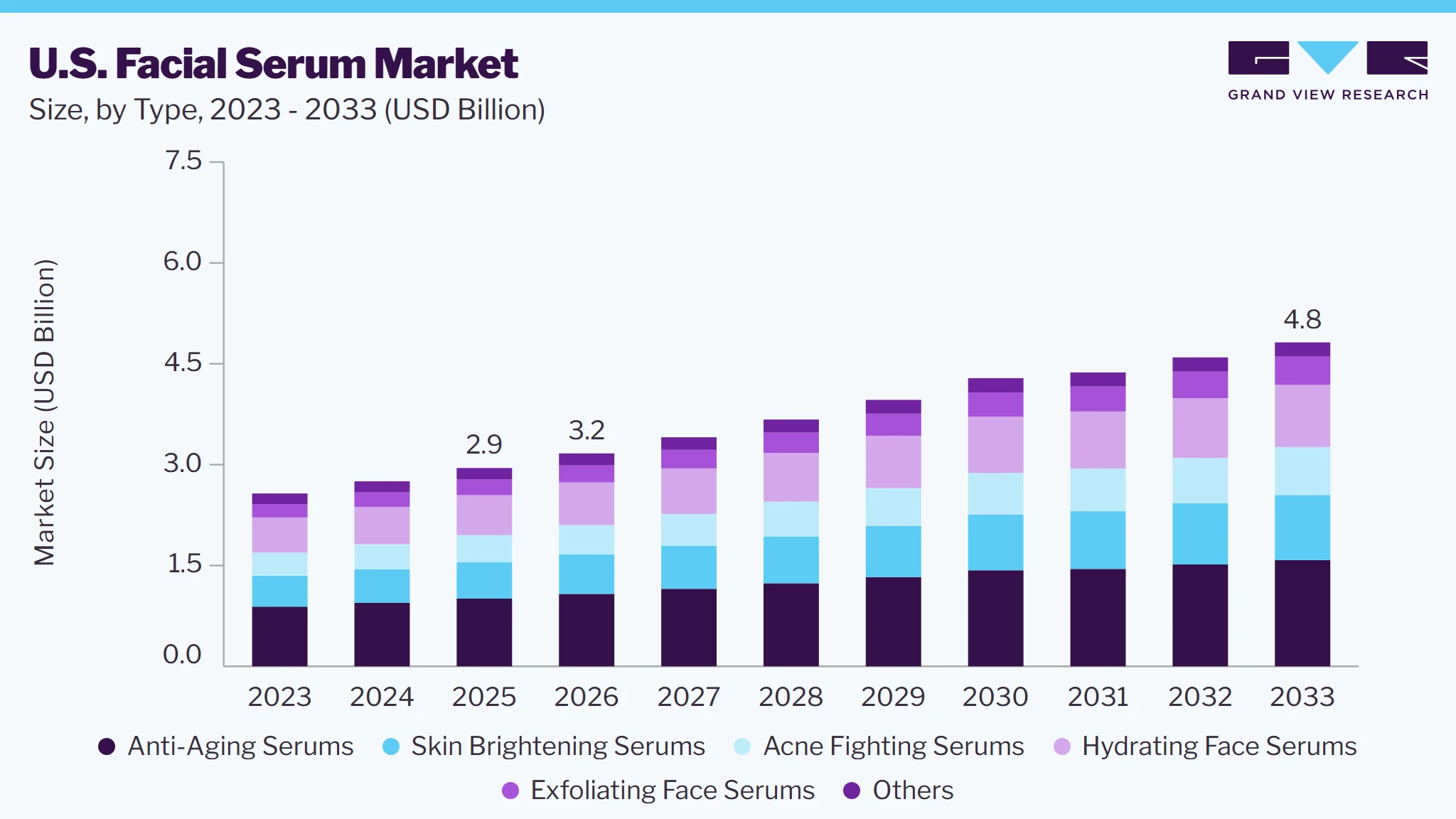 Source: Grand View Research, IR Documents, Primary Interviews, Paid DatabasesTo learn more about this report,
 Download Free Sample Report
 Peptides are emerging as a major innovation area within the facial serum market, particularly for consumers seeking firmness, elasticity, and health-aging benefits. Current skincare coverage points to greater use of targeted peptides and growth-factor-inspired formulations, alongside improvements in delivery systems intended to enhance stability and ingredient performance. COSRX's May 2026 launch of its Blue Peptide Bakuchiol Plump Glow Serum, available through Amazon and COSRX's U.S. website, illustrates the expansion of peptide-focused facial serums for plumpness, elasticity, and healthy aging.
Major Trends in the U.S. Facial Serum Market
Ingredient-led formulations are shaping serum preferences Consumers are increasingly selecting facial serums based on recognizable active ingredients and targeted benefits. Vitamin C is sought by 58% of skincare shoppers, while retinol is sought by 44%, with Vitamin C reaching 71% among consumers aged 18-29. This is encouraging brands to develop serums around clearly communicated brightening, anti-aging, and skin-renewal benefits.
Regenerative ingredients are gaining momentum PDRN is emerging as a high-growth ingredient within the U.S. facial serum market, with consumer interest in PDRN serums increasing by more than 1,000% over the past year. Centella ampoules are also gaining traction, reflecting growing consumer interest in regenerative, soothing, and skin-barrier-focused formulations.
Multifunctional serums are combining multiple skin benefits Brands are increasingly combining peptides, hyaluronic acid, niacinamide, antioxidants, and botanical ingredients within single serum formulations. These products target multiple concerns, including hydration, firmness, uneven skin tone, texture, and signs of aging, allowing consumers to consolidate several skincare benefits into a single step.
Social media is accelerating serum discovery among younger consumers Social platforms are becoming important discovery channels for facial serums, particularly among younger shoppers. In 2024, among consumers aged 18-29, 50% are influenced by influencer accounts, 47% by Instagram advertisements, and 45% by YouTube advertisements. This is increasing the importance of creator-led recommendations, ingredient education, product demonstrations, and viral skincare trends within the facial serum industry.
Market Dynamics
Growing consumer emphasis on efficacy, visible results, and targeted skin concerns is driving demand across the U.S. facial serum market. Consumers are increasingly seeking formulations designed to address specific concerns such as wrinkles, acne, dark spots, redness, dryness, and uneven skin tone, increasing the relevance of concentrated serum formats containing proven active ingredients. This shift is strengthening demand within the facial serum market, particularly for anti-aging, acne-fighting, skin-brightening, and hydrating formulations. Circana reported in 2025 that only 14% of U.S. beauty buyers believe higher prices indicate better quality, highlighting the shift toward efficacy and value rather than price alone; it also reported that masstige skincare brands recorded double-digit growth, indicating demand for high-performing products at accessible price points. This focus on targeted performance and ingredient efficacy is supporting product innovation and broader consumer adoption across the facial serum industry.
The increasing concentration of active ingredients in facial serums can restrain market growth by raising the risk of skin irritation, redness, dryness, peeling, and sensitivity, particularly among consumers with sensitive or compromised skin. Facial serums increasingly incorporate potent ingredients such as retinol, alpha-hydroxy acids (AHAs), beta-hydroxy acids (BHAs), and high-strength vitamin C to address acne, pigmentation, fine lines, and uneven skin tone. However, combining multiple active ingredients or using them at high concentrations can increase the likelihood of adverse skin reactions, prompting some consumers to reduce usage frequency or shift toward lower-strength, barrier-focused formulations. This creates a challenge for brands in balancing efficacy claims with tolerability, particularly as consumers become more aware of ingredient concentrations and potential irritation.
Increasing consumer focus on specific skincare concerns, including acne, hyperpigmentation, fine lines, dehydration, and uneven skin tone, is creating opportunities for brands in the U.S. facial serum market to develop targeted formulations. Consumers are increasingly seeking products that address individual skin concerns rather than relying on a single multifunctional product, prompting brands to differentiate facial serums by highlighting active ingredients such as salicylic acid, retinol, niacinamide, vitamin C, and hyaluronic acid. CeraVe’s Resurfacing Retinol Serum is designed to address post-acne marks, visible pores, and uneven skin tone, combining retinol, niacinamide, and ceramides in a targeted facial serum. Such concern-specific product positioning offers the facial serum industry an opportunity to expand through specialized formulations tailored to distinct consumer skincare needs.
Consumer Insights
The U.S. facial serum market serves consumers seeking targeted skincare solutions for concerns such as hydration, aging, acne, pigmentation, dullness, and uneven skin tone. Demand across the facial serum market is influenced by consumers’ skin concerns, ingredient preferences, product efficacy, skincare routines, and willingness to spend on specialized products.
 To learn more about this report, Download Free Sample Report
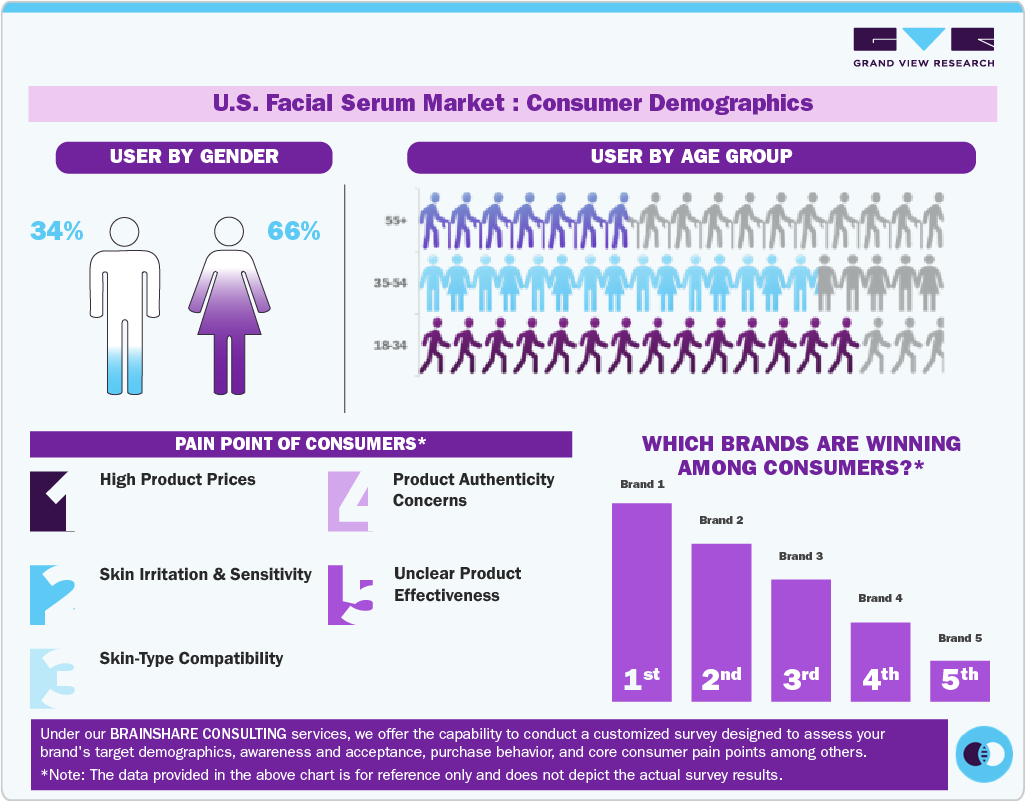
 Users by Gender:
-
Female consumers account for the largest share at 66%, reflecting their higher participation in facial skincare routines and demand for targeted products addressing hydration, anti-aging, brightening, pigmentation, and skin texture concerns. Women also show strong demand for ingredient-focused and premium facial serums as part of multi-step skincare routines.
-
Male consumers account for 34%, supported by increasing adoption of facial skincare products and growing interest in simplified routines targeting hydration, acne, oil control, signs of aging, and overall skin appearance. Male consumers are also increasingly seeking multifunctional facial serums that combine several skincare benefits in a single product.
Users by Age Group:
Consumers aged 18-34 represent an important user group in the U.S. facial serum market, comprising younger adults, professionals, and skincare-conscious consumers seeking solutions for acne, hydration, pigmentation, dullness, and early signs of aging. This group is also highly engaged with ingredient-led skincare, digital beauty content, and personalized skincare routines. Consumers aged 35-54 represent a significant segment of the facial serum market, with demand increasingly centered on anti-aging, hydration, firmness, fine lines, pigmentation, and skin texture. Consumers in this age group often seek targeted formulations containing active ingredients that can be incorporated into established skincare routines. Consumers aged 55+ primarily seek facial serums addressing visible signs of aging, dryness, wrinkles, loss of firmness, and uneven skin tone. Within the facial serum industry, these consumers tend to place greater emphasis on moisturizing benefits, formulation suitability, product quality, and trusted skincare brands.
Consumers in the U.S. facial serum market commonly face several challenges when selecting and purchasing facial serums.
-
High product prices remain a concern, particularly for premium facial serums containing specialized ingredients, advanced formulations, or concentrated active ingredients, which can increase the cost of maintaining a regular skincare routine.
-
Skin irritation and sensitivity can affect product adoption, as concentrated active ingredients may cause redness, dryness, irritation, or discomfort among consumers with sensitive or reactive skin.
-
Skin-type compatibility remains another challenge because consumers need to identify formulations suitable for oily, dry, combination, acne-prone, or sensitive skin while addressing specific skincare concerns.
-
Product authenticity concerns can arise when consumers purchase facial serums through third-party online marketplaces, particularly when product origin, packaging, storage conditions, or seller reliability is uncertain.
-
Unclear product effectiveness can discourage repeat purchases when consumers do not observe expected improvements or find that product claims do not align with their individual skin concerns and expectations.
Analyst Perspective
The U.S. facial serum market is evolving toward targeted, efficacy-focused skincare, with consumers increasingly seeking concentrated formulations designed to address specific concerns such as aging, acne, pigmentation, hydration, and uneven skin tone. Demand is supported by growing interest in active ingredients and science-led formulations that offer visible skincare benefits. Brands across the facial serum market are expanding portfolios with ingredient-focused products, premium formulations, and dermatologist-oriented solutions while strengthening online and specialty beauty distribution. The facial serum industry is also seeing greater product differentiation through advanced formulations, personalized skincare positioning, and multifunctional serums tailored to diverse consumer needs.
Type Insights
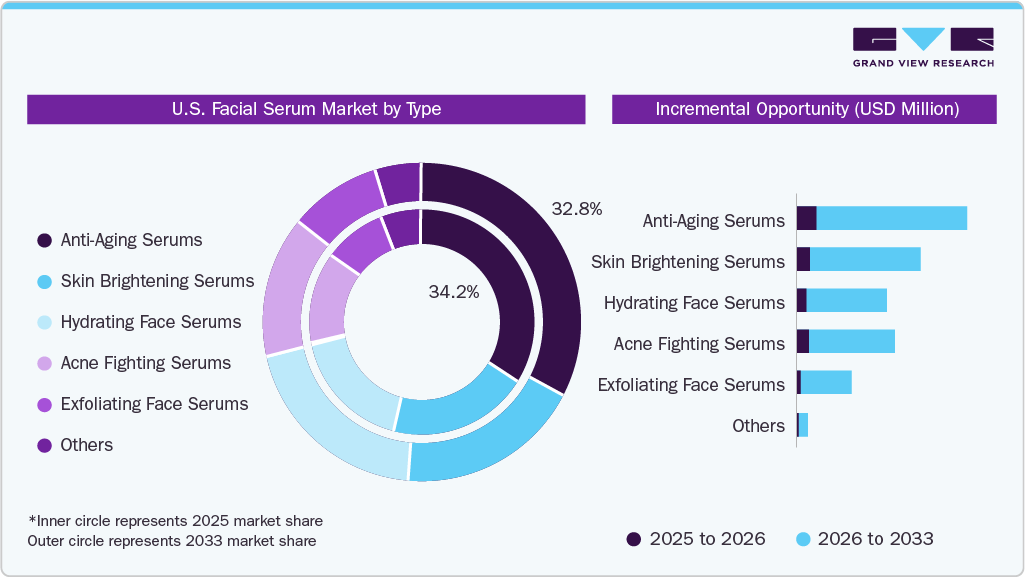
The anti-aging serums accounted for the largest revenue share of 34.2% in 2025. The segment is benefiting from the emergence of next-generation formulations that position anti-aging around skin regeneration, collagen support, and long-term skin vitality, rather than only conventional wrinkle reduction. In July 2025, Fresh launched its Black Tea Renewal Serum, formulated with a patented Mauritius black tea extract and complemented by ocean kelp, niacinamide, and ceramide NP. The product was positioned to visibly firm skin and smooth wrinkles while providing retinol-like results without irritation, and was made available through Sephora and Ulta, demonstrating the expansion of differentiated anti-aging treatments across major U.S. beauty retail channels. This product development reflects how the U.S. facial serum market is moving toward targeted, multifunctional anti-aging solutions.
 To learn more about this report, Download Free Sample Report
 The exfoliating face serums segment is expected to grow at a CAGR of 7.5% from 2026 to 2033, as consumers increasingly seek targeted formulations for uneven texture, dullness, clogged pores, and post-breakout marks. The trend is reflected in the growing visibility of acid-based serum formulations that combine exfoliation with hydration and barrier-supporting ingredients. In June 2026, Allure highlighted Mara Flower Acid Algae Serum, an exfoliating serum formulated with 11% lactic acid, gluconolactone, squalane, glycerin, and marine algae, positioning the product around smoothing rough texture while maintaining hydration. The coverage also identified the formulation as suitable for consumers seeking gentler exfoliation, indicating the facial serum industry's shift toward multifunctional exfoliating treatments that balance skin-renewal benefits with tolerability.
Type by End-user Insights
The skin brightening serums for women accounted for the largest revenue share of 75.2% in 2025, with demand centered on products targeting dark spots, uneven skin tone, discoloration, and loss of radiance. The focus on women is supported by L’Oréal Paris’ July 2026 launch of Revitalift Melasyl Dark Spot Creamy-Serum, which combines the patented Melasyl ingredient with Vitamin Cg and niacinamide to visibly correct dark spots and improve skin-tone uniformity. Importantly, in a consumer test conducted for the product, 97% of women agreed that their skin tone appeared more even and radiant, providing a direct indication of consumer response to brightening-focused serum formulations.
 To learn more about this report, Download Free Sample Report
 The exfoliating face serums for men segment is expected to grow at a CAGR of 7.5% from 2026 to 2033. Male consumers increasingly seek targeted solutions for excess oil, clogged pores, and uneven skin texture. For instance, Menn & Co’s AHA BHA PHA Face Serum for Oily Skin, which combines AHA, BHA, and PHA to exfoliate dead skin cells, unclog pores, manage excess oil, and improve skin texture. The product is specifically positioned within men's skincare, demonstrating how brands are developing multi-acid facial treatments tailored to men's common skin concerns and expanding the role of active-based products within the U.S. facial serum industry.
Type by Price Tier Insights
The mass-market (below USD 20) exfoliating face serums accounted for the largest revenue share of 45.5% in 2025. Combining targeted acne treatment with accessible pricing, this segment enables consumers to incorporate active-based products into regular skincare routines without moving into premium price points. For instance, The INKEY List Beta Hydroxy Acid (BHA) Serum, priced at USD 14, which contains 2% salicylic acid and 1% hyaluronic acid to clear acne and blackheads while maintaining skin hydration. This affordable, treatment-oriented positioning supports demand for value-focused products within the U.S. facial serum market and reflects the facial serum industry's expansion of targeted acne solutions across accessible price points.
The luxury (above USD 50) exfoliating face serums segment is expected to grow at a CAGR of 8.9% from 2026 to 2033, driven by consumer interest in premium resurfacing treatments that combine exfoliating actives with skin-conditioning and barrier-supporting ingredients. For instance, Sunday Riley Good Genes All-In-One Lactic Acid Treatment, priced at USD 85, uses lactic acid to exfoliate dull surface cells and improve the appearance of uneven tone, fine lines, and skin texture. The product's premium positioning and multifunctional treatment benefits demonstrate how luxury exfoliating formulations are differentiating beyond basic acid exfoliation, supporting value growth within the U.S. facial serum industry.
Type by Distribution Channel Insights
The online marketplaces distribution channel for acne fighting serums accounted for the largest revenue share of 48.5% in 2025, supported by high consumer search activity and strong sales of acne-focused formulations on platforms such as Amazon. For instance, The Ordinary Salicylic Acid 2% Solution recorded approximately 100,000 units in estimated monthly Amazon U.S. sales in July 2026, making it one of the highest-volume products identified for the “acne serum for face” category. The product is priced at around USD 6 and uses 2% salicylic acid to target blemishes and clogged pores. The strong marketplace sales volume demonstrates that Amazon provides acne-serum brands with substantial consumer reach and product discoverability, while its search-driven purchasing environment enables consumers to compare competing acne treatments by price, ratings, ingredients, and reviews. This is strengthening the role of online marketplaces within the facial serum industry.
The brand-owned DTC websites distribution channel for acne-fighting serums is expected to grow at a CAGR of 13.4% from 2026 to 2033, as emerging skincare brands launch targeted formulations directly through their own digital storefronts. For instance, Reale Actives, founded by Alix Earle, launched its acne-focused skincare line in March 2026, including a USD 39 mandelic acid serum formulated for breakout-prone skin. The brand sells its products directly through its own website, enabling greater control over product presentation, pricing, consumer education, and the overall skincare routine experience. This development reflects how emerging acne-focused brands are using DTC websites to strengthen direct consumer relationships and expand targeted serum offerings within the facial serum market, supporting the growing role of direct digital sales in the U.S. facial serum industry.
Key U.S. Facial Serum Company Insights
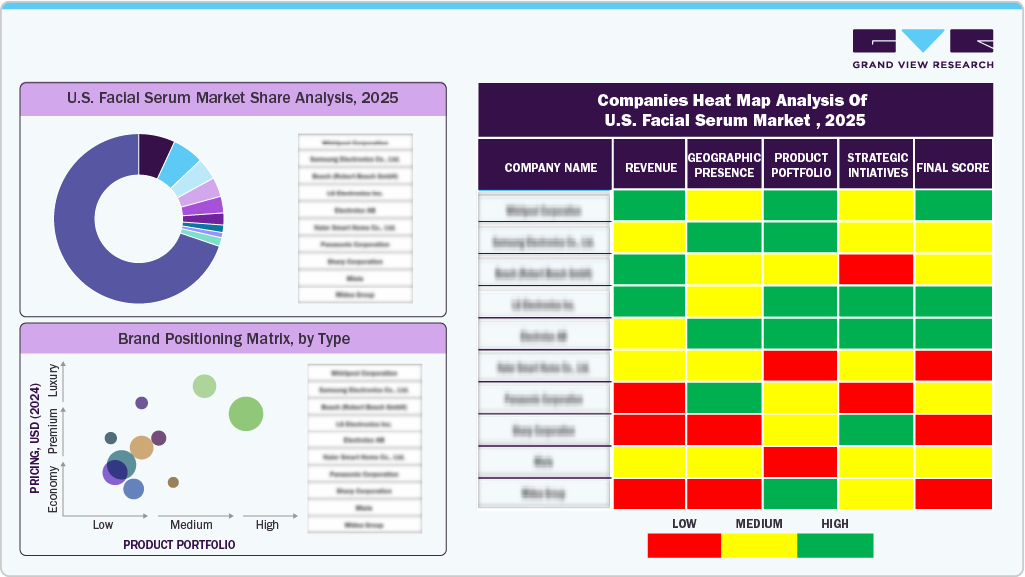
The U.S. facial serum market is characterized by competition among global beauty companies, prestige skincare groups, dermatological skincare specialists, and Asian beauty players. Competition within the facial serum market is shaped by active-ingredient innovation, product efficacy, brand positioning, clinical validation, price positioning, and omnichannel distribution. Companies are expanding their serum portfolios across anti-aging, skin brightening, acne, hydration, and exfoliation applications to address increasingly targeted skincare needs. The facial serum industry also continues to see greater emphasis on science-led formulations, premium products, and direct-to-consumer and e-commerce distribution.
-
Global Beauty & Skincare Companies: L'Oréal S.A., Procter & Gamble (P&G), Unilever PLC, and Kenvue Inc. compete across mass-market, masstige, and premium skincare through broad brand portfolios and extensive retail distribution. L'Oréal has a particularly broad presence in dermatological skincare through brands such as CeraVe, La Roche-Posay, Vichy, and SkinCeuticals. In 2025, SkinCeuticals surpassed EUR 1 billion in global sales, supported by innovations such as P-Tiox and A.G.E. Interrupter, while CeraVe continued to strengthen its U.S. skincare business. P&G participates through Olay and SK-II, while Unilever's portfolio includes Paula's Choice and Dermalogica, enabling these companies to target consumers at different price points and with varying skincare concerns.
-
Prestige & Luxury Skincare Companies: The Estée Lauder Companies Inc. and Shiseido Company, Limited, compete through premium formulations, established skincare franchises, advanced anti-aging technologies, and strong presence across prestige beauty retailers. Their positioning in the facial serum market is supported by products targeting visible signs of aging, hydration, pigmentation, and other specialized facial skincare concerns. Their established prestige brands enable participation in higher-priced serum categories where formulation technology, brand heritage, and perceived efficacy are important purchase considerations.
-
Dermatological & Science-led Skincare Players: Beiersdorf AG and Galderma S.A. compete through dermatologist-oriented brands, clinically positioned formulations, and ingredient-led product development. Beiersdorf leverages brands such as Eucerin and La Prairie, while Galderma operates Cetaphil and Alastin. Galderma reported USD 1.45 billion in 2025 Dermatological Skincare sales, with U.S. growth driven particularly by Alastin and continued momentum from Cetaphil. The company also launched high-potency serums under the Cetaphil brand in response to demand for targeted skincare solutions.
-
Japanese Skincare & Beauty Companies: Shiseido Company, Limited and Kao Corporation strengthen competition through formulation expertise, skincare research, and established Japanese beauty brands. Their portfolios address concerns including skin aging, hydration, sensitivity, and skin-barrier care, enabling them to participate in both premium and specialized segments of the U.S. facial serum market. Kao's portfolio includes brands such as Curél and Bioré, while Shiseido maintains a broad international skincare portfolio.
-
K-Beauty & Asian Skincare Companies: Amorepacific Corporation competes through Korean skincare expertise, ingredient-focused formulations, and digitally driven brand expansion. Its portfolio includes LANEIGE, Sulwhasoo, AESTURA, and COSRX, providing exposure to hydration, anti-aging, derma skincare, and targeted treatment categories. In 2025, Amorepacific's Americas revenue increased by 20%, supported by LANEIGE skincare, the expansion of AESTURA, and COSRX's skincare portfolio, indicating growing participation by Korean skincare brands in the U.S. market.
 To learn more about this report, Download Free Sample Report
Key U.S. Facial Serum Companies
-
L'Oréal S.A.
-
The Estée Lauder Companies Inc.
-
Procter & Gamble (P&G)
-
Unilever PLC
-
Kenvue Inc.
-
Beiersdorf AG
-
Shiseido Company, Limited
-
Kao Corporation
-
Galderma S.A.
-
Amorepacific Corporation
Competitive Benchmarking
Category
Operating Strategies
Competitive Edge
Key Challenges
Established Players (L'Oréal S.A.; The Estée Lauder Companies Inc.; Procter & Gamble (P&G); Unilever PLC; Kenvue Inc.; Beiersdorf AG; Shiseido Company, Limited)
- Maintain diversified facial serum portfolios targeting anti-aging, hydration, brightening, acne, pigmentation, and skin-barrier concerns. These companies use established brands, active-ingredient innovation, multi-tier pricing, and extensive offline and online distribution to reach a broad U.S. consumer base.
- Strong brand recognition, extensive retail presence, established R&D and formulation capabilities, and the ability to serve mass, premium, and prestige segments.
- High competition among similar serums with similar benefits and ingredients makes product differentiation challenging. Large portfolios also face pressure from specialized and digitally native skincare brands.
Expansion-focused Players (Kao Corporation; Galderma S.A.; Amorepacific Corporation)
- Strengthen their U.S. facial serum presence through sensitive-skin solutions, dermatological formulations, barrier-care products, and K-beauty-inspired technologies. Their strategies emphasize targeted skin concerns and differentiate ingredient platforms.
- Specialized positioning in sensitive skin, dermatological skincare, barrier repair, and K-beauty formulations provides differentiation from broader beauty portfolios.
- Comparatively narrower U.S. brand portfolios and distribution networks can limit shelf visibility and consumer reach. These companies also face strong competition from established skincare groups and specialist serum brands.
Recent Developments
-
In July 2026, SkinCeuticals launched the next-generation C E Ferulic, an antioxidant facial serum featuring 0.3% Carnosine and 1% Endophytol™ alongside its existing 15% pure vitamin C, 1% vitamin E, and 0.5% ferulic acid formulation. The serum was positioned around skin longevity, with the company reporting improvements across multiple signs of aging, including wrinkles, discoloration, and radiance.
-
In September 2025, ZO Skin Health launched Peptide Facial Refining Concentrate, an advanced peptide serum designed to complement the visible effects of neurotoxins and dermal fillers while also functioning as a standalone at-home treatment. The formulation features four peptide technologies and ZPOLY Complex to target multiple signs of aging, including fine lines, facial contours, skin texture, and visible redness.
U.S. Facial Serum Market Report Scope
Report Attribute
Details
Market size in 2025
USD 2.9 billion
Estimated market size in 2026
USD 3.2 billion
Projected market size by 2033
USD 4.8 billion
Growth rate
CAGR of 6.2% from 2026 to 2033
Base year
2025
Actuals
2021 - 2025
Forecast period
2026 - 2033
Quantitative units
Revenue in USD Million and CAGR from 2026 to 2033
Report coverage
Revenue forecast, company ranking, competitive landscape, growth factors, and trends
Segments covered
Type, type by end user, type by price tier, type by distribution channel
Key companies profiled
L'Oréal S.A.; The Estée Lauder Companies Inc.; Procter & Gamble (P&G); Unilever PLC; Kenvue Inc.; Beiersdorf AG; Shiseido Company, Limited; Kao Corporation; Galderma S.A.; Amorepacific Corporation
Customization scope
Free report customization (equivalent up to 8 analysts’ working days) with purchase. Addition or alteration to country, regional & segment scope.
Pricing and purchase options
Avail customized purchase options to meet your exact research needs. Explore purchase options
U.S. Facial Serum Market Report Segmentation
This report forecasts revenue growth at the country level and provides an analysis of the latest trends and opportunities in each of the sub-segments from 2026 to 2033. For this study, Grand View Research has segmented the U.S. facial serum market report based on type, type by end user, type by price tier, and type by distribution channel:
-
Type Outlook (Revenue, USD Million, 2021 - 2033)
-
Anti-Aging Serums
-
Skin Brightening Serums
-
Acne Fighting Serums
-
Hydrating Face Serums
-
Exfoliating Face Serums
-
Other
-
-
Type by End-user Outlook (Revenue, USD Million, 2021 - 2033)
-
Anti-Aging Serums
-
Men
-
Women
-
-
Skin Brightening Serums
-
Men
-
Women
-
-
Acne Fighting Serums
-
Men
-
Women
-
-
Hydrating Face Serums
-
Men
-
Women
-
-
Exfoliating Face Serums
-
Men
-
Women
-
-
Others
-
Men
-
Women
-
-
-
Type by Price Tier Outlook (Revenue, USD Million, 2021 - 2033)
-
Anti-Aging Serums
-
Mass-Market (below USD 20)
-
Premium (USD 20-50)
-
Luxury (above USD 50)
-
-
Skin Brightening Serums
-
Mass-Market (below USD 20)
-
Premium (USD 20-50)
-
Luxury (above USD 50)
-
-
Acne Fighting Serums
-
Mass-Market (below USD 20)
-
Premium (USD 20-50)
-
Luxury (above USD 50)
-
-
Hydrating Face Serums
-
Mass-Market (below USD 20)
-
Premium (USD 20-50)
-
Luxury (above USD 50)
-
-
Exfoliating Face Serums
-
Mass-Market (below USD 20)
-
Premium (USD 20-50)
-
Luxury (above USD 50)
-
-
Others
-
Mass-Market (below USD 20)
-
Premium (USD 20-50)
-
Luxury (above USD 50)
-
-
-
Type by Distribution Channel Outlook (Revenue, USD Million, 2021 - 2033)
-
Anti-Aging Serums
-
Offline
-
Supermarkets and Hypermarkets
-
Drugstores & Pharmacies
-
Specialty Beauty Stores
-
Department Stores
-
Others
-
-
Online
-
Brand-owned DTC Websites
-
Online Marketplaces
-
Retailer Websites
-
-
-
Skin Brightening Serums
-
Offline
-
Supermarkets and Hypermarkets
-
Drugstores & Pharmacies
-
Specialty Beauty Stores
-
Department Stores
-
Others
-
-
Online
-
Brand-owned DTC Websites
-
Online Marketplaces
-
Retailer Websites
-
-
-
Acne Fighting Serums
-
Offline
-
Supermarkets and Hypermarkets
-
Drugstores & Pharmacies
-
Specialty Beauty Stores
-
Department Stores
-
Others
-
-
Online
-
Brand-owned DTC Websites
-
Online Marketplaces
-
Retailer Websites
-
-
-
Hydrating Face Serums
-
Offline
-
Supermarkets and Hypermarkets
-
Drugstores & Pharmacies
-
Specialty Beauty Stores
-
Department Stores
-
Others
-
-
Online
-
Brand-owned DTC Websites
-
Online Marketplaces
-
Retailer Websites
-
-
-
Exfoliating Face Serums
-
Offline
-
Supermarkets and Hypermarkets
-
Drugstores & Pharmacies
-
Specialty Beauty Stores
-
Department Stores
-
Others
-
-
Online
-
Brand-owned DTC Websites
-
Online Marketplaces
-
Retailer Websites
-
-
-
Others
-
Offline
-
Supermarkets and Hypermarkets
-
Drugstores & Pharmacies
-
Specialty Beauty Stores
-
Department Stores
-
Others
-
-
Online
-
Brand-owned DTC Websites
-
Online Marketplaces
-
Retailer Websites
-
-
-
Research Methodology
The U.S. facial serum market figures in this report are based on a proven research process that combines executive interviews with secondary research from proprietary databases, company filings, and recognized regulatory and institutional sources. Market size is built through value-chain sizing - reconciling supply-side and demand-side estimates - and triangulated with bottom-up and top-down approaches. Every estimate passes multiple levels of expert validation before publication, with each U.S. facial serum segment quantified using the revenue-capture definitions in the table below.
Segment Definition
Segment - Type
Revenue capture definition
Offline
Revenue is generated from the sale of facial serums through physical retail outlets, including specialty beauty stores, department stores, drugstores, pharmacies, supermarkets, and other brick-and-mortar retailers.
Online
Revenue is generated from the sale of facial serums through digital channels, including brand websites, direct-to-consumer platforms, online marketplaces, beauty e-commerce platforms, and retailer websites.
Estimation Model
No.
Layer
Question
Description
01
Facial Skincare Consumer Base Layer
Who purchases Facial Serums?
Identifies U.S. consumers who purchase facial skincare products and have potential demand for facial serum. Includes consumers across age groups, genders, and skin-care routines.
02
Facial Serum Demand Layer
Who is likely to use Facial Serums?
Captures consumers seeking targeted solutions for specific skin concerns such as hydration, anti-aging, acne, pigmentation, dullness, and uneven skin tone.
03
Purchase & Distribution Layer
Who actively purchases Facial Serums?
Segments demand by serum type, formulation, ingredient, price tier, and distribution channel. Also considers purchases through specialty stores, pharmacies, supermarkets, brand websites, marketplaces, and other online channels.
04
Monetization Layer
How much revenue is generated?
Converts facial serum purchases into market revenue using selling prices, purchase volumes, repeat purchases, premiumization, and channel-level sales. Revenue reflects consumer spending on facial serums across online and offline channels.
Delivered Customizations
This report has been delivered with the following In-depth customizations
Client Request
Customization Delivered
Value Adds
Assessment of Facial Serum Formulation and Ingredient Adoption
Evaluated serum formulations by key active ingredients, including vitamin C, hyaluronic acid, niacinamide, retinol, peptides, ceramides, and botanical actives, along with their targeted skin concerns.
Identified ingredient-specific opportunities and formulation trends, supporting product development, positioning, and innovation decisions.
Benchmarking Facial Serum Products Across Price Tiers and Brands
Compared facial serum products across mass, premium, and luxury tiers based on pricing, formulation, claims, active ingredients, packaging, and brand positioning.
Identified pricing differentials and product-positioning gaps, supporting competitive benchmarking and portfolio strategy.
Mapping Facial Serum Demand by Skin Concern and Distribution Channel
Assessed serum offerings across anti-aging, hydration, brightening, acne, pigmentation, and barrier-care applications across specialty beauty stores, drugstores, mass retailers, and online channels.
Identified high-potential product applications and channel opportunities, supporting targeted portfolio expansion and go-to-market planning.
Frequently Asked Questions About This Report
The U.S. facial serum market size was valued at USD 2.9 billion in 2025 and is estimated at USD 3.2 billion in 2026.
The U.S. facial serum Market is driven by rising demand for targeted skincare solutions, particularly anti-aging, brightening, hydration, and blemish-focused formulations containing active ingredients such as retinol, vitamin C, niacinamide, and peptides.
Key players in the U.S. facial serum market include L’Oréal, Estée Lauder, Procter & Gamble, Unilever, Shiseido, Kenvue, Beiersdorf, Clarins, Coty, and Kao Corporation.
The skin brightening serums for women accounted for the largest revenue share of 75.2% in 2025, while exfoliating face serums for men segment is the fastest-growing type by end-user.
The mass-market (below USD 20) exfoliating face serums accounted for the largest revenue share of 45.5% in 2025, while luxury (above USD 50) exfoliating face serums segment is the fastest-growing type by price tier.
The U.S. facial serum market is expected to grow at a CAGR of 6.2% from 2026 to 2033, reaching USD 4.8 billion by 2033.
The anti-aging serums accounted for the largest revenue share of 34.2% in 2025, while exfoliating face serums segment is the fastest-growing type.
The online marketplaces distribution channel for acne fighting serums accounted for the largest revenue share of 48.5% in 2025, while brand-owned DTC websites distribution channel for acne-fighting serums is the fastest-growing type by distribution channel.
About the Author(s)
Beauty & Personal Care Research Team
Consumer Goods · Beauty & Personal CareThis report was authored by the beauty & personal care research team at Grand View Research - comprising two research analysts, one senior research analyst, and one industry expert - with specialized expertise in the beauty & personal care segment of the consumer goods industry. All findings are based on proprietary consumer goods databases, executive interviews, and regulatory analysis, subject to internal peer review prior to publication.
Last Updated:
Speak to Analyst

Customize this report to your needs - add regions, segments, or data points, with 20% free customization.
Or view our licence options:


ISO 9001:2015 & 27001:2022 Certified
We are GDPR and CCPA compliant! Your transaction & personal information is safe and secure. For more details, please read our privacy policy.


