
- Home
- »
- Beauty & Personal Care
- »
-
U.S. Hair Conditioner Market Size And Share Report, 2033GVR Report cover

U.S. Hair Conditioner Market (2026 - 2033)
Size, Share & Trends Analysis Report By Product (Rinse-out, Leave-in), By Price Range (Mass, Mid-Range, Premium), By Gender (Men), By Distribution Channel (Specialty Beauty Stores, Online/E-commerce), And Segment Forecasts
Market Size, 2025
$6.1BMarket Estimate, 2026
$6.4BMarket Forecast, 2033
$10.1BCAGR, 2026–2033
6.6%U.S. Hair Conditioner Market Summary
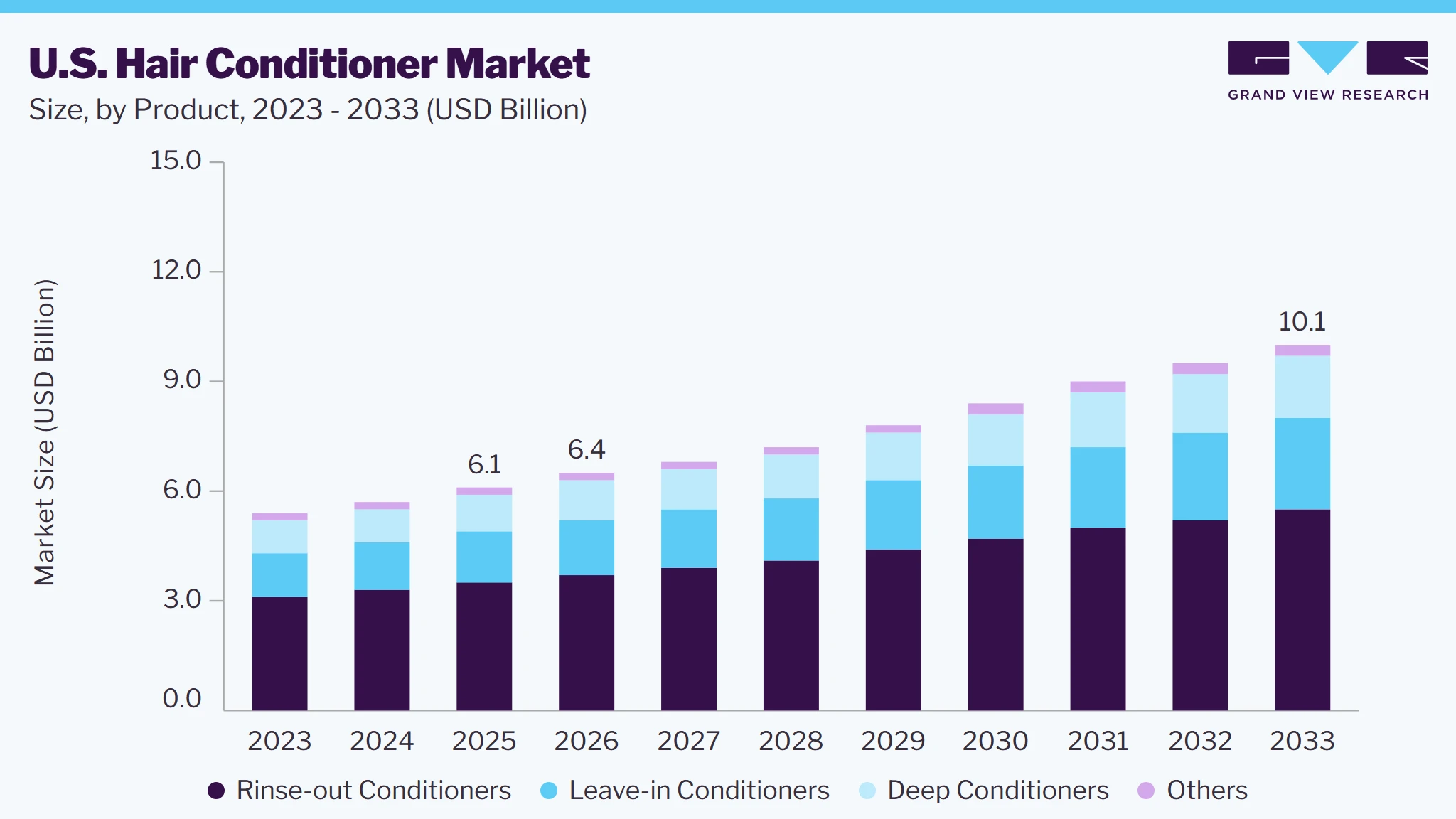
The U.S. hair conditioner market size was valued at USD 6.1 billion in 2025 and is projected to reach USD 6.4 billion in 2026 and USD 10.1 billion by 2033, at a CAGR of 6.6% from 2026 to 2033. Conditioner remains a high-frequency haircare category closely linked to shampoo usage, but its role is expanding from basic softening and detangling toward moisture retention, damage repair, frizz control, strengthening, heat protection, curl definition, color protection, and overall hair manageability.
Key Market Trends & Insights
- By product: Rinse-out conditioners segment led the market with a share of 57.3% in 2025.
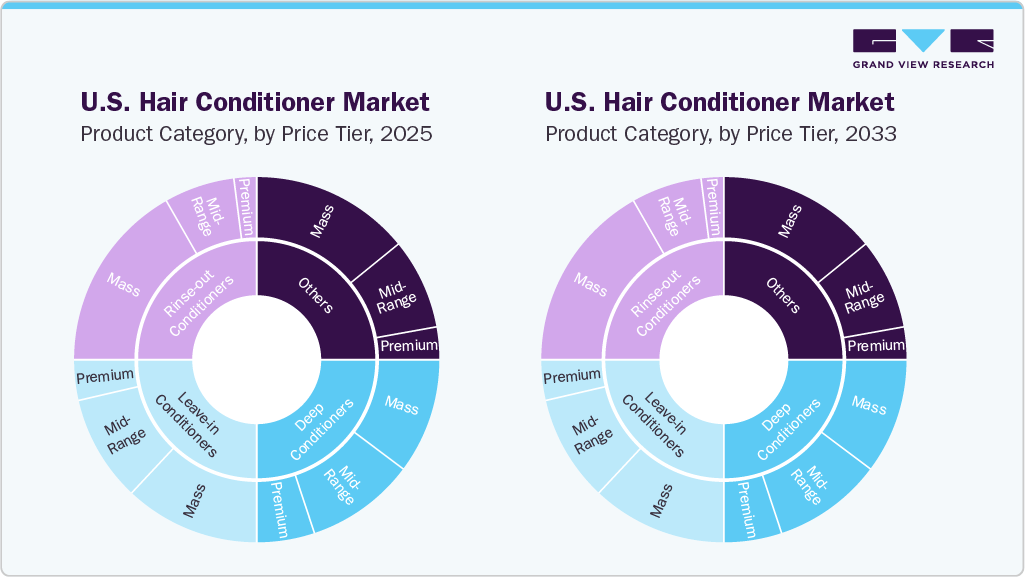
- By price tier: Mass segment led the industry with a share of 57.8% in 2025.
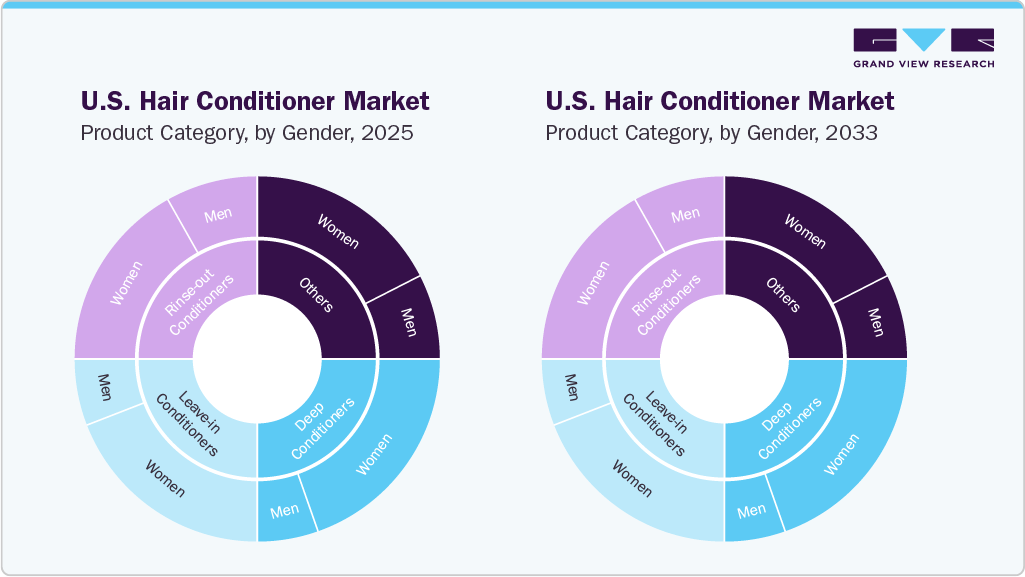
- By gender: Women's conditioner segment led the industry with a share of 71.0% in 2025.
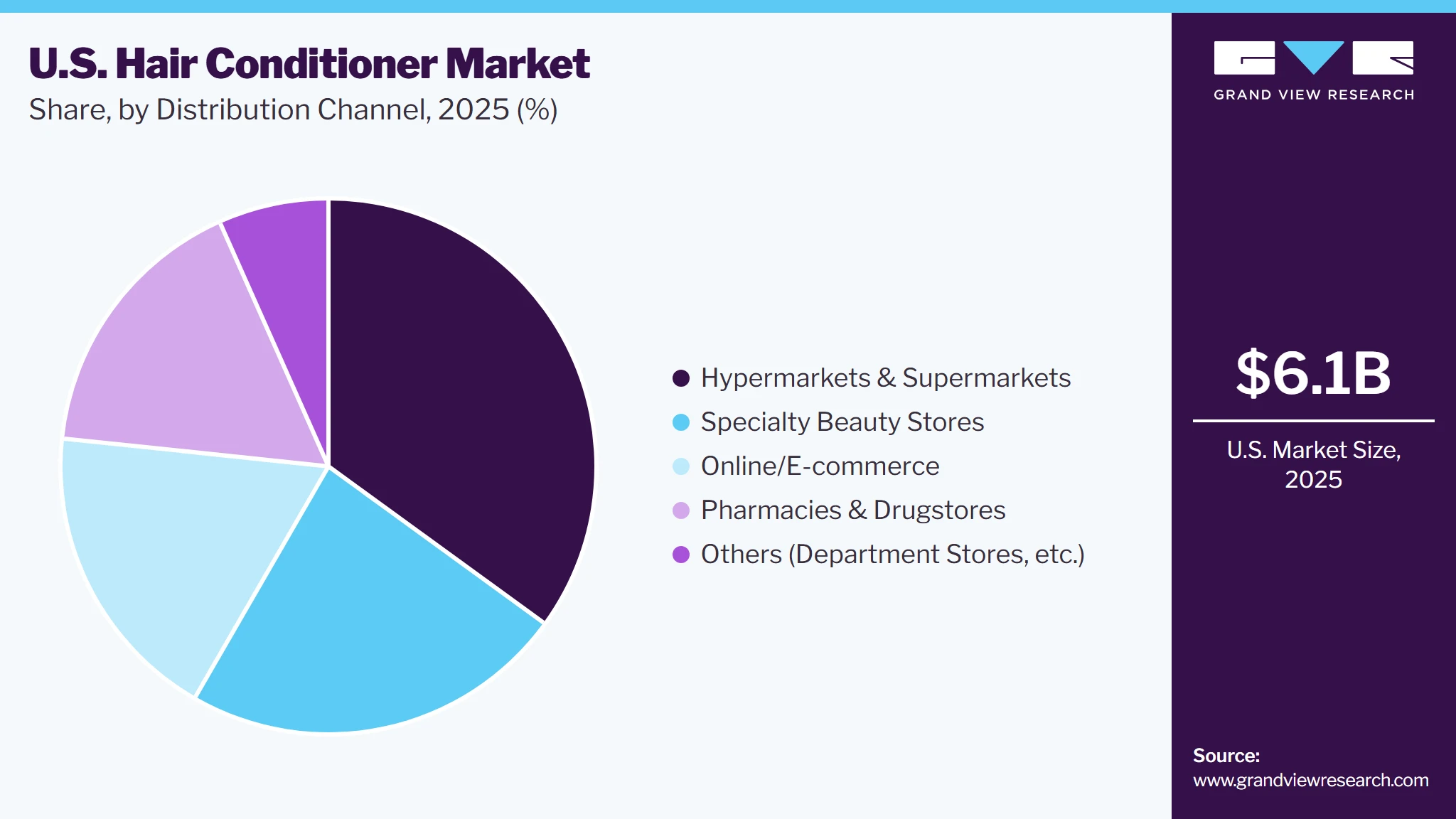
- By distribution channel: Hypermarkets & supermarkets segment led the market with a share of 34.5% in 2025.
Market Size & Forecast
- Market size in 2025: USD 6.1 Billion
- Estimated market size in 2026: USD 6.4 Billion
- Projected market size by 2033: USD 10.1 Billion
- CAGR (2026-2033): 6.6%
Three ways to get this report
Buy it, customize it, or ask a question.Ask an Analyst
A direct answer, usually in 1 working day
- AccessReport author, directly
- Reply timeWithin 1 working day
- No sales callDirect answer only
- FormatEmail reply
- CostFree, no cost
Get the Full Report
What the study covers
- FormatsPDF · Excel · Dashboard
- Timeline2026–2033 annual, 2025 base
- Coverage20+ countries, 5 regions
- Companies10+ key players profiled
Customize the Report
20% free customization
- IncludeCountries, segments, points
- TailorTo your product definition
- ExtendDeeper competitor detail
- OrA fully bespoke study
- Turnaround5–10 working days
The U.S. market encompasses rinse-out, leave-in, deep-conditioning, and other specialized formats, with products increasingly differentiated by hair type, damage level, ingredient technology, and desired outcome. Broad retail availability across supermarkets, mass merchants, drugstores, beauty specialty retailers, salons, brand websites, and marketplaces continues to support recurring purchases and category penetration.The shift toward performance-oriented conditioning is evident in the product strategies of major haircare companies: P&G positions Pantene around targeted benefits such as damage repair, strengthening and nourishment through products including Pantene Pro-V Miracle Rescue Deep Repair Conditioner, while Head & Shoulders extends conditioning into scalp-focused propositions through products such as Supreme Nourish & Smooth Conditioner; P&G’s FY2026 results also show Hair Care delivering mid-single-digit organic sales growth, indicating continued momentum in the category and the importance of innovation within its portfolio. Unilever provides another direct example through Dove’s renovated haircare range, which uses Bio-Protein Care technology to replenish amino acids lost to damage and was rolled out in the U.S. alongside other major markets; Unilever specifically reported that Dove delivered double-digit growth in 2025 following the renovated haircare launch, demonstrating the company’s move toward scientifically positioned, benefit-led conditioning and treatment products.
 Source: Grand View Research, IR Documents, Primary Interviews, Paid DatabasesTo learn more about this report,
 Download Free Sample Report
 Henkel is similarly expanding conditioning beyond basic softness through Schwarzkopf KERATÎME Deep Repair Conditioner, which uses Multiplex Bonding Technology to strengthen and protect damaged hair, alongside KERATÎME Color Protect Conditioner, positioned around stronger hair and color-vibrancy protection; the company describes the broader KERATÎME system as addressing damage caused by washing, heat styling, coloring, and environmental exposure. These examples indicate that conditioners are increasingly being developed and marketed as targeted performance products that repair, strengthen, protect color, and address specific hair/scalp needs, rather than solely as conventional post-shampoo softening products.
Within this broader performance shift, protein- and fibre-focused formulations are emerging as a distinct area of conditioner innovation. Unilever's Dove portfolio provides a direct example, with its Bio-Protein Care technology positioned to replenish amino acids and help restore hair affected by everyday stressors such as heat styling and coloring. The Dove Intensive Repair range incorporates a conditioner into a broader three-step repair regimen, extending the product proposition from post-shampoo conditioning toward a more comprehensive hair-fibre care system. Unilever's FY2025 results reported double-digit growth for Dove, supported by the launch of its new fibre-repair technology range, indicating that technology-led repair propositions are gaining commercial traction. This creates an opportunity for conditioner manufacturers to differentiate through specific hair-fiber benefits, targeted repair technologies, and regimen-based solutions, rather than relying primarily on conventional softness and manageability claims.
A related development is the increasing “skinification” of hair and scalp care, which is expanding the functional scope of conditioning products beyond the hair shaft. Companies are incorporating skincare-inspired ingredients and treatment concepts into hair and scalp products, with Unilever extending propositions around scalp health through formulations featuring ingredients such as niacinamide and glycerine. This reflects a shift toward addressing the scalp alongside the hair fiber, creating opportunities for conditioners and adjacent treatments positioned around scalp compatibility, hydration, strengthening, barrier support, and targeted care. For the U.S. conditioner market, skinification therefore represents a move toward more specialized formulations in which ingredient functionality and substantiated benefits become increasingly important alongside conventional softness and manageability claims.
Premiumization is reinforcing this shift, as higher-income consumers show greater participation in higher-priced conditioner and professional haircare channels. This consumer behavior supports opportunities for premium and professional conditioners positioned around advanced repair, bond-building, intensive hydration, color protection, and specialized hair-type performance. The professional channel is also seeing continued innovation, with L'Oréal reporting strong growth in its Professional Products division in 2025 and identifying premium haircare as particularly dynamic, while Kérastase delivered strong performance within the portfolio. These developments indicate that consumers are increasingly willing to pay for differentiated formulations and professional-grade claims when the benefit is clearly communicated.
Beyond formulation and pricing, portfolio expansion is broadening the competitive definition of hair health. Unilever's Beauty & Wellbeing portfolio combines conventional haircare brands such as Dove with wellness-oriented businesses, including Nutrafol and Liquid I.V., illustrating how large beauty companies are participating across multiple points of the consumer wellness journey. Although ingestible supplements and hydration products fall outside the conventional conditioner category, their presence within the same broader beauty portfolio reflects an increasingly interconnected approach to hair and wellness. For conditioner manufacturers, this creates a wider competitive environment in which consumers can address hair concerns through cleansing, conditioning, treatments, scalp care, professional services, and complementary wellness routines, increasing the importance of clearly defining the specific role and benefit of each conditioner proposition.
 To learn more about this report, Download Free Sample Report
 Manufacturers are also moving beyond the traditional single-bottle conditioner model toward multi-step hair treatment systems. Dove's repair propositions, for example, incorporate conditioner into broader routines spanning shampoo, treatment masks, serums, and other complementary products, allowing the brand to address different stages of the haircare routine through a connected regimen. This approach also parallels the multi-step structure established in skincare, where consumers increasingly select products based on specific treatment objectives rather than relying on a single universal formulation. Within conditioning, this is expanding the role of leave-in conditioners, deep conditioners, masks, serums, and treatment-oriented formats, creating additional occasions for product usage and opportunities for brands to build higher-value routines around specific hair concerns.
Taken together, these developments are broadening the competitive basis of the market. The category is increasingly being defined not only by the conditioning function itself, but by how effectively brands address specific consumer needs across the haircare routine. This is reflected in the strategies of major participants: P&G maintains a broad mass-market reach through brands such as Pantene and Head & Shoulders, L'Oréal spans mass, premium, and professional haircare through brands including L'Oréal Paris, Kérastase, and Redken, while Unilever is extending Dove into repair-focused and scalp-oriented propositions. As a result, product architecture, targeted claims, regimen integration, and specialized formats are becoming increasingly important components of competitive positioning, with basic softness and fragrance functioning more as foundational attributes than as the sole basis for differentiation.
Major Trends in the U.S. Hair Conditioner Market
Trend
Description
Bond-building technology is expanding conditioner repair propositions
Conditioner innovation is increasingly incorporating technologies positioned around strengthening damaged hair and reinforcing weakened bonds, particularly for consumers exposed to coloring, bleaching, and heat styling. Olaplex Nº.5 Bond Maintenance Conditioner uses the brand’s patented Bond Building Technology and Bis-Aminopropyl Diglycol Dimaleate, which Olaplex positions around rebuilding disulfide bonds that contribute to hair strength. Redken Acidic Bonding Concentrate Conditioner similarly uses a citric-acid-based bonding care complex and an acidic, pH-balancing formulation designed to address damage associated with coloring and heat styling, with the brand reporting a 56% reduction in breakage when the shampoo and conditioner are used together versus non-conditioning shampoo. Unilever’s acquisition of 91.88% of K18 in 2024 further demonstrates the strategic importance of molecular-repair technology within premium haircare, bringing the K18 brand and its peptide-based repair proposition into Unilever’s Beauty & Wellbeing portfolio.
Protein and amino-acid formulations are strengthening damage-repair claims
Conditioner brands are also using proteins, peptides and amino-acid technologies to move damage repair beyond conventional softness and manageability benefits. Dove Damage Therapy Intensive Repair Conditioner combines Bio-Protein Care with Glutamic Amino Serum and is positioned around restoring damaged hair and strengthening hair fibers after exposure to coloring, bleaching, straightening and blow-drying. Dove claims that hair feels 10x stronger when the collection is used as directed and that the conditioner helps stop 98% of visible damage versus non-conditioning shampoo. The formulation also contains ingredients including hydrolyzed soy protein, oat peptide, and ceramides, illustrating how mass-market conditioners are incorporating protein- and biomolecule-oriented technologies traditionally associated with more specialized repair products.
Scalp-focused formulations are extending conditioning beyond the hair fiber
The functional scope of conditioning is increasingly extending toward the scalp, as brands incorporate skincare-inspired ingredients and scalp-specific benefits into haircare routines. Olaplex Nº.5Fine Bond Maintenance Volumizing Conditioner, for example, combines its bond-building technology with niacinamide and hyaluronic acid while targeting lightweight hydration for fine hair. This reflects a broader movement toward formulations that combine conditioning with ingredient-led care rather than focusing solely on softness and detangling. As scalp health becomes more prominent across haircare, conditioners can increasingly be positioned as complementary products within routines addressing hydration, sensitivity, strength and overall hair-and-scalp care.
Hair-type and texture-specific conditioners are expanding portfolio segmentation
Conditioner portfolios are increasingly being segmented around curl pattern, hair texture, thickness, and moisture requirements, replacing the traditional one-formula approach with more targeted propositions. SheaMoisture offers conditioners specifically designed for different hair types, including its Coconut & Hibiscus Curl & Shine Conditioner for wavy, curly, kinky, and coily hair and its Manuka Honey & Mafura Oil Conditioner for dry, brittle, damaged coily hair. Mielle similarly positions its Rosemary Mint Strengthening Conditioner around textured strands, emphasizing hydration, detangling and strengthening, while its broader conditioner portfolio categorizes products across concerns such as coily, curly and wavy hair, as well as low-porosity hair.
Leave-in and regimen-based formats are expanding the role of conditioning
Conditioning is increasingly being incorporated into multi-product treatment routines rather than being limited to a conventional rinse-out step. Redken Acidic Bonding Concentrate spans shampoo, conditioner, intensive treatment, and leave-in treatment, while its leave-in product adds heat protection and additional breakage-reduction claims to the conditioning routine. Dove similarly positions its Intensive Repair collection around a broader repair regimen incorporating conditioner and treatment formats. This expansion creates additional usage occasions for conditioning products and allows brands to address different stages of the haircare routine, including cleansing, rinse-out conditioning, intensive treatment and leave-in care.
Free-from and formulation credentials are increasingly integrated into premium conditioner positioning
Conditioner brands are increasingly combining free-from and formulation credentials with specific functional benefits, particularly in premium, repair, and clean-positioned propositions. Herbal Essences markets conditioners such as its Bio: Renew Argan Oil of Morocco Conditioner as free from mineral oil and colorants and formulated with ingredients positioned around hydration and hair repair, while Dove incorporates sulfate-free and paraben-free formulations into selected haircare propositions alongside claims focused on repair and strengthening. In the premium segment, Redken Acidic Bonding Concentrate Conditioner combines a sulfate-free formulation with its bonding-care technology and damage-repair positioning. This indicates that formulation attributes such as sulfate-free, paraben-free, silicone-free, vegan, and cruelty-free are increasingly being communicated together with tangible hair benefits, enabling brands to address both ingredient preferences and performance expectations within the same conditioner proposition.
These developments indicate that the market is evolving from a largely standardized post-shampoo product toward more targeted, efficacy-led and hair-health-oriented solutions. Innovation is increasingly centered on specific consumer needs, including damage repair, bond and protein strengthening, scalp care, curl and texture management, hydration, and specialized hair-type requirements. At the same time, manufacturers are expanding product formats through leave-in conditioners, intensive treatments, and multi-step regimens, while incorporating ingredient-conscious and free-from positioning alongside functional claims.
Market Dynamics
The market is increasingly supported by consumers seeking specific hair-health outcomes beyond basic softness and detangling, particularly repair, strengthening, hydration, frizz control, breakage reduction, and protection from chemical and heat-related damage. The American Academy of Dermatology recommends moisturizing conditioner after every shampoo because it coats the hair shaft and can help reduce breakage and split ends; it also recommends leave-in conditioners or detanglers for fragile or thinning hair. This creates a stronger functional role for conditioners within routine hair maintenance, particularly among consumers who regularly color, chemically treat, heat-style, or manage textured hair. Brands are responding by moving from generic conditioning toward targeted, problem-solution formulations.
Product innovation illustrates this shift. OLAPLEX has positioned its Nº.5 Bond Maintenance Conditioner around bond strengthening, breakage reduction, hydration, detangling, and repair, with the company reporting 68% lower breakage and 90% smoother, better-detangled hair in its stated clinical results. The brand has also expanded into more specialized propositions: its Nº.5FINE Bond Maintenance Conditioner is designed specifically for fine hair, while Nº.5CURL Bond Shaper targets curls and coils with hydration, definition, and damage reduction; OLAPLEX reports 50% less frizz in high humidity for its curl system and 96% agreement that hair was easier to detangle. Such segmentation demonstrates how conditioner innovation is increasingly addressing hair type, damage condition, and specific hair-health goals, encouraging consumers to trade up from conventional conditioners to specialized repair-oriented products.
The proliferation of counterfeit, diluted, expired, or otherwise low-quality hair conditioners is becoming a restraint as U.S. consumers increasingly encounter products through fragmented online and third-party seller networks. U.S. Customs and Border Protection (CBP) reported nearly 20,000 intellectual-property-violating shipments containing almost 32 million counterfeit items, with a potential genuine retail value of USD 5.4 billion. Importantly for haircare, CBP notes that approximately 87% of counterfeit shipments occur in the small-package environment, which is highly relevant to e-commerce fulfillment. Conditioners are particularly exposed because branded products can be replicated using similar packaging, while the formulation, preservation, fragrance, or active ingredients may differ materially. The U.S. Food and Drug Administration (FDA) also warns that cosmetics sold through online marketplaces or resale channels may be past their shelf life, diluted, tampered with, or counterfeit.
This issue can undermine both consumer trust and brand economics, particularly for premium and treatment-oriented conditioners where consumers pay for specific repair, strengthening, or bond-building claims. OLAPLEX, for example, explicitly warns consumers that counterfeiters have become proficient at copying its products and states that it cannot guarantee the safety, quality, or authenticity of products purchased outside authorized channels; the company uses packaging-level authentication measures such as QR codes. The risk is amplified by the scale of low-value cross-border e-commerce: CBP reported that 97% of its intellectual-property seizures in FY2024 were associated with de minimis shipments, representing 31 million counterfeit items. For conditioner manufacturers and retailers, counterfeit availability can divert legitimate sales, create price inconsistencies, increase monitoring and enforcement costs, and generate adverse consumer experiences that may be incorrectly attributed to the authentic brand. FDA guidance further highlights that poor manufacturing, storage, packaging, or preservation can allow cosmetic products to become contaminated, reinforcing the quality and safety implications of uncontrolled supply channels.
Demand for natural and cleaner ingredient profiles is creating an opportunity for U.S. conditioner brands to differentiate through plant-derived oils, botanical extracts, proteins, and formulations positioned as free from sulfates, parabens, silicones, and other ingredients consumers actively avoid. Consumer research reported by Global Cosmetic Industry indicates that 59% of U.S. haircare buyers prefer cleaner, more natural ingredients, while plant extracts and roots were sought by 59%, essential and other oils by 50%, and botanicals by 43%. Separately, NSF’s 2024 U.S. consumer research found that 74% of consumers consider organic ingredients important in personal-care products, highlighting an opportunity for conditioner manufacturers to strengthen ingredient transparency, naturally derived formulations, and credible clean-label positioning. Companies are responding by combining naturally positioned ingredients with performance technologies; for example, OLAPLEX’s Nº.5 Fine Bond Maintenance Conditioner combines botanical ingredients such as quinoa, pea, sunflower, grapeseed, rosemary, rice-bran, and jojoba-derived ingredients with its patented bond-building technology.
Personalization and multifunctionality further expand the opportunity as consumers increasingly seek conditioners addressing specific hair types, textures, and concerns rather than one-size-fits-all products. Prose’s Custom Conditioner, for instance, uses a consultation covering 85+ factors and selects from 185+ clean ingredients to create formulas tailored to individual hair characteristics and goals; the brand offers customization for fine, curly, and colored hair, among other needs. Meanwhile, multifunctional conditioning propositions are moving beyond basic softness and detangling toward repair, hydration, strengthening, frizz control, volume, and color protection in a single product. OLAPLEX’s Nº.5 conditioners, for example, combines bond strengthening, hydration, manageability, smoothing, and frizz reduction, while its Fine formulation targets volume alongside damage repair. This creates whitespace for U.S. brands to develop targeted, ingredient-led conditioners that combine multiple benefits without increasing routine complexity.
Analyst Perspective
The market is shaped by demand for products addressing frizz, dryness, damage, scalp concerns, and hair-texture-specific needs. Rinse-out conditioners remain the core format, while leave-in and deep conditioners are gaining relevance as consumers adopt more treatment-oriented routines. Conditioner usage varies considerably by hair type, with frizzy, wavy, and thick-hair consumers reporting more frequent use. Mass-market products remain important across grocery, mass merchants, and drugstores, while premium conditioners benefit from higher-income consumers seeking specialized formulations. Online purchasing is also gaining importance, particularly for premium and treatment-led haircare, supported by replenishment and convenience.
Consumer Insights
 To learn more about this report, Download Free Sample Report
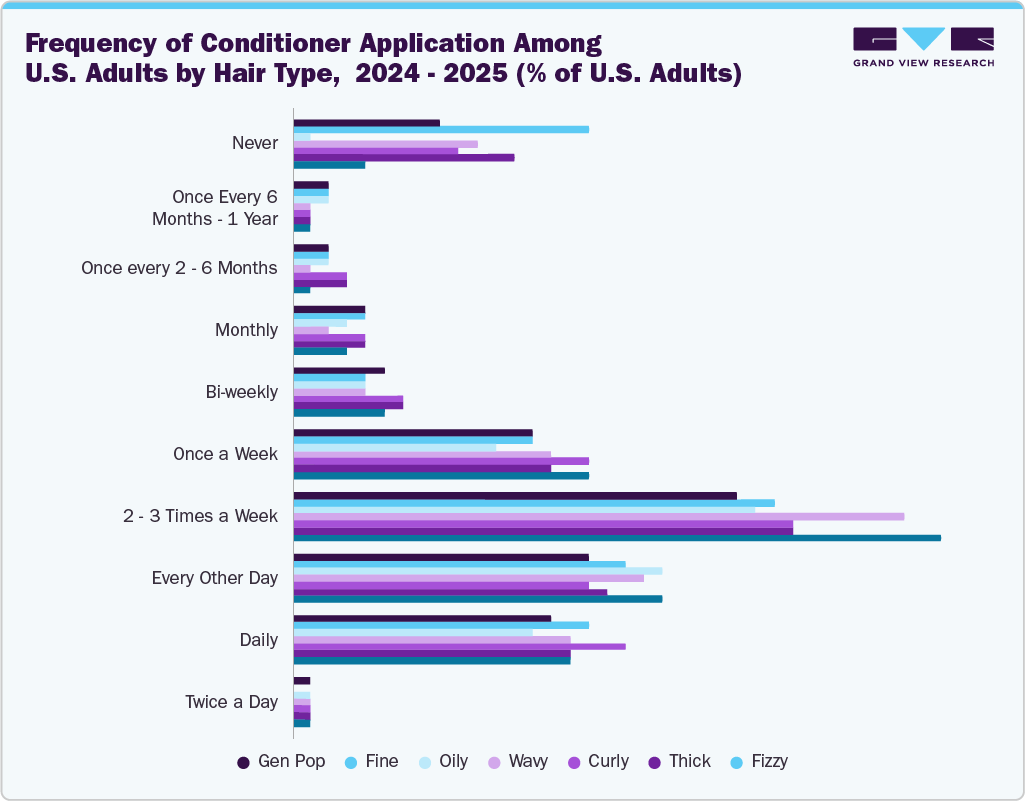
 Conditioner remains an important but less universal component of U.S. haircare routines: Conditioner is widely used alongside shampoo, but usage frequency varies considerably by hair type and consumer needs. According to YouGov’s 2025 U.S. haircare survey, 21% of Americans do not use conditioner, while 24% use it two to three times per week and 14% use it daily. This creates opportunities to increase penetration among non-users while expanding treatment-oriented conditioning routines.
-
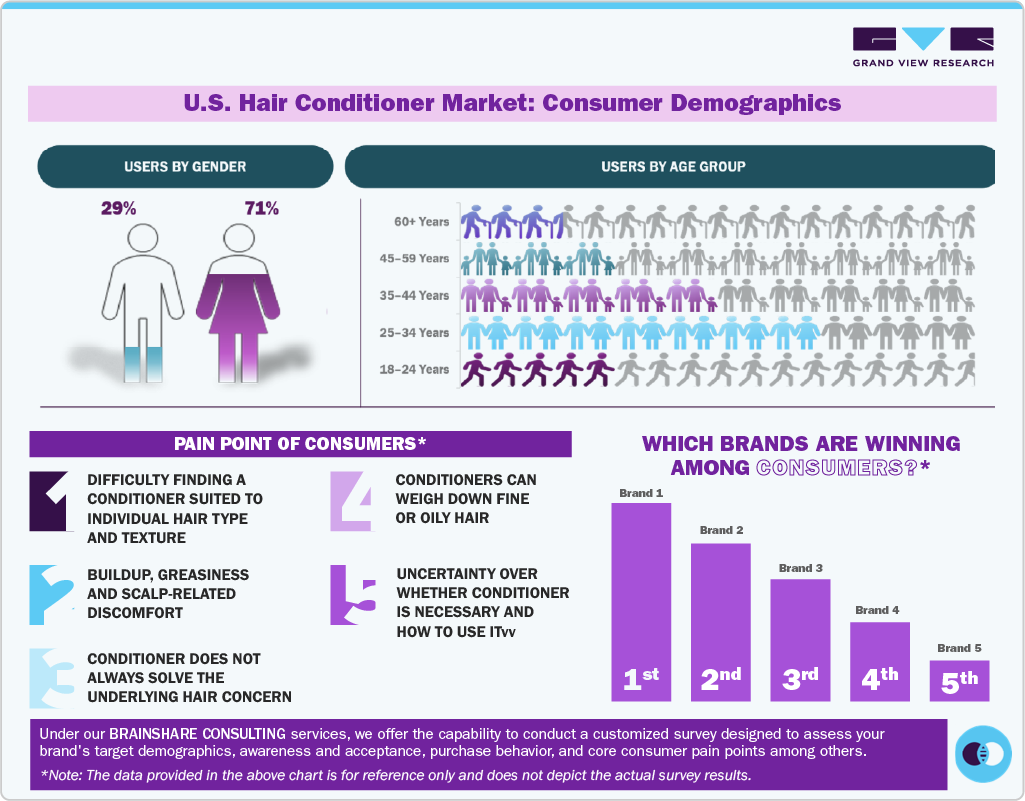
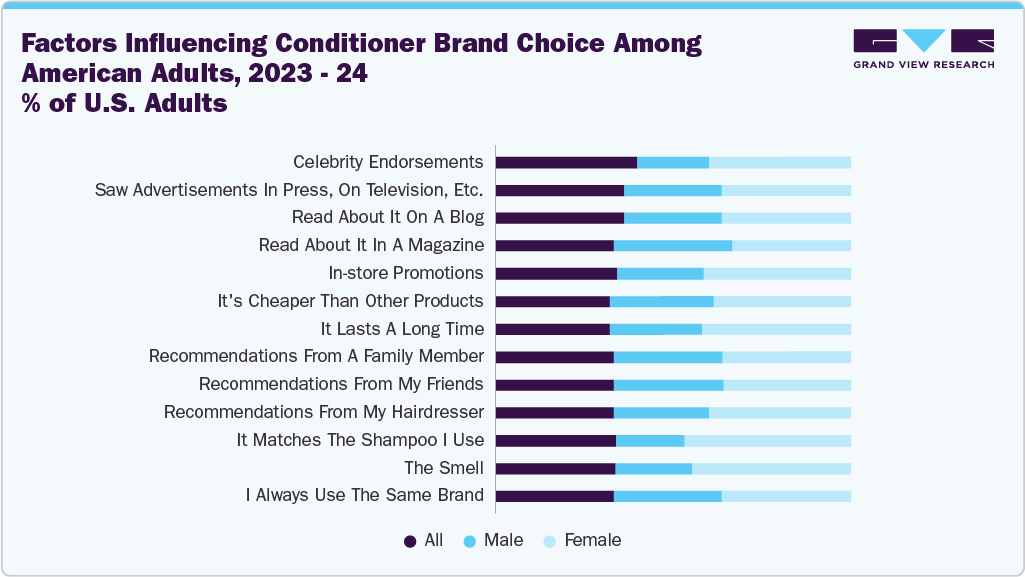
Women represent the core conditioner consumer base in the U.S.: Women have a substantially higher level of engagement with conditioning and broader hair-treatment routines than men. A 2025 YouGov survey of 1,236 U.S. adults found that 93% of women use shampoo or conditioner, compared with 79% of men, while women were also substantially more likely to use serums, masks, or leave-in products (31% vs. 4%). Conditioner purchasing also shows stronger female involvement: in YouGov's 2024 haircare research, 37% of women who purchase conditioner said they are loyal to the same brand, compared with 31% of men, while 18% of women considered hairdresser recommendations when selecting conditioner, versus 12% of men. This positions women as an important consumer group for both core rinse-out conditioners and higher-value treatment extensions.
-
Consumers are expanding conditioning into multiple product formats: The conditioner routine increasingly extends beyond conventional rinse-out products into deep conditioners, leave-ins, masks, and other treatment formats. Coresight's U.S. consumer tracking shows that 22.0% of consumers purchased hair deep conditioners in July 2026, demonstrating meaningful demand for more intensive conditioning formats. This shift is also reflected in brand portfolios; OLAPLEX, for example, offers strengthening conditioners alongside Rich Hydration Mask and Weightless Nourishing Mask, with the masks positioned as weekly treatments that can replace conventional conditioner on treatment days. The company's routine architecture combines shampoo, conditioner, mask, repair treatment, and bonding oil, illustrating how brands are encouraging consumers to build multi-step conditioning and treatment routines.
-
Hair texture and condition strongly influence conditioner frequency: Conditioner usage is closely linked to perceived moisture, manageability, and frizz-control needs. YouGov found that 35% of consumers with frizzy hair and 33% with wavy hair use conditioner two to three times per week, compared with 24% of consumers overall. Thick-haired consumers also show elevated usage at 27%. In contrast, consumers with oily and fine hair are more likely to avoid conditioner, with 18% of oily-haired and 16% of fine-haired consumers reporting that they never use it. This suggests that consumers do not view conditioner as a uniform product; perceived weight, buildup, moisture requirements, and hair manageability affect adoption.
 To learn more about this report, Download Free Sample Report
 -
Sensory attributes remain relevant alongside functional performance: Conditioner delivers an immediate sensory experience through softness, smoothness, detangling, manageability, and fragrance, making the product experience an important part of repeat usage. Fragrance can influence the perceived sensory experience and emotional appeal of a conditioner. YouGov's 2024 research found that 25% of women said product smell influences their conditioner choice, compared with 12% of men. The stronger female response suggests that fragrance can contribute to differentiation among otherwise similar moisturizing, strengthening, or smoothing products, particularly in mass-premium and premium segments. The prevalence of fragrance and sensory claims indicates that conditioner competes not only on functional efficacy but also on the experience it creates during and after use.
-
Digital discovery is reinforcing treatment-led and occasion-based haircare behavior: Haircare searches increasingly occur around specific moments, needs, and occasions rather than only routine product replenishment. Captify/Publicis Media's global haircare search analysis identified convenience, relaxation, and bargains as major sporadic haircare moments, where conditioner accounts for 37% of all searches around haircare products, making it the most important among consumers. The report also recorded substantial search uplifts around seasonal and event-driven moments such as the New Year, spring, summer holidays, and autumn. While these findings are global rather than U.S.-specific, they provide useful context for the U.S. market; consumers can enter the conditioner category through specific occasions or problems and then move toward treatment-oriented products.
-
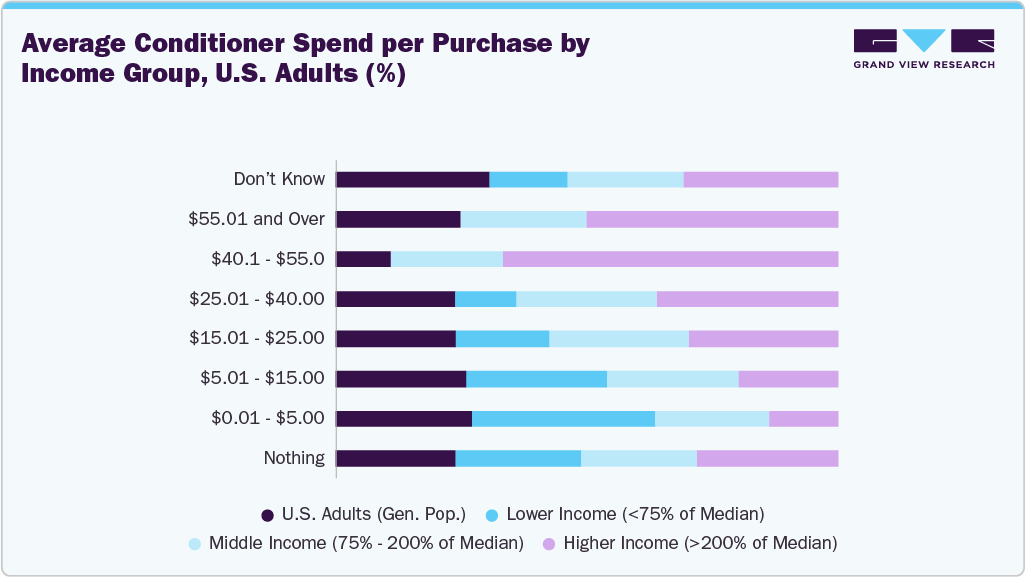
Value remains important even as consumers trade up into specialized conditioners: Conditioner is a frequently replenished product, but consumers still balance performance against price. YouGov's 2025 data found that 15% of higher-income adults spend $25-$55 on conditioner, compared with 7% of the overall population, indicating that higher-income consumers are more represented in premium spending. At the same time, mass-market distribution remains important, making tiered offerings-from basic moisturizing conditioners to premium repair and treatment formulas-relevant across consumer segments.
 To learn more about this report, Download Free Sample Report
 -
Consumers increasingly expect specific benefits rather than generic conditioning: Product selection is becoming more benefit-led as shoppers look for solutions to identifiable hair concerns. The Benchmarking Company’s January 2022 primary survey of more than 3,400 U.S. female-identifying consumers found that 97% sought specific benefits to address their hair concerns when purchasing a new shampoo or conditioner. The same study found high usage of complementary products, including leave-in conditioners (55%), frizz-control products (43%), heat protectants (41%), hair masks (36%), and hair serums (32%), indicating that consumers increasingly approach haircare as a broader, multi-product routine rather than relying solely on traditional rinse-out conditioners. This suggests that claims such as hydration, anti-frizz, strengthening, heat protection, color protection, detangling, and repair can help consumers distinguish between otherwise similar conditioner products.
-
The premium conditioner opportunity is increasingly tied to efficacy rather than price alone: U.S. consumers are showing greater interest in products that deliver elevated performance, but premium pricing by itself does not guarantee perceived value. Circana reported in 2025 that only 14% of U.S. beauty buyers believed that higher prices indicate better quality, while the prestige hair category continued to benefit from innovation in treatments. This creates a favorable environment for conditioners that justify higher prices through demonstrable benefits, such as bond repair, intensive hydration, damage recovery, or specialized texture care, rather than relying solely on premium branding or packaging.
Leading Conditioner Brands in the U.S. for Consumers 2025
Brand
Consumer Preference/Market Position
Key Conditioner Proposition
Dove
Strong mass-market brand with broad household reach and established hair-care equity
Moisturization, damage repair, softness, and everyday conditioning
Pantene
Well-established mainstream brand with broad consumer consideration across hair-care routines
Strengthening, moisture, repair, and everyday conditioning
TRESemmé
Strong mass-market presence with salon-inspired positioning and performance-oriented products
Smoothing, moisture, repair, and frizz control
Head & Shoulders
Strong scalp-care brand that extends into conditioning and hair manageability
Scalp care, moisture, softness, and damage protection
Herbal Essences
Established mass-market brand differentiated through botanical and sensory-led propositions
Moisture, softness, botanical ingredients, and fragrance
L'Oréal Paris
Broad hair-care portfolio addressing multiple hair concerns across mass retail channels
Repair, hydration, anti-frizz, strengthening, and targeted hair care
Consumers are increasingly extending their core cleansing and conditioning routines with complementary treatments such as masks, leave-ins, oils, serums, and heat protectants. This creates opportunities for conditioner brands to move beyond standalone products and build integrated hair-care routines, including everyday conditioners paired with weekly masks, leave-in products for styling and hydration, and intensive treatments targeting damaged or stressed hair.
Product Insights
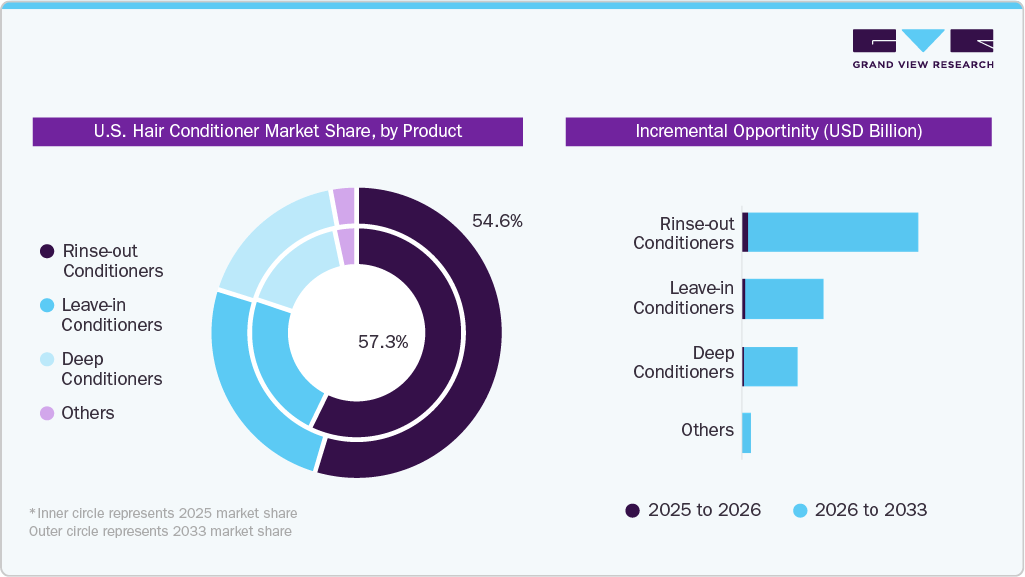
The rinse-out conditioners segment dominated the market, accounting for a 57.3% revenue share in 2025, supported by its widespread use as the conventional conditioning step following shampooing. Rinse-out conditioners are commonly formulated to improve softness, detangling, manageability, moisture retention, and surface smoothness, making them suitable for routine use across a broad range of hair types. The segment benefits from extensive product availability across mass retailers, drugstores, specialty beauty stores, and e-commerce platforms, with brands such as Dove, Pantene, TRESemmé, Herbal Essences, and L'Oréal Paris offering multiple formulations. The continued introduction of products addressing specific needs, such as damage repair, color protection, frizz control, curl definition, and strengthening, is also supporting demand for rinse-out conditioners in the U.S. market.
 To learn more about this report, Download Free Sample Report
 Leave-in conditioners are expected to grow at the fastest CAGR of 7.9% from 2025 to 2030, supported by the increasing adoption of multi-step hair-care routines and demand for products that provide conditioning benefits beyond the shower. Unlike traditional rinse-out products, leave-ins remain on the hair and can provide ongoing hydration, detangling, frizz management, heat protection, and styling support. Their use is particularly relevant for consumers with curly, coily, dry, damaged, or chemically treated hair, for whom maintaining moisture and manageability between washes is important. Brands such as Mielle, Pattern, SheaMoisture, Kérastase, and Olaplex have expanded leave-in propositions around specific hair textures and concerns, while the growing popularity of treatment-oriented hair care is encouraging consumers to incorporate leave-ins alongside conventional conditioners.
Price Tier Insights
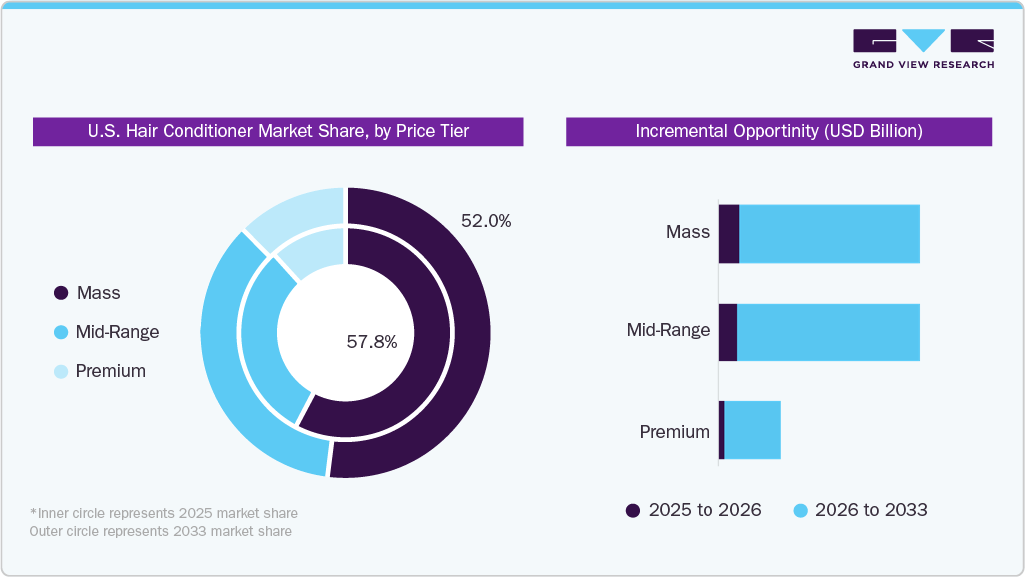
The mass price tier accounted for the largest revenue market share, representing 57.8% of revenue in 2025. The segment benefits from the high frequency of conditioner usage and the extensive availability of affordable products through supermarkets, mass merchants, drugstores, and online retailers. Leading brands such as Pantene, Dove, TRESemmé, Herbal Essences, and Suave offer conditioners across multiple hair types and concerns at accessible price points, supporting widespread household penetration. Mass-market manufacturers are also incorporating increasingly sophisticated claims, including bond repair, strengthening, hydration, anti-frizz performance, and color protection, allowing consumers to access targeted hair-care benefits without moving into premium price points.
 To learn more about this report, Download Free Sample Report
 Mid-range conditioners are expected to register the fastest CAGR of 8.6% from 2025 to 2030, with their share increasing from 30.4% in 2025 to 35.5% by 2033. Growth is being supported by consumers seeking higher perceived performance while remaining below premium and professional price points. Brands positioned within this tier increasingly differentiate through targeted formulations, advanced ingredients, improved sensorial experiences, and hair-concern-specific benefits such as bond repair, intensive hydration, curl definition, strengthening, and damage protection. The expansion of specialty beauty retailers such as Ulta Beauty and Sephora has also increased visibility for masstige and emerging hair-care brands, enabling products with more specialized positioning to reach a broader U.S. consumer base. This combination of accessible pricing and elevated product performance is expected to support the continued expansion of the mid-range conditioner segment.
Gender Insights
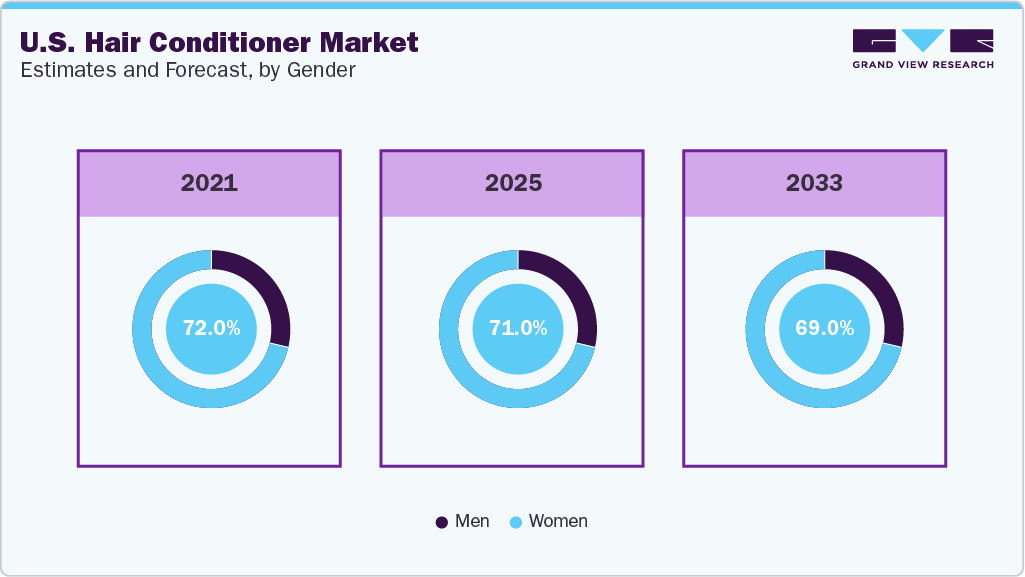
The women's conditioner segment dominated the U.S. market, accounting for a 71.0% revenue share in 2025. The segment benefits from a broad assortment of products addressing hair texture, length, styling, damage, hydration, color treatment, frizz, volume, and other specific hair concerns. Women's hair-care portfolios span mass-market brands such as Dove, Pantene, Herbal Essences, and TRESemmé as well as professional and prestige brands such as Redken, Kérastase, Olaplex, and Moroccanoil. The increasing use of specialized products for curls, coils, chemically treated hair, color-treated hair, and damaged hair further expands conditioner consumption among female consumers. In addition, the growing adoption of multi-product routines that combine rinse-out conditioners with masks, leave-ins, oils, and serums provides additional opportunities for brands to increase product usage and basket size. The women's segment is expected to remain dominant through 2033, although its share is projected to moderate to 69.0%.
 To learn more about this report, Download Free Sample Report
 Men's conditioners are expected to grow at a CAGR of 7.5% from 2025 to 2030, supported by the gradual expansion of men's grooming routines beyond basic cleansing. Conditioner propositions for men increasingly address scalp dryness, oil control, dandruff, hydration, hair thinning, and manageability, while simplified formats such as 2-in-1 shampoo and conditioner continue to lower the barrier to adoption. Brands such as American Crew, Jack Black, Every Man Jack, and Head & Shoulders offer products positioned around men's grooming and scalp-care needs. The expansion of men's specialty grooming and the increasing availability of gender-neutral hair-care products are also broadening the addressable consumer base for conditioners in the U.S.
Distribution Channel Insights
Hypermarkets & supermarkets accounted for the largest market share, representing 34.5% in 2025. The channel benefits from the routine and replenishment-oriented nature of conditioner purchases, as consumers frequently purchase conditioner alongside shampoo and other personal-care products during regular shopping trips. Large-format retailers also provide extensive shelf space across mass and mid-range products, allowing established brands such as Dove, Pantene, TRESemmé, Herbal Essences, and L'Oréal Paris to maintain broad visibility. Retailers such as Walmart, Target, and Kroger offer conditioners across multiple price points and hair-care needs, while promotional activity, multipacks, and shampoo-conditioner combinations further encourage purchase.
 To learn more about this report, Download Free Sample Report
 Online/e-commerce is projected to grow at the fastest CAGR of 8.5% from 2026 to 2033. The channel is benefiting from greater consumer familiarity with online beauty purchasing, broader product assortments, subscription and replenishment options, and the ability to compare ingredients, reviews, claims, and prices before purchase. E-commerce is particularly relevant to specialized conditioner formats such as leave-ins, deep conditioners, bond-repair products, and products formulated for specific curl patterns or hair concerns, which may have more limited shelf presence in conventional stores. Amazon, Ulta Beauty, Sephora, Target, and brand-owned websites provide consumers with access to both established and emerging conditioner brands, while digital reviews and creator-led product discovery increasingly influence product consideration. The channel's faster projected growth reflects the continued shift toward digitally enabled discovery and purchasing within the U.S. hair-care category.
Cross-Segmentation Analysis
The study provides detailed cross-segmentation market analysis to identify how demand varies across product types, price tiers, and consumer groups. Beyond individual segment analysis, the report evaluates rinse-out, leave-in, deep, and other conditioner formats across mass, mid-range, and premium price tiers, providing a more granular view of how different conditioner formats are positioned across the market. The analysis also cross-segments each product type by gender, enabling assessment of differences in conditioner demand between male and female consumers. These cross-segment insights help identify premiumization opportunities, opportunities for targeted leave-in and deep-conditioning formulations, gender-specific product positioning, and areas where brands can expand differentiated products across price tiers and consumer needs.
 To learn more about this report, Download Free Sample Report
  To learn more about this report, Download Free Sample Report
 Key U.S. Company Insights
 To learn more about this report, Download Free Sample Report
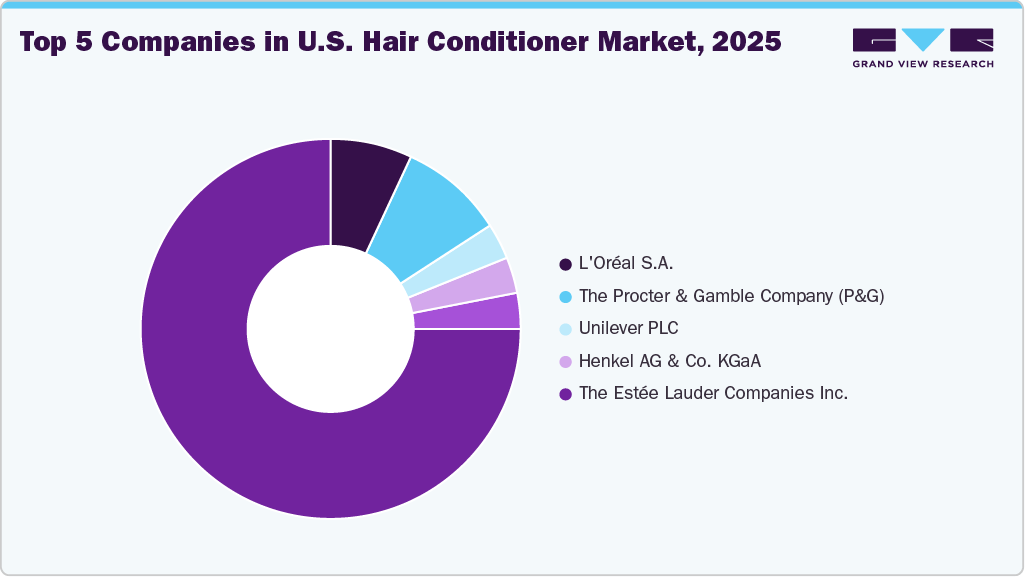
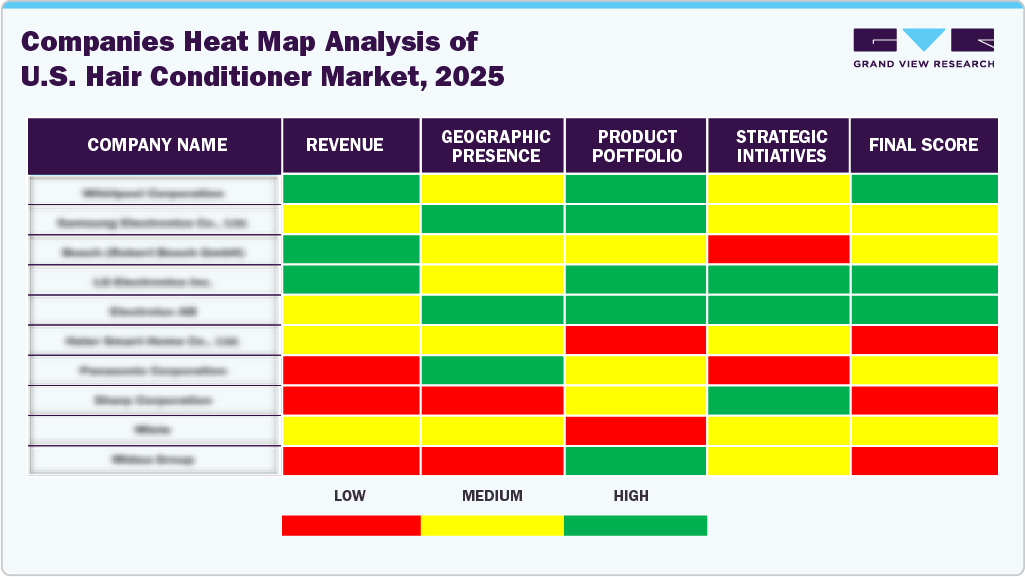
 The market is characterized by competition across mass, mid-range, premium, and professional price points, with major beauty and consumer-goods companies using established brands to address increasingly specific hair-care needs. L'Oréal, P&G, Unilever, Henkel, Kao, Estée Lauder, Coty, Kenvue, Revlon, and Amway participate through portfolios spanning everyday rinse-out conditioners, leave-in treatments, deep-conditioning products, repair-focused formulations, curl and texture care, moisture, color protection, and salon-oriented solutions. Competition is shifting beyond basic conditioning toward complete hair-care routines, with brands using formulation technology, targeted benefits, premium positioning, product-format extensions, and omnichannel distribution to differentiate their offerings.
-
Broad brand portfolios create coverage across conditioner formats and price points: Competition in the U.S. market is supported by brands that span conventional rinse-out conditioners, deep conditioners, leave-in conditioners, masks, and treatment conditioners. L’Oréal participates through brands such as L’Oréal Paris, Elvive, Garnier, Redken, Matrix, and Kérastase, while P&G competes through Pantene and Herbal Essences. Unilever participates through Dove, TRESemmé, Nexxus, and SheaMoisture, while Henkel’s U.S. portfolio includes Schwarzkopf, Not Your Mother’s, and OLAPLEX. This breadth enables companies to address multiple conditioner occasions, from everyday post-shampoo conditioning to intensive repair, curl care, and premium treatment routines.
-
Conditioner positioning is becoming increasingly benefit-led: U.S. conditioner brands are differentiating products around specific hair concerns rather than relying primarily on general softness and manageability claims. Damage repair, breakage, dryness, frizz, curl definition, color protection, heat exposure, and strengthening are increasingly used to define conditioner propositions. For example, Redken Acidic Bonding Concentrate positions its conditioner around bond care and damage repair, while Pantene offers conditioner variants focused on moisture, strengthening, repair, and other targeted needs. This allows brands to create more specialized conditioner SKUs for consumers with distinct hair conditions and routines.
-
Conditioners are increasingly positioned as part of complete treatment routines: Leading brands are connecting conditioners with complementary shampoo, leave-in, mask, oil, and treatment products rather than positioning the conditioner as an isolated product. In the U.S., this supports conditioner cross-selling through coordinated ranges such as shampoo-plus-conditioner systems and multi-step repair routines. Premium brands such as OLAPLEX particularly emphasize treatment-led hair routines, with the brand's acquisition by Henkel strengthening its presence across professional, specialty retail, and e-commerce channels.
-
Innovation is expanding beyond conventional rinse-out conditioners: Product development in the U.S. conditioner market is increasingly moving toward intensive repair, bond-building, heat protection, hydration, curl definition, and leave-in conditioning. Unilever, for example, highlighted the rollout of Dove's renovated hair-care range using BioProtein Care technology in the U.S., while K18 launched HeatBounce with heat-shielding technology. These developments broaden the functional role of conditioning products and create opportunities for brands to capture spending beyond the traditional rinse-out conditioner.
-
Mass-market brands compete through accessibility, replenishment, and conditioner–shampoo pairing: Mass-market conditioner remains highly relevant because the product is typically purchased as a recurring companion to shampoo. Brands such as Pantene, Herbal Essences, Dove, and TRESemmé use broad retail availability, multiple pack sizes, promotional pricing, and coordinated shampoo-conditioner ranges to maintain visibility across supermarkets, mass merchants, drugstores, and e-commerce. This creates a competitive environment in which established brands can defend volume through convenience and accessible price points while introducing specialized variants within their existing conditioner ranges.
-
Premium and professional channels are expanding the higher-value conditioner segment: U.S. conditioner competition extends beyond mass retail into salons, specialty beauty stores, professional distribution, and e-commerce. Redken, Matrix, and Kérastase provide L’Oréal with access to professional and premium consumers, while OLAPLEX has an established presence across professional, specialty retail, and e-commerce channels. Henkel's acquisition of OLAPLEX therefore expands its participation in premium conditioner and treatment-led propositions, particularly where consumers are seeking professional-oriented repair and performance benefits.
The competitive landscape is therefore evolving from a traditional battle among shampoo-and-conditioner brands toward competition between complete hair-care ecosystems. Established mass players retain advantages in distribution, brand recognition, and accessible pricing, while premium and professional brands are using treatment efficacy, formulation technology, and specialized hair concerns to support higher-value propositions. The expansion of leave-in and deep-conditioning formats, targeted products for specific textures and damage conditions, and increasing integration of e-commerce and professional channels provide additional avenues for differentiation. Companies with the ability to combine broad distribution with specialized formulations and cohesive multi-product routines are positioned to participate across more consumer needs and price points.
 To learn more about this report, Download Free Sample Report
 Key U.S. Hair Conditioner Companies
-
L'Oréal S.A.
-
The Procter & Gamble Company (P&G)
-
Unilever PLC
-
Henkel AG & Co. KGaA
-
The Estée Lauder Companies Inc.
-
Kao Corporation
-
Coty Inc.
-
Kenvue Inc.
-
Revlon, Inc.
-
Amway Corporation
Competitive Benchmarking
Category
Operating Strategies
Competitive Edge
Weakness
Established Players (L'Oréal S.A.; The Procter & Gamble Company (P&G); Unilever PLC; Henkel AG & Co. KGaA; Kao Corporation; Kenvue Inc.)
- Maintain broad conditioner portfolios spanning rinse-out, leave-in, deep-conditioning, and specialized formulations across mass, mid-range, and premium price tiers. Strengthen distribution through mass retailers, supermarkets, pharmacies, specialty beauty stores, and e-commerce platforms. Invest in product innovation around hair repair, moisture, scalp care, damage protection, natural ingredients, and personalized hair-care solutions while leveraging established brand portfolios and advertising capabilities.
- Strong brand recognition, extensive product portfolios, large-scale manufacturing capabilities, and broad distribution networks across the U.S. hair-care market. Significant R&D resources and marketing budgets enable frequent product launches, reformulations, and targeted offerings for different hair types and consumer needs.
- Large organizational structures can result in longer product development and decision-making cycles. High exposure to raw material costs, intense competition across mass and premium conditioner categories, and the need for continuous marketing investment can pressure margins.
Premium & Beauty-Focused and Diversified & Direct-Selling Players (The Estée Lauder Companies Inc.; Coty Inc.; Revlon, Inc., Amway Corporation)
- Focus on premium and specialized hair-conditioning products positioned around salon-quality performance, repair, nourishment, color protection, luxury ingredients, and targeted hair concerns. Expand through specialty beauty retailers, salons, department stores, and direct-to-consumer channels while using celebrity, professional, and influencer-led marketing to strengthen brand positioning.
- Leverage direct-selling networks, independent distributors, digital commerce, and relationship-based marketing to reach consumers. Develop hair-care products emphasizing ingredient positioning, everyday conditioning, hair nourishment, and broader personal-care routines while using cross-category product portfolios to increase consumer engagement and repeat purchases.
- Strong expertise in premium beauty, brand building, formulation innovation, and consumer-oriented product positioning. Established relationships with beauty retailers, salons, and professional channels support premium pricing and access to higher-value consumers.
- Extensive direct-selling infrastructure, established consumer relationships, and the ability to combine digital and distributor-led sales. Diversification across personal-care categories provides opportunities for cross-selling and supports recurring purchases.
- Greater dependence on discretionary consumer spending and premium beauty demand can increase vulnerability during economic slowdowns. Relatively higher price points may limit penetration among mass-market consumers and increase sensitivity to competitive private-label and mass-market alternatives.
- Greater reliance on distributor networks and relationship-based selling can limit visibility compared with brands with extensive mass-retail presence. Maintaining distributor engagement and competing for consumer attention across increasingly digital and omnichannel hair-care channels can create additional challenges.
Recent Developments
-
In September 2026, Diane Perfect Beauty launched nationwide at Target in the U.S., introducing five collections comprising 10 shampoo and conditioner products priced at approximately USD 15.00 each. The Japanese hair-care brand positioned the range around ingredient-rich, salon-performance formulas, expanding its U.S. presence through Target Beauty Studio and Target.com. The launch illustrates how international hair-care brands are using major U.S. mass retailers to introduce premium-accessible conditioner propositions to American consumers.
-
In June 2026, e.l.f. Beauty entered the U.S. hair-care market with e.l.f. Hair, including a conditioner alongside shampoo, treatment oil, anti-frizz spray, styling cream, and styling cream wand. The six-product range was priced at approximately USD 6 to USD 10 and rolled out through TikTok Shop and Target, with Target serving as the exclusive U.S. retail partner. The launch brings e.l.f.’s affordable, digitally driven beauty positioning into conditioners and increases competition in the accessible-price segment.
-
In May 2026, Dove launched its UV Repair & Glow Collection in the U.S., including Dove UV Repair & Glow Conditioner at a suggested retail price of USD 5.99 for 18 oz. The conditioner is positioned around smoothing and sealing the cuticle, locking in moisture, strengthening hair, and enhancing shine, while the broader collection addresses UV-related hair damage. The launch highlights growing conditioner innovation around environmental protection and multifunctional repair benefits.
-
In March 2026, Schwarzkopf launched its KERATÎME Care & Styling collection exclusively at Walmart in the U.S., extending its portfolio into professional-inspired hair repair and bonding care. The collection includes conditioner-led care propositions across Deep Repair and Color Protect routines and is powered by the brand’s Multiplex Bonding Technology. Priced at approximately USD 14.97, the launch combines repair-focused conditioning with mass-retail accessibility and reflects increasing competition around bond-building and damaged-hair solutions.
-
In March 2026, Suave introduced its Hydra Gloss and Moisture Repair hair-care collections as part of a 36-product U.S. innovation rollout, with products priced below USD 6. The sulfate-free ranges emphasize hydration, shine, and moisture repair, strengthening Suave’s value-oriented positioning against higher-priced hair-care systems. The development demonstrates continued innovation in affordable conditioner propositions, particularly around premium-inspired performance claims at mass-market price points.
-
In March 2026, Hairitage by Mindy introduced its Next Gen shampoos and conditioners exclusively at Walmart in the U.S. The conditioner range was positioned around simplified formulations containing 12 or fewer ingredients, while being free from sulfates, parabens, phthalates, silicones, mineral oil, and gluten. The launch reflects continued demand for ingredient-conscious conditioner products that combine clean-positioning claims with accessible mass-retail distribution.
Hair Conditioner Market Report Scope
Report Attribute
Details
Market size in 2025
USD 6.1 billion
Estimated market size in 2026
USD 6.4 billion
Estimated market size in 2026
USD 10.1 billion
Growth rate
CAGR of 6.6% from 2026 to 2033
Actuals
2021 - 2025
Forecast period
2026 - 2033
Quantitative units
Revenue in USD billion and CAGR from 2026 to 2033
Report coverage
Revenue forecast, company ranking, competitive landscape, growth factors, and trends
Segments covered
Product, price tier, gender, distribution channel
Key companies profiled
L'Oréal S.A.; The Procter & Gamble Company (P&G); Unilever PLC; Henkel AG & Co. KGaA; The Estée Lauder Companies Inc.; Kao Corporation; Coty Inc.; Kenvue Inc.; Revlon, Inc.; Amway Corporation
Customization scope
Free report customization (equivalent up to 8 analysts’ working days) with purchase. Addition or alteration to country, regional & segment scope.
Pricing and purchase options
Avail customized purchase options to meet your exact research needs. Explore purchase options
U.S. Hair Conditioner Market Report Segmentation
This report forecasts revenue growth at the country level and provides an analysis of the latest trends and opportunities in each of the sub-segments from 2021 to 2033. For this study, Grand View Research has segmented the U.S. hair conditioner market report based on product, price tier, gender, and distribution channel:
-
Product Outlook (Revenue, USD Billion, 2021 - 2033)
-
Rinse-out Conditioners
-
Leave-in Conditioners
-
Deep Conditioners
-
Others
-
-
Price Tier Outlook (Revenue, USD Billion, 2021 - 2033)
-
Mass
-
Mid-Range
-
Premium
-
-
Gender Outlook (Revenue, USD Billion, 2021 - 2033)
-
Men
-
Women
-
-
Distribution Channel Outlook (Revenue, USD Billion, 2021 - 2033)
-
Hypermarkets & Supermarkets
-
Specialty Beauty Stores
-
Pharmacies & Drugstores
-
Online/E-commerce
-
Others
-
Research Methodology
The U.S hair conditioner market figures in this report are based on a proven research process that combines executive interviews with secondary research from proprietary databases, company filings, and recognized regulatory and institutional sources. Market size is built through value-chain sizing-reconciling supply-side and demand-side estimates-and triangulated with bottom-up and top-down approaches. Every estimate passes multiple levels of expert validation before publication, with each U.S. hair conditioner segment quantified using the revenue-capture definitions in the table below.
Segment Definition
Segment - Product
Revenue capture definition
Rinse-out Conditioners
The scope covers hair conditioners designed to be applied after shampooing and rinsed from the hair. It includes moisturizing, smoothing, volumizing, strengthening, anti-frizz, color-protecting, and damage-repair formulations. Products marketed for different hair types, textures, concerns, and usage occasions are included across mass, mid-range, and premium price tiers.
Leave-in Conditioners
The scope covers conditioner formulations designed to remain on the hair without rinsing after application. It includes creams, sprays, lotions, milks, and similar leave-in formats offering detangling, hydration, frizz control, heat protection, strengthening, and styling-related benefits. Products for different hair textures, lengths, and consumer needs are included.
Deep Conditioners
The scope covers intensive conditioning products formulated for extended application to provide enhanced moisturization and treatment benefits. It includes deep-conditioning masks, treatment conditioners, repair treatments, and intensive moisturizing formulations addressing dryness, breakage, frizz, chemical damage, and weakened hair. Both rinse-off and treatment-oriented deep-conditioning products are included.
Others
The scope covers hair-conditioning products that do not fall within rinse-out, leave-in, or deep-conditioning categories. It includes co-wash conditioners, cleansing conditioners, 2-in-1 conditioning products, conditioner bars, conditioning treatments, and other specialized formats. Products are assessed across their applicable formulations, usage formats, hair concerns, and consumer applications.
Segment - Price Tier
Revenue capture definition
Mass
The scope covers hair conditioner products positioned for broad consumer accessibility and generally sold at lower price points. It includes rinse-out, leave-in, deep, and other conditioner formats available through mass-market retailers, supermarkets, drugstores, and online platforms. Products from mass-market and value-oriented brands are included within this tier.
Mid-Range
The scope covers hair conditioner products positioned between mass-market and premium offerings in terms of pricing and product positioning. It includes formulations across rinse-out, leave-in, deep, and other conditioner categories, incorporating specialized ingredients, targeted benefits, and enhanced formulations sold through retail, beauty, pharmacy, and online channels.
Premium
The scope covers higher-priced hair conditioner products positioned through specialized formulations, ingredients, brand positioning, packaging, or targeted performance benefits. It includes premium rinse-out, leave-in, deep, and other conditioning products sold through specialty beauty retailers, department stores, brand-owned channels, salons, and e-commerce platforms.
Segment - Gender
Revenue capture definition
Men
The scope covers hair conditioners specifically marketed, formulated, or positioned for male consumers. It includes rinse-out, leave-in, deep, and other conditioning products addressing hydration, scalp and hair care, damage repair, frizz management, grooming, and styling needs. Products sold through physical retail, specialty, pharmacy, and online channels are included.
Women
The scope covers hair conditioners specifically marketed, formulated, or positioned for female consumers. It includes rinse-out, leave-in, deep, and other conditioning products addressing hydration, damage repair, frizz control, detangling, color protection, strengthening, and styling-related needs. Products across price tiers, formulations, formats, and distribution channels are included.
Segment - Distribution Channel
Revenue capture definition
Hypermarkets & Supermarkets
The scope covers hair conditioner sales through large-format grocery and general merchandise retailers, including hypermarkets and supermarkets. It includes products sold through physical stores and retailer-operated online platforms where applicable. Sales across rinse-out, leave-in, deep, and other conditioner categories and across mass, mid-range, and premium tiers are included.
Specialty Beauty Stores
The scope covers hair conditioner sales through specialty beauty retailers and dedicated beauty stores offering professional, prestige, or specialized hair-care products. It includes physical and retailer-operated online sales where applicable, covering conditioner products across product formats, price tiers, genders, formulations, and targeted hair-care benefits.
Pharmacies & Drugstores
The scope covers hair conditioner sales through pharmacies and drugstore retailers, including products available through physical outlets and associated digital channels. It includes mass, mid-range, and selected premium conditioners across rinse-out, leave-in, deep, and other formats, covering products positioned for routine hair care and specific hair concerns.
Online/E-commerce
The scope covers hair conditioner sales conducted through digital commerce platforms, including brand-owned websites, online marketplaces, retailer websites, and other e-commerce channels. It includes products across all conditioner formats, price tiers, and consumer groups, encompassing direct-to-consumer and third-party online sales of hair-conditioning products.
Others (Department Stores, etc.)
The scope covers hair conditioner sales through distribution channels outside hypermarkets and supermarkets, specialty beauty stores, pharmacies and drugstores, and online/e-commerce platforms. It includes department stores, salons, professional beauty outlets, brand-owned physical stores, and other relevant retail formats through which hair conditioner products are sold.
Estimation Model
Layer
Key Question
Description
Hair-Care Consumer Base Layer
Who has a recurring need for hair conditioner?
The U.S. population with recurring hair-care needs forms the core consumer base. Demographic characteristics, household structure, age, gender, hair type, hair texture, and frequency of hair washing provide the basis for estimating the population using conditioning products. The framework also considers consumers with specific needs such as moisture, damage repair, frizz control, detangling, smoothness, curl definition, and scalp or hair-health concerns.
Conditioner Usage & Product Accessibility Layer
Who regularly uses commercially available hair conditioner?
Conditioner usage is assessed across consumers with access to commercially available products through hypermarkets & supermarkets, specialty beauty stores, pharmacies, drugstores, salons, brand stores, and e-commerce. Product availability is triangulated using retail-channel coverage, retailer assortments, brand portfolios, and online distribution.
Purchase Frequency & Replacement Layer
How frequently is hair conditioner purchased?
Annual conditioner demand is established through conditioner consumption and purchase frequency, incorporating household size, hair-washing frequency, conditioner-use frequency, bottle/package size, product format, and replenishment behavior. Separate usage and purchase assumptions can be applied across mass, mid-range, and premium products, while accounting for differences between rinse-out, leave-in, deep-conditioning, and other products.
Monetisation Layer
How much is spent on hair conditioner products?
Annual conditioner unit demand is multiplied by blended selling prices across product type and price tiers. Revenue is differentiated across mass, mid-range, and premium offerings, with additional consideration for pack sizes, specialty formulations, treatment-oriented conditioners, premium ingredients, and higher-priced products.
Delivered Customizations
This report has been delivered with the following In-depth customizations
Client Request
Customization Delivered
Value Adds
Cross-Segmentation Analysis of Conditioner Products Across Price Tiers and Consumer Groups
Detailed cross-segmentation of the U.S. hair conditioner industry across Rinse-out Conditioners, Leave-in Conditioners, Deep Conditioners, and Others, mapped against Mass, Mid-Range, and Premium price tiers. The analysis can further cross-map product types against Men and Women and evaluate how each conditioner format is positioned across consumer groups.
Identifies where premiumization is concentrated, whether premium demand is stronger in treatment-oriented formats such as leave-in and deep conditioners, and how product positioning differs between male and female consumers. This also highlights white spaces for targeted formulations and price-tier expansion.
Brand & Product Portfolio Benchmarking
Comprehensive benchmarking of major U.S. conditioner companies and brands, including P&G, L'Oréal, Unilever, Henkel, Kenvue, Church & Dwight, Kao, John Paul Mitchell Systems, Wella, and relevant independent/premium brands. Benchmarking covers product format, price point, pack size, claims, ingredients, target consumer, distribution presence, and premium/mass positioning. SKU-level benchmarking can be incorporated for leading conditioner products.
Helps distinguish mass-market scale players from premium and specialist brands, while showing how companies compete through repair, hydration, frizz control, color protection, curl care, scalp/hair-health claims, clean ingredients, and specialized formulations. It also identifies portfolio gaps and areas of product differentiation.
Pricing, Consumer Need-State & Distribution Opportunity Mapping
Assessment of conditioner pricing across Mass, Mid-Range, and Premium tiers, linked with product formats and major distribution channels including Hypermarkets & Supermarkets, Specialty Beauty Stores, Pharmacies & Drugstores, Online/E-commerce, and Others. The analysis can additionally map major conditioner need-states such as moisturization, damage repair, frizz control, color protection, curl definition, strengthening, and scalp/hair-health support against product and channel positioning.
Shows where consumers trade up for specialized or treatment-oriented conditioners, which formats are more suitable for mass retail versus specialty and online channels, and where premium products can command higher price points. Online channels are particularly useful for analyzing assortment depth, reviews, product education, and specialized-conditioner discovery.
Frequently Asked Questions About This Report
Key factors include conditioner remains a high-frequency haircare category closely linked to shampoo usage, but its role is expanding from basic softening and detangling toward moisture retention, damage repair, frizz control, strengthening, heat protection, curl definition, color protection, and overall hair manageability.
The rinse-out conditioners segment dominated the market, accounting for a 57.3% revenue share in 2025, while leave-in conditioners segment is the fastest growing product.
The mass price tier accounted for the largest revenue market share, representing 57.8% of revenue in 2025, while mid-range conditioners segment is the fastest growing price tier.
The women segment dominated the market with a 71.0% revenue share in 2025, while the men segment is the fastest-growing gender.
The U.S. hair conditioner market size was valued at USD 6.1 billion in 2025 and is estimated at USD 6.4 billion in 2026.
The U.S. hair conditioner market is expected to grow at a CAGR of 6.6% from 2026 to 2033, reaching USD 10.1 billion by 2033.
Hypermarkets & supermarkets accounted for the largest market share, representing 34.5% in 2025, while online/e-commerce is the fastest-growing distribution channel.
Key players include L'Oréal S.A.; The Procter & Gamble Company (P&G); Unilever PLC; Henkel AG & Co. KGaA; The Estée Lauder Companies Inc.; Kao Corporation; Coty Inc.; Kenvue Inc.; Revlon, Inc.; Amway Corporation
About the Author(s)
Beauty & Personal Care Research Team
Consumer Goods · Beauty & Personal CareThis report was authored by the beauty & personal care research team at Grand View Research - comprising two research analysts, one senior research analyst, and one industry expert - with specialized expertise in the beauty & personal care segment of the consumer goods industry. All findings are based on proprietary consumer goods databases, executive interviews, and regulatory analysis, subject to internal peer review prior to publication.
Last Updated:
Speak to Analyst

Customize this report to your needs - add regions, segments, or data points, with 20% free customization.
Or view our licence options:


ISO 9001:2015 & 27001:2022 Certified
We are GDPR and CCPA compliant! Your transaction & personal information is safe and secure. For more details, please read our privacy policy.


