- Home
- »
- Next Generation Technologies
- »
-
U.S. Humanoid Robot Market Size & Share Report, 2033GVR Report cover
![U.S. Humanoid Robot Market (2026 - 2033)Report]()
U.S. Humanoid Robot Market (2026 - 2033)
Size, Share & Trends Analysis Report By Component (Hardware, Software), By Application (Manufacturing, Logistics & Warehousing, Healthcare, Hospitality), By Motion Type (Biped, Wheel Drive), By Sales Channel, And Segment Forecasts
Market Size, 2025
$897.6MMarket Estimate, 2026
$1,545.4MMarket Forecast, 2033
$12,766.8MCAGR, 2026–2033
35.2%U.S. Humanoid Robot Market Summary
The U.S. humanoid robot market size was valued at USD 897.6 million in 2025 and is projected to grow from USD 1,545.4 million in 2026 to USD 12,766.8 million by 2033, at a CAGR of 35.2% from 2026 to 2033. The market growth is driven by increasing investments in AI-driven humanoid robotics R&D, expanding use of humanoid robots across industrial and service sectors, rising adoption of Industry 4.0 and automation technologies, growing labor shortages, and continuous advancements in mobility, battery efficiency, and human-robot interaction.
Key Market Trends & Insights
- By component: Hardware segment accounted for the largest revenue share of 69.8% in 2025.
- By motion type: Biped segment dominated the market with the largest revenue share of over 73.9% in 2025
- By application: Manufacturing segment held the largest market share of 31.0% in 2025.
- By sales channel: Direct sales segment accounted for the largest market revenue share in 2025.
Market Size & Forecast
- Market Size in 2025: USD 897.6 Million
- Estimated Market Size in 2026: 1,545.4 Million
- Projected market size by 2033: USD 12,766.8 Million
- CAGR (2026-2033): 35.2%
The humanoid robot industry is expanding rapidly, owing to major advancements in artificial intelligence, machine learning, computer vision, and robotics engineering. These technologies are enabling humanoid robots to perform complex, human-like tasks with greater autonomy and adaptability. Improved perception, reasoning, and Motion Type control capabilities are making robots more effective in dynamic environments. As a result, humanoid robots are increasingly moving closer to practical, real-world deployment across multiple sectors.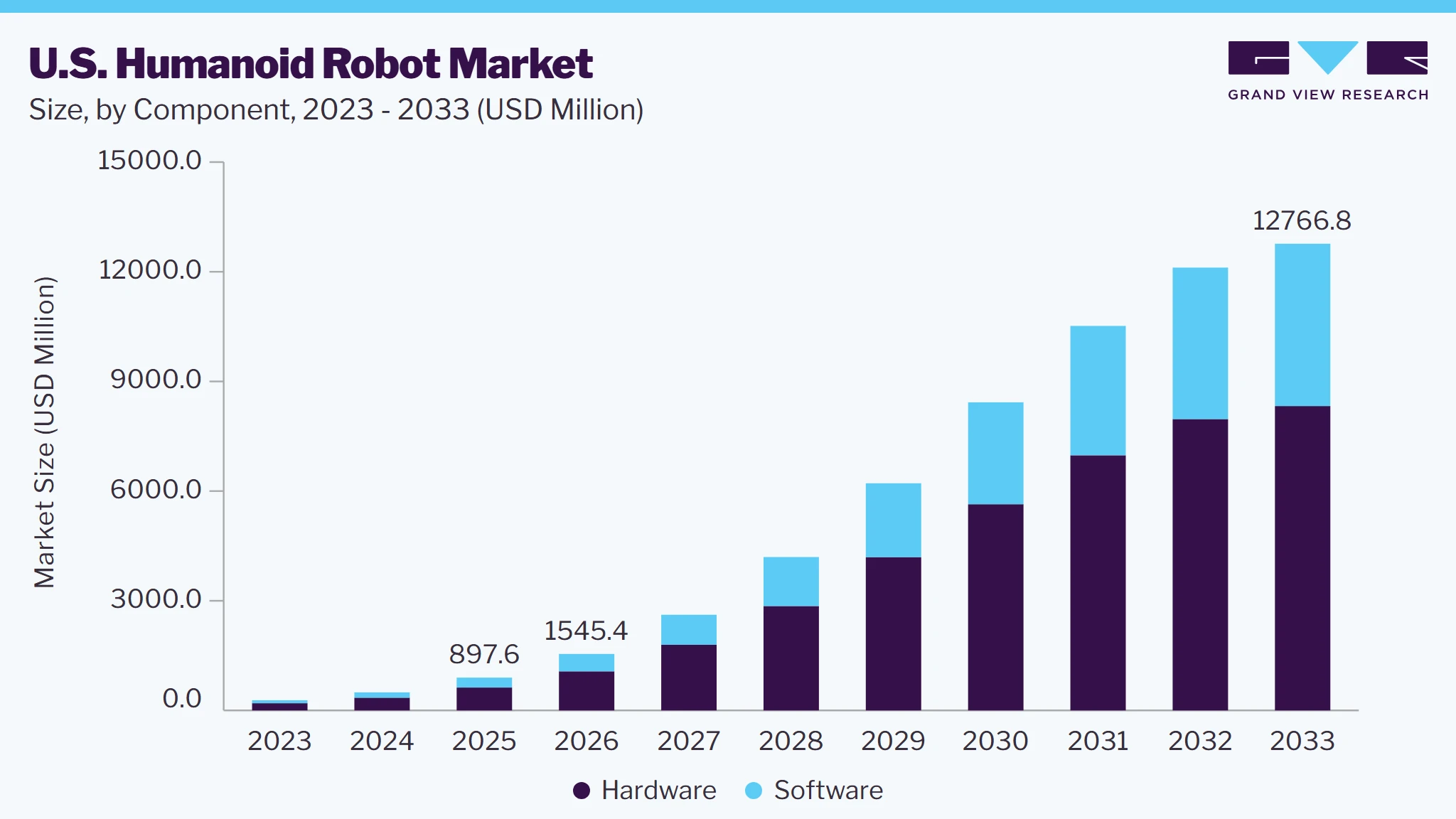
In addition, the growing adoption of advanced artificial intelligence and robotic perception technologies is expected to enhance robotic autonomy, improve operational precision, and enable humanoid robots to operate safely in dynamic industrial and human-centric environments. Growing focus on intelligent automation, human-robot collaboration, and workplace safety, along with digital transformation across manufacturing, logistics, healthcare, and retail, is driving investment in humanoid robotic platforms and supporting growth in the humanoid robotics industry.
Furthermore, the labor shortage across industries such as manufacturing, logistics, healthcare, and retail is becoming increasingly critical. This challenge is being intensified by aging populations and a declining pool of skilled workers in many regions. Humanoid robots are emerging as an effective solution to handle repetitive, physically demanding, and hazardous tasks. Their ability to seamlessly operate within existing human-centric environments further enhances their adoption potential.
Moreover, the application scope of humanoid robots is expanding beyond industrial settings into service-oriented sectors. Industries such as hospitality, education, defense & security, and personal assistance are increasingly using humanoid robots for interactive, customer-facing roles. These applications include customer service, training assistance, surveillance, and companionship services. This diversification is significantly widening the humanoid robot industry's potential and expanding the overall demand base.
Market Dynamics
The rapid advancement and adoption of AI-driven robotics technologies are significantly fueling demand for humanoid robots across manufacturing, logistics, healthcare, retail, and service-oriented industries. Organizations are increasingly integrating humanoid robots to automate repetitive and labor-intensive tasks, enhance operational efficiency, and mitigate persistent workforce shortages.
For instance, in February 2026, Agility Robotics expanded the deployment of its humanoid robot, Digit, at Toyota Motor Corporation’s Canada facility for warehouse and production support tasks such as tote handling and material movement. This reflects growing adoption of AI-powered humanoid robots to automate repetitive work, improve efficiency, and address labor shortages in manufacturing and logistics.
Furthermore, the growing advancements in generative AI, edge computing, and real-time data analytics are enhancing decision-making capabilities and operational intelligence, thereby supporting the large-scale commercialization and integration of humanoid robots across diverse end-use industries. Overall, the ongoing advancements are accelerating the widespread adoption and commercialization of humanoid robots.
The humanoid robot industry faces substantial challenges due to the high development costs and technical complexity of advanced robotic systems. Advanced components such as precision actuators, high-resolution sensors, AI processing units, and energy-efficient power systems significantly increase the overall cost of humanoid robots. In addition, the integration of complex hardware and software systems requires specialized expertise, further raising development expenses and limiting affordability for many end users.
Moreover, the lack of standardization across robotics platforms adds to technical complexity and slows down large-scale commercialization. Many enterprises face challenges with system compatibility, maintenance, and lengthy deployment cycles, which limit widespread adoption. These factors collectively make it difficult for small and mid-sized organizations to invest in humanoid robotics solutions at scale.
A significant opportunity in the U.S. humanoid robot industry is the growing investment from governments, tech giants, and startups in artificial intelligence and advanced robotics development. These investments are accelerating research and development to improve the intelligence, mobility, and energy efficiency of humanoid robots. Strong funding support is also enabling faster prototyping, testing, and commercialization of next-generation humanoid platforms.
In addition, the growing collaboration between robotics companies, AI developers, and academic institutions is fostering innovation and technological breakthroughs. This is leading to the development of more capable, affordable, and scalable humanoid robots that can be deployed across diverse industries. With expanding R&D efforts, the market is expected to witness faster product evolution and wider commercial adoption.
Market Concentration & Characteristics:
The U.S. humanoid robot industry is moderately concentrated, with a mix of established robotics companies, diversified technology giants, and emerging startups actively competing for technological leadership and commercialization. The market is characterized by a high degree of innovation, driven by rapid advancements in AI, machine learning, computer vision, and robotics hardware, which are continuously improving humanoid capabilities and expanding real-world applications.
In addition, the level of M&A activities is medium, as strategic partnerships and selective acquisitions are increasing, but the market is still in an early-to-growth stage where organic R&D remains dominant. The impact of regulations is low to medium, as most regions are still developing dedicated frameworks for humanoid robotics, though safety and AI governance standards are gradually evolving.
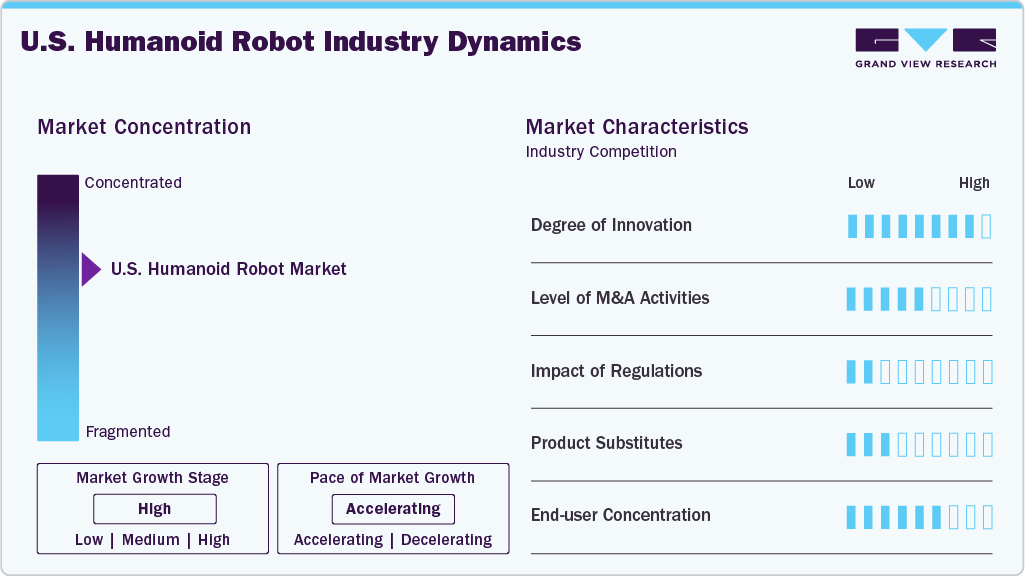
Furthermore, the threat of product substitutes is medium, as traditional industrial robots, collaborative robots (cobots), and software automation solutions can partially replace humanoid robots in certain applications. Moreover, end-user concentration is medium to high, as early adoption is primarily driven by industries such as manufacturing, logistics, and technology-forward enterprises, while broader adoption in the consumer and service sectors is still emerging.
Analyst Perspective
The U.S. humanoid robot market is poised for strong growth, driven by rapid advancements in artificial intelligence, increasing labor shortages, rising demand for industrial automation, and the growing need for robots capable of operating in human-centric environments. Enterprises are accelerating investments in humanoid robots for manufacturing, logistics, warehousing, healthcare, retail, hospitality, and other service applications to improve productivity, operational flexibility, and workforce efficiency. The growing commercialization of general-purpose humanoid robots and increasing investments from technology companies, automotive manufacturers, and robotics startups are further supporting market expansion. Furthermore, advancements in generative AI, computer vision, natural language processing, motion control, dexterous manipulation, sensors, and battery technologies are improving the autonomy, adaptability, and human-robot interaction capabilities of humanoid systems.
Component Insights
The hardware segment led the market with the largest revenue share of 69.8% in 2025, driven by the high cost, complexity, and essential role of physical components in building humanoid robots. Key elements such as advanced sensors, actuators, control systems, power supply units, and precision-engineered structural frameworks form the core foundation of these robots and significantly contribute to overall system value. The ongoing enhancements in materials, robotics engineering, and motion type control technologies are further strengthening the demand for advanced hardware.
The software segment is expected to grow at the fastest CAGR of 37.6% from 2026 to 2033. This growth is attributed to rapid advancements in artificial intelligence, machine learning, deep learning, and robotic operating systems that are enhancing the cognitive and functional capabilities of humanoid robots. Furthermore, the rising demand for autonomous decision-making, adaptive learning systems, and enhanced human-robot collaboration is driving continuous innovation in robotics software platforms, thereby accelerating deployment across industrial and service applications.
Motion Type Insights
The biped motion type segment led the market with the largest revenue share of 73.9% in 2025 and is anticipated to grow at the fastest CAGR during the forecast period, driven by its ability to replicate human locomotion, enabling humanoid robots to navigate environments designed for people, such as stairs, uneven terrain, and narrow pathways. In addition, the increasing demand for human-like interaction in industrial, service, and defense applications is further supporting the adoption of biped humanoid robots, as they can seamlessly integrate into human-centric workflows without requiring infrastructure modifications.
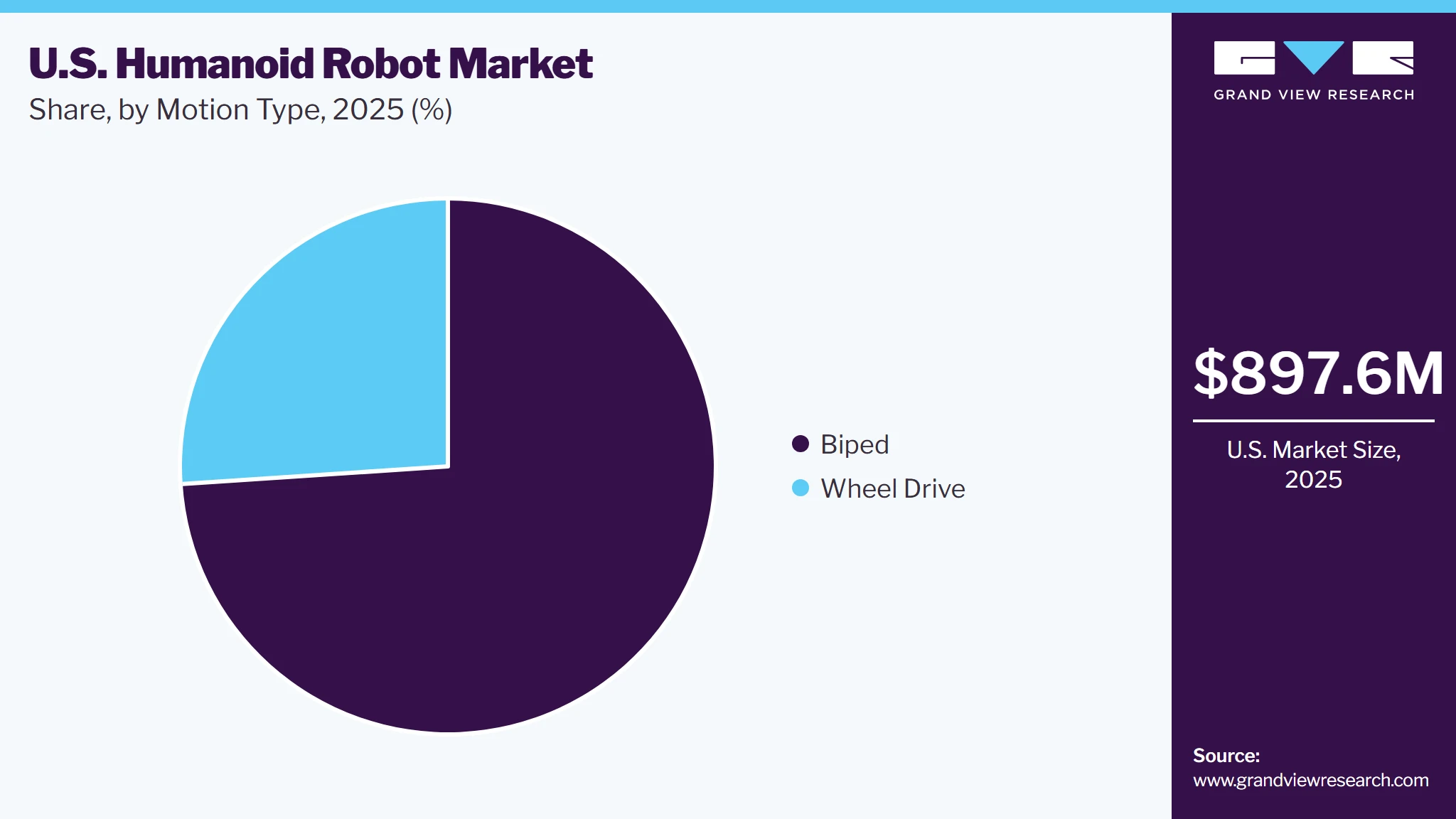
The wheel drive segment is expected to witness at a significant CAGR from 2026 to 2033. This growth is attributed to continuous improvements in autonomous navigation, sensor fusion, and AI-based path planning, which are enhancing operational efficiency and enabling reliable performance in repetitive material-handling and service tasks. Furthermore, their lower cost, higher energy efficiency, and ease of deployment in structured environments such as warehouses and retail spaces are further accelerating adoption across industrial applications.
Application Insights
The manufacturing segment accounted for the largest market revenue share of 31.0% in 2025, driven by the increasing need for automation in repetitive, precision-based, and hazardous industrial tasks such as assembly, inspection, welding support, and material handling. In addition, rising labor shortages and growing pressure to improve productivity and operational efficiency are encouraging manufacturers to adopt humanoid robots that can seamlessly operate in existing factory environments, which is further driving the segmental growth.
The retail & e-commerce segment is expected to grow at the fastest CAGR from 2026 to 2033. This growth is attributed to the increasing adoption of humanoid robots for customer assistance, inventory management, order fulfillment, product handling, and in-store operations as retailers focus on improving operational efficiency and customer experience. Furthermore, continuous advancements in AI, computer vision, autonomous navigation, and human-robot interaction are making humanoid robots more capable of performing dynamic retail and warehouse tasks, supporting long-term adoption across retail stores, fulfillment centers, and e-commerce operations.
Sales Channel Insights
The direct sales segment accounted for the largest market revenue share in 2025, driven by the preference of large enterprises and industrial customers to procure humanoid robots directly from manufacturers for customized, high-value, and application-specific deployments. Direct engagement enables customers to access tailored robotic solutions, technical consultation, system integration, training, and dedicated after-sales support.
The distribution sales segment is expected to grow at the fastest CAGR of over 39% from 2026 to 2033. This growth is attributed to the expanding network of robotics distributors, system integrators, and specialized technology resellers that are improving access to the humanoid robots across industrial, commercial, healthcare, and service applications. Furthermore, growing demand for localized sales support, product demonstrations, customization, installation, and after-sales services is encouraging manufacturers to strengthen their distribution partnerships.
Key U.S. Humanoid Robot Company Insights
Some of the key players operating in the market are SoftBank Robotics and UBTECH Robotics Inc., among others.
-
SoftBank Robotics is a Japan-based robotics company that develops humanoid and service robots for human interaction and commercial use cases. It is known for robots such as Pepper and NAO, which are widely deployed in education, retail, hospitality, and research settings. In the humanoid robot market, SoftBank Robotics plays an important role in the early-stage commercialization of social humanoids, focusing on customer interaction, service automation, and enterprise-level robot deployment across the markets.
-
UBTECH Robotics Inc. is a U.S.-based robotics company developing AI-powered humanoid robots and intelligent service robotics systems. The company has created advanced humanoids such as the Walker series, designed for household assistance, education, and industrial environments. In the humanoid robot market, UBTECH is a key Chinese player focused on scaling the adoption of humanoid robots, integrating AI, computer vision, and motion control technologies to expand use cases across consumer and enterprise segments.
1X Technologies and Engineered Arts Limited are some of the emerging participants in the U.S. humanoid robot industry.
-
1X Technologies is a robotics technology provider developing AI-driven humanoid robots designed for real-world environments. The company builds general-purpose humanoids such as NEO, aimed at home assistance and service tasks, with a focus on human-centric design and autonomous learning capabilities. In the humanoid robot market, 1X Technologies is positioned as an emerging player targeting household robotics and labor-assist applications, using advanced AI and actuation systems to enable practical real-world deployment.
-
Engineered Arts Limited is an emerging robotics company specializing in highly expressive humanoid robots designed for entertainment, research, and AI interaction applications. The company’s Ameca humanoid platform, known for advanced facial animation, modular robotic architecture, and realistic human-like expressions, supports next-generation human-machine communication and immersive robotic interactions. Continuous investments in AI-integrated robotics software and interactive humanoid systems are strengthening Engineered Arts Limited’s market presence in the humanoid robot industry.
Key U.S. Humanoid Robot Companies:
The following key companies have been profiled for this study on the U.S. humanoid robot market.
-
1X Technologies
-
Agility Robotics, LLC
-
Apptronik
-
Boston Dynamics
-
Engineered Arts Limited
-
Figure AI
-
Fourier Intelligence
-
Hanson Robotics Limited
-
Honda Motor Co., Ltd.
-
Kawada Robotics Corporation
-
Kepler Robotics (Hangzhou Kolin Electric Co., Ltd.)
-
LimX Dynamics Inc.
-
NVIDIA Corporation
-
National Aeronautics and Space Administration (NASA)
-
PAL Robotics S.L.
-
Promobot Corp.
-
Robo Garage Co., Ltd.
-
RobotEra
-
ROBOTIS Co., Ltd.
-
Samsung Electronics Co., Ltd.
-
Sanctuary Cognitive Systems Corporation
-
SoftBank Robotics Group Corp.
-
Tesla, Inc.
-
Toshiba
-
Toyota Motor Corporation
-
UBTECH Robotics Inc.
-
Unitree
-
WowWee Group Limited
-
Xiaomi
-
XPENG, Inc.
Competitive Benchmarking
Category
Operating Strategies
Competitive Edge
Weakness
Established Players: SoftBank Robotics, UBTECH Robotics Inc., Agility Robotics, LLC
- Focus on expanding AI-powered service robotics ecosystems through cloud and automation partnerships.
- Invest heavily in humanoid robotics R&D for scalable customer interaction and healthcare solutions.
- Strong deployment network supports large-scale humanoid robot commercialization.
- Advanced conversational AI capabilities strengthen personalized human-robot interaction and operational efficiency leadership.
- Dependence on service robotics markets may limit diversification across industrial automation applications.
- High operational costs can reduce profitability amid increasing competition from emerging robotics startups.
Emerging Players: Engineered Arts Limited, Promobot Corp., Robo Garage Co., Ltd
- Focus on advancing AI-powered humanoid robotics through automation, conversational AI, and research partnerships.
- Invest heavily in expressive robotics, intelligent mobility systems, and scalable humanoid platform development.
- Advanced human-robot interaction technologies strengthen personalization, engagement, and immersive communication.
- Flexible innovation-driven business models support rapid humanoid robotics customization across emerging commercial applications.
- Limited manufacturing scale may restrict large-volume humanoid robot commercialization and market penetration.
- Smaller operational structures can face funding limitations against established multinational robotics technology competitors.
Recent Developments
-
In June 2026, NVIDIA Corporation unveiled a humanoid robotics reference platform (Isaac GR00T / H2+) in partnership with Unitree and Sharpa, designed to accelerate development of general-purpose humanoid robots
-
In May 2026, Tesla expanded deployment of its humanoid robot Optimus Gen 3 at the Fremont factory, with reports indicating 1,000+ units operating on live production lines performing tasks such as battery handling, parts sorting, and assembly support.
-
In May 2026, SoftBank Robotics expanded its strategic partnership with Direct Supply to accelerate the deployment of autonomous robotic solutions across senior living communities in North America. The initiative focuses on integrating AI-powered service robotics, autonomous floor care systems, and physical AI programs to improve operational efficiency, reduce labor dependency, and enhance resident experiences, thereby supporting the sustained expansion of the humanoid robot market.
U.S. Humanoid Robot Market Report Scope:
Report Attribute
Details
Market size value in 2025
USD 897.6 million
Estimated Market Size in 2026
USD 1,545.4 million
Projected market size by 2033
USD 12,766.8 million
Growth rate
CAGR of 35.2% from 2026 to 2033
Base year for estimation
2025
Historical data
2021 - 2024
Forecast period
2026 - 2033
Quantitative units
Revenue in USD million/billion; volume in thousand units, and CAGR from 2026 to 2033
Report Product
Revenue forecast, company ranking, competitive landscape, growth factors, and trends
Segments covered
Component, motion type, application, sales channel
Country scope
U.S.
Key companies profiled
1X Technologies, Agility Robotics, LLC; Apptronik; Boston Dynamics; Engineered Arts Limited; Figure AI; Fourier Intelligence; Hanson Robotics Limited; Honda Motor Co., Ltd.; Kawada Robotics Corporation; Kepler Robotics (Hangzhou Kolin Electric Co., Ltd.); LimX Dynamics Inc.; NVIDIA Corporation; National Aeronautics and Space Administration (NASA); PAL Robotics S.L.; Promobot Corp.; Robo Garage Co., Ltd.; RobotEra; ROBOTIS Co., Ltd.; Samsung Electronics Co., Ltd.; Sanctuary Cognitive Systems Corporation; SoftBank Robotics Group Corp.; Tesla, Inc.; Toshiba; Toyota Motor Corporation; UBTECH Robotics Inc.; Unitree; WowWee Group Limited; Xiaomi; XPENG, Inc.
Customization scope
Free report customization (equivalent to up to 8 analyst’s working days) with purchase. Addition or alteration to country, regional & segment scope.
Pricing and purchase options
Avail customized purchase options to meet you exact research needs. Explore purchase options
U.S. Humanoid Robot Market Report Segmentation
This report forecasts revenue growth at the country level and provides an analysis of the latest technology trends across each sub-segment from 2021 to 2033. For this study, Grand View Research has segmented the U.S. humanoid robot market report based on component, motion type, application & sales channel.
-
Component Outlook (Revenue, USD Million, 2021 - 2033)
-
Hardware
-
Software
-
-
Motion Type Outlook (Volume, Thousand Units; Revenue, USD Million, 2021 - 2033)
-
Biped
-
Wheel Drive
-
-
Application Outlook (Volume, Thousand Units; Revenue, USD Million, 2021 - 2033)
-
Manufacturing
-
Logistics & Warehousing
-
Healthcare
-
Retail & E-commerce
-
Hospitality
-
Education & Research
-
Defense & Security
-
Residential
-
Others
-
-
Sales Channel Outlook (Volume, Thousand Units; Revenue, USD Million, 2021 - 2033)
-
Direct Sale
-
Distribution Sale
-
Research Methodology
The U.S. humanoid robot market figures in this report are based on a proven research process that combines executive interviews with secondary research from proprietary databases, company filings, and recognized regulatory and institutional sources. Market size is built through value-chain sizing-reconciling supply-side and demand-side estimates-and triangulated with bottom-up and top-down approaches. Every estimate passes multiple levels of expert validation before publication, with each U.S. humanoid robot segment quantified using the revenue-capture definitions in the table below.
Segment Definition
Segment - Component
Revenue capture definition
Hardware
Revenue is generated from physical components used in humanoid robots, including actuators, sensors, control systems, power units, robotic frames, and mobility systems. Monetization is driven by hardware sales, system integration, assembly, and deployment of humanoid robotic platforms across industrial and commercial environments.
Software
Revenue is derived from AI-driven software platforms enabling perception, decision-making, motion planning, and human-robot interaction in humanoid robots. Monetization includes licensing, subscriptions, embedded AI models, robotic operating systems, and integration with cloud and edge computing ecosystems.
Segment - Motion Type
Revenue capture definition
Biped
Revenue is generated from humanoid robots designed with two-legged locomotion systems that enable human-like movement in complex environments. Monetization is driven by advanced robotics hardware, AI-based motion control systems, and deployment in industrial, service, and research applications requiring human-centric mobility.
Wheel Drive
Revenue is derived from humanoid robots using wheeled mobility systems that provide stable, energy-efficient movement in structured environments. Monetization includes deployment in logistics, warehousing, retail, and controlled industrial settings where cost efficiency and operational stability are prioritized.
Segment - Industry Vertical
Revenue capture definition
Manufacturing
Revenue is generated from deployment of humanoid robots in industrial environments for tasks such as assembly, inspection, material handling, and production support. Monetization is driven by automation contracts, productivity enhancement solutions, and smart factory integration services.
Logistics & Warehousing
Revenue is derived from humanoid robots used for inventory management, sorting, picking, packing, and internal transportation of goods. Monetization includes warehouse automation systems, fleet deployment, and operational efficiency optimization solutions.
Healthcare
Revenue is generated from humanoid robots used in patient assistance, elderly care, rehabilitation support, and hospital service operations. Monetization is driven by healthcare automation solutions, caregiving services, and assistive robotics deployment.
Retail & E-commerce
Revenue is derived from humanoid robots used for customer assistance, in-store support, inventory management, and order fulfillment tasks. Monetization includes service automation, customer engagement solutions, and retail operational optimization systems.
Hospitality
Revenue is generated from humanoid robots used in hotels, restaurants, and tourism services for guest assistance, concierge services, and service delivery. Monetization is driven by customer experience enhancement and service automation solutions.
Education & Research
Revenue is derived from humanoid robots used in academic training, robotics research, AI experimentation, and skill development programs. Monetization includes educational robotics platforms, research collaborations, and institutional deployments.
Defense & Security
Revenue is generated from humanoid robots used in surveillance, reconnaissance, threat detection, and security operations. Monetization includes defense contracts, security automation systems, and autonomous monitoring solutions.
Residential
Revenue is derived from humanoid robots used in home assistance, companionship, elderly care, and domestic task automation. Monetization includes consumer robotics sales, subscription-based services, and smart home integration.
Others
Revenue is generated from emerging and niche applications of humanoid robots, such as entertainment, personal assistance, and experimental deployments, among others.
Segment - Sales Channel
Revenue capture definition
Direct Sales
Revenue is generated through the direct sale of humanoid robots by manufacturers to end users, including industrial enterprises, logistics companies, healthcare facilities, research institutions, and commercial organizations, without the involvement of third-party distributors or resellers.
Distribution Sales
Revenue is generated through the sale of humanoid robots via third-party distribution channels, including authorized distributors, system integrators, technology resellers, and robotics solution providers that market and sell humanoid robots to end users.
Estimation Model
Layer Name
Key Question
Description
Humanoid Robot Demand Base Layer
What forms the demand base?
Identify the demand for humanoid robots across key end-use sectors, including manufacturing, logistics & warehousing, healthcare, retail, hospitality, construction, defense, education, and domestic services. This layer establishes the total addressable market by assessing labor-intensive processes, automation requirements, workforce shortages, and tasks suitable for human-like robotic intervention.
Adoption & Deployment Penetration Layer
Where are humanoid robots being adopted?
Estimate the penetration of humanoid robots across industries, comparing pilot deployments, commercial-scale implementations, and future adoption potential. Assess adoption rates by geography, enterprise size, and application type, while evaluating factors such as labor economics, automation maturity, technological readiness, and return-on-investment considerations.
Operational Intensity Layer
How extensively are humanoid robots utilized?
Analyze average robot utilization rates, operating hours, fleet sizes, task complexity, autonomy levels, and human-robot collaboration requirements across industries. Operational intensity is influenced by workflow complexity, labor replacement potential, AI capabilities, environmental adaptability, safety requirements, and enterprise automation strategies.
Revenue Layer
How is market revenue generated?
Market revenue is generated through the sale, leasing, and deployment of humanoid robots, as well as recurring revenues from software subscriptions, AI platform licensing, maintenance contracts, system integration, training, fleet management, upgrades, and after-sales support services. Revenue streams are driven by demand from industrial enterprises, logistics providers, healthcare institutions, commercial facilities, government agencies, and consumer applications.
Delivered Customizations
This report has been delivered with the following In-depth customizations
Client Request
Customization Delivered
Value Adds
U.S. Humanoid Robot Market Adoption & Commercialization Trends
Conducted a comprehensive assessment of humanoid robot adoption across manufacturing, logistics & warehousing, healthcare, retail, hospitality, defense, construction, and domestic service sectors. The study evaluated key adoption drivers, labor substitution opportunities, human-robot collaboration requirements, deployment readiness, use-case maturity, and scalability potential across industrial and commercial environments.
Helps stakeholders identify high-growth adoption segments, prioritize investment areas, assess market readiness, and evaluate opportunities arising from workforce shortages, productivity improvement initiatives, and rising demand for automation.
Humanoid Robot Technology Landscape & Innovation Assessment
Evaluated advancements in AI-enabled autonomy, machine vision, sensor fusion, natural language processing, dexterous manipulation, mobility systems, edge computing, battery technologies, and embedded intelligence. Assessed technology maturity levels, development roadmaps, and emerging innovations shaping next-generation humanoid robot capabilities.
Enables stakeholders to understand technology evolution, identify disruptive innovations, benchmark technology leadership, and prioritize R&D investments aligned with future market requirements.
Competitive Benchmarking & Strategic Positioning Analysis
Analyzed leading humanoid robot manufacturers, robotics startups, AI technology providers, and system integrators. Assessed product portfolios, performance capabilities, pricing models, deployment strategies, partnership ecosystems, funding activities, and commercialization progress across markets.
Supports strategic decision-making by identifying competitive advantages, market gaps, partnership opportunities, acquisition targets, and areas for differentiation in a rapidly evolving market landscape.
Frequently Asked Questions About This Report
The hardware segment accounted for the largest share of 69.8% of revenue in 2025, while the software segment is the fastest growing component.
The biped motion type segment led the market with the largest revenue share of 73.9% in 2025 and is the fastest growing motion type.
The manufacturing segment accounted for the largest share, with 26.5% of revenue in 2025, while retail & e-commerce segment is the fastest growing application.
The direct sales segment accounted for the largest share of 71.6% of revenue in 2025, while distribution sales segment is the fastest growing sales channel.
The market growth is driven by increasing investments in AI-driven humanoid robotics R&D, expanding use of humanoid robots across industrial and service sectors, rising adoption of Industry 4.0 and automation technologies, growing labor shortages, and continuous advancements in mobility, battery efficiency, and human-robot interaction.
Some key players operating in the U.S. humanoid robot market include1X Technologies, Agility Robotics, LLC, Apptronik, Boston Dynamics, Engineered Arts Limited, Figure AI, Fourier Intelligence, Hanson Robotics Limited, Honda Motor Co., Ltd., Kawada Robotics Corporation, Kepler Robotics (Hangzhou Kolin Electric Co., Ltd.), LimX Dynamics Inc., NVIDIA Corporation, National Aeronautics and Space Administration (NASA), PAL Robotics S.L., Promobot Corp., Robo Garage Co., Ltd., RobotEra, ROBOTIS Co., Ltd., Samsung Electronics Co., Ltd., Sanctuary Cognitive Systems Corporation, SoftBank Robotics Group Corp., Tesla, Inc., Toshiba, Toyota Motor Corporation, UBTECH Robotics Inc., Unitree, WowWee Group Limited, Xiaomi, and XPENG, Inc.
The U.S. humanoid robot market size was valued at USD 897.6 million in 2025 and is expected to reach USD 1,545.4 million in 2026.
The global U.S. humanoid robot market is expected to grow at a CAGR of 35.2% from 2026 to 2033 to reach USD 12,766.8 million by 2033.
About the Author(s)
Next Generation Technologies Research Team
Technology · Next Generation TechnologiesThis report was authored by the next generation technologies research team at Grand View Research - comprising two research analysts, one senior research analyst, and one industry expert - with specialized expertise in the next generation technologies segment of the technology industry. All findings are based on proprietary technology databases, executive interviews, and regulatory analysis, subject to internal peer review prior to publication.
Last Updated:
Speak to Analyst

Customize this report to your needs — add regions, segments, or data points, with 20% free customization.
Or view our licence options:


ISO 9001:2015 & 27001:2022 Certified
We are GDPR and CCPA compliant! Your transaction & personal information is safe and secure. For more details, please read our privacy policy.