
- Home
- »
- Organic Chemicals
- »
-
U.S. Industrial Gases Market Size, Industry Report, 2033GVR Report cover

U.S. Industrial Gases Market (2026 - 2033) Size, Share & Trends Analysis Report By Product (Oxygen, Nitrogen, Carbon Dioxide), By Application (Healthcare, Manufacturing, Food & Beverages, Chemical & Energy), And Segment Forecasts
U.S. Industrial Gases Market Summary
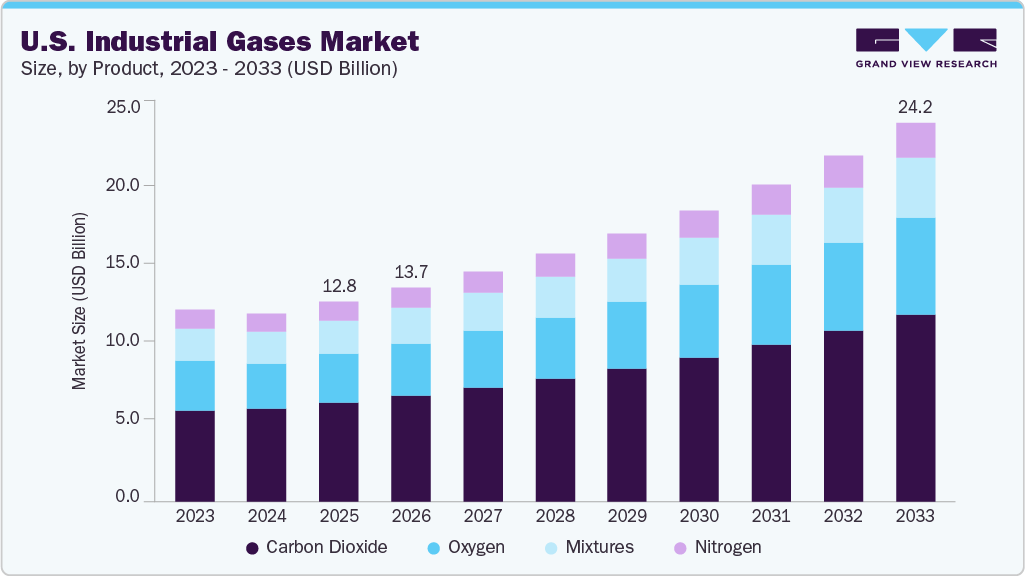
The U.S. industrial gases market size was valued at USD 12.8 billion in 2025 and is expected to reach USD 24.2 billion by 2033, growing at a CAGR of 8.5% from 2026 to 2033. The market is primarily driven by the presence of strong manufacturing and high-tech sectors, especially semiconductors, electronics, aerospace, and chemicals.
Key Market Trends & Insights
- The oxygen segment is expected to grow at a CAGR of 9.0% from 2026 to 2033 in terms of revenue.
- The healthcare application segment dominated the market with the largest revenue share of 27.0% in 2025.
- In 2025, the carbon dioxide segment captured the largest revenue share of 49.5%.
Market Size & Forecast
- 2025 Market Size: USD 12.8 Billion
- 2033 Projected Market Size: USD 24.2 Billion
- CAGR (2026-2033): 8.5%
Three ways to get this report
Buy it, customize it, or ask a question.Ask an Analyst
Analyst response in 1 business day
- AccessReport author, directly
- Reply timeWithin 1 working day
- No sales callDirect answer only
- FormatEmail reply
- CostFree, no cost
Get the Full Report
What the study covers
- FormatsPDF · Excel · Dashboard
- Timeline2026–2033 annual, 2025 base
- Coverage20+ countries, 5 regions
- Companies10+ key players profiled
Customize the Report
20% free customization
- IncludeCountries, segments, points
- TailorTo your product definition
- ExtendDeeper competitor detail
- OrA fully bespoke study
- Turnaround5–10 working days
Nitrogen, argon, and specialty gases are essential for precision manufacturing, including chip fabrication and metal processing. Increased domestic semiconductor production, supported by policies such as the CHIPS and Science Act, is raising demand for ultra-high-purity gases used in cleanroom environments and wafer processing. The accelerating transition toward clean energy and low-carbon industrial processes, which is boosting demand for hydrogen and carbon capture-related gases, is also driving the market.
 Source: Grand View Research, IR Documents, Primary Interviews, Paid DatabasesTo learn more about this report,
 Download Free Sample Report
Investments in hydrogen infrastructure, refining, and mobility applications are creating new demand streams for industrial gas suppliers. For instance, in October 2023, the U.S. Department of Energy announced USD 7 billion in funding for regional hydrogen hubs to scale clean hydrogen production and usage across industries, reinforcing long-term growth opportunities in the market.
The expansion of the healthcare and medical ecosystem, particularly due to rising chronic diseases and an aging population, is another key factor driving market growth. Industrial gases such as medical oxygen and nitrous oxide are essential for respiratory therapy, anesthesia, and critical care, making them indispensable in hospitals and home healthcare settings. According to the U.S. health expenditure estimates, healthcare spending in the country reached USD 5.3 trillion in 2024, reflecting strong and sustained demand for medical infrastructure and related consumables, including gases.
Market Concentration & Characteristics
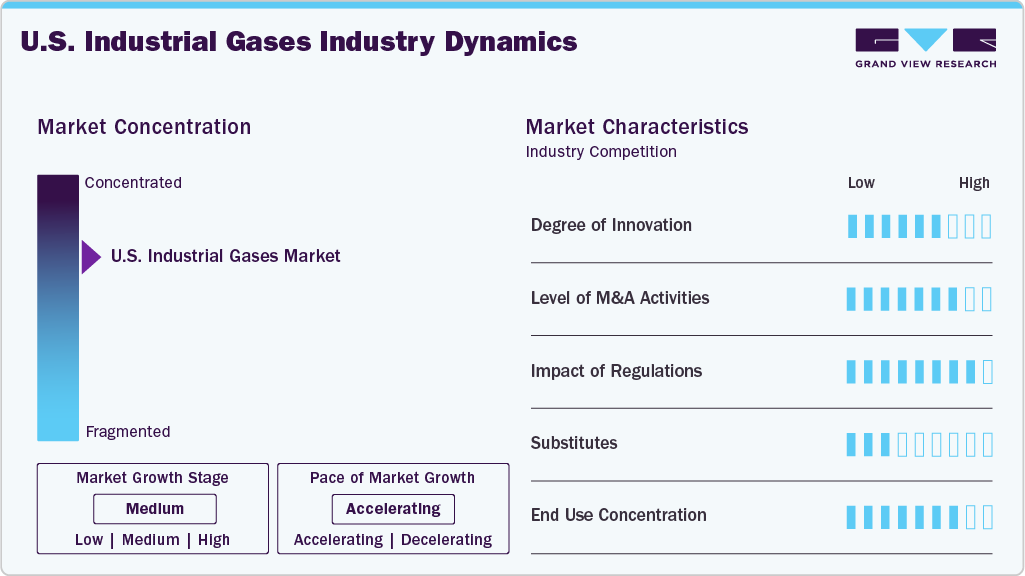
The U.S. industrial gases market is characterized by a moderately consolidated competitive landscape, dominated by a few global industrial gas leaders alongside a limited presence of regional and niche suppliers. Major players such as Linde PLC, Air Liquide, and Air Products and Chemicals, Inc. hold a significant share of the market, supported by large-scale production facilities, long-term supply contracts, and strong distribution networks. These companies focus on bulk gases, on-site supply systems, and advanced applications such as hydrogen energy, electronics-grade gases, and carbon capture solutions to maintain their leadership positions across key industries, including manufacturing, chemicals, and healthcare.
 To learn more about this report, Download Free Sample Report
At the same time, regional and specialized players such as Messer North America, Inc., Matheson Tri-Gas, Inc., and MESA Specialty Gases & Equipment compete by offering customized gas mixtures, flexible supply models, and strong local customer relationships. The market is seeing increased focus on strategic initiatives, such as capacity expansions, hydrogen infrastructure investments, and partnerships, to support the clean energy transition. In addition, innovation in specialty and high-purity gases for semiconductors and the healthcare sector is emerging as a key differentiator, while energy costs and logistics infrastructure continue to influence competitive dynamics across both domestic and global participants.
Product Insights
The carbon dioxide segment dominated the U.S. industrial gases market, accounting for the largest revenue share of 49.5% in 2025, primarily due to its strong demand in food and beverage carbonation, dry ice for cold chain logistics, and increasing use in carbon capture and utilization applications. The expansion of packaged food consumption and temperature-controlled transportation across the U.S. continues to support consistent demand for CO₂. For instance, in June 2025, Linde PLC announced the expansion of its Freeport, Texas, facility by adding a new CO₂ liquefaction facility to increase the supply for food, beverage, and low-carbon fuel applications. This reflects the segment’s expanding role across both traditional and sustainability-driven applications in the U.S. market.
The oxygen segment is growing steadily due to its essential role across steel manufacturing, chemical processing, and large-scale fabrication, where it is widely used in basic oxygen furnaces and metal-cutting operations. In addition, industries are increasingly adopting large-scale on-site air separation units to ensure continuous and cost-efficient oxygen supply for high-volume operations. For instance, in June 2024, Air Liquide partnered with ExxonMobil on a major low-carbon hydrogen project in Texas, featuring new air separation units to supply around 9,000 metric tons of oxygen per day, highlighting the growing scale and strategic importance of oxygen demand in clean energy and industrial applications.
Application Insights
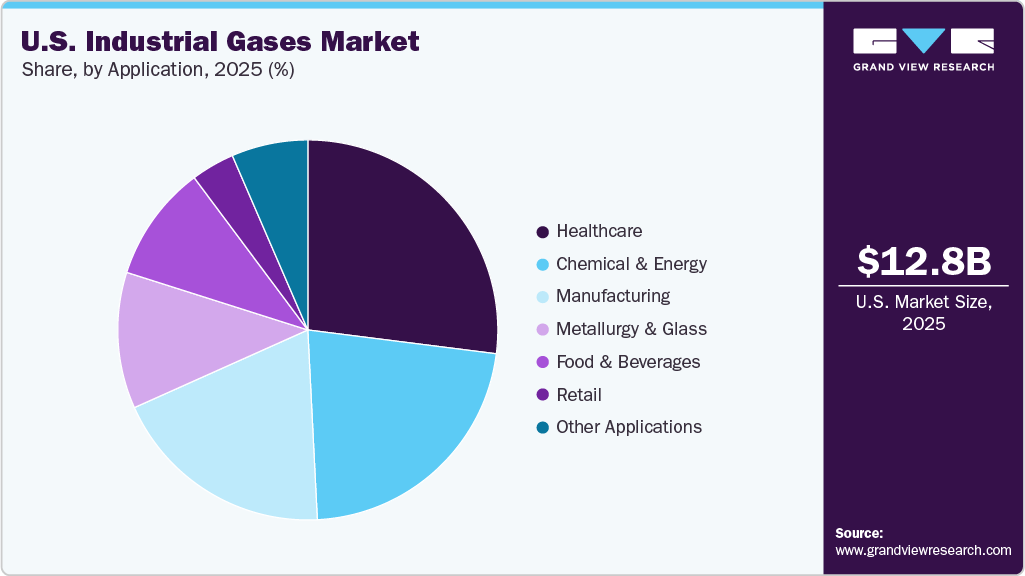
The healthcare segment dominated the U.S. industrial gases market, accounting for the largest revenue share of 27.0% in 2025, primarily due to the extensive use of medical gases, including oxygen, nitrous oxide, and medical air, across hospitals, surgical procedures, and home-based respiratory care. The U.S. healthcare system handles a high volume of inpatient admissions and critical care cases, where these gases are essential for life support, anesthesia, and emergency treatment. In addition, the rising burden of respiratory diseases and an aging population are driving the need for long-term oxygen therapy, particularly in home healthcare settings, strengthening consistent demand across the country. For instance, according to the Centers for Disease Control and Prevention, Chronic Obstructive Pulmonary Disease (COPD) was the fifth leading cause of death in the U.S. in 2023, resulting in 141,733 deaths, and it incurs annual medical costs of around USD 24 billion among adults aged 45 and older, highlighting the scale of respiratory care needs and sustained demand for medical oxygen and related gases.
 To learn more about this report, Download Free Sample Report
The chemical & energy segment in the U.S. industrial gases market is an important application area due to the extensive use of gases such as hydrogen, nitrogen, and oxygen in refining, petrochemicals, and low-carbon energy production. The U.S. Gulf Coast remains a major hub for industrial gases, essential to hydroprocessing, ammonia production, and emissions management. In addition, the shift toward decarbonization is increasing the role of gases in carbon capture and low-carbon fuel production, strengthening long-term demand across this segment. For instance, in July 2025, CF Industries Holdings, Inc., in partnership with ExxonMobil, began construction of a carbon capture facility in Louisiana capable of capturing and storing up to 2 million metric tons of CO₂ annually, enabling large-scale, low-carbon ammonia production and highlighting the growing integration of industrial gases into clean energy systems.
Key U.S. Industrial Gases Company Insights
Key players such as Air Liquide, BASF, Linde PLC are dominating the industrial gases market in the U.S. Organizations have been tactically implementing various plans, such as collaborations, expansions, mergers and acquisitions, and others, to gain a competitive advantage.
-
Linde PLC is recognized as a global leader in the production and supply of industrial gases and engineering solutions. The company specializes in atmospheric gases, process gases, and high-purity gases used primarily in manufacturing, healthcare, energy, electronics, and chemical industries. Linde’s industrial gas solutions are critical in processes such as metal fabrication, refining, semiconductor production, and medical oxygen supply, supporting a wide range of essential industrial and healthcare applications.
-
Air Liquide is a global leader in gases, technologies, and services for industry and healthcare sector. The company specializes in oxygen, nitrogen, hydrogen, and specialty gases used primarily in healthcare, energy, electronics, and chemical industries. Air Liquide’s gas solutions are critical in applications such as medical care, hydrogen energy systems, semiconductor manufacturing, and industrial processing, supporting innovation and sustainability across multiple sectors.
Key U.S. Industrial Gases Companies:
- Messer North America, Inc.
- Air Products and Chemicals, Inc.
- Linde PLC
- Air Liquide
- NIPPON SANSO MATHESON, INC.
- BASF
- MESA Specialty Gases & Equipment
- UNIVERSAL INDUSTRIAL GASES, LLC.
Recent Developments
-
In June 2025, Linde PLC announced plans to build a new carbon dioxide production plant in Freeport, Texas, expected to be operational by 2027, which will capture and liquefy CO₂ from MEGlobal American’s plant, significantly expanding supply capacity for food, beverage, and industrial applications.
-
In June 2024, Air Liquide announced an investment of up to USD 850 million to build and operate four large air separation units in Texas, supplying around 9,000 metric tons of oxygen per day for ExxonMobil’s low-carbon hydrogen project.
U.S. Industrial Gases Market Report Scope
Report Attribute
Details
Market size value in 2026
USD 13.7 billion
Revenue forecast in 2033
USD 24.2 billion
Growth rate
CAGR of 8.5% from 2026 to 2033
Base year for estimation
2025
Historical data
2021 - 2024
Forecast period
2026 - 2033
Quantitative units
Revenue in USD Million, Volume in Kilotons, and CAGR from 2026 to 2033
Report coverage
Revenue forecast, company ranking, competitive landscape, growth factors, and trends
Segments covered
Product and Application
Key companies profiled
Messer North America, Inc.; Air Products and Chemicals, Inc.; Linde PLC; Air Liquide; NIPPON SANSO MATHESON, INC.; BASF; MESA Specialty Gases & Equipment; UNIVERSAL INDUSTRIAL GASES, LLC.
Customization scope
Free report customization (equivalent up to 8 analysts working days) with purchase. Addition or alteration to country, regional & segment scope.
Pricing and purchase options
Avail customized purchase options to meet your exact research needs. Explore purchase options U.S. Industrial Gases Market Report Segmentation
This report forecasts volume and revenue growth at the country level and provides an analysis of the latest industry trends in each of the sub-segments from 2021 to 2033. For this study, Grand View Research has segmented the U.S. industrial gases market report based on product and application:
-
Product Outlook (Volume, Kilotons; Revenue, USD Million; 2021 - 2033)
-
Oxygen
-
Nitrogen
-
Carbon Dioxide
-
Mixtures
-
-
Application Outlook (Volume, Kilotons; Revenue, USD Million; 2021 - 2033)
-
Healthcare
-
Manufacturing
-
Metallurgy & Glass
-
Food & Beverages
-
Retail
-
Chemicals & Energy
-
Other Applications
-
Frequently Asked Questions About This Report
The U.S. industrial gases market size was estimated at USD 12.8 billion in 2025 and is expected to reach 13.7 billion in 2026.
The U.S. industrial gases market is expected to grow at a compound annual growth rate of 8.5% from 2026 to 2033 to reach USD 24.2 billion by 2033.
The carbon dioxide segment dominated the market with a revenue share of 49.5% in 2025, primarily due to its strong demand in food and beverage carbonation, dry ice for cold chain logistics, and increasing use in carbon capture and utilization applications.
Some of the key players operating in the U.S. industrial gases market include Messer North America, Inc.; Air Products and Chemicals, Inc.; Linde PLC; Air Liquide; NIPPON SANSO MATHESON, INC.; BASF; MESA Specialty Gases & Equipment; UNIVERSAL INDUSTRIAL GASES, LLC.
Strong growth in semiconductor and advanced manufacturing industries is driving demand for high-purity industrial gases. Rising investments in clean energy and hydrogen infrastructure are further contributing to market expansion.
About the Author(s)
Organic Chemicals Research Team
Bulk Chemicals · Organic ChemicalsThis report was authored by the organic chemicals research team at Grand View Research - comprising two research analysts, one senior research analyst, and one industry expert - with specialized expertise in the organic chemicals segment of the bulk chemicals industry. All findings are based on proprietary bulk chemicals databases, executive interviews, and regulatory analysis, subject to internal peer review prior to publication.
Last Updated:
Speak to Analyst

Customize this report to your needs - add regions, segments, or data points, with 20% free customization.
Or view our licence options:


ISO 9001:2015 & 27001:2022 Certified
We are GDPR and CCPA compliant! Your transaction & personal information is safe and secure. For more details, please read our privacy policy.


