
- Home
- »
- Plastics, Polymers & Resins
- »
-
U.S. Metallocene LDPE Market Size, Industry Report, 2033GVR Report cover
![U.S. Metallocene LDPE Market Size, Share & Trends Report]()
U.S. Metallocene LDPE Market (2025 - 2033) Size, Share & Trends Analysis Report By Polymer Type (mLLDPE, mHDPE), By Application (Films, Sheets, Extrusion Coating, Injection Molding, Blow Molding, Wire & Cable Insulation), By Region And Segment Forecasts
U.S. Metallocene LDPE Market Summary
The U.S. Metallocene LDPE market size was estimated at USD 2.09 billion in 2024 and is projected to reach USD 3.60 billion by 2033, growing at a CAGR of 6.2% from 2025 to 2033. The product is characterized by its superior film clarity, toughness, and enhanced sealing performance.
Key Market Trends & Insights
- By polymer type, the mLLDPE is expected to grow at the fastest CAGR of 6.4% from 2025 to 2033 in terms of revenue.
- By application, the sheet is expected to grow at the fastest CAGR of 6.5% from 2025 to 2033 in terms of revenue.
Market Size & Forecast
- 2024 Market Size: USD 2.09 billion
- 2033 Projected Market Size: USD 3.60 billion
- CAGR (2025-2033): 6.2%
mLDPE, produced using metallocene catalysts, offers improved mechanical properties over conventional LDPE, making it a preferred material for high-performance packaging applications such as food packaging, medical films, shrink wraps, and industrial liners.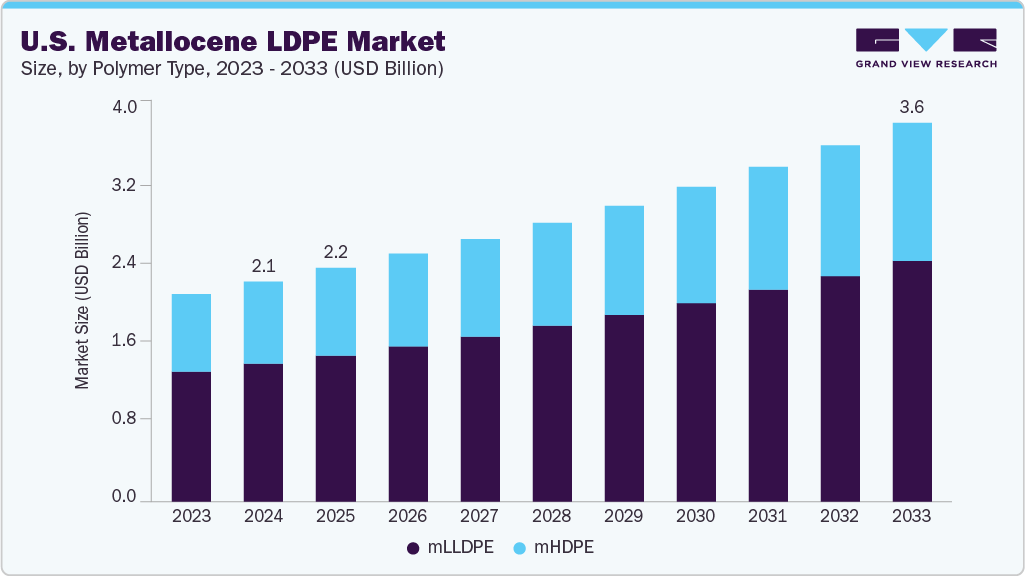
Drivers, Opportunities & Restraints
One of the primary drivers for the U.S. mLDPE market is the growing demand for high-performance and sustainable packaging in the food, medical, and consumer goods sectors. mLDPE's ability to deliver excellent toughness, puncture resistance, and improved processability makes it ideal for downgauging, reducing packaging material usage while maintaining strength.
Additionally, the shift towards recyclable mono-material packaging and consumer preference for lightweight, durable solutions further accelerate the adoption of mLDPE in the U.S. packaging industry.
Significant opportunities in the U.S. mLDPE market lie in the development of sustainable, recyclable, and mono-material packaging structures that can help brands comply with tightening environmental regulations. As major consumer goods companies set aggressive targets for recyclability and plastic reduction, mLDPE's compatibility with circular packaging systems positions it as a key material for next-generation packaging.
Further growth opportunities exist in specialty applications like medical films and advanced shrink films, where demand for precision, durability, and regulatory compliance continues to rise.
However, mLDPE's higher production cost compared to conventional LDPE and some competing polyolefins like LLDPE is limiting its broader adoption in the U.S. This cost premium can be a barrier for price-sensitive applications, especially when the performance advantages of mLDPE are not fully required.
Additionally, fluctuations in raw material prices, limited availability of metallocene catalysts, and competition from emerging biodegradable and compostable alternatives may further challenge the growth trajectory of mLDPE in certain segments.
Market Concentration and Characteristics
The Metallocene LDPE market is in a medium growth stage, and the pace is accelerating. The degree of innovation in the U.S. mLDPE market is moderately high, with continuous advancements in catalyst design and polymerization processes aimed at improving film properties and processing efficiencies. Innovations are focused on enhancing recyclability, developing thinner films without compromising performance, and creating resins compatible with circular economy initiatives.
The level of mergers and acquisitions (M&A) activity in the industry is moderate, with key chemical and material companies pursuing strategic acquisitions to strengthen their position in specialty polyethylene. M&A efforts are often aimed at securing proprietary metallocene catalyst technologies, expanding production capacity, and integrating value-added film production capabilities.
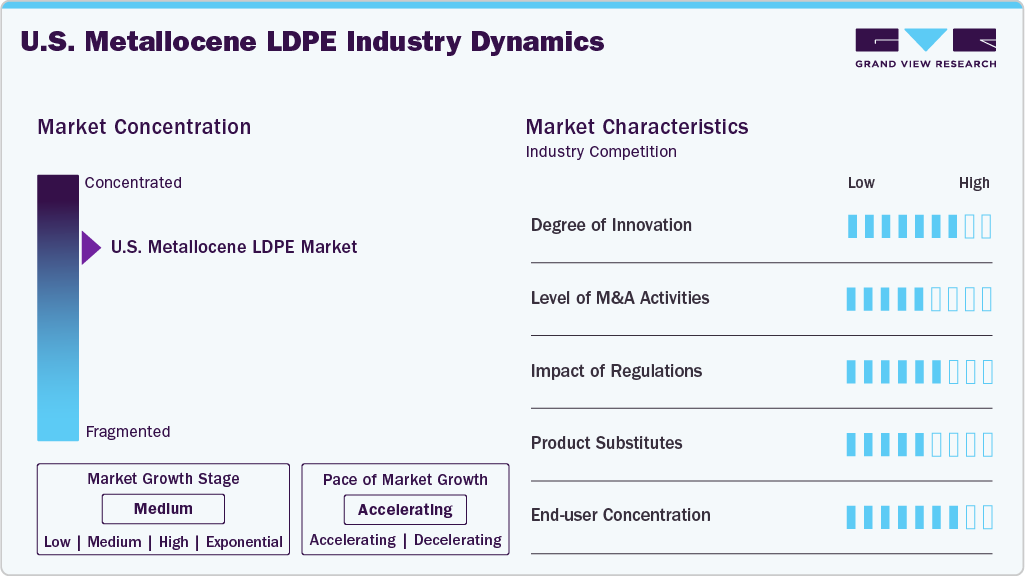
Regulatory pressures in the market are intensifying, particularly around single-use plastics, recyclability mandates, and sustainability disclosures. The growing emphasis on extended producer responsibility (EPR) programs and state-level packaging regulations is pushing manufacturers to develop mLDPE grades that are more recyclable and suitable for closed-loop systems.
Key substitutes for mLDPE include linear low-density polyethylene (LLDPE), ethylene-vinyl acetate (EVA), and high-performance barrier films. LLDPE is particularly competitive due to its lower cost and widespread availability, although it may lack some of the performance advantages of mLDPE. Biodegradable and compostable films are also emerging as long-term substitutes, especially in response to tightening plastic waste regulations.
The market exhibits moderate to high end-user concentration, with the majority of demand driven by large-scale players in the food packaging, medical, and consumer goods sectors. Major multinational brands and packaging converters hold significant purchasing power and influence material selection trends, particularly those prioritizing sustainability and supply chain resilience.
Polymer Type Insights
mLLDPE dominated the market with a revenue share of 62.65% in 2024. This type of polymer is widely recognized for its superior mechanical properties, such as enhanced tensile strength, puncture resistance, and excellent sealing performance. These features make mLLDPE highly desirable in applications like stretch films, heavy-duty sacks, and food packaging where durability and flexibility are critical.
Additionally, mLLDPE offers excellent optical properties, including higher clarity and gloss, which enhances the visual appeal of packaged products. This is particularly valuable for consumer goods packaging, where product visibility influences purchasing decisions. The material’s compatibility with recyclable mono-material structures further aligns with sustainability trends in the U.S. market.
mHDPE is anticipated to grow at a significant CAGR of 6.0% over the forecast period. The product is gaining traction owing to its improved stiffness, toughness, and chemical resistance compared to conventional HDPE. mHDPE’s more uniform polymer structure provides excellent barrier properties, making it suitable for applications that require resistance to moisture and chemicals, such as industrial liners, detergent bottles, and some food packaging formats.
Moreover, mHDPE exhibits improved processability, allowing manufacturers to achieve better control over film thickness and consistency during extrusion, which reduces waste and improves manufacturing efficiency. Innovations in metallocene catalyst technology are also making mHDPE more versatile, which is expected to unlock further market opportunities over the forecast period.
Application Insights
Films led the market with a revenue share of 55.66% in 2024. It is driven by their extensive use in packaging, particularly for food, personal care, industrial wraps, and agricultural products. mLDPE’s ability to produce thin, high-clarity films with excellent puncture resistance and superior sealing performance makes it an ideal material for applications like shrink films, stretch wraps, and high-performance food packaging.
The Metallocene-based sheets segment is expected to expand at a substantial CAGR of 7.2% through the forecast period. These sheets are used in various industries, including construction, agriculture, and automotive, for applications such as protective barriers, liners, and insulation layers. The superior toughness and flexibility of mLDPE sheets, combined with their ease of processing, make them well-suited for demanding environments.
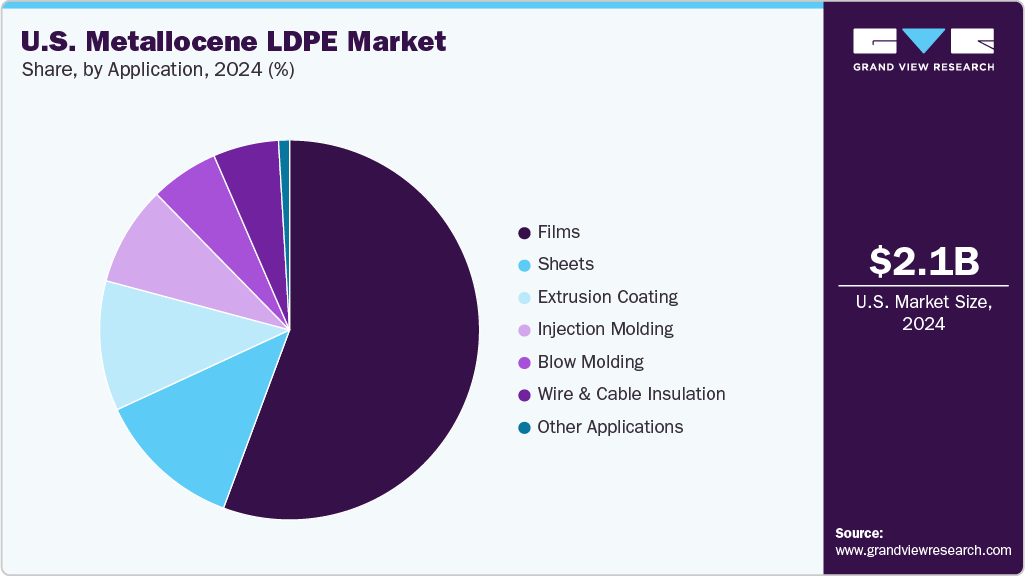
mLDPE is commonly used in extrusion coating applications where it provides excellent adhesion to substrates like paper, aluminum foil, and other polymers. This makes it valuable for liquid packaging, flexible food pouches, and disposable medical items. In the U.S. market, extrusion coating with mLDPE is gaining traction due to its ability to offer improved sealing, high barrier properties, and enhanced surface aesthetics, which are essential for both consumer convenience and product protection.
In injection molding, mLDPE is utilized to produce items that require flexibility, impact resistance, and smooth surface finishes, such as lids, caps, and various consumer goods. The material’s flow characteristics and dimensional stability make it a preferred choice for complex and thin-walled parts. Although the injection molding segment is smaller compared to films and sheets, demand is increasing in niche U.S. markets where high-quality, durable molded parts are required.
Key U.S. Metallocene LDPE Company Insights
The competitive landscape of the U.S. Metallocene LDPE (mLDPE) market is moderately consolidated, with a few major players such as SABIC, Chevron Phillips Chemical Company LLC., Dow, and Exxon Mobil Corporation holding significant market shares. These companies compete on the basis of advanced catalyst technologies, product quality, processing efficiency, and sustainability-oriented solutions like recyclable mono-material films. Additionally, strategic partnerships, capacity expansions, and investments in circular economy initiatives are shaping the competitive dynamics as companies strive to meet evolving regulatory standards and consumer preferences for sustainable packaging.
Key U.S. Metallocene LDPE Companies:
- SABIC
- Chevron Phillips Chemical Company LLC.
- Brentwood Plastics, Inc.
- Univation Technologies, LLC.
- Entec Polymers.
- Dana Poly, Inc.
- Reliable Industries
- Dow Chemicals
- Exxon Mobil Corporation.
Recent Developments
-
Univation Technologies has announced a major upgrade to its flagship UNIPOL PE Process, introducing a new world-scale design capable of producing 800,000 tonnes per year of polyethylene. This next-generation platform is designed to manufacture a broad spectrum of resins, unimodal HDPE, bimodal HDPE, LLDPE, and metallocene PE, while offering enhanced flexibility for producers. The advanced design promises significant economies of scale, reduced per-ton capital costs, and uses the proven UNIPOL technology.
U.S. Metallocene LDPE Market Report Scope
Report Attribute
Details
Market size value in 2025
USD 2.21 billion
Revenue forecast in 2033
USD 3.60 billion
Growth rate
CAGR of 6.2% from 2025 to 2033
Actual data
2021 - 2024
Forecast period
2025 - 2033
Quantitative units
Revenue in USD million/billion, volume in kilotons, and CAGR from 2025 to 2033
Report coverage
Revenue forecast, competitive landscape, growth factors, and trends
Segments covered
Polymer type, application
Country scope
U.S.
Key companies profiled
SABIC; Chevron Phillips Chemical Company LLC.; Brentwood Plastics, Inc.; Univation Technologies, LLC.; Entec Polymers; Dana Poly, Inc.; Reliable Industries; Dow Chemicals; Exxon Mobil Corporation.
Customization scope
Free report customization (equivalent up to 8 analyst’s working days) with purchase. Addition or alteration to country, regional & segment scope
Pricing and purchase options
Avail customized purchase options to meet your exact research needs. Explore purchase options
U.S. Metallocene LDPE Market Report Segmentation
This report forecasts revenue growth at the country level and provides an analysis of the latest industry trends in each of the sub-segments from 2021 to 2033. For this study, Grand View Research has segmented the U.S. Metallocene LDPE market report based on polymer type and application:
-
Polymer Type Outlook (Volume, Kilotons; Revenue, USD Million, 2021 - 2033)
-
mLLDPE
-
mHDPE
-
-
Application Outlook (Volume, Kilotons; Revenue, USD Million, 2021 - 2033)
-
Films
-
Sheets
-
Extrusion Coating
-
Injection Molding
-
Blow Molding
-
Wire & Cable Insulation
-
Other Applications
-
Frequently Asked Questions About This Report
The U.S. metallocene LDPE market size was estimated at USD 2.09 billion in 2024 and is expected to reach USD 2.22 billion in 2025.
The U.S. metallocene LDPE market is expected to grow at a compound annual growth rate of 6.1% from 2025 to 2033 to reach USD 3.60 billion by 2033.
mLLDPE dominated the U.S. metallocene LDPE market with a share of 62.65% in 2024 owing to its wide utilization in high-performance film applications due to its high toughness, clarity, and sealing characteristics.
Some key players operating in the U.S. metallocene LDPE market include SABIC, Chevron Phillips Chemical Company LLC., Brentwood Plastics, Inc., Univation Technologies, LLC., Entec Polymers., Dana Poly, Inc., Reliable Industries, Dow Chemical, and Exxon Mobil Corporation.
Key factors that are driving the U.S. metallocene LDPE market growth include growing demand for high-performance and sustainable packaging in the food, medical, and consumer goods sectors.
About the Author(s)
Plastics, Polymers & Resins Research Team
Bulk Chemicals · Plastics, Polymers & ResinsThis report was authored by the plastics, polymers & resins research team at Grand View Research - comprising two research analysts, one senior research analyst, and one industry expert - with specialized expertise in the plastics, polymers & resins segment of the bulk chemicals industry. All findings are based on proprietary bulk chemicals databases, executive interviews, and regulatory analysis, subject to internal peer review prior to publication.
Last Updated:
Speak to Analyst

Customize this report to your needs — add regions, segments, or data points, with 20% free customization.
Or view our licence options:


ISO 9001:2015 & 27001:2022 Certified
We are GDPR and CCPA compliant! Your transaction & personal information is safe and secure. For more details, please read our privacy policy.












