
- Home
- »
- Beauty & Personal Care
- »
-
U.S. Nail Polish Market Size, Share & Analysis Report, 2033GVR Report cover

U.S. Nail Polish Market (2026 - 2033)
Size, Share & Trends Analysis Report By Product (Regular Nail Polish, UV Gel Nail Polish, Dip Powder, Acrylics, Polygel), By Price Tier (Mass, Mid-Range, Premium), By Distribution Channel, And Segment Forecasts
Market Size, 2025
$2.7BMarket Estimate, 2026
$2.8BMarket Forecast, 2033
$4.4BCAGR, 2026–2033
6.6%U.S. Nail Polish Market Summary
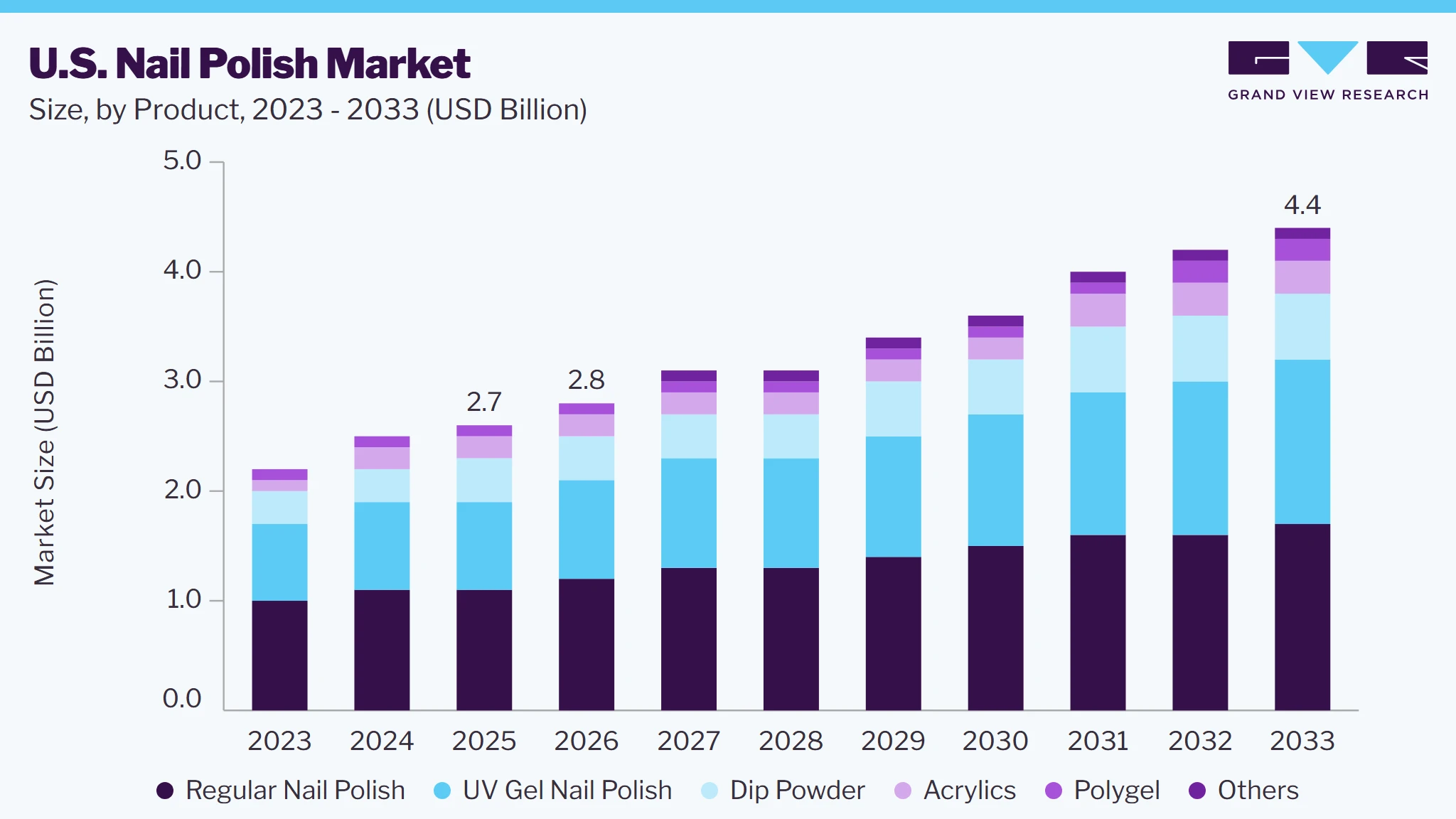
The U.S. nail polish market size was valued at USD 2.7 billion in 2025 and is projected to grow from USD 2.8 billion in 2026 to USD 4.4 billion by 2033, at a CAGR of 6.6% from 2026 to 2033. The U.S. market is increasingly being influenced by the expansion of at-home manicure routines and the development of complete DIY nail ecosystems.
Key Market Trends & Insights
- By product: Regular nail polish segment held the largest market share of 43.2% in 2025.
- By price tier: Mass segment held the largest market share of 54.2% in 2025.
- By distribution channel: Specialty beauty stores segment held the largest market share of 34.1% in 2025.
Market Size & Forecast
- Market size in 2025: USD 2.7 Billion
- Estimated market size in 2026: USD 2.8 Billion
- Projected market size by 2033: USD 4.4 Billion
- CAGR (2026-2033): 6.6%
Prism AI by Grand View Research Free to tryAsk a question about the U.S. nail polish marketTry asking✓Every figure cited from GVR research Prefer the report? Download free sample →
Brands are moving beyond standalone polish to offer consumers coordinated products spanning color, treatments, tools, press-ons, and application systems. In January 2026, Olive & June expanded into approximately 600 Ulta Beauty stores with more than 100 SKUs, including polish, treatments, tools, press-ons, and an Ulta-exclusive Gel Mani System. This expansion demonstrates how specialist nail brands are using physical retail to bring previously digital-first DIY propositions to a wider consumer base. The broader implication for the market is that nail polish is increasingly being purchased as part of a complete at-home manicure routine, creating opportunities for brands to increase basket size through complementary products rather than relying solely on individual polish sales.Product innovation is simultaneously broadening the role of nail polish from basic color application toward customized nail looks and trend-led experimentation. Consumers can increasingly create differentiated finishes by layering colors, combining textures, or selecting coordinated products across lacquer and gel systems.
 Source: Grand View Research, IR Documents, Primary Interviews, Paid DatabasesTo learn more about this report,
 Download Free Sample Report
Performance and application efficiency are becoming key differentiators as consumers seek faster, more convenient manicure routines. Nail-polish manufacturers are investing in formulas that reduce drying time, improve coverage, simplify application, and provide longer-lasting finishes. Revlon's Ultra HD Snap, for example, is positioned as a one-coat, quick-drying nail enamel with an ergonomic cap and a 320 bristle brush designed to provide controlled, streak-free application.
The formulation is also marketed as 100% vegan and 20-free, and incorporates hexanal, shea butter, and botanical ingredients into a strengthening complex. Such innovations demonstrate how conventional lacquer is being upgraded through both application technology and formulation attributes, allowing brands to compete on convenience and performance in addition to shade selection.
The convergence of nail color and longer-wear technologies is further expanding the competitive boundaries of the category. Rather than requiring consumers to choose between conventional lacquer and professional gel services, brands are introducing intermediate solutions designed to deliver aspects of a gel manicure through consumer-friendly systems.
OPI introduced GELement in 2025 as its first gel system specifically designed for DIY consumers, combining a base coat, no-wipe top coat, 30 gel shades, and an LED curing lamp in an at-home system. The company positioned the products around durable, long-lasting results while retaining a broad selection of neutral, bright, crème, shimmer, and dark shades. This development is significant for the U.S. nail-polish industry because it demonstrates how established polish brands are using technology to retain consumers within their ecosystems as purchasing preferences move toward longer-wear manicure formats.
Formulation transparency and ingredient considerations are also influencing product positioning in the U.S. nail category. Nail products are regulated as cosmetics by the U.S. Food and Drug Administration, and retail cosmetic products must provide ingredient declarations; the FDA specifically identifies ingredients such as formaldehyde, phthalates, and toluene among substances associated with nail products.
The agency notes that formaldehyde can occur in certain nail hardeners and polishes and that toluene has historically been used as a solvent in some nail products. This regulatory environment creates an incentive for brands to communicate formulation characteristics more clearly and develop differentiated ingredient positioning. Revlon's 20-free positioning is one example of how formulation considerations have become part of the consumer-facing value proposition rather than remaining solely a technical product attribute. As a result, competition increasingly encompasses not only color and wear but also consumers' expectations regarding formulation, transparency, and perceived nail health.
Digital commerce and social discovery are further changing how nail products are marketed and purchased in the U.S. nail products are particularly suited to visual digital content because colors, finishes, designs, and application techniques can be demonstrated directly through short-form video, tutorials, creator content, and online product demonstrations. This is encouraging companies to connect product launches with digital engagement rather than relying solely on traditional retail merchandising.
Coty, which owns Sally Hansen, reported that e-commerce accounted for approximately 20% of its overall business in its fiscal 2025 earnings commentary, with continued online market-share momentum for several Consumer Beauty brands, including Sally Hansen. Coty also cited innovations such as Sally Hansen nail strips as part of its Consumer Beauty strategy. The increasing importance of digital channels therefore gives nail brands additional opportunities to introduce new formats, demonstrate application techniques, and convert trend-driven discovery into online purchases.
The competitive structure is consequently evolving from a market dominated primarily by traditional nail-enamel brands toward a broader ecosystem encompassing lacquer, long-wear systems, gel, press-ons, treatments, tools, and digitally enabled purchasing experiences. Heritage companies such as Revlon, OPI, essie, and Sally Hansen continue to compete through brand recognition, extensive shade portfolios, formulation innovation, and retail reach, while newer companies such as Olive & June and Glamnetic are using direct-to-consumer heritage, social-media relevance, press-on innovation, and specialty-retail partnerships to gain visibility. The resulting competitive environment is characterized by rapid product cycles, increasingly blurred boundaries between nail color and nail care, and greater consumer movement between manicure formats. For brands, sustainable growth is therefore likely to depend on combining attractive colors and trend relevance with tangible benefits such as durability, convenience, fit, formulation differentiation, and ease of use.
Major Trends in the U.S. Nail Polish Market
Trends
Description
Long-Wear and Gel-Like Performance Are Reshaping Nail Polish Innovation
U.S. consumers are increasingly seeking nail products that combine the accessibility of conventional polish with the durability, shine, and finish associated with salon gel manicures. Personal Care Insights, citing Innova Market Insights, reports that long-lasting claims appeared in more than half of North American nail-polish launches over the past five years, while gel-based textures and formats reached 17% penetration. OPI’s Infinite Shine, for example, uses pre-cured gel technology and claims up to 11 days of gel-like wear and shine, while Sally Hansen Miracle Gel focuses on chip resistance and easier removal. Premium Beauty News similarly notes that UV/gel technologies are gaining traction in the U.S., supported by consumers seeking longer-lasting manicures and increasingly accessible at-home solutions.
Nail Health and “Cleaner” Formulations are Becoming Important Differentiators
The category is increasingly incorporating nail-care benefits alongside color, reflecting a broader “skinification” of nail products. Fiabila has developed hybrid products that combine polish with strengthening, moisturizing, and protective actives, while its Nail’Glow Bronzer combines color effects with ingredients focused on nail strengthening and repair. Premium Beauty News also highlights growing interest in formulas designed to reduce sensitization and improve removal, particularly as consumers become more aware of potential nail damage associated with repeated gel use. In the U.S. and Canada, 26% of consumers reportedly find natural products particularly appealing, while ethical, vegan, and animal-related claims have gained substantial penetration among nail-polish launches.
At-Home Manicure Solutions Are Expanding Beyond Conventional Liquid Polish
The boundary between traditional nail polish, salon services, and DIY manicure systems is increasingly blurred. Nail strips, press-ons, at-home gel systems, and other ready-to-apply formats allow consumers to achieve salon-inspired results with less time and technical expertise. Premium Beauty News identifies nail patches and strips as particularly popular in the U.S., with newer products offering approximately 10 days of wear while requiring no UV curing. Fiabila's Wear Ever Manicure Strips, for example, use real nail lacquer in a ready-to-apply format. The company's My UV Gel @Home similarly targets consumers seeking up to three weeks of wear at home.
Chrome, Cat-Eye, Jelly, and Multidimensional Finishes Are Broadening Color and Texture Demand
Nail polish is increasingly functioning as a fashion accessory, with finishes becoming as important as the underlying shade. U.S. nail artists have highlighted chrome, cat-eye, magnetic, jelly, aura, velvet, and 3D effects as prominent trends. Allure's 2025 coverage identified cat-eye, chrome, 3D embellishments, and jewel-toned finishes as important directions, while its 2026 coverage shows chrome being layered over cat-eye finishes to create shifting, iridescent effects. This trend is also visible in product innovation, with brands introducing polishes that combine shimmer, glitter, metallic, holographic, and other effects in a single product.
Customization and Inclusivity Are Creating More Differentiated Nail-Polish Offerings
Nail polish innovation is moving toward greater personalization, including customized colors, gender-neutral products, and products designed around individual nail conditions and preferences. Premium Beauty News reports that Blank Beauty's technology can produce up to 40,000 customized polish shades, allowing consumers to create colors online or in retail environments. Fiabila has also introduced a gender-neutral nail perfector positioned around nail protection and strengthening rather than conventional color cosmetics. This reflects a broader movement toward customization and inclusivity, in which nail products are increasingly positioned as tools for individualized beauty and self-expression.
Social Media is Accelerating Micro-Trends and Increasing Demand for Trend-Led Shades
TikTok, Instagram, and other visual platforms are shortening the lifecycle of nail trends and encouraging consumers to experiment with new colors and designs. TikTok is influencing nail-polish preferences, with viral microtrends encouraging consumers to purchase products associated with emerging aesthetics such as chrome, glitter, and holographic nails. U.S. beauty coverage likewise shows rapid movement between trends such as glazed finishes, chrome, cat-eye, aura, and seasonal color stories. This creates opportunities for limited-edition collections, trend-responsive launches, collaborations, and frequent shade refreshes rather than relying solely on permanent core color ranges.
The U.S. nail polish industry is therefore shifting from basic color cosmetics toward a more performance-, experience-, and care-oriented category. Conventional polish remains important, but growth in gel-like wear, nail strips, press-ons, magnetic and chrome effects, hybrid nail-care formulas, customized shades, and trend-responsive collections is expanding the definition of nail polish. At the same time, consumer concerns around nail health, ingredient safety, ease of removal, and affordability are encouraging brands to differentiate through cleaner formulations and easier application. Social-media-driven aesthetics are further accelerating innovation, making long wear, salon-like results at home, nail health, customization, and highly visual finishes the key themes shaping the U.S. market.
Market Dynamics
Growing attention to personal grooming and appearance is strengthening demand for nail polish in the U.S., as manicures increasingly serve as both routine beauty maintenance and a form of self-expression. The U.S. Bureau of Labor Statistics identifies manicures, pedicures, and nail-color changes as an “affordable luxury” and notes that growing interest in grooming and wellness among women and an increasing number of men is supporting demand for nail services. The professional ecosystem also remains substantial, with approximately 201,800 manicurists and pedicurists being employed in the U.S. in 2025, with employment projected to increase 9% between 2025 and 2035, compared with 3% across all occupations. This expanding grooming infrastructure supports recurring exposure to nail color, while consumers can extend salon-inspired looks through at-home polish purchases.
Consumer behavior further demonstrates how deeply nail appearance is embedded in U.S. beauty routines. A May 2025 survey of more than 4,000 U.S. beauty-buying women found that 96% regularly polished their nails either at home or in salons, while 47% combined professional services with DIY nail care and 43% did their nails exclusively at home. Among salon users, 55% received gel manicures, while 39% opted for basic manicures with nail polish, highlighting the role of color as a recurring component of grooming rather than an occasional cosmetic purchase. Brands are responding by expanding color choices, finishes, and salon-to-home formats. For example, OPI's 2025 OPI’m Dreaming collection introduced 12 shimmery sheer pastel shades across nail lacquer and GelColor, alongside additional Infinite Shine, dip-powder and press-on offerings, enabling consumers to replicate and personalize salon-inspired looks at home. The combination of regular grooming routines, DIY participation, and continuous product innovation therefore creates a sustained demand base for nail polish in the U.S.
Growing consumer awareness of potentially harmful or sensitizing ingredients is creating a restraint for the U.S. market, particularly as shoppers become more attentive to formulation transparency and “free-from” claims. The U.S. FDA identifies formaldehyde, formaldehyde-releasing ingredients, toluene, phthalates, and methacrylate monomers among nail-product ingredients that warrant specific safety attention. While the FDA states that nail products may be legally marketed when safe for their intended use, it also notes that formaldehyde can cause skin irritation and allergic reactions, and that frequent use of formaldehyde-containing nail hardeners can make nails brittle and more prone to breaking or peeling. Historical FDA testing also detected dibutyl phthalate (DBP) in 11 nail products, with concentrations ranging from 123 to 62,607 µg/g, underscoring that ingredient scrutiny remains relevant even as manufacturers have reduced the use of some legacy chemicals. California’s Proposition 65 has further influenced formulation practices: the state’s environmental health agency notes that toluene, associated with reproductive harm, has been removed from many nail-care products following regulatory pressure.
The concern extends beyond traditional lacquer ingredients to acrylates used in gel and artificial-nail systems, which can trigger allergic contact dermatitis and, more broadly, create negative perceptions of nail cosmetics. A 2024 study of 199 individuals reporting reactions to acrylic nail cosmetics found that 78% had used home acrylic kits, while 83% of home users reported developing their first skin reaction after beginning home-kit use; social media was the primary information source for 68% of respondents. This risk is encouraging brands to differentiate through cleaner formulations. For example, OPI states that its U.S. Nail Lacquer, Nature Strong, Infinite Shine, RapiDry, and Nail Envy products are formulated without formaldehyde, formaldehyde resin, toluene, xylene, camphor, parabens, ethyl tosylamide, DBP, and triphenyl phosphate, while its professional gel products are HEMA-free. Although such reformulation can support consumer trust, the underlying safety concerns can simultaneously discourage ingredient-sensitive consumers, increase formulation and compliance requirements, and shift demand away from conventional nail polishes toward “clean,” “free-from,” vegan, and hypoallergenic alternatives.
AI-enabled personalization presents a clear opportunity for the U.S. nail polish industry by helping brands move from standardized shade portfolios toward digitally assisted shade discovery, individualized color matching, and custom nail-color creation. The commercial potential is already demonstrated within nail polish rather than broader beauty. Coty’s Sally Hansen deployed Perfect Corp.’s AI- and AR-powered AgileHand technology, initially covering 200 shades and subsequently expanding toward its 500+ shade portfolio and multiple finishes. Following implementation, Sally Hansen reported a 300% increase in the number of nail-color shades viewed, with the average number of shades explored rising from 3.5 to 12 per session, and time spent on product pages increased by more than 100%. The technology also produced a 120% increase in purchase intent, demonstrating that digital personalization can increase both exploration of extensive color assortments and consumer confidence in selecting nail colors.
The opportunity extends beyond virtual try-on toward actual custom formulation, creating scope for premium and niche nail-polish propositions. U.S. based ORLY has established ORLY Color Labs, where customers can create a nail-polish shade digitally and have it produced by color specialists; its virtual service allows consumers to work with mixologists to develop a personalized color, including pearl or metallic shimmer, with custom colors priced at USD 24 per bottle. ORLY also lets consumers match a nail color to an existing object or source of inspiration, turning an image or physical color reference into a personalized polish concept. This model creates whitespace for U.S. nail-polish manufacturers to combine AI-driven image/color recognition, virtual hand visualization, finish selection, and on-demand formulation into a single digital journey. These capabilities could support highly specific niches, including exact outfit matching, personalized nude shades, limited-edition digital trends, event-specific colors, and creator-designed shades, while letting brands monetize personalization through premium pricing, customized collections, and low-volume specialty production.
Analyst Perspective
The U.S. nail polish industry is driven by consumers seeking at-home manicure solutions, frequent color changes, and products that balance finish, wear time, and ease of application. Regular nail polish remains widely accessible, while UV gel, dip powder, acrylic, and polygel systems expand the market toward longer-lasting, salon-inspired manicures. Product demand is increasingly influenced by shade variety, quick-drying properties, chip resistance, ingredient preferences, and ease of removal. Mass and mid-range products maintain strong presence through drugstores, mass merchants, beauty retailers, and supermarkets, while premium offerings compete through specialized finishes, cleaner formulations, and professional positioning. E-commerce further expands access to niche shades, manicure systems, and specialty nail brands.
Consumer Insights
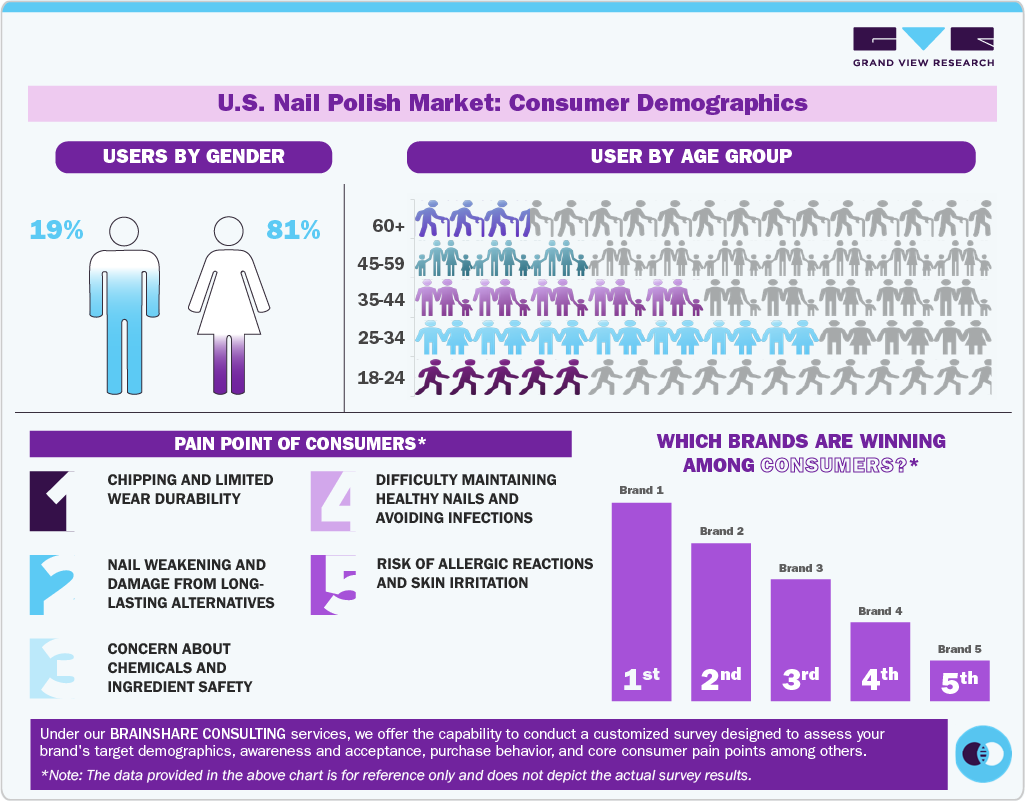
U.S. nail polish consumption is increasingly influenced by at-home beauty routines, salon-DIY crossover, performance expectations, trend-driven experimentation, and nail-health considerations. Consumers are moving between traditional polish, gel-inspired products, fast-dry formulations, and nail-art looks depending on the occasion, desired durability, and time available. Convenience remains important, but consumers also increasingly expect nail products to provide salon-like results while being easier to apply and remove at home.
 To learn more about this report, Download Free Sample Report
-
Women represent the dominant consumer base for nail polish in the U.S.: A May 2025 survey of more than 4,000 U.S. beauty-buying women found that 96% regularly polished their nails either at home or in a salon. The behavior was broad across age groups, with 91% of Baby Boomer respondents also reporting regular nail polishing. In addition, 43% performed their nail care exclusively at home, while 47% combined DIY and salon services, highlighting the importance of women in both retail nail-polish consumption and professional nail-service occasions. Established brands such as OPI, Essie, Sally Hansen, and Revlon remain particularly prominent among these consumers.
-
Consumers are increasingly using nail polish as an expression of personal style rather than only as a basic grooming product: The breadth of current U.S. product launches demonstrates the movement toward shade and finish personalization. For example, OPI's 2025 fall collection offered 12 opaque and semi-sheer shades across Nail Lacquer, GelColor, and dip powder, as well as additional Infinite Shine shades and press-on sets. The simultaneous launch across multiple formats illustrates how consumers can select the same aesthetic based on their preferred application method, durability, and level of commitment.
-
Long wear, quick drying, and ease of application are major purchase drivers: Consumers increasingly seek products that reduce the inconvenience associated with conventional lacquer. In the 2025 U.S. consumer study, 77% prioritized long-lasting color, 74% prioritized quick-drying performance, 67% prioritized ease of application, and 65% prioritized resistance to chipping within one week. This supports demand for products such as Essie Gel Couture, OPI Infinite Shine, Sally Hansen Insta-Dri, and Revlon Gel Envy, which position traditional polish around extended wear, faster application, or gel-like performance.
-
Nail polish is increasingly discovered through digital culture, particularly among younger consumers: Social platforms are becoming important sources of inspiration for nail colors, designs, and application techniques. 51% of Gen Z consumers cited TikTok as a source of inspiration for new nail looks, compared with 33% of consumers overall, while Instagram was cited by 43% of Gen Z versus 32% overall. This gives brands such as OPI, Essie, Olive & June, Sally Hansen, and ILNP opportunities to generate demand through creator-led content, seasonal shade launches, tutorials, and trend-based collections rather than relying exclusively on conventional advertising.
 To learn more about this report, Download Free Sample Report
- Digital trends are accelerating demand for personalized, technique-driven, and visually distinctive nail products: Vogue Business' Beauty Trend Tracker shows growing TikTok interest in #SpookyNailArt, while its September 2025-August 2026 nail analysis highlights rising interest in the Italian manicure, nail-art pens, lettered nails, glass nail polish, and vibrant nail looks. The trends indicate that consumers are increasingly seeking more than conventional single-color manicures, with demand shifting toward precision techniques, customized designs, glossy translucent finishes, and bold colors. The growing visibility of DIY-focused brands further reinforces this behavior: Never Have I Ever offers reusable press-ons featuring licensed artwork, Double Rhythm focuses on soak-off gel polish and nail-art supplies, IPolish offers smartphone-controlled color-changing press-ons, Heyhae provides sun-cured gel strips, and Sparkle & Co. specializes in dip powders featuring glitter, foil, glow-in-the-dark, and color-changing effects. This suggests that social-media-driven discovery is encouraging U.S. consumers to experiment with new formats, effects, application techniques, and personalized nail designs rather than relying solely on conventional nail lacquer.
Trending Nail Trends in the U.S. Nail Polish Market, September 2025-August 2026
Nail Trend
Average Monthly Searches
Year-on-Year Growth
Italian manicure
720
2100%
Nail art pen
6,660
1200%
Letters on nails
1,740
615%
Glass nail polish
1,600
582%
Vibrant nails
980
530%
-
Consumers are balancing conventional polish with salon-inspired and alternative formats: The expansion of gel polish, dip powder, and press-on products means consumers can select products according to the desired combination of wear time, application effort, removal process, and appearance. OPI's current portfolio itself spans conventional lacquer, Infinite Shine, GelColor, dip powder, and press-ons, demonstrating how one brand can address different consumer occasions rather than relying on traditional lacquer alone.
-
Ingredient transparency and nail safety are becoming relevant to product consideration: The FDA advises consumers to read nail-product labels and warnings because some products can cause irritation, allergic reactions, or other adverse effects. FDA specifically identifies ingredients such as formaldehyde, toluene, phthalates, and methacrylate monomers in its nail-product guidance. Formaldehyde-containing nail hardeners, for example, can make nails brittle and more prone to breaking or peeling with frequent use. These considerations create consumer interest in "free-from," gentler, vegan, cruelty-free, and nail-strengthening propositions, although the FDA cautions that terms such as "natural" or "hypoallergenic" should not automatically be interpreted to mean a product is safer.
-
The category is increasingly characterized by a trade-off between convenience and professional-looking results: At-home consumers seek products that provide an attractive finish without the time and expense associated with frequent salon appointments. This supports demand for quick-dry, long-wear, gel-effect, easy-removal, and simplified-application formulations. At the same time, professional nail services continue to shape consumer expectations, meaning retail brands increasingly compete against the results consumers associate with salon manicures rather than simply against other bottles of nail polish.
Fastest-Growing Nail Brands, By Search Interest in the U.S., September 2025–August 2026
Nail Brand
Average Monthly Searches
Year-on-Year Growth
Never Have I Ever
480
6700%
Double Rhythm
3,110
984%
IPolish
11,240
831%
Heyhae
2,020
673%
Sparkle & Co.
4,300
495%
-
Value remains important, but consumers can justify premium products when the benefit is clearly differentiated: Nail polish has a relatively low absolute purchase price, allowing consumers to experiment with colors and brands while remaining price conscious. This creates a two-tier behavioral pattern: mass-market brands such as Sally Hansen, Revlon, and SinfulColors benefit from accessibility and frequent promotional activity, while OPI, Essie, CND, Zoya, and Olive & June can command greater consideration when consumers associate the product with superior finish, wear, formulation, salon credibility, or a distinctive brand identity. The 2025 KPMG U.S. Consumer Pulse survey also found that, among teens' beauty purchases, 56% preferred affordable/drugstore options for "other trendy products," including nail polish and nail tools, while 32% preferred a mix of affordable and high-end products.
Overall, U.S. nail-polish consumption is shifting toward a more personalized and occasion-driven model. Consumers increasingly alternate between traditional lacquer and salon-inspired or alternative formats, while social and trend culture encourages frequent experimentation with colors and finishes. At the same time, safety, ingredient transparency, convenience, and perceived value are becoming important filters in product consideration. This creates opportunities for brands to compete not only through color breadth but also through format innovation, differentiated formulations, trend responsiveness, and credible performance benefits.
Product Insights
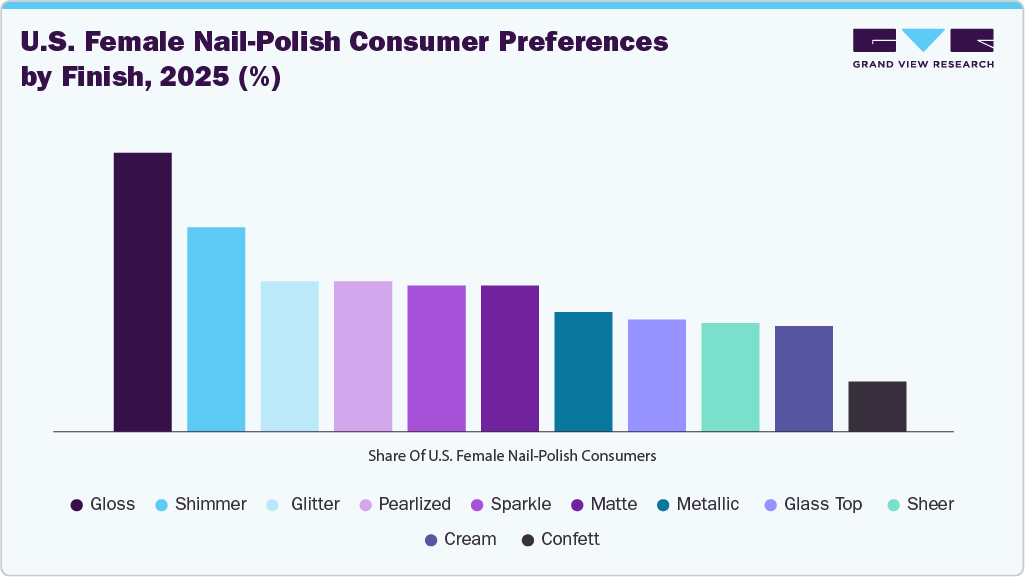
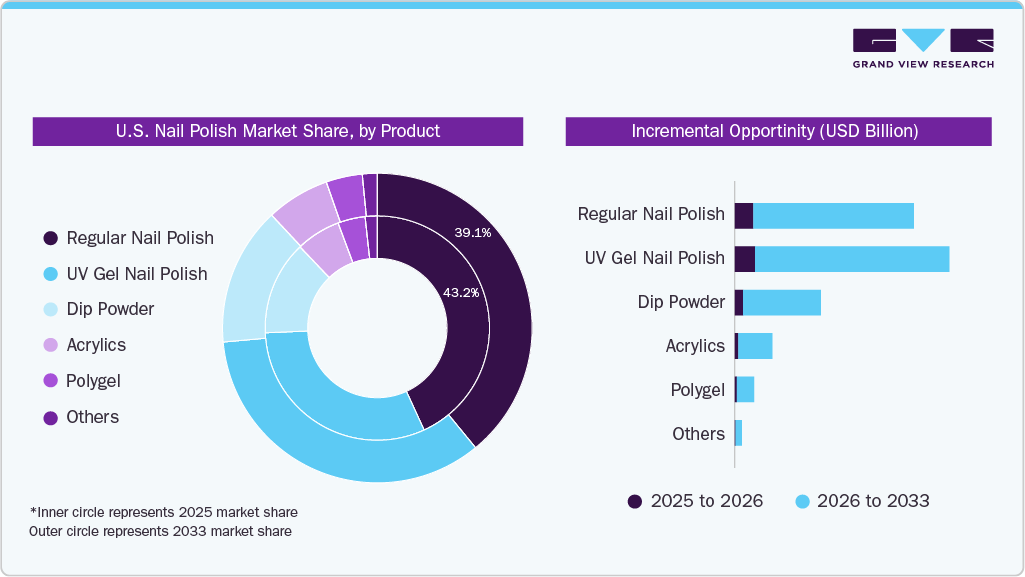
The regular nail polish segment accounted for the largest revenue share of 43.2% in 2025, reflecting its continued relevance as an accessible, equipment-free manicure format. Unlike UV gel products, traditional lacquer can be applied and removed without a curing lamp, supporting frequent at-home shade changes and making it particularly suitable for everyday consumers. U.S. consumer research from The Benchmarking Company found that 79% of female respondents preferred a traditional gloss finish, while 77% identified long-lasting color and 74% quick-drying performance as important nail-polish attributes. Brand purchasing also demonstrates the strength of conventional polish: OPI was purchased by 76% of respondents, Essie by 62%, Sally Hansen by 54%, and Revlon by 34% in 2025. These brands have substantial conventional-lacquer portfolios, including OPI Nail Lacquer, Essie Original, Sally Hansen Insta-Dri, and Revlon Super Lustrous Nail Enamel.
 To learn more about this report, Download Free Sample Report
The UV gel nail polish segment is anticipated to grow at the fastest CAGR of 8.0% from 2026 to 2033, driven specifically by demand for longer-wearing, high-gloss color and salon-style manicures at home. The strength of this format is evident in current U.S. retail assortments: Sally Beauty's online nail category lists more than 600 gel-polish products, compared with fewer than 400 conventional nail-polish products, illustrating the depth of assortment being developed around gel formats. Its gel assortment includes OPI, ASP, Nailboo, Dashing Diva, Gelish, KISS and Sally Hansen, among others.
Price Tier Insights
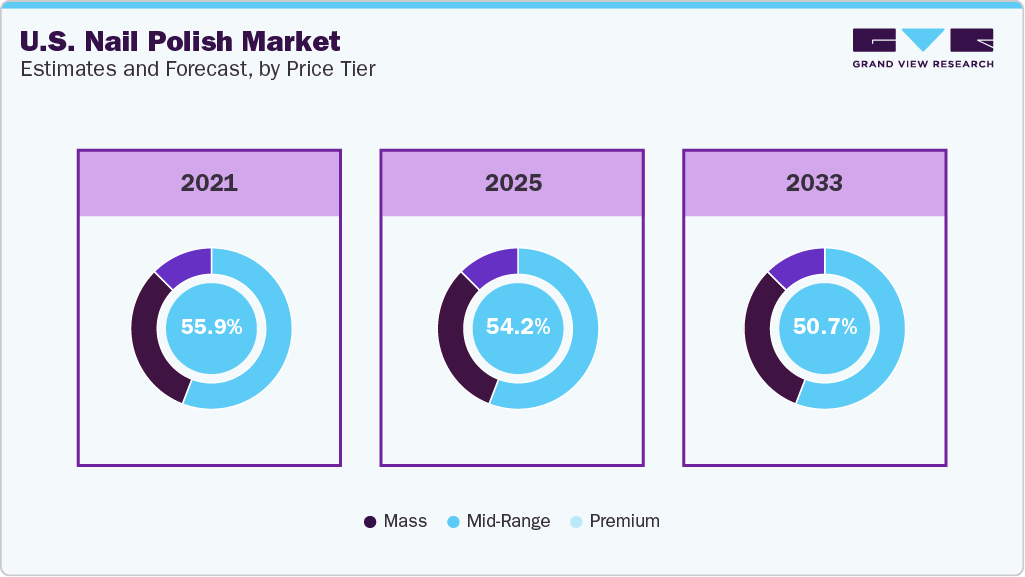
The mass segment dominated the market with the largest revenue share of 54.2% in 2025, supported by the affordability and broad availability of conventional nail-color products. The Benchmarking Company found that 72% of U.S. female respondents typically spend USD 6-USD 15 for a bottle of nail polish, while 12% typically purchase value brands, highlighting the importance of accessible price points within the category. Mass-market brands such as Sally Hansen and Revlon have extensive nail-polish portfolios priced affordably, while even salon-associated brands such as Essie and OPI offer products within relatively attainable price ranges. The strong penetration of these brands supports the continued volume contribution of the mass tier, particularly among consumers purchasing multiple colors for routine or seasonal use.
 To learn more about this report, Download Free Sample Report
The premium nail polish segment is projected to grow at the fastest CAGR of 9.2% from 2026 to 2033, as consumers increasingly trade up for prestige brands, distinctive shade collections, advanced formulations, and nail-care benefits. The premium opportunity remains smaller than mass but is supported by consumers already spending above mainstream price points: 11% of surveyed U.S. women reported typically spending USD 16-USD 20 per bottle, while 3% specifically reported purchasing prestige nail-polish brands. Premium players such as Chanel, Dior, Gucci, and Hermès differentiate through luxury brand equity, high-shine finishes, formulation technologies, and curated color ranges. For example, Chanel, Dior, and Hermès are positioned as luxury nail-color offerings, while Gucci's nail products emphasize a high-gloss finish and vegan formulation.
Distribution Channel Insights
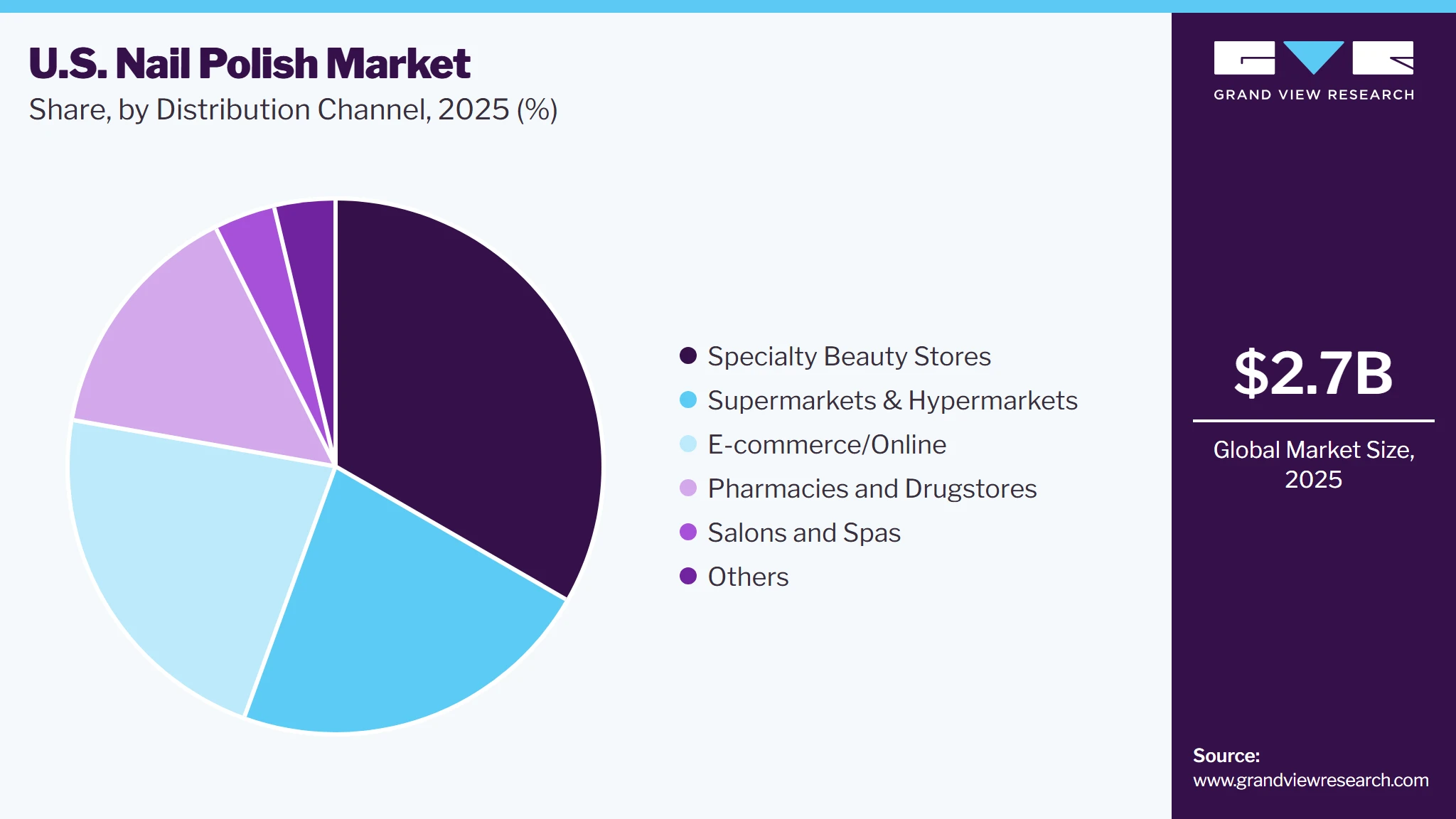
The specialty beauty stores segment led the market with the largest revenue share of 34.1% in 2025, benefiting from their concentration of nail-specific brands, broader shade selection, and access to both conventional and professional-oriented products. The Benchmarking Company found that 42% of surveyed U.S. women purchase nail polish at Ulta and 27% at Sephora, while 68% purchase at superstores and 47% at drugstores/pharmacies. Specialty retailers are particularly important for consumers seeking a broader assortment beyond basic mass-market lacquer. Sally Beauty illustrates this specialization: in 2025, it expanded its nail assortment to more than 1,400 nail products, spanning classic polish, gel polish, dip powder, and press-ons, with brands including OPI, Gelish, KISS, Nailboo, and Dashing Diva.
 To learn more about this report, Download Free Sample Report
The e-commerce/online segment is projected to grow at the fastest CAGR from 2026 to 2033, supported by the unusually broad assortment and highly visual nature of nail color. Consumers can compare shades, finishes, reviews, and wear characteristics online while accessing products that may not be stocked in their local stores. The channel is also gaining share within specialty beauty retail; Sally Beauty's e-commerce contribution increased from 6.2% of Sally sales in fiscal 2023 to 8.2% in fiscal 2025, before reaching 9.6% during the first nine months of fiscal 2026. Nail brands are actively supporting this shift; OPI directs U.S. consumers to purchase through Ulta, Target, CVS, Walgreens, Amazon, and Sally Beauty, while Sally Beauty combines online purchasing with BOPIS, two-hour delivery, and digital marketplaces. This omnichannel expansion strengthens online access to both conventional and gel nail polish and supports the channel's faster projected growth.
Cross Segmentation Analysis
The study provides a detailed cross-segmental analysis of the U.S. nail polish industry to assess how demand varies across regular nail polish, UV gel nail polish, dip powder, acrylics, polygel, and other nail enhancement products by mass-, mid-range-, and premium-price tiers. The analysis evaluates price-tier distribution within each product category to identify differences in consumer spending, product positioning, salon usage, and premiumization trends.
In addition, product types are assessed across supermarkets & hypermarkets, pharmacies & drugstores, specialty beauty stores, salons & spas, e-commerce/online, and other distribution channels to identify channel-specific purchasing patterns and differences in professional versus at-home demand.
Further cross-segmentation of price tiers across distribution channels highlights differences in accessibility, digital adoption, specialty retail penetration, and premium product purchasing. These cross-segment insights help identify opportunities in premiumization, adoption of gels and nail enhancements, salon-to-home consumption, product innovation, and omnichannel expansion.
Key U.S. Nail Polish Company Insight
 To learn more about this report, Download Free Sample Report
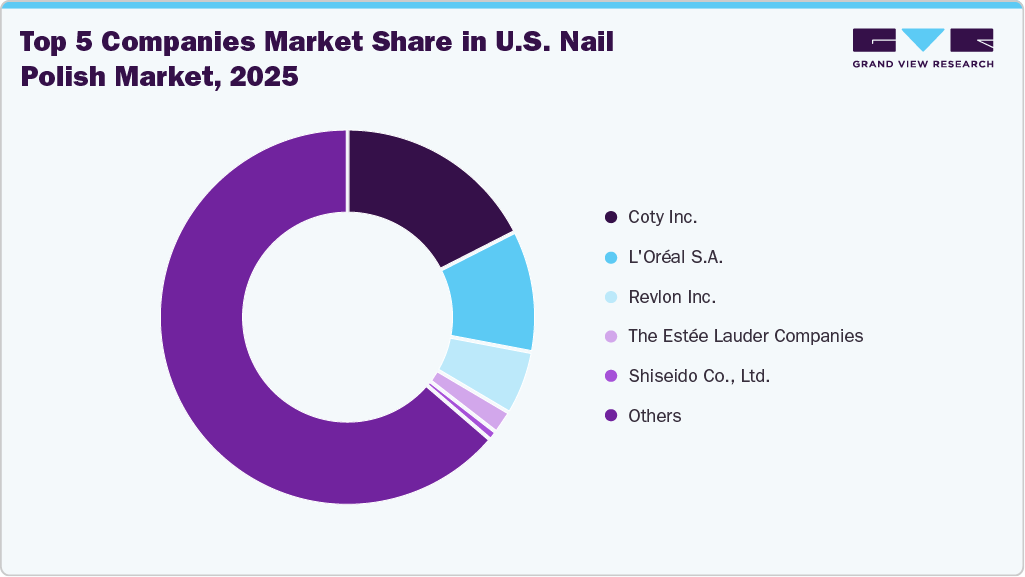
Top 5 Companies
Market Share (%), 2025
L'Oréal S.A.
XX%
The Estée Lauder Companies
XX%
Revlon Inc.
XX%
Shiseido Co., Ltd.
XX%
Coty Inc.
XX%
The U.S. nail polish industry is characterized by competition among diversified beauty groups, prestige brands, mass-market nail-color companies, and specialized professional nail manufacturers. Competition is increasingly shaped by long-wear performance, shade innovation, nail-care positioning, professional-grade systems, ingredient preferences, and omnichannel accessibility. Coty has a particularly broad position through OPI and Sally Hansen, while L'Oréal competes through Essie. Revlon maintains a strong consumer nail-color presence, whereas AII, Art of Beauty, ORLY, and CND provide greater specialization across professional, treatment-oriented, and natural-nail segments.
-
Broad Shade Portfolios and Frequent Color Innovation Remain Central to Competition: Nail polish remains a highly color-driven category, making shade breadth, seasonal collections and limited-edition launches important competitive tools. L'Oréal's Essie uses fashion and cultural partnerships to maintain visibility; in 2025, its collaboration with the WNBA's New York Liberty promoted Gel by Essie, with the campaign generating approximately 4 billion organic impressions according to Glossy.
-
Long-Wear, Gel Effects & Professional Performance Are Key Differentiators: Competitive positioning is moving from conventional lacquer toward products that reproduce the appearance or durability of salon manicures. Revlon's Super Lustrous Nail Enamel combines a chip-resistant film, ridge-filling technology, faster drying, and Vitamin E, while its ColorStay franchise has historically positioned long wear and gel-like shine as key performance attributes. OPI competes across Nail Lacquer, Infinite Shine and GelColor, allowing Coty to address conventional lacquer, longer-wear consumer applications and professional gel services.
-
Nail Health & Ingredient Positioning Are Creating Brand Differentiation: Companies are increasingly combining color with treatment-oriented benefits as consumers become more attentive to nail condition and product ingredients. ORLY's Breathable 1-Step range combines treatment and color and uses ingredients including argan oil, pro-vitamin B5, and vitamin C. Zoya has taken a more explicit ingredient-led approach; the brand states that its polishes are 10-free and vegan and reports an assortment exceeding 400 colors, with its product heritage built around toxin-free natural-nail formulations. Revlon also incorporates Vitamin E into its current Super Lustrous Nail Enamel formulation and promotes a chip-resistant film that strengthens and protects the manicure.
-
Mass-Market Scale and Professional Distribution Create Distinct Competitive Advantages: The U.S. market contains a wide price and positioning spectrum, ranging from accessible drugstore nail enamels to prestige and luxury lacquers. Revlon positions Super Lustrous Nail Enamel at USD 6.49 on its U.S. website, emphasizing affordable at-home application and a broad shade assortment. At the opposite end, Dior Vernis is sold in the U.S. at USD 34 and combines couture branding, gel-effect performance, and protective nail-care positioning. L'Oréal's Essie occupies an intermediate mass-prestige position, while OPI, Zoya, ORLY, and CND span mid- to premium consumer and professional applications. This segmentation enables the market to capture both frequent low-ticket purchases and higher-value premium manicures and nail systems.
-
Prestige Brands Are Raising the Upper End of the Nail Polish Market: Luxury houses are increasingly treating nail lacquer as an extension of broader fashion and beauty identity rather than simply a functional cosmetic. LVMH's Parfums Christian Dior generated USD 9.19 billion in revenue in 2025, while Dior Vernis currently combines couture color, long-wear, gel-effect shine, and protective nail care. The U.S. Dior Vernis range includes more than 20 shades, with colors linked closely to Dior's broader fashion and beauty aesthetic. The presence of Dior alongside prestige offerings from Estée Lauder and other luxury beauty houses increases competitive pressure on specialist brands to deliver differentiated packaging, formulation, shade storytelling, and brand experience.
The U.S. market is therefore evolving from competition primarily around shade variety and basic lacquer performance toward a broader contest involving long wear, gel-effect finishes, nail health, ingredient positioning, professional-grade systems, digital engagement and premium brand experience. L'Oréal benefits from Essie's strong consumer positioning and the group's USD 49.84 billion consolidated revenue base in 2025; Coty combines OPI and Sally Hansen across professional and mass-market channels; Revlon continues to compete through a broad consumer nail-enamel assortment, including 64 listed Super Lustrous shades; AII brings extensive specialty and professional distribution through China Glaze and its broader portfolio; Art of Beauty differentiates Zoya through 10-free, vegan and large-shade-assortment positioning; ORLY competes across conventional lacquer, treatment-color and 21-day GELFX systems; and CND maintains a specialized position in salon gel services with 14+ day wear.
LVMH adds luxury pressure through Dior Vernis, while Estée Lauder and Shiseido contribute prestige beauty capabilities. The resulting competitive environment is increasingly defined by performance, formulation, professional credibility, color innovation, omnichannel accessibility, and brand equity rather than nail color alone.
 To learn more about this report, Download Free Sample Report
Key U.S. Nail Polish Companies
-
L'Oréal S.A.
-
The Estée Lauder Companies
-
Revlon Inc.
-
Shiseido Co., Ltd.
-
Coty Inc.
-
LVMH Moët Hennessy Louis Vuitton SE
-
American International Industries (AII)
-
Art of Beauty, Inc.
-
ORLY International, Inc.
-
Creative Nail Design, Inc. (CND)
-
Chanel Ltd.
Competitive Benchmarking
Category
Operating Strategies
Competitive Edge
Weakness
Established Players (L'Oréal S.A.; The Estée Lauder Companies; Revlon Inc.; Shiseido Co., Ltd.; Coty Inc.; LVMH Moët Hennessy Louis Vuitton SE; Chanel Ltd.)
- Maintain broad nail color portfolios spanning regular polish, premium and luxury collections, treatment-oriented products, and seasonal shades.
- Leverage established beauty brands, extensive retail and e-commerce networks, celebrity and designer collaborations, and strong marketing capabilities to reach mass, mid-range, and premium consumers. Continue investing in product innovation, long-wear formulations, clean-label positioning, and omnichannel distribution.
- Strong brand recognition, substantial marketing resources, extensive retail presence, and established relationships with beauty retailers and department stores.
- Diversified brand portfolios enable coverage across multiple price tiers and consumer segments, while global R&D and product-development capabilities support frequent launches and trend-responsive collections.
- Large corporate structures can result in slower decision-making and longer product-development cycles compared with specialized nail brands.
- Broad beauty portfolios may also dilute focus on nail-specific innovation, while premium positioning can increase exposure to discretionary consumer spending and changing beauty preferences.
Other Emerging & Specialized Players (American International Industries (AII); Art of Beauty, Inc.; ORLY International, Inc.; Creative Nail Design, Inc. (CND))
- Focus on nail-specific product development, professional salon channels, specialized formulations, and trend-driven collections. Strengthen relationships with nail technicians, salons, beauty schools, specialty retailers, and e-commerce platforms while expanding direct-to-consumer and professional education initiatives.
- Emphasize long-wear performance, specialized finishes, treatment benefits, and professional-grade products to differentiate from broader beauty companies.
- Stronger specialization in nail care and professional nail services, with established expertise in nail formulations, salon applications, education, and technician-oriented products.
- Greater agility allows these companies to respond quickly to nail-art trends, new finishes, professional requirements, and niche consumer preferences.
- Smaller scale and marketing budgets compared with multinational beauty companies can constrain mass-market visibility and geographic expansion.
- Greater dependence on the nail category and professional channels can also increase exposure to shifts in salon traffic, discretionary spending, and changes in at-home nail-care adoption.
Recent Developments
-
In September 2026, OPI expanded its nail-color portfolio with its “Most Requested” Fall 2026 collection, bringing back consumer-requested shades from its archive across Nail Lacquer, Gel Polish, and Infinite Shine. The collection combines nostalgic colors from the brand’s 1990s and 2000s portfolio with new shades, supporting OPI’s strategy of using heritage colors and multiple wear formats to drive consumer engagement.
-
In July 2026, Sally Beauty expanded its nail-category focus through its COLORfest campaign and on-campus activation, bringing professional-quality nail products directly to Gen Z consumers across college campuses. The initiative featured brands including OPI, Dashing Diva, Gelish, KISS, Nailboo, Kiara Sky, and BTArtbox, while Sally Beauty also promoted hundreds of new product launches across its stores and digital channels.
-
In July 2026, Beetles Gel Polish introduced Beetles Nail Glow, its first collaboration with Pantone, at Cosmoprof North America Las Vegas. The launch expanded the brand’s color-focused offering while showcasing its broader Stay Shining and Beetles PRO systems, which together comprise nearly 500 SKUs. The initiative reinforces the shift toward accessible gel systems, color innovation, and complete at-home nail solutions.
-
In June 2026, CND launched its next-generation SHELLAC system in the U.S., introducing a new Visible Light Lamp that does not rely on conventional UV or LED curing. The relaunch expanded the SHELLAC franchise to nearly 140 shades and added six retro-inspired colors, 10 returning professional favorites, and updated base and top-coat systems, strengthening the premium long-wear and salon-performance segment.
-
In March 2026, Color Street launched a collaboration with Marilyn Monroe to commemorate the Hollywood icon’s 100th birthday year. The U.S. collection debuted with six nail shades and a set of manicure charms and was distributed through ColorStreet.com, Amazon, and independent stylists, illustrating the increasing use of entertainment and cultural partnerships to create limited-edition nail-color demand.
-
In February 2026, OPI launched its OPIcons Spring 2026 collection to celebrate its 45th anniversary, reinterpreting iconic shades across Nail Lacquer, GelColor Intelli-Gel, Powder Perfection, and Infinite Shine. The collection also included 11 xPRESS/ON sets, demonstrating OPI’s strategy of extending established nail-color franchises across traditional polish, long-wear, professional, and press-on formats.
-
In January 2026, Sally Hansen introduced a new generation of nail products centered on an upgraded Miracle Gel formula, Short ’Ease Perfect Press-Ons, nail and cuticle care, and a new scented Color Therapy collection. The updated Miracle Gel added eight shades alongside Super Charged formula and Color Grip technology designed to improve adhesion, wear, and shine, strengthening the brand’s at-home alternative to salon gel manicures.
-
In January 2026, Olive & June expanded its U.S. retail distribution through a nationwide launch at Ulta Beauty, entering approximately 600 stores and Ulta.com. The assortment included nail polish, press-ons, treatments, tools, and an Ulta-exclusive deluxe Gel Mani System, broadening access to the brand’s DIY nail ecosystem and strengthening the mass-premium at-home manicure segment.
U.S. Nail Polish Market Report Scope
Report Attribute
Details
Market size in 2025
USD 2.7 billion
Estimated market size in 2026
USD 2.8 billion
Projected market size by 2033
USD 4.4 billion
Growth rate
CAGR of 6.6% from 2026 to 2033
Base year for estimation
2025
Historical data
2021 - 2024
Forecast period
2026 - 2033
Quantitative units
Revenue in USD billion and CAGR from 2026 to 2033
Report coverage
Revenue forecast, company ranking, competitive landscape, growth factors, and trends
Segments covered
Product, price tier, distribution channel
Country scope
U.S.
Key companies profiled
L'Oréal S.A.; The Estée Lauder Companies; Revlon Inc.; Shiseido Co., Ltd.; Coty Inc.; LVMH Moët Hennessy Louis Vuitton SE; American International Industries (AII); Art of Beauty, Inc.; ORLY International, Inc.; Creative Nail Design, Inc. (CND); Chanel Ltd.
Customization scope
Free report customization (equivalent up to 8 analysts’ working days) with purchase. Addition or alteration to country, regional & segment scope.
Pricing and purchase options
Avail customized purchase options to meet your exact research needs. Explore purchase options
U.S. Nail Polish Market Report Segmentation
This report forecasts revenue growth at country level and provides an analysis of the latest trends and opportunities in each of the sub-segments from 2026 to 2033. For this study, Grand View Research has segmented the U.S. nail polish market report based on the product, price tier, and distribution channel.
-
Product Outlook (Revenue, USD Billion, 2021 - 2033)
-
Regular Nail Polish
-
UV Gel Nail Polish
-
Dip Powder
-
Acrylics
-
Polygel
-
Others
-
-
Price Tier Outlook (Revenue, USD Billion, 2021 - 2033)
-
Mass
-
Mid-Range
-
Premium
-
-
Distribution Channel Outlook (Revenue, USD Billion, 2021 - 2033)
-
Supermarkets & Hypermarkets
-
Pharmacies and Drugstores
-
Specialty Beauty Stores
-
Salons and Spas
-
E-commerce/Online
-
Others
-
-
Product By Price Tier Outlook (Revenue, USD Billion, 2021 - 2033)
-
Regular Nail Polish
-
Mass
-
Mid-Range
-
Premium
-
-
UV Gel Nail Polish
-
Mass
-
Mid-Range
-
Premium
-
-
Dip Powder
-
Mass
-
Mid-Range
-
Premium
-
-
Acrylics
-
Mass
-
Mid-Range
-
Premium
-
-
Polygel
-
Mass
-
Mid-Range
-
Premium
-
-
Others
-
Mass
-
Mid-Range
-
Premium
-
-
-
Product By Distribution Channel Outlook (Revenue, USD Billion, 2021 - 2033)
-
Regular Nail Polish
-
Supermarkets & Hypermarkets
-
Pharmacies and Drugstores
-
Specialty Beauty Stores
-
Salons and Spas
-
E-commerce/Online
-
Others
-
-
UV Gel Nail Polish
-
Supermarkets & Hypermarkets
-
Pharmacies and Drugstores
-
Specialty Beauty Stores
-
Salons and Spas
-
E-commerce/Online
-
Others
-
-
Dip Powder
-
Supermarkets & Hypermarkets
-
Pharmacies and Drugstores
-
Specialty Beauty Stores
-
Salons and Spas
-
E-commerce/Online
-
Others
-
-
Acrylics
-
Supermarkets & Hypermarkets
-
Pharmacies and Drugstores
-
Specialty Beauty Stores
-
Salons and Spas
-
E-commerce/Online
-
Others
-
-
Polygel
-
Supermarkets & Hypermarkets
-
Pharmacies and Drugstores
-
Specialty Beauty Stores
-
Salons and Spas
-
E-commerce/Online
-
Others
-
-
Others
-
Supermarkets & Hypermarkets
-
Pharmacies and Drugstores
-
Specialty Beauty Stores
-
Salons and Spas
-
E-commerce/Online
-
Others
-
-
Research Methodology
The U.S. nail polish marketfigures in this report are based on a proven research process that combines executive interviews with secondary research from proprietary databases, company filings, and recognized regulatory and institutional sources. Market size is built through value-chain sizing-reconciling supply-side and demand-side estimates-and triangulated with bottom-up and top-down approaches. Every estimate passes multiple levels of expert validation before publication, with eachU.S. nail polish segment quantified using the revenue-capture definitions in the table below.
Segment Definition
Product
Revenue capture definition
Regular Nail Polish
The scope includes conventional nail lacquer formulations that are applied directly to natural nails and dry under ambient conditions. It includes base colors, sheer and opaque finishes, glossy and matte formulations, glitter, metallic, shimmer, and specialty-effect nail polishes sold through retail, online, and professional channels.
UV Gel Nail Polish
The scope includes gel-based nail color formulations that require curing under UV or LED lamps to harden. It includes soak-off gel polishes, gel color coats, extended-wear gel formulations, and gel products available in different colors and finishes. Products sold individually or as part of gel manicure systems are included.
Dip Powder
The scope includes colored powder formulations that are applied to natural or artificial nails using bonding agents and activators. It includes colored, clear, translucent, glitter, and specialty-effect powders, as well as complete dip manicure systems. Products intended for professional and at-home dip powder applications are included.
Acrylics
The scope includes acrylic nail enhancement products formulated using acrylic powder and liquid monomer systems. It includes colored, clear, tinted, glitter, and specialty-effect acrylic powders used for nail extensions, overlays, shaping, and color application. Products supplied for professional salon services and at-home nail applications are included.
Polygel
The scope includes hybrid nail enhancement formulations that combine characteristics of acrylic and gel systems. It includes clear, nude, colored, glitter, and specialty-effect polygels supplied in tubes, jars, or similar formats. Products used for nail extensions, overlays, shaping, and color applications that require UV or LED curing are included.
Others
The scope includes nail color and enhancement products that do not fall under regular nail polish, UV gel nail polish, dip powder, acrylics, or polygel. It includes peel-off nail colors, nail polish strips, nail wraps, nail stickers with integrated color, and other specialized nail-color formats sold for consumer or professional applications.
Price Tier
Revenue capture definition
Mass
The scope includes nail polish and nail color products positioned at accessible retail price points and sold primarily through mainstream distribution channels. It includes value-oriented products across regular polish, gel, and other nail color categories available through mass merchants, supermarkets, hypermarkets, drugstores, online retailers, and similar retail outlets.
Mid-Range
The scope includes nail polish and nail color products positioned between mass-market and premium offerings based on retail price and brand positioning. It includes products with differentiated formulations, finishes, packaging, or brand characteristics across regular, gel, and other nail color categories sold through retail stores, specialty outlets, and online channels.
Premium
The scope includes higher-priced nail polish and nail color products positioned through premium branding, specialized formulations, elevated packaging, exclusive collections, or prestige distribution. It includes premium regular polish, gel-based colors, specialty finishes, and other nail color products sold through department stores, specialty retailers, brand boutiques, salons, and online channels.
Estimation Model
Layer Name
Key Question
Description
Nail Beauty Consumer Base Layer
Who represents the potential user base for nail polish?
The market encompasses U.S. consumers who use nail-color and manicure products for personal grooming, beauty enhancement, fashion, and special occasions. Demographic characteristics, beauty-product usage, manicure participation, and at-home nail-care behavior provide measurable indicators of the consumer population relevant to nail polish demand.
Nail Care Engagement Layer
Which consumers demonstrate an active need for nail-color products?
Consumer engagement with manicures, nail-care routines, at-home beauty treatments, salon services, and seasonal or occasion-based nail styling establishes the commercially relevant consumer pool. The assessment also considers the shift between professional and at-home nail applications, which influences the frequency and type of polish purchases.
Purchase & Product Adoption Layer
Which consumers purchase nail polish and how frequently?
Purchase incidence, usage frequency, product replenishment, shade variety, and switching between conventional and newer nail-color formats provide the basis for assessing annual product demand. Product-level adoption is evaluated across regular nail polish, UV gel nail polish, dip powder, acrylics, polygel, and other products within the defined market scope.
Monetisation Layer
How much is spent on Nail Color products?
Annual consumer and professional product demand is represented through prevailing retail and professional selling prices across product categories and price tiers. The revenue assessment reflects differences between mass, mid-range, and premium offerings, as well as the contribution of specialty beauty retailers, drugstores, supermarkets, salons, and e-commerce channels.
Delivered Customizations
This report has been delivered with the following In-depth customizations
Client Request
Customization Delivered
Value Adds
Cross-Segmentation Analysis of Nail Polish Products Across Price Tiers and Distribution Channels
Detailed cross-segmentation of Regular Nail Polish, UV Gel Nail Polish, Dip Powder, Acrylics, Polygel and Others across Mass, Mid-Range and Premium price tiers and Supermarkets & Hypermarkets, Pharmacies & Drugstores, Specialty Beauty Stores, Salons & Spas, E-commerce/Online and Others. The analysis maps how each product format is positioned by price and where it is predominantly sold, distinguishing mass-market lacquer from higher-value gel, dip and professional-oriented systems.
Identifies the product-price-channel combinations driving U.S. category value, helping distinguish accessible everyday nail color from premium and professional-performance formats. It also highlights where premiumization is strongest and which formats are more dependent on specialty, salon or digital distribution.
Product × Distribution Channel Opportunity Mapping
Assessment of product penetration and channel suitability across retail, specialty beauty, salon/professional and online channels, with specific mapping of Regular Polish, UV Gel, Dip Powder, Acrylics and Polygel. The customization evaluates which formats are better suited to at-home application versus professional services, while assessing the role of e-commerce in discovery, replenishment, kits and specialty shades.
Helps identify channel white spaces and expansion opportunities. For example, specialty retailers can support technically demanding products and professional brands, while e-commerce can broaden assortment across shades, finishes and DIY kits. Current U.S. specialty retail assortments demonstrate this breadth, with gel, dip, polygel, acrylic and manicure kits offered alongside traditional nail polish.
Competitive Brand & Portfolio Benchmarking
Benchmarking of leading U.S. nail brands across product breadth, price tier, channel presence, professional affiliation, shade/finish assortment, DIY positioning and innovation. The analysis can compare mass brands such as Sally Hansen with professional/specialty players such as OPI, Gelish, Nailboo, Dashing Diva and others, rather than evaluating companies only at corporate level.
Identifies competitive white spaces and portfolio overlaps, showing which brands compete primarily on accessibility, professional credibility, technology, trend-led colors or at-home convenience. This is particularly useful because specialty retailers carry overlapping portfolios across regular polish, gel, dip and enhancement systems.
Frequently Asked Questions About This Report
The U.S. nail polish market size was valued at USD 2.7 billion in 2025 and is estimated at USD 2.8 billion for 2026.
The U.S. nail polish market is expected to grow at a CAGR of 6.6% from 2026 to 2033, reaching USD 4.4 billion by 2033.
Key factors include rising consumer interest in nail care and at-home manicures, growing demand for long-lasting UV gel and dip powder products, increasing preference for premium nail formulations, expanding e-commerce availability, and continued innovation in nail colors, finishes, and application systems.
The regular nail polish segment dominated the U.S. nail polish market with a 43.2% revenue share in 2025.
Key players include L'Oréal S.A., The Estée Lauder Companies Inc., Revlon Inc., Shiseido Co., Ltd., Coty Inc., LVMH Moët Hennessy Louis Vuitton SE, American International Industries, Art of Beauty, Inc. (OPI), ORLY International, Inc., and Creative Nail Design, Inc. (CND).
The UV gel nail polish segment is projected to be the fastest-growing product segment, registering an 8.0% CAGR from 2026 to 2033.
The mass segment held the largest revenue share of 54.2% in 2025.
The premium segment is projected to be the fastest-growing price tier, registering a 9.2% CAGR from 2026 to 2033.
Specialty beauty stores held the largest revenue share of 34.1% in 2025, while e-commerce/online is projected to be the fastest-growing distribution channel, with an 8.2% CAGR from 2026 to 2033.
About the Author(s)
Beauty & Personal Care Research Team
Consumer Goods · Beauty & Personal CareThis report was authored by the beauty & personal care research team at Grand View Research - comprising two research analysts, one senior research analyst, and one industry expert - with specialized expertise in the beauty & personal care segment of the consumer goods industry. All findings are based on proprietary consumer goods databases, executive interviews, and regulatory analysis, subject to internal peer review prior to publication.
Last Updated:
Speak to Analyst

Customize this report to your needs - add regions, segments, or data points, with 20% free customization.
Or view our licence options:


ISO 9001:2015 & 27001:2022 Certified
We are GDPR and CCPA compliant! Your transaction & personal information is safe and secure. For more details, please read our privacy policy.


