
- Home
- »
- Biotechnology
- »
-
U.S. Organ-on-a-Chip Market Size, Industry Report, 2033GVR Report cover

U.S. Organ-on-a-Chip Market (2025 - 2033) Size, Share & Trends Analysis Report By Product & Service, By Application (Drug Discovery, Toxicology Research), By End-use (Academic & Research Institutes, Pharmaceutical & Biotechnology Companies), And Segment Forecasts
U.S. Organ-on-a-Chip Market Summary
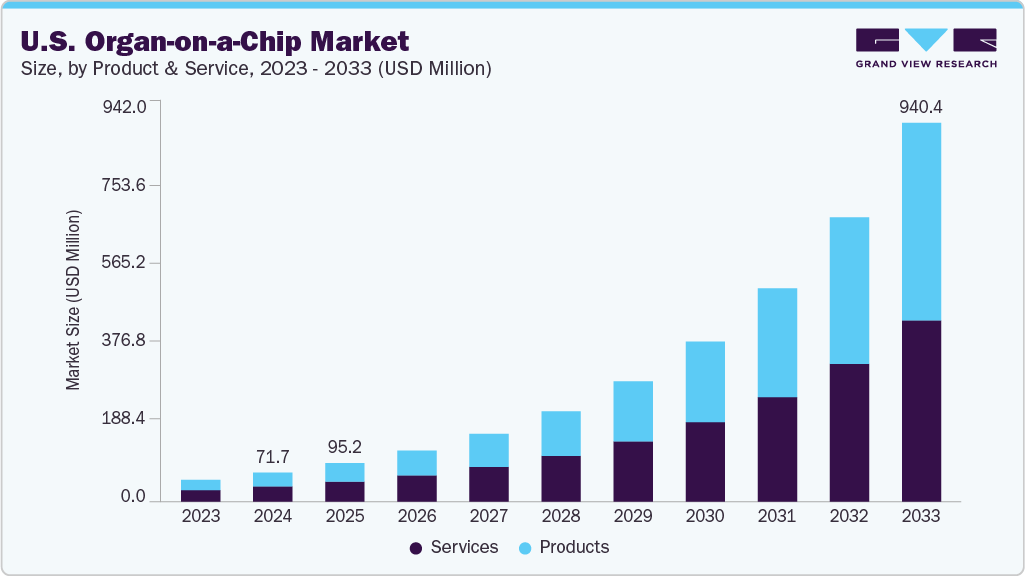
The U.S. organ-on-a-chip market size was estimated at USD 71.7 million in 2024 and is projected to reach USD 940.4 million by 2033, growing at a CAGR of 33.14% from 2025 to 2033. This growth is driven by increasing demand for more predictive preclinical testing models, a shift from animal testing, and rapid advancements in microfluidics, tissue engineering, and personalized medicine.
 Source: Grand View Research, IR Documents, Primary Interviews, Paid DatabasesTo learn more about this report,
 Download Free Sample Report
As pharmaceutical companies, biotech firms, and research institutions seek more accurate, ethical, and cost-effective ways to study human physiology and disease, organ-on-a-chip technologies are gaining traction as a transformative solution across the biomedical landscape.
Advancements in Microfluidics & Tissue Engineering
Advancements in microfluidics and tissue engineering have become a foundational driver of growth in the U.S. organ-on-a-chip industry. Microfluidic technologies enable precise control over the flow of nutrients, drugs, and mechanical stimuli at a microscale, closely mimicking the dynamic conditions of the human body. Tissue engineering complements this by enabling the creation of 3D cellular structures using human-derived cells, which can be designed to functionally resemble specific organs like the liver, lung, heart, or gut. These innovations have significantly improved the physiological relevance of preclinical testing, offering researchers more predictive and ethically responsible tools for studying disease and drug response.
Summary of Applications for Organ-on-a-Chip Technology
Organ on a Chip
Applications/ Model
Lung on a Chip
Model pulmonary edema, in-vivo environment for human airways, model for viral infection
Brain on a Chip
Blood Brain Barrier functioning, Neural Network
Heart on a Chip
Electrical stimulation, cardiac electrophysiology and different heart diseases
Liver on a Chip
Liver specific Protein Synthesis,
Kidney on a chip
Drug induced nephrotoxicity, Glomerular filtration
Skin on a Chip
Dermal diffusion testing, toxicology studies, efficacy testing, wound healing, inflammation, repair, ageing and shear stress studies
Gut on a Chip
Drug pharmacokinetics, host-gut microbiota cross talk, and nutrition metabolism
Source: Applied Surface Science Advances., Secondary Research, Grand View Research
The integration of stem cell technology, particularly induced pluripotent stem cells (iPSCs), further enhances the value of OOC platforms by allowing the development of patient-specific models. These personalized chips can reflect genetic variations and disease phenotypes unique to individuals, supporting precision medicine approaches. Moreover, recent innovations have allowed multiple organ systems to be connected on a single chip, enabling researchers to study how drugs or diseases affect the body rather than in isolation. This convergence of engineering and biology fuels sustained demand across the pharmaceutical, biotech, and academic research.
Better Disease Modeling
There is a rising need for more accurate and human-specific disease models. Traditional preclinical tools, such as 2D cell cultures and animal models, often fail to replicate the complexity of human physiology and disease progression. This has led to poor translation from lab results to clinical outcomes, contributing to high drug failure rates. Organ-on-a-chip platforms address these limitations by recreating the 3D architecture, mechanical forces, and multi-cellular interactions in human tissues. This technological edge is especially valuable in the U.S., where investment in biomedical innovation and personalized medicine continues to grow.
Moreover, the ability to use patient-derived stem cells in OOC devices is helping U.S. researchers and clinicians model rare and individualized disease states, accelerating the development of targeted therapies. These systems are proving essential for studying genetic variations, understanding disease mechanisms, and screening treatments in a personalized context, all without the ethical and scientific constraints of animal testing. With strong support from federal agencies like the NIH and growing interest from biotech startups and pharmaceutical companies, organ-on-a-chip technology is becoming a core part of disease modeling strategies across the U.S. research ecosystem. This shift improves drug development efficiency and aligns with broader healthcare trends toward precision medicine and patient-centered innovation.
Market Concentration & Characteristics
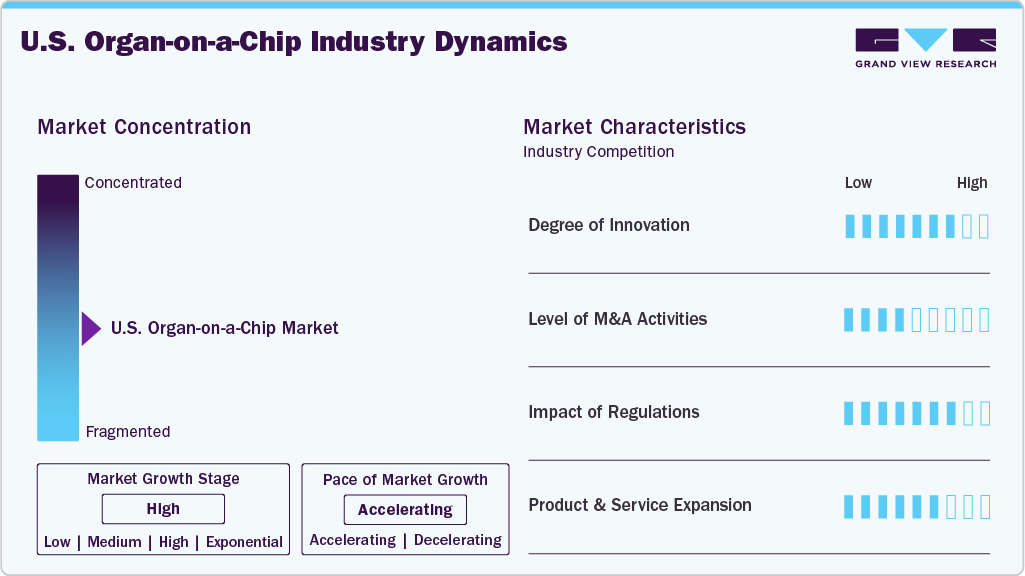
The U.S. organ-on-a-chip industry exhibits a high degree of innovation fueled by cutting-edge research at leading universities and strong collaboration with biotech startups and pharmaceutical companies. Advances in microfluidics, 3D bioprinting, and stem cell technology have created sophisticated, human-relevant models that replicate complex organ functions and interactions. Integration of real-time sensors and data analytics further enhances the capability of these platforms to monitor biological responses continuously. For instance, in June 2025, Emulate launched the AVA Emulation System in the U.S. This high-throughput organ-chip platform accelerated drug development by enabling simultaneous testing of 96 samples with reduced costs and labor.
The U.S. organ-on-a-chip industry is experiencing growing mergers and acquisitions (M&A) activity as larger pharmaceutical and biotech companies seek to incorporate advanced OOC technologies into their drug discovery and development pipelines. For instance, in July 2023, AxoSim acquired Vyant Bio’s StemoniX assets, including the microBrain platform and patents, enhancing its neurological drug discovery capabilities in the U.S. through a USD 2.25 million deal, highlighting this trend toward consolidation. Driven by the need for more predictive human disease models, streamlined development processes, and personalized medicine solutions, M&A in this sector is expected to accelerate. In addition, increasing recognition by regulatory bodies like the FDA of organ-on-chip platforms as viable alternatives to traditional preclinical testing further fuels industry interest and investment.
 To learn more about this report, Download Free Sample Report
Regulations play a crucial role in shaping the growth and adoption of organ-on-a-chip technologies in the U.S. While traditional drug development has heavily relied on animal testing, recent regulatory shifts, such as the FDA Modernization Act 2.0, have opened the door for alternative testing methods, including organ-on-a-chip platforms. This regulatory acceptance encourages pharmaceutical companies to integrate OOC systems into their preclinical pipelines as more ethical, cost-effective, and potentially predictive tools. Moreover, ongoing efforts by regulatory agencies to develop clear guidelines and validation frameworks for OOC technologies are enhancing industry confidence and accelerating commercialization. Overall, favorable regulatory support is a key factor driving innovation and investment in the U.S. organ-on-a-chip industry.
Product & service expansion is a significant driver in the U.S. organ-on-a-chip industry. Companies continuously develop new and improved chip models to mimic a broader range of human organs and physiological functions. Initially focused on single-organ systems such as liver or lung chips, manufacturers are now advancing multi-organ platforms that simulate complex interactions within the human body, often called “body-on-a-chip.” For instance, in April 2024, CN Bio raised USD 21 million in Series B funding to advance its PhysioMimix organ-on-a-chip technology and expand globally in toxicology and drug development markets. This continuous product diversification not only broadens the applications of organ-on-chip technology but also attracts wider adoption across pharmaceutical, biotech, and academic research sectors in the U.S. organ-on-a-chip industry.
Product & Services Insights
The services segment accounted for the largest revenue share in 2024, driven by the increasing demand for contract research, custom device development, and validation services from pharmaceutical and biotechnology companies aiming to accelerate drug discovery and reduce reliance on animal testing.
The products segment is projected to witness at the fastest CAGR over the forecast period, fueled by ongoing technological advancements and growing adoption of organ-on-chip devices in pharmaceutical research and personalized medicine. Increasing investments in R&D and rising demand for reliable in vitro models to replace animal testing are key factors driving market growth.
Application Insights
The drug discovery segment led the market with the largest revenue share of 62.82% in 2024, driven by the rising need for more accurate and cost-effective preclinical testing models that improve the prediction of human responses, thereby accelerating the development of safer and more effective drugs. Moreover, stringent regulatory requirements and growing emphasis on reducing animal testing have further boosted the adoption of organ-on-chip technologies in pharmaceutical R&D.
The toxicology research segment is projected to witness at the fastest CAGR over the forecast period, driven by increasing demand for advanced, reliable, and ethical alternatives to animal testing. Rising regulatory pressure to improve safety assessments and the growing use of organ-on-chip models for evaluating drug toxicity and environmental chemicals are key factors propelling growth in this segment. For instance, in August 2023, Emulate launched its human Liver Chip, which demonstrated 87% sensitivity and 100% specificity in predicting drug-induced liver injury, improving preclinical toxicology and reducing clinical trial failures.
End-use Insights
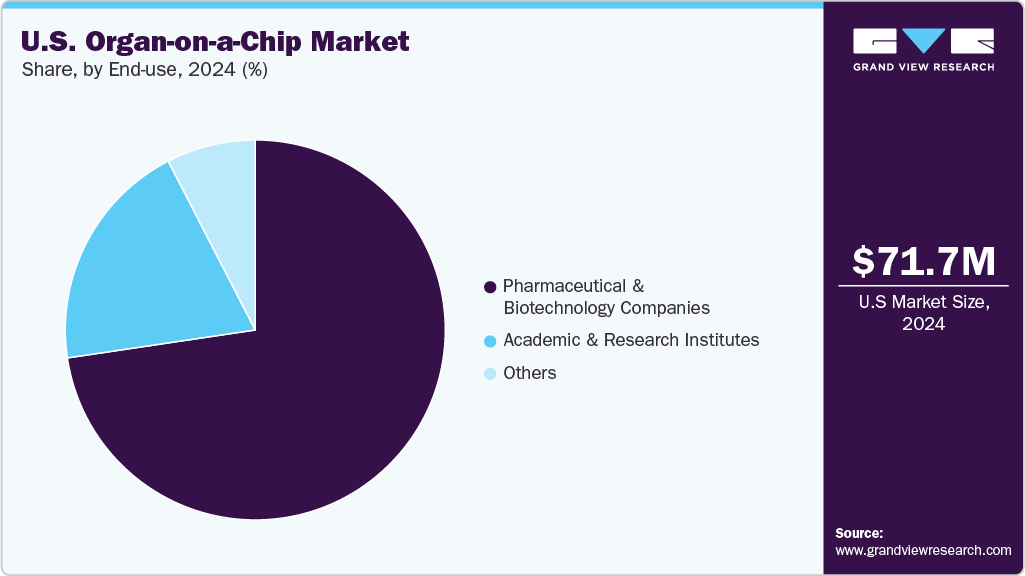
The pharmaceutical and biotechnology companies segment led the market with the largest revenue share of 72.65% in 2024, driven by their extensive adoption of organ-on-chip technologies to enhance drug development processes. These companies increasingly rely on these platforms for more predictive preclinical testing, reducing drug development timelines and costs while improving safety and efficacy assessments.
 To learn more about this report, Download Free Sample Report
The academic & research institutes segment is expected to witness at the fastest CAGR over the forecast period, driven by increasing funding for biomedical research and growing interest in organ-on-chip technologies for disease modeling and personalized medicine. These institutes are crucial in advancing technology, developing novel applications, and collaborating with industry partners to accelerate innovation.
Key U.S. Organ-on-a-Chip Company Insight
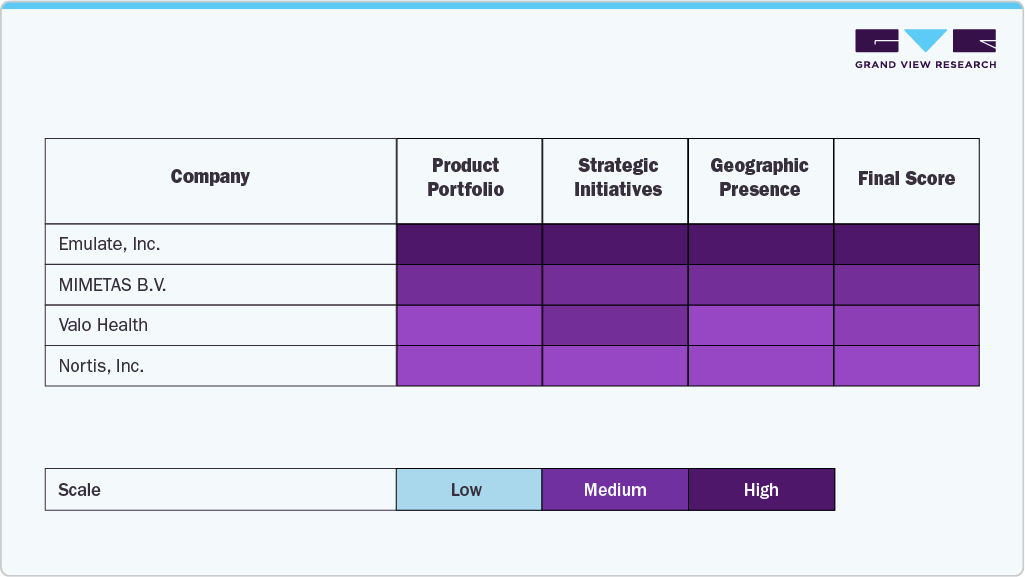
The U.S. organ-on-a-chip industry is characterized by a diverse array of established players who lead through robust product portfolios, strategic partnerships, and sustained investments in research and development. Leading companies such as Emulate, Inc., MIMETAS B.V., Valo Health, Nortis, Inc., AxoSim, BICO - The Bio Convergence Company, CN Bio Innovations Ltd, The Charles Stark Draper Laboratory, Inc., SynVivo, Inc., and AlveoliX AG hold significant market shares, driven by their advanced microfluidic technologies, wide-ranging organ models, and strong collaborations with pharmaceutical and biotechnology industries.
Organizations like Nortis, Inc., SynVivo, Inc., and AxoSim are expanding their footprint by offering innovative, customizable organ-on-chip platforms tailored to the growing needs of drug discovery, toxicology testing, and personalized medicine. These companies focus on delivering physiologically relevant in vitro models that reduce reliance on animal testing and enhance predictive accuracy for human responses.
 To learn more about this report, Download Free Sample Report
Market leaders maintain dominance by combining cutting-edge technological expertise with comprehensive service offerings and strategic growth initiatives, such as co-development agreements and licensing deals. They also reinforce their leadership by addressing the increasing demand for reliable, high-throughput, and multi-organ systems that support drug development, disease modeling, and regenerative medicine research.
As demand for precision medicine, safer drug development, and ethical testing methods accelerates, the U.S. organ-on-a-chip industry is increasingly shaped by commitments to scalability, affordability, and regulatory compliance factors that will be pivotal in defining its future trajectory and aligning it with broader healthcare innovation and sustainability goals. The market is witnessing a dynamic blend of established expertise and innovative newcomers, with strategic collaborations, mergers and acquisitions, and breakthroughs in biomimetic accuracy and automation intensifying competition. Companies that successfully integrate scientific innovation with client-focused solutions are well-positioned to create lasting value in this rapidly evolving and promising field.
Key U.S. Organ-on-a-Chip Companies:
- Emulate, Inc.
- MIMETAS B.V.
- Valo Health
- Quris Technologies LTD. (Nortis, Inc.)
- AxoSim
- BICO - THE BIO CONVERGENCE COMPANY
- CN Bio Innovations Ltd
- The Charles Stark Draper Laboratory, Inc.
- SynVivo, Inc.
- AlveoliX AG
Three ways to get this report
Buy it, customize it, or ask a question.Ask an Analyst
Analyst response in 1 business day
- AccessReport author, directly
- Reply timeWithin 1 working day
- No sales callDirect answer only
- FormatEmail reply
- CostFree, no cost
Get the Full Report
What the study covers
- FormatsPDF · Excel · Dashboard
- Timeline2025–2033 annual, 2024 base
- Coverage20+ countries, 5 regions
- Companies10+ key players profiled
Customize the Report
20% free customization
- IncludeCountries, segments, points
- TailorTo your product definition
- ExtendDeeper competitor detail
- OrA fully bespoke study
- Turnaround5–10 working days
Recent Developments
-
In June 2025, World Precision Instruments and SynVivo launched the EVOM™ Chip in Florida, enabling real-time, multiplexed TEER monitoring across 12 channels for organ-on-a-chip models.
-
In June 2025, Emulate launched the AVA Emulation System in Boston, a high-throughput organ-on-a-chip platform enabling 96-sample culture and imaging, accelerating drug development with reduced costs and labor.
-
In October 2024, Quris-AI acquired Nortis, combining Kidney-on-Chip tech with AI to enhance drug safety predictions and reduce animal testing in preclinical development.
U.S. Organ-on-a-Chip Market Report Scope
Report Attribute
Details
Market size value in 2025
USD 95.2 million
Revenue forecast in 2033
USD 940.4 million
Growth rate
CAGR of 33.14% from 2025 to 2033
Base year for estimation
2024
Historical data
2021 - 2023
Forecast period
2025 - 2033
Quantitative units
Revenue in USD million/billion and CAGR from 2025 to 2033
Report coverage
Revenue forecast, company ranking, competitive landscape, growth factors, and trends
Segments covered
Products & service, application, end-use
Key companies profiled
Emulate, Inc.; MIMETAS B.V.; Valo Health; Quris Technologies LTD. (Nortis, Inc.).; AxoSim; BICO - THE BIO CONVERGENCE COMPANY; CN Bio Innovations Ltd; SynVivo, Inc.; The Charles Stark Draper Laboratory, Inc.; AlveoliX AG.
Customization scope
Free report customization (equivalent up to 8 analyst’s working days) with purchase. Addition or alteration to country & segment scope.
Pricing and purchase options
Avail customized purchase options to meet your exact research needs. Explore purchase options
U.S. Organ-on-a-Chip Market Report Segmentation
This report forecasts revenue growth and provides an analysis on the latest trends in each of the sub-segments from 2021 to 2033. For the purpose of this report, Grand View Research has segmented the U.S. organ-on-a-chip market report based on the product & service, application, and end-use:
-
Product & Service Outlook (Revenue, USD Million, 2021 - 2033)
-
Products
-
Instrument
-
Devices
-
Liver-on-a-Chip
-
Lung-on-a-Chip
-
Intestine-on-a-Chip
-
Kidney-on-a-Chip
-
Heart-on-a-Chip
-
Others
-
-
-
Services
-
-
Application Outlook (Revenue, USD Million, 2021 - 2033)
-
Drug Discovery
-
Toxicology Research
-
Others
-
-
End-use Outlook (Revenue, USD Million, 2021 - 2033)
-
Academic & Research Institutes
-
Pharmaceutical & Biotechnology Companies
-
Others
-
Frequently Asked Questions About This Report
The U.S. organ-on-a-chip market size was estimated at USD 71.7 million in 2024 and is expected to reach USD 95.2 million in 2025.
The U.S. organ-on-a-chip market is expected to grow at a compound annual growth rate of 33.14% from 2025 to 2033 to reach USD 940.4 million by 2033.
Drug discovery segment dominated the U.S. organ-on-a-chip market with a share of 63.02% in 2024. This is attributable to its ability to provide more accurate human-relevant data, reduce drug development time, and lower preclinical failure rates.
Some key players operating in the U.S. organ-on-a-chip market include Emulate, Inc.; MIMETAS B.V.; Valo Health; Quris Technologies LTD. (Nortis, Inc.).; AxoSim; BICO - THE BIO CONVERGENCE COMPANY; CN Bio Innovations Ltd; SynVivo, Inc.; The Charles Stark Draper Laboratory, Inc.; AlveoliX AG.
Key factors that are driving the U.S. organ-on-a-chip market growth include rising demand for drug screening alternatives, advancements in microfluidics, growing investments in personalized medicine, and increased focus on reducing animal testing in preclinical research.
About the Author(s)
Biotechnology Research Team
Healthcare · BiotechnologyThis report was authored by the biotechnology research team at Grand View Research - comprising two research analysts, one senior research analyst, and one industry expert - with specialized expertise in the biotechnology segment of the healthcare industry. All findings are based on proprietary healthcare databases, executive interviews, and regulatory analysis, subject to internal peer review prior to publication.
Last Updated:
Speak to Analyst

Customize this report to your needs - add regions, segments, or data points, with 20% free customization.
Or view our licence options:


ISO 9001:2015 & 27001:2022 Certified
We are GDPR and CCPA compliant! Your transaction & personal information is safe and secure. For more details, please read our privacy policy.


