
- Home
- »
- Consumer F&B
- »
-
U.S. Organic Banana Market Size And Share Report, 2033GVR Report cover

U.S. Organic Banana Market (2026 - 2033)
Size, Share & Trends Analysis Report By Product (Ripe Organic Bananas, Raw/Green Organic Bananas), By Distribution Channel (Supermarkets & Hypermarkets, Convenience Stores, Specialty Organic Stores), And Segment Forecasts
Market Size, 2025
$1.2BMarket Estimate, 2026
$1.3BMarket Forecast, 2033
$2.1BCAGR, 2026–2033
7.4%U.S. Organic Banana Market Summary
The U.S. organic banana market was valued at USD 1.2 billion in 2025 and is expected to grow from USD 1.3billion in 2026 to USD 2.1 billion by 2033, at a CAGR of 7.4% from 2026 to 2033. The U.S. organic banana industry is mainly supported by the rising preference for healthier and naturally produced foods.
Key Market Trends & Insights
- By product: Ripe organic banana market held the largest share of 67.3% in 2025.
- By distribution channel: Supermarkets & hypermarkets channel held the largest share of 61.7% in 2025.
Key Market Trends & Insights
- Market size in 2025: USD 1.2 Billion
- Estimated market size in 2026: USD 1.3 Billion
- Projected market size by 2033: USD 2.1 Billion
- CAGR (2026-2033): 7.4%
Three ways to get this report
Buy it, customize it, or ask a question.Ask an Analyst
A direct answer, usually in 1 working day
- AccessReport author, directly
- Reply timeWithin 1 working day
- No sales callDirect answer only
- FormatEmail reply
- CostFree, no cost
Get the Full Report
What the study covers
- FormatsPDF · Excel · Dashboard
- Timeline2026–2033 annual, 2025 base
- Coverage20+ countries, 5 regions
- Companies10+ key players profiled
Customize the Report
20% free customization
- IncludeCountries, segments, points
- TailorTo your product definition
- ExtendDeeper competitor detail
- OrA fully bespoke study
- Turnaround5–10 working days
Consumers are becoming more conscious of their diet and the environmental impact of food production, which is encouraging them to choose organic products. Additionally, the growing availability of organic bananas in supermarkets and retail stores is making them easier for consumers to purchase.
Organic bananas are also increasingly used in smoothies, snacks, breakfast meals, and food-service applications. According to FAO data, organic banana production promotes sustainable farming through organic agriculture, reduced pesticide use, and environmental protection. These practices, supported by organic certification and sustainability standards, can strengthen consumer confidence and market opportunities for U.S. organic bananas.
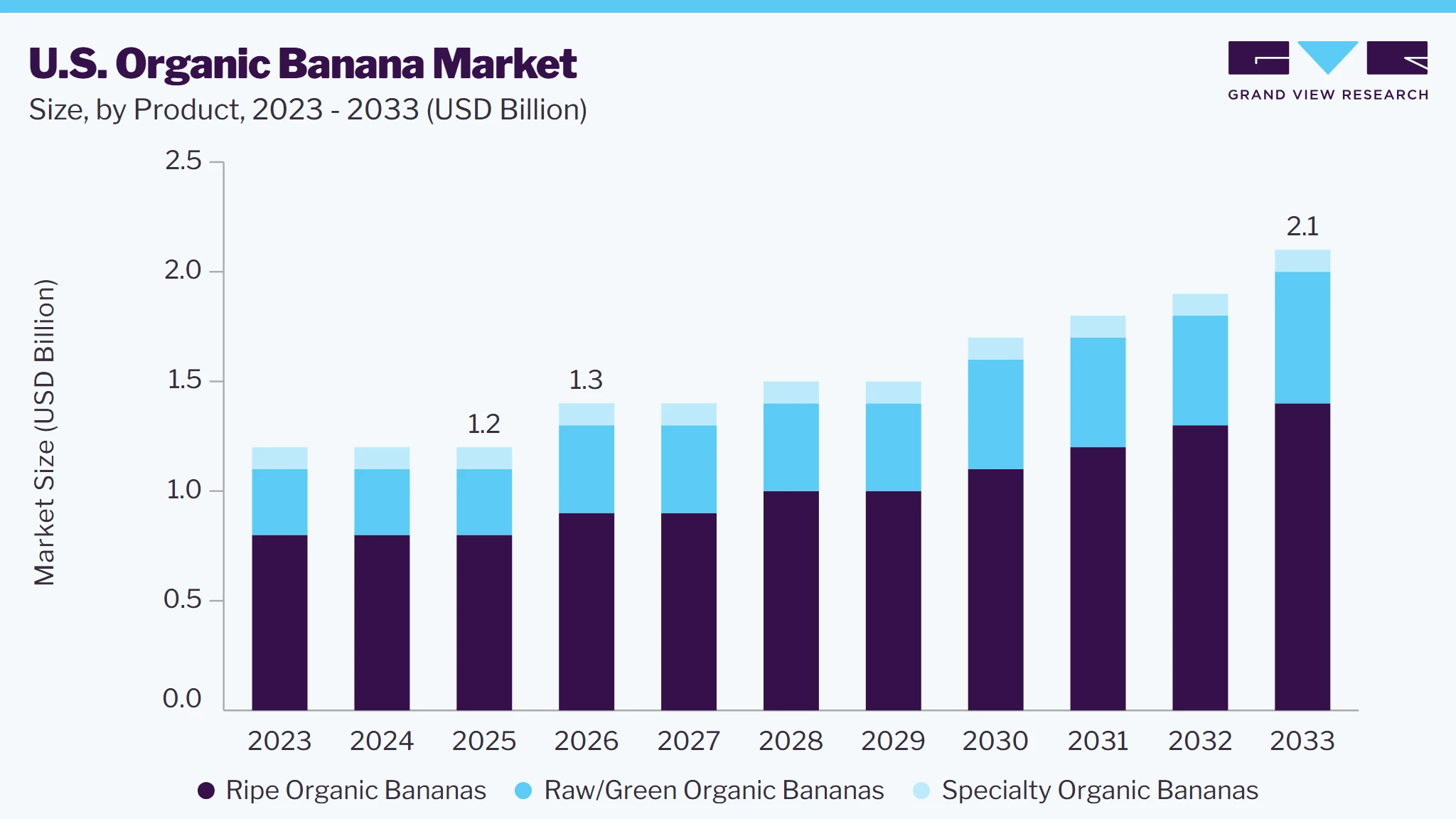 Source: Grand View Research, IR Documents, Primary Interviews, Paid DatabasesTo learn more about this report,
 Download Free Sample Report
 According to SPINS data published in April 2024, certified regenerative organic products increased 8.6%, compared with a 3.5% rise in certified non-GMO Project products. This growth in certification- and sustainability-led products highlights increasing U.S. consumer interest in differentiated attributes, supporting opportunities for organic banana suppliers to strengthen positioning around organic certification, responsible sourcing, and sustainability.
The market is further influenced by the growing presence of private-label organic produce and premium fruit brands. Competitive pricing strategies, promotional campaigns, and attractive product displays are helping businesses strengthen their position. Online grocery platforms are also providing new sales channels for organic banana suppliers.
According to The Packer data published in October 2025, organic bananas are gaining popularity among U.S. consumers, particularly younger shoppers. In 2024, about 13% of bananas entering the U.S. were certified organic, up from approximately 7% a decade earlier, indicating continued market growth.
Market Dynamics
Consumer preferences in the U.S. are increasingly shifting toward food products perceived as natural and minimally processed. Organic bananas benefit from this broader movement toward cleaner food choices. Consumers who pay attention to ingredient sourcing and farming methods may be more willing to select certified organic fruit. According to a survey of 1,521 U.S. consumers, published in February 2025, about 58% consumers prefer organic products as they tend to have fewer synthetic chemicals and additives. This preference provides a stable demand base for organic bananas. It also supports the long-term expansion of the category within the fresh produce market.
Organic banana production generally involves additional costs related to certification, compliance, and approved farming practices. These expenses can increase the overall cost of bringing the product to market. Higher operating costs may place pressure on suppliers and retailers to maintain competitive margins. According to Fairtrade data, updated banana minimum prices increased by 6% at the Ex Works level and 4.6% at the FOB level, reflecting the rising costs of sustainable banana production. These higher production costs can contribute to higher prices across the supply chain, creating a cost challenge for suppliers and retailers in the U.S. banana market.
In addition, data published in June 2026, proposed U.S. Farm Bill restrictions on non-U.S. foods could create additional sourcing challenges, particularly because the U.S. relies heavily on imported bananas from Central and South America. Together, these cost and sourcing pressures can make cost management an important challenge for businesses in the U.S. organic banana market.
Online grocery platforms offer suppliers an additional channel to reach consumers across the U.S. Digital retail can provide greater product visibility and enable businesses to communicate information about sourcing and certification. Subscription-based grocery services may also support regular purchases of fresh produce. Improvements in online ordering and delivery infrastructure can make this channel more practical for perishable products. This creates room for organic banana suppliers to develop new distribution strategies.
Analyst Perspective
The U.S. organic banana market is evolving as consumers increasingly seek differentiated fresh produce with stronger traceability and transparent sourcing. Retailers are placing greater emphasis on supplier reliability, product consistency, and responsible procurement practices as they expand their organic fruit offerings. Advances in inventory management and ripening operations are helping market participants reduce quality losses and improve product handling. Competition is also encouraging companies to strengthen branding, packaging, and merchandising strategies to attract specific consumer groups. The market is therefore expected to benefit from continued innovation in sourcing, distribution, and product positioning.
Product Insights
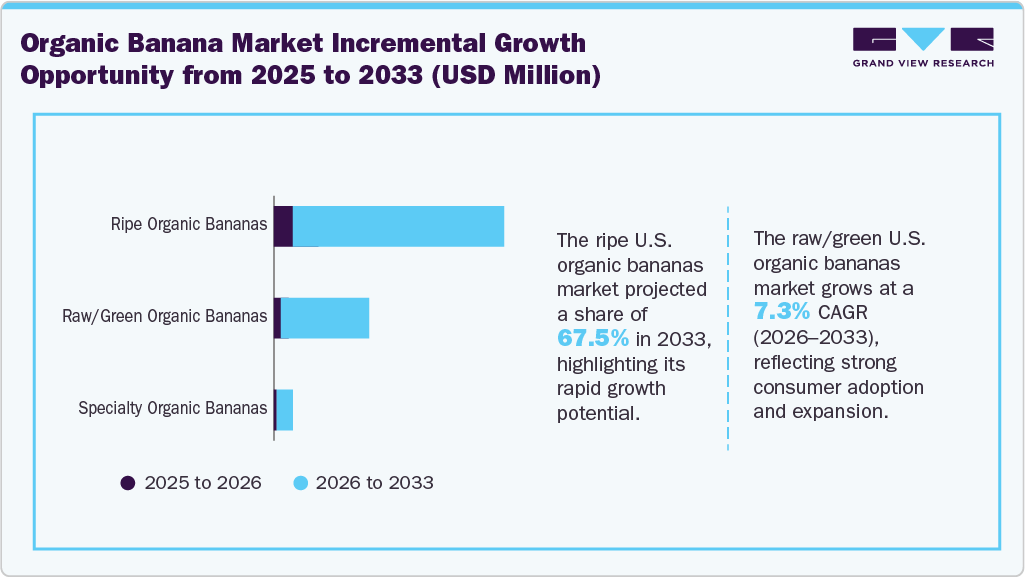
The ripe organic banana accounted for the largest share of 67.3% of the revenue in 2025. Ripe organic bananas are supported by their ready-to-eat nature, which suits consumers seeking convenient fresh fruit. Their natural sweetness and soft texture make them suitable for direct consumption without additional preparation. They are also commonly used in breakfast dishes, desserts, and blended beverages. Food-service businesses can use ripe bananas when immediate consumption or preparation is required. These characteristics help maintain a steady demand for ripe organic bananas in the U.S. market.
 To learn more about this report, Download Free Sample Report
 The raw/green U.S. organic banana market is projected to grow significantly at a CAGR of 7.3% from 2026 to 2033. Raw or green organic bananas are driven by their longer handling window compared with fully ripe fruit. Their firmer condition allows retailers and distributors greater flexibility in managing inventory and transportation. Green bananas can also be ripened according to specific retail or food-service requirements. This feature helps businesses coordinate supply with expected purchasing patterns. Their suitability for controlled ripening supports demand across different stages of the U.S. distribution chain.
Distribution Channel Insights
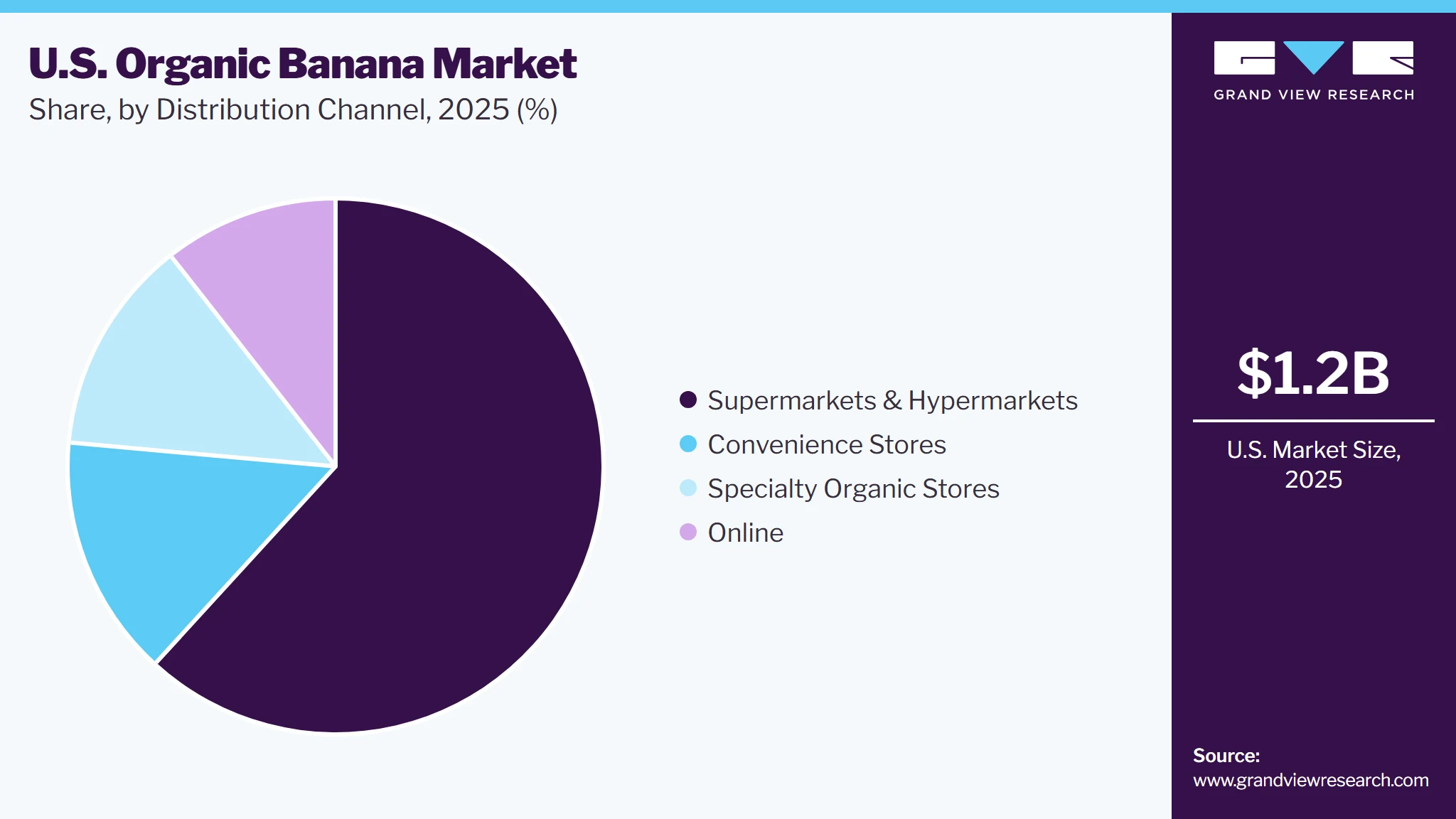
The supermarkets and hypermarkets channel in the U.S. organic banana market accounts for the largest share of 61.7% of the revenue in 2025. Supermarkets and hypermarkets benefit from their extensive fresh-produce sections and high customer traffic. Their broad store networks allow organic bananas to reach consumers across different regions. In-store displays and promotions can improve product visibility at the point of purchase. These outlets also provide shoppers with the opportunity to assess fruit quality before buying. Strong relationships with organic produce suppliers can further support consistent shelf availability.
 To learn more about this report, Download Free Sample Report
 The online channel in the U.S. organic banana industry is projected to grow at the fastest CAGR of 7.7% from 2026 to 2033. Online distribution is supported by the convenience of ordering fresh produce without visiting a physical store. Digital platforms allow consumers to compare products, prices, and available delivery options easily. Home-delivery services can be particularly attractive to customers with limited time for grocery shopping. Retailers can also use digital product information to highlight certifications, sourcing details, and product characteristics. Improved cold-chain and last-mile delivery capabilities are making online channels more suitable for perishable produce.
Key U.S. Organic Banana Company Insights
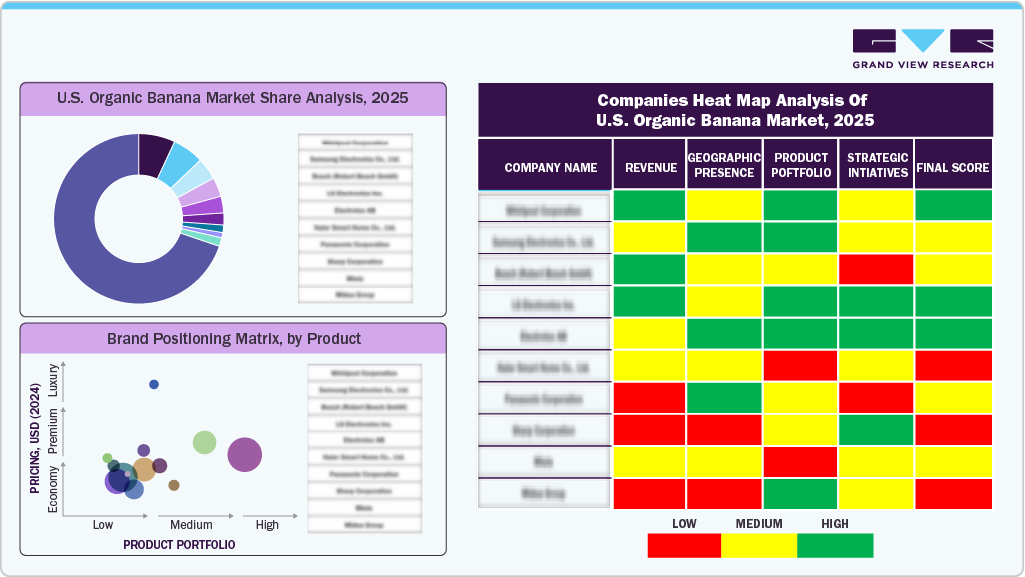
The U.S. organic banana industry features a competitive landscape with both established fruit companies and specialized organic produce suppliers. Leading players focus on maintaining reliable sourcing, efficient distribution, and consistent product quality. Companies compete through brand positioning, retailer partnerships, product availability, and supply-chain efficiency. Market share is influenced by the ability to secure dependable supply and meet the requirements of major retail channels. Overall, competition remains shaped by brand strength, distribution reach, and operational capabilities.
 To learn more about this report, Download Free Sample Report
 Key U.S. Organic Banana Companies
The following key companies have been profiled for this study on the U.S. organic banana market.
-
Dole plc
-
Chiquita Brands International
-
Fresh Del Monte Produce Inc.
-
Daabon Organics USA
-
Earth Source Foods.
-
Organics Unlimited
-
Kapi Kapi Growers
-
Pacific Trellis Fruit
-
Robinson Fresh
-
Sunrise Growers
Competitive Benchmarking
Category
Operating Strategies
Competitive Edge
Weakness
Established Players (Dole plc, Chiquita Brands International)
Scale organic volumes, secure retail contracts, optimize sourcing.
Broad distribution and strong retailer access.
Margin pressure and supply-chain complexity.
Emerging Players (Daabon Organics USA)
Focus on premium niches, differentiated sourcing, and specialty channels.
Flexibility and strong organic specialization.
Limited scale and market visibility.
Recent Developments
-
In May 2026, Alden’s Organic expanded its product portfolio with Banana Cookie Crumble, a dessert-inspired organic ice cream combining banana flavor with vanilla wafer pieces. The new offering became a permanent addition to the brand and was distributed through major U.S. natural and specialty grocery retailers, including Sprouts, Fresh Thyme, The Fresh Market, and Natural Grocers.
-
In October 2024, Kapi Kapi Growers launched an organic banana program targeting retailers in the U.S. and Canada. The initiative expanded the company’s organic banana offerings and strengthened its presence in the North American market.
U.S. Organic Banana Market Report Scope
Report Attribute
Details
Market size in 2025
USD 1.2 billion
Market value size in 2026
USD 1.3 billion
Revenue Forecast in 2033
USD 2.1 billion
Growth Rate (Revenue)
CAGR of 7.4% from 2026 to 2033
Actuals
2021 - 2025
Forecast period
2026 - 2033
Quantitative (Revenue) units
Revenue in USD million/billion and CAGR from 2026 to 2033
Report coverage
Revenue forecast, company ranking, competitive landscape, growth factors, and trends
Segments covered
Product, distribution channel
Country scope
U.S.
Key companies profiled
Dole plc; Chiquita Brands International; Fresh Del Monte Produce Inc.; Daabon Organics USA; Earth Source Foods; Organics Unlimited; Kapi Kapi Growers; Pacific Trellis Fruit; Robinson Fresh; Sunrise Growers
Customization scope
Free report customization (equivalent up to 8 analysts’ working days) with purchase. Addition or alteration to country, regional & segment scope.
Pricing and purchase options
Avail customized purchase options to meet your exact research needs. Explore purchase options
U.S. Organic Banana Market Report Segmentation
This report forecasts revenue growth at the regional and country levels and provides an analysis of the latest industry trends and opportunities in each of the sub-segments from 2021 to 2033. For the purpose of this study, Grand View Research has segmented the U.S. organic banana market report on the basis of product and distribution channel:
-
Product Outlook (Revenue, USD Million, 2021 - 2033)
-
Ripe Organic Bananas
-
Raw/Green Organic Bananas
-
Specialty Organic Bananas
-
-
Distribution Channel Outlook (Revenue, USD Million, 2021 - 2033)
-
Supermarkets & Hypermarkets
-
Convenience Stores
-
Specialty Organic Stores
-
Online
-
Research Methodology
The U.S. organic banana market figures in this report are based on a proven research process that combines executive interviews with secondary research from proprietary databases, company filings, and recognized regulatory and institutional sources. Market size is built through value-chain sizing-reconciling supply-side and demand-side estimates-and triangulated with bottom-up and top-down approaches. Every estimate passes multiple levels of expert validation before publication, with each U.S. organic banana segment quantified using the revenue-capture definitions in the table below.
Segment Definition
Segment - Product
Revenue capture definition
Ripe Organic Bananas
Ripe organic bananas capture revenue through sales of fruit that has reached its preferred consumption stage. Suppliers earn income from individual units, bunches, and consumer-sized packs across multiple retail formats. Pricing can vary according to appearance, size, certification, and presentation. Merchandising near other fresh fruits can encourage impulse purchases and increase basket value.
Raw/Green Organic Bananas
Raw/green organic bananas generate revenue by serving buyers that prefer fruit at an earlier stage of maturity. Suppliers can sell larger quantities to distributors and commercial buyers requiring flexibility in handling and ripening. Pricing is influenced by order volume, fruit specifications, and delivery requirements. Their ability to remain in storage for controlled periods can support planned commercial purchasing.
Specialty Organic Bananas
Specialty organic bananas earn revenue by catering to consumers interested in less-common varieties and differentiated produce. Suppliers can command premium prices when distinctive characteristics justify a higher perceived value. Sales may focus on gourmet retailers, specialty produce stores, and curated food businesses. Limited-volume offerings can further support premium positioning within the organic fruit category.
Estimation Model
Layer
Key Question
Description
Consumption Profile Layer
Who buys organic bananas?
Health-conscious U.S. households seeking pesticide-free, nutritious, and sustainably produced fruit.
Market Reach Layer
Where are organic bananas available?
Sold through supermarkets, natural-food retailers, club stores, online grocery, and foodservice channels.
Purchase & Retention Layer
What encourages repeat purchases of organic bananas?
Consistent freshness, ripeness, organic certification, competitive pricing, and dependable in-stock availability.
Value Generation Layer
How is revenue generated from organic banana consumers?
Through premium pricing, private-label products, branded offerings, value packs, and differentiated quality positioning.
Customization Table
Client Request
Customization Delivered
Value Adds
Organic Banana Market Size & Growth Analysis
Quantified market value, volume, historical performance, and projected growth across major markets.
Establishes market attractiveness and supports investment and expansion decisions.
Organic Banana Pricing & Cost Analysis
Benchmarked farm-gate, wholesale, retail, and import/export prices while assessing key cost drivers.
Helps businesses optimize pricing strategies and understand margin opportunities.
Retail & E-commerce Channel Assessment
Evaluated supermarkets, specialty organic stores, foodservice, online grocery, and direct-to-consumer channels.
Determines the most effective routes to market and uncovers channel expansion opportunities.
Frequently Asked Questions About This Report
The U.S. organic banana market size was valued at USD 1.2 billion in 2025 and is estimated at USD 1.3 billion for 2026.
The U.S. organic banana market is expected to grow at a CAGR of 7.4% from 2026 to 2033, reaching USD 2.1 billion by 2033.
Key factors driving the U.S. organic banana market include rising consumer preference for organic and sustainably produced fruits, driven by increasing health and environmental awareness. Growing demand for clean-label, pesticide-free, and nutritious food products is encouraging consumers to choose organic bananas over conventional varieties.
Ripe organic banana market held the largest share of 67.3% in 2025, while raw/green organic bananas segment is fastest growing product.
Key players include Dole plc, Chiquita Brands International, Fresh Del Monte Produce Inc., Daabon Organics USA, Earth Source Foods, Organics Unlimited, Kapi Kapi Growers, Pacific Trellis Fruit, Robinson Fresh, and Sunrise Growers.
Supermarkets & hypermarkets channel held the largest share of 61.7% in 2025, while online channel segment is fastest growing distribution channel.
About the Author(s)
Consumer F&B Research Team
Consumer Goods · Consumer F&BThis report was authored by the consumer f&b research team at Grand View Research - comprising two research analysts, one senior research analyst, and one industry expert - with specialized expertise in the consumer f&b segment of the consumer goods industry. All findings are based on proprietary consumer goods databases, executive interviews, and regulatory analysis, subject to internal peer review prior to publication.
Last Updated:
Speak to Analyst

Customize this report to your needs - add regions, segments, or data points, with 20% free customization.
Or view our licence options:


ISO 9001:2015 & 27001:2022 Certified
We are GDPR and CCPA compliant! Your transaction & personal information is safe and secure. For more details, please read our privacy policy.


