
- Home
- »
- Consumer F&B
- »
-
U.S. Protein-fortified Food Products Market Size Report 2033GVR Report cover

U.S. Protein-fortified Food Products Market (2026 - 2033)
Size, Share & Trends Analysis Report By Nature (Organic, Conventional), By Product (Bakery & Snacks Products, Protein Bars), By Distribution Channel (Hypermarkets & Supermarkets, Convenience Stores), And Segment Forecasts
Market Size, 2025
$24.1BMarket Estimate, 2026
$25.6BMarket Forecast, 2033
$39.7BCAGR, 2026–2033
6.5%U.S. Protein-fortified Food Products Market Summary
The U.S. protein-fortified food products market size was valued at USD 24.1 billion in 2025 and is projected to grow from USD 25.6 billion in 2026 to USD 39.7 billion by 2033, at a CAGR of 6.5% from 2026 to 2033. Rising consumer emphasis on health, satiety, muscle maintenance, and everyday nutrition is accelerating demand for protein-fortified foods in the U.S.
Key Market Trends & Insights
- By nature: Conventional segment led the market with a revenue share of 71.0% in 2025.
- By product: The use of protein-fortified food products for protein bars led the market with a share of 20.0% in 2025.
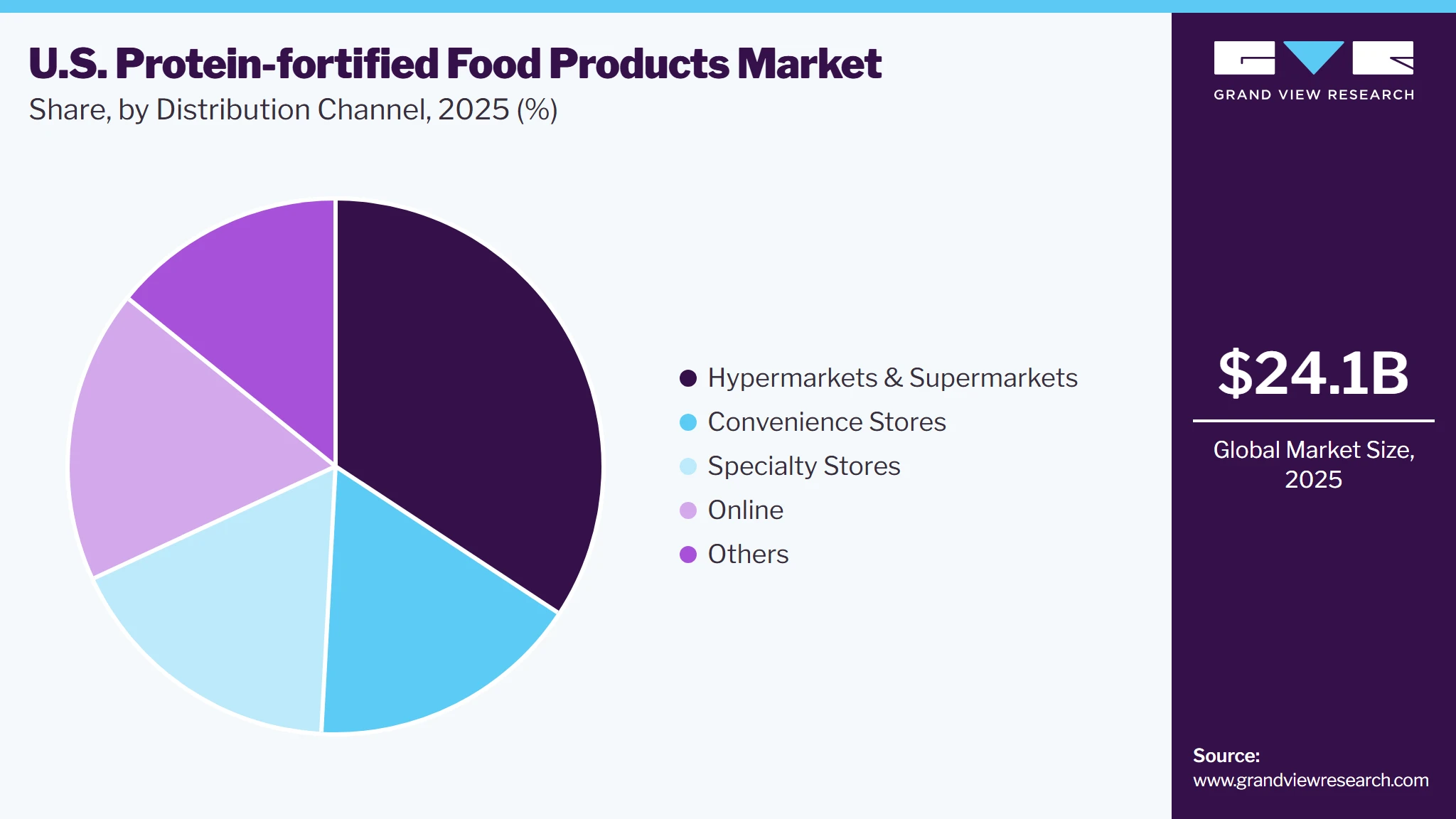
- By distribution channel: Supermarkets & hypermarkets led the market with a share of 34.3% in 2025.
Market Size & Forecasts
- Market Size in 2025: USD 24.1 Billion
- Estimated market size in 2026: USD 25.6 Billion
- Projected market size by 2033: USD 39.7 Billion
- CAGR (2026-2033): 6.5%
Three ways to get this report
Buy it, customize it, or ask a question.Ask an Analyst
A direct answer, usually in 1 working day
- AccessReport author, directly
- Reply timeWithin 1 working day
- No sales callDirect answer only
- FormatEmail reply
- CostFree, no cost
Get the Full Report
What the study covers
- FormatsPDF · Excel · Dashboard
- Timeline2026–2033 annual, 2025 base
- Coverage20+ countries, 5 regions
- Companies10+ key players profiled
Customize the Report
20% free customization
- IncludeCountries, segments, points
- TailorTo your product definition
- ExtendDeeper competitor detail
- OrA fully bespoke study
- Turnaround5–10 working days
Consumers are increasingly incorporating protein into snacks, breakfast products, dairy, beverages, and convenient meal formats rather than limiting intake to sports nutrition. This broader adoption is encouraging manufacturers to expand high-protein product portfolios, develop convenient formats, and introduce products aligned with active, wellness-focused lifestyles.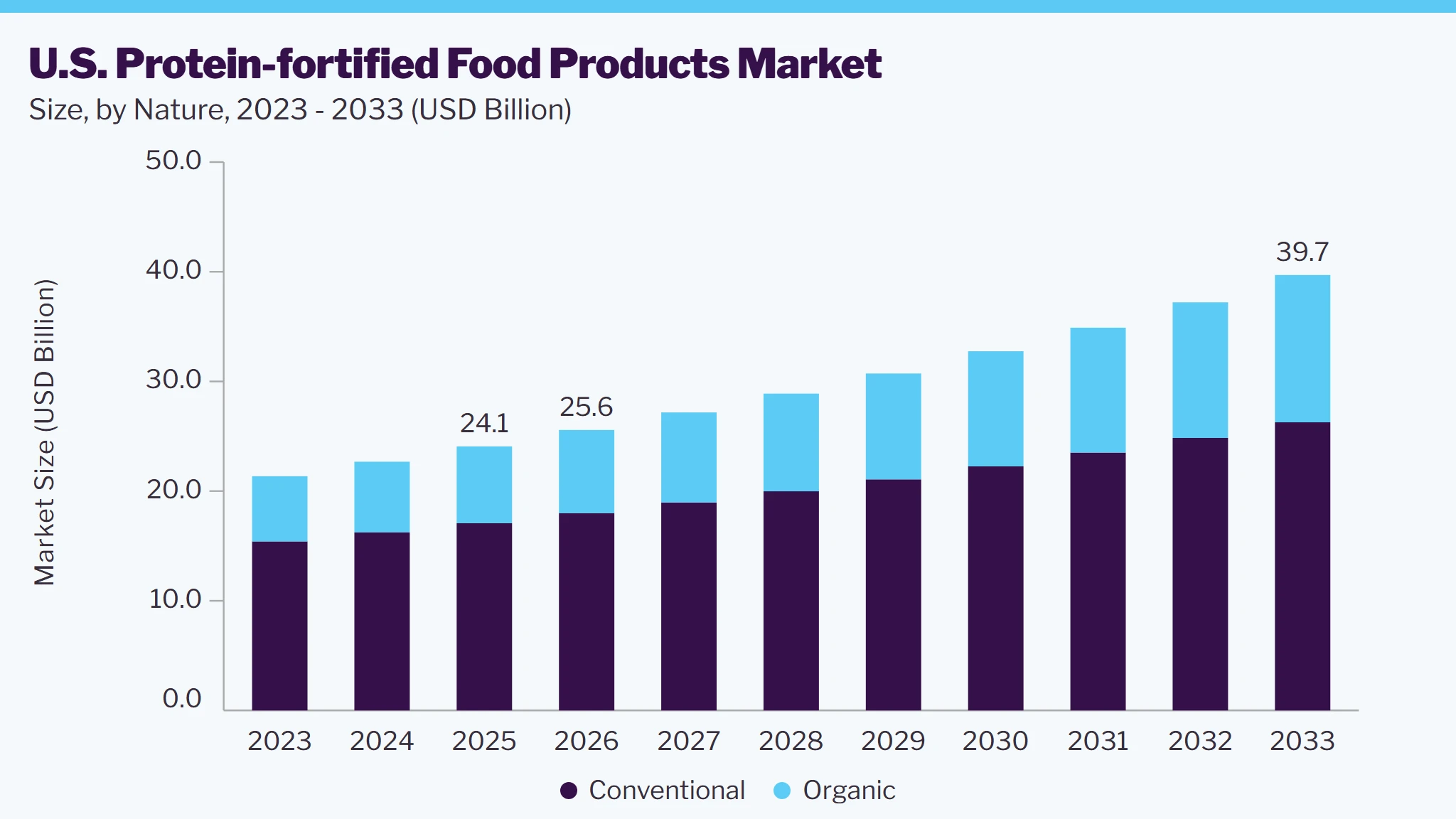 Source: Grand View Research, IR Documents, Primary Interviews, Paid DatabasesTo learn more about this report,
 Download Free Sample Report
 Protein has evolved into a mainstream nutritional priority among U.S. consumers, extending well beyond traditional athletes and sports-nutrition users. Circana reported in August 2026 that 48% of U.S. adults were seeking more protein in their diets, up 7 percentage points from the previous year, making protein one of the leading nutritional attributes consumers want to increase. This rising interest is creating opportunities across snacks, dairy products, beverages, breakfast foods, meal replacements, and ready-to-eat meals. Demand is also spreading across different eating occasions, as consumers increasingly look for convenient ways to incorporate protein throughout the day. The shift is encouraging food manufacturers to expand high-protein product portfolios, reformulate conventional products with added protein, and introduce convenient formats that combine nutritional value with taste and portability, thereby supporting the continued growth of the U.S. market.
Market Dynamics
Protein is increasingly being incorporated into mainstream snack and indulgence categories, allowing manufacturers to attract consumers who want nutritional benefits without changing their usual eating habits. U.S. brands are expanding protein beyond bars and shakes into crackers, frozen desserts, cereals, and savory snacks. This diversification is increasing the number of occasions in which consumers can obtain protein through familiar foods. The trend is also encouraging manufacturers to balance higher protein content with appealing taste, texture, and convenience, making fortified products more competitive with conventional alternatives and supporting broader consumer adoption across the U.S. food market.
Higher ingredient and formulation costs can constrain the adoption of protein-fortified foods, particularly when manufacturers use concentrated dairy or plant-based protein ingredients. Consumers may perceive these products as more expensive than conventional alternatives, thereby limiting purchase frequency among price-sensitive households. In addition, increasing protein content can create challenges related to taste, texture, sweetness, and product stability, requiring additional formulation work. The broader pressure on consumer budgets may further restrict premium-food purchases, particularly as U.S. households remain sensitive to food and commodity costs.
The expanding use of GLP-1 medications in the U.S. is creating an emerging opportunity for protein-fortified food manufacturers. Circana reported that 65% of U.S. adults using GLP-1 medications were seeking more protein, compared with 48% of adults overall. This preference is increasing demand for nutrient-dense, convenient food options that provide adequate protein in smaller portions. Manufacturers can capitalize on this trend by developing high-protein snacks, beverages, dairy products, meal replacements, and ready-to-eat foods tailored to changing dietary preferences. The growing overlap between weight-management needs and protein consumption is expected to create additional opportunities for market expansion.
Consumer Insights
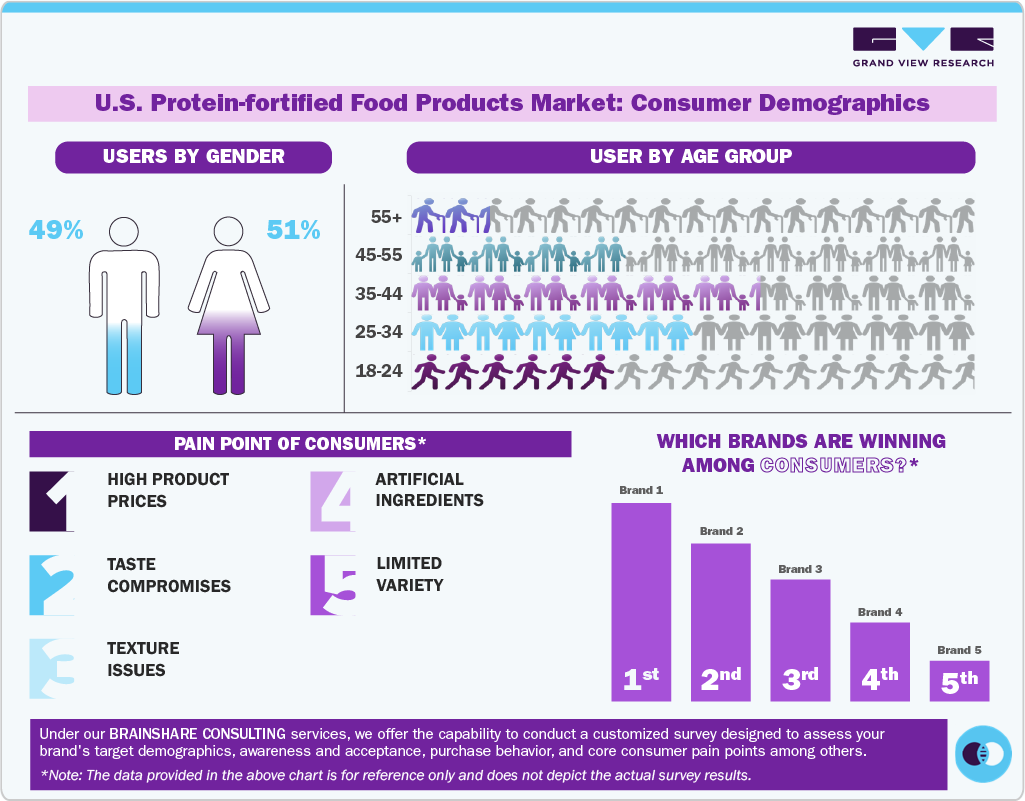
Consumers are increasingly prioritizing protein in their everyday diets, driven by greater awareness of its role in muscle maintenance, satiety, energy, and overall wellness. The demand is no longer limited to athletes or fitness-oriented consumers, as mainstream shoppers are seeking convenient foods that provide meaningful protein content. This trend is strengthening interest in protein-enriched snacks, dairy products, beverages, breakfast foods, and meal-replacement products across the U.S. market.
 To learn more about this report, Download Free Sample Report
 Convenience is also influencing purchasing decisions, with consumers favoring portable and ready-to-consume formats that can fit into busy lifestyles. Manufacturers are responding by incorporating protein into familiar food categories while offering diverse flavors, formats, and nutritional profiles. This wider availability is encouraging trial and repeat consumption, supporting continued expansion of the protein-fortified food products market.
Analyst PerspectiveThe U.S. protein-fortified food products market is positioned for sustained expansion as protein consumption becomes increasingly integrated into everyday diets. Growing demand for convenient, nutrient-dense foods is encouraging manufacturers to incorporate protein into snacks, dairy products, beverages, cereals, and meal replacements. Product innovation, broader retail availability, and rising interest in wellness-oriented nutrition are expected to support market penetration. Increasing competition is also likely to drive greater differentiation through formulation, taste, functionality, and clean-label positioning.
Nature Insights
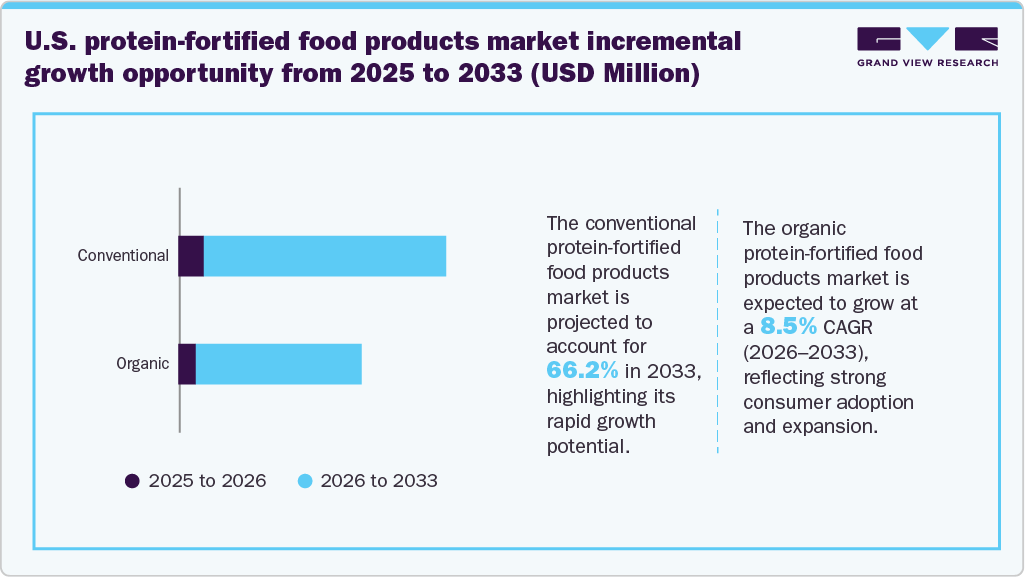
The conventional segment held the largest share of 71.0% in 2025. Its leading position is supported by broad availability through mainstream grocery, mass-market, club, and online retail channels, along with greater consumer familiarity and generally lower prices than organic alternatives. The extensive presence of conventional products across snack, dairy, beverage, cereal, and meal categories further supports their widespread consumption and market penetration.
 To learn more about this report, Download Free Sample Report
 The organic protein-fortified food products segment is projected to expand at the fastest CAGR of 8.5% from 2026 to 2033. Growth is supported by increasing consumer interest in clean-label ingredients, healthier formulations, and nutrient-dense foods. Rising sales of organic yogurt, nutrition bars, and functional beverages are further creating opportunities for protein enrichment, while younger consumers’ preference for transparent and wellness-oriented products is supporting broader adoption of organic protein offerings in the U.S.
Product Insights
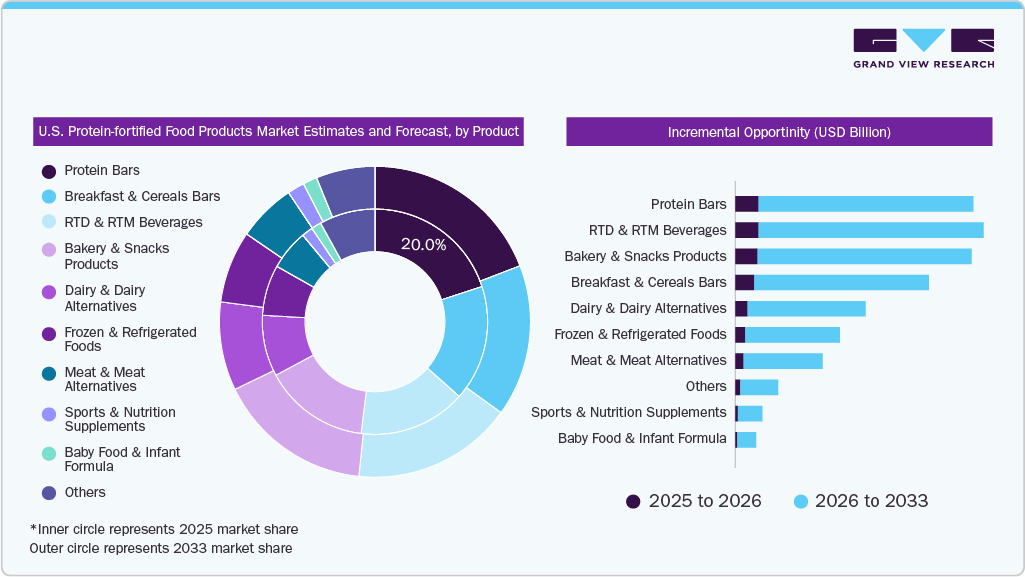
The protein bars segment accounted for 20.0% of the U.S. market in 2025, driven by their portability, convenience, and suitability for on-the-go consumption. Continued investment from major snack manufacturers is further strengthening the category as consumers increasingly seek convenient sources of protein. In August 2026, Mondelēz expanded its protein-snacking presence in the U.S. through brands including Grenade, CLIF, Perfect Bar, and Builders, highlighting its efforts to capitalize on rising demand for high-protein snack formats.
 To learn more about this report, Download Free Sample Report
 The sports and nutrition supplements segment is projected to register a CAGR of 7.7% from 2026 to 2033, supported by rising participation in fitness activities and growing consumer emphasis on performance, recovery, and daily wellness. Increasing interest in protein intake, energy enhancement, muscle development, and active lifestyles is encouraging consumers to incorporate sports nutrition products into regular routines, while product innovation and broader retail availability are further expanding category penetration.
Distribution Channel Insights
Sales of protein-fortified food products through supermarkets and hypermarkets represented the largest distribution-channel share of 34.3% in 2025. In the U.S., these outlets provide extensive shelf space across protein bars, fortified dairy, beverages, cereals, and snacks, enabling consumers to compare multiple brands during routine grocery trips. Their nationwide store networks, promotional activity, private-label offerings, and established purchasing habits further support product visibility and encourage wider adoption of protein-fortified foods.
 To learn more about this report, Download Free Sample Report
 The online distribution channel segment is projected to expand at a CAGR of 7.6% from 2026 to 2033. Growth is supported by the convenience of home delivery, broad product selection, subscription options, and easy price comparison. Major e-commerce platforms and direct-to-consumer websites also enable consumers to access specialized protein bars, beverages, snacks, and fortified foods beyond their local retail stores.
Country Insights
U.S. Protein-fortified Food Products Market Trends
The protein-fortified food products industry in the U.S. is supported by high consumer awareness of protein nutrition, strong fitness and wellness participation, widespread availability of functional foods, and continuous product innovation. The country’s developed retail infrastructure, extensive supermarket networks, and rapidly expanding e-commerce ecosystem provide manufacturers with multiple routes to reach consumers. Growing demand for convenient, nutrient-dense foods across snacks, dairy, beverages, cereals, and meal replacements further strengthens market development.
Key U.S. Protein-Fortified Food Products Company Insights
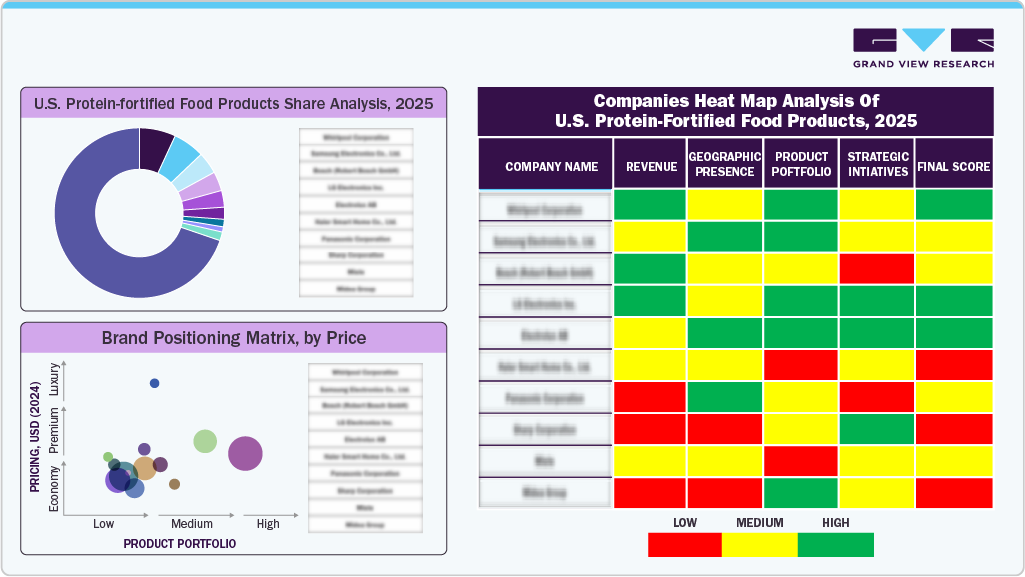
The U.S. protein-fortified food products industry is characterized by a competitive landscape comprising established food and beverage manufacturers, sports-nutrition companies, and emerging health-focused brands. Leading participants leverage extensive distribution networks, strong brand recognition, product innovation, and broad portfolios across protein bars, dairy, beverages, cereals, snacks, and meal-replacement products. Competition is increasingly centered on protein content, ingredient quality, taste, convenience, and product positioning, while strategic acquisitions and new product development are enabling companies to expand their presence across high-growth protein categories.
 To learn more about this report, Download Free Sample Report
 Key U.S. Protein-Fortified Food Products Companies:
-
1440 Foods
-
BELLRING BRANDS, INC.
-
Caveman Foods LLC
-
Kellogg Company
-
Nestlé
-
Mondelez International
-
Glanbia
-
GNC Holdings
-
Mars Incorporated
-
MYPROTEIN - The Hut.com Ltd
Competitive Benchmarking
Category
Operating Strategies
Competitive Edge
Weakness
Established Players (Kellogg Company, Nestlé, Mondelēz International, Glanbia, GNC Holdings, Mars Incorporated)
Expand protein-focused portfolios, introduce innovative formats, strengthen retail and e-commerce distribution, leverage established brands, and invest in product development, marketing, and strategic partnerships.
Strong brand recognition, extensive distribution networks, established customer bases, diversified product portfolios, and strong marketing and product-development capabilities.
Higher operating costs, complex organizational structures, portfolio overlap across categories, and intense competition from specialized protein and emerging nutrition brands.
Emerging Players (1440 Foods, BellRing Brands, Caveman Foods LLC, MYPROTEIN - The Hut.com Ltd.)
Concentrate on high-protein product categories, develop differentiated formulations and formats, expand through e-commerce and specialty retail, and use targeted marketing to reach fitness- and wellness-oriented consumers.
Strong category specialization, focused brand positioning, faster innovation cycles, direct consumer engagement, and greater ability to respond to emerging protein-consumption trends.
Relatively narrower product portfolios, greater dependence on specific categories or consumer segments, lower scale than diversified food conglomerates, and comparatively higher exposure to competitive pricing and brand substitution.
Recent Developments:
-
In August 2026, Mondelēz International expanded CLIF’s U.S. portfolio with the launch of the CLIF High Protein Bar, marking the brand’s entry into the dedicated high-protein bar segment. Each bar delivers 20g of protein and is offered in Peanut Butter Chocolate Chip and Cinnamon French Toast flavors, reflecting the growing emphasis on protein-rich and convenient snack formats in the U.S. market.
-
In July 2026, Premier Protein expanded its U.S. ready-to-drink portfolio with Premier Protein Ultimate, a 14-ounce shake delivering 42g of protein per serving. Available in Chocolate, Vanilla, Strawberry, and Café Latte, the product combines high protein content with a convenient ready-to-consume format. Its nationwide retail rollout, including major channels such as Walmart and Amazon, reflects continued innovation within the U.S. RTD protein beverage segment.
U.S. Protein-fortified Food Products Market Report Scope
Report Attribute
Details
Market size in 2025
USD 24.1 billion
Estimated market size in 2026
USD 25.6 billion
Projected market size by 2033
USD 39.7 billion
Growth rate (Revenue)
CAGR of 6.5% from 2026 to 2033
Actuals
2021 - 2025
Forecast period
2026 - 2033
Quantitative (Revenue) units
Revenue in USD billion and CAGR from 2026 to 2033
Report coverage
Revenue forecast, company ranking, competitive landscape, growth factors, and trends
Segments covered
Nature, product, distribution channel
Key companies profiled
1440 Foods; BellRing Brands, Inc.; Caveman Foods LLC; Kellogg Company; Nestlé; Mondelēz International; Glanbia; GNC Holdings; Mars Incorporated; MYPROTEIN - The Hut.com Ltd.
Customization scope
Free report customization (equivalent up to 8 analysts’ working days) with purchase. Addition or alteration to country, regional & segment scope.
Pricing and purchase options
Avail customized purchase options to meet your exact research needs. Explore purchase options
U.S. Protein-fortified Food Products Market Report Segmentation
This report forecasts revenue growth and provides an analysis of the latest industry trends and opportunities in each of the sub-segments from 2021 to 2033. For this study, Grand View Research has segmented the U.S. protein-fortified food products market report based on nature, product, distribution channel, and region.
-
Nature Outlook (Revenue, USD Billion, 2021 - 2033)
-
Organic
-
Conventional
-
-
Product Outlook (Revenue, USD Billion, 2021 - 2033)
-
Bakery & Snacks Products
-
Cookies
-
Chips
-
Cereals
-
Breads
-
Sweet Goods (Muffins, Pastries, etc.)
-
-
Protein Bars
-
Sports Nutrition Bars
-
Meal Replacement Bars
-
Others
-
-
RTD & RTM Beverages
-
RTD Shakes
-
RTD Smoothies
-
RTM Powders
-
-
Dairy & Dairy Alternatives
-
Yogurt
-
Milk
-
Cheese
-
-
Meat & Meat Alternatives
-
Protein Jerky
-
Meat Alternatives
-
-
Breakfast & Cereals Bars
-
Frozen & Refrigerated Foods
-
Protein Ice Creams
-
Frozen Meals
-
-
Baby Food & Infant Formula
-
Baby Food
-
Infant Formula
-
-
Sports & Nutrition Supplements
-
Others
-
-
Distribution Channel Outlook (Revenue, USD Billion, 2021 - 2033)
-
Hypermarkets & Supermarkets
-
Convenience Stores
-
Specialty Stores
-
Online
-
Others
-
Research Methodology
The U.S. protein-fortified food products market figures in this report are based on a proven research process that combines executive interviews with secondary research from proprietary databases, company filings, and recognized regulatory and institutional sources. Market size is built through value-chain sizing—reconciling supply-side and demand-side estimates—and triangulated with bottom-up and top-down approaches. Every estimate passes multiple levels of expert validation before publication, with each U.S. protein-fortified food products segment quantified using the revenue-capture definitions in the table below.
Segment Definition
Segment - Nature
Revenue capture definition
Organic
The segment covers revenue generated from the sales of protein-fortified food products made with certified organic ingredients and produced in accordance with applicable organic production standards.
Conventional
The segment covers revenue generated from the sales of protein-fortified food products made with non-organic ingredients and produced using conventional agricultural and food-processing practices.
Estimation Model
Each layer progressively narrows the population pool and applies a conversion rate to arrive at addressable revenue.
Step Number
Layer
Guiding Question
Description
01
Consumption Universe Layer
Who consumes protein‑fortified foods?
Captures the broad consumer base interested in increasing protein intake through everyday foods. Includes consumers seeking benefits such as muscle maintenance, satiety, weight management, healthy aging, and overall nutritional well‑being.
02
Access & Availability Layer
Who can access protein‑fortified foods?
Covers consumers exposed to protein‑fortified products through supermarkets, hypermarkets, convenience stores, specialty nutrition stores, e‑commerce platforms, and foodservice channels.
03
Purchase & Usage Layer
Who regularly purchases protein‑fortified foods?
Focuses on consumers purchasing protein‑fortified products for regular breakfast, snacking, meal, and on‑the‑go occasions, including protein‑enriched dairy, cereals, bakery products, snacks, beverages, and frozen foods.
04
Revenue Conversion Layer
How is revenue generated from protein‑fortified food consumers?
Measures revenue across protein‑fortified bakery and snacks, beverages, dairy, meat alternatives, breakfast, frozen foods, baby food, and sports nutrition products.
Delivered Customizations
This report has been delivered with the following In-depth customizations
CLIENT REQUEST
CUSTOMIZATION DELIVERED
VALUE ADDS
U.S. Protein-fortified Food Products Company Market Share Analysis
A detailed assessment of the competitive landscape covering company-level market shares, competitive positioning, market concentration, key product portfolios, and strategic presence of leading protein-fortified food manufacturers in the U.S. The analysis evaluates major participants across protein bars, beverages, dairy, snacks, cereals, and other fortified food categories.
Enables companies to benchmark their competitive position, identify leading and emerging participants, assess market concentration and competitive intensity, and identify potential gaps for portfolio expansion. The analysis also supports competitor benchmarking, strategic planning, partnership or acquisition evaluation, and identification of high-potential product categories and channels.
U.S. Protein-fortified Food Products Volume Analysis
A comprehensive volume-based assessment of the U.S. protein-fortified food products market, covering consumption volumes, historical trends, category-level demand, and the forecast outlook. The analysis complements revenue estimates by measuring underlying product consumption.
Provides a clearer understanding of U.S. demand beyond revenue metrics, supporting production planning, volume forecasting, pricing evaluation, capacity decisions, and identification of high-growth product opportunities.
U.S. Protein-fortified Food Products Regulatory & Claims Landscape
An assessment of the U.S. regulatory and claims environment for protein-fortified food products, covering FDA requirements, Nutrition Facts and labeling considerations, protein-related nutrient content claims, health claims, and key compliance considerations applicable to food and beverage products.
Helps companies evaluate U.S. market-entry requirements, minimize regulatory and labeling risks, develop compliant product claims, and identify opportunities for effective protein-focused product positioning within applicable FDA guidelines.
Frequently Asked Questions About This Report
The U.S. protein-fortified food products market size was valued at USD 24.1 billion in 2025 and is estimated at USD 39.7 billion for 2026.
Key factors include growing consumer interest in protein-rich diets, increasing focus on muscle and overall health, demand for convenient nutritious foods, and the expansion of protein-fortified products across snacks, beverages, dairy, and ready-to-eat foods.
The conventional segment led with a 71.0% revenue share in 2025, while organic is the fastest-growing segment.
Supermarkets & hypermarkets led the market with a share of 34.3% in 2025.
Key players include 1440 Foods; BELLRING BRANDS, INC.; Caveman Foods LLC; Kellogg Company; Nestlé; Mondelez International; Glanbia; GNC Holdings; Mars Incorporated; and MYPROTEIN - The Hut.com Ltd.
The U.S. protein-fortified food products market is expected to grow at a CAGR of 6.5% from 2026 to 2033, reaching USD 39.7 billion by 2033
The use of protein-fortified food products for protein bars led the market with a share of 20.0% in 2025.
About the Author(s)
Consumer F&B Research Team
Consumer Goods · Consumer F&BThis report was authored by the consumer f&b research team at Grand View Research - comprising two research analysts, one senior research analyst, and one industry expert - with specialized expertise in the consumer f&b segment of the consumer goods industry. All findings are based on proprietary consumer goods databases, executive interviews, and regulatory analysis, subject to internal peer review prior to publication.
Last Updated:
Speak to Analyst

Customize this report to your needs - add regions, segments, or data points, with 20% free customization.
Or view our licence options:


ISO 9001:2015 & 27001:2022 Certified
We are GDPR and CCPA compliant! Your transaction & personal information is safe and secure. For more details, please read our privacy policy.


