
- Home
- »
- Homecare & Decor
- »
-
U.S. Self-Publishing Market Size & Share Report, 2026 - 2033GVR Report cover

U.S. Self-Publishing Market (2026 - 2033) Size, Share & Trends Analysis Report By Genre (Fiction, Non-Fiction), By Format (Print-On-Demand (POD), Books (Hard Copy), E-book, Audiobook), Key Companies, Competitive Analysis, And Segment Forecasts
Market Size, 2025
$3.6BMarket Estimate, 2026
$3.9BMarket Forecast, 2033
$5.7BCAGR, 2026–2033
5.7%U.S. Self-Publishing Market Summary
The U.S. self-publishing market size was valued at USD 3.6 billion in 2025 and is projected to grow from USD 3.9 billion in 2026 to USD 5.7 billion by 2033, at a CAGR of 5.7% from 2026 to 2033. The market is experiencing steady expansion driven by the growing adoption of digital publishing platforms, an increasing preference for independent publishing, and rising demand for print-on-demand, eBook, and audiobook publishing services.
Key Market Trends & Insights
- The U.S. self-publishing industry is expected to grow at a CAGR of 5.7% from 2026 to 2033, driven by increasing adoption of digital publishing platforms, rising independent content creation, and expanding demand for eBooks and audiobooks.
- By genre, the fiction segment accounted for a dominant revenue share in 2025, supported by strong consumer demand for romance, fantasy, thriller, and science fiction categories across digital and print publishing platforms.
- By format, the eBook segment held a significant market share in 2025, supported by lower publishing costs, faster content distribution, and expanding digital publishing platforms.
Market Size & Forecast
- 2025 Market Size: USD 3.6 Billion
- 2033 Projected Market Size: USD 5.7 Billion
- CAGR (2026-2033): 5.7%
Three ways to get this report
Buy it, customize it, or ask a question.Ask an Analyst
Analyst response in 1 business day
- AccessReport author, directly
- Reply timeWithin 1 working day
- No sales callDirect answer only
- FormatEmail reply
- CostFree, no cost
Get the Full Report
What the study covers
- FormatsPDF · Excel · Dashboard
- Timeline2026–2033 annual, 2025 base
- Coverage20+ countries, 5 regions
- Companies10+ key players profiled
Customize the Report
20% free customization
- IncludeCountries, segments, points
- TailorTo your product definition
- ExtendDeeper competitor detail
- OrA fully bespoke study
- Turnaround5–10 working days
Authors are increasingly shifting toward self-publishing models to retain creative ownership, improve royalty earnings, and accelerate publication timelines compared to traditional publishing channels. In addition, the growing influence of social media marketing, online reader communities, and direct-to-consumer distribution channels is enhancing the visibility of self-published titles across fiction, non-fiction, educational, and niche content categories. The market is further supported by the increasing penetration of mobile reading applications, subscription-based digital libraries, and expanding consumer acceptance of independently published content.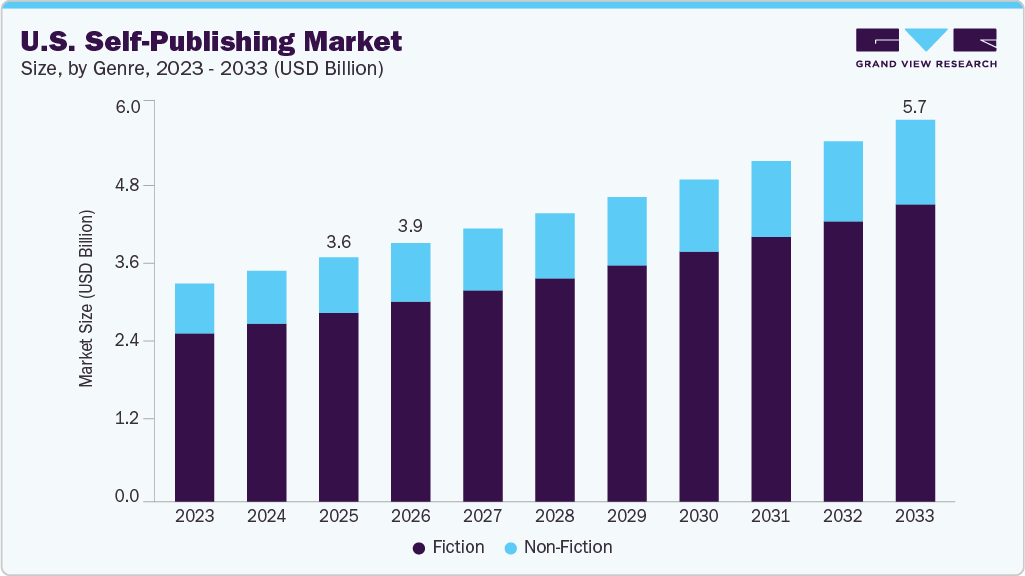 Source: Grand View Research, IR Documents, Primary Interviews, Paid DatabasesTo learn more about this report,
 Download Free Sample Report
 The market is also witnessing strong technological advancements through the integration of AI-powered writing assistance tools, automated formatting solutions, multilingual publishing capabilities, and AI-based audiobook narration services. Self-publishing platforms are continuously enhancing their service portfolios by offering editing, cover design, analytics, marketing support, and global distribution solutions to strengthen author reach and audience engagement. Furthermore, the rising popularity of multi-format publishing strategies, including simultaneous print, eBook, and audiobook releases, is creating new revenue-generation opportunities for independent authors and publishers engaged in independent publishing. Despite challenges associated with intense competition, content discoverability, and increasing dependence on platform algorithms, the U.S. self-publishing industry is expected to maintain sustained growth, supported by ongoing digital transformation, innovation in content delivery technologies, and the continued expansion of the creator economy.
Market Dynamics
The U.S. self-publishing industry is witnessing strong structural growth driven by a significant surge in overall book production, which surpassed 4 million titles in 2025, marking a 32.5% increase compared to the previous year. A major share of this growth is attributed to self-published works, which expanded by approximately 38.7% year-over-year, rising from around 2.5 million titles in 2024 to nearly 3.53 million titles in 2025. This acceleration highlights the increasing dominance of self-publishing within the broader publishing ecosystem, supported by widespread adoption of AI-assisted writing, editing, formatting, and distribution tools that have significantly reduced production time and lowered entry barriers for independent authors. In addition, the expansion of digital publishing platforms has further streamlined content creation and distribution, enabling authors to publish at scale and respond quickly to evolving reader demand across both fiction and non-fiction segments.
The U.S. self-publishing industry is increasingly constrained by declining discoverability, driven by the emergence of a near-zero-cost production ecosystem enabled by AI-assisted writing, editing, formatting, and marketing tools. While these advancements have significantly reduced entry barriers and accelerated publishing output, they have also contributed to a substantial increase in low-cost, high-volume content production across digital platforms. As a result, visibility within the market has become heavily dependent on algorithm-driven discovery systems such as Amazon rankings, BookTok trends, and genre-specific online communities, which prioritize engagement metrics, sales velocity, and user interaction over content quality and originality. This shift has weakened traditional editorial curation mechanisms and intensified competition for reader attention, leading to a highly uneven discoverability landscape where only a limited proportion of titles achieve meaningful exposure, while the majority remain largely invisible. Consequently, this structural imbalance poses a significant restraint on sustained author visibility, revenue stability, and long-term market efficiency within the self-publishing ecosystem.
Consumer Insights
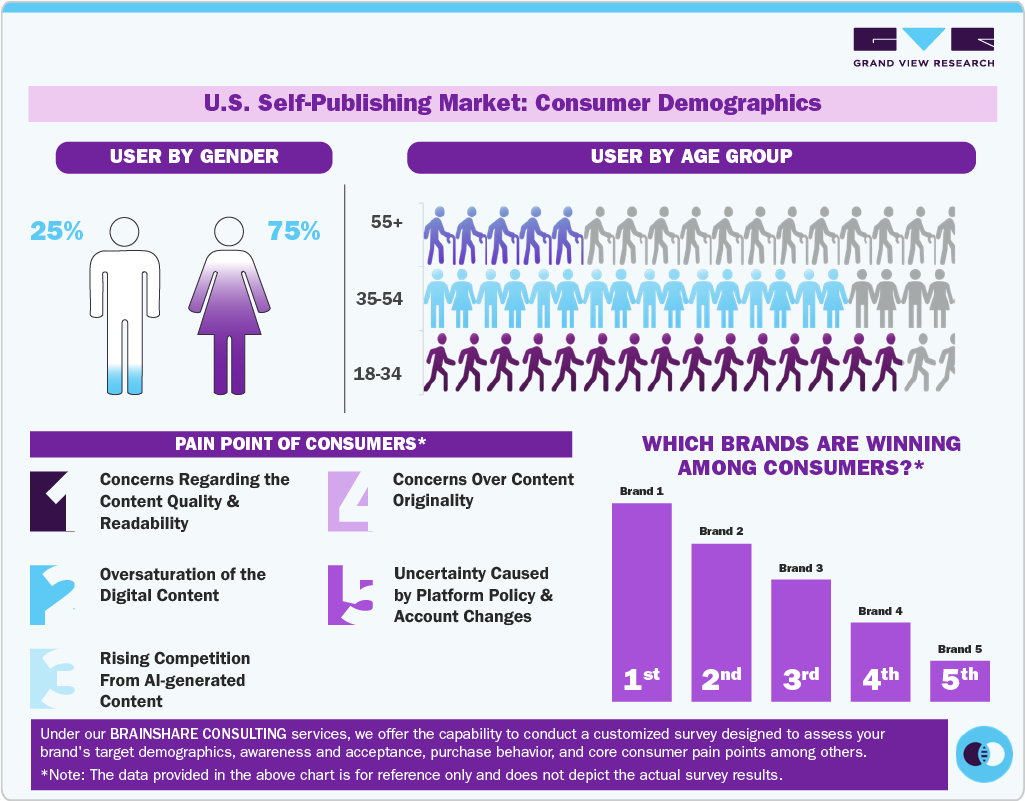
The U.S. self-publishing industry is supported by a substantial and highly engaged reader base, alongside a continuously expanding ecosystem of independent authors. Consumption patterns are increasingly shaped by digital-first behavior, with strong adoption of eBooks, audiobooks, and mobile reading platforms. High internet penetration, widespread digital literacy, and the growing popularity of subscription-based reading services collectively reinforce sustained content engagement. In parallel, the rise of independent writers leveraging self-publishing platforms has strengthened content diversity, enabling creators to target niche audiences, monetize intellectual property, and operate outside traditional publishing frameworks. Digital communities and creator-led ecosystems play a pivotal role in shaping content discovery, recommendation, and readership trends.
 To learn more about this report, Download Free Sample Report
 Consumer preferences within the market are primarily driven by genre specialization, personalization, and ease of discoverability. Fiction categories, including romance, fantasy, thriller, and science fiction, continue to demonstrate strong reader engagement, while non-fiction demand remains concentrated in self-help, business, wellness, and professional development segments. Reading and purchasing decisions are significantly influenced by algorithmic recommendations, online reviews, and community-driven word-of-mouth, underscoring the importance of digital visibility for authors. The market further reflects differentiated consumption behavior, with a strong inclination toward serialized and rapid-release formats in fiction, while non-fiction readers prioritize practical, experience-based, and solution-oriented content. In addition, increasing preference for diverse narratives, niche storytelling, and independently published works highlights a growing demand for authenticity and differentiated content across the self-publishing landscape.
Genre Insights
The fiction segment accounted for a dominant share in the market in 2025 and is projected to register a CAGR of 5.8% from 2026 to 2033. This segment continues to be driven by strong reader demand across romance, fantasy, thriller, mystery, and science fiction categories on digital publishing platforms within the self-publishing industry. The increasing influence of online reading communities, social media-driven recommendations, and creator-led ecosystems such as “BookTok” is significantly enhancing the visibility and discoverability of independently published fiction titles. In addition, the adoption of rapid release publishing models, serialized storytelling formats, and the growing penetration of eBooks and audiobooks are enabling authors to improve reader engagement and sustain recurring content consumption. Rising preference for niche, immersive, and character-driven narratives further continues to reinforce long-term growth in the segment of self-publishing.
 To learn more about this report, Download Free Sample Report
 The non-fiction segment is projected to grow at a CAGR of 5.3% from 2026 to 2033. Growth is primarily supported by increasing demand for education, self-help, wellness, business, finance, and professional development content in the Self-publishing industry. The segment is witnessing greater participation from independent educators, industry professionals, and subject-matter experts entering the self-publishing ecosystem to monetize knowledge and expertise. Expansion of digital learning environments, creator-led educational ecosystems, and podcast-influenced content discovery is further strengthening audience engagement. In addition, readers are increasingly favoring practical, experience-based, and niche informational content that delivers actionable insights and personalized learning value, thereby supporting sustained expansion of the non-fiction self-publishing segment.
Format Insights
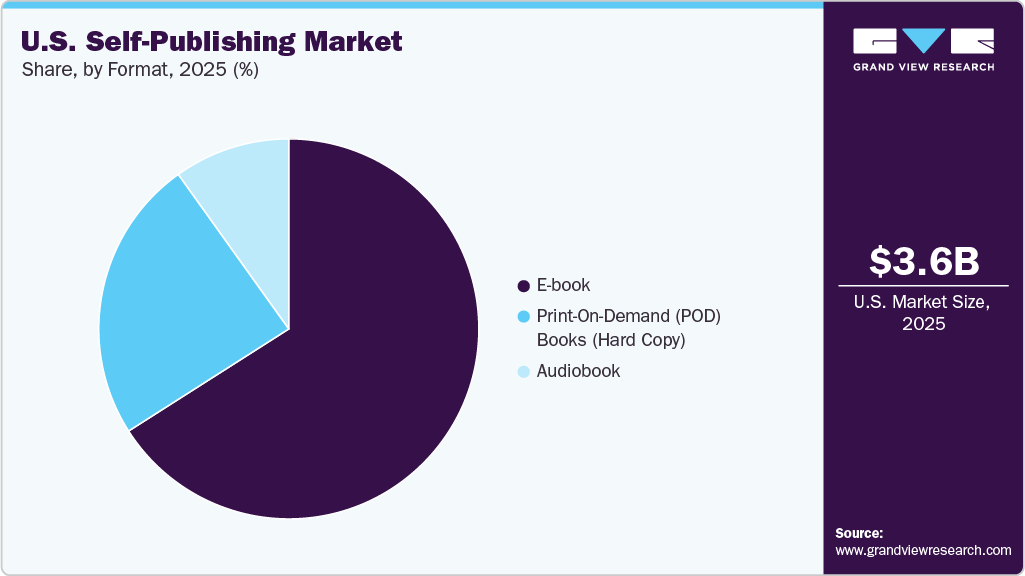
The eBook segment accounted for a market share of 65.97% in 2025, driven by the growing preference for instant content access, faster publishing timelines, and cost-efficient digital distribution models. Increasing consumer engagement with subscription-based reading platforms, online book communities, and social media-driven book discovery trends is further supporting segment growth. In addition, self-published authors are increasingly favoring eBook formats due to higher royalty potential, real-time content updates, and broader global audience reach. The rising demand for niche, independent, and genre-specific content is also contributing to the continued expansion of the eBook segment within the U.S. market.
 To learn more about this report, Download Free Sample Report
 The Print-On-Demand (POD) Books (Hard Copy) segment held a market share of 24.15% in 2025, supported by sustained consumer demand for physical books and the growing preference for low-risk inventory management among independent authors and publishers. POD technology enables cost-efficient printing, eliminates bulk inventory requirements, and allows publishers to offer customized and niche content with greater flexibility. Furthermore, the continued popularity of printed books among educational readers, collectors, and traditional book consumers is contributing to stable segment demand. The increasing availability of POD services through major online retail and distribution platforms is also strengthening the segment’s market penetration.
Competitive Landscape
The U.S. self-publishing industry is characterized by a highly fragmented yet platform-driven competitive landscape, with competition centered around publishing ecosystems, distribution reach, royalty structures, print-on-demand capabilities, and value-added author services. The market comprises digital publishing platforms, print-on-demand providers, author service companies, content aggregators, and hybrid publishing firms that collectively support independent authors throughout the publishing value chain.
 To learn more about this report, Download Free Sample Report
 The competitive environment is led by major self-publishing platforms such as Amazon Kindle Direct Publishing (KDP), which maintains a dominant position through its extensive ebook ecosystem, integrated marketplace access, print-on-demand capabilities, and global distribution network. The platform’s scale, royalty structure, and direct integration with Amazon’s retail infrastructure continue to make it the preferred publishing channel for a significant share of independent authors.
Other key market participants, including IngramSpark, Draft2Digital, BookBaby, Lulu Press, and Barnes & Noble Press, compete by offering expanded distribution networks, bookstore accessibility, print manufacturing capabilities, and comprehensive author support services, including editing, formatting, design, metadata optimization, and marketing solutions.
Key U.S. Self-Publishing Companies:
-
Amazon.com, Inc. (Kindle Direct Publishing)
-
Ingram Content Group, LLC (IngramSpark)
-
Lulu Press, Inc.
-
Draft2Digital, LLC
-
BookBaby (AVL Digital Group)
-
Barnes & Noble, Inc. (Barnes & Noble Press)
-
Blurb, Inc.
-
Smashwords, Inc.
-
Scribe Media, LLC
-
Apple Books for Authors
Recent Developments
-
In December 2025, Amazon Kindle Direct Publishing (KDP) introduced enhanced DRM-free ebook download capabilities, enabling self-published authors to distribute their titles in EPUB and PDF formats starting in 2026. The development reflects the industry’s increasing focus on broader content accessibility, multi-format compatibility, and greater distribution flexibility, allowing independent authors to expand audience reach across diverse digital reading platforms and devices.
-
In May 2025, Ingram Content Group enhanced its Ingram iD platform by introducing AI-powered advertising and automated marketing solutions designed for publishers and self-published authors. The upgraded platform incorporated features such as AI-generated promotional content, genre-specific image creation, and multi-channel campaign management tools, enabling independent authors to strengthen book discoverability, optimize audience targeting, and improve digital marketing efficiency across publishing channels.
-
In February 2026, Bookshop.org partnered with Draft2Digital to expand access to self-published ebooks across independent bookstores in the United States through Bookshop.org’s growing digital marketplace. The collaboration added hundreds of thousands of indie-published titles to the platform, representing a significant advancement in broadening non-Amazon distribution channels for self-published authors. The initiative also reflects the increasing demand for diversified ebook distribution models, as Bookshop.org’s ebook platform recorded more than 200,000 ebook sales and generated over US$9.5 million in revenue contributions for independent bookstores during 2025.
U.S. Self-publishing Market Report Scope
Report Attribute
Details
Market size value in 2025
USD 3.6 billion
Market size value in 2026
USD 3.9 billion
Revenue forecast in 2033
USD 5.7 billion
Growth rate
CAGR of 5.7% from 2026 to 2033
Base year for estimation
2025
Historical data
2021 - 2024
Forecast period
2026 - 2033
Quantitative units
Revenue in USD billion and CAGR from 2026 to 2033
Report coverage
Revenue forecast, company ranking, competitive landscape, growth factors, and trends
Segments covered
Genre; format
Country scope
U.S.
Key companies profiled
Amazon.com, Inc. (Kindle Direct Publishing); Ingram Content Group, LLC (IngramSpark); Lulu Press, Inc.; Draft2Digital, LLC; BookBaby (AVL Digital Group); Barnes & Noble, Inc. (Barnes & Noble Press); Blurb, Inc.; Smashwords, Inc.; Scribe Media, LLC; Apple Books for Authors
Customization scope
Free report customization (equivalent up to 8 analysts working days) with purchase. Addition or alteration to country, regional & segment scope.
Pricing and purchase options
Avail customized purchase options to meet your exact research needs. Explore purchase options U.S. Self-Publishing Market Report Segmentation
This report forecasts revenue growth at country levels and provides an analysis of the latest trends and opportunities in each of the sub-segments from 2021 to 2033. In this study, Grand View Research has segmented the U.S. self-publishing market report based on genre and format:
-
Genre Outlook (Revenue, USD Billion, 2021 - 2033)
-
Fiction
-
Non-Fiction
-
-
Format Outlook (Revenue, USD Billion, 2021 - 2033)
-
Print-On-Demand (POD) Books (Hard Copy)
-
E-book
-
Audiobook
-
Frequently Asked Questions About This Report
The U.S. self-publishing market was estimated at USD 3.6 billion in 2025 and is expected to reach USD 3.9 billion in 2026.
The U.S. self-publishing market is expected to grow at a compound annual growth rate (CAGR) of 5.7% from 2026 to 2033 to reach USD 5.7 billion by 2033.
Fiction books accounted for a revenue share of 77.3% in 2025, driven by strong reader demand for genre-based content, rapid digital consumption, author flexibility in storytelling, and the growing popularity of self-published romance, fantasy, and thriller titles.
Some key players operating in the U.S. self-publishing market include Amazon KDP (Kindle Direct Publishing); IngramSpark (Ingram Content Group); Apple Books for Authors (Apple); Lulu Press, Inc.; Barnes & Noble Press (B&N); Draft2Digital LLC; Google Play Books; BookBaby (DIY; Media Group); Blurb, Inc.; and Scribe Media.
Key factors driving market growth include the rapid rise of BookTok-driven fiction sales, expanding AI-assisted editing and formatting tools, and increasing author monetization through direct-to-reader subscription platforms.
About the Author(s)
Homecare & Decor Research Team
Consumer Goods · Homecare & DecorThis report was authored by the homecare & decor research team at Grand View Research - comprising two research analysts, one senior research analyst, and one industry expert - with specialized expertise in the homecare & decor segment of the consumer goods industry. All findings are based on proprietary consumer goods databases, executive interviews, and regulatory analysis, subject to internal peer review prior to publication.
Last Updated:
Speak to Analyst

Customize this report to your needs - add regions, segments, or data points, with 20% free customization.
Or view our licence options:


ISO 9001:2015 & 27001:2022 Certified
We are GDPR and CCPA compliant! Your transaction & personal information is safe and secure. For more details, please read our privacy policy.


