
- Home
- »
- Homecare & Decor
- »
-
Publishing Market Size & Share Report, 2026-2033GVR Report cover

Publishing Market (2026 - 2033)
Size, Share & Trends Analysis Report by Type (Book Publishing, Newspaper Publishing, Magazine Publishing), By Format (Hard Copy, E-Book, Audiobook), By Region, and Segment Forecasts
Market Size, 2025
$298.4BMarket Estimate, 2026
$307.0BMarket Forecast, 2033
$391.0BCAGR, 2026–2033
3.5%Publishing Market Summary
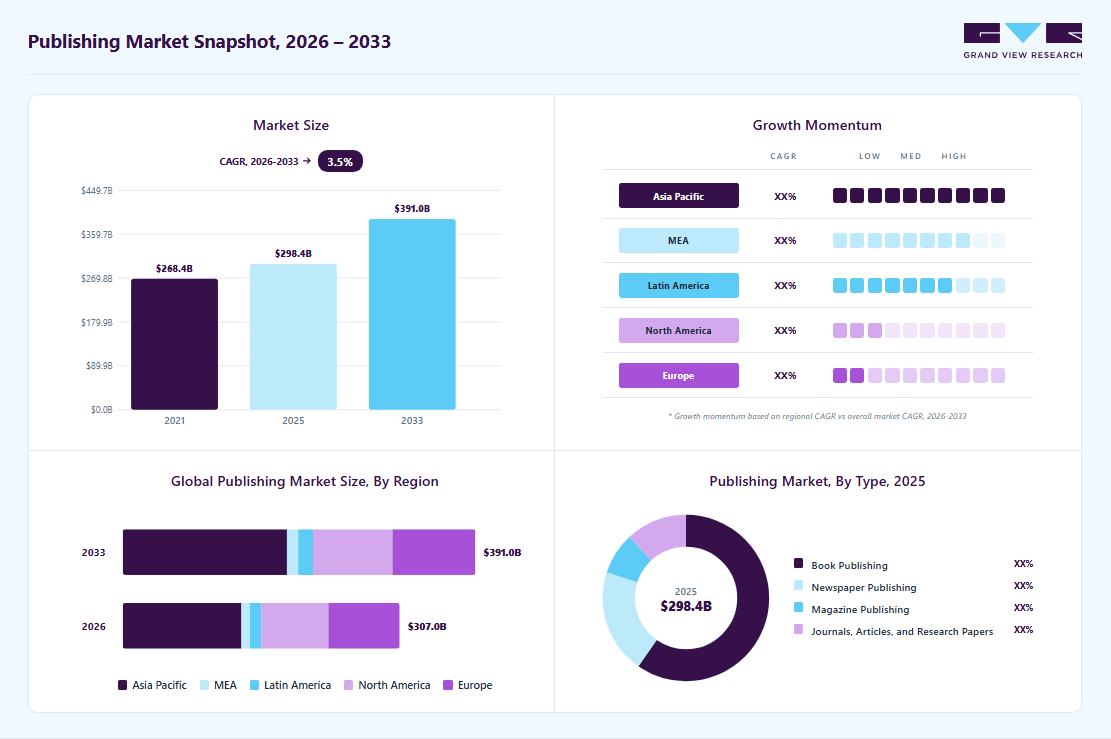
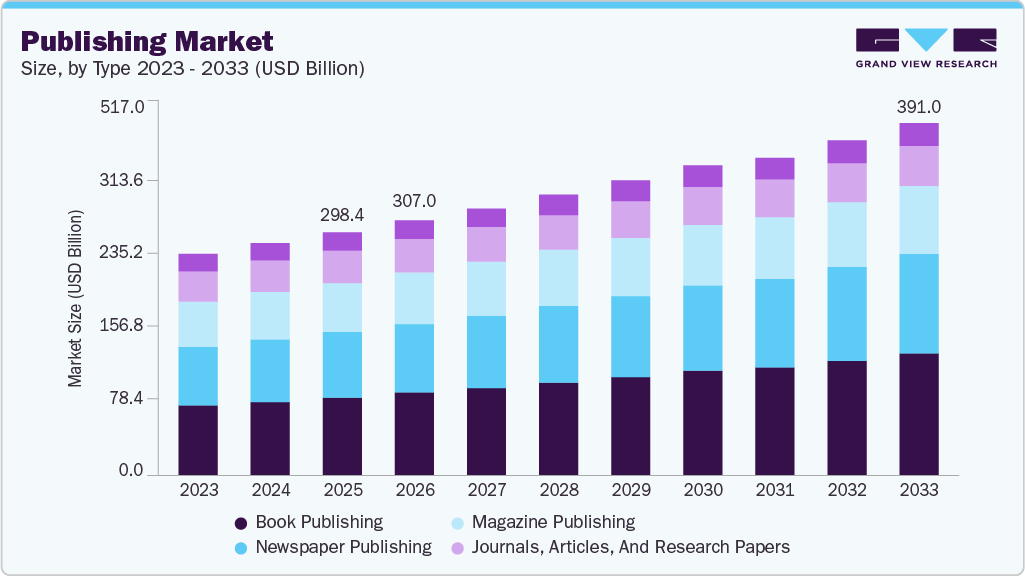
The global publishing market size was valued at USD 298.4 billion in 2025 and is projected to grow from USD 307.0 billion in 2026 to USD 391.0 billion by 2033, at a CAGR of 3.5% from 2026 to 2033. The Asia Pacific publishing market held the largest share of 42.3% of the global market in 2025. Rising digital content consumption, increasing demand for educational and professional learning materials, and the growing popularity of audiobooks and e-books are significantly driving the expansion of the global publishing industry.
 Source: Grand View Research, IR Documents, Primary Interviews, Paid DatabasesTo learn more about this report,
 Download Free Sample Report
 Key Market Trends & Insights
- By format: Hard copy publishing led the global publishing industry and accounted for a share of 67.7% in 2025.
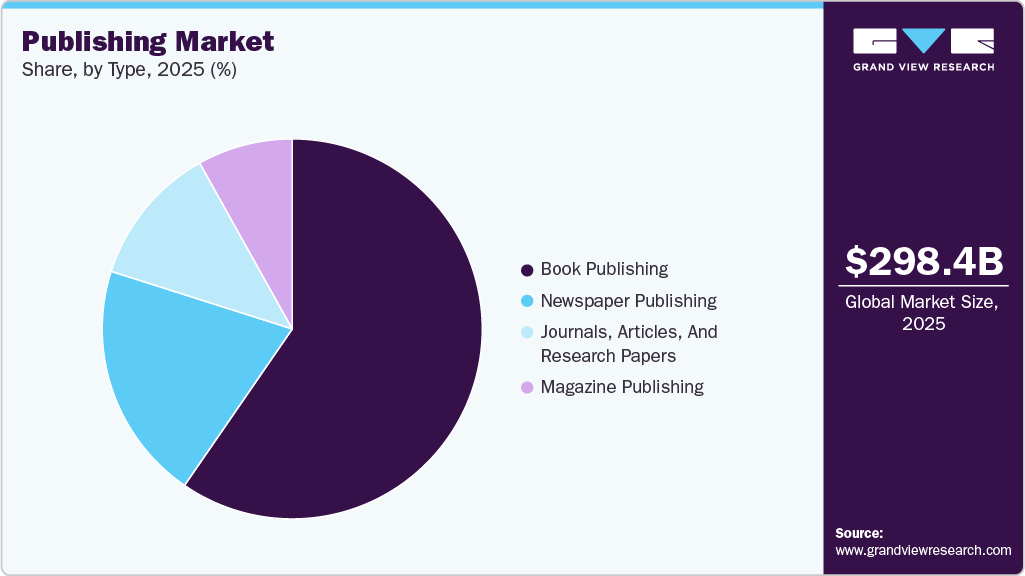
- By type: Book publishing segment led the market and accounted for a share of 59.6% in 2025.
Regional Highlights
- Largest regional market: Asia Pacific (42.3% revenue share, 2025)
- By country: The publishing industry in the China held the largest revenue share in 2025.
Market Size & Forecast
- Market size in 2025: USD 298.4 Billion
- Estimated market size in 2026: USD 307.0 Billion
- Projected market size by 2033: USD 391.0 Billion
- CAGR (2026-2033): 3.5%
Three ways to get this report
Buy it, customize it, or ask a question.Ask an Analyst
Analyst response in 1 business day
- AccessReport author, directly
- Reply timeWithin 1 working day
- No sales callDirect answer only
- FormatEmail reply
- CostFree, no cost
Get the Full Report
What the study covers
- FormatsPDF · Excel · Dashboard
- Timeline2026–2033 annual, 2025 base
- Coverage20+ countries, 5 regions
- Companies10+ key players profiled
Customize the Report
20% free customization
- IncludeCountries, segments, points
- TailorTo your product definition
- ExtendDeeper competitor detail
- OrA fully bespoke study
- Turnaround5–10 working days
Consumers are increasingly engaging with content across multiple formats, encouraging publishers to diversify distribution strategies and invest in digital publishing technologies. Demand is steadily shifting toward flexible and accessible content formats such as e-books, audiobooks, and subscription-based digital libraries, particularly among younger consumers and mobile-first readers. For instance, in 2025, Spotify expanded its audiobook offerings across multiple international markets, increasing accessibility to digital audio content and strengthening global consumer adoption of audiobooks.Educational and academic publishing continues to be a major growth driver, supported by rising adoption of online learning and institutional demand for digital course materials and research databases. The rapid global rise of Japanese-origin content, particularly manga, is also contributing substantially to market growth. Manga demand has expanded significantly due to anime streaming popularity and growing fan communities. At the same time, newspaper and magazine publishers are increasingly adopting subscription-driven digital business models to offset declining print circulation. Major media publishers are focusing on premium digital memberships, mobile applications, newsletters, and multimedia journalism to improve reader engagement and recurring revenue streams. This ongoing transformation is accelerating innovation across both print and digital publishing ecosystems globally.
 To learn more about this report, Download Free Sample Report
 The global market is witnessing a steady transformation driven by evolving consumer reading preferences, rapid digitization, and increasing demand for accessible content across educational, professional, and entertainment categories. Readers are increasingly consuming content across multiple formats, including print, e-books, and audiobooks, encouraging publishers to adopt diversified publishing and distribution strategies. The growing integration of digital platforms into daily life is also strengthening engagement with books, journals, magazines, and serialized content across both developed and emerging economies.
The rising adoption of digital reading ecosystems is significantly influencing market expansion, particularly among younger consumers and mobile-first audiences. E-books and audiobooks are gaining strong momentum due to convenience, portability, and compatibility with multitasking lifestyles. Subscription-based reading platforms and audio content services are further accelerating digital consumption by offering affordable, on-demand access to large content libraries. This shift is encouraging publishers to prioritize digital-first release models and invest in technology-enabled reader engagement strategies.
Book publishing continues to dominate the global market, reflecting sustained consumer demand for educational books, fiction, non-fiction, and digital reading formats. The continued expansion of online learning, professional upskilling, and recreational reading habits is supporting long-term growth across both print and digital book categories. Consumer interest in specialized and immersive content categories is also reshaping global publishing demand. Japanese-origin content, especially manga, continues to experience substantial international growth supported by the expanding influence of anime culture, online fan communities, and digital comic platforms. Manga represents the dominant category within Japanese-origin publishing. The segment continues to benefit from strong readership among Gen Z and millennial consumers. Popular manga franchises, including One Piece, Attack on Titan, Demon Slayer, and Jujutsu Kaisen, continue to generate high global sales across print and digital channels. Rising demand for serialized storytelling, collector editions, and mobile comic applications is further strengthening the segment’s commercial performance.
The market is also seeing strong sales momentum across fantasy, romance, self-help, and young adult fiction. Titles such as Harry Potter, Atomic Habits, The Psychology of Money, and Fourth Wing continue to perform strongly across global retail channels, driven by growing consumer interest in personal development, immersive storytelling, and lifestyle-focused reading. Educational publishing also remains highly resilient, supported by sustained institutional demand for textbooks, competitive exam materials, digital learning platforms, and academic resources.
At the same time, academic and professional publishing remains a key pillar of market growth as institutions, researchers, and corporate learners increasingly depend on digital journals, research databases, and online educational materials. The expansion of remote learning environments and continuous professional development programs is supporting long-term demand for scientific publications, scholarly articles, and skill-based learning content. Publishers are responding by expanding open-access models, enhancing access to digital research, and integrating AI-driven discovery tools into academic platforms. In addition, growing demand for localized, multilingual, and culturally diverse content is encouraging publishers to expand regional content portfolios and global distribution partnerships.
Market Dynamics
Increasing digital content consumption and the growing demand for educational, professional, and entertainment reading materials are key market drivers. Consumers are increasingly adopting e-books, audiobooks, digital journals, and online newspapers due to rising smartphone usage, internet accessibility, and changing reading habits. The expansion of subscription-based reading and audio platforms is further improving content accessibility across multiple devices. The growing adoption of online learning and continuous skill development is also supporting demand for digital textbooks, academic journals, certification materials, and self-improvement books. In addition, the global popularity of manga and Japanese-origin content is accelerating publishing growth, driven by strong digital and print sales. Rising consumer spending on premium books, collectible editions, and subscription book services is further strengthening the broader publishing ecosystem, including digital distribution platforms and audiobook services.
The increasing prevalence of digital piracy and the gradual decline in print readership are major factors restraining market growth. Unauthorized distribution of e-books, digital journals, audiobooks, and research content across online platforms continues to impact publisher revenues and intellectual property protection. Easy access to pirated content often discourages consumers from purchasing legitimate copies, particularly in price-sensitive markets. In addition, changing consumer entertainment preferences and increased screen time on social media, streaming platforms, gaming, and short-form video are reducing reading frequency among certain demographics. Traditional print segments such as newspapers and magazines are especially facing pressure as consumers increasingly shift toward free digital news and online media platforms.
Brand Market Share Insights
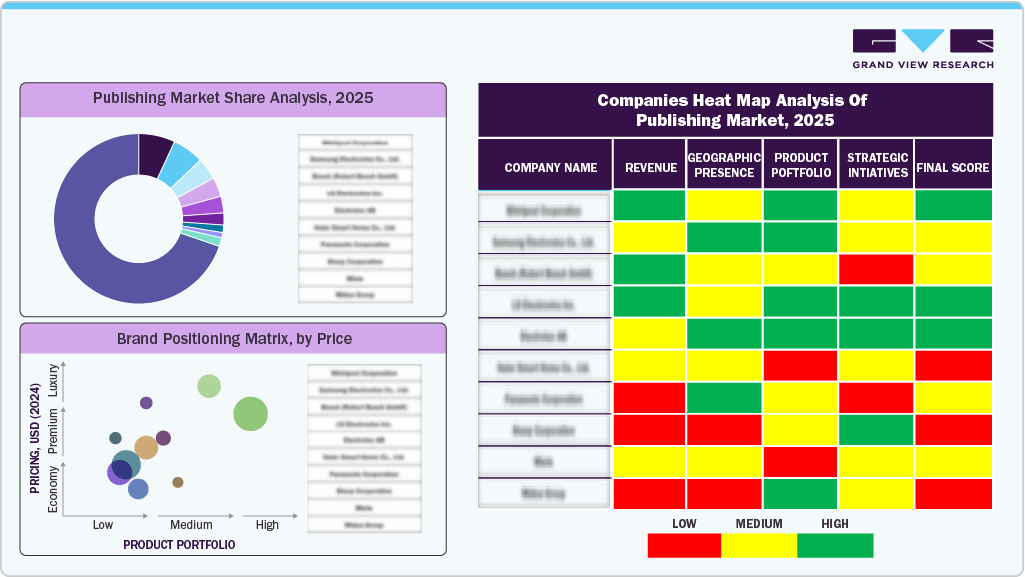
The global market is highly competitive, driven by rapid digital transformation, evolving consumer reading preferences, and growing demand for diversified content formats across print, e-books, and audiobooks. Major companies such as RELX Group plc (Elsevier), Pearson plc, Springer Nature AG & Co. KGaA, HarperCollins Publishers LLC, John Wiley & Sons, Inc., and Bertelsmann SE & Co. KGaA compete through continuous expansion of digital publishing platforms, academic content portfolios, educational learning solutions, and global licensing strategies. Competition is increasingly centered on digital accessibility, subscription-based content ecosystems, personalized reading experiences, and multimedia publishing capabilities.
 To learn more about this report, Download Free Sample Report
 Publishers are investing heavily in e-books, audiobooks, open-access research publishing, and direct-to-consumer distribution models to strengthen reader engagement and recurring revenue streams. The growing popularity of manga, fantasy fiction, self-improvement books, and serialized digital content is also intensifying competition among publishers seeking to expand international readership and secure high-performing intellectual properties.
Consumer Insights
Consumer behavior in the global market is increasingly centered on accessibility, personalization, and immersive content experiences, with readers prioritizing convenience, flexible consumption formats, and value-driven content over traditional reading patterns. Consumers are actively seeking content that aligns with personal interests, self-improvement goals, entertainment preferences, and professional development needs, driving strong demand for e-books, audiobooks, and subscription-based reading platforms.
 To learn more about this report, Download Free Sample Report
 Readers are increasingly engaging with genres such as fantasy, manga, romance, self-help, finance, and mental wellness, reflecting a broader shift toward emotionally engaging and lifestyle-oriented content. At the same time, demand for educational and skill development materials continues to rise as consumers invest more in continuous learning and career advancement. This trend is encouraging publishers to expand their digital learning ecosystems, adopt interactive content formats, and implement personalized recommendation systems.
Consumers increasingly prefer audio formats for commuting, exercise, and daily activities, thereby strengthening engagement with long-form storytelling and educational content. In addition, social media platforms, online reading communities, and influencer-driven book trends are significantly influencing purchasing behavior, particularly among Gen Z and millennial audiences.
Consumers are also demonstrating rising interest in premium and collectible publishing products, including hardcover editions and special releases, reflecting a stronger emotional connection with physical reading experiences despite ongoing digital adoption. This evolving consumer behavior is reinforcing the market as a highly engagement-driven industry where content relevance, accessibility, and user experience play a critical role in purchasing decisions.
Format Insights
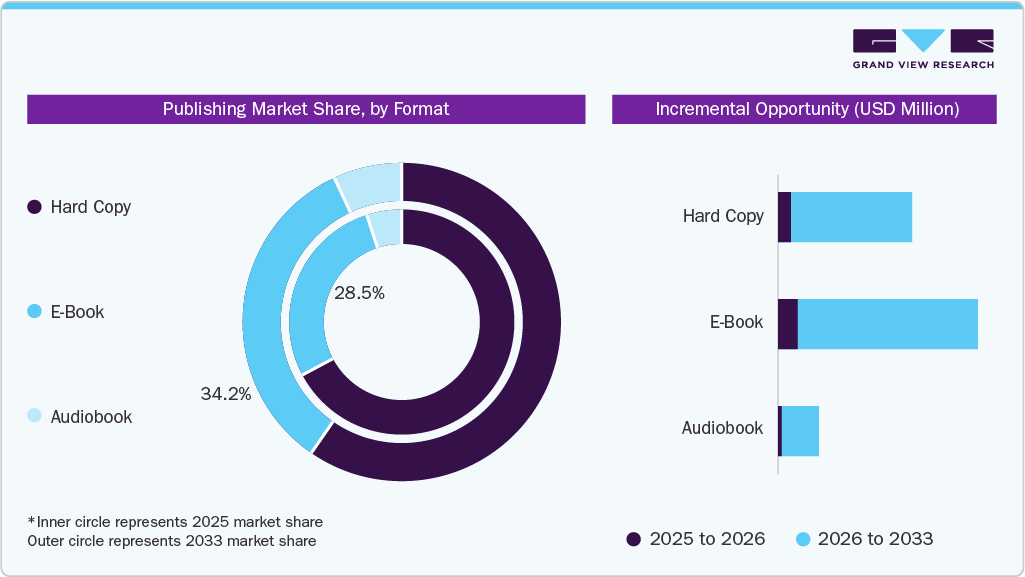
Hard copy publishing accounted for the largest share of 67.7% in 2025. The segment continues to maintain dominance due to strong consumer preference for physical books, educational textbooks, children’s literature, and premium hardcover editions. Print formats remain highly popular among students, academic institutions, libraries, and traditional readers who value the reading experience, long-term ownership, and reduced screen dependency that physical books offer. In addition, demand for special editions, manga collections, and gift-oriented publishing products continues to support hard copy sales globally. Physical bookstores, educational procurement channels, and retail book chains also remain important contributors to segment stability despite the ongoing rise of digital publishing formats.
 To learn more about this report, Download Free Sample Report
 Audiobooks are projected to be the fastest-growing segment in the global market, expanding at a CAGR of 9.0% from 2026 to 2033. The segment is experiencing rapid growth due to rising consumer preference for multitasking-friendly content consumption, particularly during commuting, exercise, travel, and daily activities. Rising smartphone penetration, improved internet accessibility, and the growing popularity of audio streaming platforms are significantly accelerating audiobook adoption worldwide. The increasing availability of subscription-based audiobook services, AI-powered recommendations, and multilingual audio content is further strengthening consumer engagement. Younger demographics, working professionals, and digitally connected consumers are increasingly adopting audiobooks as a convenient alternative to traditional reading formats. In addition, the growing popularity of self-help, business, fiction, fantasy, and manga-inspired audio storytelling is contributing to sustained demand growth across global markets.
Type Insights
Book publishing emerged as the largest segment in the global market, accounting for 59.6% of the total market share in 2025. The segment continues to dominate due to sustained global demand for fiction, non-fiction, educational books, self-improvement titles, manga, and professional learning content across both print and digital formats. Strong consumer engagement with recreational reading, academic learning, and skill development is supporting segment growth globally. In addition, the increasing popularity of fantasy fiction, self-help books, manga series, and collectible editions is further strengthening demand across retail and online publishing channels. Educational institutions, libraries, and digital learning platforms also continue to contribute significantly to long-term market expansion.
 To learn more about this report, Download Free Sample Report
 Journals, articles, and research papers are emerging as one of the fastest-growing segments in the global market, projected to expand at a CAGR of 4.5% from 2026 to 2033. Growth in this segment is primarily driven by increasing global research activity, rising investments in higher education, and growing demand for scientific, technical, medical, and professional content across digital platforms. Universities, research institutions, healthcare organizations, and corporate learners are increasingly relying on digital journals and research databases for real-time access to credible and peer-reviewed information. The rapid expansion of online learning, remote education models, and professional certification programs is further accelerating demand for academic and research publishing content globally. In addition, the growing adoption of open-access publishing models is improving access to content and increasing readership in emerging markets. Publishers are also investing heavily in AI-powered research discovery tools, digital archives, and institutional subscription platforms to strengthen engagement and improve content distribution efficiency.
Regional Insights
The Asia Pacific publishing market accounted for a significant 42.3% share in 2025, making it one of the fastest-expanding and most dynamic regions globally. The industry is primarily driven by a large and diverse consumer base, increasing literacy rates, rapid digital adoption, and strong demand for educational, entertainment, and Japanese-origin content such as manga. Consumers in the region are increasingly shifting toward digital reading formats, including e-books, audiobooks, online journals, and mobile-based reading platforms, supported by high smartphone penetration and affordable internet access. Demand is particularly strong for educational publishing, competitive exam preparation materials, language-learning content, and professional upskilling resources, especially in countries such as India, China, Japan, and South Korea. The region also demonstrates strong growth in manga and graphic novel consumption, driven by cultural proximity to Japan and the rising influence of anime streaming platforms.
 To learn more about this report, Download Free Sample Report
 China Publishing Market Trends
The publishing industry in China holds the largest share of the Asia Pacific, accounting for 57.2% in 2025, driven by its massive readership base, strong education system, and rapidly expanding digital content ecosystem. The book publishing market in China is highly dynamic, supported by strong demand across educational, academic, and consumer reading segments. The market is primarily fuelled by intense academic competition and a strong culture of education, in which students and professionals extensively consume textbooks, exam-preparation materials, and skill-development content. This has created sustained demand for both print and digital book formats, particularly in language learning and professional certification categories. The country also plays a key role in global fiction and web literature exports, with several Chinese online novels gaining international readership through translation and licensing. At the same time, strong government support for publishing regulation, coupled with large-scale investments in digital libraries and smart education initiatives, continues to strengthen the overall structure of the book publishing industry in China.
India publishing market is emerging as the fastest-growing in the Asia Pacific, with a CAGR of 8.3% over the forecast period. This strong growth is supported by a rapidly expanding young population, rising literacy levels, and increasing adoption of digital reading platforms across urban and semi-urban regions. The book publishing industry in India is witnessing robust demand across both educational and consumer segments. This has created consistent demand for both affordable print books and cost-effective digital learning solutions.
At the same time, India is experiencing a sharp rise in digital reading, driven by e-books, mobile apps, and online learning platforms. Increasing smartphone penetration, affordable data access, and growth in edtech ecosystems are significantly improving access to reading content across diverse income groups. In addition, the country is witnessing growing interest in online literature platforms and serialized storytelling formats, particularly among younger readers. This shift is encouraging publishers to invest in digital-first strategies, multilingual content development, and subscription-based reading models, positioning India as a key growth engine in the regional publishing landscape. India ranks 10th globally, with approximately 90,000 book titles published annually, reflecting a large-scale, continuously expanding publishing ecosystem. However, the industry remains highly fragmented, with thousands of regional and independent publishers operating alongside major domestic and international players, and no fully centralized dataset capturing the total market size.
Europe Publishing Market Trends
The publishing industry in Europe accounted for a 26.0% share of the global market in 2025, supported by its strong academic tradition, well-established publishing infrastructure, and high demand for multilingual and research-driven content. The region is a key hub for academic, scientific, and literary publishing, with widespread consumption across both print and digital formats. The market is strongly driven by demand for educational and scholarly content, particularly in countries such as the United Kingdom, Germany, France, and the Netherlands. There is a high concentration of academic institutions and research organizations, which fuels consistent demand for journals, research papers, and professional reference materials. This makes Europe one of the most important regions for global scientific and technical publishing.
In addition, consumer publishing remains highly active, with strong readership for fiction, historical literature, crime novels, and translated international titles. The region also demonstrates strong performance in children’s books and illustrated literature, supported by well-developed bookstore networks and public library systems. Among widely consumed titles in Europe, international bestsellers such as Harry Potter and The Lord of the Rings series continue to maintain strong long-term sales, alongside high demand for contemporary fiction, academic publications, and translated literary works across multiple languages.
Germany publishing marketholds the largest share of Europe, accounting for 25.0% in 2025, driven by its strong literary culture, advanced academic ecosystem, and highly developed publishing infrastructure. The country has a long-standing tradition of book readership, supported by extensive bookstore networks, public libraries, and strong institutional purchasing from schools and universities. The market is primarily driven by demand from academic and professional publishers, particularly in fields such as engineering, medicine, science, and business education. Universities and research institutions play a major role in sustaining demand for journals, technical books, and research publications, making Germany a key contributor to Europe’s scholarly publishing landscape.
Germany’s manga market continues to witness strong consumer demand, supported by the growing popularity of Japanese entertainment and collector-focused publishing formats. According to Egmont Manga, the publisher managed a portfolio of nearly 1,500 manga titles in 2025, including 193 newly released German editions, reflecting the expanding depth of manga publishing in the country. The market remains heavily driven by globally recognized Japanese franchises. Titles such as Chainsaw Man and Vagabond ranked among the top-selling manga properties in Germany during 2025. Premium collector formats, particularly Master Edition releases, also demonstrated strong traction, indicating rising demand among German readers for high-quality physical manga editions.
The publishing market in the UK is emerging as the fastest-growing in Europe, with a CAGR of 2.3% over the forecast period. Growth in the UK publishing industry is supported by strong digital adoption, high consumer reading engagement, and a well-developed ecosystem for both trade and academic publishing. The market is characterized by strong demand across fiction, non-fiction, and educational content, with particularly high consumption of crime thrillers, fantasy literature, self-help books, and contemporary fiction. Established reading culture, widespread bookstore networks, and strong library infrastructure continue to support steady consumption of print books, while digital formats are gaining increasing traction.
Digital publishing growth in the UK is being driven by rising adoption of e-books and audiobooks, supported by subscription-based platforms and mobile reading applications. Consumers are increasingly shifting toward convenient, on-demand access to content, particularly among younger demographics and working professionals. Audiobooks are also witnessing strong uptake due to their compatibility with multitasking lifestyles.
North America Publishing Market Trends
The publishing industry in North America accounted for a 24.6% share in 2025, driven by high consumer purchasing power, strong digital infrastructure, and a mature publishing ecosystem. The region demonstrates well-established demand across trade books, educational content, academic publishing, and rapidly expanding digital formats such as e-books and audiobooks. The market is strongly influenced by a highly developed retail and subscription ecosystem, where consumers actively engage with digital reading platforms, online bookstores, and audiobook services. There is a significant preference for convenience-driven consumption, leading to higher adoption of subscription-based reading models and multi-format content access across devices.
North America also serves as a major hub for global bestsellers and franchise-driven publishing success. Long-standing high-selling titles such as Harry Potter, The Hunger Games, and Diary of a Wimpy Kid series continue to maintain strong sales momentum, alongside growing demand for contemporary fiction, business literature, and digital-first releases.
The U.S. publishing market dominates North America, accounting for 88.7% share in 2025, driven by a highly developed reading culture, strong institutional publishing demand, and advanced digital content infrastructure. The U.S. book publishing industry is characterized by strong consumer engagement across multiple genres, including fiction, non-fiction, self-help, business, academic, and children’s literature. Demand is particularly high for best-selling trade books, educational textbooks, and professional development content, supported by widespread participation in lifelong learning and certification programs.
The market also benefits from strong adoption of digital reading formats, with e-books and audiobooks gaining significant traction across mobile-first consumers and subscription-based platforms. This shift is encouraging publishers to invest in digital-first releases, personalized content recommendations, and integrated reading ecosystems across print, audio, and online platforms. In addition, the U.S. remains a global hub for major publishing houses and content distributors, enabling strong international licensing and high global visibility for bestselling titles. Popular genres such as fantasy, romance, business, and self-improvement continue to dominate sales charts, while franchise-driven publishing and multimedia adaptations further strengthen book demand.
The publishing market in Mexico is emerging as the fastest-growing market in North America, registering a CAGR of 3.9% during the forecast period. The growth of the publishing sector in Mexico is being driven by rising literacy levels, expanding digital infrastructure, and increasing consumer interest in both educational and entertainment-based reading content.
Educational publishing is a key growth driver in Mexico, supported by strong demand for school textbooks, competitive exam preparation materials, and vocational learning content. Government initiatives aimed at improving education quality and increasing access to learning resources are further supporting market expansion. In addition, growing consumer interest in fiction, self-development, and Spanish-language literature is strengthening demand for trade publishing. The increasing availability of localized and culturally relevant content is improving reader engagement and encouraging higher consumption across both print and digital formats.
Central & South America Publishing Market Trends
The publishing industry in CSA accounted for a 4.2% share in 2025, supported by a steadily growing reading culture, improving digital infrastructure, and increasing demand for affordable educational and entertainment content. The publishing market in the region is primarily driven by rising consumption of Spanish and Portuguese-language content, with strong demand for educational books, academic materials, and affordable mass-market fiction. Government initiatives to improve literacy rates and expand access to education are further supporting textbook publishing and institutional demand across schools and universities.
Digital publishing adoption is gradually increasing, particularly through mobile e-book platforms and online learning resources, as consumers shift toward more cost-effective, accessible reading formats. The expansion of internet connectivity and smartphone usage is enabling a broader reach of digital books, journals, and serialized content, especially among younger demographics. In addition, growing interest in translated international fiction, self-help books, and regional authors is strengthening trade publishing across major countries such as Brazil, Mexico, and Argentina. The market is also witnessing increasing penetration of online retail channels and subscription-based reading platforms, which are improving content accessibility and supporting gradual market expansion across both urban and semi-urban populations.
Middle East & Africa Publishing Market Trends
The publishing industry in MEA accounted for 3.1% of global publishing in 2025 and represents an emerging yet steadily developing region, driven by improving literacy rates, expanding education infrastructure, and growing digital content penetration. The region is witnessing increasing demand for educational publishing, particularly textbooks, language-learning materials, and exam-preparation content, supported by government-led initiatives to strengthen school and higher education systems. In several countries, investments in digital education platforms and curriculum modernization are further accelerating the adoption of structured learning materials.
At the same time, rising smartphone usage and improved internet connectivity are enabling gradual growth in digital publishing formats, including e-books, online journals, and mobile-based reading applications. Younger demographics are increasingly engaging with digital content, especially in urban areas where access to online platforms is expanding. The region is also seeing growing interest in professional and skills-based learning content, driven by workforce development programs and an increasing emphasis on employability. While print publishing remains significant due to traditional consumption patterns, the shift toward digital channels is expected to gradually reshape the market landscape over the forecast period.
Key Publishing Companies:
The following key companies have been profiled for this study on the Publishing market.
-
RELX Group plc (Elsevier)
-
Bertelsmann SE & Co. KGaA
-
Pearson plc
-
Hachette Livre SA
-
HarperCollins Publishers LLC
-
Holtzbrinck Publishing Group
-
Springer Nature AG & Co. KGaA
-
John Wiley & Sons, Inc.
-
McGraw-Hill LLC
- Scholastic Corporation
Recent Developments:
-
In February 2026, Spotify Technology S.A. partnered with Bookshop.org to enable physical book purchases directly through the Spotify app, expanding beyond audiobooks into integrated print and digital publishing experiences. The company also introduced “Page Match” technology, allowing users to sync physical books with audiobook playback, reflecting the growing convergence of print, e-book, and audio publishing ecosystems.
-
In March 2026, GlobalComix raised USD 13 million and acquired manga platform INKR to strengthen global manga distribution and AI-powered localization capabilities. The development highlights increased investment in digital manga publishing and the expansion of multilingual content as global demand for Japanese-origin content continues to accelerate.
-
In March 2026, Audible announced plans to expand its audiobook services into 11 new international markets, including language-specific recommendations and regional payment support. The initiative reflects rising global demand for audiobooks and the continued expansion of audio-based publishing consumption worldwide.
Publishing Market Report Scope
Report Attribute
Details
Market size in 2025
USD 298.4 billion
Estimated Market size in 2026
USD 307.0 billion
Projected Market size by 2033
USD 391.0 billion
Growth rate
CAGR of 3.5% from 2026 to 2033
Historical data
2021 - 2025
Forecast period
2026 - 2033
Quantitative units
Revenue in USD million/billion and CAGR from 2026 to 2033
Report coverage
Revenue forecast, company ranking, competitive landscape, growth factors, and trends
Segments covered
Type, format, region
Regional scope
North America; Europe; Asia Pacific; CSA; MEA
Country scope
U.S.; Canada; Mexico; UK; Germany; France; Italy; Spain; China; India; Japan; South Korea; Australia & New Zealand; Brazil; South Africa
Key companies profiled
RELX Group plc (Elsevier); Bertelsmann SE & Co. KGaA; Pearson plc; Hachette Livre SA; HarperCollins Publishers LLC; Holtzbrinck Publishing Group; Springer Nature AG & Co. KGaA; John Wiley & Sons, Inc.; McGraw-Hill LLC; Scholastic Corporation
Customization scope
Free report customization (equivalent up to 8 analysts working days) with purchase. Addition or alteration to country, regional & segment scope.
Pricing and purchase options
Avail customized purchase options to meet your exact research needs. Explore purchase options
Global Publishing Market Report Segmentation
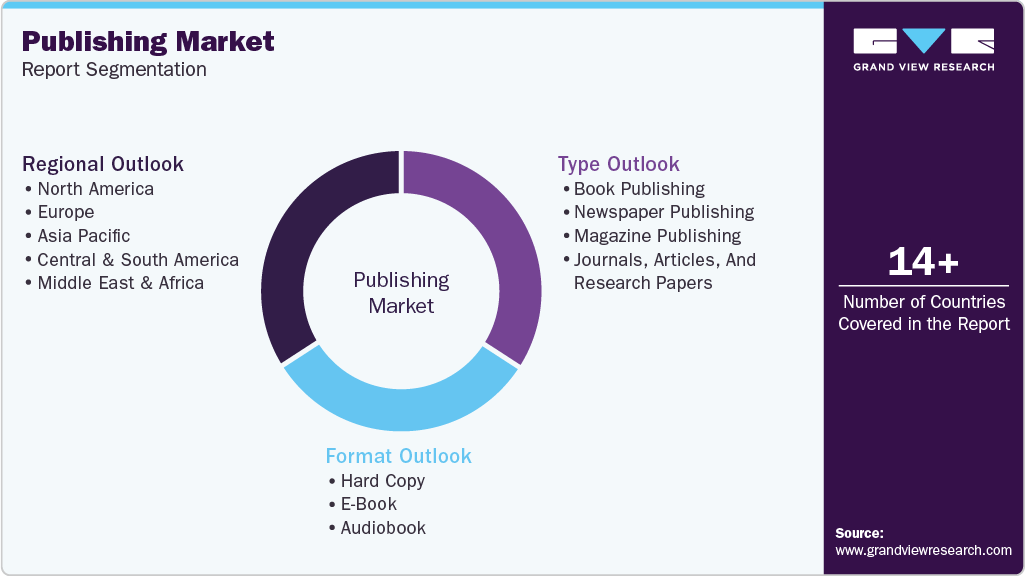
This report forecasts revenue growth at global, regional & country levels and provides an analysis of the latest trends and opportunities in each of the sub-segments from 2021 to 2033. For this study, Grand View Research has segmented the global publishing market based on type, format, and region:
 To learn more about this report, Download Free Sample Report
 -
Type Outlook (Revenue, USD Million, 2021 - 2033)
-
Book Publishing
-
Non-Japanese Content
-
Japanese-Origin Content
-
Manga
-
Other Japanese Literature
-
-
-
Newspaper Publishing
-
Magazine Publishing
-
Journals, Articles, and Research Papers
-
-
Format Outlook (Revenue, USD Million, 2021 - 2033)
-
Hard Copy
-
E-Book
-
Audiobook
-
-
Regional Outlook (Revenue, USD Million, 2021 - 2033)
-
North America
-
U.S.
-
Canada
-
Mexico
-
-
Europe
-
UK
-
Germany
-
France
-
Italy
-
Spain
-
-
Asia Pacific
-
China
-
India
-
Japan
-
South Korea
-
Australia & New Zealand
-
-
Central & South America
-
Brazil
-
-
Middle East & Africa
-
South Africa
-
-
Delivered Customizations
This report has been delivered with the following In-depth customizations
Client Request
Customization Delivered
Value Adds
Digital Publishing & Format Transition Analysis
Developed a tailored assessment of the global market focused on the transition from hard copy publishing to digital formats, including e-books and audiobooks. The study analyzed changing consumer reading habits, subscription-based content consumption, mobile reading adoption, audiobook engagement trends, and publisher investment strategies across digital ecosystems.
Enables stakeholders to understand evolving format preferences, identify high-growth digital publishing opportunities, optimize content distribution strategies, and evaluate long-term revenue potential across print and digital publishing channels.
Consumer Reading Behavior & Content Consumption Trends Analysis
Delivered a customized evaluation of evolving global reading behavior across fiction, non-fiction, self-help, fantasy, educational, and serialized content categories. The analysis included demographic reading preferences, audiobook listening trends, online book purchasing behavior, and subscription-based reading patterns.
Provides insights into changing consumer engagement patterns, emerging high-demand book categories, premium publishing opportunities, and evolving purchasing behavior, enabling publishers to optimize product portfolios and targeted marketing strategies.
Japanese-Origin Content & Manga Expansion Analysis
Delivered a customized evaluation of the growing global demand for Japanese-origin content, including manga and other Japanese literature. The analysis incorporated readership trends, anime-driven demand, regional consumption hotspots, and digital manga platform expansion strategies.
Provides actionable insights into emerging manga demand, supports international expansion planning, identifies commercially attractive content categories, and helps publishers align licensing and localization strategies with evolving consumer preferences.
Frequently Asked Questions About This Report
The book publishing segment held the largest market share of 59.6% in the publishing market in 2025 due to its sustained global demand for fiction, non-fiction, educational books, self-improvement titles, manga, and professional learning content across both print and digital formats.
Key players in the publishing market are RELX Group plc (Elsevier), Bertelsmann SE & Co. KGaA, Pearson plc, Hachette Livre SA, HarperCollins, Publishers LLC, Holtzbrinck Publishing Group, Springer Nature AG & Co. KGaA, John Wiley & Sons, Inc., McGraw-Hill LLC, and Scholastic Corporation.
The global publishing market was valued at USD 298.4 billion in 2025 and is expected to reach USD 307.0 billion in 2026.
The global publishing market is expected to grow at a compound annual growth rate of 3.5% from 2026 to 2033 to reach USD 391.0 billion by 2033.
Asia Pacific dominated with a 42.3% revenue share in 2025.
Key factors include rising digital content consumption, increasing demand for educational and professional learning materials, and the growing popularity of audiobooks and e-books.
The hard copy publishing segment led with a 67.7% revenue share in 2025, while audiobooks is the fastest-growing segment.
About the Author(s)
Homecare & Decor Research Team
Consumer Goods · Homecare & DecorThis report was authored by the homecare & decor research team at Grand View Research - comprising two research analysts, one senior research analyst, and one industry expert - with specialized expertise in the homecare & decor segment of the consumer goods industry. All findings are based on proprietary consumer goods databases, executive interviews, and regulatory analysis, subject to internal peer review prior to publication.
Last Updated:
Speak to Analyst

Customize this report to your needs - add regions, segments, or data points, with 20% free customization.
Or view our licence options:


ISO 9001:2015 & 27001:2022 Certified
We are GDPR and CCPA compliant! Your transaction & personal information is safe and secure. For more details, please read our privacy policy.


