
- Home
- »
- Consumer F&B
- »
-
U.S. Vitamin Supplements Market Size Report, 2026-2033GVR Report cover

U.S. Vitamin Supplements Market (2026 - 2033)
Size, Share & Trends Analysis Report By Type (Multivitamin, Vitamin A, Vitamin B, Vitamin C, Vitamin D) By Form (Powder, Tablet) By Distribution Channel (Online, Offline), And Segment Forecasts
Market Size, 2025
$15.6BMarket Estimate, 2026
$16.3BMarket Forecast, 2033
$21.2BCAGR, 2026–2033
3.9%U.S. Vitamin Supplements Market Summary
The U.S. vitamin supplements market size was valued at USD 15.6 billion in 2025 and is projected to grow from USD 16.3 billion in 2026 to USD 21.2 billion in 2033, at a CAGR of 3.9% from 2026 to 2033. The rising consumer focus on preventive healthcare and wellness is driving demand for vitamin supplements as consumers increasingly seek convenient solutions to support immunity, energy, and overall health.
Key Market Trends & Insights
- By type: The multivitamin supplements led the market and accounted for a share of 40.2% in 2025.
- By form: The gummies segment is expected to grow at the fastest CAGR for 4.4% from 2026 to 2033.
- By distribution channel: The offline channels dominated the U.S. vitamin supplements industry, accounting for an 80.1% share in 2025.
Key Market Trends & Insights
- Market size in 2025: USD 15.6 Billion
- Estimated market size in 2026: USD 16.3 Billion
- Projected market size by 2033: USD 21.2 Billion
- CAGR (2026-2033): 3.9%
Three ways to get this report
Buy it, customize it, or ask a question.Ask an Analyst
Analyst response in 1 business day
- AccessReport author, directly
- Reply timeWithin 1 working day
- No sales callDirect answer only
- FormatEmail reply
- CostFree, no cost
Get the Full Report
What the study covers
- FormatsPDF · Excel · Dashboard
- Timeline2026–2033 annual, 2025 base
- Coverage20+ countries, 5 regions
- Companies10+ key players profiled
Customize the Report
20% free customization
- IncludeCountries, segments, points
- TailorTo your product definition
- ExtendDeeper competitor detail
- OrA fully bespoke study
- Turnaround5–10 working days
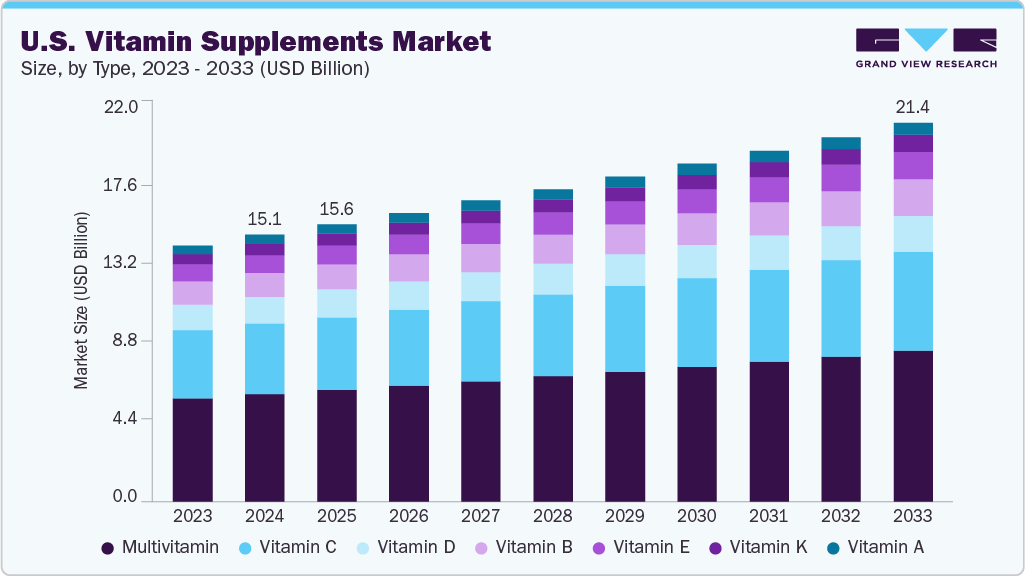 Source: Grand View Research, IR Documents, Primary Interviews, Paid DatabasesTo learn more about this report,
 Download Free Sample Report
Growing awareness of nutritional deficiencies, coupled with personalized nutrition trends, is encouraging consumers to incorporate targeted vitamin supplementation into their daily routines. The market is being supported by preventive health, nutrient-gap awareness, healthy aging, immunity, energy, and beauty from within. Consumers increasingly use vitamins as part of their everyday wellness routines, while seeking products that address specific needs rather than relying only on conventional multivitamins. Manufacturers are therefore focusing on targeted formulations, multifunctional products, convenient gummy and chewable formats, and cleaner-label or zero-sugar options to improve relevance, convenience, and daily adherence. Manufacturers are increasingly prioritizing new product development to capture these evolving consumer needs. For instance, in July 2026, One A Day introduced a reformulated Women’s Multi Gummy containing 1,000 mcg of biotin per serving, positioning the product around daily nutritional support as well as hair, skin, and nail health. The formulation combines biotin with vitamins A, C, E, zinc, vitamin D, and B vitamins, demonstrating the industry's shift toward multifunctional, benefit-led products that simplify supplementation while strengthening product differentiation.Market Dynamics
The U.S. vitamin supplements industry is gaining momentum from rising consumer emphasis on preventive wellness, nutritional sufficiency, healthy aging, immunity, sleep, and specific health outcomes. Consumers are increasingly prioritizing products with defined functional benefits over generalized multivitamin solutions. This demand is prompting manufacturers to strengthen targeted portfolios, combine multiple functional ingredients, and adopt more convenient delivery formats that support everyday consumption. For instance, in June 2026, Unisom entered the vitamin and mineral supplement segment with Sleep Support Gummies, combining magnesium and ashwagandha in a melatonin-free formulation. The launch demonstrates manufacturers' shift toward purpose-led supplementation and consumer-friendly formats to capture emerging wellness occasions and broaden market reach.
Market growth is constrained by product-selection complexity, safety concerns, limited ingredient transparency, and uncertainty about dosages and supplement combinations. The expanding range of formulations and benefit claims can create decision barriers for consumers, particularly when products target overlapping health objectives. Concerns regarding ingredient quality, sourcing, efficacy, and potential product interactions can further weaken purchase confidence and repeat adoption.
The market offers strong growth potential through personalized, life-stage-specific, and benefit-led supplementation as consumers increasingly seek products tailored to their age, gender, lifestyle, and individual wellness priorities. This creates opportunities for manufacturers to move beyond standardized formulations by combining science-backed ingredients, transparent sourcing, targeted nutrient profiles, and convenient delivery formats. For instance, in September 2026, SugarbearPRO introduced Hair Prenatal Vegan Vitamin Gummies, combining prenatal nutritional support with a beauty-focused proposition. Such innovations highlight the opportunity to develop multi-benefit, consumer-specific solutions that strengthen product differentiation, expand usage occasions, and support premium positioning.
Analyst Perspective
The market is driven by preventive healthcare, nutritional gaps, and increasing awareness of age- and lifestyle-related wellness needs. Consumers are shifting from broad supplementation toward purpose-specific products targeting immunity, energy, healthy aging, beauty, and nutritional requirements. Key trends include personalized nutrition, multifunctional formulations, clean-label ingredients, and convenient formats such as gummies. Opportunities remain in life-stage-specific products, targeted formulations, and digital personalization. Going forward, manufacturers are expected to focus on product innovation, transparent formulations, consumer convenience, and differentiated wellness propositions to strengthen engagement and support market growth.
Consumer Insights
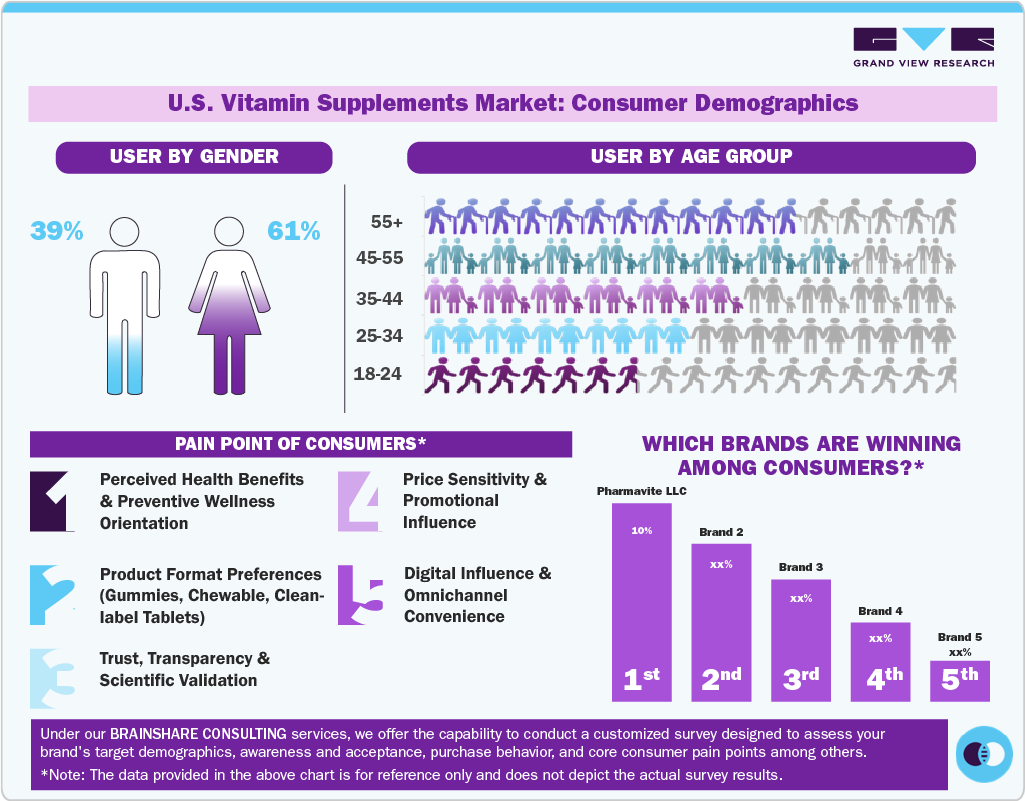
Vitamin supplement demand in the U.S. is increasingly driven by preventive health priorities and persistent micronutrient gaps, encouraging consumers to seek products that address specific nutritional needs and wellness goals. Recent NIH-published research using U.S. national health data found that iron deficiency among women of reproductive age increased from 11.6% to 17.4%, while folate insufficiency rose from 15.7% to 21.4%.
 To learn more about this report, Download Free Sample Report
The findings highlight nutritional vulnerabilities within an important consumer segment and strengthen the relevance of targeted iron, folate, multivitamin, and women-focused formulations. In response, manufacturers are moving beyond standardized products toward purpose-specific, multifunctional, and life-stage-oriented solutions. For instance, in June 2026, WeNatal launched Iron+ in the U.S., a targeted iron and vitamin C supplement designed for situations where additional iron support may be required. The formulation provides 18 mg of iron bisglycinate with 100 mg of vitamin C, with the company positioning the product around changing iron requirements associated with factors such as life stage, dietary patterns, pregnancy, postpartum recovery, and heavy menstrual cycles.
Type Insights
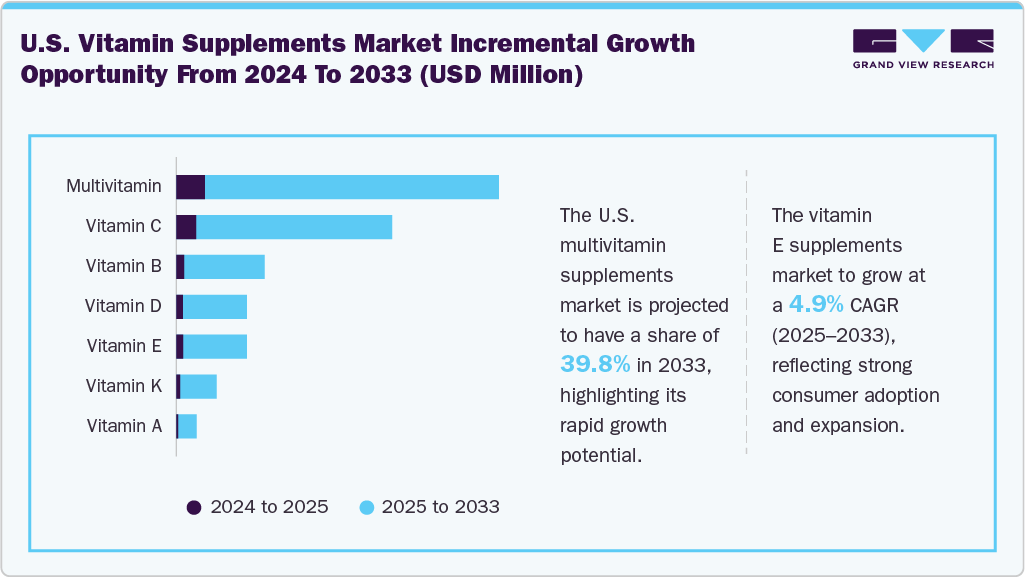
The multivitamin supplements segment accounted for the largest share of around 40.2% in 2025. Reflecting strong consumer preference for consolidated nutritional solutions. Multivitamins provide multiple essential nutrients in a single product, offering a practical alternative to purchasing and managing several individual supplements. This positioning aligns with consumers’ growing focus on daily wellness, nutritional adequacy, and simplified supplementation routines. Manufacturers are further strengthening the segment through multifunctional formulations that combine vitamins and minerals with benefits such as immune, energy, digestive, and healthy-aging support. For instance, in April 2026, KAL Vitamins expanded its U.S. multivitamin portfolio with four age-specific formulations for men and women aged 18+ and 50+, targeting nutritional requirements across different stages of adulthood. The launch demonstrates how manufacturers are evolving the conventional multivitamin proposition through age-specific nutrient profiles and benefit-led positioning, helping consumers select products that better align with their individual nutritional needs.
 To learn more about this report, Download Free Sample Report
The vitamin E supplements is projected to grow at the fastest CAGR of 4.8% from 2026 to 2033. supported by growing consumer interest in antioxidant protection, immune function, skin health, and healthy aging. Vitamin E is increasingly positioned across both nutritional and beauty-oriented wellness applications, broadening its consumer relevance beyond traditional supplementation. Rising awareness of oxidative stress and age-related health concerns is further supporting demand for targeted vitamin E products. Manufacturers are responding with standalone formulations, combination supplements, higher-potency products, and convenient soft-gel and gummy formats, enabling more targeted use and strengthening product differentiation.
Form Insights
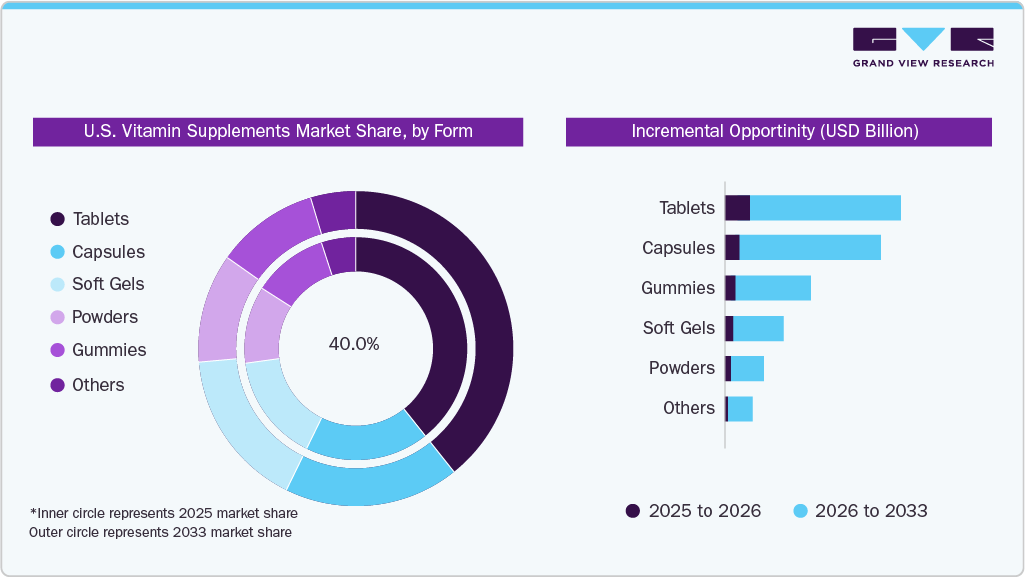
The vitamin supplements in tablet form accounted for the largest revenue share of 40.0% in 2025, supported by strong consumer familiarity, precise dosage delivery, cost efficiency, and longer stability. Tablets also provide manufacturers with greater formulation flexibility, efficient packaging, and scalable production, making them suitable for both multivitamins and single-nutrient products. Their broad availability across pharmacies, retail stores, and e-commerce channels further reinforces accessibility and routine usage. For instance, in June 2025, Trivia Pharmaceuticals introduced NewVite Tablets in the U.S., a multivitamin formulation combining vitamins A, B-complex, C, D, and E with biotin and folic acid. The launch underscores continued manufacturer reliance on tablets to deliver multi-nutrient formulations in a standardized and convenient format.
 To learn more about this report, Download Free Sample Report
The vitamin supplements in gummy form is projected to grow at a CAGR of 4.4% from 2026 to 2033. driven by rising consumer demand for convenient, palatable, and easy-to-administer supplementation. Gummies provide an accessible alternative to tablets and capsules, particularly for consumers seeking easier consumption and better adherence to daily wellness routines. Manufacturers are broadening the format across multivitamin, immunity, beauty, energy, and healthy-aging applications, while introducing sugar-free, plant-based, and multifunctional formulations to strengthen product differentiation. For instance, in April 2026, NOW Foods introduced its first vitamin gummies in the U.S., comprising Vitamin C and Vitamin D3 Gummies. The launch reflects established manufacturers' efforts to capitalize on the shift toward consumer-friendly delivery formats and convenient alternatives to traditional supplements.
Distribution Channel Insights
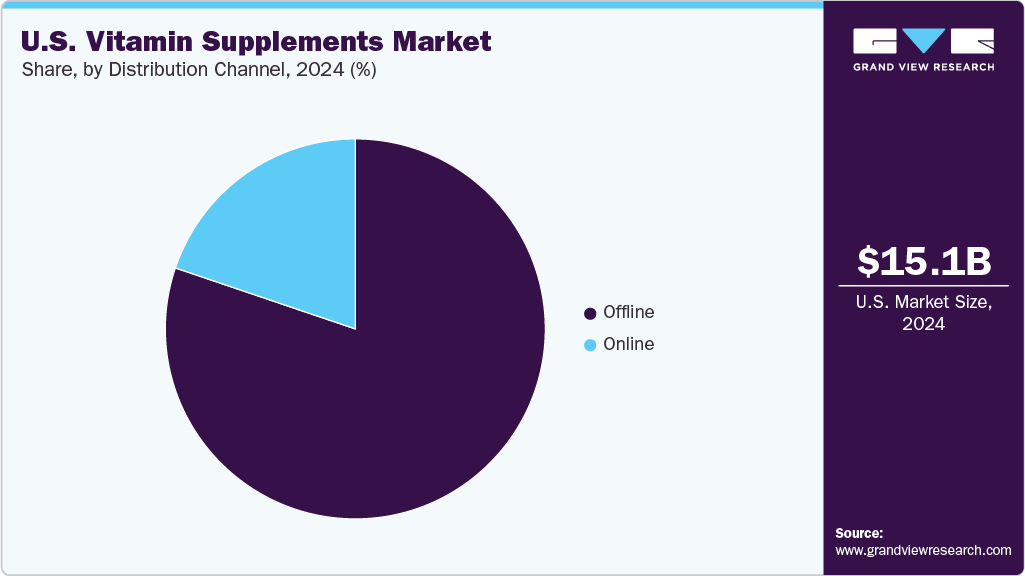
The offline channel accounted for the largest market share of 80.1% in 2025. supported by the extensive presence of pharmacies, drugstores, supermarkets, and specialty health retailers. Physical stores benefit from high product visibility, immediate availability, established consumer trust, and promotional activity, supporting routine supplement purchases. Retail networks also enable manufacturers to achieve broad geographic coverage and strengthen brand presence at the point of purchase. For instance, in June 2026, TruHeight Vitamins expanded its U.S. distribution to 5,000 CVS Pharmacy locations nationwide, placing its Growth Gummies, Sleep Gummies, and Growth Capsules across CVS stores. The expansion highlights manufacturers' focus on scaling retail distribution to improve accessibility, visibility, and consumer penetration.
 To learn more about this report, Download Free Sample Report
The online channel is projected to grow at the fastest CAGR of 4.6% from 2026 to 2033, driven by growing e-commerce adoption, convenient home delivery, wider product availability, and recurring-purchase models. Digital channels allow consumers to evaluate ingredients, compare product propositions, review customer feedback, and identify supplements aligned with specific wellness needs before purchasing. Manufacturers are strengthening their digital strategies through direct-to-consumer platforms, subscription programs, online marketplaces, and social commerce channels to expand market reach and establish direct relationships with consumers. For instance, in June 2026, Promino launched its U.S. direct-to-consumer platform for Drink Rej while expanding distribution through Amazon and TikTok Shop USA, illustrating manufacturers' increasing reliance on digital channels to enhance accessibility, consumer engagement, and repeat purchasing.
Key U.S. Vitamin Supplements Company Insights
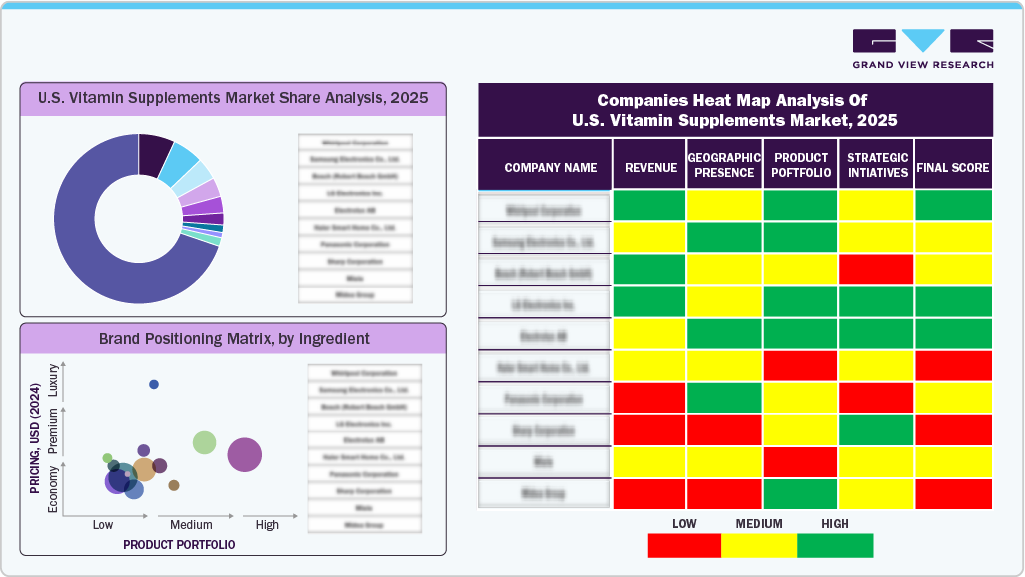
The market is highly competitive, with established brands and emerging wellness companies competing through targeted formulations, innovative formats, and broad online and offline distribution. Brand trust, product efficacy, ingredient transparency, convenience, and affordability remain key purchase factors, driving manufacturers to differentiate through science-backed and consumer-centric solutions.
 To learn more about this report, Download Free Sample Report
Key U.S. Vitamin Supplements Companies
-
Abbott
-
The Nature's Bounty Co.
-
NOW Foods
-
Herbalife Nutrition
-
Glanbia plc
-
Pfizer Inc.
-
Bayer AG
-
Amway Corp.
-
GlaxoSmithKline plc.
-
Pharmavite LLC
Competitive Benchmarking
Category
Operating Strategies
Competitive Edge
Weakness
Established Players (Abbott, The Nature's Bounty Co., NOW Foods, Herbalife Nutrition, Bayer AG, Amway Corp., Pharmavite LLC)
- Expand broad vitamin portfolios, strengthen retail and e-commerce distribution, introduce targeted formulations, and invest in product quality and brand building.
- Strong brand recognition, extensive distribution, established consumer bases, and diversified product portfolios.
- High competition, regulatory exposure, pricing pressure, and slower adaptation to rapidly changing consumer preferences.
Emerging Players (Glanbia plc, Pfizer Inc.)
- Expand into specialized nutrition, functional health, performance nutrition, and science-led formulations while leveraging existing capabilities.
- Strong R&D capabilities, scientific expertise, manufacturing resources, and opportunities to connect vitamins with broader functional nutrition trends.
- Lower concentration in conventional vitamin categories and comparatively less specialized consumer positioning than leading vitamin-focused brands.
Recent Developments
-
In July 2026, Lemme introduced its Skin Firming & Hydrating Gummy Rings, combining ceramides, hyaluronic acid, sea buckthorn, and vitamins C and E. The launch demonstrates innovation in beauty-focused supplementation, with the company using a novel gummy-ring format to improve consumer appeal and differentiate its portfolio
-
In February 2026, Fatty15 launched its Healthy Aging Gummies for Adults, introducing its patented C15:0 ingredient in a sugar-free, vegan-friendly, high-fiber gummy format. The launch expands the brand’s healthy-aging portfolio into a convenient, capsule-free format, reflecting growing manufacturer focus on functional ingredients, accessible delivery formats, and long-term wellness positioning.
U.S. Vitamin Supplements Market Report Scope
Report Attribute
Details
Market size in 2025
USD 15.6 billion
Estimated market size in 2026
USD 16.3 billion
Projected market size by 2033
USD 21.2 billion
Growth rate (revenue)
CAGR of 3.9% from 2026 to 2033
Actuals
2021 - 2025
Forecast period
2026 - 2033
Quantitative (Revenue) units
Revenue in USD billion, and CAGR from 2026 to 2033
Report coverage
Revenue forecast, company ranking, competitive landscape, growth factors, and trends
Segments covered
Type, form, distribution channel
Country scope
U.S.
Key companies profiled
Abbott; The Nature's Bounty Co.; NOW Foods; Herbalife Nutrition; Glanbia plc; Pfizer Inc.; Bayer AG; Amway Corp.; GlaxoSmithKline plc.; Pharmavite LLC
Customization scope
Free report customization (equivalent up to 8 analysts’ working days) with purchase. Addition or alteration to country, regional & segment scope.
Pricing and purchase options
Avail customized purchase options to meet your exact research needs. Explore purchase options
U.S. Vitamin Supplements Market Report Segmentation
This report forecasts revenue growth at the country level and provides an analysis of the latest industry trends and opportunities in each of the sub-segments from 2021 to 2033. For this study, Grand View Research has segmented the U.S. vitamin supplements market report based on type, form, and distribution channel:
-
Type Outlook (Revenue, USD Billion; 2021 - 2033)
-
Multivitamin
-
Vitamin A
-
Vitamin B
-
Vitamin C
-
Vitamin D
-
Vitamin E
-
Vitamin K
-
-
Form Outlook (Revenue, USD Billion; 2021 - 2033)
-
Powder
-
Tablets
-
Capsules
-
Softgels
-
Gummies
-
Others
-
-
Distribution Channel Outlook (Revenue, USD Billion; 2021 - 2033)
-
Offline
-
Pharmacies & Drugstores
-
Hypermarkets/Supermarkets
-
Others
-
-
Online
-
Research Methodology
The U.S. vitamin supplements market figures in this report are based on a proven research process that combines executive interviews with secondary research from proprietary databases, company filings, and recognized regulatory and institutional sources. Market size is built through value-chain sizing-reconciling supply-side and demand-side estimates-and triangulated with bottom-up and top-down approaches. Every estimate passes multiple levels of expert validation before publication, with each U.S. vitamin supplements segment quantified using the revenue-capture definitions in the table below.
Segment Definition
Type
Revenue capture definition
Multivitamin
Supplements combining multiple essential vitamins, often with minerals, to provide broad nutritional support and address overall wellness needs.
Vitamin A
Supplements provide vitamin A to support vision, immune function, and normal cell growth and maintenance.
Vitamin B
Supplements containing one or more B vitamins to support energy metabolism, nervous-system function, and overall nutritional health.
Vitamin C
Supplements provide vitamin C to support immune function, antioxidant protection, collagen formation, and iron absorption.
Vitamin D
Supplements provide vitamin D to support calcium absorption, bone health, muscle function, and immune health.
Vitamin E
Supplements providing vitamin E primarily for antioxidant support, cellular protection, and skin and immune health.
Vitamin K
Supplements providing vitamin K to support normal blood clotting and bone health.
Estimation Model
Layer Name
Key Question
Description
Consumption Profile Layer
Who uses vitamin supplements?
Demand is supported by consumers seeking nutritional support, preventive wellness, immunity, energy, healthy aging, and specific health benefits. Purchasing is influenced by age, lifestyle, health priorities, nutritional gaps, convenience, and preferred dosage formats.
Market Reach Layer
Where do consumers purchase them?
Vitamin supplements are distributed through pharmacies, drugstores, supermarkets, specialty health retailers, e-commerce platforms, and direct-to-consumer channels. Broad retail availability and expanding digital access strengthen consumer reach and product accessibility.
Innovation & Differentiation Layer
How do brands differentiate?
Brands compete through targeted formulations, clinically supported ingredients, innovative delivery formats, clean-label packaging, personalized nutrition, and multifunctional products. Manufacturers increasingly tailor products to specific health objectives, life stages, and consumer preferences.
Value Generation Layer
How do companies generate value from the market?
Value is generated through premium and differentiated products, brand loyalty, retail availability, repeat purchases, and expansion across distribution channels.
Delivered Customizations
This report has been delivered with the following In-depth customizations
Client Request
Customization Delivered
Value Adds
Assess U.S. vitamin supplement consumption patterns and consumer preferences.
Developed a U.S.-specific consumer assessment covering supplement usage, health objectives, preferred vitamin types, dosage formats, purchasing behavior, and key factors influencing product selection.
Identifies high-potential consumer segments and key purchase drivers, supporting more precise product positioning and market-entry strategies.
Evaluate the competitive positioning of vitamin supplement companies in the U.S.
Assessed leading and emerging players based on product portfolios, vitamin categories, formulation strategies, delivery formats, pricing, distribution footprint, innovation, and brand positioning.
Provides a structured competitive benchmark, highlighting differentiation strategies, portfolio gaps, and opportunities to strengthen market positioning.
Identify emerging product categories and innovation opportunities in the U.S. vitamin supplements market
Evaluated key product dimensions, including multivitamins, individual vitamins, targeted formulations, gummies, tablets, personalized nutrition, multifunctional products, and life-stage-specific solutions, with emphasis on evolving consumer requirements.
Highlights attractive areas for product development, portfolio expansion, and innovation, enabling manufacturers to align offerings with emerging U.S. consumer demand.
Frequently Asked Questions About This Report
The key market players in the U.S. vitamin supplements market includes Abbott; The Nature's Bounty Co.; NOW Foods; Herbalife Nutrition; Glanbia plc; Pfizer Inc.; Bayer AG; Amway Corp.; GlaxoSmithKline plc.; Pharmavite LLC.
Growth in the U.S. vitamin supplements market is being primarily driven by increasing health-oriented consumer trends, concerns about nutrient deficiencies, an aging population, and rising interest in preventative healthcare.
Multivitamin supplements accounted for the largest share of 40.2% of the revenue in 2025.
Offline channels accounted for the largest share of 80.1% of the revenue in 2025.
The U.S. vitamin supplements market size was estimated at USD 15.6 billion in 2025 and is expected to reach USD 16.3 billion in 2026.
The U.S. vitamin supplements market is expected to witness 3.9% revenue growth from 2026 to 2033 to reach USD 21.2 billion by 2033.
Tablets vitamin supplements accounted for the largest share of 40.0% of the revenue in 2025.
About the Author(s)
Consumer F&B Research Team
Consumer Goods · Consumer F&BThis report was authored by the consumer f&b research team at Grand View Research - comprising two research analysts, one senior research analyst, and one industry expert - with specialized expertise in the consumer f&b segment of the consumer goods industry. All findings are based on proprietary consumer goods databases, executive interviews, and regulatory analysis, subject to internal peer review prior to publication.
Last Updated:
Speak to Analyst

Customize this report to your needs - add regions, segments, or data points, with 20% free customization.
Or view our licence options:


ISO 9001:2015 & 27001:2022 Certified
We are GDPR and CCPA compliant! Your transaction & personal information is safe and secure. For more details, please read our privacy policy.


