
- Home
- »
- Healthcare IT
- »
-
AR and VR in Healthcare Market Size Report, 2026-2033GVR Report cover
![Augmented Reality And Virtual Reality In Healthcare Market (2026 - 2033)Report]()
Augmented Reality And Virtual Reality In Healthcare Market (2026 - 2033)
Size, Share & Trends Analysis Report By Component (Hardware, Software), By Technology (Augmented Reality, Virtual Reality), By Region, And Segment Forecasts
Market Size, 2025
$4.6BMarket Estimate, 2026
$5.4BMarket Forecast, 2033
$19.0BCAGR, 2026–2033
19.6%Augmented Reality And Virtual Reality In Healthcare Market Summary
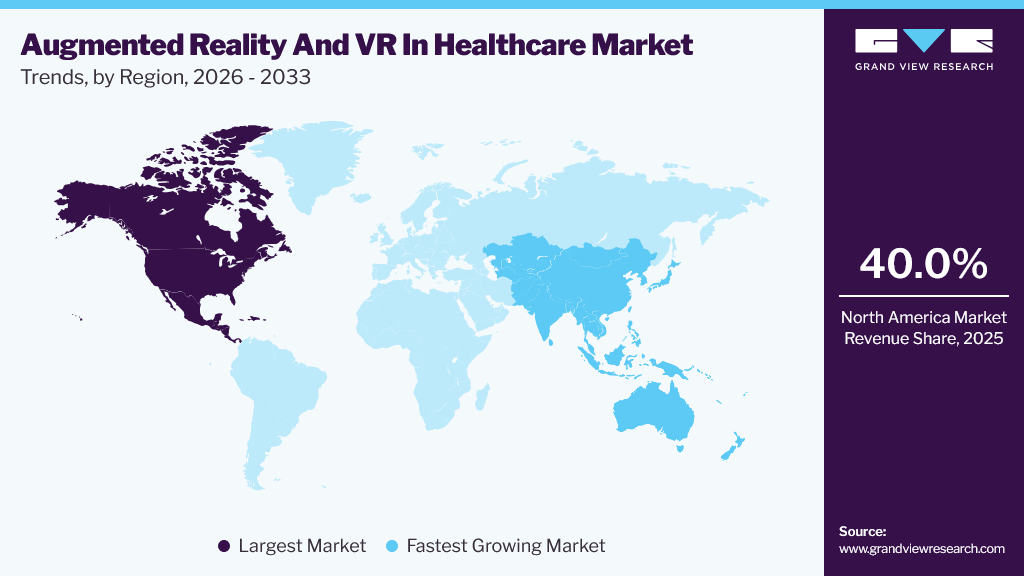
The global augmented reality and virtual reality in healthcare market size was valued at USD 4.6 billion in 2025 and is projected to grow from USD 5.4 billion in 2026 to USD 19.0 billion in 2033, at a CAGR of 19.6% from 2026 to 2033. The North America dominated the market, accounting for a revenue share of 40.0% in 2025. Technological advancements and digitalization in healthcare, favorable government initiatives, rising healthcare expenditure, growing use of surgical procedures, and medical training are among the fundamental factors anticipated to drive the growth and adoption of augmented reality (AR) and virtual reality (VR) technologies in the healthcare industry.
Key Market Trends & Insights
- By component: The hardware segment dominated the market for AR and VR in healthcare and accounted for the largest revenue share of over 65.0% in 2025.
- By technology: The augmented reality segment dominated the market with the highest share of around 60.0% in 2025.
Regional Highlights
- Largest regional market: North America (40.0% revenue share, 2025)
- Fastest-growing regional market: Asia Pacific (highest CAGR, 2026-2033)
Market Size & Forecast
- Market size in 2025: USD 4.6 Billion
- Estimated market size in 2026: USD 5.4 Billion
- Projected market size by 2033: USD 19.0 Billion
- CAGR (2026-2033): 19.6%
Three ways to get this report
Buy it, customize it, or ask a question.Ask an Analyst
A direct answer, usually in 1 working day
- AccessReport author, directly
- Reply timeWithin 1 working day
- No sales callDirect answer only
- FormatEmail reply
- CostFree, no cost
Get the Full Report
What the study covers
- FormatsPDF · Excel · Dashboard
- Timeline2026–2033 annual, 2025 base
- Coverage20+ countries, 5 regions
- Companies10+ key players profiled
Customize the Report
20% free customization
- IncludeCountries, segments, points
- TailorTo your product definition
- ExtendDeeper competitor detail
- OrA fully bespoke study
- Turnaround5–10 working days
Augmented Reality (AR) and Virtual Reality (VR) are pivotal innovations in immersive technology. AR enhances our perception of the real world by integrating digital information, such as sounds, images, or text, into our view of our surroundings. This capability facilitates interactive experiences and allows for the visualization of complex concepts in a tangible context. On the other hand, VR provides immersive experiences, transporting users into simulated environments. This allows for interaction in a digital space that offers an experience distinct from the real world. These technologies are essential in advancing user engagement and understanding across various sectors.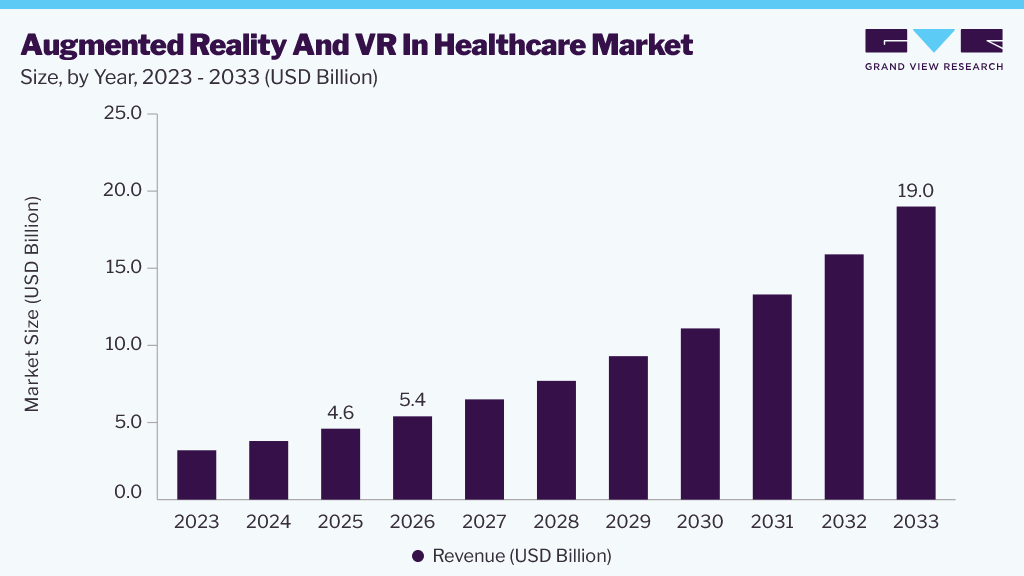
In the field of medical education, virtual reality is revolutionizing training by providing immersive, interactive experiences that enhance knowledge retention and create risk-free environments. For instance, in June 2026, Elsevier launched Shadow Health Lab with Virtual Reality, an immersive clinical simulation platform. This platform is designed to support nursing education through virtual patient encounters and evidence-based training scenarios. It enables students to practice clinical decision-making and patient-interaction skills in a realistic virtual environment, allowing healthcare learners to gain practical experience without risking actual patients. This development highlights the growing adoption of VR-based medical education solutions to improve clinical preparedness, knowledge retention, and the efficiency of workforce training.
AR is significantly transforming medical education by allowing students to explore anatomical structures and disease pathologies through an interactive, 3D format. For instance, in March 2024, Siemens Healthineers launched its Cinematic Reality application for Apple Vision Pro. This application enables surgeons, medical students, and patients to interact with immersive, three-dimensional holographic representations of human anatomy generated from medical imaging data. Users can visualize and manipulate realistic anatomical renderings, enhancing applications in medical education, patient communication, and surgical planning. This development underscores the growing adoption of augmented reality and spatial computing technologies in healthcare education by enabling interactive visualization of complex anatomical structures and improving clinical learning experiences.
Analyst Perspective
The augmented reality and virtual reality in healthcare market is witnessing steady growth owing to the increasing adoption of immersive technologies in medical education, surgical training, rehabilitation, and patient care. The market is witnessing growing demand for AR and VR solutions as healthcare providers and technology companies focus on improving training efficiency, treatment planning, and patient outcomes through interactive 3D visualization and simulation-based learning. Advancements in artificial intelligence, medical imaging, and digital healthcare platforms are further supporting the development of advanced AR/VR applications. Although challenges such as high costs, limited infrastructure, and integration issues remain, continuous innovation and increasing digital transformation in healthcare are creating new growth opportunities. Companies investing in scalable, user-friendly, and clinically effective AR/VR solutions are expected to benefit from the expanding adoption of immersive technologies across the healthcare industry.
Component Insights
In 2025, the hardware segment dominated the market, accounting for over 65.0% of revenue. Devices such as head-mounted displays, smart glasses, and 3D sensors hold significant market share. Head-mounted devices and smart glasses are widely used in training and simulation, surgeries, diagnostics, telementoring, and many other applications. In the current market, AR/VR hardware has a large, commercialized product base and a high adoption rate, especially in developed countries, as companies are actively investing in advancing AR and VR devices to enhance their applications in healthcare. In November 2025, Augmedics received U.S. FDA 510(k) clearance for its next-generation X2 augmented reality headset designed for use with the xvision Spine System. The surgical AR headset features improved visualization, a wider field of view, higher image resolution, and an ergonomic design to support surgeons during spinal procedures. This development highlights the continued advancement of AR healthcare hardware, with companies focusing on specialized head-mounted devices that improve surgical precision, reduce workflow limitations, and expand the use of immersive technologies in clinical applications.
The service segment is expected to grow at the fastest CAGR during the forecast period. The complexity of AR and VR technologies requires specialized expertise to implement, integrate, customize, maintain, and support them within healthcare systems. Moreover, healthcare institutions often require customized solutions that seamlessly integrate AR/VR with existing systems, such as medical imaging devices. In addition, the demand for AR and VR in medical training, education, and simulation is driving service providers to offer training programs and simulation development, further fueling the growth of this segment. Furthermore, companies provide ongoing support, maintenance, updates, and scalability options as healthcare organizations expand their AR/VR initiatives, demonstrating measurable ROI and encouraging further adoption and investment in these technologies.
Technology Insights
By technology, the augmented reality segment dominated the market, with a share of around 60.0% in 2025, owing to its use across various medical disciplines, such as surgical preparation and minimally invasive surgery. Technological advancements and the rising demand to reduce the complexity of medical procedures are driving increased adoption of augmented reality technology. Market players operating in AR technology are partnering with domestic players to expand their product reach and launch new products. In October 2025, MediView XR, Inc. secured a USD 24 million Series A funding round led by GE HealthCare, with participation from the Cleveland Clinic, Mayo Clinic, Edge Ventures, Emplify Health, and JobsOhio Growth Capital Fund, to increase the commercialization of its augmented reality-based surgical navigation and medical imaging platform. The company’s FDA-cleared AR platform combines 3D CT scans with live ultrasound imaging to provide clinicians with real-time 3D visualization of patient anatomy during minimally invasive procedures. This development highlights the increasing adoption of AR technology in healthcare, as companies focus on improving surgical precision, enhancing image-guided procedures, and reducing complexity in clinical workflows.
The virtual reality segment is expected to grow at the fastest CAGR during the forecast period. The growth is due to various healthcare IT companies increasingly investing in this sector, given its potential. In 2025, FundamentalVR continued to expand its VR-based surgical simulation platform, Fundamental Surgery, by enhancing haptic technology and adding procedural training capabilities to improve surgical skill development. The platform enables surgeons and medical trainees to practice complex procedures in immersive virtual environments with realistic touch feedback, supporting risk-free training across multiple surgical specialties. This development reflects the growing adoption of VR-based healthcare education solutions, as healthcare institutions and technology providers increasingly focus on improving surgical training, expanding access to simulation, and enhancing clinical preparedness.
Regional Insights
North America Augmented Reality And Virtual Reality In Healthcare Market Trends
The North America augmented reality and virtual reality in healthcare industry accounted for the largest global revenue share, at around 40.0%, in 2025. Factors driving growth in this region include higher adoption of these technologies, investment in R&D, and favorable government initiatives. Moreover, the growing number of complex surgeries in the region is expected to contribute to the market growth. In May 2024, the American Orthopedic Consortium (AOC) and PrecisionOS announced a partnership to integrate virtual reality-based surgical simulation into orthopedic education and training programs. Through this collaboration, PrecisionOS’s immersive VR platform will support orthopedic surgeons and trainees by providing realistic, interactive surgical simulations that allow them to practice procedures in a risk-free virtual environment. This development highlights the growing adoption of VR healthcare technologies in North America, supported by collaborations between medical education organizations and technology providers to enhance surgical training, improve clinical skills, and address the increasing demand for advanced simulation-based learning solutions.
U.S. Augmented Reality And Virtual Reality In Healthcare Market Trends
The U.S. augmented reality and virtual reality in healthcare industry accounted for the largest share in North America in 2025 due to the introduction of several solutions, supportive government policies, technical advancements, and the presence of key companies undertaking strategic initiatives. In October 2025, Osso VR partnered with America’s Essential Hospitals to expand access to immersive virtual reality-based healthcare training solutions across safety-net hospitals in the U.S. Through this collaboration, Osso VR’s surgical and clinical training platform will support healthcare professionals, including nurses and surgical teams, by providing realistic, simulation-based learning environments without patient risk. This development highlights the growing adoption of VR healthcare technologies in the U.S., supported by increasing demand for advanced clinical training solutions, workforce development initiatives, and digital transformation across healthcare institutions.
Europe Augmented Reality And Virtual Reality In Healthcare Market Trends
Augmented reality and virtual reality in the healthcare industry in Europe are expected to grow significantly during the forecast period. The growth is attributed to increased government initiatives to promote virtual reality in the healthcare industry. For instance, Medicalholodeck, a Switzerland-based company, introduced TeamXR, a virtual reality-based medical teamwork platform in 2025 that enables surgeons, physicians, educators, and students to collaborate in immersive 3D environments. The platform allows healthcare professionals to review medical imaging, discuss patient cases, and conduct virtual medical education using interactive anatomical models, supporting the growing adoption of VR solutions in healthcare training, surgical planning, and clinical collaboration.
The Germany augmented reality and virtual reality in healthcare industry had a substantial revenue share in 2025. This can be attributed to the growing use of VR technology in several medical applications. For instance, in 2025, Siemens Healthineers continued driving the digital transformation of healthcare by integrating artificial intelligence, extended reality (AR/VR), and digital twin technologies to enhance medical workflows and clinical decision-making. In Germany, the company’s digital innovation hubs in Forchheim and Erlangen serve as major global centers for healthcare innovation, virtual demonstrations, and the development of advanced digital healthcare solutions. This development reflects the growing adoption of immersive and AI-enabled healthcare technologies to improve operational efficiency, medical training, and patient care outcomes.
The augmented reality and virtual reality in healthcare industry in the UK is expected to grow significantly during the forecast period due to increasing investment and various initiatives to boost the adoption of AR & VR. In March 2026, Oxford Medical Simulation (OMS) secured Euro 5.78 million in growth funding from Salica Investments to expand its virtual reality based healthcare training platform and accelerate product development. The funding will support the company’s investment in AI-driven clinical scenarios, learning analytics, and workflow tools, enabling healthcare professionals and students to practice realistic medical situations through immersive VR environments. This development highlights the growing adoption of VR technology in the UK healthcare market, driven by the need for scalable clinical training solutions, improved workforce readiness, and advanced simulation-based medical education.
Asia Pacific Augmented Reality And Virtual Reality In Healthcare Market Trends
The Asia Pacific augmented reality and virtual reality in healthcare sector is expected to be the fastest-growing over the forecast period. The growth is attributed to increased public awareness and improved healthcare infrastructure. Developing markets such as India and China are promising destinations for outsourcing services for the development and distribution of AR and VR technologies in healthcare.
Augmented reality and virtual reality in the healthcare industry in Japan had the largest market share in 2025. Growing investment in companies offering AR and VR solutions for the healthcare industry is a key driver of market growth. In November 2025, Jolly Good Inc. announced the adoption of its medical VR education platform ‘JOLLYGOOD’ at Kindai University’s new medical campus and hospital in Japan. The VR platform enables medical students, residents, nurses, and healthcare professionals to experience immersive clinical training scenarios using 360-degree VR content and simulation-based learning. This development highlights the increasing adoption of VR healthcare solutions in Japan, driven by healthcare digital transformation initiatives, demand for advanced medical training, and the need to improve clinical skill development through immersive technologies.
The India augmented reality and virtual reality in healthcare industry is expected to grow significantly during the forecast period. The growth is attributed to the growing adoption of AR and VR in hospitals. In January 2026, MediSim VR, an immersive healthcare simulation company, collaborated with Krupanidhi Group of Institutions to establish a VR Skill and Simulation Lab in Bengaluru, India. The facility integrates virtual reality-based medical simulation into healthcare education, enabling students and healthcare professionals to practice clinical procedures and high-risk scenarios in realistic immersive environments. This development highlights the increasing adoption of VR technologies in Asia Pacific, supported by growing investments in digital healthcare education, medical simulation infrastructure, and advanced training solutions to improve clinical competency and patient safety.
Key Augmented Reality And Virtual Reality In Healthcare Company Insights
The augmented reality and virtual reality in healthcare industry comprises competitive players, including CAE Healthcare Inc., Siemens Healthineers, GE HealthCare, and others. These players are involved in new product launches, partnerships, and acquisitions to gain a competitive edge over each other.
Key Augmented Reality And Virtual Reality In Healthcare Companies:
The following key companies have been profiled for this study on the augmented reality and virtual reality in healthcare market:
-
CAE Healthcare Inc.
-
Siemens Healthineers
-
Koninklijke Philips N.V.
-
Hologic, Inc.
-
EON Reality, Inc.
-
Intuitive Surgical Operations, Inc.
-
GE HealthCare
-
Layar.eu
-
WorldViz, Inc.
-
TheraSim, Inc.
Recent Developments
-
In May 2026, Siemens Healthineers received FDA clearance for six new interventional systems equipped with its Optiq AI Imaging Chain technology, designed to improve image quality and support image guided procedures. The advancement reflects Siemens Healthineers’ continued focus on digital visualization technologies that complement AR/VR-enabled healthcare workflows, particularly in surgical navigation, interventional procedures, and advanced clinical decision support.
-
In May 2026, EON Reality launched EON Spatial OS, an AI-powered XR platform designed for immersive learning and simulation across industries, including healthcare education. The platform integrates AI-assisted content creation and spatial computing capabilities for AR/VR-based interactive training, highlighting the growing adoption of XR technologies in medical education and simulation-based healthcare learning.
-
In February 2026, GE HealthCare expanded its collaboration with the U.S. BARDA through a USD 35 million initiative to advance AI-powered ultrasound solutions for trauma care and emergency preparedness. The collaboration supports the development of advanced imaging technologies to improve real-time visualization and clinical decision-making in healthcare settings.
Augmented Reality And Virtual Reality In Healthcare Market Report Scope
Report Attribute
Details
Market size in 2025
USD 4.6 billion
Estimated market size in 2026
USD 5.4 billion
Projected market size by 2033
USD 19.0 billion
Growth rate
CAGR of 19.6% from 2026 to 2033
Base year for estimation
2025
Actual data
2021 – 2024
Forecast period
2026 – 2033
Quantitative units
Revenue in USD billion and CAGR from 2026 to 2033
Report coverage
Revenue forecast, company ranking, competitive landscape, growth factors, and trends
Segments covered
Component, technology, region
Regional Scope
North America; Europe; Asia Pacific; Latin America; MEA
Country Scope
U.S.; Canada; UK; Germany; Spain; France; Italy; Spain; Denmark; Sweden; Norway; China; Japan; India; Australia; South Korea; Thailand; Brazil; Mexico; Argentina; South Africa; Saudi Arabia; UAE; Kuwait
Key companies profiled
CAE Healthcare Inc.; Siemens Healthineers; Koninklijke Philips N.V.; Hologic, Inc.; EON Reality, Inc.; Intuitive Surgical Operations, Inc.; GE HealthCare; Layar.eu; WorldViz, Inc.; TheraSim, Inc.
Customization scope
Free report customization (equivalent up to 8 analysts working days) with purchase. Addition or alteration to country, regional & segment scope.
Pricing and purchase options
Avail of customized purchase options to meet your exact research needs. Explore purchase options
Augmented Reality And Virtual Reality in the Healthcare Market Report Segmentation
This report forecasts revenue growth and provides analysis at the global, regional, and country levels of the latest trends in each sub-segment from 2021 to 2033. For this report, Grand View Research has segmented the global augmented reality and virtual reality in healthcare market report based on component, technology, and region:
-
Component Outlook (Revenue, USD Billion, 2021 - 2033)
-
Hardware
-
Software
-
Services
-
-
Technology Outlook (Revenue, USD Billion, 2021 - 2033)
-
Augmented Reality
-
Surgical Application
-
Rehabilitation
-
Training & Continuing Medical Education
-
-
Virtual Reality
-
Simulation
-
Diagnostics
-
Virtual Reality Exposure Therapy (VRET)
-
Rehabilitation
-
Pain Distraction
-
-
-
Regional Outlook (Revenue, USD Billion, 2021 - 2033)
-
North America
-
U.S.
-
Canada
-
Mexico
-
-
Europe
-
UK
-
Germany
-
France
-
Italy
-
Spain
-
Sweden
-
Denmark
-
Norway
-
-
Asia Pacific
-
Japan
-
China
-
India
-
Australia
-
South Korea
-
Thailand
-
-
Latin America
-
Brazil
-
Argentina
-
-
Middle East & Africa
-
Saudi Arabia
-
South Africa
-
UAE
-
Kuwait
-
-
Frequently Asked Questions About This Report
Key players in the market include CAE Healthcare Inc.; Siemens Healthineers; Koninklijke Philips N.V.; Hologic, Inc.; EON Reality, Inc.; Intuitive Surgical Operations, Inc.; GE HealthCare; Layar.eu; WorldViz, Inc.; TheraSim, Inc., and others.
Key factors driving the augmented reality and virtual reality in healthcare market growth include the growing integration of technology & digitalization in healthcare, increasing healthcare expenditure & focus on the delivery of efficient health services, and its significance in training healthcare professionals worldwide.
⮚ North America dominated with an approximately 40.0% revenue share in 2025.
Asia Pacific is the fastest-growing region over the forecast period.
The augmented reality segment dominated the market with the highest share of around 60.0% in 2025.
The global augmented reality and virtual reality in healthcare market size was valued at USD 4.6 billion in 2025 and is estimated at USD 5.4 billion for 2026
The global augmented reality and virtual reality in healthcare market is expected to grow at a CAGR of 19.6% from 2026 to 2033, reaching USD 19.0 billion.
Based on the component, the hardware segment dominated the AR and VR in healthcare market with a share of 65.0% in 2025. This is attributable to the growing importance of hardware devices such as desktops, head-mounted displays, and other display devices while using these technologies.
About the Author(s)
Healthcare IT Research Team
Healthcare · Healthcare ITThis report was authored by the healthcare it research team at Grand View Research - comprising two research analysts, one senior research analyst, and one industry expert - with specialized expertise in the healthcare it segment of the healthcare industry. All findings are based on proprietary healthcare databases, executive interviews, and regulatory analysis, subject to internal peer review prior to publication.
Last Updated:
Speak to Analyst


Customize this report to your needs - add regions, segments, or data points, with 20% free customization.
Or view our licence options:


ISO 9001:2015 & 27001:2022 Certified
We are GDPR and CCPA compliant! Your transaction & personal information is safe and secure. For more details, please read our privacy policy.


