
- Home
- »
- Healthcare IT
- »
-
Wearable AI Market Size, Share & Trends Report, 2026-2033GVR Report cover

Wearable AI Market (2026 - 2033)
Size, Share & Trends Analysis Report By Type (Smartwatches, Smart Eyewear, Smart Earwear), By Application (Consumer Electronics, Healthcare), By Operations, By Component, By Region, And Segment Forecasts
Market Size, 2025
$43.6BMarket Estimate, 2026
$55.7BMarket Forecast, 2033
$310.6BCAGR, 2026–2033
27.8%Wearable AI Market Summary
The global wearable AI market size was valued at USD 43.6 billion in 2025 and is projected to grow from USD 55.7 billion in 2026 to USD 310.6 billion by 2033, at a CAGR of 27.8% from 2026 to 2033. Asia Pacific dominated the market, accounting for a revenue share of 32.9% in 2025. The growing adoption of real-time health tracking and personalized wellness solutions, coupled with technological advancements in AI and sensor technologies, are significant factors contributing to market growth.
 Source: Grand View Research, IR Documents, Primary Interviews, Paid DatabasesTo learn more about this report,
 Download Free Sample Report
 Key Market Trends & Insights
- By type: The smart earwear segment held the largest market share of 50.0% in 2025.
- By application: The consumer segment held the largest market share of 32.0% in 2025.
- By operation: The on-device AI segment held the largest market share of 59.1% in 2025.
- By component: The sensors segment held the largest market share of 55.5% in 2025.
Regional Highlights
- Largest regional market: Asia Pacific (32.9% revenue share, 2025)
- By country: China held the largest market share in 2025.
Market Size & Forecast
- Market size in 2025: USD 43.6 billion
- Estimated market size in 2026: USD 55.7 billion
- Projected market size by 2033: USD 310.6 billion
- CAGR (2026-2033): 27.8%
Three ways to get this report
Buy it, customize it, or ask a question.Ask an Analyst
Analyst response in 1 business day
- AccessReport author, directly
- Reply timeWithin 1 working day
- No sales callDirect answer only
- FormatEmail reply
- CostFree, no cost
Get the Full Report
What the study covers
- FormatsPDF · Excel · Dashboard
- Timeline2026–2033 annual, 2025 base
- Coverage20+ countries, 5 regions
- Companies10+ key players profiled
Customize the Report
20% free customization
- IncludeCountries, segments, points
- TailorTo your product definition
- ExtendDeeper competitor detail
- OrA fully bespoke study
- Turnaround5–10 working days
In addition, growing enterprise adoption and augmented reality applications are some other factors fueling market growth further. The increasing demand for health monitoring and fitness tracking, coupled with rising interest in personalized digital wellness, is a primary driver in the global wearable AI industry. AI-powered wearable devices enable continuous, real-time monitoring of physiological metrics such as heart rate, sleep patterns, blood oxygen saturation, and walking steps, providing actionable data for consumers and healthcare professionals.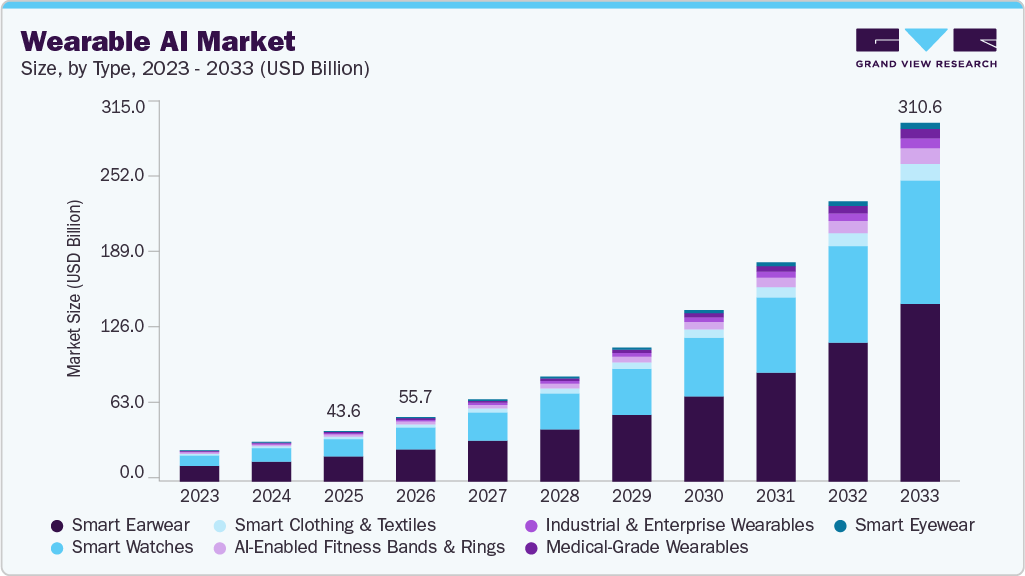 To learn more about this report, Download Free Sample Report
 Moreover, wearable devices are increasingly being utilized in disease prevention and management of chronic conditions. The Cardiosense CardioTag is a significant example of this trend. It is an FDA-cleared, multimodal wearable sensor for cardiac monitoring, combining ECG (electrocardiogram), PPG (photoplethysmogram), and SCG (seismocardiogram) signals. In addition, healthcare ecosystems increasingly integrate wearable AI devices with telemedicine and remote patient monitoring programs. Industry partnerships, such as the alliance between Philips and Masimo in September 2025, are developing AI wearables equipped with medical-grade sensors for comprehensive cardiovascular and respiratory monitoring.
 To learn more about this report, Download Free Sample Report
 These collaborations demonstrate growing clinical acceptance and regulatory progress for wearable technologies, underscoring their roles in preventive care, chronic disease management, and emergency response.
Furthermore, advances in artificial intelligence, machine learning, and sensor miniaturization have significantly enhanced the functionality and accuracy of wearable devices. Advancements in sensor technology, such as those that track heart rate, glucose levels, and motion, make wearables more compact, efficient, and capable of continuous monitoring. For instance, in August 2024, Singapore launched a new hydrogel-based wearable sensor capable of tracking health data related to diabetes and stroke risk. The device utilizes advanced analytics and continuous monitoring, enabling the early detection and intervention of metabolic and cardiovascular conditions.
Furthermore, the increasing use of wearable AI technologies in enterprises is a key driver of the global wearable AI industry. Organizations in manufacturing, logistics, healthcare, retail, and field services are adopting these devices to enhance operational efficiency and workforce safety. For instance, in October 2024, P&G, A*STAR, and NTU Singapore developed HapSense, the country's first wearable sensor for real-time skin feel measurement. Shaped like a signet ring, HapSense captures skin friction and pressure data on the fingertip, delivering objective, rapid analysis for skincare product testing and enabling personalized consumer and R&D applications at scale.
"HapSense is an innovative wearable skin sensor designed to revolutionize skin care product analysis. Its primary role is to provide scientists with precise, objective measurements of tactile sensations, such as friction and pressure, on the skin."
-Prof Chen Xiaodong, NTU Singapore
Market Dynamics
Growing adoption of real-time health tracking and personalized wellness solutions, coupled with technological advancements in AI and sensor technologies are significant factors contributing to market growth.
The increasing demand for health monitoring and fitness tracking, coupled with rising interest in personalized digital wellness, is a primary driver in the global wearable AI market. AI-powered wearable devices enable continuous, real-time monitoring of physiological metrics such as heart rate, sleep patterns, blood oxygen saturation, and steps taken, providing actionable data for consumers and healthcare professionals. For instance, according to an article published by the University of Arizona Health Sciences in June 2025, advanced sensor platforms use deep learning models to predict physiological events, including labor onset and stress response, from high-frequency biometric data. These devices serve as an early warning system to detect health risks prior to symptom onset. This approach transforms health management from episodic to proactive intervention, reducing the burden of late diagnoses and emergency care.
Moreover, wearable devices are increasingly being utilized in disease prevention and management of chronic conditions. The Cardiosense CardioTag is a significant example of this trend. It is an FDA-cleared, multimodal wearable sensor for cardiac monitoring, combining ECG (electrocardiogram), PPG (photoplethysmogram), and SCG (seismocardiogram) signals. It leverages advanced AI algorithms to analyze these high-fidelity signals for early heart failure detection, comprehensive cardiac assessment, and personalized therapy guidance, enabling noninvasive measurement of cardiac mechanics, hemodynamics (such as left ventricular ejection time), and volume status in both clinical and home settings.
The increasing use of wearable AI technologies in enterprises is a key driver of the global wearable AI market. Organizations in manufacturing, logistics, healthcare, retail, and field services are adopting these devices to enhance operational efficiency and workforce safety. Augmented reality devices that use computer vision and AI are transforming frontline operations. For instance, according to an article published in XR Today in November 2025, Lenovo and VR Vision are partnering to revolutionize workforce training by integrating AI with immersive VR learning solutions.
In maintenance and repair, AR smart glasses display interactive visualizations, schematics, and alerts on physical assets, increasing first-time fix rates and reducing errors. In logistics and warehousing, AI-powered wearables guide workers through optimized picking routes, inventory tracking, and order verification, improving productivity and transparency.
Moreover, healthcare organizations use AR headsets for telemedicine, surgical assistance, and remote diagnostics, enabling real-time collaboration without requiring physical presence. For instance, according to a news article published in April 2025, Moldova is innovating in healthcare by testing and adopting VR surgery and AI-guided clinical tools. Argus AI, a Moldovan start-up, has developed a VR platform enabling neurosurgeons to explore patient brain anatomy in 3D, plan procedures, and rehearse operations for safer tumor removals.
The growth of AI-enabled wearables is significantly constrained by persistent challenges related to measurement accuracy, limited clinical validation, and the increasing regulatory rigor applied to AI-driven health and diagnostic functions. These constraints impact multiple segments including smartwatches with diagnostic features, smart rings, medical-grade patches, enterprise wearables, and AI-powered smart eyewear and collectively hinder large-scale adoption, reimbursement support, and clinical integration.
Although AI-enabled wearables are increasingly promoted as continuous monitors for stress, sleep, recovery, glucose trends, cardiovascular health, and overall wellness, independent evidence shows substantial variation in accuracy, especially beyond basic metrics such as steps, resting heart rate, and simple activity tracking. A 2024 systematic review published on PubMed Central reported that while consumer-grade trackers show reliable performance for steps and heart rate, their diagnostic reliability remains uncertain, especially for clinical applications such as arrhythmia detection, sleep staging, or blood pressure assessment. The authors concluded that wearable outputs “should not be used as standalone decision-making tools in clinical practice.”
Gesture-controlled wearables represent a significant opportunity for more intuitive, hands-free interaction across consumer and enterprise domains. Optical and EMG-based sensor technologies enable highly precise recognition of hand and finger movements, allowing for contactless control of devices and immersive interaction with augmented and virtual reality environments. AI-optimized AR glasses and headsets utilize advanced hand and finger gesture recognition to control devices, interface with software, and navigate immersive environments without physical contact. For instance, in September 2025, Engineers at UC San Diego developed an AI-powered wearable patch that allows people to control machines using natural arm gestures, even while moving. The stretchable patch integrates motion and muscle sensors with on-chip AI to filter noise, accurately recognizing gestures in chaotic environments and transmitting real-time commands.
“By integrating AI to clean noisy sensor data in real time, the technology enables everyday gestures to reliably control machines even in highly dynamic environments.”
“This work establishes a new method for noise tolerance in wearable sensors. It paves the way for next-generation wearable systems that are not only stretchable and wireless, but also capable of learning from complex environments and individual users.”
- Xiangjun Chen, postdoctoral researcher, UC San Diego Jacobs School of Engineering
Tested in scenarios such as running and ocean waves, it enables intuitive and robust human-machine interaction for applications including rehabilitation, industrial use, and underwater robot control. This innovation advances wearable technology by overcoming motion noise limitations. Thus, such advancements deliver productivity benefits for field technicians, remote healthcare workers, and logistics teams, enabling seamless control in hazardous or sterile settings.
Market Concentration & Characteristics
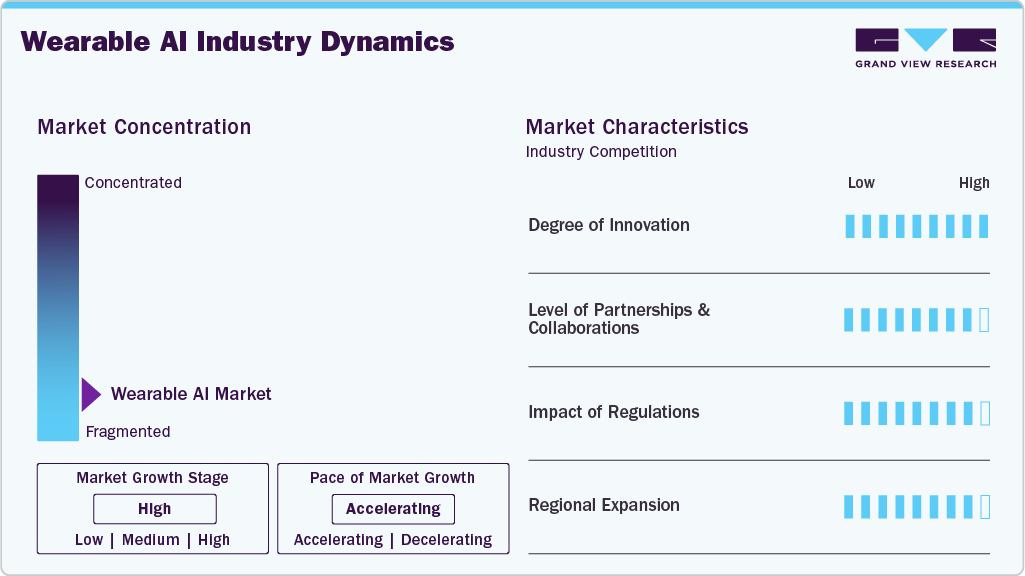
The chart below illustrates the relationship between industry concentration, industry characteristics, and industry participants. The x-axis represents the level of industry concentration, ranging from low to high. The y-axis represents various industry characteristics, including industry competition, level of partnerships & collaboration activities, degree of innovation, impact of regulations, and regional expansion. The wearable AI industry is highly fragmented. Moreover, several emerging players are entering the market, thereby contributing to increased fragmentation within the market. The degree of innovation, the level of partnerships & collaborations, the impact of regulations, and the regional expansion of industry is high.
The wearable AI industry is characterized by constant innovation, with a strong focus on launching new platforms and devices to leverage administrative tasks, improve diagnostic accuracy, and enhance care delivery. Prominent players are launching advanced solutions to sustain a competitive advantage. For instance, UC San Diego researchers have developed a wearable, stretchable gesture sensor that uses AI to remove motion noise and reliably detect user gestures even during high activity (e.g., running, driving, rough seas). Worn as a soft patch on an armband, it tracks muscle impulses and movements, transmitting data for real-time deep learning signal processing. The system enables robust, hands-free machine and robot control for rehabilitation, mobility assistance, industrial, and first responder use, even in highly dynamic or hazardous environments. This innovation expands interaction modalities beyond touchscreens, enabling intuitive control over smart devices in various settings, from healthcare to entertainment.
 To learn more about this report, Download Free Sample Report
 The industry is experiencing a high level of partnerships & collaborations undertaken by several key players. This is due to the desire to gain a competitive advantage in the industry, enhance technological capabilities, and consolidate in a rapidly growing market. For instance, in June 2025, Sphere Technology Holdings partnered with Vuzix Corporation to integrate its AI-powered mixed reality (MR) platform with Vuzix M400 and M4000 AR smart glasses.
Regulations, such as the HIPAA in the U.S. and the GDPR in Europe, establish standards for safeguarding patient data privacy and security. Compliance with these regulations is crucial for AI applications in healthcare to ensure the safe and secure handling of patient information, reducing the risk of data breaches and unauthorized access.
The industry is witnessing high geographical expansion. Companies within the wearable AI industry seek geographic expansion strategies to maintain their foothold in emerging markets and attract customers from these regions. In addition, the increasing prevalence of chronic diseases fosters demand for continuous health monitoring and remote diagnostics. For instance, recent collaborations in October 2024, such as Incor’s development of the TRAda AI platform for advanced arrhythmia detection, underscore innovative applications tailored to regional healthcare challenges. These technologies help improve clinical outcomes and reduce healthcare costs by enabling early diagnosis and continuous health tracking, especially in underserved areas.
“We see an opportunity in a significant and untapped market in Brazil to prove a more cost-effective and efficient arrhythmia risk management solution. We believe that this innovative approach will not only contribute to saving lives but also enhance healthcare system resources by helping to reduce costs and improve the quality of care,”
“After successful market validation in Brazil, we plan to expand our solution to new markets in Latin America over the next two years, ensuring that our system is adapted to the specific demographics and regulatory landscape of each region,”
-Ricardo Bloj, President of Lenovo Brazil.
Recent Developments in the wearable AI market include
Company/Institute
Year
Month
Description
New Product Launch
Starkey Laboratories, Inc.
2025
October
Starkey launched Omega AI, its advanced hearing aid line, which integrates deep neural network directionality, 8 dB improved spatial awareness, 51-hour battery life, waterproofing, LED status/find-my-device indicators, TeleHear AI troubleshooting, and new health features such as balance and respiratory rate monitoring.
“Since being the first to introduce AI technology in hearing aids, Starkey has continued to set the speed of innovation for the industry. We are once again excited to push the boundaries of science and raise the bar of expectation for hearing professionals and their patients. Omega AI is an engineering feat only Starkey could accomplish, and it reflects our unwavering commitment to creating advanced technology that connects people back to their lives.”
-Brandon Sawalich, President and CEO of Starkey.
Meta
2025
September
Meta launched its Ray-Ban Display AI Glasses, featuring a full-color, high-resolution in-lens display, for tasks, visual Meta AI prompts, messaging, video calling, navigation, live captions/translation, music playback, photo/video capture, and intuitive EMG gesture control. Available in Black/Sand, with standard/large frames, and up to 6 hours of battery use.
Xiaomi
2025
September
Xiaomi globally launched three devices: the OpenWear Stereo Pro wireless earbuds, featuring a five-unit acoustic system and Harman tuning; the Xiaomi Watch S4; and the Smart Band 10 Glimmer Edition.
Vuzix Corporation
2025
August
Vuzix launched LX1 smart glasses for warehouse operations. Purpose-built for logistics, LX1 enables 10-hour hands-free performance with hybrid voice and vision-picking, a color HD display, Qualcomm processor, 4K camera, and rugged design.
Collaborations & Partnerships
Vuzix Corporation
2025
September
Vuzix Corporation and TCL China Star Optoelectronics Technology (TCL CSOT) announced a long-term partnership to integrate microLED displays with waveguide optics for smart glasses.
"We are excited to enter into this collaboration with TCL CSOT. The combination of microLEDs and waveguide optics is a key enabler for the next generation of smart glasses. This partnership represents not only a nearterm opportunity but also a long-term product and market roadmap."
-Paul Travers, President and CEO of Vuzix
Vuzix Corporation
2025
September
Saphlux and Vuzix formed a strategic collaboration to deliver advanced optical solutions for next-generation AI/AR smart glasses.
Meta
2025
June
Meta partnered with Oakley to launch the Oakley Meta HSTN AI-powered smart glasses. They feature a hands-free high-res camera, open-ear speakers, water resistance, and Meta AI integration.
Starkey Laboratories, Inc.
2025
February
Starkey and Stanford University collaborated to validate Starkey’s Edge AI hearing aid Balance Assessment for fall risk detection. Using onboard motion sensors and AI with the My Starkey app, the tool accurately matches clinician observations. It enables remote self-assessment, making fall prevention more accessible and enhancing patient health monitoring, particularly in underserved regions.
“This research collaboration with Stanford Medicine demonstrates the potential of leveraging artificial intelligence and motion sensor technology to address critical health challenges like fall risk. By validating our Balance Assessment feature, we are taking a significant step toward empowering patients to proactively monitor their health and improve their quality of life."-Achin Bhowmik, Ph.D., Chief Technology Officer and Executive Vice President of Engineering at Starkey.
Regional Expansion
Garmin
2025
November
Garmin announced its plans to establish a factory in Thailand to manufacture smartwatches and other electronic products. This strategic investment aims to expand Garmin’s production capacity, diversify its supply chain, and meet growing demand in the Asia-Pacific wearable technology market.
Apple, Inc.
2025
September
Apple launched the AirPods Pro 3 in India, featuring an upgraded design, improved audio, and twice the noise cancellation. Key features include heart rate tracking, real-time calorie monitoring for workouts, and AI-powered live translation.
Apple, Inc.
2025
September
Apple launched Apple Watch Series 11, SE 3, and Ultra 3 in India.
Huawei Technologies Co. Ltd.
2025
June
Huawei launched Band 10 in India, featuring advanced health and fitness tracking, AI-powered swim stroke and lap recognition (with 95% accuracy), Pro-Level sleep analysis, and an emotional well-being assistant.
Analyst Perspective
The global wearable AI market features intense competition between established technology giants and specialized emerging innovators. Companies such as Samsung Electronics, Apple, Google, Huawei, Garmin, Sony, Meta, Xiaomi, and Fitbit dominate through continuous product innovation, strategic acquisitions, and expanding AI-enabled health and fitness capabilities, leveraging extensive portfolios, global distribution, and investments in AI, sensors, and cloud ecosystems—though rising regulatory scrutiny and rapid technological change demand sustained R&D investment. Meanwhile, emerging players including Oura Health, Ultrahuman, Hexoskin, Sensoria, SmartCardia, Empatica, and RealWear differentiate through specialized AI-driven solutions for health monitoring, remote patient care, industrial use, and performance optimization, relying on strategic partnerships and niche innovation despite limited resources and brand recognition. As AI capabilities advance, collaboration between established and specialized players is expected to accelerate innovation and broaden wearable AI adoption across industries.
Type Insights
By type, the smart earwear segment held the largest market share of 50.0% in 2025. However, the medical-grade wearables segment is anticipated to witness the fastest growth with a CAGR over the forecast period. The increasing adoption of remote work and virtual communication has accelerated the demand for AI-enhanced earwear, which supports clear audio communication, language translation, and smart virtual assistance. For instance, in May 2025, Acer launched the AI TransBuds earphones featuring real-time, two-way voice translation in 15 major languages, live captioning, and transcription. Furthermore, healthcare applications addressing hearing impairments and cognitive health are driving market growth by combining consumer convenience with medical-grade functionality.
The medical grade wearables segment is expected to grow at the fastest CAGR during the forecast period. The medical-grade wearables segment is rapidly expanding, driven by the rising prevalence of chronic diseases, demand for non-invasive continuous health monitoring, and advances in sensor accuracy and AI analytics. This segment includes AI-powered continuous monitoring devices such as ECG patches, glucose monitors, and rehabilitation trackers. These medical-grade wearables enable real-time, precise monitoring of vital signs and biochemical parameters, facilitating early disease detection, personalized treatment, and remote patient management.
Application Insights
By application, consumer segment held the largest market share of 32.0% in 2025. However, the healthcare segment is expected to register fastest growth over the forecast period. This growth is driven by increasing consumer demand for technologically advanced devices such as smartwatches, fitness bands, and smart earphones that offer integrated health monitoring and personalized AI-driven experiences. The segment is characterized by rapid innovation, fueled by advancements in AI algorithms, sensor integration, and connectivity, which cater to lifestyle enhancement and wellness management. The growing consumer preference for seamless integration with smartphones and smart home ecosystems further accelerates demand.
 To learn more about this report, Download Free Sample Report
 The healthcare segment is anticipated to register the fastest growth from 2026 to 2033. This segment is rapidly expanding, driven by the integration of AI-powered sensors and analytics in medical wearables. These devices enable continuous, real-time monitoring of vital signs, facilitate chronic disease management, and the early detection of health anomalies. Their role in telehealth and remote patient monitoring enhances healthcare accessibility, reduces hospitalization rates, and facilitates proactive interventions, significantly improving patient outcomes. For instance, in December 2023, Best Buy Health and Biobeat partnered to integrate Biobeat's remote patient monitoring (RPM) wearables into Best Buy Health solutions. The company’s technology utilizes an AI-powered Early Warning Score system, which provides clinicians with real-time alerts when a patient’s condition indicates possible deterioration.
Operations Insights
By operations, the on-device AI segment held the largest market share of 59.1% in 2025. In addition, this segment and is expected to witness the fastest growth during the forecast period from 2026 to 2033. In addition, this segment is anticipated to grow at the fastest CAGR during the forecast period. On-device AI in wearable technology executes artificial intelligence algorithms directly on the device’s hardware, using specialized processors such as neural processing units (NPUs), digital signal processors (DSPs), and application-specific integrated circuits (ASICs). This approach reduces reliance on cloud computing, minimizes latency, and enhances data security by keeping sensitive user data on the device.
For instance, in September 2025, Brilliant Labs partnered with Liquid AI to integrate Liquid’s lightweight vision-language foundation models into the next-gen Halo AI glasses. These open-source wearables offer real-time scene understanding, conversational AI, agentic memory, and Vibe Mode while ensuring privacy and fast on-device intelligence.
The cloud-based AI segment is projected to grow at a significant CAGR from 2026 to 2033. The cloud-based AI segment enables real-time data processing, storage, and advanced analytics by leveraging cloud infrastructure. This segment supports continuous health monitoring, personalized fitness insights, and remote diagnostics by transmitting large volumes of biometric data to cloud servers for AI-driven analysis. The scalability and flexibility of cloud platforms enable seamless integration with multiple wearable devices, thereby enhancing user experience and system interoperability.
Component Insights
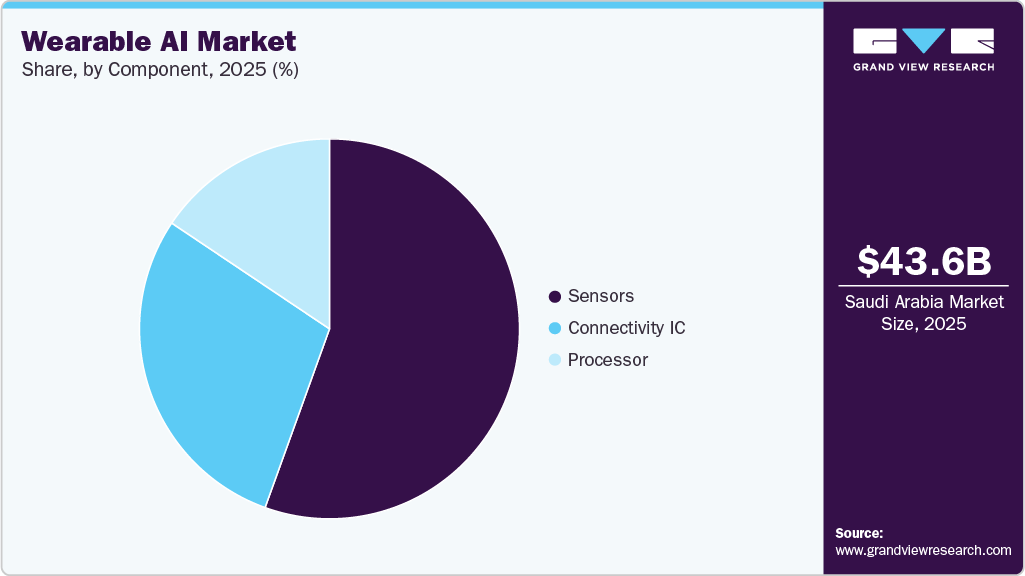
By component, the sensors segment held the largest market share of 55.5% in 2025. In addition, this segment and is expected to witness the fastest growth during the forecast period from 2026 to 2033. In addition, this segment is projected to grow at the fastest CAGR over the forecast period. The sensors segment is crucial for enabling continuous, real-time monitoring of physiological, environmental, and contextual data. Technological advances focus on miniaturization, energy efficiency, and flexibility, facilitating seamless integration into diverse wearable forms, including wristbands, smart clothing, and medical patches. For instance, in June 2023, scientists from the National University of Singapore (NUS) and the Agency for Science, Technology and Research (A*STAR) developed PETAL, a paper-thin, AI-powered wearable patch for wound monitoring. The patch tracks five biomarkers—temperature, acidity, uric acid, moisture, and trimethylamine—using color-changing sensors.
The connectivity IC segment is projected to grow at a significant rate over the forecast period. It is essential for seamless communication and data exchange between wearable devices, smartphones, and cloud platforms. It includes wireless technologies such as Bluetooth, Wi-Fi, NFC, and 5G modules, which enable real-time synchronization, remote monitoring, and low-latency interaction. Deploying Bluetooth 5.3 and advanced Wi-Fi standards in wearables improves interoperability, power efficiency, and data transmission speed, making connectivity ICs vital for uninterrupted AI-based functions.
Regional Insights
North America Wearable AI Market Trends
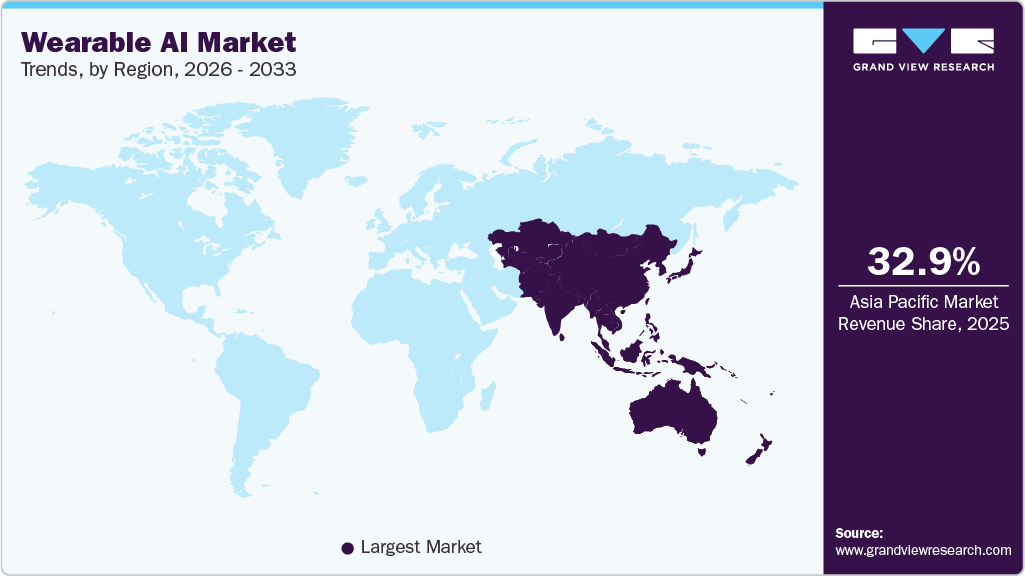
Asia Pacific dominated the wearable AI market with the largest revenue share of 32.9% in 2025. This growth is driven primarily by technological advancements and innovation in artificial intelligence integrated into wearable devices. Moreover, the robust technology infrastructure and extensive R&D investments in the U.S. play a pivotal role in driving market expansion, alongside government initiatives that support the development of AI. For instance, in July 2025, Meta Platforms Inc. purchased a nearly 3% stake in EssilorLuxottica SA, the maker of Ray-Ban and Oakley, investing approximately USD 3.5 billion to enhance its commitment to AI-powered smart glasses.
U.S. Wearable AI Market Trends
The U.S. wearable AI industry held the largest market share in 2025 in the North American region, driven by its strong emphasis on advanced health monitoring and personalized wellness solutions. In addition, this growth is attributed to the widespread integration of AI wearables into clinical healthcare workflows, especially for remote patient monitoring and chronic disease management. Moreover, consumer behavior and market dynamics shape the U.S. wearable AI industry. The mature and competitive market supports rapid adoption of new product categories, including smart clothing and AI-enabled rings. In May 2025, RingConn launched its Gen 2 Smart Ring for sleep apnea monitoring at Target.com, marking its U.S. retail debut.
Europe Wearable AI Market Trends
Europe wearable AI industry is primarily driven by the widespread adoption of smartwatches, smart hearing aids, AI-enabled fitness bands, and medical-grade wearables in response to growing health awareness. Consumers increasingly seek devices that enable continuous health monitoring, early detection of chronic conditions, and personalized wellness insights. For instance, according to the two studies published in January 2023, researchers from University College London (UCL) used wearable motion sensors and AI to track progression in movement disorders, including Friedreich's ataxia and Duchenne muscular dystrophy. This technology identifies disease-specific movement patterns, predicts disease progression, and enhances trial efficiency and precision, enabling faster drug development, particularly for rare conditions with small patient populations.
The UK wearable AI industry is positioned for sustained high growth, driven by technological innovation, regulatory support, and diverse end-user adoption. In addition, the National Health Service (NHS) accelerates the adoption of innovative wearable solutions through digital health initiatives and funding. For instance, in July 2025, UK-based AI wearables startup Movetru secured USD 1.9 million in pre-seed funding. Movetru’s technology focuses on real-time motion tracking and personalized AI-driven insights for sports and rehabilitation, aiming to enhance technique, prevent injuries, and improve performance through wearable devices combined with advanced analytics.
Germany’s wearable AI industry is primarily driven by a robust healthcare sector that emphasizes preventive care and remote patient monitoring. In addition, the country’s market is significantly driven by an active and health-conscious population, including fitness enthusiasts and sports professionals. Strong consumer interest in fitness tracking devices such as AI-enabled fitness bands, smartwatches, and smart clothing fuels demand. For instance, in September 2025, Garmin partnered with Meta to offer Oakley Meta Vanguard AI glasses, featuring real-time training insights through the Meta AI app available in the Garmin Connect IQ Store. Athletes can access live fitness metrics, receive audible AI feedback, and view LED status updates hands-free, with automatic workout video capture and performance summaries integrated into the Meta AI mobile app.
"We are thrilled to team up with Meta to support the Vanguard line of AI glasses with real-time fitness metrics and post-activity insights. The ability to receive personalized Garmin data while working out hands-free will help athletes optimize their performance and stay in the zone."
-Susan Lyman, Garmin Vice President of Consumer Sales and Marketing
Asia Pacific Wearable AI Market Trends
The Asia Pacific wearable AI industry held the largest market share of 32.93% in 2025. The wearable AI market in china held the largest share in the Asia Pacific region in 2025. This growth is driven by increasing consumer health awareness and the rising adoption of smartwatches, fitness bands, and medical-grade wearables. Countries such as China, India, Japan, and South Korea are major contributors due to their large populations and growing middle-class incomes. In addition, technological advancements in AI, machine learning, and the rollout of 5G infrastructure significantly enhance device capabilities in the Asia Pacific region. For instance, in February 2025, Singapore-based BUZUD and Tan Tock Seng Hospital (TTSH) launched the CARB-CGM system, an AI-powered mobile app combined with a wearable continuous glucose monitoring device, to simplify diabetes management. The system enables real-time glucose tracking, AI-driven dietary analysis via meal photos, and personalized insulin dosing, thereby reducing the risks of hyper- and hypoglycemia.
 To learn more about this report, Download Free Sample Report
 “We’re reimagining diabetes management through AI technology, focusing on reducing complications and enhancing the quality of life. This aligns with our mission to leverage technology for superior healthcare outcomes,”
- Frankie Fan, CEO of BUZUD
India’s wearable AI industry is experiencing significant growth driven by increasing health awareness and technological advancement. The rising adoption of smartwatches, AI-enabled fitness bands, and medical-grade wearables is driven by a growing middle class that prioritizes preventive healthcare and fitness tracking. Moreover, technological innovations from major domestic and international players are propelling India’s wearable AI industry. In 2025, companies such as Fastrack, boAt, and Noise launched AI-driven smartwatches offering personalized health tracking, adaptive coaching, and biometric authentication. In addition, initiatives such as Lenskart’s smart glasses platform and the launch of Meta’s AI-powered Ray-Ban glasses in India enhance product diversity and accessibility. Such variety of offerings appeals to tech-savvy Indian consumers seeking multifunctional devices.
The Japan wearable AI industry is driven by the country’s advanced digital infrastructure and rapidly aging population, creating demand for health monitoring and assisted living solutions. Smartwatches, AI-enabled fitness bands, and medical-grade wearables are increasingly deployed for remote monitoring of elderly patients, fall detection, and chronic disease management. For instance, according to an article published in the Interesting Engineering Journal in November 2025, Japanese researchers and companies are pioneering advanced AI-driven wearables that feature gesture control and noise-tolerant voice recognition, enhancing the user experience in challenging environments.
In addition, the country’s market is strongly supported by a significant innovation ecosystem, supported by major industry events such as the WEARABLE EXPO held annually in Tokyo. This expo serves as a significant platform showcasing the latest AI-enabled wearable devices, attracting global participants focused on advancing sensor technology, AI integration, and novel interfaces.
Latin America Wearable AI Market Trends
Latin America’s wearable AI industry is driven by increasing consumer engagement with smartwatches, smart earwear, and AI-enabled fitness bands, reflecting rising health consciousness and digital lifestyle adoption. The growing penetration of smartphones and improvements in internet infrastructure enhance the accessibility and usage of AI-driven wearables.
Brazil’s wearable AI industry is experiencing accelerated growth, driven by rising consumer health awareness and the adoption of smart wearables, including smartwatches, AI-enabled fitness bands, and medical-grade devices. In addition, technological advancements and diversification of product offerings further propel market growth.
Middle East and Africa Wearable AI Market Trends
The Middle East and Africa (MEA) wearable AI industry is driven by the increasing demand for smartwatches, smart eyewear, and AI-enabled fitness bands, supported by the adoption of urban tech and digital lifestyles. Moreover, healthcare is a key growth area, with government and private sector initiatives adopting AI-enabled medical wearables for early detection and chronic disease monitoring. Virtual hospitals, such as SEHA, utilize wearable AI devices in telemedicine to support remote patient monitoring and enhance access to care. These advances are supported by significant funding and policies focused on digitalizing healthcare with AI-enhanced wearables.
Saudi Arabia’s wearable AI industry is growing rapidly, driven by increasing health awareness and government initiatives aligned with Vision 2030, which aims to promote active and preventive healthcare. The market is witnessing a widespread adoption of smartwatches, AI-enabled fitness bands, and medical-grade wearables, driven by the increasing prevalence of chronic diseases and a tech-savvy young population adopting health monitoring technologies. Initiatives promoting digital health integration, remote patient monitoring, and wellness tracking are other key contributors to growth.
Key Wearable AI Company Insights
Key players operating in the wearable AI industry are undertaking various initiatives to strengthen their market presence and increase the reach of their products and services. Strategies such as new product launches and partnerships play a key role in propelling market growth.
Key Wearable AI Companies:
The following key companies have been profiled for this study on the wearable AI market.
-
Samsung Electronics Co. Ltd.
-
Meta
-
Fitbit, Inc. (Google, Inc.)
-
Garmin Ltd.
-
Google, Inc.
-
Huawei Technologies Co. Ltd.
-
Xiaomi
-
Motorola Solutions, Inc.
-
Starkey Laboratories, Inc.
-
Apple, Inc.
-
Sony Corporation
-
Hexoskin
-
Sensoria
-
Oura Health Oy
-
Ultrahuman Healthcare Pvt Ltd.
-
Zepp INC. (Amazfit India)
-
RealWear Inc.
-
Ultrahuman Healthcare Pvt Ltd.
-
Vuzix Corporation
-
F. Hoffmann-La Roche Ltd.
-
SmartCardia Inc.
-
Empatica Inc.
-
Phonak - A Sonova brand
Competitive Benchmarking
Category
Operating Strategies
Competitive Edge
Weakness
Established Players (Samsung Electronics Co. Ltd.; Meta; Fitbit, Inc. (Google, Inc.); Garmin Ltd.; Google, Inc.; Huawei Technologies Co. Ltd.; Xiaomi; Motorola; Solutions, Inc.; Apple, Inc.; Sony Corporation; Zepp INC. (Amazfit India); Vuzix Corporation; Phonak - A Sonova brand; F. Hoffmann-La Roche Ltd.; Starkey Laboratories, Inc.)
- These players are adopting various strategic initiatives, such as product launches, mergers and acquisitions to sustain & build their position in the market.
- Moreover, these players emphasize more on innovation and bring new solutions in the market.
- Robust and wider portfolio of products provide a competitive advantage.
- Continuously update and improve existing products with the latest technological advancements.
- Increasing competition from emerging players in the market.
- Government regulations and stringent approval guidelines for the integration of new technology into the products.
Emerging & Specialized Players (Hexoskin; Sensoria; Oura Health Oy; Ultrahuman Healthcare Pvt Ltd.; RealWear Inc.; SmartCardia Inc.; Empatica Inc.)
- Entering into agreements with larger players to maintain position in the market.
- Partner with established distributors to expand market reach and streamline logistics.
- Offering innovative and technologically advanced products to meet increasing demand and drive the competition among emerging players.
- Limited resources and capital compared to mature players. Difficulties in establishing reliable supply chains.
Recent Developments
-
In July 2025, Sony launched the WF-C710N true wireless earbuds, highlighting their active noise cancellation, AI-powered voice pickup for calls, and long battery life (up to 40 hours).
-
In June 2025, Xiaomi launched advanced AI glasses, which serve as a smart device control center, supporting voice commands, real-time translation, and meeting transcription.
-
In June 2025, Xiaomi launched the Smart Band, featuring AI-powered fitness tracking, heart rate broadcasting, over 150 workout modes, personalized recovery, and deep integration with the Xiaomi ecosystem.
-
In April 2025, Vuzix Corporation acquired an advanced waveguide research and development facility in Milpitas, California. The acquisition strengthens Vuzix’s capability to develop lightweight, high-performance optical solutions for next-generation AI-powered smart glasses, supporting their ODM/OEM partners.
"This facility strengthens our ability to support our partners with the highest-quality waveguide solutions, ensuring they have the technology needed to bring advanced, fashion-forward smart glasses to market. AI and AR are converging rapidly, and Vuzix is positioned to lead the way in this evolution."
- Paul Travers, President and CEO of Vuzix.
-
In February 2025, Vuzix Corporation partnered with TranscribeGlass to launch an AI-powered real-time speech-to-text transcription service using Vuzix Z100 smart glasses.
-
In December 2024, Vuzix Corporation entered a partnership with Augmex, a Netherlands-based one-stop-shop solutions provider, to supply smart glasses bundled with Augmex software to supply chain customers across Europe. The initial six-figure order, shipped in late 2024, targets warehouse, logistics, installation, service, healthcare, and hospital markets.
-
In January 2021, Google completed its acquisition of Fitbit for USD 2.1 billion. The deal aims to advance health and wellness accessibility, strengthen Google’s wearables strategy, and enhance innovation in smart devices.
Wearable AI Market Report Scope
Report Attribute
Details
Market size value in 2025
USD 43.6 billion
Estimated market size in 2026
USD 55.7 billion
Projected market size by 2033
USD 310.6 billion
Growth rate
CAGR of 27.8% from 2026 to 2033
Historical data
2021 - 2024
Forecast period
2026 - 2033
Quantitative units
Revenue in USD million/billion and CAGR from 2026 to 2033
Report coverage
Revenue forecast, company ranking, competitive landscape, growth factors, and trends
Segments covered
Type, application, component, operation, region
Regional scope
North America; Europe; Asia Pacific; Latin America; MEA
Country scope
U.S.; Canada; Mexico; Germany; UK; France; Italy; Spain; Norway; Denmark; Sweden; Russia; China; Japan; India; South Korea; Australia; Thailand; Singapore; Brazil; Argentina; Saudi Arabia; South Africa; UAE; Kuwait
Key companies profiled
Samsung Electronics Co. Ltd.; Meta; Fitbit, Inc. (Google, Inc.); Garmin Ltd.; Google, Inc.; Huawei Technologies Co. Ltd.; Xiaomi; Motorola Solutions, Inc.; Starkey Laboratories, Inc.; Apple, Inc.; Sony Corporation; Hexoskin; Sensoria; Oura Health Oy; Ultrahuman Healthcare Pvt Ltd.; Zepp INC. (Amazfit India); RealWear Inc.; Vuzix Corporation; F. Hoffmann-La Roche Ltd.; SmartCardia Inc.; Empatica Inc.; Phonak - A Sonova brand
Customization scope
Free report customization (equivalent up to 8 analysts' working days) with purchase. Addition or alteration to country, regional & segment scope.
Pricing and purchase options
Avail customized purchase options to meet your exact research needs. Explore purchase options
Global Wearable AI Market Report Segmentation
This report forecasts revenue growth at global, regional, and country levels and provides an analysis of the latest industry trends in each of the sub-segments from 2021 to 2033. For this study, Grand View Research has segmented the global wearable AI market report based on type, application, component, operations, and region.
-
Type Outlook (Revenue, USD Million, 2021 - 2033)
-
Smart Earwear
-
Smart Watches
-
Smart Clothing & Textiles
-
AI-Enabled Fitness Bands & Rings
-
Industrial & Enterprise Wearables
-
Medical-Grade Wearables
-
Smart Eyewear
-
-
Application Outlook (Revenue, USD Million, 2021 - 2033)
-
Consumer Electronics
-
Healthcare
-
Automotive
-
Military and Defense
-
Media and Entertainment
-
Others
-
-
Operations Outlook (Revenue, USD Million, 2021 - 2033)
-
On-Device AI
-
Cloud-based AI
-
-
Component Outlook (Revenue, USD Million, 2021 - 2033)
-
Processor
-
Connectivity IC
-
Sensors
-
-
Regional Outlook (Revenue, USD Million, 2021 - 2033)
-
North America
-
U.S.
-
Canada
-
Mexico
-
-
Europe
-
Germany
-
UK
-
France
-
Italy
-
Spain
-
Denmark
-
Sweden
-
Norway
-
Russia
-
-
Asia Pacific
-
China
-
Japan
-
India
-
South Korea
-
Australia
-
Thailand
-
Singapore
-
-
Latin America
-
Brazil
-
Argentina
-
-
MEA
-
South Africa
-
Saudi Arabia
-
UAE
-
Kuwait
-
-
Research Methodology
The wearable AI market figures in this report are based on a proven research process that combines executive interviews with secondary research from proprietary databases, company filings, and recognized regulatory and institutional sources. Market size is built through value-chain sizing - reconciling supply-side and demand-side estimates - and triangulated with bottom-up and top-down approaches. Every estimate passes multiple levels of expert validation before publication, with each wearable AI segment quantified using the revenue-capture definitions in the table below.
Segment Definition
Segment - Type
Revenue capture definition
Smart watches
AI-integrated wrist-worn devices that provide advanced health and wellness monitoring, including heart rate, sleep tracking, and activity analysis. They support smart notifications, voice assistants, and standalone connectivity features. Smartwatches combine sensors and machine learning to deliver personalized insights and predictive analytics.
Smart Eyewear
Head-mounted or glasses-like devices equipped with AR displays and AI for real-time information overlay. Used for navigation, remote assistance, hands-free communication, and productivity enhancement. Adopted across consumer applications as well as industries like healthcare, logistics, and manufacturing.
Smart Earwear
Earbuds and hearing systems using AI for biometric tracking, adaptive audio enhancement, and real-time coaching. They enable seamless voice command functionality, noise optimization, and health data collection. AI algorithms continuously learn user behavior to optimize audio output and safety alerts.
Smart Clothing & Textile
Garments embedded with AI-driven sensors that collect physiological, biomechanical, or environmental data. Used in professional sports, remote health monitoring, workplace safety, and rehabilitation. These wearables convert body signals into insights for performance enhancement and injury prevention.
AI-Enabled Fitness Bands & Rings
Compact wearable devices offering continuous health metrics like movement, stress, sleep cycle, and metabolism. AI engines analyze collected data to provide personalized wellness recommendations and progress tracking. Favored for long battery life, comfort, and targeted fitness-oriented functionality.
Medical-Grade Wearables
Clinically certified AI devices designed for diagnostic accuracy and continuous patient health supervision. Used for chronic disease monitoring, cardiac rhythm analysis, glucose control, neurological assessment, and telehealth. They comply with healthcare standards such as FDA, CE, and MDR to ensure medical reliability.
Industrial & Enterprise Wearables
AI-enhanced devices supporting workforce productivity, remote training, and safety intelligence in industrial settings. They provide AR visual work instructions, fatigue monitoring, hazard detection, and real-time communications. Used in sectors including manufacturing, oil & gas, logistics, and field engineering.
Segment - Application
Revenue capture definition
Consumer Electronics
Wearables used for everyday lifestyle and personal convenience applications like communication, fitness tracking, and entertainment. AI enables personalization, gesture recognition, voice interaction, and notification automation. Adopted widely due to affordability, user appeal, and feature integration with smart ecosystems.
Healthcare
Wearable AI assists clinicians and patients with continuous monitoring, predictive diagnostics, and remote care. Supports early disease detection, rehabilitation, and chronic condition management. Enables data-driven clinical decision-making through real-time analytics.
Automotive
Wearables enabling enhanced driver safety, hands-free control, and in-car connectivity. AI features include fatigue detection, gesture recognition, and navigation alerts integrated with automotive systems. Used by consumers and fleet operators to reduce accidents and improve operational efficiency.
Military & Defense
AI wearables used for soldier performance tracking, situational awareness, and mission coordination. Include AR helmets, biomedical sensors, and tactical smart gear for real-time battlefield insights. Improve safety, decision-making efficiency, and communication in critical environments.
Media & Entertainment
Devices designed to support immersive and interactive experiences using AR/VR, spatial audio, and motion tracking. AI enhances user engagement by adapting experiences based on behavior and context. Widely used in gaming, live events, and virtual content development.
Others
Covers education, industrial training, corporate wellness, sports analytics, and smart workplace integration. These use cases leverage AI for improving learning outcomes, skill training, and employee safety. Designed to optimize performance efficiency and reduce operational risks.
Segment - Operation
Revenue capture definition
On-device AI
AI computation occurs locally on the device without relying on cloud connectivity. Ensures faster processing, improved privacy, and responsiveness even offline. Ideal for real-time decisions such as fall detection, ECG interpretation, or gesture control.
Cloud-based AI
AI models run on remote cloud servers enabling large-scale data storage and high computational power. Supports complex deep learning tasks, predictive modelling, and multi-device data integration. Requires stable connectivity, suitable for longitudinal analytics and population health tracking.
Segment - Component
Revenue capture definition
Processor
AI-optimized chips integrated within wearables to execute machine learning and edge computing tasks. They enhance device performance, reduce latency, and support advanced sensor interpretation. Examples include neural processing units (NPUs) and low-power AI accelerators.
Connectivity IC
Communication chips enabling wireless connections such as Bluetooth, Wi-Fi, NFC, and cellular modules. Allow real-time data transfer between wearable devices and smartphones, cloud platforms, or IoT networks. Critical for synchronization, location tracking, and remote updates.
Sensors
Embedded motion, biometric, and environmental sensors gathering raw physical data for AI analysis. Common sensors include accelerometers, gyroscopes, ECG, PPG, EEG, temperature, and SpO₂ sensors. They form the core data input layer enabling health monitoring and predictive intelligence.
Estimation Model
 To learn more about this report, Download Free Sample Report
 Market Estimation Process:
Market-specific Research Models:
Consensus-Based Estimates & Forecasting
The wearable AI market presents emerging to dominant opportunities, featuring global key players such as Samsung Electronics Co. Ltd.; Meta; Fitbit, Inc. (Google, Inc.); Garmin Ltd.; Google, Inc.; Huawei Technologies Co. Ltd.; Xiaomi; Motorola Solutions, Inc.; Starkey Laboratories, Inc.; Apple, Inc.; Sony Corporation; Hexoskin; Sensoria; Oura Health Oy; Ultrahuman Healthcare Pvt Ltd.; Zepp INC. (Amazfit India); RealWear Inc.; Vuzix Corporation; F. Hoffmann-La Roche Ltd.; SmartCardia Inc.; Empatica Inc.; Phonak - A Sonova brand. To ensure a holistic approach, the GVR research team adopted a comprehensive methodology, considering multiple companies worldwide and utilizing various variables for data accuracy.
Our methodology included:
Model 1: Volume Price Analysis - This methodology approach uses a structured bottom-up framework supported by secondary research analysis, industry reports, and open-source insights from established market intelligence providers such as S&P Global, NCBI, IDC, Bain & Co., Gartner, and others. The approach integrates global device shipments, AI adoption indicators, consumer readiness insights, and realistic pricing benchmarks.
Model 2: Parent Market Analysis
Model 3: Country-level Multivariate Analysis Assumptions
Model 4: Segment-level Multivariate Analysis Assumptions
Model 5: Wearable AI Market CAGR Calculations
 To learn more about this report, Download Free Sample Report
 Model 1: Volume Price Analysis
1. Market Definition & Segmentation AlignmentThe methodology begins with clearly defined segment boundaries across:
-
Type: Smart Earwear, Smart Watches, Smart Clothing & Textiles, AI-Enabled Fitness Bands & Rings, Industrial & Enterprise Wearables, Medical-Grade Wearables, Smart Eyewear
-
Application: Consumer Electronics, Healthcare, Automotive, Military & Defense, Media & Entertainment, Others (Sports & Professional Athletics, Research Institutions & Innovation Labs, industrial and manufacturing, etc.)
-
Operation: On-Device AI, Cloud-Based AI
-
Components: Processor, Connectivity IC, Sensors
Each segment is mapped based on technology readiness, AI integration depth, and availability of credible volume and pricing indicators.
2. Secondary Research Compilation
The methodology incorporates extensive secondary data collection from:
-
Industry reports and global wearable device shipment trackers (e.g., categories such as earwear, smartwatches, wrist bands, rings, and smart glasses).
-
Market adoption indicators available through research articles, whitepapers, and consumer technology studies.
-
Insights from leading market intelligence providers (e.g., S&P Global, IDC, Bain & Co., Gartner, etc.) for validation of penetration trends, consumer readiness towards AI features, and emerging use cases.
This ensures a fact-based foundation for unit estimates, pricing ranges, and AI enablement trends.
3. Volume Establishment
The baseline wearable universe is established using the IDC Worldwide Wearable Device Forecast (2025), which provides category-wise shipment volumes.
4. Bottom-Up Volume Assessment
A bottom-up approach is applied to estimate the total volume of AI-enabled wearable devices:
Global wearable device shipments by product category are sourced from established shipment trackers (e.g., earwear, watches, wrist bands, rings, smart glasses, etc.).
5. AI Penetration Estimation Using Behavior & Adoption Insights
6. Pricing Model Development (Volume × Price Framework)
A structured volume-price modeling approach is used:
Price ranges (low/medium/high) are defined for each product category based on device specifications, AI integration depth, sensor complexity, and current market positioning.
7. Market Size & Forecasting Framework
The combined Volume × Penetration × ASP framework produces segment-level and total market value estimates across all device types.
Delivered Customizations
This report has been delivered with the following In-depth customizations
Client Request
Customization Delivered
Value Adds
Wearable AI Adoption & Intelligent Health Monitoring Analysis
Developed a tailored analysis of the global Wearable AI market focused on AI-enabled smartwatches, smart rings, smart glasses, fitness bands, smart clothing, hearing wearables, and remote patient monitoring devices. The study assessed adoption trends across consumers, healthcare providers, enterprises, sports organizations, and industrial workplaces while evaluating increasing demand for continuous health monitoring, preventive healthcare, personalized wellness, and AI-powered wearable technologies driving market growth.
Enables stakeholders to understand evolving wearable AI adoption trends, identify high-growth product categories, assess demand across healthcare, fitness, consumer electronics, and enterprise applications, and evaluate the impact of AI-enabled wearables on user engagement, health outcomes, and long-term market expansion.
AI Algorithms, Sensor Technologies & Digital Health Ecosystem Assessment
Delivered a customized evaluation of Wearable AI applications across activity tracking, heart rate monitoring, ECG analysis, blood oxygen (SpO2) monitoring, sleep analysis, stress detection, fall detection, voice assistance, augmented reality (AR), industrial workforce support, and chronic disease management. The analysis assessed advancements in AI algorithms, machine learning, biosensors, computer vision, edge AI processing, cloud connectivity, and predictive health analytics. Additionally, it evaluated technology innovations and adoption patterns among leading companies including Apple, Samsung Electronics, Google, Fitbit, Garmin, Meta, Huawei, Xiaomi, Sony, Oura Health, Ultrahuman, Zepp (Amazfit), Vuzix, RealWear, Empatica, SmartCardia, Hexoskin, Sensoria, Starkey Laboratories, Phonak (Sonova), and F. Hoffmann-La Roche.
Provides actionable insights into commercially attractive Wearable AI segments, emerging intelligent sensing technologies, evolving consumer and clinical requirements, and growth opportunities associated with personalized healthcare, remote patient monitoring, workplace safety, sports performance optimization, and AI-driven health intelligence.
Wearable AI Infrastructure, Regulatory Environment & Competitive Landscape Assessment
Conducted a focused assessment of the Wearable AI ecosystem, including hardware manufacturing, AI software platforms, cloud infrastructure, mobile ecosystem integration, interoperability frameworks, cybersecurity, data privacy regulations, and competitive positioning. The analysis evaluated implementation challenges, regulatory requirements for AI-enabled medical wearables, reimbursement considerations, technology adoption barriers, ecosystem partnerships, and competitive differentiation initiatives among leading market participants such as Apple, Samsung, Google, Meta, Garmin, Huawei, Xiaomi, Roche, Sonova, Oura, Ultrahuman, Zepp, Vuzix, RealWear, Empatica, and SmartCardia.
Supports strategic planning for product innovation, AI platform development, healthcare collaborations, ecosystem expansion, geographic market entry, regulatory compliance, and technology investments by identifying adoption drivers, operational challenges, commercialization opportunities, competitive advantages, and long-term growth prospects across the global Wearable AI value chain.
Frequently Asked Questions About This Report
The global wearable AI market size was valued at USD 43.6 billion in 2025 and is estimated at USD 55.7 billion for 2026.
The global wearable AI market is expected to grow at a CAGR of 27.8% from 2026 to 2033, reaching USD 310.6 billion.
Asia Pacific dominated the market, accounting for a revenue share of 32.9% in 2025.
Key factors driving the market growth include growing adoption of real-time health tracking and personalized wellness solutions, coupled with technological advancements in AI and sensor technologies are significant factors contributing to market growth.
On-device AI segment held the largest market share of 59.1% in 2025 and is the fastest growing segment.
Sensors segment held the largest market share of 55.5% in 2025 and is the fastest growing segment.
Smart earwear held the largest revenue share 50.0% in 2025, while medical grade wearables is the fastest-growing segment.
Consumer electronics segment led with a 32.0% revenue share in 2025, while healthcare is the fastest-growing application.
Key players include Samsung Electronics Co. Ltd.; Meta; Fitbit, Inc. (Google, Inc.); Garmin Ltd.; Google, Inc.; Huawei Technologies Co. Ltd.; Xiaomi; Motorola Solutions, Inc.; Starkey Laboratories, Inc.; Apple, Inc.; Sony Corporation; Hexoskin; Sensoria; Oura Health Oy; Ultrahuman Healthcare Pvt Ltd.; Zepp INC. (Amazfit India); RealWear Inc.; Vuzix Corporation; F. Hoffmann-La Roche Ltd.; SmartCardia Inc.; Empatica Inc.; Phonak - A Sonova brand
About the Author(s)
Healthcare IT Research Team
Healthcare · Healthcare ITThis report was authored by the healthcare it research team at Grand View Research - comprising two research analysts, one senior research analyst, and one industry expert - with specialized expertise in the healthcare it segment of the healthcare industry. All findings are based on proprietary healthcare databases, executive interviews, and regulatory analysis, subject to internal peer review prior to publication.
Last Updated:
Speak to Analyst

Customize this report to your needs - add regions, segments, or data points, with 20% free customization.
Or view our licence options:


ISO 9001:2015 & 27001:2022 Certified
We are GDPR and CCPA compliant! Your transaction & personal information is safe and secure. For more details, please read our privacy policy.


