
- Home
- »
- Advanced Interior Materials
- »
-
Weaving Machinery Market Size And Share Report, 2033GVR Report cover

Weaving Machinery Market (2026 - 2033)
Size, Share & Trends Analysis Report By Machine Type (Air-Jet Loom, Shuttle Loom), By Application (Apparel & Fashion, Automotive Textiles), By Region (North America, Europe, Asia Pacific, Latin America, MEA) And Segment Forecasts
Market Size, 2025
$5.3BMarket Estimate, 2026
$5.6BMarket Forecast, 2023
$8.5BCAGR, 2026–2023
6.2%Weaving Machinery Market Summary
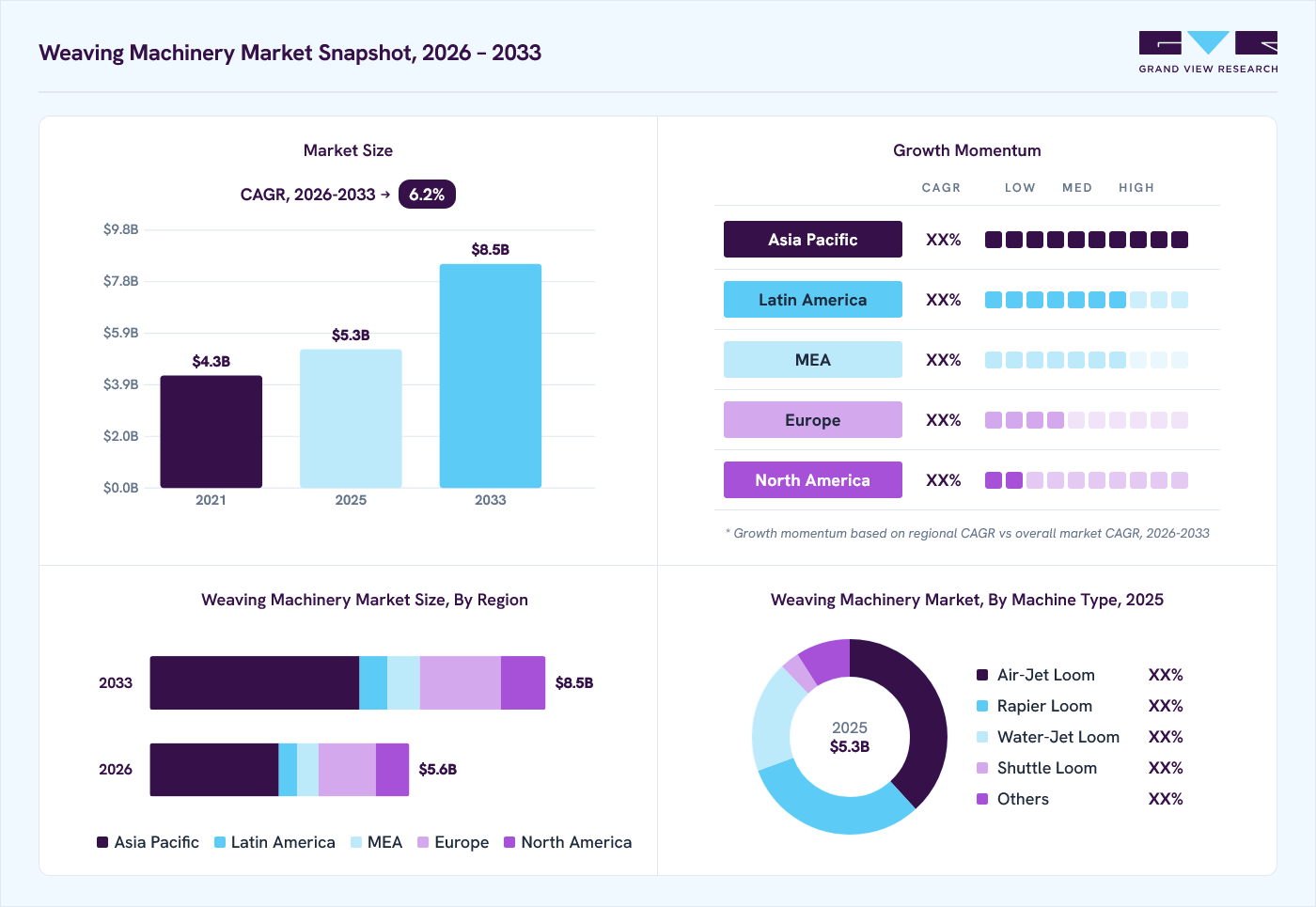
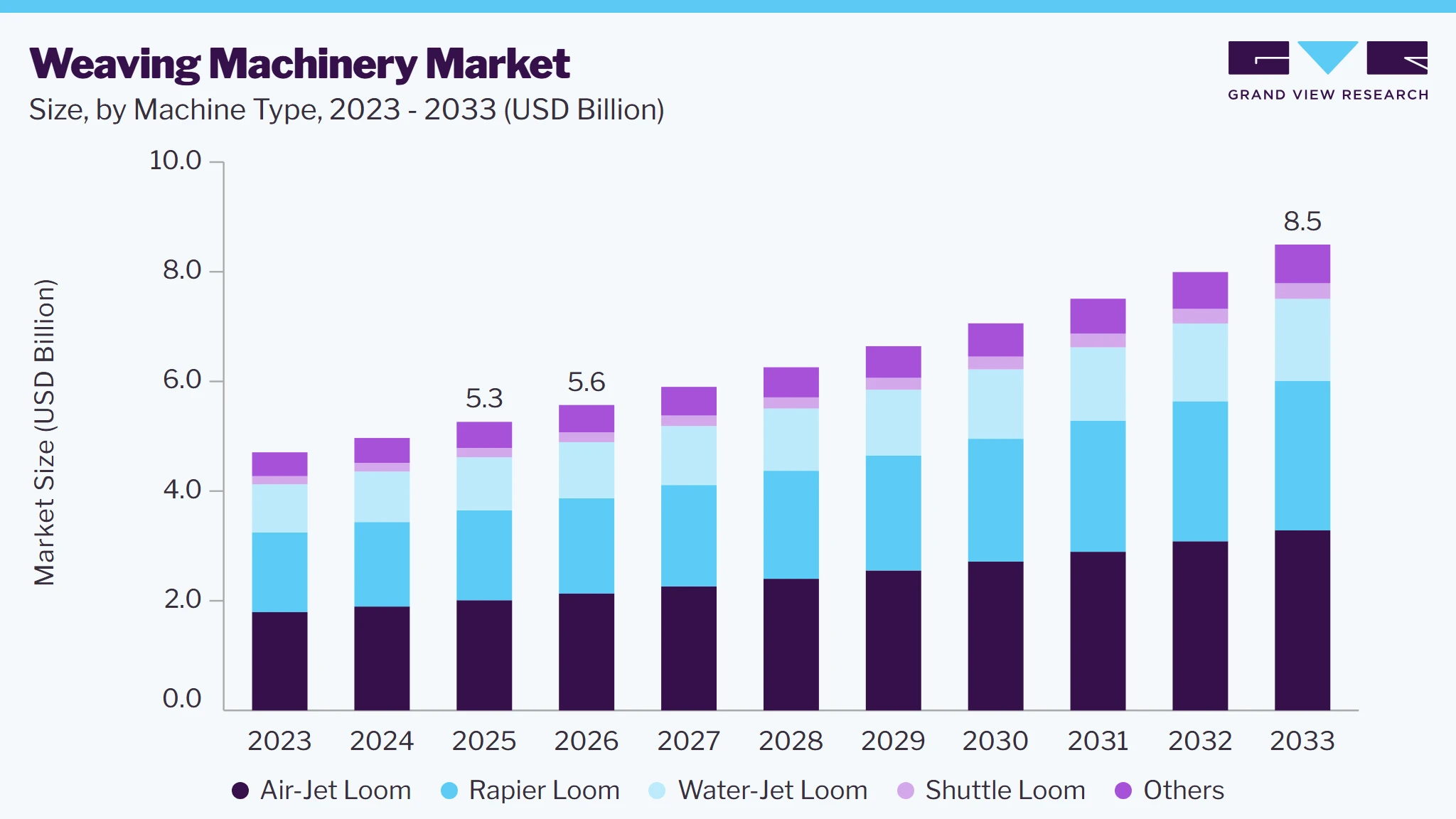
The global weaving machinery market size was valued at USD 5.3 billion in 2025 and is projected to grow from USD 5.6 billion in 2026 to USD 8.5 billion by 2033, at a CAGR of 6.2% from 2026 to 2033. Asia Pacific dominated the market with the largest revenue share of 49.7% in 2025. The market is driven by sustained demand for woven fabrics across apparel, home textiles, technical textiles, and industrial applications.
 Source: Grand View Research, IR Documents, Primary Interviews, Paid DatabasesTo learn more about this report,
 Download Free Sample Report
 Key Market Trends & Insights
- By machine type: The air-jet loom dominated the market in 2025, accounting for 38.2% market share.
- By application: The automotive textiles is projected to register the fastest growth, at a CAGR of 6.9% during the forecast period.
Regional Highlights
- Largest regional market: Asia Pacific (49.7% revenue share, 2025)
- By country: China held the largest share in the Asia Pacific region in 2025.
Market Size & Forecast
- Market Size in 2025: USD 5.3 Billion
- Estimated Market Size in 2026: USD 5.6 Billion
- Projected Market Size by 2033: USD 8.5 Billion
- CAGR (2026-2033): 6.2%
Three ways to get this report
Buy it, customize it, or ask a question.Ask an Analyst
A direct answer, usually in 1 working day
- AccessReport author, directly
- Reply timeWithin 1 working day
- No sales callDirect answer only
- FormatEmail reply
- CostFree, no cost
Get the Full Report
What the study covers
- FormatsPDF · Excel · Dashboard
- Timeline2026–2023 annual, 2025 base
- Coverage20+ countries, 5 regions
- Companies10+ key players profiled
Customize the Report
20% free customization
- IncludeCountries, segments, points
- TailorTo your product definition
- ExtendDeeper competitor detail
- OrA fully bespoke study
- Turnaround5–10 working days
Textile manufacturers are increasing investments in advanced looms to expand production capacity, maintain fabric uniformity, and accommodate a broader range of yarns and fabric constructions. Modernization of aging equipment and expansion of textile manufacturing facilities in key production regions are further supporting machinery demand. In addition, the adoption of digital technologies is influencing equipment selection as manufacturers seek greater visibility into machine performance, production parameters, and maintenance requirements.
 To learn more about this report, Download Free Sample Report
 Features such as automated monitoring, electronic let-off and take-up systems, defect detection, and production-data integration are gaining relevance in industrial weaving operations. Energy consumption is another consideration, particularly for large-scale facilities operating multiple looms continuously, encouraging demand for machinery with improved resource utilization.
Market Dynamics
The market is shaped by textile manufacturing output, shifts in fabric demand, machinery replacement cycles, and the movement of textile production across regions. Demand varies according to fabric width, construction, yarn characteristics, order volumes, and end-use requirements, resulting in differentiated equipment needs across apparel, household, technical, and industrial textiles. Market conditions are also influenced by raw material availability, labor costs, energy expenses, and manufacturers' investment strategies.
Growth in differentiated fabric applications is creating demand for weaving machinery capable of producing varied structures, widths, densities, and material combinations. Apparel and home textile producers require equipment that can accommodate changing designs and shorter production runs, while technical and industrial textile applications require machines capable of handling specialized yarns and demanding fabric constructions. This diversification of textile output is encouraging manufacturers to adopt machinery with broader operating ranges and application-specific configurations.
Fluctuations in yarn prices, energy costs, labor expenses, and textile orders can affect manufacturers' investment decisions. Weaving mills operating under narrow margins may defer machinery purchases when production visibility is limited or operating costs increase. Currency movements and variations in textile export demand can further influence the affordability of imported equipment in major manufacturing markets. Consequently, machinery procurement can be sensitive to broader conditions within the textile manufacturing industry rather than being determined solely by technological requirements.
Expansion of technical and industrial textile applications presents an opportunity for weaving machinery manufacturers to address specialized fabric requirements beyond conventional apparel production. Applications such as automotive fabrics, filtration media, protective textiles, geotextiles, and other engineered materials require machinery designed for specific yarn characteristics, fabric structures, and performance requirements. Suppliers capable of offering equipment suited to these applications can broaden their addressable market as textile producers diversify into higher-value and application-specific products.
Market Concentration & Characteristics
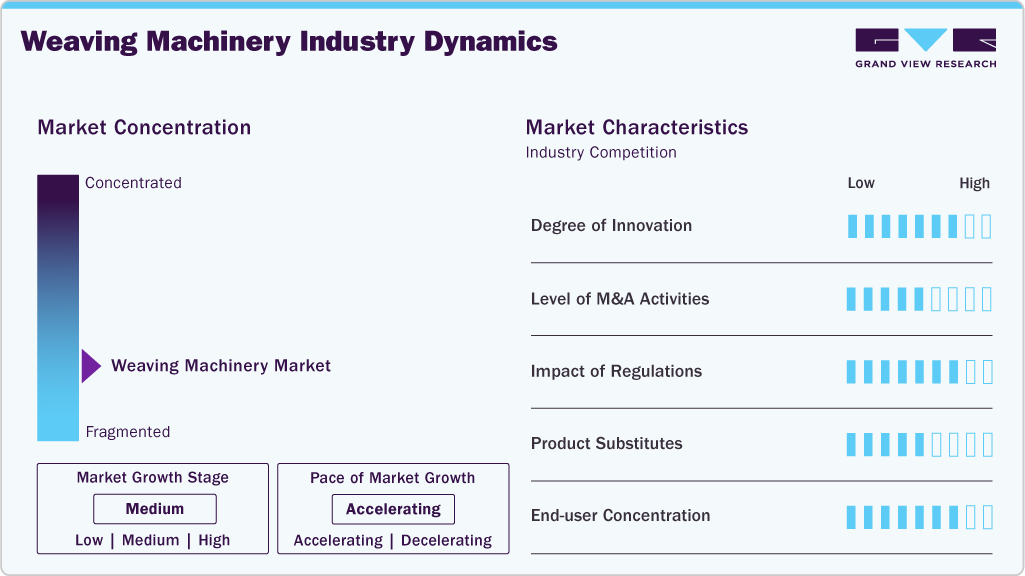
The weaving machinery industry is moderately fragmented, comprising established global manufacturers, specialized equipment suppliers, and regional producers serving different loom technologies and textile applications. Competition is shaped by differences in machine configuration, production capacity, fabric compatibility, automation level, and pricing. Leading manufacturers generally compete through broader technology portfolios and established service networks, while regional suppliers often focus on specific machine categories, customer requirements, or textile-producing markets.
Technology development is a central characteristic of the industry, with manufacturers focusing on precision control, higher operating speeds, machine stability, and compatibility with diverse yarn and fabric specifications. Modern weaving systems increasingly incorporate electronic shedding, automated tension control, machine monitoring, and digital interfaces to support consistent production and reduce operator intervention. Energy consumption, machine uptime, maintenance requirements, and ease of configuration are also becoming important considerations in equipment development and procurement.
 To learn more about this report, Download Free Sample Report
 Market demand is closely tied to textile manufacturing capacity, mill modernization, and changes in fabric production requirements. New installations are associated with capacity expansion and the establishment of new production lines, while replacement demand is influenced by equipment age, technological obsolescence, and requirements for improved production performance. Long equipment lifecycles, technical installation requirements, and the need for specialized maintenance contribute to established supplier relationships and make after-sales service, spare-parts availability, and technical support important characteristics of the competitive landscape.
Analyst Perspective
The market is shifting from conventional loom systems toward flexible and technically capable equipment designed to handle diverse yarns, fabric structures, widths, and processing requirements. Demand is supported by the expansion of technical textiles, industrial fabrics, home textiles, and higher-value apparel materials, along with the replacement of aging looms across established textile manufacturing centers. Machinery purchasing is increasingly influenced by fabric quality, machine stability, operating flexibility, energy consumption, maintenance requirements, and compatibility with specific textile applications. Manufacturers are differentiating through loom architecture, electronic control systems, operating performance, and application-specific configurations, while digital monitoring and machine diagnostics are gaining relevance for process control and equipment management. Market development is closely linked to textile manufacturing capacity, modernization of weaving facilities, adoption of automated systems, and the need for machinery capable of meeting increasingly varied fabric specifications.
Machine Type Insights
The air-jet loom generated the largest revenue market share in 2025. Its strong market position is associated with high-speed weaving capabilities and suitability for the continuous production of lightweight to medium-weight fabrics. Technology is widely applied in apparel, home textiles, and other woven fabric categories where production throughput and fabric consistency are important. Its ability to support broad production requirements and integration with automated textile manufacturing lines further contributes to its commercial adoption.
Shuttle loom is projected to register the fastest growth, with a CAGR of 6.9% during the forecast period. Demand for shuttle-based systems is linked to fabric applications requiring specific construction characteristics, controlled yarn insertion, and production of specialized or heavier woven materials. Technology continues to serve textile producers where fabric structure, material handling, and application-specific requirements take precedence over very high production speeds. Ongoing demand from specialized weaving operations is expected to support its expansion across selected textile manufacturing segments.
Application Insights
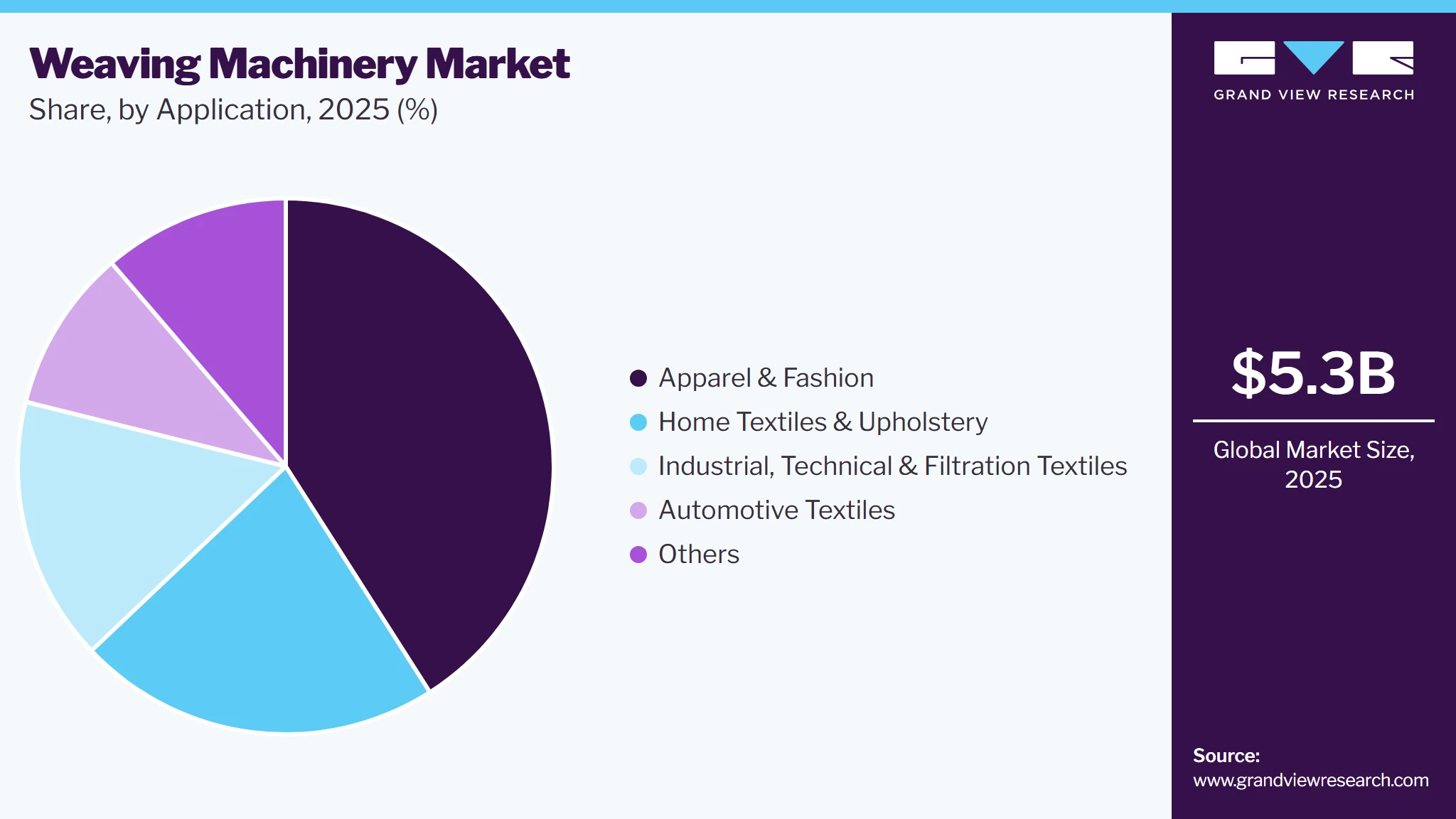
Apparel & fashion accounted for the largest revenue share of 41.0% in 2025. The segment encompasses a broad range of woven clothing materials, including shirting, suiting, denim, dresses, and fashion fabrics, resulting in substantial machinery requirements across different fabric constructions and yarn combinations. Frequent changes in styles, fabric patterns, and material blends also create demand for weaving equipment that can accommodate varied production specifications. The scale and diversity of apparel fabric manufacturing make this application an important revenue base for weaving machinery suppliers.
 To learn more about this report, Download Free Sample Report
 Automotive textiles is projected to register the fastest CAGR during the forecast period. Woven materials used in vehicle interiors, seat components, safety systems, insulation, and other automotive applications require controlled structural properties and compliance with application-specific performance standards. Increasing incorporation of functional and engineered textiles in vehicles is broadening the range of fabric structures produced for automotive use. This is creating opportunities for weaving machinery designed to process technical yarns and manufacture fabrics with defined strength, dimensional stability, and durability characteristics.
Regional Insights
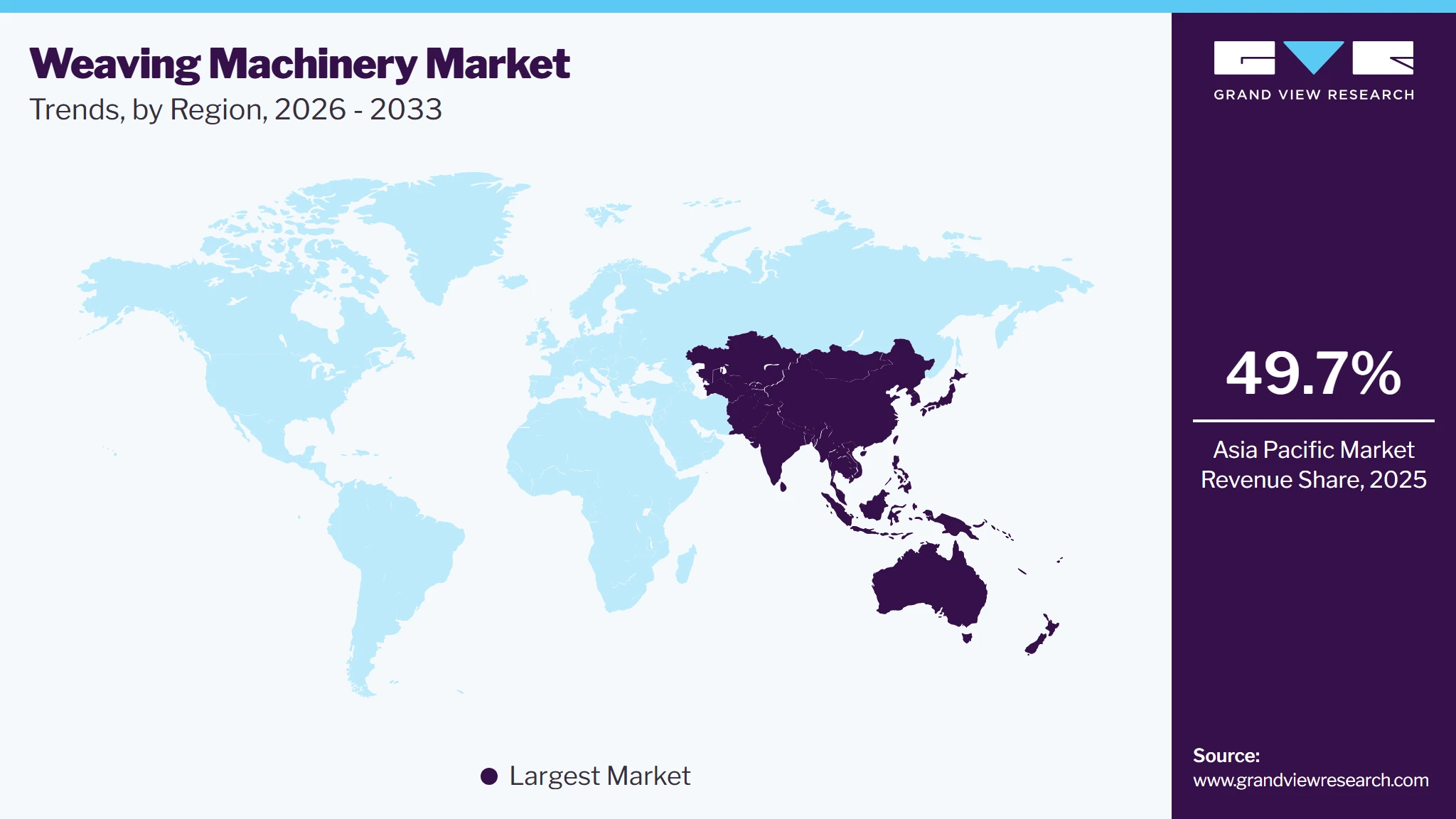
Asia Pacific dominated the market with the largest revenue share of 49.7% in 2025. Asia Pacific has a broad and diverse weaving machinery market spanning large textile manufacturing clusters, export-oriented mills, domestic fabric producers, and decentralized weaving operations. The region covers extensive production of apparel fabrics, home textiles, synthetic fabrics, denim, industrial textiles, and technical materials. This diversity creates demand for multiple loom configurations, production capacities, and technology levels. The region's extensive textile manufacturing infrastructure also makes machinery requirements closely connected with the scale and composition of individual textile-producing countries.
 To learn more about this report, Download Free Sample Report
 China Weaving Machinery Market Trends
The weaving machinery market in China has an extensive integrated textile industry covering synthetic and natural fibers, yarn manufacturing, weaving, processing, and downstream textile production. Its market serves high-volume apparel and household textile production alongside industrial and technical fabric applications. The country's broad manufacturing base creates demand for machinery across different fabric widths, yarn characteristics, and construction requirements. Large textile production clusters also contribute to a substantial installed base of weaving equipment.
India weaving machinery market reflects the country's diverse textile structure, which includes organized textile mills, powerloom operations, handloom-linked production, and expanding technical textile manufacturing. Cotton, synthetic, blended, home textile, apparel, and industrial fabrics form important parts of the production mix. This creates a wide spectrum of machinery requirements ranging from conventional weaving systems to more advanced equipment for specialized fabric production. The coexistence of different production models gives India a distinct machinery demand structure within the Asia Pacific.
North America Weaving Machinery Market Trends
The weaving machinery market in North America has a specialized shape due to the production of technical textiles, industrial fabrics, automotive materials, home furnishings, and selected apparel fabrics. The regional textile industry places greater emphasis on application-specific fabric performance, including strength, durability, filtration, and dimensional stability. This creates demand for weaving equipment capable of producing engineered fabric structures and processing advanced fibers and yarns. The installed machinery base also provides an established aftermarket for replacement looms, components, and related services.
The U.S. weaving machinery market has a diversified textile manufacturing landscape in which technical and industrial textiles represent important areas of production. Woven materials are used in transportation, construction, filtration, medical products, protective equipment, and other specialized applications. Consequently, machinery requirements are closely tied to the technical characteristics of the finished fabric, including density, strength, and structural uniformity. The country's demand base, therefore, extends beyond conventional apparel weaving into application-specific production.
The weaving machinery market in Canada is comparatively concentrated in specialty and industrial textile applications. Manufacturers serve niche markets requiring fabrics with specific functional or material characteristics rather than standardized high-volume products. This production structure creates requirements for adaptable weaving equipment capable of accommodating different fibers, yarn compositions, and fabric constructions. The country's relatively specialized textile base gives its machinery market a distinct demand profile within North America.
Europe Weaving Machinery Market Trends
The weaving machinery market in Europe has a well-established textile manufacturing industry with strong participation in technical textiles, automotive fabrics, furnishing materials, fashion textiles, and other specialized woven Machine Types. The regional market is characterized by stringent fabric specifications, established textile engineering capabilities, and demand for high-quality production. Weaving machinery requirements vary across applications, with manufacturers seeking equipment capable of producing complex structures and processing specialized fibers and yarns. The presence of established machinery manufacturers and textile production clusters further supports technological development within the regional market.
Germany weaving machinery market has a strong industrial textile base, particularly in automotive, filtration, construction, protective, and other technical applications. These applications require woven materials with specific mechanical, dimensional, and performance characteristics, creating demand for machinery designed for precise fabric formation and specialized yarn handling. Equipment selection is closely associated with the technical requirements of the final fabric rather than volume alone. Germany's broader engineering and manufacturing ecosystem also supports demand for sophisticated weaving technologies.
The weaving machinery market in the UKhas a comparatively specialized textile industry spanning premium fabrics, interior textiles, heritage Machine Types, technical materials, and niche manufacturing applications. Production is often differentiated by fabric design, material composition, and smaller or customized production requirements. This creates demand for weaving machinery offering configuration flexibility and precise control over fabric construction. The market's emphasis on specialized textile Machine Types distinguishes its machinery requirements from those of large-scale commodity fabric manufacturing centers.
Middle East & Africa Weaving Machinery Market Trends
The weaving machinery market in MEA remains concentrated in selected textile-producing economies, with the scale of weaving activity varying considerably across countries. Regional production includes apparel fabrics, household textiles, and selected industrial textile applications, while several markets have limited domestic fabric manufacturing capacity. Machinery demand is consequently associated with specific textile manufacturing clusters rather than a broad regional production base. Development of local textile value chains can create additional requirements for weaving equipment as countries seek to increase domestic fabric production.
Saudi Arabia weaving machinery market is linked to the development of domestic textile and apparel manufacturing within the country's broader industrial diversification agenda. Textile production remains relatively specialized compared with established global weaving centers, creating a market centered on selected fabrics and downstream manufacturing applications. New textile manufacturing initiatives can generate requirements for looms as production moves toward greater local value addition. The country's machinery demand is therefore closely associated with the development of domestic textile manufacturing capacity.
Latin America Weaving Machinery Market Trends
The weaving machinery market in Latin America is supported by established textile and apparel industries in countries with significant domestic fabric production. The regional production mix includes apparel fabrics, denim, home textiles, furnishings, and industrial materials, creating demand for different weaving technologies. Market conditions are influenced by domestic consumption, textile imports, manufacturing costs, and the competitiveness of locally produced fabrics. Machinery investment, therefore, varies according to the product positioning and production economics of individual textile manufacturers.
Brazil weaving machinery market has the most diversified textile manufacturing structure in Latin America, with an integrated value chain extending from fibers and yarns to fabrics, apparel, home textiles, and industrial products. Its large domestic consumer market provides a broad base for woven fabric production across multiple categories. Weaving machinery demand is consequently distributed across apparel, household, furnishing, and industrial applications rather than being concentrated in a single product segment. The country's diversified textile base supports demand for machinery capable of processing different fibers, yarns, and fabric constructions.
Key Weaving Machinery Company Insights
Some of the key players operating in the market include Picanol Group, Itema S.p.A, and Toyota Industries Corporation.
-
Picanol Group is a Belgium-based technology company with industrial weaving machinery as one of its principal businesses. The company develops, manufactures, and sells weaving machines, primarily including air-jet and rapier weaving systems, through its Picanol weaving business. Its machinery portfolio covers applications such as apparel, home textiles, terry fabrics, denim, and technical textiles, with different configurations designed for specific fabric production requirements. The company also provides weaving-machine components, spare parts, upgrades, and technical services to support equipment operation and maintenance.
-
Itema S.p.A. is an Italy-based textile machinery manufacturer specializing in weaving technology. The company develops, manufactures, and sells rapier, air-jet, and projectile weaving machines for a range of fabric manufacturing applications. Its portfolio includes machinery for apparel, home textiles, denim, technical fabrics, and other specialized woven materials, with configurations addressing different fabric widths and production requirements. The company also develops weaving technologies focused on weft insertion, machine control, energy consumption, and material utilization, complemented by spare parts and after-sales services.
Key Weaving Machinery Companies
The following key companies have been profiled for this study on the weaving machinery market.
-
Picanol Group
-
Itema S.p.A.
-
Toyota Industries Corporation
-
Tsudakoma Corporation
-
Lindauer DORNIER GmbH
-
RIFA Textile Machinery
-
Jingwei Textile Machinery
-
SMIT Textile
-
Van de Wiele Group
-
Qingdao Haijia Machinery Co., Ltd.
-
Qingdao Tianyi Red Flag Textile Machinery Co., Ltd.
-
Zhejiang Tongda Textile Machinery Co., Ltd.
-
Zhejiang Yinchun Machine Co., Ltd.
-
Jiangsu Jinsheng Industry Co., Ltd.
-
CTMTC Group.
Competitive Benchmarking
Category
Operating Strategies
Competitive Edge
Weakness
Established Players (e.g., Picanol Group, Itema S.p.A., Toyota Industries Corporation, Tsudakoma Corporation, Lindauer DORNIER GmbH, SMIT Textile, Van de Wiele Group)
- Expand air-jet, rapier, water-jet, projectile, and specialty loom portfolios for diverse fabric applications.
- Invest in automation, electronic controls, energy-efficient systems, digital monitoring, and application-specific machine configurations.
- Strong loom-engineering expertise, established installed bases, and long-term relationships with weaving mills.
- Broad product portfolios, global service networks, and established aftermarket capabilities support international customer coverage.
- High R&D, engineering, and manufacturing costs can increase equipment prices.
- Long procurement, installation, commissioning, and qualification cycles can delay machinery investments.
Emerging & Regional Players (e.g., RIFA Textile Machinery, Jingwei Textile Machinery, Qingdao Haijia Machinery Co., Ltd., Qingdao Tianyi Red Flag Textile Machinery Co., Ltd., Zhejiang Tongda Textile Machinery Co., Ltd., Zhejiang Yinchun Machine Co., Ltd., Jiangsu Jinsheng Industry Co., Ltd., CTMTC Group)
- Focus on air-jet, water-jet, rapier, and specialty looms tailored to regional textile production requirements.
- Develop competitively priced machines with flexible configurations for apparel, home textiles, synthetic fabrics, and technical textiles.
- Regional manufacturing and application knowledge enable competitive pricing and closer customer engagement.
- Flexible configurations and localized installation, spare parts, and technical support can improve responsiveness.
- Smaller installed bases and more limited international service networks can restrict global customer coverage.
- Narrower R&D resources and Machine Type portfolios can limit participation in highly specialized weaving applications.
Recent Developments:
-
In September 2025, Itema unveiled the Galileo-AX air-jet weaving machine at ITMA Asia + CITME 2025 in Singapore, representing the global debut of the new platform. The machine integrates Itema’s weaving technologies with a focus on cost competitiveness and energy efficiency, broadening the company’s air-jet machinery offering. Itema also presented an upgraded Galileo-RX rapier weaving machine featuring a 540-cm weaving width and free-flight weft transfer for technical fabric applications. The company further displayed the R9500EVO with newly developed MEC-T mechanical tuckers and the R9500EVO denim equipped with iSAVEReco technology, designed to minimize material waste in denim production.
-
In 2025, Picanol introduced the next-generation OmniPlus-i Connect air-jet weaving machine, with a redesigned platform addressing energy consumption, weaving performance, and automation requirements. Its EcoBoost system is stated to provide energy savings of up to 1.5 kW per machine, while EcoWeft reduces weft-yarn consumption and AirStream optimizes air usage during weft insertion. The platform also incorporates SmartShed Pro for enhanced digital shedding control and WeavePilot for automated machine-setting adjustments, helping reduce setup requirements and operator intervention. Picanol subsequently demonstrated the OmniPlus-i Connect at ITM 2026, including a live application in poplin fabric weaving.
Weaving Machinery Market Report Scope
Report Attribute
Details
Market size in 2025
USD 5.3 billion
Estimated market size in 2026
USD 5.6 billion
Projected market size in 2033
USD 8.5 billion
Growth Rate
CAGR of 6.2% from 2026 to 2033
Historical data
2021 - 2025
Forecast period
2026 - 2033
Quantitative units
Revenue in USD billion and CAGR from 2026 to 2033
Report coverage
Revenue forecast, company ranking, competitive landscape, growth factors, and trends
Segments covered
Machine type, application, region
Regional scope
North America; Europe; Asia Pacific; Latin America; MEA
Country scope
U.S.; Canada; Mexico; UK; Germany; France; Spain; Italy; China; Japan; India; Australia; South Korea; Brazil; Argentina; Saudi Arabia; South Africa; UAE
Key companies profiled
Picanol Group; Itema S.p.A.; Toyota Industries Corporation; Tsudakoma Corporation; Lindauer DORNIER GmbH; RIFA Textile Machinery; Jingwei Textile Machinery; SMIT Textile; Van de Wiele Group; Qingdao Haijia Machinery Co., Ltd.; Qingdao Tianyi Red Flag Textile Machinery Co., Ltd.; Zhejiang Tongda Textile Machinery Co., Ltd.; Zhejiang Yinchun Machine Co., Ltd.; Jiangsu Jinsheng Industry Co., Ltd.; CTMTC Group.
Customization scope
Free report customization (equivalent up to 8 analysts working days) with purchase. Addition or alteration to country, regional & segment scope.
Pricing and purchase options
Avail customized purchase options to meet your exact research needs. Explore purchase options
Global Weaving Machinery Market Report Segmentation
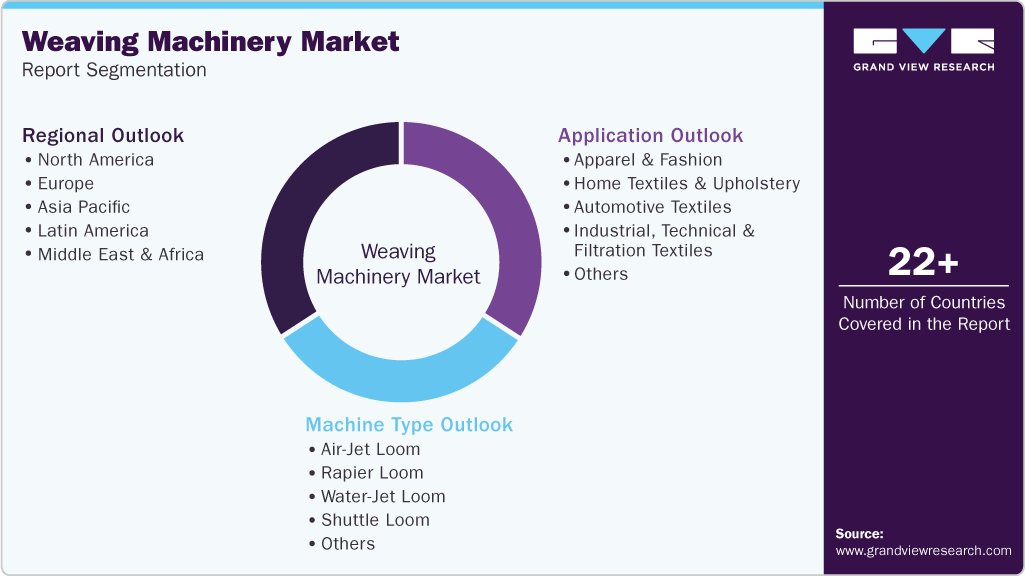
This report forecasts revenue growth at global, regional, and country levels and provides an analysis of the latest industry trends in each of the sub-segments from 2021 to 2033. For this study, Grand View Research has segmented the global weaving machinery market report based on machine type, application, and region:
 To learn more about this report, Download Free Sample Report
 -
Machine Type Outlook (Revenue, USD Billion, 2021 - 2033)
-
Air-Jet Loom
-
Rapier Loom
-
Water-Jet Loom
-
Shuttle Loom
-
Others
-
-
Application Outlook (Revenue, USD Billion, 2021 - 2033)
-
Apparel & Fashion
-
Home Textiles & Upholstery
-
Automotive Textiles
-
Industrial, Technical & Filtration Textiles
-
Others
-
-
Regional Outlook (Revenue, USD Billion, 2021 - 2033)
-
North America
-
U.S.
-
Canada
-
Mexico
-
-
Europe
-
Germany
-
France
-
Italy
-
Spain
-
UK
-
-
Asia Pacific
-
China
-
India
-
Japan
-
South Korea
-
Australia
-
-
Latin America
-
Brazil
-
Argentina
-
-
Middle East and Africa
-
Saudi Arabia
-
UAE
-
South Africa
-
-
Research Methodology
The weaving machinery market figures in this report are based on a proven research process that combines executive interviews with secondary research from proprietary databases, company filings, and recognized regulatory and institutional sources. Market size is built through value-chain sizing-reconciling supply-side and demand-side estimates-and triangulated with bottom-up and top-down approaches. Every estimate passes multiple levels of expert validation before publication, with each weaving machinery segment quantified using the revenue-capture definitions in the table below.
Segment Definition
Machine Type
Revenue Capture Definition
Air-Jet Loom
Revenue generated from the sale of air-jet weaving machines that use compressed air to insert weft yarn across the warp shed. These machines are sold for high-speed production of a range of woven fabrics.
Rapier Loom
Revenue generated from the sale of rapier weaving machines that use one or more rapiers to transfer weft yarn through the warp shed. Revenue includes machines configured for conventional, wide-width, and specialized fabric production.
Water-Jet Loom
Revenue generated from the sale of water-jet weaving machines that use a controlled water stream to carry weft yarn through the warp shed. These systems are primarily sold for weaving suitable synthetic and lightweight fabrics.
Shuttle Loom
Revenue generated from the sale of shuttle weaving machines that transport weft yarn across the warp shed using a shuttle mechanism. Revenue covers machinery supplied for fabric production requiring shuttle-based weaving.
Others
Revenue generated from the sale of weaving machinery using technologies other than air-jet, rapier, water-jet, and shuttle systems. This includes projectile and other specialty weaving machines.
Application
Revenue Capture Definition
Apparel & Fashion
Revenue generated from weaving machinery sold for manufacturing fabrics used in apparel and fashion products. This includes machinery configured for woven fabrics such as shirting, suiting, denim, and other garment materials.
Home Textiles & Upholstery
Revenue generated from weaving machinery sold for manufacturing fabrics used in household and furnishing products. Applications include upholstery, bedding, curtains, towels, decorative fabrics, and other home textile materials.
Automotive Textiles
Revenue generated from weaving machinery sold for manufacturing woven textile materials used in automotive applications. This includes equipment for fabrics used in interiors, seat components, airbags, and other automotive textile products.
Industrial, Technical & Filtration Textiles
Revenue generated from weaving machinery sold for manufacturing engineered woven fabrics for industrial and technical applications. These include filtration media, geotextiles, protective fabrics, construction textiles, conveyor materials, and other performance-oriented products.
Others
Revenue generated from weaving machinery sold for fabric applications not classified under apparel and fashion, home textiles and upholstery, automotive textiles, or industrial, technical and filtration textiles.
Estimation Model
Layer Name
Key Question
Description
Textile Production Demand Layer
What determines demand for weaving machinery?
Assess woven-fabric production volumes, textile manufacturing capacity, mill utilization, fabric output, and expansion across apparel, home textiles, automotive, and technical textile applications. Evaluate production requirements by fabric type, yarn characteristics, fabric width, and weaving complexity to determine underlying machinery demand.
Capacity Expansion & Replacement Layer
Where is demand for new weaving machinery being generated?
Evaluate new weaving mill installations, production-line expansions, modernization programs, machinery replacement cycles, and investments in new fabric manufacturing capacity. Assess replacement requirements based on machine age, production requirements, technological obsolescence, and the need for higher-capacity or more specialized weaving systems.
Machine Type Adoption Layer
Which weaving technologies are being adopted?
Assess the adoption of air-jet, rapier, water-jet, shuttle, and other weaving machines across fabric applications and production environments. Incorporate factors such as production speed, fabric width, yarn compatibility, fabric construction, automation, energy consumption, and application-specific requirements into machine-type estimates.
Revenue Conversion Layer
How is weaving machinery demand translated into market revenue?
Estimate annual machinery shipments by machine type, application, and region, considering new installations and replacement purchases. Convert shipment volumes into market revenue using machine-specific pricing benchmarks and capture revenue generated from the sale of complete weaving machinery to textile manufacturers.
Delivered Customizations
This report has been delivered with the following In-depth customizations
CLIENT REQUEST
CUSTOMIZATION DELIVERED
VALUE ADDS
Competitive Benchmarking
Evaluated weaving machinery manufacturers based on loom technology, product architecture, machine specifications, fabric-width range, operating speed, weft insertion systems, automation features, digital controls, application coverage, customization capabilities, and technical support. The assessment also considered product breadth across air-jet, rapier, water-jet, shuttle, and specialized weaving systems.
Established a structured view of supplier capabilities, technology positioning, product specialization, and competitive differentiation. The analysis supports comparison of manufacturers across product portfolios, technical capabilities, application focus, and service offerings.
Regional Segmentation
Assessed market requirements across geographic areas using textile manufacturing capacity, installed weaving equipment, mill modernization, new facility investments, replacement activity, fabric-production structures, and adoption of different loom technologies. Regional analysis also considered variations in apparel, home textile, automotive, industrial, and technical textile manufacturing.
Highlighted differences in machinery adoption patterns, textile manufacturing structures, and equipment requirements across geographic markets. The segmentation helps identify markets with established installed bases, modernization requirements, new capacity additions, and changing technology preferences.
Opportunity Assessment
Examined growth opportunities arising from aging loom populations, modernization of conventional equipment, expansion of technical and industrial textile manufacturing, increasing automation, demand for wider and higher-speed machines, and requirements for application-specific weaving systems. The assessment also considered opportunities associated with energy-efficient equipment, digital machine monitoring, flexible configurations, and specialized fabric production.
Identified specific areas where machinery suppliers can expand their addressable market through new equipment categories, technology upgrades, specialized loom configurations, and application-focused solutions. The assessment provides a basis for prioritizing product development, technology investment, and market-entry initiatives.
Frequently Asked Questions About This Report
Key companies operating in the weaving machinery market include Picanol Group, Itema S.p.A., Toyota Industries Corporation, Tsudakoma Corporation, Lindauer DORNIER GmbH, RIFA Textile Machinery, Jingwei Textile Machinery, SMIT Textile, Van de Wiele Group, Qingdao Haijia Machinery Co., Ltd., Qingdao Tianyi Red Flag Textile Machinery Co., Ltd., Zhejiang Tongda Textile Machinery Co., Ltd., Zhejiang Yinchun Machine Co., Ltd., Jiangsu Jinsheng Industry Co., Ltd., and CTMTC Group.
The global weaving machinery market was valued at USD 5.3 billion in 2025 and is projected to reach USD 8.5 billion by 2033
The global weaving machinery market is projected to expand at a CAGR of 6.2% from 2026 to 2033.
Air-Jet Loom accounted for the largest revenue share in 2025, with a 38.2% share, supported by its suitability for high-speed production and continuous weaving operations.
Asia Pacific dominated the global weaving machinery market in 2025, accounting for 49.2% of revenue, supported by its extensive textile manufacturing base and broad installed base of weaving equipment.
The automotive textiles is projected to register the fastest growth, at a CAGR of 6.9% during the forecast period.
China accounted for the leading share of the Asia Pacific weaving machinery market in 2025, reflecting its extensive textile manufacturing ecosystem and broad demand for weaving equipment across apparel, household, synthetic, industrial, and technical textile production.
About the Author(s)
Advanced Interior Materials Research Team
Advanced Materials · Advanced Interior MaterialsThis report was authored by the advanced interior materials research team at Grand View Research - comprising two research analysts, one senior research analyst, and one industry expert - with specialized expertise in the advanced interior materials segment of the advanced materials industry. All findings are based on proprietary advanced materials databases, executive interviews, and regulatory analysis, subject to internal peer review prior to publication.
Last Updated:
Speak to Analyst

Customize this report to your needs - add regions, segments, or data points, with 20% free customization.
Or view our licence options:


ISO 9001:2015 & 27001:2022 Certified
We are GDPR and CCPA compliant! Your transaction & personal information is safe and secure. For more details, please read our privacy policy.


