
- Home
- »
- Food Additives & Nutricosmetics
- »
-
Wetting Agents Market Size And Share Report, 2026-2033GVR Report cover

Wetting Agents Market (2026 - 2033)
Size, Share & Trends Analysis Report By Product (Anionic, Non-ionic, Cationic, Amphoteric), By Form (Solid, Liquid), By End Use (Agrochemical, Paints & Coatings, Household & Personal Care), By Region, And Segment Forecasts
Market Size, 2025
$1.5BMarket Estimate, 2026
$1.6BMarket Forecast, 2033
$2.3BCAGR, 2026–2033
5.5%Wetting Agents Market Summary
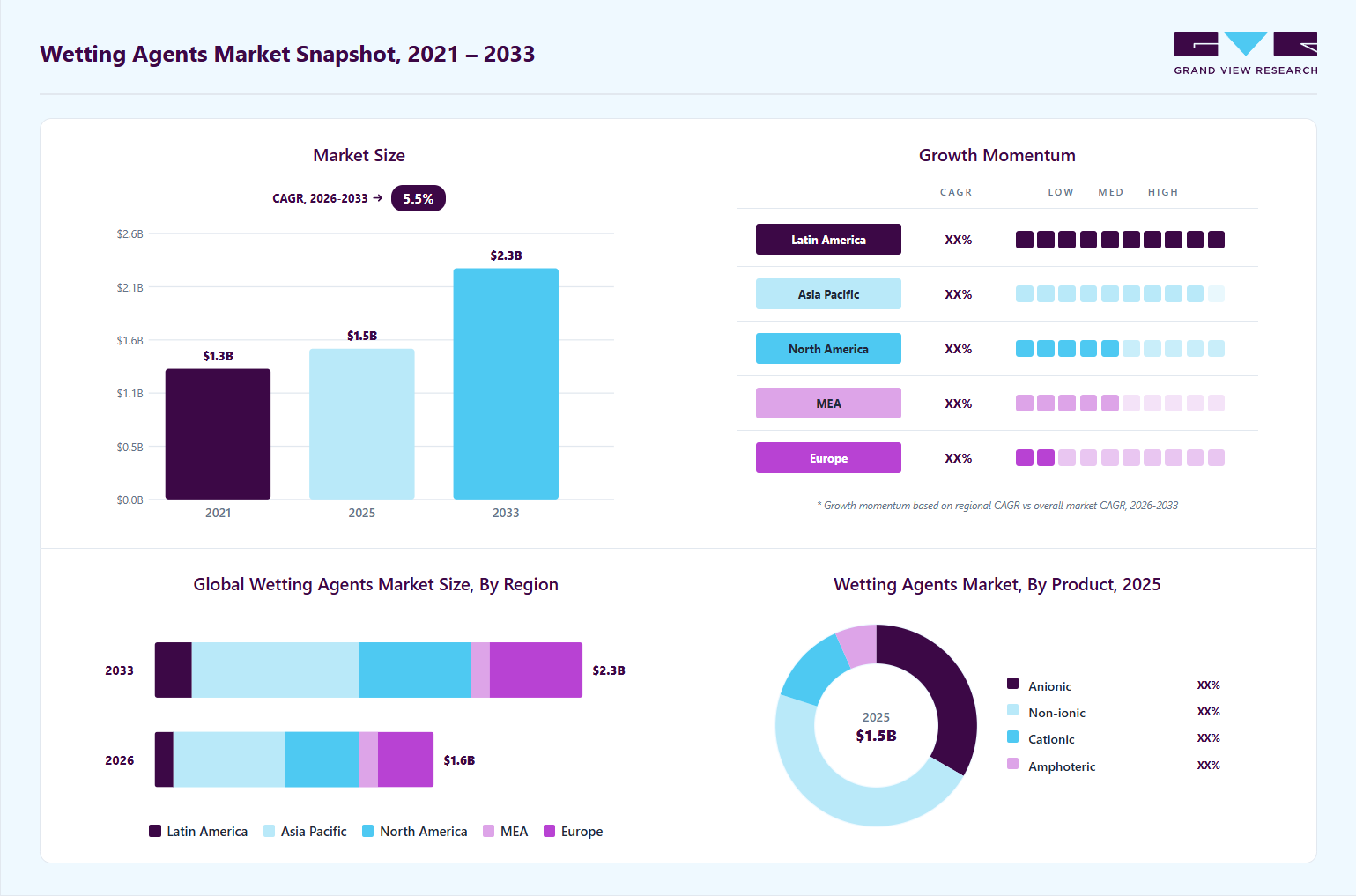
The global wetting agents market size was valued at USD 1.5 billion in 2025 and is projected to grow from USD 1.6 billion in 2026 to USD 2.3 billion by 2033, at a CAGR of 5.5% from 2026 to 2033. The market in Asia Pacific dominated with a revenue share of 39.3% in 2025. The growth of the market is being strongly driven by the increasing demand for high-performance coatings, agrochemicals, and industrial cleaning formulations across multiple end use industries.
 Source: Grand View Research, IR Documents, Primary Interviews, Paid DatabasesTo learn more about this report,
 Download Free Sample Report
 Key Market Trends & Insights
- By form: Liquid segment held the largest market share of 78.8% in 2025.
- By product: Non-ionic segment held the largest market share of 46.7% in 2025.
- By end use: Agrochemical segment held the largest market share of 34.0% in 2025.
Regional Highlights
- Largest regional market: Asia Pacific (39.3% revenue share, 2025)
- Fastest-growing regional market: Latin America (highest CAGR, 2026-2033)
- By country: China held the largest market share in 2025
Market Size & Forecast
- Market size in 2025: USD 1.5 Billion
- Estimated market size in 2026: USD 1.6 Billion
- Projected market size by 2033: USD 2.3 Billion
- CAGR (2026-2033): 5.5%
Three ways to get this report
Buy it, customize it, or ask a question.Ask an Analyst
A direct answer, usually in 1 working day
- AccessReport author, directly
- Reply timeWithin 1 working day
- No sales callDirect answer only
- FormatEmail reply
- CostFree, no cost
Get the Full Report
What the study covers
- FormatsPDF · Excel · Dashboard
- Timeline2026–2033 annual, 2025 base
- Coverage20+ countries, 5 regions
- Companies10+ key players profiled
Customize the Report
20% free customization
- IncludeCountries, segments, points
- TailorTo your product definition
- ExtendDeeper competitor detail
- OrA fully bespoke study
- Turnaround5–10 working days
Wetting agents play a critical role in improving surface coverage, spreading efficiency, penetration, and adhesion properties, making them essential in applications such as paints and coatings, crop protection chemicals, inks, adhesives, and detergents.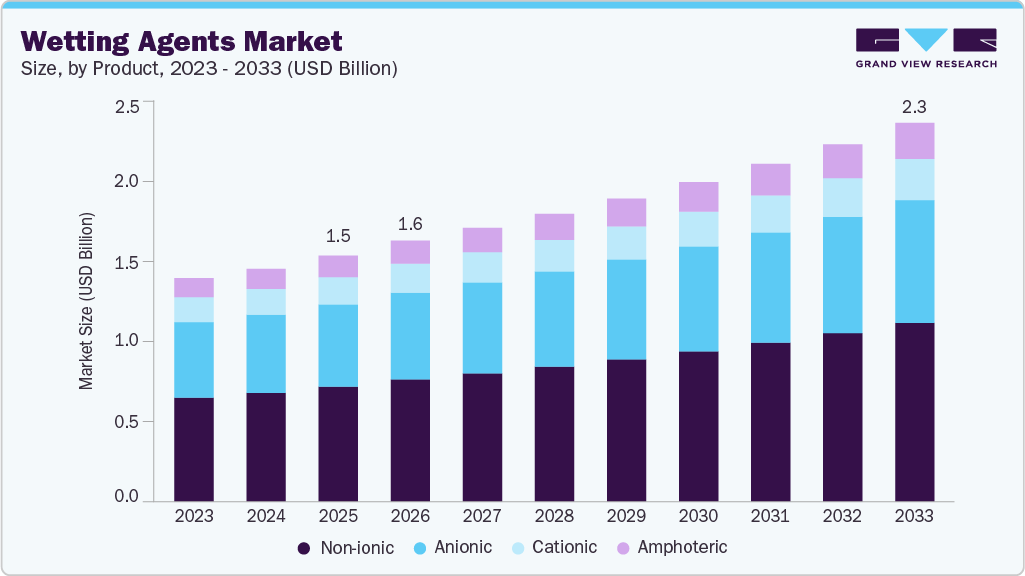 To learn more about this report, Download Free Sample Report
 Expanding applications in precision agriculture, electric vehicle coatings, advanced industrial coatings, and specialty textile treatments are expected to create new revenue streams for market participants. In addition, rapid industrialization and infrastructure development across emerging economies in Asia-Pacific, Latin America, and the Middle East are likely to support long-term demand for innovative wetting solutions with enhanced compatibility, durability, and formulation efficiency.
Market Dynamics
The wetting agents market is being driven by the increasing demand for high-performance coatings, agrochemicals, and industrial formulations that require improved spreading, penetration, and surface coverage properties. Industries such as automotive, construction, furniture, and industrial manufacturing are increasingly adopting advanced wetting agents to enhance coating appearance, substrate compatibility, and formulation stability. The growing transition toward waterborne and low-VOC products, supported by stringent environmental regulations, is further accelerating the adoption of specialty wetting additives that deliver superior performance while meeting sustainability requirements.
The expanding application of wetting agents in agricultural formulations to improve the efficiency of pesticides, herbicides, and fertilizers is driving the market growth. These additives enhance spray distribution and adhesion on crop surfaces, reducing chemical wastage and improve crop productivity. Increasing emphasis on sustainable farming practices, precision agriculture, and environmentally friendly surfactant technologies is encouraging manufacturers to develop biodegradable, silicone-free, and low-toxicity wetting solutions, creating strong long-term demand across the global market.
The wetting agents market faces challenges due to increasingly stringent environmental and chemical safety regulations associated with the use of surfactants and specialty additives in industrial and agricultural applications. Regulatory authorities across North America and Europe are imposing stricter limits on volatile organic compounds (VOCs), hazardous substances, and non-biodegradable chemical formulations, compelling manufacturers to invest heavily in product reformulation and compliance activities. These regulatory pressures can increase production costs and lengthen product development timelines, particularly for companies operating in highly regulated end-use industries such as coatings, agrochemicals, and industrial cleaning.
Volatility in raw material prices and supply chain disruptions affecting the production of specialty chemicals used in wetting agents restrain the growth of the market. Fluctuations in the prices of petrochemical derivatives, silicone compounds, and surfactant intermediates can significantly impact manufacturing costs and profit margins. In addition, intense competition from low-cost regional suppliers and the availability of alternative surface modification technologies may limit pricing flexibility for established manufacturers, creating additional pressure on market growth and long-term profitability.
Market Concentration & Characteristics
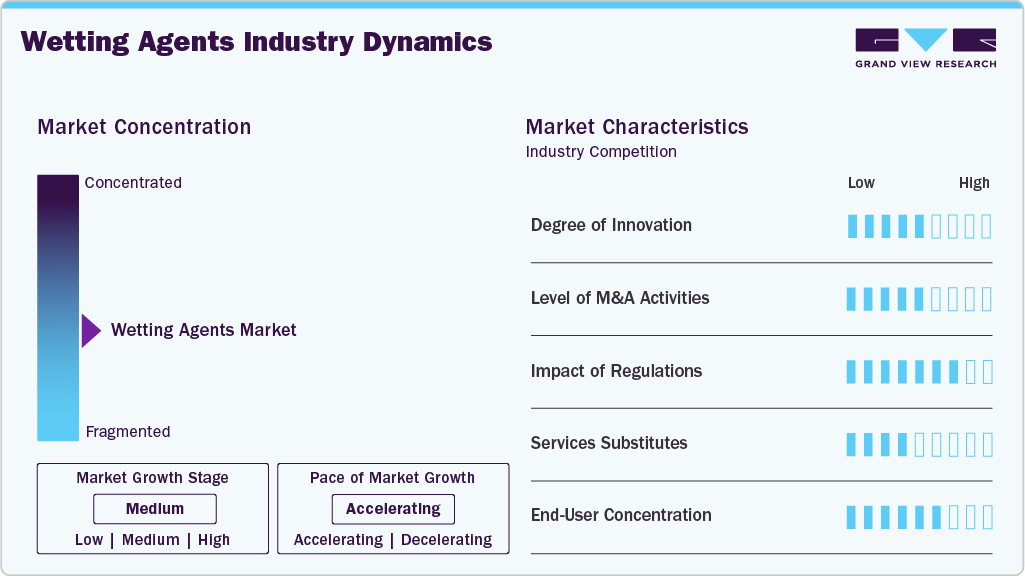
The wetting agents market is moderately fragmented, with the presence of several global specialty chemical manufacturers alongside numerous regional and local suppliers competing across diverse end use industries. Major companies focus on product innovation, sustainable formulations, and application-specific solutions to strengthen their market position, particularly in coatings, agriculture, construction, and industrial processing applications. The market is characterized by continuous investments in research and development aimed at improving wetting efficiency, biodegradability, low VOC compatibility, and multifunctional performance properties.
 To learn more about this report, Download Free Sample Report
 It is characterized by the presence of both multinational specialty chemical companies and many regional manufacturers serving diverse industrial applications. The market is highly innovation-driven, with companies focusing on the development of advanced wetting technologies that provide improved spreading, penetration, leveling, dispersion stability, and surface compatibility across coatings, agrochemicals, adhesives, inks, textiles, and industrial cleaning products. Increasing demand for sustainable and environmentally compliant formulations has encouraged manufacturers to invest in biodegradable, silicone-free, low-foaming, and low-VOC wetting agents that align with evolving global regulatory standards.
Product Insights
Non-ionic accounted for the largest share of 46.7% in 2025, due to its broad compatibility, low toxicity, excellent emulsification properties, and extensive use across coatings, agrochemicals, detergents, and industrial processing applications. Non-ionic wetting agents are widely preferred for their strong surface tension reduction capabilities and stability under varying pH and temperature conditions, making them suitable for waterborne and environmentally compliant formulations. Their growing utilization in paints and coatings, textile processing, and agricultural chemicals continues to support segment dominance across global markets.
Amphoteric is expected to witness the fastest growth at a CAGR rate of 6.6% during the forecast period, driven by increasing demand for mild, multifunctional, and environmentally friendly surfactants across industrial and specialty applications. Amphoteric wetting agents offer superior compatibility with both cationic and anionic systems along with enhanced foaming, wetting, and conditioning characteristics, supporting their adoption in personal care, industrial cleaning, and specialty coating formulations. Rising focus on sustainable chemical formulations and high-performance surfactant technologies is further expected to accelerate growth within this segment.
Form Insights
The liquid segment held the largest market share of 78.8% in 2025 and is also projected to grow at the fastest CAGR of 5.6% from 2026 to 2033. The dominance of the segment is attributed to the ease of handling, superior dispersion efficiency, faster solubility, and broad compatibility of liquid wetting agents across coatings, agrochemicals, detergents, adhesives, and industrial processing applications. Liquid formulations are widely preferred in waterborne systems due to their ability to provide uniform spreading and improved formulation stability, while growing demand for low-VOC and high-performance specialty chemicals continues to support segment expansion.
The solid segment also maintains a significant market presence, particularly in applications requiring extended shelf life, easier transportation, and controlled formulation properties. Solid wetting agents are commonly used in powdered detergents, dry agrochemical blends, construction chemicals, and specialty industrial formulations where storage stability and reduced handling complexity are important. Increasing demand for compact and cost-efficient chemical formulations in industrial and agricultural sectors is expected to support the steady growth of the solid segment over the forecast period.
End Use Insights
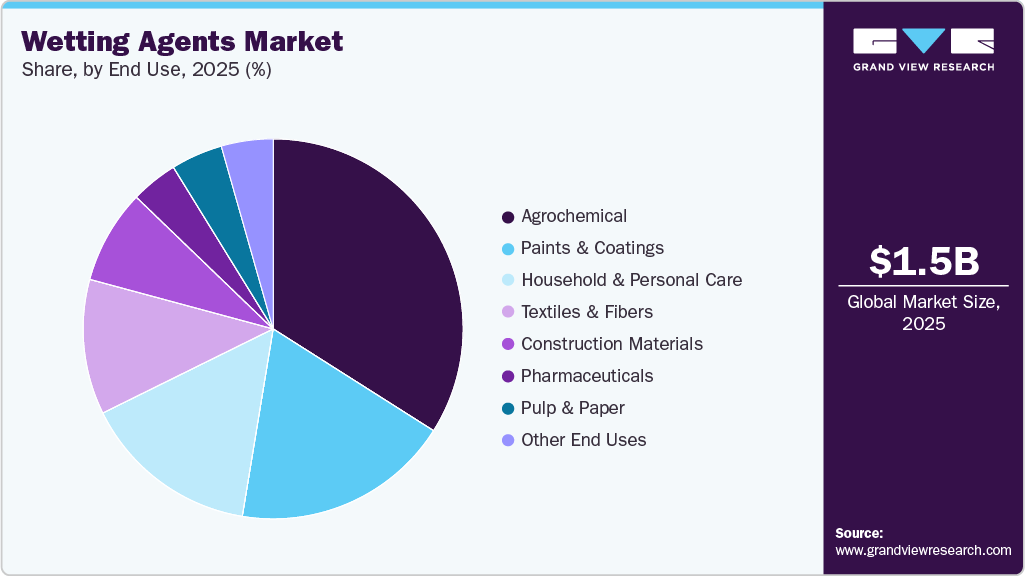
Agrochemicals dominated the market in 2025 with a revenue share of 34.0%, driven by the increasing use of wetting agents in pesticide, herbicide, and fertilizer formulations to improve spray coverage, penetration, and adhesion on crop surfaces. Growing global demand for higher agricultural productivity, efficient water utilization, and precision farming practices has significantly increased the adoption of advanced surfactant technologies in crop protection applications. In addition, rising focus on sustainable agriculture and improved agrochemical performance continues to support strong demand for specialty wetting agents across the agricultural sector.
 To learn more about this report, Download Free Sample Report
 Pharmaceuticals segment is projected to grow at the fastest CAGR of 6.1% over the forecast period, owing to the increasing use of wetting agents in drug formulation, solubility enhancement, emulsification, and coating applications. Wetting agents play an important role in improving the bioavailability and stability of pharmaceutical products, particularly in oral solid dosage forms and topical formulations. Rising pharmaceutical manufacturing activities, growing demand for advanced drug delivery systems, and continuous innovation in specialty excipients are expected to further accelerate segment growth globally.
Regional Insights
Asia Pacific Wetting Agents Market Trends
Asia Pacific dominated the market in 2025 with a revenue share of 39.3% supported by rapid industrialization, expanding agricultural activities, and strong growth in the paints and coatings, construction, textile, and automotive industries across countries such as China, India, Japan, and South Korea. The region benefits from large-scale manufacturing capabilities, increasing consumption of agrochemicals, and rising demand for waterborne and high-performance coating formulations. Growing infrastructure development, rising population levels, and supportive government initiatives promoting industrial and agricultural productivity continue to strengthen the demand for specialty wetting agents across the region.
 To learn more about this report, Download Free Sample Report
 Wetting agents market in China is experiencing significant growth due to expanding industrial manufacturing, increasing agricultural chemical consumption, and rising demand for high-performance coatings and construction materials. Strong growth in automotive production, electronics manufacturing, and infrastructure development is accelerating the use of advanced wetting agents in paints, inks, adhesives, and industrial formulations. Increasing focus on environmentally friendly and low-VOC chemical solutions is encouraging the adoption of sustainable wetting technologies across multiple industries.
North America Wetting Agents Market Trends
The North America wetting agents market is driven by strong demand from the coatings, agrochemical, pharmaceutical, and industrial cleaning sectors. The region is witnessing increasing adoption of waterborne and sustainable formulations driven by stringent environmental regulations and a growing emphasis on product performance optimization. Technological advancements in specialty surfactants and rising investments in high-performance industrial applications continue to support market expansion across the United States and Canada.
U.S. Wetting Agents Market Trends
The U.S. wetting agents market is supported by robust growth in advanced coatings, precision agriculture, and specialty chemical manufacturing industries. Increasing demand for sustainable surfactants in industrial and consumer applications, along with strong research and development activities by leading chemical companies, is contributing to market growth. Rising utilization of wetting agents in pharmaceutical formulations, agrochemical applications, and low-emission coating systems is further strengthening demand across the country.
Europe Wetting Agents Market Trends
The Europe wetting agents market is growing steadily due to increasing regulatory focus on environmentally sustainable chemical formulations and the rising adoption of bio-based and low-VOC additives. Strong demand from automotive coatings, industrial manufacturing, construction, chemicals, and personal care applications is supporting market development across the region. Manufacturers are increasingly investing in innovative wetting technologies that comply with stringent environmental and product safety standards established by European regulatory authorities.
Wetting agents market in Germany represents a key market for wetting agents in Europe owing to its strong automotive, industrial coatings, and specialty chemicals industries. The country’s advanced manufacturing infrastructure and growing emphasis on sustainable industrial processes are increasing demand for high-performance wetting additives used in waterborne coatings, adhesives, and industrial formulations. Continuous technological innovation and increasing adoption of environmentally compliant surfactants are further supporting market growth in Germany.
Latin America Wetting Agents Market Trends
The Latin America wetting agents market is expected to witness the fastest growth at a CAGR of 6.0% during the forecast period, driven by expanding agricultural activities, rising construction projects, and increasing industrial development across countries such as Brazil, Mexico, and Argentina. Growing demand for agrochemical formulations to improve crop productivity and the rising use of industrial coatings and cleaning chemicals are supporting market expansion. Increasing investments in infrastructure and manufacturing activities are also creating favorable opportunities for wetting agent manufacturers in the region.
Middle East & Africa Wetting Agents Market Trends
The Middle East & Africa wetting agents market is gaining momentum due to increasing investments in construction, industrial manufacturing, and water treatment applications across the region. Rising demand for high-performance coatings, detergents, and specialty chemicals in rapidly developing economies is contributing to market growth. Expanding agricultural activities and growing focus on efficient resource utilization are encouraging the adoption of advanced wetting technologies in agrochemical and industrial applications.
Key Wetting Agents Company Insights
Some key players operating in the market include BASF, Dow, Evonik Industries AG, among others.
-
BASF
BASF is one of the leading participants in the global wetting agents market, supported by its extensive portfolio of specialty chemicals, surfactants, and performance additives used across coatings, agriculture, industrial cleaning, and construction applications. The company focuses on developing high-performance and sustainable wetting solutions that improve formulation efficiency, surface coverage, dispersion stability, and environmental compatibility. Its strong global manufacturing network, continuous investment in research and development, and emphasis on low-VOC and bio-based technologies strengthen its competitive position in the market.
-
Dow
Dow is a prominent player in the wetting agents market with offering a broad range of surfactants and specialty additives designed for coatings, agrochemicals, personal care, and industrial processing industries. The company emphasizes innovation in advanced formulation technologies that enhance wetting performance, substrate compatibility, and application efficiency while supporting sustainability objectives. Dow’s strong presence across global industrial markets, combined with its focus on environmentally responsible chemical solutions and customer-specific product development, continues to support its growth in the wetting agents industry.
Key Wetting Agents Companies
The following key companies have been profiled for this study on the wetting agents market.
-
BASF
-
Dow
-
Evonik Industries AG,
-
Nouryon
-
CLARIANT
-
Ashland
-
Solvay
-
Fineotex Chemical Limited
-
Huntsman.
-
Croda International Plc
Competitive Benchmarking
Operating Strategies
Competitive Edge
Weaknesses
Mature Players: BASF, Dow, Evonik Industries AG, Nouryon, Clariant, Solvay, Croda International Plc
- Focus on product innovation, sustainable surfactant technologies, strategic acquisitions, expansion of specialty chemical portfolios, and strengthening global distribution networks.
- Significant investments are directed toward research and development for low-VOC, bio-based, and high-performance wetting formulations across coatings, agrochemicals, and industrial applications.
- Focus on diversified application industries including coatings, agrochemicals, construction chemicals, adhesives, textiles, and industrial cleaning.
- Strong global brand recognition and established customer relationships across industrial sectors.
- Extensive manufacturing infrastructure and integrated supply chain operations across multiple regions.
- Broad product portfolios with advanced technical expertise and strong innovation capabilities.
- Significant financial strength enabling high investment in technology development and expansion activities.
- High operational, manufacturing, and environmental compliance costs associated with global operations.
- Exposure to fluctuations in petrochemical and specialty raw material prices affecting profit margins.
- Slower decision-making processes due to complex organizational structures and large-scale operations.
- Intense competition from regional and low-cost specialty chemical manufacturers.
Emerging Players: Ashland, Fineotex Chemical Limited, Huntsman
- Focus on developing application-specific wetting agents tailored for niche industrial and agricultural requirements.
- Expansion into emerging economies through regional partnerships, local manufacturing, and distributor networks.
- Increasing investment in sustainable, biodegradable, and environmentally friendly specialty chemical technologies.
- Emphasis on customer-oriented innovation and flexible formulation capabilities to address evolving market demand.
- Competitive pricing strategies to strengthen market penetration in price-sensitive regions.
- Greater operational flexibility and faster responsiveness to changing customer and regional market requirements.
- Strong focus on customized product development and niche specialty applications.
- Growing presence in emerging markets with increasing industrialization and agricultural activities.
- Ability to introduce cost-effective specialty wetting solutions for mid-sized and regional customers.
- Limited global distribution networks and lower international market penetration compared to established multinational companies.
- Smaller research and development budgets restrict large-scale technological innovation capabilities.
- Lower production capacities and economies of scale impact overall cost competitiveness.
- Greater vulnerability to raw material price fluctuations and supply chain disruptions.
Recent Developments
-
In 2024, Evonik expanded its TEGO Wet portfolio with the launch of TEGO Wet 290 and TEGO Wet 296, advanced wetting agents developed for waterborne automotive and wood coatings applications. The additives provide improved substrate wetting, anti-cratering performance, and enhanced flow and leveling properties across wood, plastic, and metal surfaces, supporting the growing demand for high-quality and visually appealing coatings. This development reflects the increasing focus in the wetting agents market on high-performance, low-VOC, and waterborne coating technologies, driven by stringent environmental regulations and rising demand for sustainable coating formulations with superior surface performance and application efficiency.
-
In 2024, Ashland commercialized its easy-wet 300 n super wetting agent for agricultural applications, including corn, soy, wheat, watermelon, florals, and other produce crops, following successful field trials and customer pilot programs. The biodegradable, nonionic, silicone-free, and low-foaming wetting agent was developed to improve pesticide adhesion, reduce spray drift, and enhance the wettability and uniform distribution of active ingredients across leaf surfaces. This development reflects the growing demand in the wetting agents market for sustainable and high-performance agricultural surfactants.
Wetting Agents Market Report Scope
Report Attribute
Details
Market size in 2025
USD 1.5 billion
Estimated market size in 2026
USD 1.6 billion
Projected market size by 2033
USD 2.3 billion
Growth rate
CAGR of 5.5% from 2026 to 2033
Actual data
2021 - 2025
Forecast period
2026 - 2033
Quantitative units
Revenue in USD million/billion, and CAGR from 2026 to 2033
Report coverage
Revenue forecast, company ranking, competitive landscape, growth factors, and trends
Segments covered
Product, form, end use, and region
Regional scope
North America; Europe; Asia Pacific; Latin America; Middle East & Africa
Country scope
U.S.; Canada; Mexico; Germany; UK; France; Italy; China; India; Japan; South Korea; Brazil; Argentina; South Africa; Saudi Arabia
Key companies profiled
BASF; Dow; Evonik Industries AG; Nouryon; CLARIANT; Ashland; Solvay; Fineotex Chemical Limited; Huntsman; Croda International Plc
Customization scope
Free report customization (equivalent upto 8 analysts working days) with purchase. Addition or alteration to country, regional & segment scope.
Pricing and purchase options
Avail customized purchase options to meet your exact research needs. Explore purchase options
Global Wetting Agents Market Report Segmentation
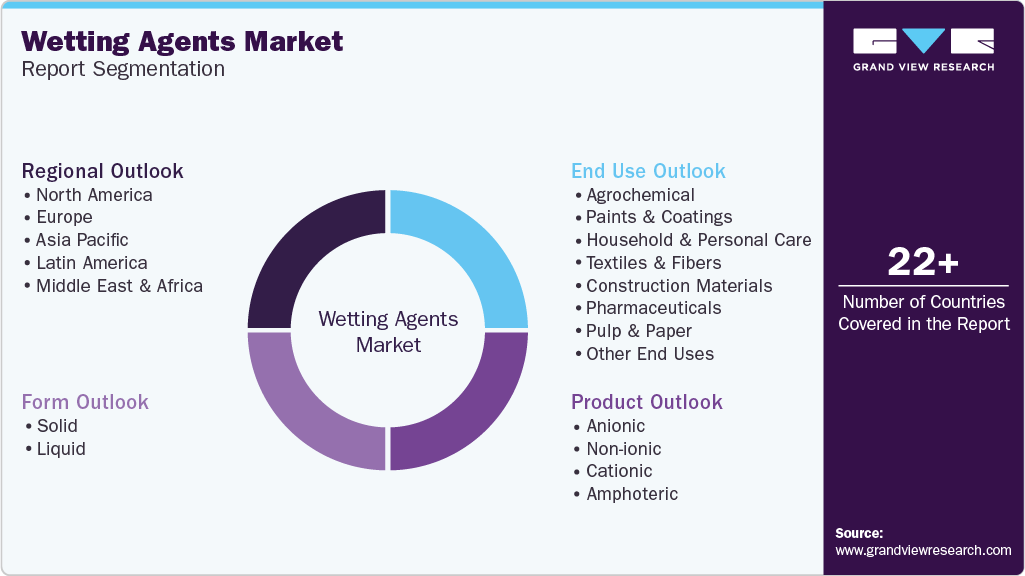
This report forecasts revenue growth at global, regional, and country levels and provides an analysis of the latest industry trends in each of the sub-segments from 2021 to 2033. For this study, Grand View Research has segmented the global wetting agents market report based on product, form, end use, and region.
 To learn more about this report, Download Free Sample Report
 -
Product Outlook (Revenue, USD Million, 2021 - 2033)
-
Anionic
-
Non-ionic
-
Cationic
-
Amphoteric
-
-
Form Outlook (Revenue, USD Million, 2021 - 2033)
-
Solid
-
Liquid
-
-
End Use Outlook (Revenue, USD Million, 2021 - 2033)
-
Agrochemical
-
Paints & Coatings
-
Household & Personal Care
-
Textiles & Fibers
-
Construction Materials
-
Pharmaceuticals
-
Pulp & Paper
-
Other End Uses
-
-
Region Outlook (Revenue, USD Million, 2021 - 2033)
-
North America
-
U.S.
-
Canada
-
Mexico
-
-
Europe
-
Germany
-
UK
-
France
-
Italy
-
Spain
-
-
Asia Pacific
-
China
-
India
-
Japan
-
South Korea
-
-
Latin America
-
Brazil
-
Argentina
-
-
Middle East & Africa
-
South Africa
-
Saudi Arabia
-
-
Frequently Asked Questions About This Report
Asia Pacific dominated with a 39.3% revenue share in 2025.
Latin America is the fastest-growing region over the forecast period.
The non-ionic segment led with a 46.7% revenue share in 2025, while amphoteric is the fastest-growing product.
The agrochemical segment led with a 34.0% revenue share in 2025, while pharmaceuticals is the fastest-growing segment.
The liquid segment dominated the wetting agents market by form in 2025, accounting for a market share of 78.8%. The segment growth is attributed to the superior dispersion efficiency, ease of formulation, faster solubility, and broad compatibility of liquid wetting agents across coatings, agrochemicals, detergents, adhesives, and industrial processing applications. Increasing demand for waterborne and low-VOC formulations, particularly in the paints and coatings industry, continues to strengthen the adoption of liquid-based wetting technologies globally.
Key players include BASF; Dow; Evonik Industries AG; Nouryon; CLARIANT; Ashland; Solvay; Fineotex Chemical Limited; Huntsman; Croda International Plc.
The wetting agents market is primarily driven by the increasing demand for high-performance coatings, agrochemicals, and industrial cleaning solutions that require enhanced spreading, penetration, and surface coverage properties. Rapid industrialization, expanding construction activities, and growing automotive production are significantly increasing the use of specialty wetting agents in paints, coatings, adhesives, and surface treatment formulations.
The global wetting agents market size was valued at USD 1.5 billion in 2025 and is estimated at USD 1.6 billion for 2026.
The global wetting agents market is expected to grow at a CAGR of 5.5% from 2026 to 2033, reaching USD 2.3 billion by 2033.
About the Author(s)
Food Additives & Nutricosmetics Research Team
Specialty & Chemicals · Food Additives & NutricosmeticsThis report was authored by the food additives & nutricosmetics research team at Grand View Research - comprising two research analysts, one senior research analyst, and one industry expert - with specialized expertise in the food additives & nutricosmetics segment of the specialty & chemicals industry. All findings are based on proprietary specialty & chemicals databases, executive interviews, and regulatory analysis, subject to internal peer review prior to publication.
Last Updated:
Speak to Analyst

Customize this report to your needs - add regions, segments, or data points, with 20% free customization.
Or view our licence options:


ISO 9001:2015 & 27001:2022 Certified
We are GDPR and CCPA compliant! Your transaction & personal information is safe and secure. For more details, please read our privacy policy.


