
- Home
- »
- Paints, Coatings & Printing Inks
- »
-
Xylene Market Size, Share & Forecast Report, 2026-2033GVR Report cover

Xylene Market (2026 - 2033)
Size, Share & Trends Analysis Report By Additives (Solvents, Monomers), By Type (Ortho-Xylene, Meta-Xylene, Mixed Xylene, Para-Xylene), By Region (North America, Europe, Asia Pacific, Central & South America, MEA), And Segment Forecasts
Market Size, 2025
$30.2BMarket Estimate, 2026
$32.1BMarket Forecast, 2033
$56.4BCAGR, 2026–2033
8.4%Xylene Market Summary
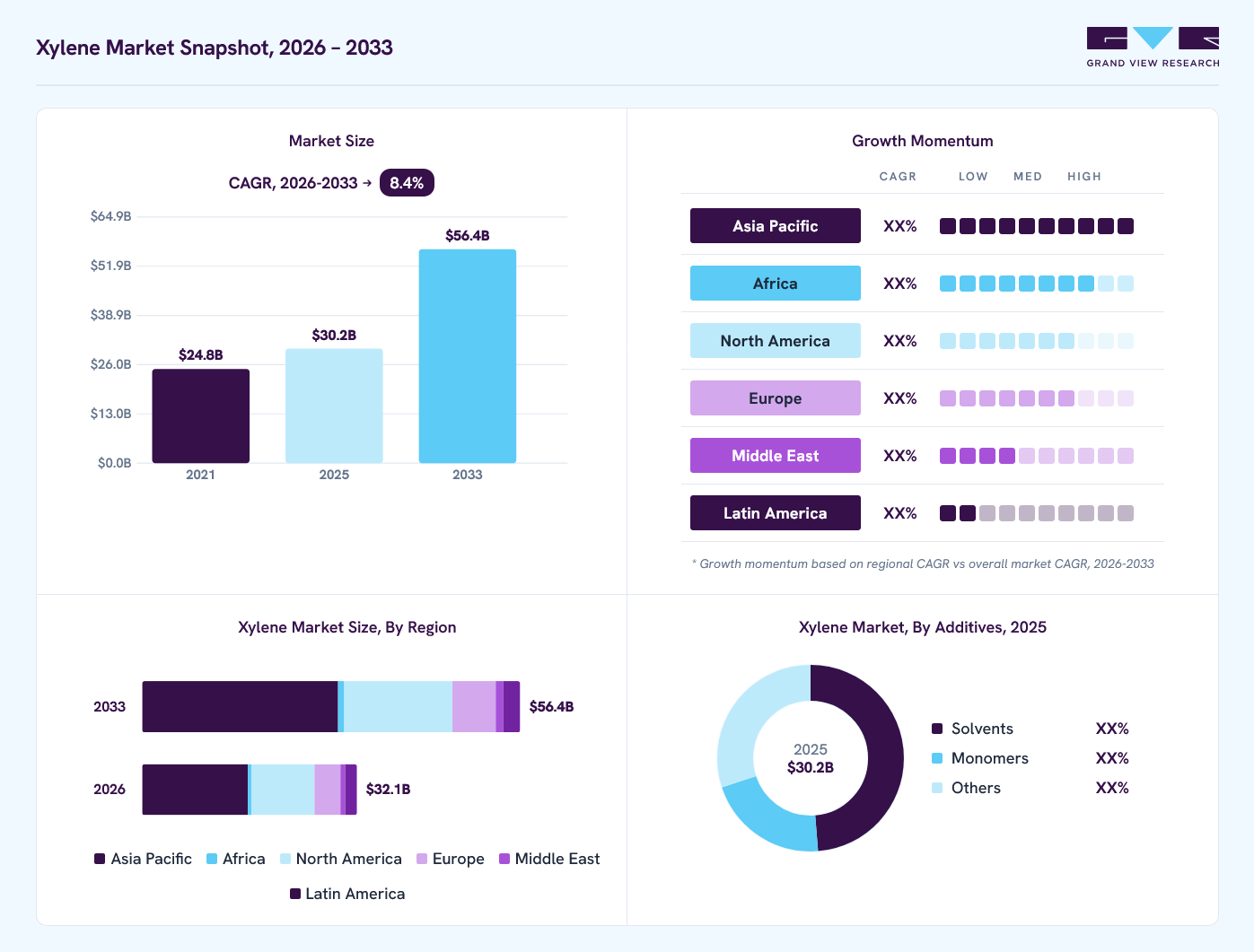
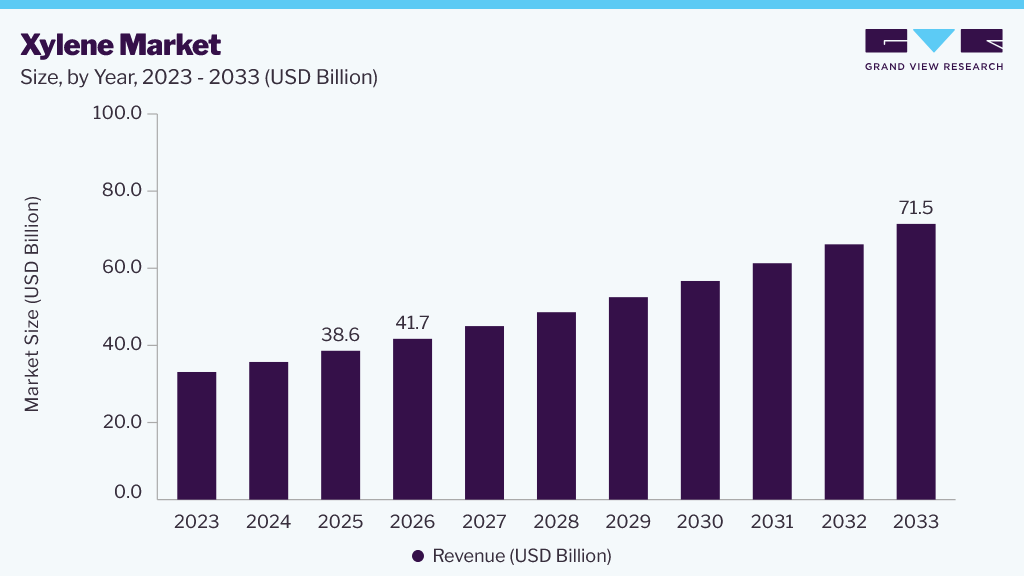
The global xylene market size was valued at USD 30.2 billion in 2025 and is projected to grow from USD 32.1 billion in 2026 to USD 56.4 billion by 2033, at a CAGR of 8.4% from 2026 to 2033. The market in Asia Pacific dominated with a revenue share of 48.8% in 2025. Xylene is a solvent and raw material widely utilized across various industries, including paints and coatings, adhesives and sealants, pharmaceuticals, plastics, and textiles.
 Source: Grand View Research, IR Documents, Primary Interviews, Paid DatabasesTo learn more about this report,
 Download Free Sample Report
Key Market Trends & Insights
- By additives: Solvents segment held the largest market share of 48.8% in 2025.
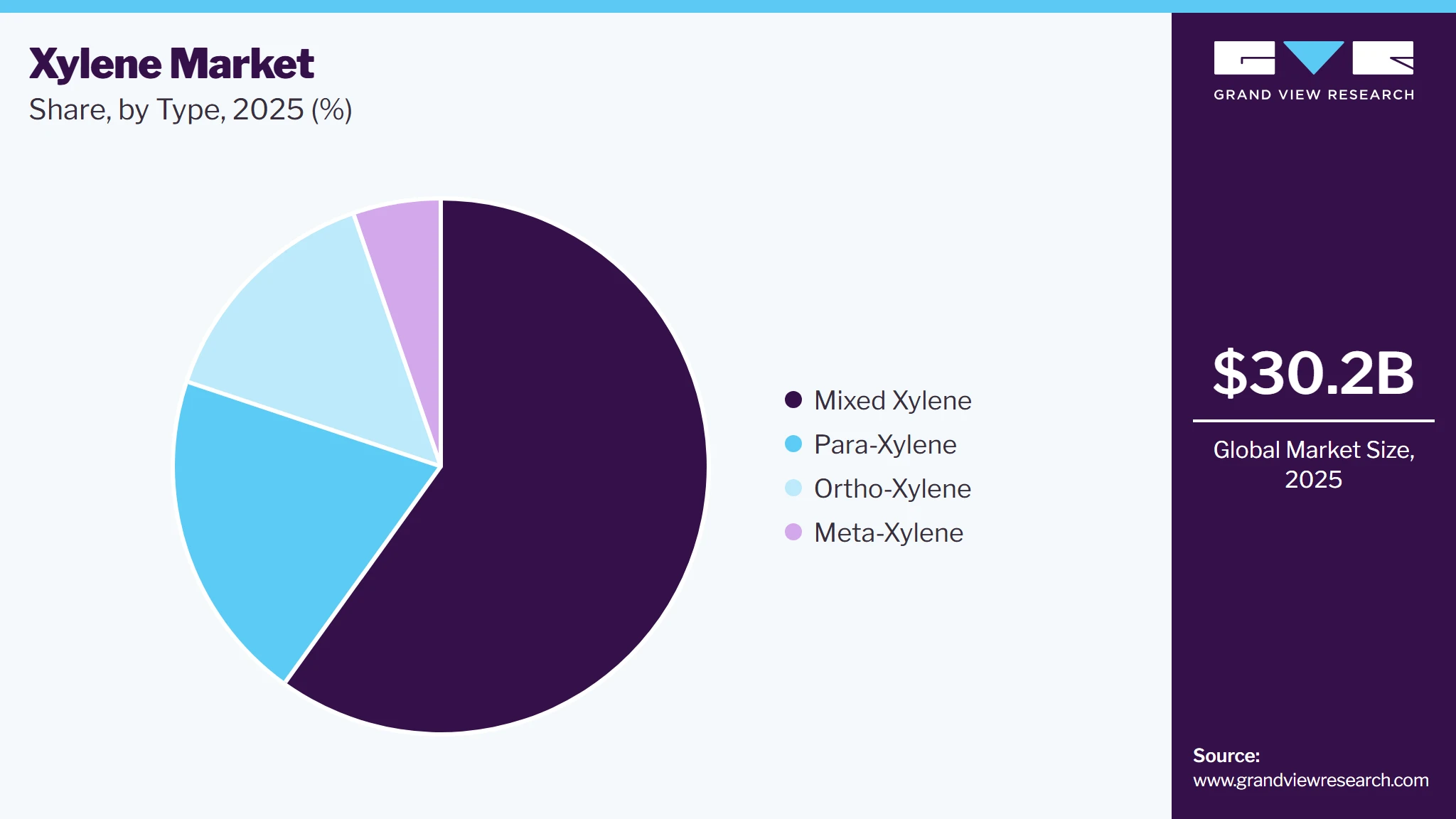
- By type: Mixed-xylene segment held the largest market share of 59.9% in 2025.
Regional Highlights
- Largest regional market: Asia Pacific (48.8% revenue share, 2025)
- By country: China held the largest market share in 2025.
Market Size & Forecast
- Market size in 2025: USD 30.2 Billion
- Estimated market size in 2026: USD 32.1 Billion
- Projected market size by 2033: USD 56.4 Billion
- CAGR (2026-2033): 8.4%
Prism AI by Grand View Research Free to tryAsk a question about the xylene marketTry asking✓Every figure cited from GVR research Prefer the report? Download free sample →In addition, the market plays a critical role in the production of various plastics, including polyester and polyethylene terephthalate (PET). These materials are extensively utilized across packaging, textile, and automotive applications, further supporting demand for xylene products. Growing consumption of end-use products in these industries continues to drive market expansion. For instance, in April 2025, China Petroleum & Chemical Corporation (Sinopec), Saudi Arabian Oil Company (Saudi Aramco), and their joint venture YASREF signed an agreement to expand the integrated refining and petrochemical complex in Yanbu, Saudi Arabia. The project includes a large mixed-feed steam cracker and an aromatics complex, significantly strengthening the downstream value chain for feedstocks such as paraxylene and mixed xylenes.
 To learn more about this report, Download Free Sample Report
Demand for additives in the U.S. market is primarily driven by their application as solvents and as constituents in various chemical intermediates, including monomers. Xylene serves as an important solvent across industries ranging from paints and adhesives to chemical manufacturing due to its high solvency, enabling the effective dissolution and blending of numerous substances.
Furthermore, xylene plays a significant role in monomer production, which serves as the foundation for a broad range of polymers and plastics. The product is widely used in the manufacture of polyester resins such as polyethylene terephthalate (PET). PET is extensively utilized in packaging materials, textiles, and beverage containers. Consequently, increasing demand for PET and related polymers continues to support xylene consumption as a critical feedstock within the polyester value chain.
Market Dynamics
The global xylene market is primarily driven by sustained demand from the polyester value chain, particularly para-xylene consumption in purified terephthalic acid (PTA) and polyethylene terephthalate (PET) production. Growth in packaging, textiles, and automotive applications continues to support market expansion, while refinery integration and investments in aromatics production enhance supply capabilities. However, fluctuations in crude oil and naphtha prices, tightening environmental regulations governing aromatic hydrocarbons, and the gradual shift toward recycled and bio-based materials present challenges to market growth.
The growth of the global xylene market is primarily driven by rising demand for para-xylene, the largest xylene derivative used in the production of purified terephthalic acid (PTA), a key raw material for polyethylene terephthalate (PET) resins and polyester fibers. Increasing consumption of PET packaging across the food & beverage, pharmaceutical, and personal care industries, coupled with expanding polyester fiber production for textiles, continues to strengthen para-xylene consumption. Rapid urbanization, population growth, and improving consumer spending in emerging economies have further accelerated demand for polyester-based products, reinforcing the need for stable xylene supply.
Ongoing investments in integrated refining and petrochemical complexes, particularly across Asia Pacific and the Middle East, are expanding aromatics production capacities and improving feedstock availability. Refiners are increasingly optimizing catalytic reforming and xylene recovery processes to maximize production efficiency and meet growing downstream demand. The commissioning of new PTA and PET manufacturing facilities, along with capacity expansions by leading petrochemical producers, is expected to sustain xylene consumption over the forecast period, supporting long-term market growth across both commodity and specialty chemical applications.
The xylene market is constrained by fluctuations in crude oil and naphtha prices, as xylene is primarily produced from petroleum-based feedstocks. Changes in feedstock costs directly affect production economics and profit margins for manufacturers, creating pricing uncertainty across the value chain. In addition, increasingly stringent environmental regulations governing volatile organic compound (VOC) emissions, hazardous air pollutants, and worker exposure to aromatic hydrocarbons have increased compliance and operational costs. These regulatory pressures, combined with the growing adoption of recycled PET and bio-based alternatives in downstream industries, may moderate the long-term growth potential of the conventional xylene market.
Rising investments in integrated refining and petrochemical complexes across emerging economies, particularly in Asia Pacific and the Middle East, present significant growth opportunities for the xylene market. Governments and leading petrochemical producers are expanding aromatics production capacities to meet increasing domestic demand for polyester, packaging materials, and performance chemicals while reducing reliance on imports. Furthermore, advancements in xylene recovery, isomerization, and process optimization technologies are improving production efficiency and product yields, enabling manufacturers to strengthen supply capabilities and capitalize on growing demand from downstream industries over the forecast period.
Analyst Perspective
The global xylene market is expected to witness steady growth over the forecast period, supported by robust demand from the polyester and PET value chain, expanding petrochemical production, and increasing investments in integrated refining complexes. Asia Pacific is anticipated to remain the primary demand and production hub, driven by large-scale manufacturing capacities and downstream industrial expansion. While feedstock price volatility and environmental regulations may influence market dynamics, ongoing capacity additions, process optimization initiatives, and growing demand for high-performance chemical intermediates are expected to strengthen the long-term growth outlook for the xylene market
Aditives Insights
Based on additives, the solvents segment accounted for the largest revenue of 48.8% in 2025. This dominance is attributed to xylene's excellent solvent properties, making it a preferred solvent across industries such as paints, adhesives, printing inks, and coatings. It functions as a highly effective solvent, facilitating the dissolution and blending of various substances. Its ability to dissolve a broad range of materials efficiently makes xylene an essential component in numerous manufacturing processes. In addition, increasing investments in industrial coatings and specialty chemicals continue to support demand for aromatic solvents across manufacturing industries. The expansion of downstream chemical production capacity is expected to further sustain consumption of xylene-based solvent formulations over the forecast period. For instance, in February 2026, Eastman Chemical Company announced additional investments to support its specialty additives and coatings portfolio at its Texas operations to meet growing demand for coating, industrial formulations, and specialty materials applications. The expansion is expected to support broader demand for aromatic solvents used in coatings and chemical formulations.
The monomers segment is expected to grow at the fastest CAGR over the forecast period. Monomers serve as essential building blocks for the synthesis of polymers and plastics. Xylene is widely utilized in the production of polyester resins, including polyethylene terephthalate (PET), which is extensively used in packaging materials, textiles, and beverage containers. The product remains a critical feedstock in PET production, contributing to the desired performance characteristics of the resulting polymers. Furthermore, increased investments in polyester production and sustainable packaging solutions are expected to support demand for paraxylene and mixed xylene feedstocks. Growing consumption of PET packaging materials and polyester fibers is anticipated to create long-term opportunities for xylene manufacturers.
Type Insights
Based on type, the mixed-xylene segment dominated the market with a revenue share of 59.9% in 2025. This is attributable to mixed xylene being a blend of ortho-, meta-, and para-xylene isomers. It is widely used as a solvent in applications such as paints, coatings, adhesives, and thinners. Mixed xylene provides a favorable balance of solvency strength and evaporation characteristics, making it suitable for numerous industrial applications. In addition, mixed xylene serves as an important feedstock for paraxylene production and integrated aromatics manufacturing. Increasing investments in refinery-petrochemical integration projects and polyester production capacity expansions are expected to support demand for mixed xylene throughout the forecast period.
 To learn more about this report, Download Free Sample Report
The meta-xylene segment is expected to grow at the fastest CAGR over the forecast period. Meta-xylene is a colorless liquid with a characteristic aromatic odor and is primarily used as a solvent and intermediate in the production of isophthalic acid, which is utilized in the manufacture of resins, coatings, and polymers. It also finds application in the production of herbicides and pharmaceutical intermediates. Rising demand for high-performance coatings, specialty resins, and engineering plastics is expected to support consumption of meta-xylene and its derivatives. Moreover, ongoing investments in specialty materials and resin production capacities are anticipated to create growth opportunities for meta-xylene applications.
Regional Insights
Asia Pacific dominated the xylene market with the highest revenue share of 48.8% in 2025. This leadership is attributed to the rapid expansion of industrial sectors across the region. Strong demand for solvents and monomers in countries such as China, Japan, India, and Malaysia contributes significantly to market growth. The region's expanding manufacturing base, including paints, coatings, adhesives, and automotive industries, generates substantial demand for xylene as a solvent. Furthermore, continued growth of the polyester industry, particularly in China, supports consumption of xylene-derived feedstocks used in PET production. For instance, in March 2025, BASF announced an expansion of polyester and polyurethane resin production capacity at its Caojing facility in China to meet rising demand from automotive coatings applications across the Asia Pacific. The expansion is expected to support regional demand for solvents and feedstocks used in coatings and resin manufacturing.
 To learn more about this report, Download Free Sample Report
North America Xylene Market Trends
In North America, demand for additives, particularly solvents and monomers, remains strong. Manufacturing industries across the U.S. and Canada continue to rely on xylene for applications ranging from paints and coatings to pharmaceuticals and plastics. In addition, the region's increasing focus on sustainability and recycling initiatives is supporting investment in PET recovery and circular material systems. For instance, in September 2025, Loop Industries and Hyosung TNC announced a strategic alliance to accelerate the adoption of circular polyester and recycled PET materials through advanced depolymerization technologies. The initiative strengthens the polyester value chain and supports long-term growth opportunities for aromatic feedstocks and derivatives.
Europe Xylene Market Trends
Europe represents a significant market for xylene-based solvents and monomer applications. The region's manufacturing and automotive industries continue to drive demand for xylene in products such as paints, adhesives, and printing inks. In addition, Europe's strong focus on sustainable packaging solutions is increasing activity across the PET value chain. For instance, in January 2025, Evonik and Oerlikon Barmag entered a strategic partnership to develop technologies for the chemical recycling of PET waste, including depolymerization and repolymerization solutions. The collaboration supports circular PET production initiatives and strengthens the long-term development of polyester and PET value chains across Europe.
Key Xylene Market Companies Insights
The xylene market is characterized by intense competition among global and regional participants. Major industry players continue to expand into new geographic markets while diversifying their product portfolios and strengthening their global presence. Companies are increasingly pursuing strategic partnerships, capacity expansions, technology collaborations, and distribution agreements to meet growing demand and strengthen their positions in key industries.
Key Xylene Companies
The following key companies have been profiled for this study on the xylene market.
-
Exxon Mobil Corporation
-
Reliance Industries Limited
-
INEOS
-
Mitsubishi Gas Chemical Company, Inc.
-
CNPC (China National Petroleum Corporation)
-
Chevron Phillips Chemical Company
-
Eastman Chemical Company
-
Honeywell International Inc.
-
Saudi Arabian Oil Co.
-
Royal Dutch Shell plc
Competitive Benchmarking
Category
Operating Strategies
Competitive Edge
Weakness
Established Players (Exxon Mobil Corporation, Saudi Arabian Oil Co. (Aramco), Shell plc, Reliance Industries Limited, INEOS, CNPC (China National Petroleum Corporation)
- Focus on integrated refining and petrochemical operations, continuous capacity expansions, feedstock optimization, long-term supply agreements, strategic joint ventures, and investments in high-value aromatics production.
- Strong global production footprint, backward integration into crude oil and refining, economies of scale, diversified customer base, advanced process technologies, and robust distribution networks.
- High capital intensity, exposure to crude oil price volatility, increasing environmental compliance costs, and dependence on cyclical petrochemical demand.
Emerging Players (Mitsubishi Gas Chemical Company, Inc., Chevron Phillips Chemical Company, Eastman Chemical Company, Honeywell International Inc.)
- Emphasize specialty chemicals, process innovation, catalyst technologies, high-performance derivatives, strategic collaborations, and expansion into value-added downstream applications.
- Strong technological expertise, differentiated specialty product portfolio, innovation-driven business models, and ability to serve niche, high-margin markets.
- Comparatively smaller presence in commodity xylene production, limited global production capacity, lower economies of scale, and greater dependence on strategic partnerships for market expansion.
Recent Developments
-
In June 2026, Saudi Aramco and PETRONAS announced that Aramco would transfer its entire 50% stake in Petronas Refinery and Petrochemical Corporation (PRefChem) to PETRONAS. The transaction provides PETRONAS with full ownership of the Pengerang Integrated Complex in Malaysia, one of Southeast Asia's largest integrated refining and petrochemical hubs, strengthening its position across downstream petrochemical and aromatics value chains.
-
In September 2025, Sinopec announced the expansion of its Tahe Refining and Petrochemical Complex in Xinjiang, China. The project includes an 800,000-tonnes-per-year aromatics complex and additional refining units, expanding China's production capacity for aromatic chemicals and reinforcing the regional supply chain for mixed xylene and related derivatives.
-
In January 2025, BPCL achieved financial closure for its Bina Refinery Expansion-cum-Petrochemical Project. The development includes a new petrochemical complex and aromatics production facilities that are expected to strengthen India's downstream chemical industry while supporting demand for xylene and other aromatic intermediates.
Xylene Market Report Scope
Report Attribute
Details
Market size in 2025
USD 30.2 billion
Estimated market size in 2026
USD 32.1 billion
Projected market size by 2033
USD 56.4 billion
Growth rate
CAGR of 8.4% from 2026 to 2033
Base year for estimation
2025
Historical data
2021 - 2024
Forecast period
2026 - 2033
Quantitative units
Revenue in USD billion and CAGR from 2026 to 2033
Report coverage
Revenue forecast, company ranking, competitive landscape, growth factors, and trends
Segments covered
Additives, Type and Region
Regional scope
North America; Europe; Asia Pacific; Latin America; Middle East; Africa
Country scope
US; Canada; Mexico; Germany; UK; Italy; Netherlands; Belgium; France; Russia; China; India; Japan; Malaysia; Indonesia; Vietnam; Australia; New Zealand; Brazil; Argentina; Columbia; Peru; Saudi Arabia; Iran; Oman; UAE; Qatar; Kuwait; South Africa; Angola; Nigeria
Key companies profiled
Exxon Mobil Corporation; Reliance Industries Limited; INEOS; Mitsubishi Gas Chemical Company Inc.; CNPC (China National Petroleum Corporation); Chevron Phillips Chemical Company; Eastman Chemical Company; Honeywell International Inc.; Saudi Arabian Oil Co.; Royal Dutch Shell plc
Customization scope
Free report customization (equivalent up to 8 analysts' working days) with purchase. Addition or alteration to country, regional & segment scope.
Pricing and purchase options
Avail customized purchase options to meet your exact research needs. Explore purchase options
Global Xylene Market Report Segmentation
This report forecasts revenue growth at global, regional, and country levels and provides an analysis of the latest industry trends and opportunities in each of the sub-segments from 2021 to 2033. For this study, Grand View Research has segmented the global xylene market report based on additives, type, and region:
-
Additives Outlook (Volume, Million Tons; Revenue, USD Billion, 2021 - 2033)
-
Solvents
-
Monomers
-
Others
-
-
Type Outlook (Volume, Million Tons; Revenue, USD Billion, 2021 - 2033)
-
Ortho-Xylene
-
Meta-Xylene
-
Para-Xylene
-
Mixed Xylene
-
-
Regional Outlook (Volume, Million Tons; Revenue, USD Billion, 2021 - 2033)
-
North America
-
U.S.
-
Canada
-
Mexico
-
-
Europe
-
Germany
-
UK
-
France
-
Italy
-
Netherlands
-
Belgium
-
Russia
-
-
Asia Pacific
-
China
-
India
-
Japan
-
Malaysia
-
Indonesia
-
Vietnam
-
Australia
-
New Zealand
-
-
Central & South America
-
Brazil
-
Argentina
-
Columbia
-
Peru
-
-
Middle East & Africa
-
Saudi Arabia
-
South Africa
-
Iran
-
Oman
-
UAE
-
Qatar
-
Kuwait
-
Nigeria
-
Angola
-
-
Research Methodology
The xylene market figures in this report are based on a proven research process that combines executive interviews with secondary research from proprietary databases, company filings, and recognized regulatory and institutional sources. Market size is built through value-chain sizing - reconciling supply-side and demand-side estimates - and triangulated with bottom-up and top-down approaches. Every estimate passes multiple levels of expert validation before publication, with each ylxene segment quantified using the revenue-capture definitions in the table below.
Segment Definition
Segment - Additives
Revenue capture definition
Solvents
Revenue generated from the sale of xylene utilized as an industrial solvent across paints & coatings, adhesives, inks, cleaning agents, and chemical processing applications is captured under this segment. The analysis includes merchant sales and direct industrial consumption.
Monomers
This segment captures revenue derived from xylene supplied as a petrochemical feedstock for the production of PTA, DMT, phthalic anhydride, isophthalic acid, and other chemical intermediates. Revenue includes sales to downstream polymer and chemical manufacturers.
Others
Revenue generated from xylene used in laboratory chemicals, fuel blending, pharmaceutical processing, agrochemicals, and other specialty industrial applications is included under this segment. It encompasses applications not classified under solvents or monomers.
Segment - Type
Revenue capture definition
Ortho-Xylene
Revenue generated from the production and commercial sale of ortho-xylene for industrial and petrochemical applications is captured under this segment. The analysis includes sales across domestic and export markets.
Meta-Xylene
This segment captures revenue derived from the manufacture and sale of meta-xylene used in specialty chemical and intermediate production. It includes revenue generated through merchant trade and direct supply agreements.
Para-Xylene
Revenue generated from the production and sale of para-xylene for downstream petrochemical applications, particularly polyester value chain manufacturing, is captured under this segment. The analysis includes sales to PTA, PET, and related chemical producers.
Mixed Xylene
This segment captures revenue generated from the commercial sale of mixed xylene used as an industrial solvent, refinery blending component, and feedstock for isomerization and xylene separation processes. Revenue from both domestic consumption and international trade is included.
Estimation Model
Layer Name
Key Question
Description
Petrochemical Industry Assessment
What is the size and growth outlook of the global petrochemical and aromatics industry?
The estimation begins with evaluating the global petrochemical industry, focusing on aromatics production, refinery throughput, and demand trends that influence xylene consumption.
Feedstock & Xylene Production Analysis
What is the global production capacity and output of xylene?
Production volumes are estimated using refinery catalytic reforming capacity, steam cracker operations, aromatics complexes, capacity utilization rates, and trade statistics across major producing countries.
Xylene Type Segmentation
How is xylene demand distributed across different xylene types?
The market is segmented into para-xylene, ortho-xylene, meta-xylene, and mixed xylene based on production volumes, downstream consumption patterns, and regional supply-demand dynamics.
Regional Demand Assessment
Which regions account for the largest xylene consumption?
Regional estimates are developed by evaluating petrochemical production, polyester manufacturing capacity, refinery infrastructure, import-export flows, and industrial demand across North America, Europe, Asia Pacific, Latin America, and the Middle East & Africa.
Delivered Customizations
This report has been delivered with the following In-depth customizations
Client Request
Customization Delivered
Value Adds
Regional Segmentation
A comprehensive regional assessment of the xylene market was conducted across North America, Europe, Asia Pacific, Latin America, and Middle East & Africa. The study evaluated country-level demand for ortho-xylene, meta-xylene, para-xylene, and mixed xylene while examining consumption across solvent, monomer, and other industrial applications. Regional production capacities, downstream petrochemical integration, and trade dynamics were also assessed.
Provides greater visibility into regional demand concentration, production hubs, and downstream consumption patterns. Supports capacity planning, geographic expansion, and identification of high-growth regional markets.
Competitive Benchmarking
Leading xylene producers were benchmarked based on production capacity, refinery and petrochemical integration, product portfolio, manufacturing footprint, supply chain capabilities, operational efficiency, and strategic developments. Competitive positioning across aromatic hydrocarbons and downstream chemical value chains was also evaluated.
Helps identify competitive strengths, integration advantages, and market positioning gaps. Facilitates strategic differentiation, partnership evaluation, and long-term competitive planning.
Opportunity Assessment
Growth opportunities were assessed across polyester value chains, PET resin manufacturing, specialty chemical production, coatings, solvents, and expanding petrochemical investments. The analysis also examined opportunities arising from refinery capacity additions, downstream integration projects, and increasing demand for aromatic intermediates in emerging economies.
Enables identification of high-growth investment areas and downstream application opportunities. Supports long-term capacity expansion, portfolio diversification, and strategic market development initiatives.
Frequently Asked Questions About This Report
Asia Pacific dominated with a 48.8% revenue share in 2025.
Key players in the market include Exxon Mobil Corporation, Reliance Industries Limited, INEOS, Mitsubishi Gas Chemical Company, Inc., CNPC (China National Petroleum Corporation), Chevron Phillips Chemical Company, Eastman Chemical Company, Honeywell International Inc., Saudi Arabian Oil Co., Royal Dutch Shell plc, and others.
The global xylene market size was valued at USD 30.2 billion in 2025 and is estimated at USD 32.1 billion for 2026.
The solvents segment led with a 48.8% revenue share in 2025.
The global xylene market is expected to grow at a CAGR of 8.4% from 2026 to 2033, reaching USD 56.4 billion by 2033.
Monomers is growing fastest with revenue CAGR of 8.8% during forecast period.
Meta-xylene is growing fastest with revenue CAGR of 8.9% during forecast period.
The mixed-xylene segment led with a 59.9% revenue share in 2025.
The xylene market faces restraints from volatile crude oil prices, stringent environmental regulations, and health and safety concerns associated with prolonged exposure. Additionally, VOC emission controls, rising compliance costs, and the availability of alternative solvents may limit xylene adoption in certain applications.
About the Author(s)
Paints, Coatings & Printing Inks Research Team
Bulk Chemicals · Paints, Coatings & Printing InksThis report was authored by the paints, coatings & printing inks research team at Grand View Research - comprising two research analysts, one senior research analyst, and one industry expert - with specialized expertise in the paints, coatings & printing inks segment of the bulk chemicals industry. All findings are based on proprietary bulk chemicals databases, executive interviews, and regulatory analysis, subject to internal peer review prior to publication.
Last Updated:
Speak to Analyst

Customize this report to your needs - add regions, segments, or data points, with 20% free customization.
Or view our licence options:


ISO 9001:2015 & 27001:2022 Certified
We are GDPR and CCPA compliant! Your transaction & personal information is safe and secure. For more details, please read our privacy policy.


